
ENERGY Where does our Energy come from Where
- Slides: 19
ENERGY Where does our Energy come from?
Where does our energy come from for…? • • • Electric light Mobile phones Power for your mp 3 TV Hot Water
Energy for these things come from Energy Resources, that are converted into energy that we can easily use. Electricity is the main form of energy that we use and can power or charge what we need energy for.
To generate electricity… 1. 2. 3. 4. 5. 6. You need an energy source, e. g. coal This is burnt to produce heat or steam The heat or steam then drives a turbine The turbine then can drive a generator The generator then produces electricity The electricity is then transported in cables to where it is needed
Energy Resources can be divided into 2 categories: 1. Non-Renewable Resources For example – coal, oil, gas, uranium or lignite Once used these resources CANNOT be used again 2. Renewable Resources For example – wind, water or solar These resources can be used over and over again
Non-Renewable Resources: COAL What is it? • Formed underground from decaying plant material How much left in the world? • About 200 years Advantages? • Plenty left • Mining is getting more efficient Disadvantages? • Pollution: CO 2 emissions (linked to global warming), SO 2 (linked to acid rain) • Heavy & bulky to transport
Non-Renewable Resources: What is it? OIL • Formed underground from decaying animal and plant material How much left in the world? • About 40 years! Advantages? • Quite easy to transport • Efficient in producing energy • Less pollution than coal Disadvantages? • Not much left • Pollution: air and danger of water pollution through spills
Non-Renewable Resources: NATURAL GAS What is it? • Formed underground from decaying animal and plant material How much left in the world? • About 60 years !!! Advantages? • Clean, least polluting of all non-renewables • Easy to transport Disadvantages? • Some air pollution • Danger of explosions
Non-Renewable Resources: NUCLEAR What is it? • Uses uranium, naturally found in some rocks How much left in the world? • Not known Advantages? • Not much waste and few CO 2 emissions released, as well as, few other greenhouse gases Disadvantages? • High cost to build and close down power stations. • Waste is radioactive. Problem with getting rid of waste safely
Non-Renewable Resources: LIGNITE What is it? • Formed underground from decaying plant material How much left in the world? • In Northern Ireland, it is thought at least 30 years (SOURCE: www. geographyinaction. co. uk/Issues/Lignite) Advantages? • For Northern Ireland: a local resource, good for generating electricity Disadvantages? • Air pollution, scarring of landscape through open-cast mining • High moisture content
Why is the term, FOSSIL FUEL used for coal, oil, gas and lignite?
Renewable Resources: WIND What is it? It the movement of air from high to low pressure How much left? Endless Advantages? No pollution Disadvantages? Winds change all the time, not predictable
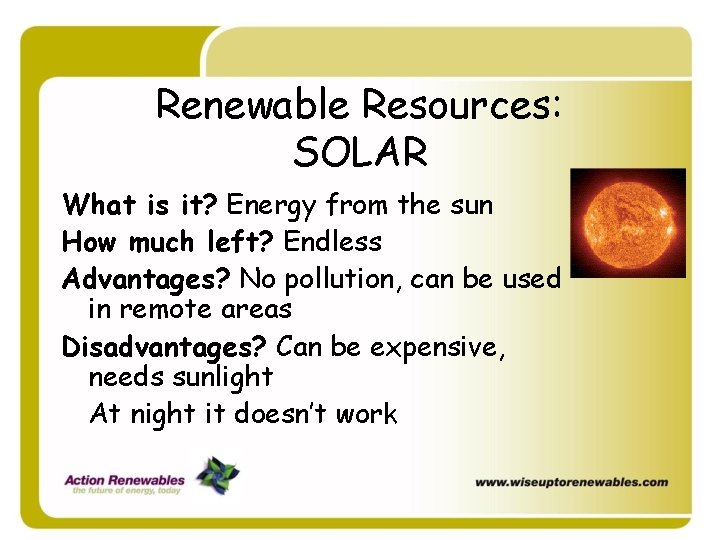
Renewable Resources: SOLAR What is it? Energy from the sun How much left? Endless Advantages? No pollution, can be used in remote areas Disadvantages? Can be expensive, needs sunlight At night it doesn’t work
Renewable Resources: BIO-ENERGY What is it? Biomass and Biogas – • fermented animal or plant waste • vegetation from sustainable sources How much left? Endless Advantages? Good availability Disadvantages? Can be expensive to set up
Renewable Resources: HYDRO What is it? Movement of water drives a turbine How much left? Endless Advantages? No CO 2 emissions, can control flooding and provide a good water supply to an area Disadvantages? Large areas maybe flooded. Visual and water pollution
Renewable Resources: GEOTHERMAL What is it? Heat from the ground – often used to heat water How much left? A lot Advantages? No CO 2 emissions Disadvantages? Expensive and can only be used in certain parts of the world
Renewable Resources: WATER & TIDAL What is it? Movement of sea drives turbines How much left? Endless Advantages? Can produce a lot of electricity, no CO 2 emissions Disadvantages? Not many suitable sites
Renewable Energy is increasing in Northern Ireland TARGET: In Northern Ireland, 12% of electricity generated by renewables by 2012 NOW: Wind energy supplies from between 3 -7% of our energy needs
Where does our Energy come from? • From renewable and non-renewable energy sources • Renewable energy sources are now increasingly being used • Renewable energy: The future of energy, today!