
Energy What is Energy Energy symbol E is
Energy
What is Energy? • Energy (symbol E) is the ability to do work or make something happen • Energy is measured in units called Joules (symbol J)
Types of Energy There are two types of energy; 1. Kinetic Energy (symbol EK) - active energy, energy that is doing something 2. Potential energy (symbol EP) - stored energy, energy that has the potential to do work
Kinetic Energy (EK) Active energy, whenever you can see, hear, feel something happening kinetic energy is being used. – Examples of EK include; • Heat energy • Sound energy • Light energy • Movement energy (Kinetic energy) • Electrical energy
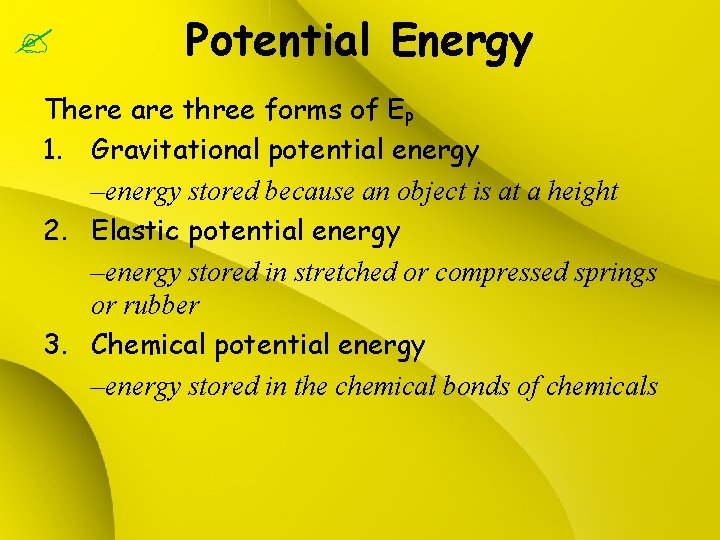
Potential Energy There are three forms of EP 1. Gravitational potential energy –energy stored because an object is at a height 2. Elastic potential energy –energy stored in stretched or compressed springs or rubber 3. Chemical potential energy –energy stored in the chemical bonds of chemicals
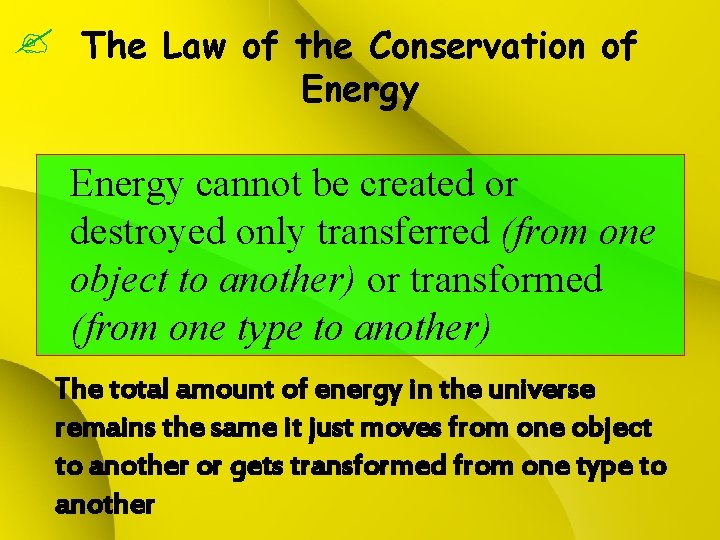
The Law of the Conservation of Energy cannot be created or destroyed only transferred (from one object to another) or transformed (from one type to another) The total amount of energy in the universe remains the same it just moves from one object to another or gets transformed from one type to another
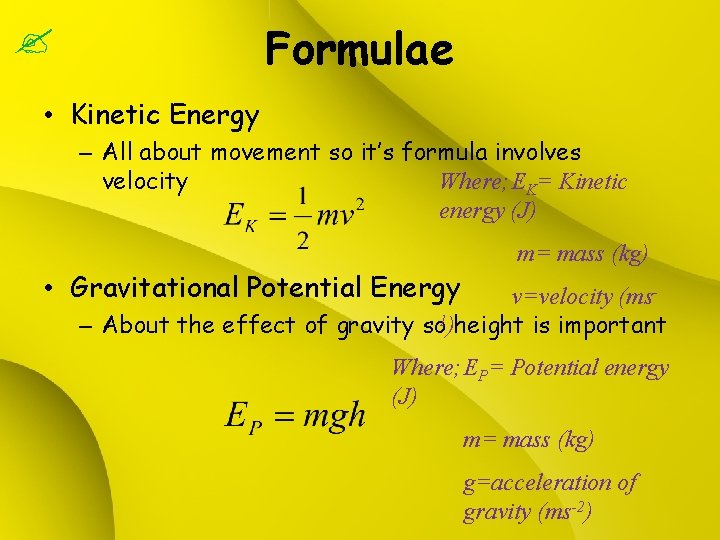
Formulae • Kinetic Energy – All about movement so it’s formula involves Where; EK= Kinetic velocity energy (J) m= mass (kg) • Gravitational Potential Energy v=velocity (ms– About the effect of gravity so 1)height is important Where; EP= Potential energy (J) m= mass (kg) g=acceleration of gravity (ms-2)
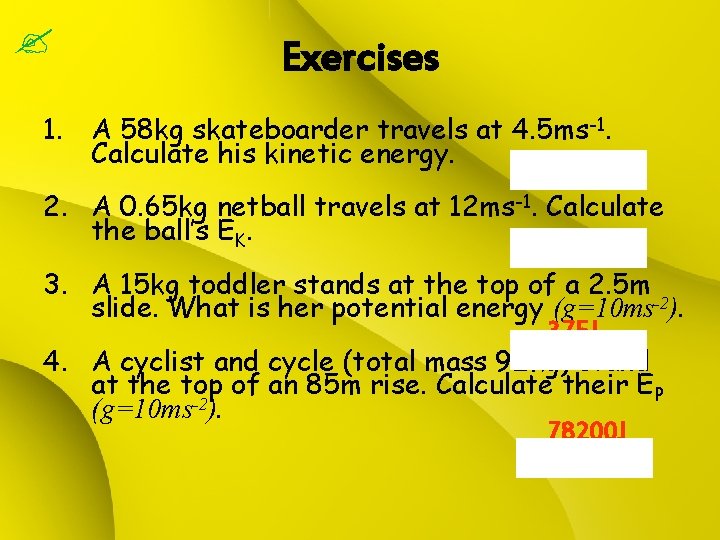
Exercises 1. A 58 kg skateboarder travels at 4. 5 ms-1. Calculate his kinetic energy. 587 J 2. A 0. 65 kg netball travels at 12 ms-1. Calculate the ball’s EK. 46. 8 J 3. A 15 kg toddler stands at the top of a 2. 5 m slide. What is her potential energy (g=10 ms-2). 375 J 4. A cyclist and cycle (total mass 92 kg) stand at the top of an 85 m rise. Calculate their EP (g=10 ms-2). 78200 J
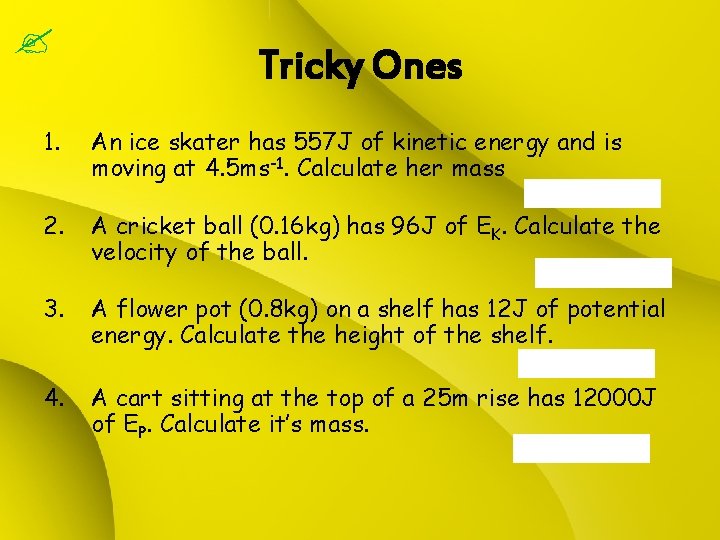
1. 2. 3. 4. Tricky Ones An ice skater has 557 J of kinetic energy and is moving at 4. 5 ms-1. Calculate her mass 55 kg A cricket ball (0. 16 kg) has 96 J of EK. Calculate the velocity of the ball. 34. 6 ms-1 A flower pot (0. 8 kg) on a shelf has 12 J of potential energy. Calculate the height of the shelf. 1. 5 m A cart sitting at the top of a 25 m rise has 12000 J of EP. Calculate it’s mass. 48 kg
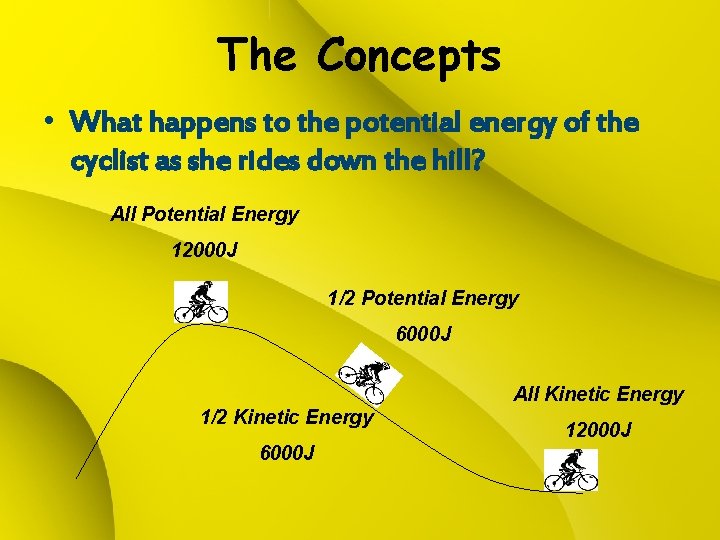
The Concepts • What happens to the potential energy of the cyclist as she rides down the hill? All Potential Energy 12000 J 1/2 Potential Energy 6000 J All Kinetic Energy 1/2 Kinetic Energy 6000 J 12000 J
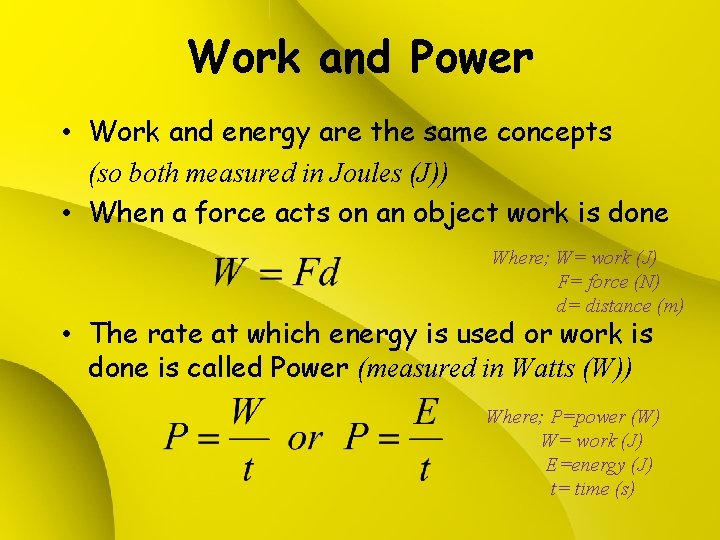
Work and Power • Work and energy are the same concepts (so both measured in Joules (J)) • When a force acts on an object work is done Where; W= work (J) F= force (N) d= distance (m) • The rate at which energy is used or work is done is called Power (measured in Watts (W)) Where; P=power (W) W= work (J) E=energy (J) t= time (s)
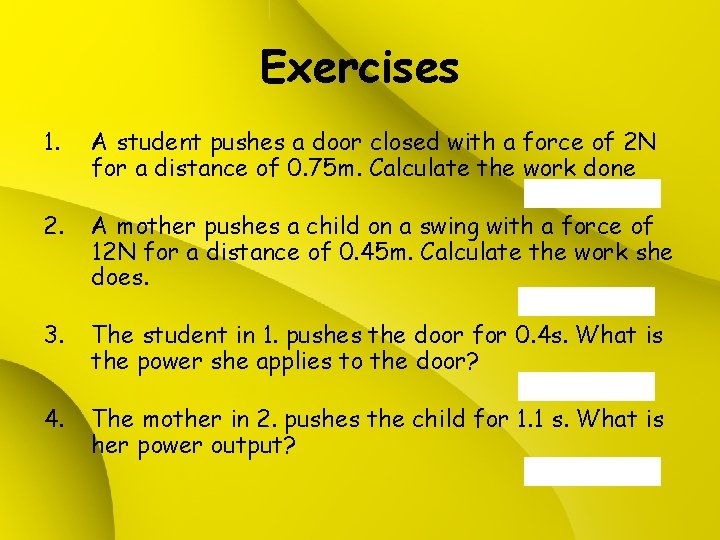
Exercises 1. 2. 3. 4. A student pushes a door closed with a force of 2 N for a distance of 0. 75 m. Calculate the work done 1. 5 J A mother pushes a child on a swing with a force of 12 N for a distance of 0. 45 m. Calculate the work she does. 5. 4 J The student in 1. pushes the door for 0. 4 s. What is the power she applies to the door? 3. 75 W The mother in 2. pushes the child for 1. 1 s. What is her power output? 4. 9 W
- Slides: 12