
Energy Transformations WARM UP You may not have

- Slides: 30
Energy Transformations!
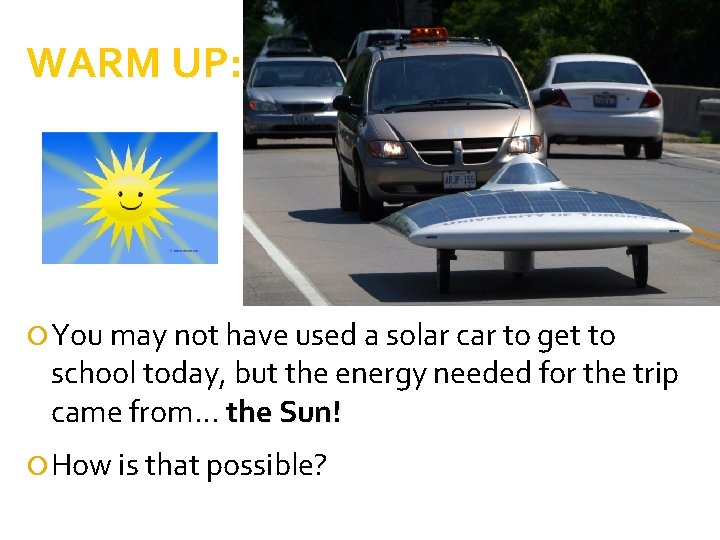
WARM UP: You may not have used a solar car to get to school today, but the energy needed for the trip came from… the Sun! How is that possible?
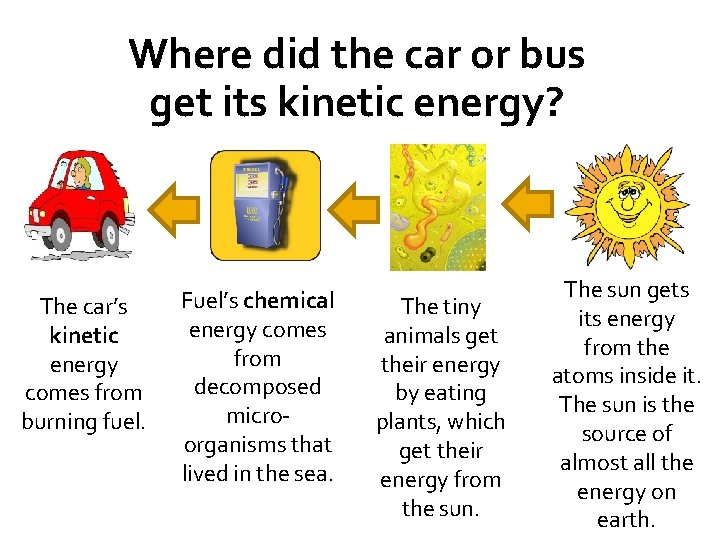
Where did the car or bus get its kinetic energy? The car’s kinetic energy comes from burning fuel. Fuel’s chemical energy comes from decomposed microorganisms that lived in the sea. The tiny animals get their energy by eating plants, which get their energy from the sun. The sun gets its energy from the atoms inside it. The sun is the source of almost all the energy on earth.
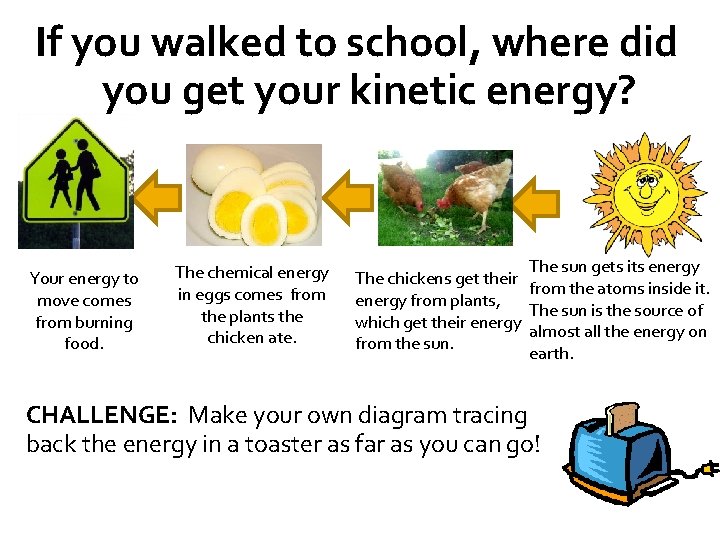
If you walked to school, where did you get your kinetic energy? Your energy to move comes from burning food. The chemical energy in eggs comes from the plants the chicken ate. The sun gets its energy The chickens get their from the atoms inside it. energy from plants, The sun is the source of which get their energy almost all the energy on from the sun. earth. CHALLENGE: Make your own diagram tracing back the energy in a toaster as far as you can go!
What is Energy? Unlike matter, energy does not have mass or take up space. People and things all around us have energy, but we cannot observe energy directly. Instead, we see only the effects of energy. The wind blows our hair, a toaster browns our bread, or gasoline fuels our car. These are examples of changes that energy causes in matter. From p. 51, Gateways to Science Grade 6
Penny on a Bottle Follow these directions with your partner: 1. Hold the neck of the bottle in the ice water for a few seconds. 2. Place the penny over the mouth of the jar. 3. Place some oil around the bottles opening or on the penny in order to provide a completely air tight seal. 4. Now hold bottle in your hands and carefully observe the penny
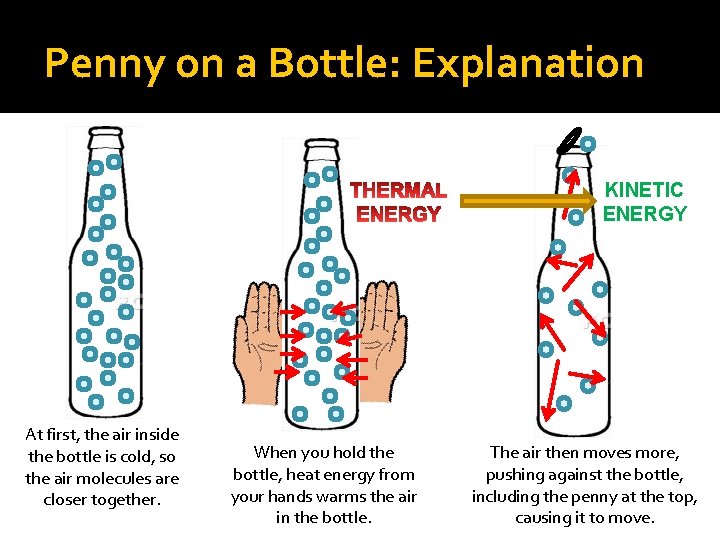
Penny on a Bottle: Explanation KINETIC ENERGY At first, the air inside the bottle is cold, so the air molecules are closer together. When you hold the bottle, heat energy from your hands warms the air in the bottle. The air then moves more, pushing against the bottle, including the penny at the top, causing it to move.
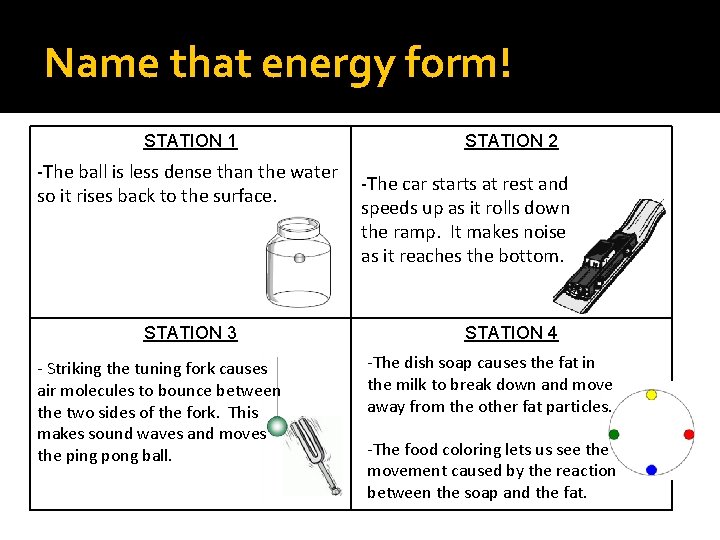
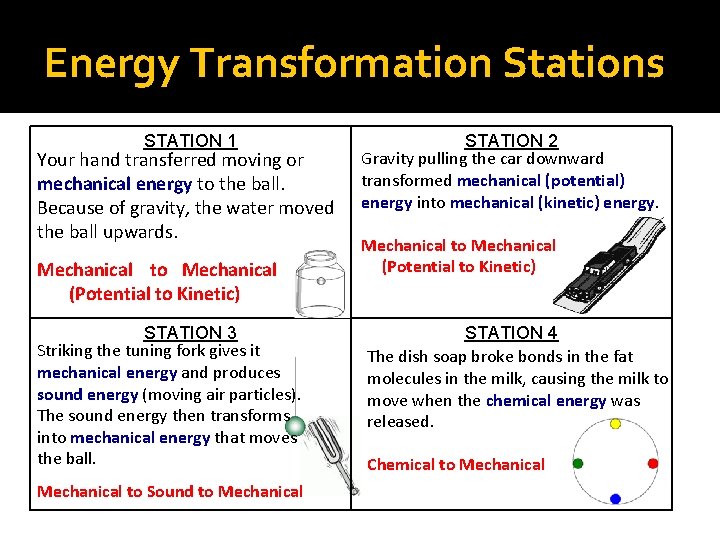
Name that energy form! STATION 1 -The ball is less dense than the water so it rises back to the surface. STATION 3 - Striking the tuning fork causes air molecules to bounce between the two sides of the fork. This makes sound waves and moves the ping pong ball. STATION 2 -The car starts at rest and speeds up as it rolls down the ramp. It makes noise as it reaches the bottom. STATION 4 -The dish soap causes the fat in the milk to break down and move away from the other fat particles. -The food coloring lets us see the movement caused by the reaction between the soap and the fat.
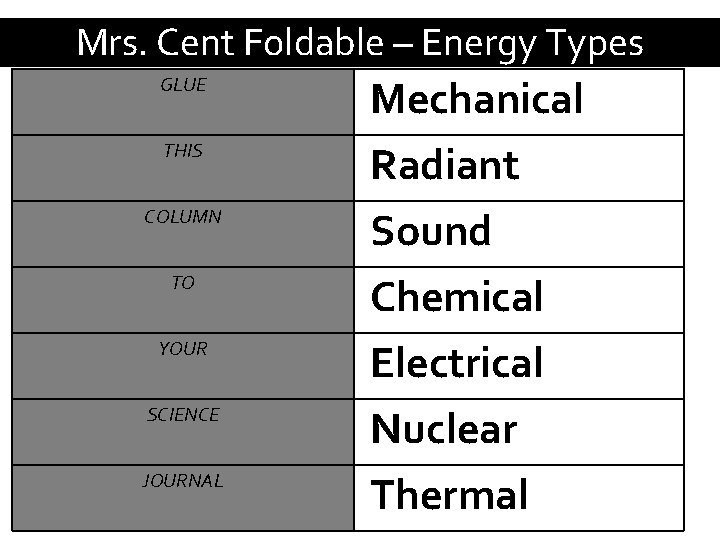
Mrs. Cent Foldable – Energy Types GLUE THIS COLUMN TO YOUR SCIENCE JOURNAL Mechanical Radiant Sound Chemical Electrical Nuclear Thermal
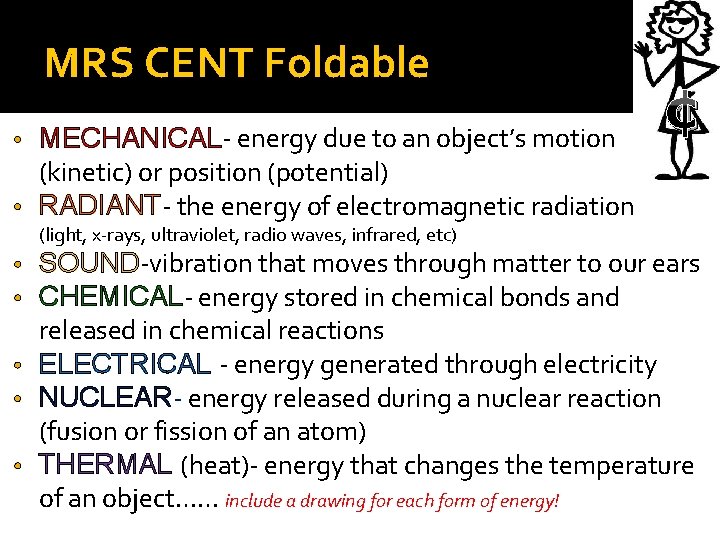
MRS CENT Foldable MECHANICAL- energy due to an object’s motion (kinetic) or position (potential) • RADIANT- the energy of electromagnetic radiation • (light, x-rays, ultraviolet, radio waves, infrared, etc) ¢ SOUND-vibration that moves through matter to our ears CHEMICAL- energy stored in chemical bonds and released in chemical reactions • ELECTRICAL - energy generated through electricity • NUCLEAR- energy released during a nuclear reaction (fusion or fission of an atom) • THERMAL (heat)- energy that changes the temperature of an object…… include a drawing for each form of energy! • •
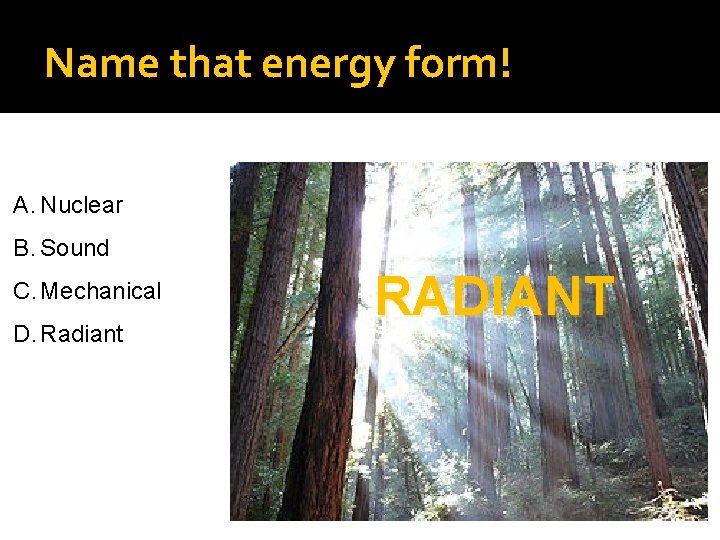
Name that energy form! A. Nuclear B. Sound C. Mechanical D. Radiant RADIANT
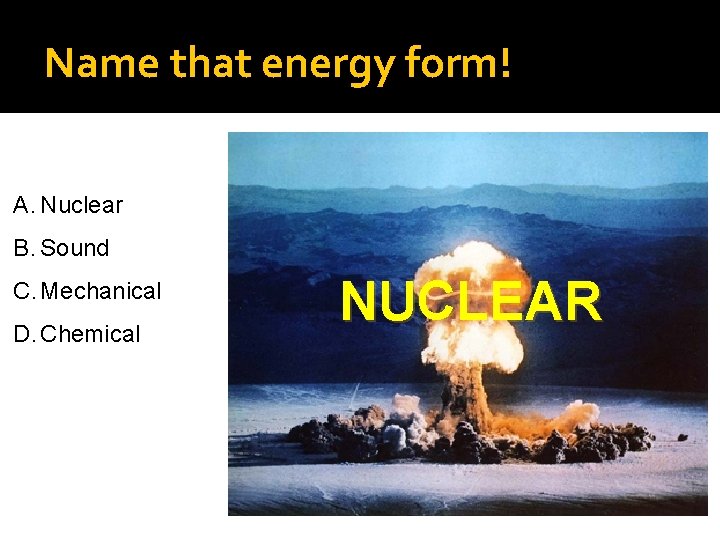
Name that energy form! A. Nuclear B. Sound C. Mechanical D. Chemical NUCLEAR
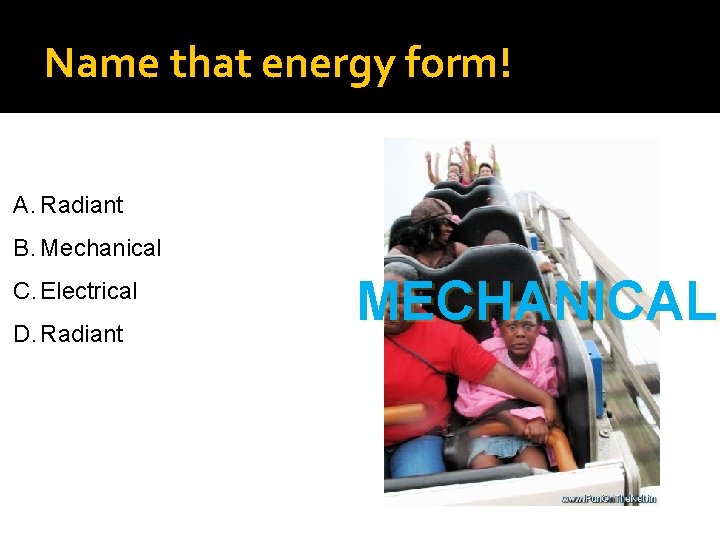
Name that energy form! A. Radiant B. Mechanical C. Electrical D. Radiant MECHANICAL
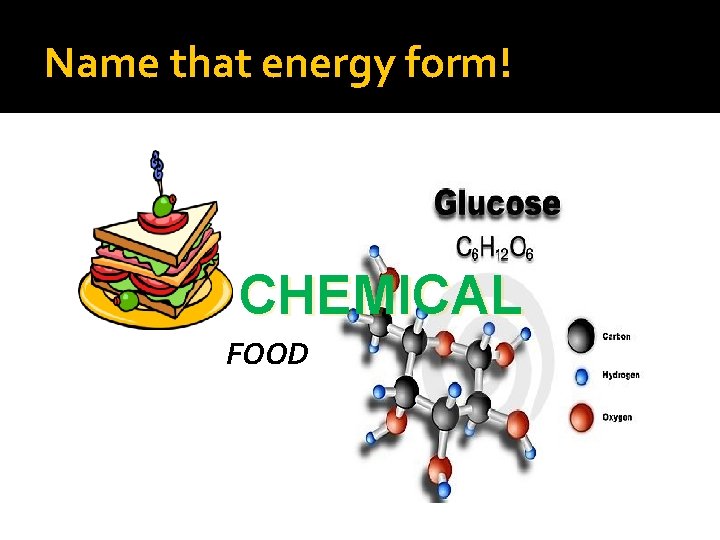
Name that energy form! CHEMICAL FOOD
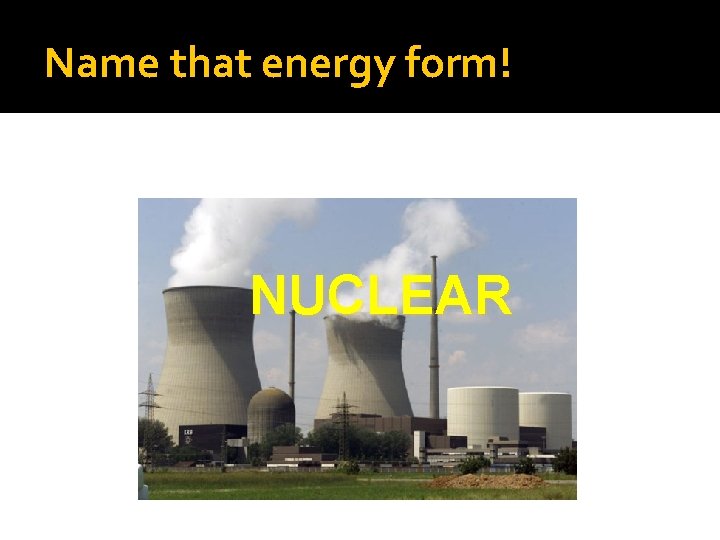
Name that energy form! NUCLEAR
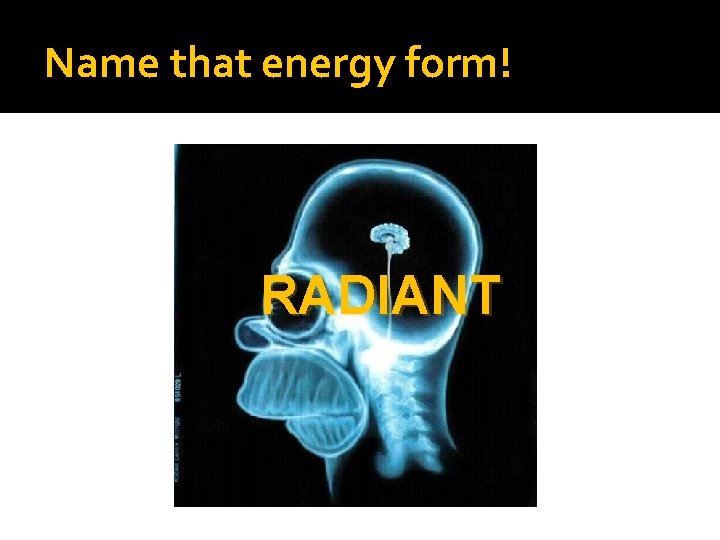
Name that energy form! RADIANT
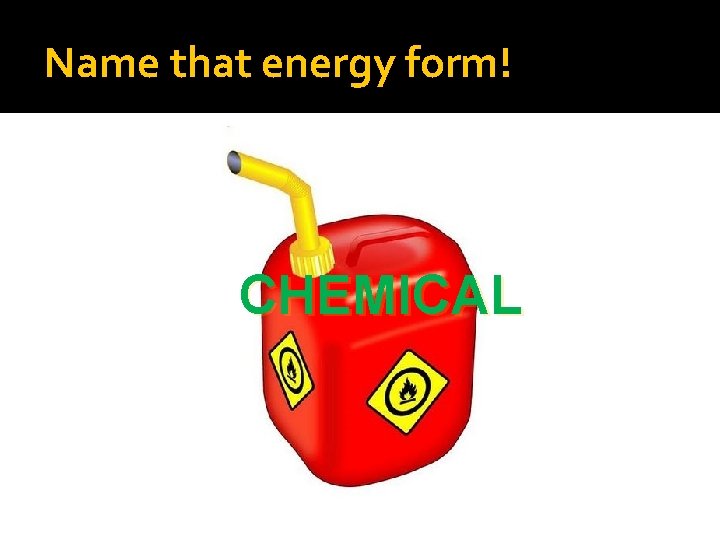
Name that energy form! CHEMICAL
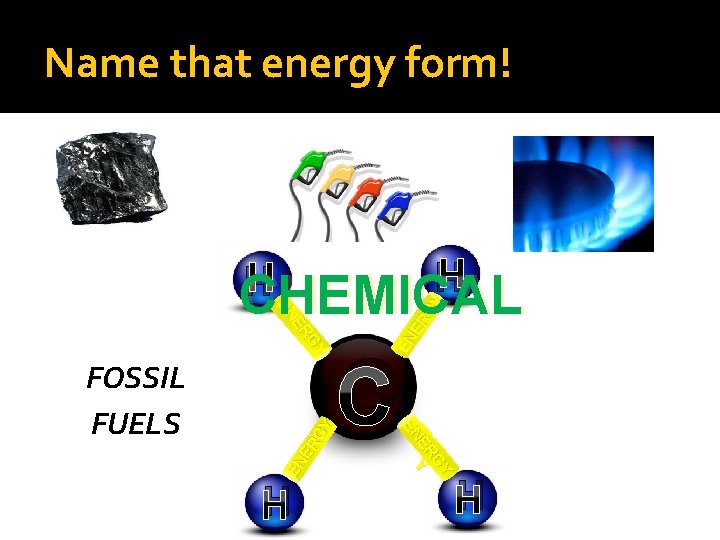
Name that energy form! H H EN ER GY C G GY ERR ENE Y EN FOSSIL FUELS GY ER EN CHEMICAL H
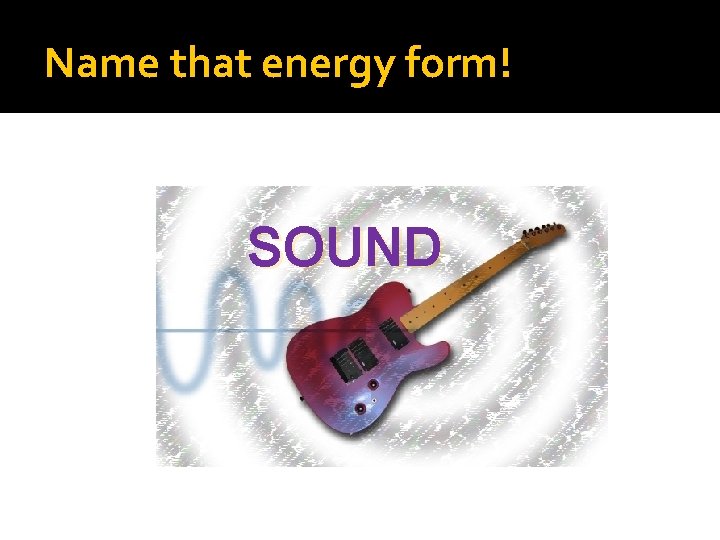
Name that energy form! SOUND
Name that energy form! THERMAL
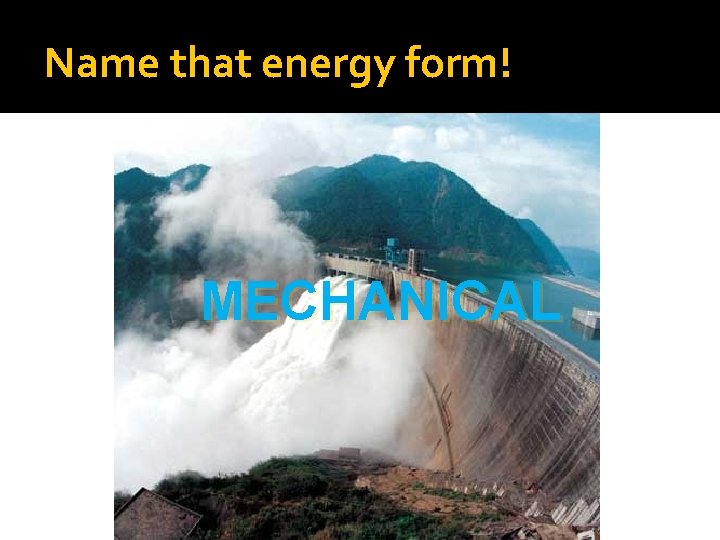
Name that energy form! MECHANICAL
Name that energy form! ELECTRICAL
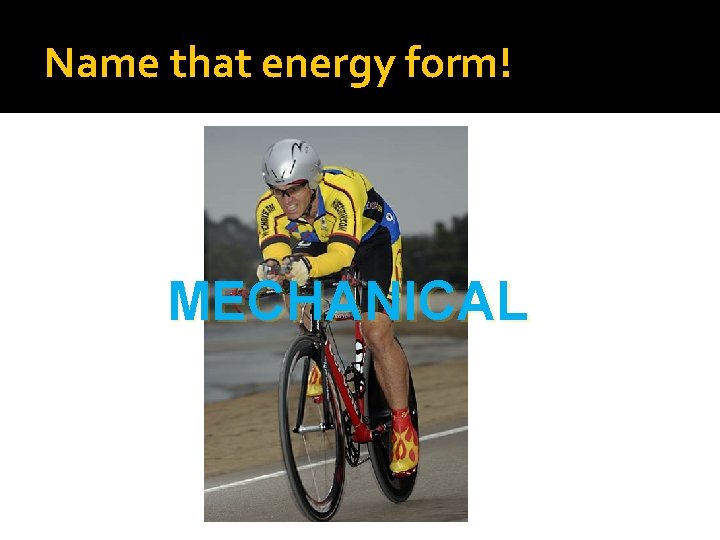
Name that energy form! MECHANICAL
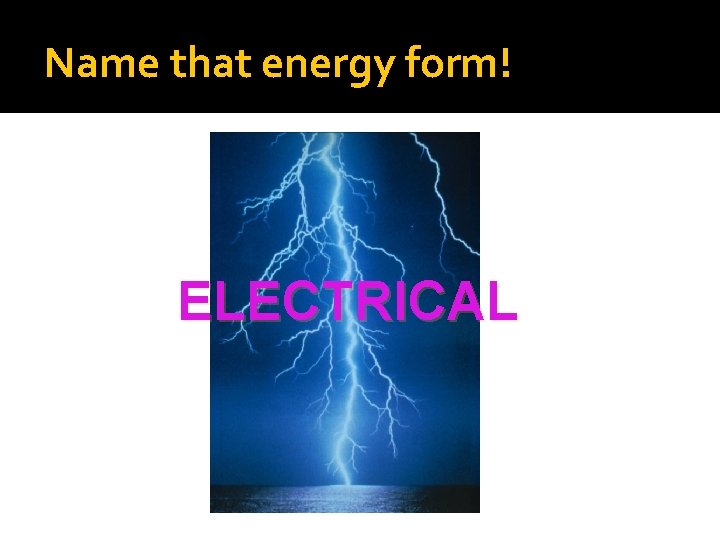
Name that energy form! ELECTRICAL
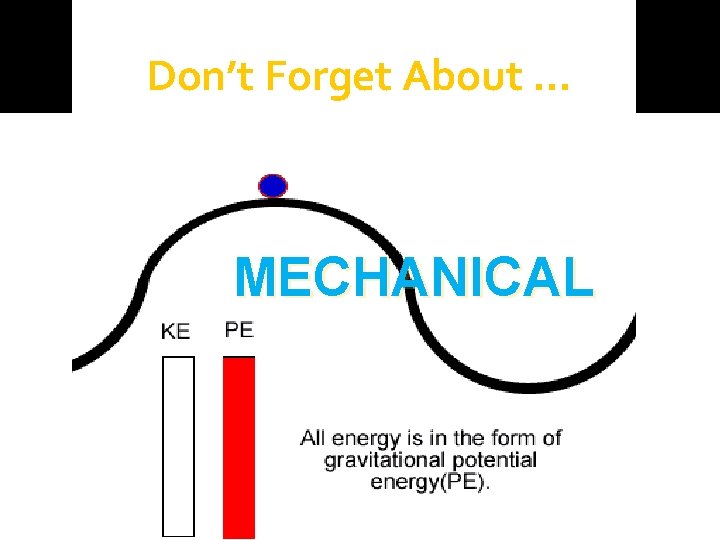
Don’t Forget About … MECHANICAL
Energy Transformation Stations STATION 1 Your hand transferred moving or mechanical energy to the ball. Because of gravity, the water moved the ball upwards. Mechanical to Mechanical (Potential to Kinetic) STATION 3 Striking the tuning fork gives it mechanical energy and produces sound energy (moving air particles). The sound energy then transforms into mechanical energy that moves the ball. Mechanical to Sound to Mechanical STATION 2 Gravity pulling the car downward transformed mechanical (potential) energy into mechanical (kinetic) energy. Mechanical to Mechanical (Potential to Kinetic) STATION 4 The dish soap broke bonds in the fat molecules in the milk, causing the milk to move when the chemical energy was released. Chemical to Mechanical
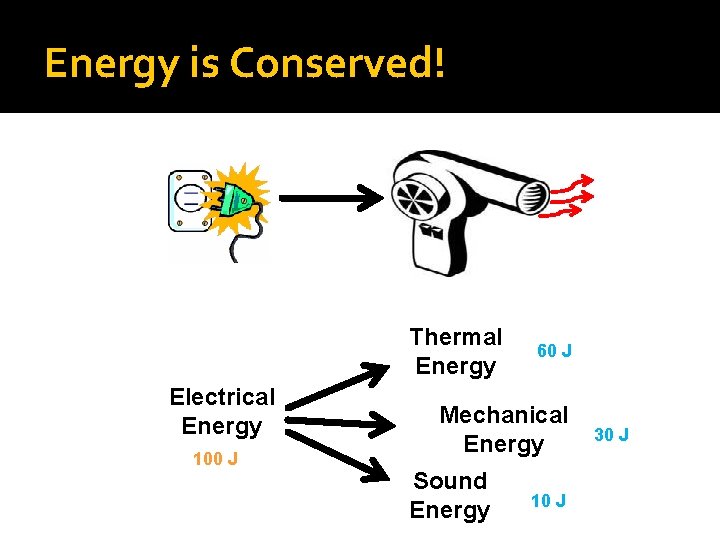
Energy Transformation Diagram Thermal Energy Electrical Energy Mechanical Energy Sound Energy
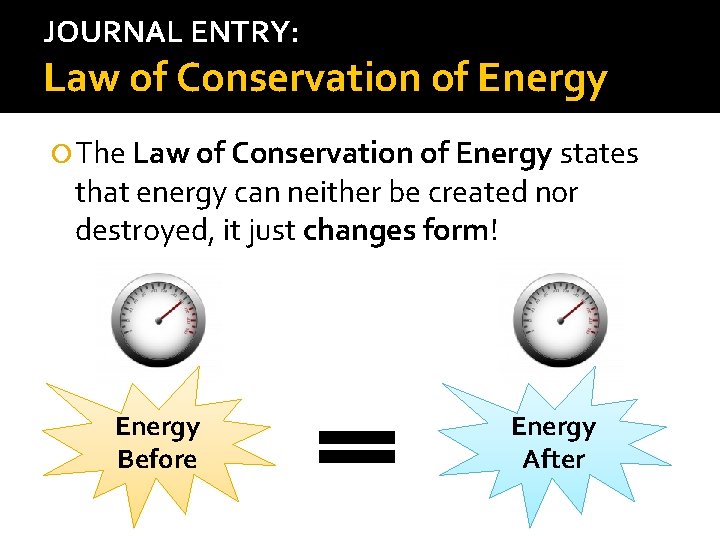
JOURNAL ENTRY: Law of Conservation of Energy The Law of Conservation of Energy states that energy can neither be created nor destroyed, it just changes form! Energy Before Energy After
Energy is Conserved! Thermal Energy Electrical Energy 100 J 60 J Mechanical Energy Sound Energy 10 J 30 J
Energy Transformations So we can’t make energy, but energy can be made more useful by changing it from one form to another. Record at least three examples of how energy is changed from one form to another to make it more useful in your own life. ? ?