
Energy Transfer Syllabus Title Page Lesson 01 Types
Energy Transfer Syllabus Title Page Lesson 01 Types of Energy Lesson 02 Energy Efficiency Lesson 03 Conduction and Convection Lesson 04 Radiation and Insulation Lesson 05 Insulating Homes Stopwatch Graph Home
Energy Stopwatch Graph Home
Energy Transfers 2/28/2021 Aim: l To define energy l To explain the purpose of a transducer and their role in the conservation of energy l To identify energy transfers Starter: in rough l Write down words / phrases about energy l Compare with your neighbour l Compare with your table l Agree a definition of energy and one of you write it down (can be more than one sentence) Stopwatch Graph Home
Energy Definition: l Energy is required to do anything (work) (e. g. heat up). l Energy is always conserved, it is never used up or destroyed it is transferred into another form (e. g. chemical to heat and light). l A transducer changes energy from one form to another (e. g. a match). Symbol: E Unit: J (joules) Analogy: l Energy is like money. l To do anything costs money. l Money is not used up but changes hands when you pay for something. Handout Demo Burning Ethanol Stopwatch Graph Home
Types of energy l l There are two groups of energy and nine types you need to learn In rough write down what types of energy you can think of in 1 minute (think about the burning ethanol demo) Stopwatch Graph Home
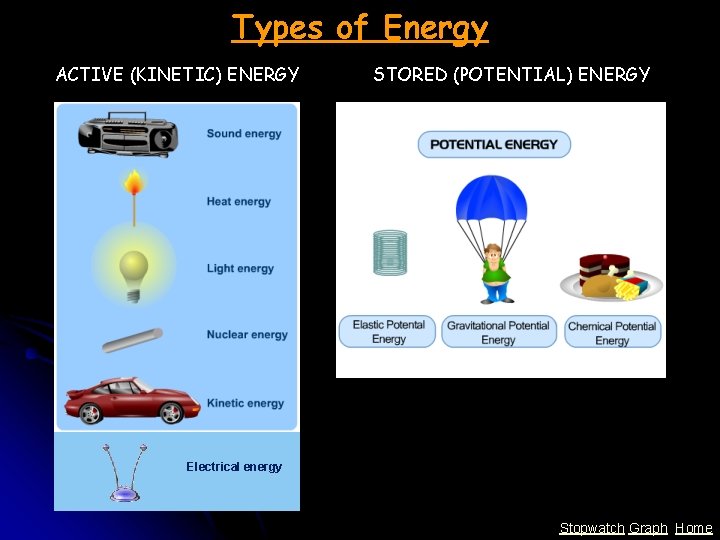
Types of Energy ACTIVE (KINETIC) ENERGY STORED (POTENTIAL) ENERGY Electrical energy Stopwatch Graph Home
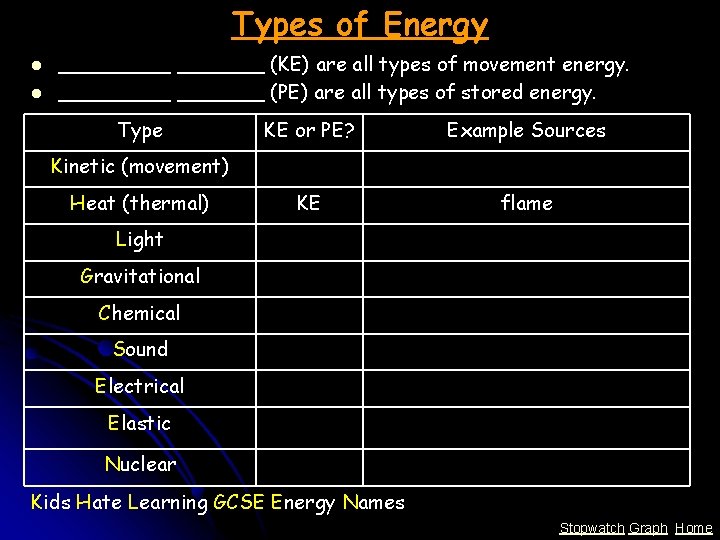
Types of Energy l l _______ (KE) are all types of movement energy. _______ (PE) are all types of stored energy. Type KE or PE? Example Sources KE flame Kinetic (movement) Heat (thermal) Light Gravitational Chemical Sound Electrical Elastic Nuclear Kids Hate Learning GCSE Energy Names Stopwatch Graph Home
On your white board write down the type of energy 1. Energy in a toffee 2. Energy in a running girl 3. Energy causing a light bulb to light 4. Energy given off by a stationary boy 5. Energy in music 6. Energy in a spring shot 7. Energy in a diver Stopwatch Graph Home
Energy Transfers Watch the demo (flour fire breathing) What energy transfers are occurring? Stopwatch Graph Home
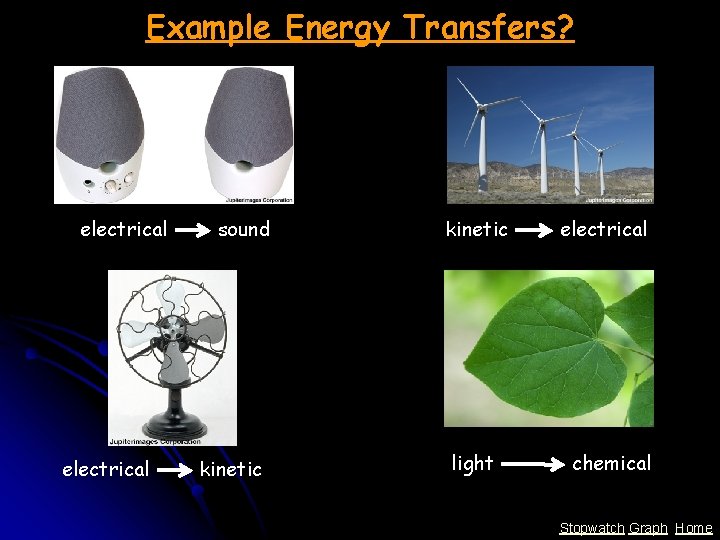
Example Energy Transfers? electrical sound kinetic light electrical chemical Stopwatch Graph Home
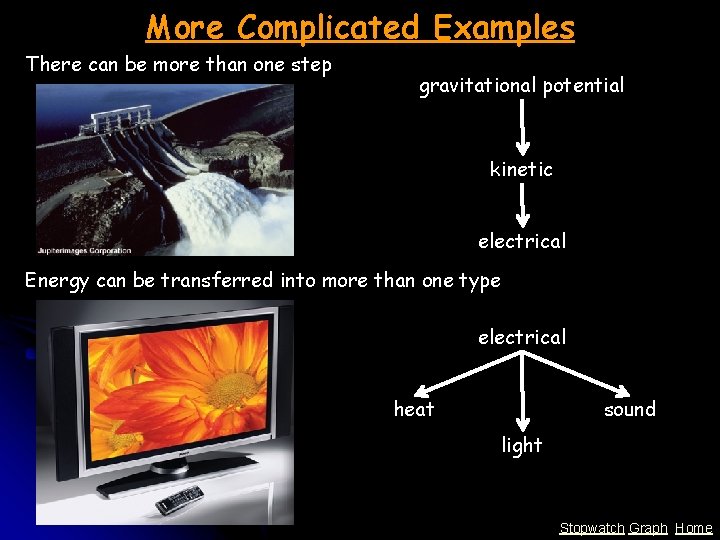
More Complicated Examples There can be more than one step gravitational potential kinetic electrical Energy can be transferred into more than one type electrical heat sound light Stopwatch Graph Home

Energy Circus l l l Around the lab are a selection of transducers. For each one identify l All the energy transfers (every stage) l Underline useful transfers l Bracket wasted transfers l Write the name and transfers into your books Example (try in your books in pencil) 1. Catapult Girl Chemical kinetic (sound) (heat) elastic kinetic Elastic gravitational (heat) Stopwatch Graph Home
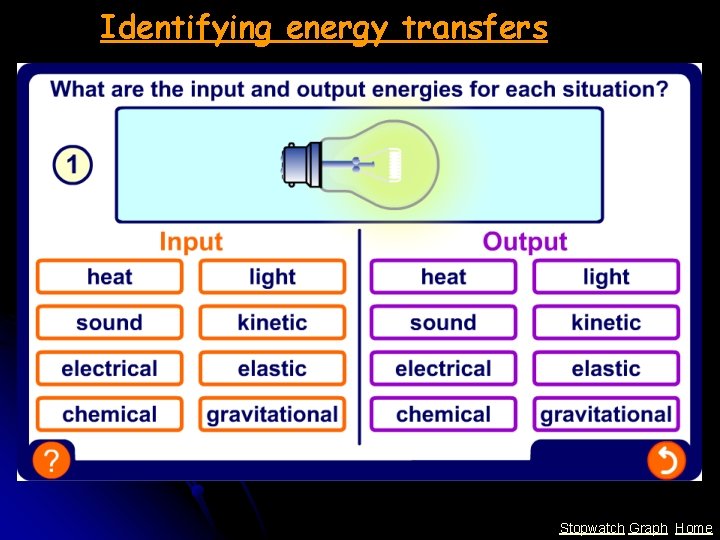
Identifying energy transfers Stopwatch Graph Home
Energy Transfers recap Aim: l To define a energy l To explain the purpose of a transducer and their role in the conservation of energy l To identify energy transfers Plenary: on whiteboards l Write down the two most important things you have learnt this lesson. Stopwatch Graph Home
Efficiency 2/28/2021 Aim: l To create sankey diagrams l To calculate efficiency Starter: l Watch the Movie (Roller Coaster) l Identify the energy transfers l How is energy wasted? Stopwatch Graph Home
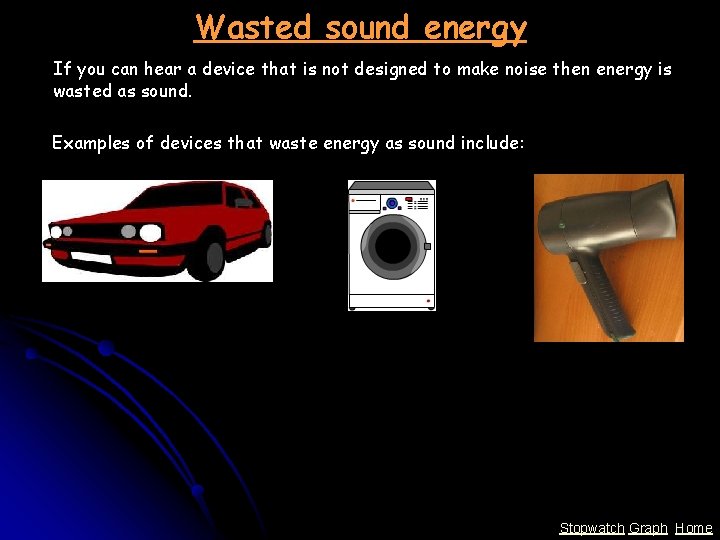
Wasted sound energy If you can hear a device that is not designed to make noise then energy is wasted as sound. Examples of devices that waste energy as sound include: Stopwatch Graph Home
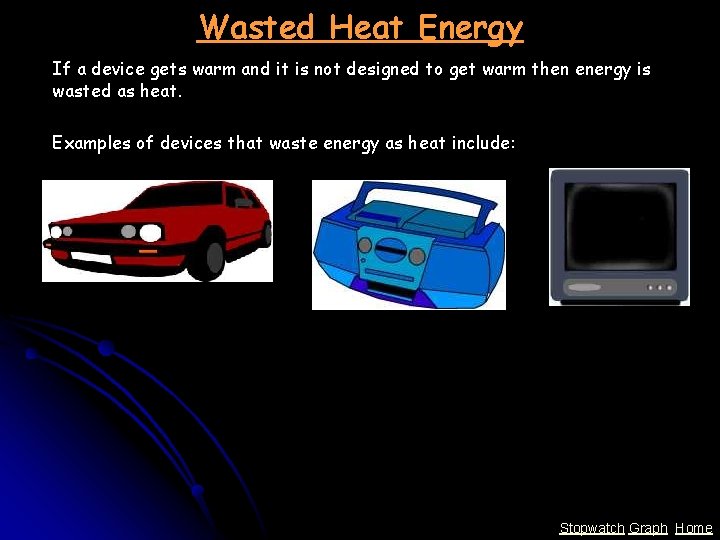
Wasted Heat Energy If a device gets warm and it is not designed to get warm then energy is wasted as heat. Examples of devices that waste energy as heat include: Stopwatch Graph Home
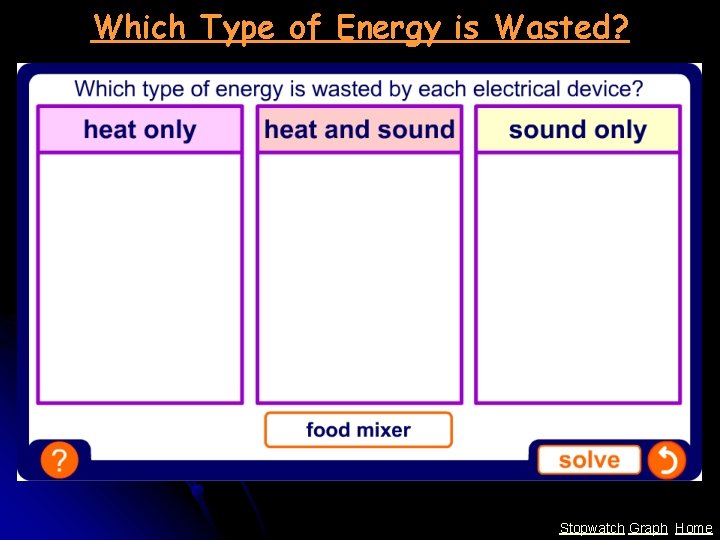
Which Type of Energy is Wasted? Stopwatch Graph Home

Wasted Energy l l l Energy is normally wasted as heat and sound Wasted energy dissipates (spreads out) into the surroundings. This dissipated energy is too spread out to do useful work and so cannot be re-used. Stopwatch Graph Home
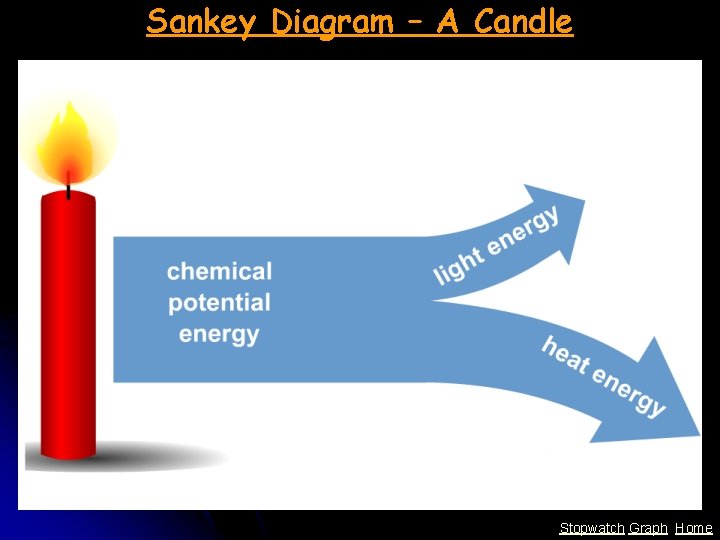
Sankey Diagram – A Candle Stopwatch Graph Home
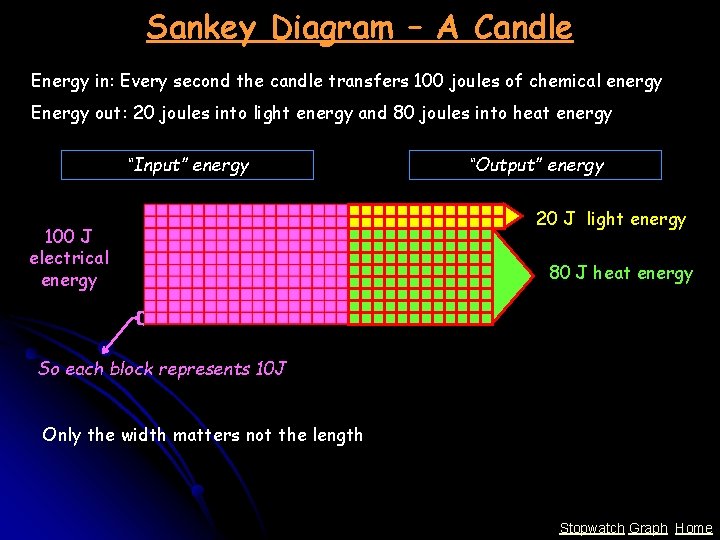
Sankey Diagram – A Candle Energy in: Every second the candle transfers 100 joules of chemical energy Energy out: 20 joules into light energy and 80 joules into heat energy “Input” energy 100 J electrical energy “Output” energy 20 J light energy 80 J heat energy So each block represents 10 J Only the width matters not the length Stopwatch Graph Home
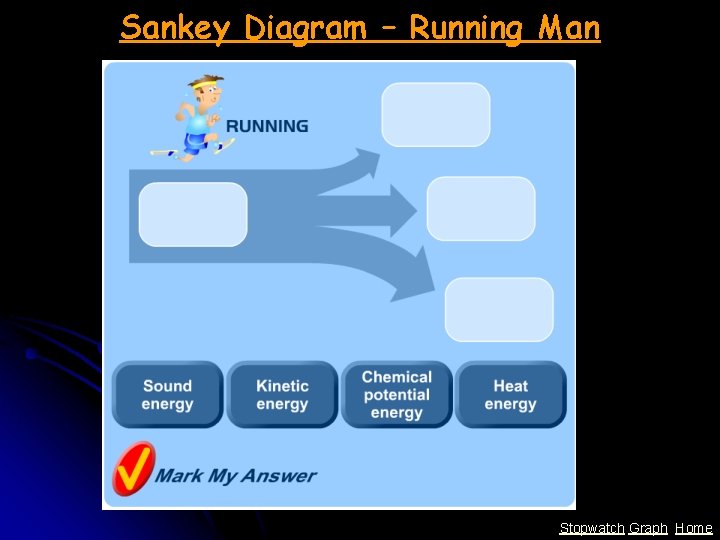
Sankey Diagram – Running Man Stopwatch Graph Home
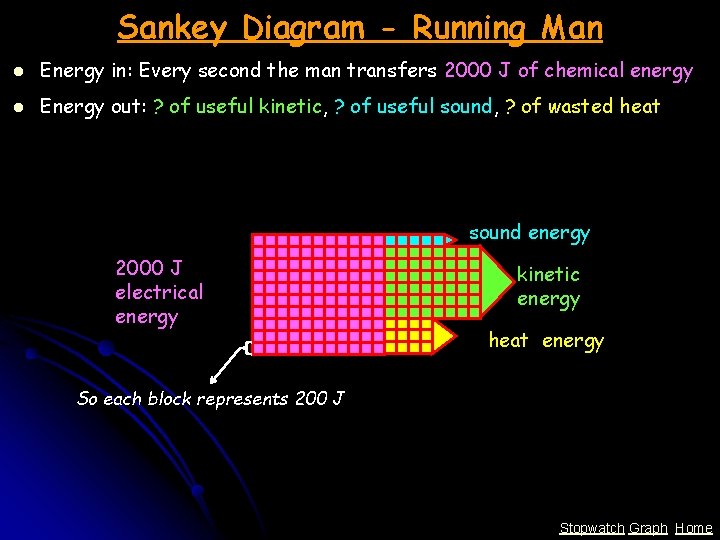
Sankey Diagram - Running Man l Energy in: Every second the man transfers 2000 J of chemical energy l Energy out: ? of useful kinetic, ? of useful sound, ? of wasted heat sound energy 2000 J electrical energy kinetic energy heat energy So each block represents 200 J Stopwatch Graph Home
Stopwatch Graph Home
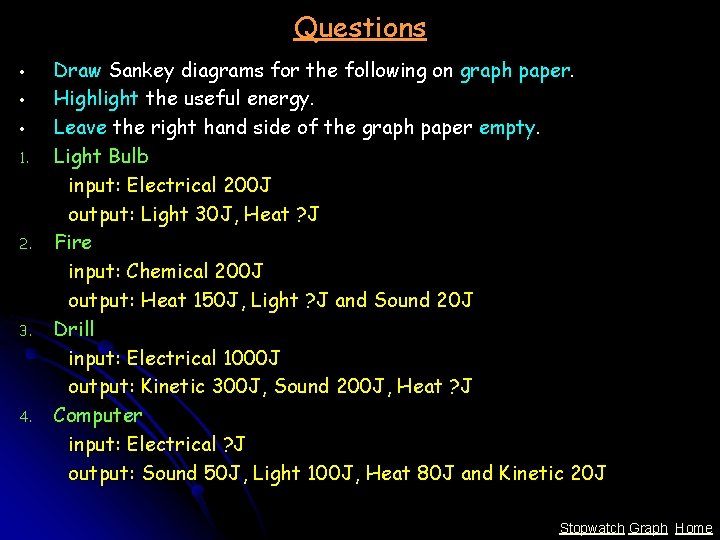
Questions • • • 1. 2. 3. 4. Draw Sankey diagrams for the following on graph paper. Highlight the useful energy. Leave the right hand side of the graph paper empty. Light Bulb input: Electrical 200 J output: Light 30 J, Heat ? J Fire input: Chemical 200 J output: Heat 150 J, Light ? J and Sound 20 J Drill input: Electrical 1000 J output: Kinetic 300 J, Sound 200 J, Heat ? J Computer input: Electrical ? J output: Sound 50 J, Light 100 J, Heat 80 J and Kinetic 20 J Stopwatch Graph Home
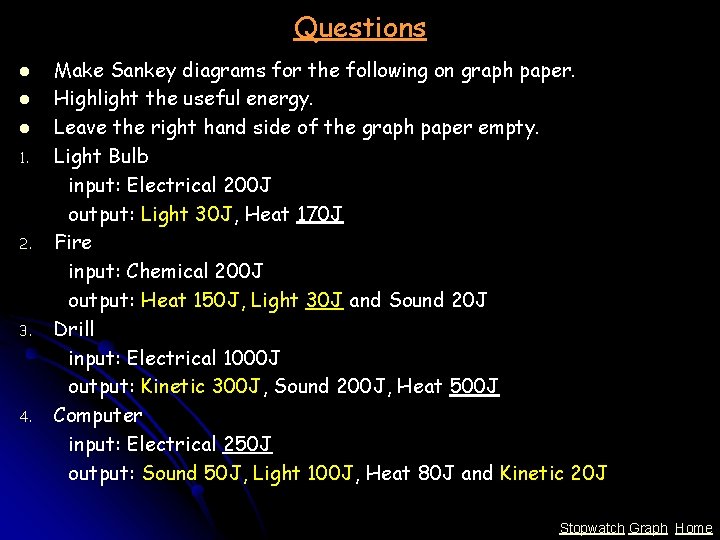
Questions l l l 1. 2. 3. 4. Make Sankey diagrams for the following on graph paper. Highlight the useful energy. Leave the right hand side of the graph paper empty. Light Bulb input: Electrical 200 J output: Light 30 J, Heat 170 J Fire input: Chemical 200 J output: Heat 150 J, Light 30 J and Sound 20 J Drill input: Electrical 1000 J output: Kinetic 300 J, Sound 200 J, Heat 500 J Computer input: Electrical 250 J output: Sound 50 J, Light 100 J, Heat 80 J and Kinetic 20 J Stopwatch Graph Home
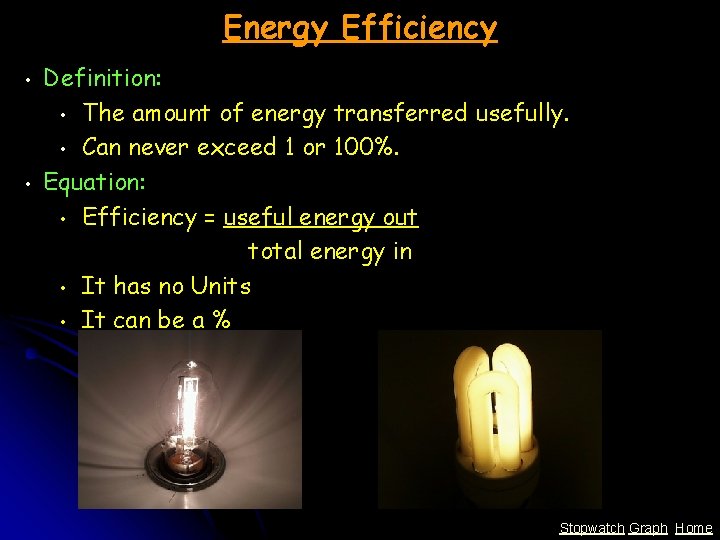
Energy Efficiency • • Definition: • The amount of energy transferred usefully. • Can never exceed 1 or 100%. Equation: • Efficiency = useful energy out total energy in • It has no Units • It can be a % Stopwatch Graph Home
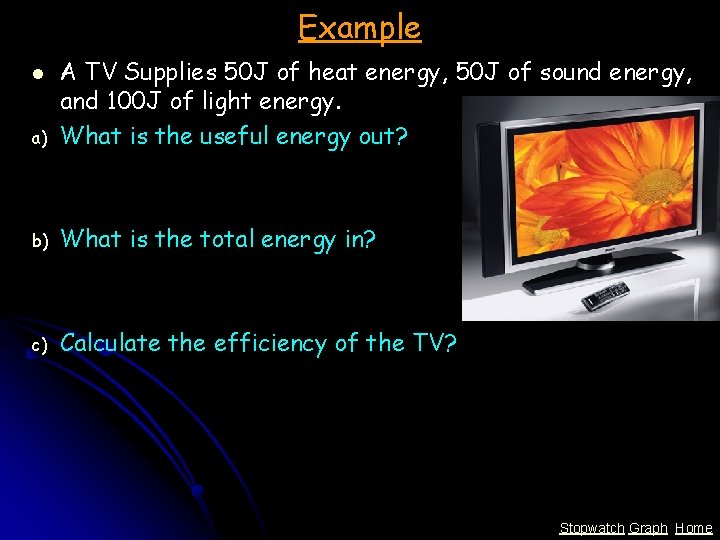
Example a) A TV Supplies 50 J of heat energy, 50 J of sound energy, and 100 J of light energy. What is the useful energy out? b) What is the total energy in? c) Calculate the efficiency of the TV? l Stopwatch Graph Home
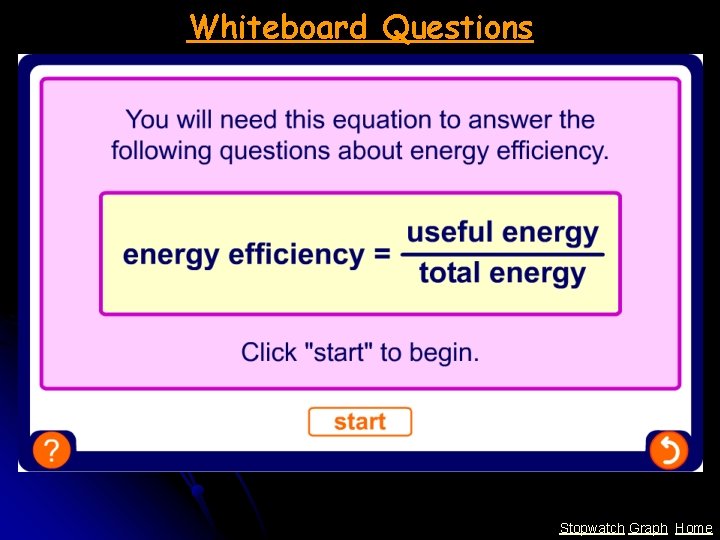
Whiteboard Questions Stopwatch Graph Home
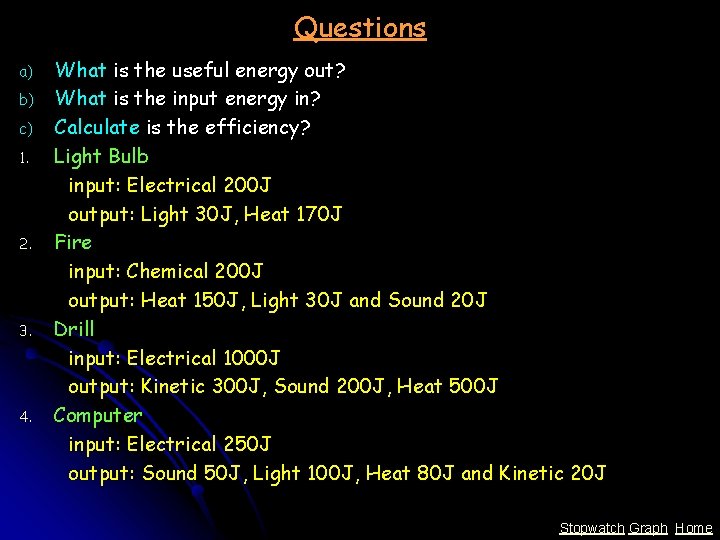
Questions a) b) c) 1. 2. 3. 4. What is the useful energy out? What is the input energy in? Calculate is the efficiency? Light Bulb input: Electrical 200 J output: Light 30 J, Heat 170 J Fire input: Chemical 200 J output: Heat 150 J, Light 30 J and Sound 20 J Drill input: Electrical 1000 J output: Kinetic 300 J, Sound 200 J, Heat 500 J Computer input: Electrical 250 J output: Sound 50 J, Light 100 J, Heat 80 J and Kinetic 20 J Stopwatch Graph Home

1) Light Bulb Electrical 200 J (total in) 170 J Heat (wasted) 30 J a) useful energy out = 30 J b) total energy in = 200 J c) Efficiency = useful total = 30 200 = 0. 15 or 15% Light (useful) Stopwatch Graph Home
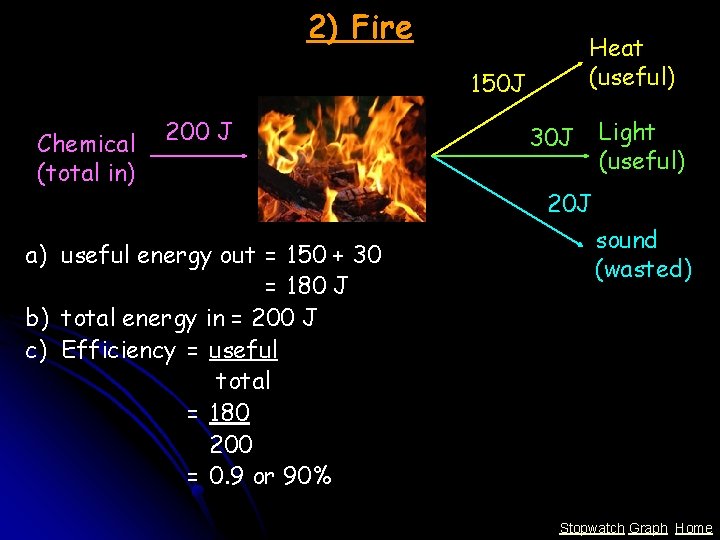
2) Fire Heat (useful) 150 J Chemical (total in) 200 J a) useful energy out = 150 + 30 = 180 J b) total energy in = 200 J c) Efficiency = useful total = 180 200 = 0. 9 or 90% 30 J Light (useful) 20 J sound (wasted) Stopwatch Graph Home
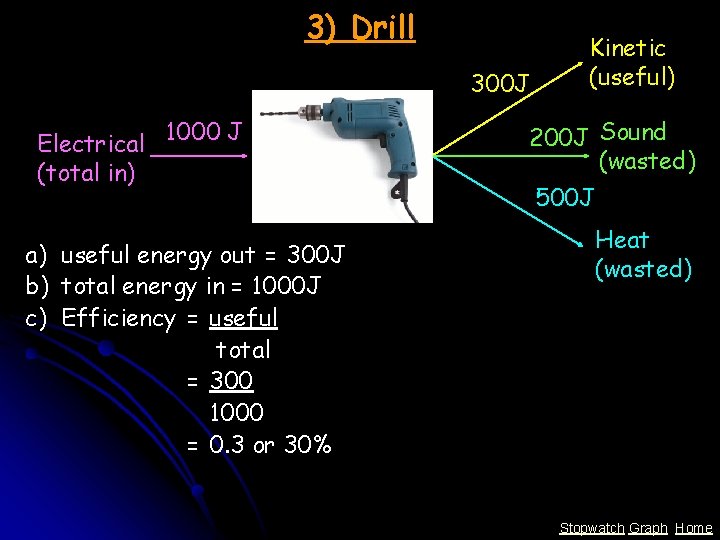
3) Drill 300 J Electrical 1000 J (total in) a) useful energy out = 300 J b) total energy in = 1000 J c) Efficiency = useful total = 300 1000 = 0. 3 or 30% Kinetic (useful) 200 J Sound (wasted) 500 J Heat (wasted) Stopwatch Graph Home
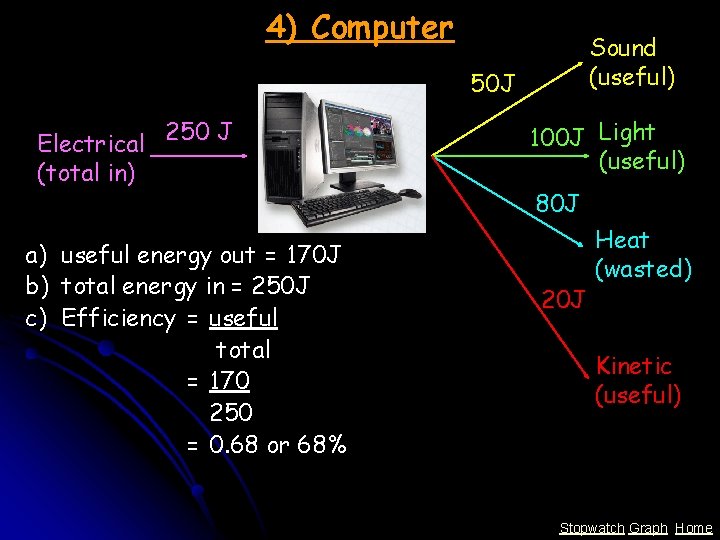
4) Computer Sound (useful) 50 J Electrical 250 J (total in) a) useful energy out = 170 J b) total energy in = 250 J c) Efficiency = useful total = 170 250 = 0. 68 or 68% 100 J Light (useful) 80 J 20 J Heat (wasted) Kinetic (useful) Stopwatch Graph Home
Multiple-choice quiz Stopwatch Graph Home
Anagrams Stopwatch Graph Home
Efficiency recap Aim: l To create sankey diagrams l To calculate efficiency Stopwatch Graph Home
- Slides: 37