
Energy Transfer Particles Do now activity Describe the
Energy Transfer: Particles Do now activity: Describe the difference between ‘temperature’ and ‘energy’
Progress indicators GOOD PROGRESS: • Recall the definition of a conductor • Describe how energy is transferred by particles in conduction and convection. OUTSTANDING PROGRESS: • Explain how an insulator can reduce energy transfer.
What is a conductor? A conductor is something that lets heat energy flow through it. When heat energy travels through solids. This is called conduction. Some materials are better heat conductors than others, a poor heat conductor is called an insulator. Task: Can you name some examples of materials which make: a) good conductors of heat b) good insulators
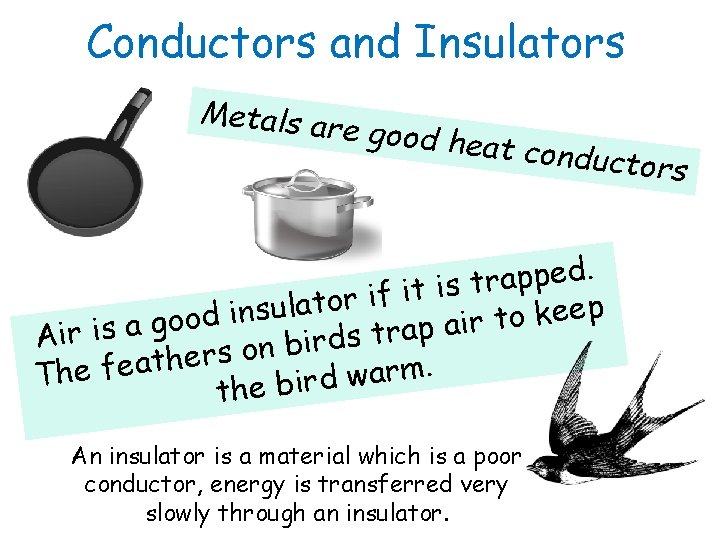
Conductors and Insulators Metals ar e good heat conducto . d e p p a r t s i t i f i r o t a l p u e s e n i k d o o t o r g i a a p s i a r r t i s A d r i b n o s r e h t a e. f m r a w The d the bir An insulator is a material which is a poor conductor, energy is transferred very slowly through an insulator. rs
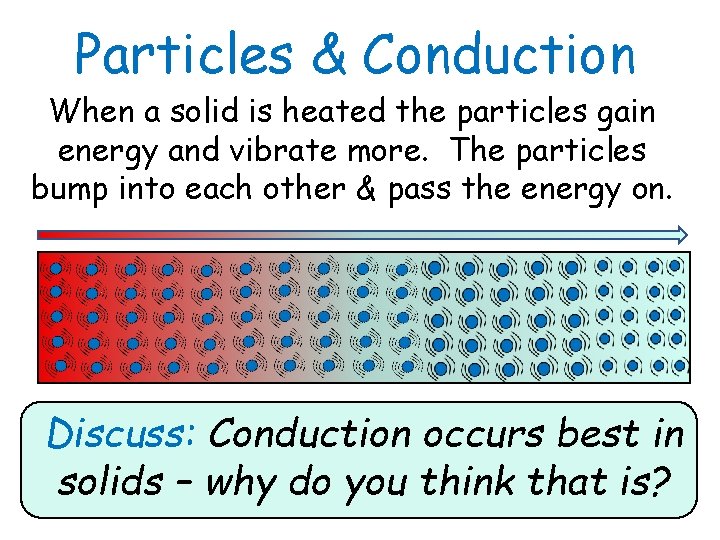
Particles & Conduction When a solid is heated the particles gain energy and vibrate more. The particles bump into each other & pass the energy on. Discuss: Conduction occurs best in solids – why do you think that is?
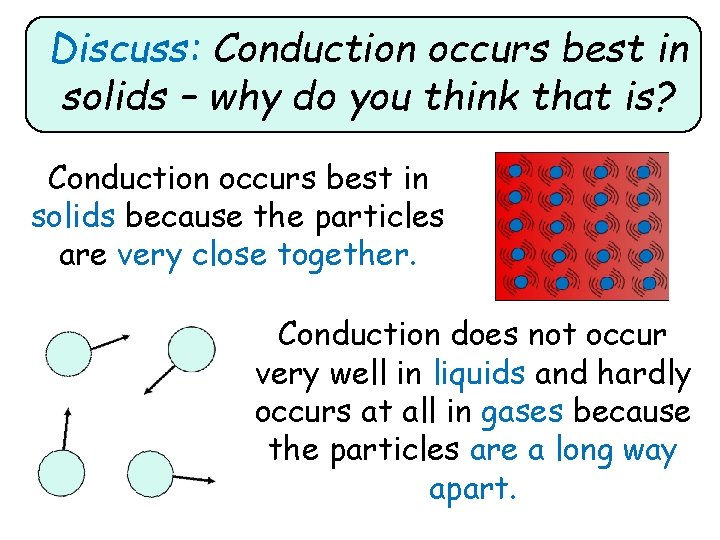
Discuss: Conduction occurs best in solids – why do you think that is? Conduction occurs best in solids because the particles are very close together. Conduction does not occur very well in liquids and hardly occurs at all in gases because the particles are a long way apart.
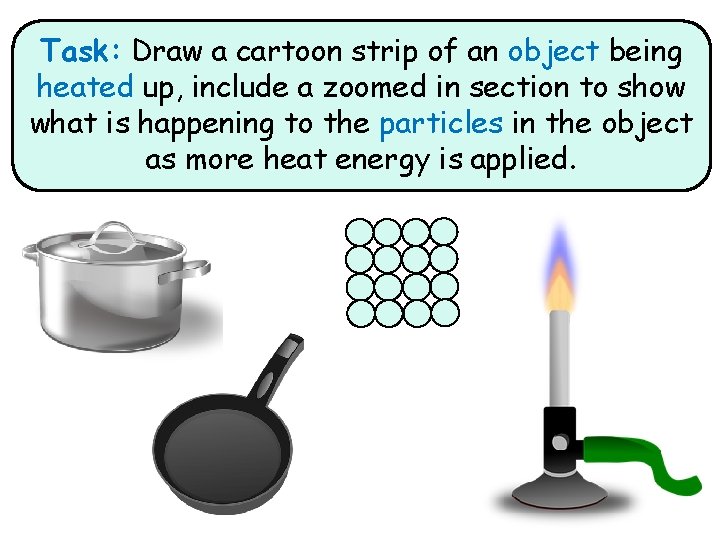
Task: Draw a cartoon strip of an object being heated up, include a zoomed in section to show what is happening to the particles in the object as more heat energy is applied.
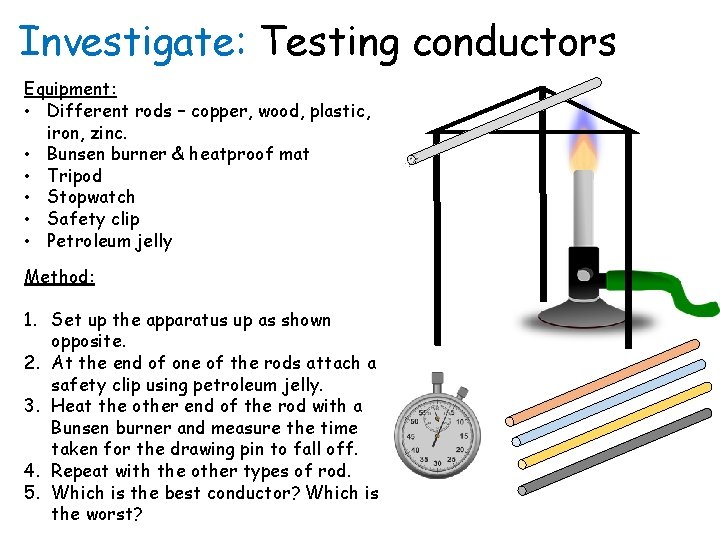
Investigate: Testing conductors Equipment: • Different rods – copper, wood, plastic, iron, zinc. • Bunsen burner & heatproof mat • Tripod • Stopwatch • Safety clip • Petroleum jelly Method: 1. Set up the apparatus up as shown opposite. 2. At the end of one of the rods attach a safety clip using petroleum jelly. 3. Heat the other end of the rod with a Bunsen burner and measure the time taken for the drawing pin to fall off. 4. Repeat with the other types of rod. 5. Which is the best conductor? Which is the worst?
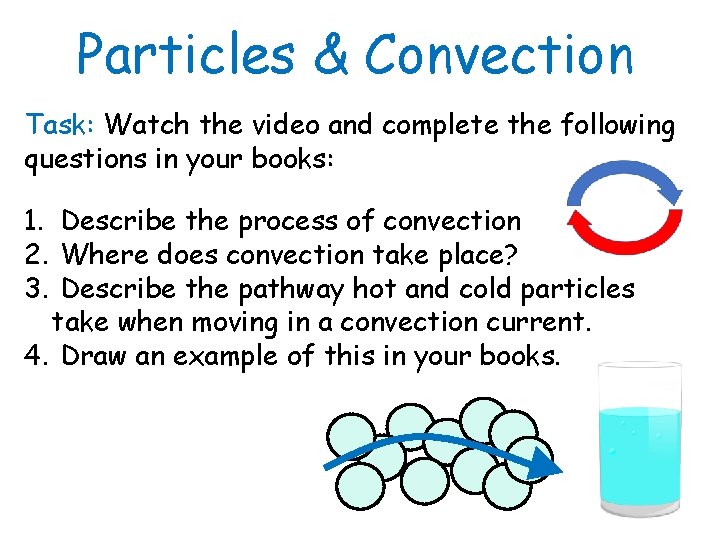
Particles & Convection Task: Watch the video and complete the following questions in your books: 1. Describe the process of convection 2. Where does convection take place? 3. Describe the pathway hot and cold particles take when moving in a convection current. 4. Draw an example of this in your books.
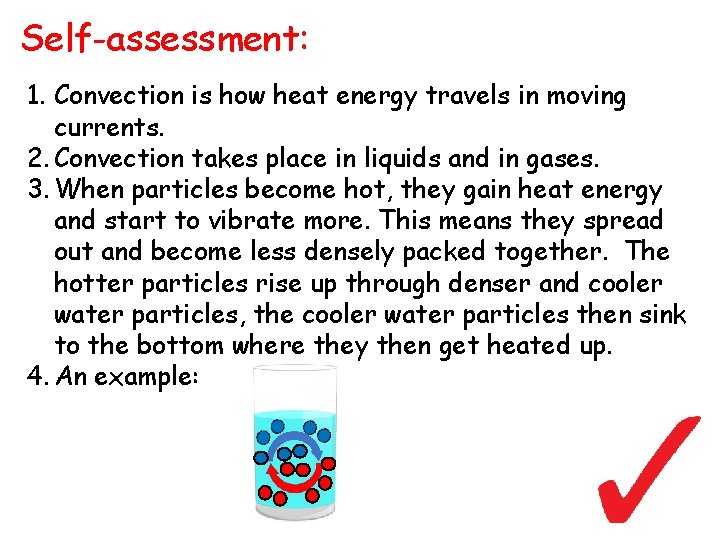
Self-assessment: 1. Convection is how heat energy travels in moving currents. 2. Convection takes place in liquids and in gases. 3. When particles become hot, they gain heat energy and start to vibrate more. This means they spread out and become less densely packed together. The hotter particles rise up through denser and cooler water particles, the cooler water particles then sink to the bottom where they then get heated up. 4. An example:
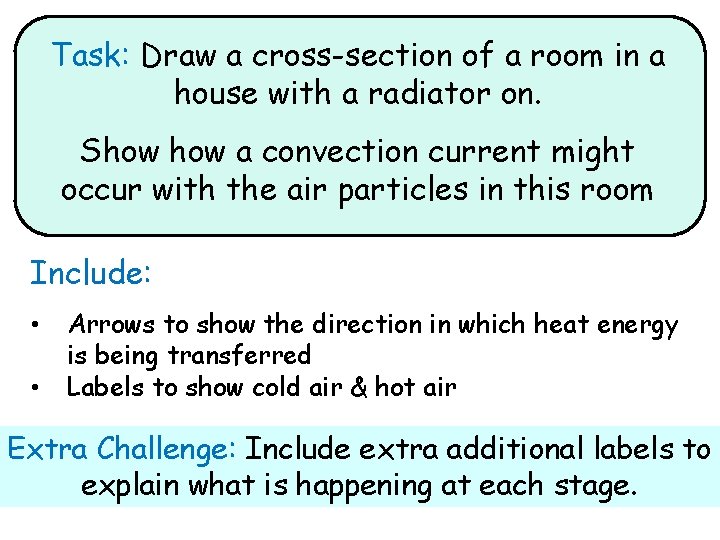
Task: Draw a cross-section of a room in a house with a radiator on. Show a convection current might occur with the air particles in this room Include: • • Arrows to show the direction in which heat energy is being transferred Labels to show cold air & hot air Extra Challenge: Include extra additional labels to explain what is happening at each stage.
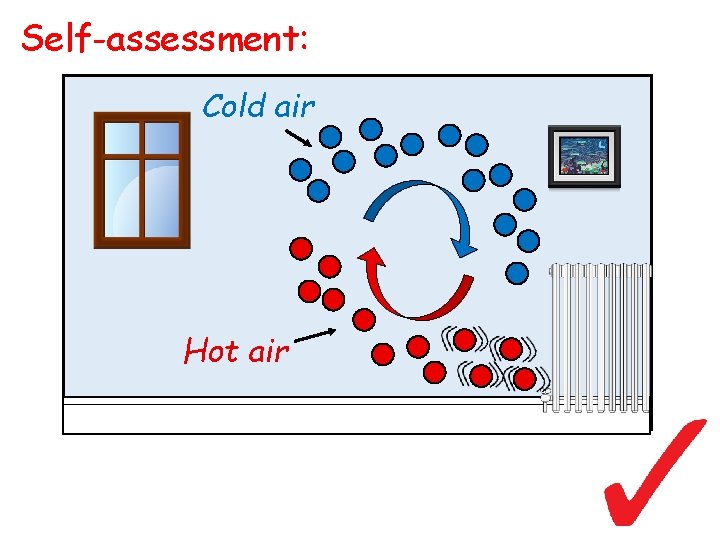
Self-assessment: Cold air Hot air
Plenary – What did you learn this lesson? • 3 facts • 3 key words • 1 question to test your peers
- Slides: 14