
Energy Systems of the Human Body The human
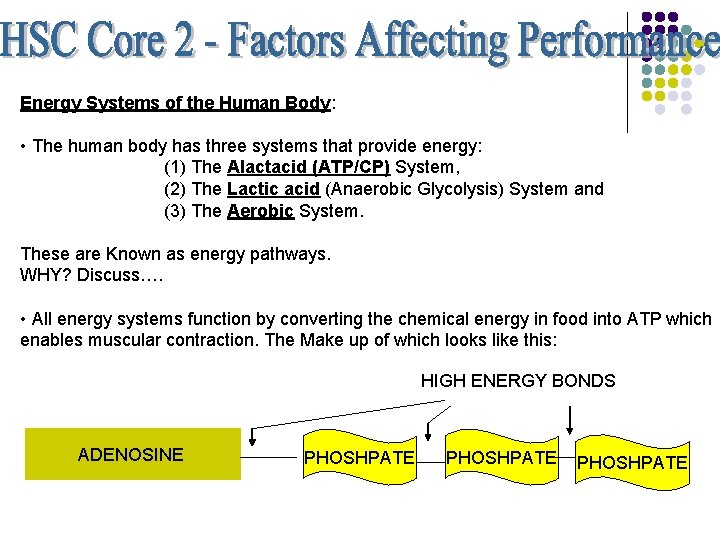
Energy Systems of the Human Body: • The human body has three systems that provide energy: (1) The Alactacid (ATP/CP) System, (2) The Lactic acid (Anaerobic Glycolysis) System and (3) The Aerobic System. These are Known as energy pathways. WHY? Discuss…. • All energy systems function by converting the chemical energy in food into ATP which enables muscular contraction. The Make up of which looks like this: HIGH ENERGY BONDS ADENOSINE PHOSHPATE
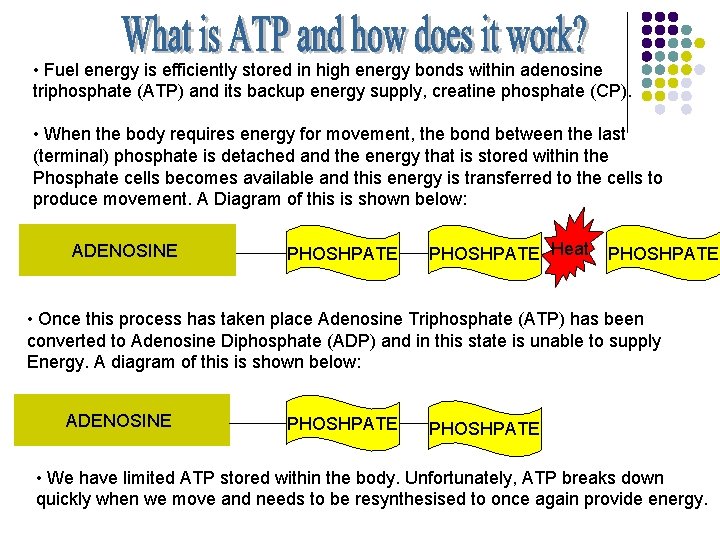
• Fuel energy is efficiently stored in high energy bonds within adenosine triphosphate (ATP) and its backup energy supply, creatine phosphate (CP). • When the body requires energy for movement, the bond between the last (terminal) phosphate is detached and the energy that is stored within the Phosphate cells becomes available and this energy is transferred to the cells to produce movement. A Diagram of this is shown below: ADENOSINE PHOSHPATE Heat PHOSHPATE • Once this process has taken place Adenosine Triphosphate (ATP) has been converted to Adenosine Diphosphate (ADP) and in this state is unable to supply Energy. A diagram of this is shown below: ADENOSINE PHOSHPATE • We have limited ATP stored within the body. Unfortunately, ATP breaks down quickly when we move and needs to be resynthesised to once again provide energy.
• The study of energy systems is about mechanisms for building up the partly destroyed ATP molecule. If we had unlimited ATP stores we would be able run like the wind all day long. LET’S LOOK AT THE ENERGY SYSTEMS IN MORE DETAIL…
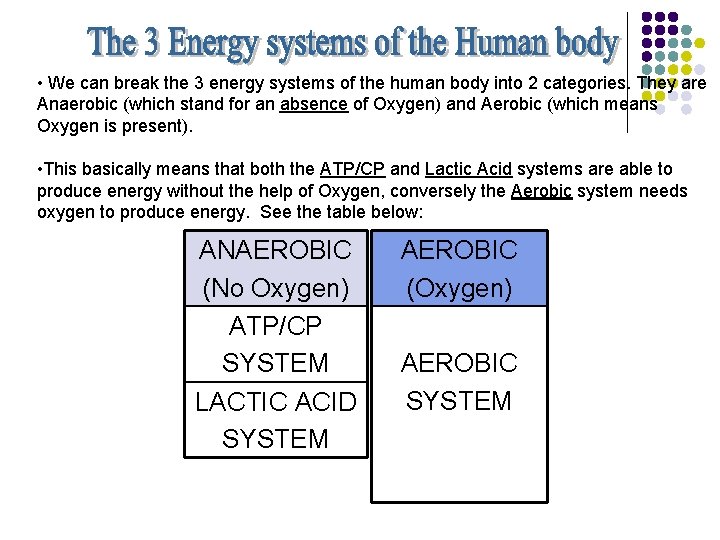
• We can break the 3 energy systems of the human body into 2 categories. They are Anaerobic (which stand for an absence of Oxygen) and Aerobic (which means Oxygen is present). • This basically means that both the ATP/CP and Lactic Acid systems are able to produce energy without the help of Oxygen, conversely the Aerobic system needs oxygen to produce energy. See the table below: ANAEROBIC (No Oxygen) ATP/CP SYSTEM LACTIC ACID SYSTEM AEROBIC (Oxygen) AEROBIC SYSTEM
HOW DOES IT WORK? After muscular contraction ATP is broken down to form ADP. Creatine phosphate (CP) is then broken down to form creatine and phosphate, which when broken off combines with ADP to form ATP is then available for further muscular contractions. SOURCE OF FUEL Creatine phosphate - it is produced naturally in the body and acts like a bandaid to resynthesise the floating phosphate molecule to an ADP molecule, which reforms ATP. EFFICIENCY OF ATP (ENERGY) PRODUCTION Creatine phosphate (CP) combines immediately with ADP to resynthesise ATP. It is a very efficient process and for each molecule of CP, one molecule of ATP is produced. This effectively gives us a ratio of (1: 1). DURATION OF SYSTEM Has the shortest duration of the 3 systems. Will only last at < 95% intensity for 10 -12 seconds (in a trained athlete).
CAUSE OF FATIGUE The muscles stores of creatine phosphate are exhausted after approximately 10 seconds. This is due to the limited supply of CP in our muscles… they simply can’t store more! Question: Can we train ourselves to store more CP? WASTE OR BY-PRODUCTS Amazingly… No waste products! YEAH!!! RATE OF RECOVERY The body will naturally replace stores of creatine phosphate. After 30 seconds there is 50% recovery, after 2 -3 minutes there is 100% recovery. Question: WHAT TYPE OF EXERCISES WOULD BE MOST SUITED TO THIS SYSTEM? Throwing events (javelin), jumping events (high jump), weight lifting, 100 and 200 m sprints, track cycling sprint.

HOW DOES IT WORK? During high intensity activity the body breaks down muscle glycogen without oxygen to form ATP. This process is called Anaerobic Glycolysis. SOURCE OF FUEL Carbohydrates are the only source of fuel in the form of muscle glycogen or blood sugar. EFFICIENCY OF ATP (ENERGY) PRODUCTION The lactic acid system produces ATP very rapidly. However due to the lack of oxygen it is very inefficient. For each molecule of muscle glucose and glycogen, two molecules of ATP are produced giving a ratio of (1: 2). Note: two molecules of lactic acid are also produced. DURATION OF SYSTEM Depends on the level of intensity. At high intensity > 90% it has a duration of 30 – 45 seconds. At a moderate intensity i. e. 60 -80% it has a duration of up to 3 -4 mins.
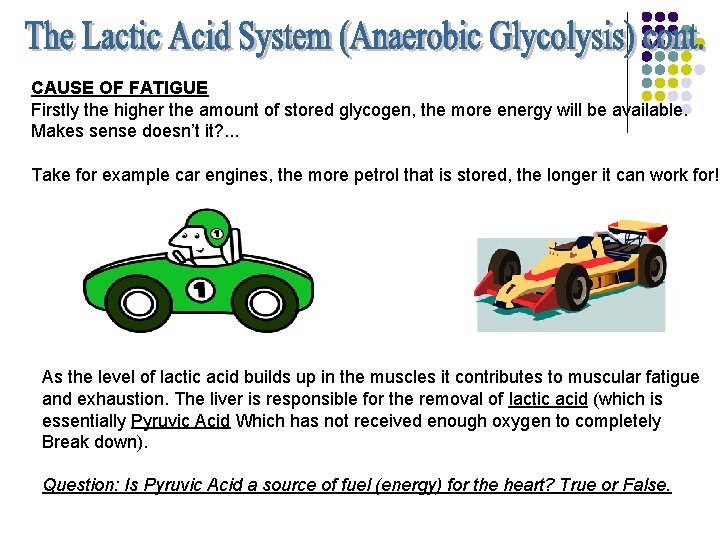
CAUSE OF FATIGUE Firstly the higher the amount of stored glycogen, the more energy will be available. Makes sense doesn’t it? . . . Take for example car engines, the more petrol that is stored, the longer it can work for! As the level of lactic acid builds up in the muscles it contributes to muscular fatigue and exhaustion. The liver is responsible for the removal of lactic acid (which is essentially Pyruvic Acid Which has not received enough oxygen to completely Break down). Question: Is Pyruvic Acid a source of fuel (energy) for the heart? True or False.
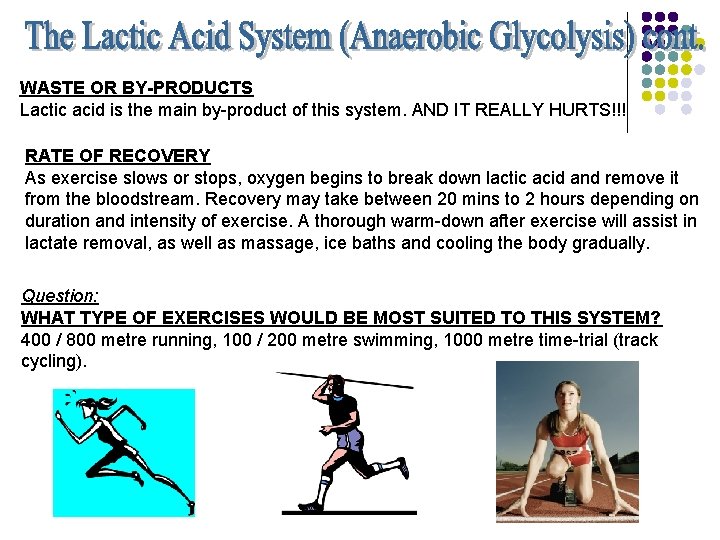
WASTE OR BY-PRODUCTS Lactic acid is the main by-product of this system. AND IT REALLY HURTS!!! RATE OF RECOVERY As exercise slows or stops, oxygen begins to break down lactic acid and remove it from the bloodstream. Recovery may take between 20 mins to 2 hours depending on duration and intensity of exercise. A thorough warm-down after exercise will assist in lactate removal, as well as massage, ice baths and cooling the body gradually. Question: WHAT TYPE OF EXERCISES WOULD BE MOST SUITED TO THIS SYSTEM? 400 / 800 metre running, 100 / 200 metre swimming, 1000 metre time-trial (track cycling).


The most frequently talked about and arguably most trained system out of the 3. HOW DOES IT WORK? Well firstly as we already know what needs to be present for this system to function? During continuous activity the body is able to supply oxygen to working muscles. This oxygen can be used to break down muscle glycogen to form ATP. This process is referred to as aerobic glycolysis. SOURCE OF FUEL Carbohydrate-foods are broken down into glucose, which can be used by the body for energy. Glucose may also stored as glycogen in the muscles and/or the liver. A further source of fuel is fat, which can be used over longer periods of exercise. Don’t Forget that in extreme circumstances proteins are also utilised for energy production. EFFICIENCY OF ATP (ENERGY) PRODUCTION The aerobic system is the slowest but most efficient form of energy production. It utilises oxygen to metabolise muscle and liver glycogen as well as blood glucose and free fatty acids. For each glucose molecule metabolised there is 36 molecules of ATP produced. A Ratio of (1: 36). For each fatty acid molecule metabolised 130 molecules of ATP are produced. A ratio of a staggering (1: 130)! Mmmm! LOT’S OF ENERGY FROM FATS…
DUATION OF SYSTEM Duration can be virtually unlimited depending on intensity. And how much food can be Ingested whilst exercising… Think of the Tour De France, the athletes are forced to Compete at high intensity Aerobic thresholds for up to 6 hrs a day the only way they can do this is by eating food whilst on the flats or going down hill. CAUSE OF FATIGUE Aerobic glycolysis will continue as long as the body has sufficient levels of blood glucose, muscle glycogen or stores of energy (e. g. fat protein stores) which can be mobilised and used in energy production. Therefore the cause of fatigue is simply a lack of available fuel to convert to energy… WASTE OR BY-PRODUCTS Water and carbon dioxide are by-products. The body also produces heat. Which is then dealt with by our thermoregulatory adaptations such as sweating, breathing etc. RATE OF RECOVERY This system takes the longest time to recover, as fuel stores need to be replenished. After long intensive activity, it may take up to 24 hours for this to occur. Have you ever wondered Shortly after exercising, why you are extremely hungry?
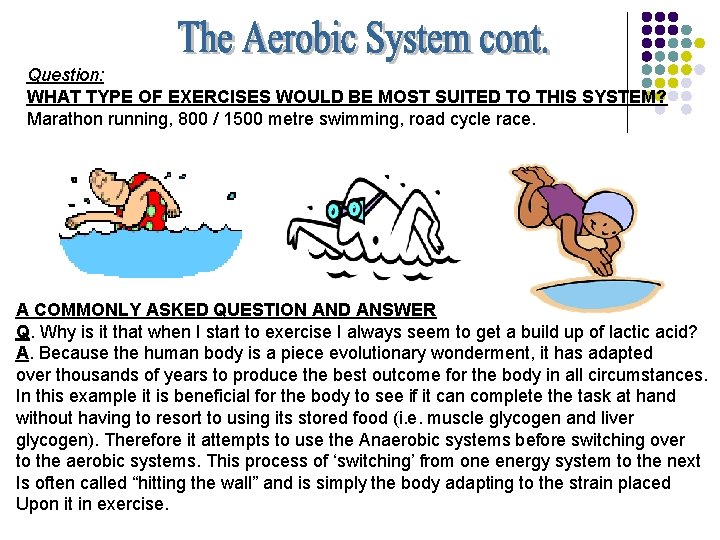
Question: WHAT TYPE OF EXERCISES WOULD BE MOST SUITED TO THIS SYSTEM? Marathon running, 800 / 1500 metre swimming, road cycle race. A COMMONLY ASKED QUESTION AND ANSWER Q. Why is it that when I start to exercise I always seem to get a build up of lactic acid? A. Because the human body is a piece evolutionary wonderment, it has adapted over thousands of years to produce the best outcome for the body in all circumstances. In this example it is beneficial for the body to see if it can complete the task at hand without having to resort to using its stored food (i. e. muscle glycogen and liver glycogen). Therefore it attempts to use the Anaerobic systems before switching over to the aerobic systems. This process of ‘switching’ from one energy system to the next Is often called “hitting the wall” and is simply the body adapting to the strain placed Upon it in exercise.

- Slides: 15