
Energy Systems All movement requires energy The methods
- Slides: 10
Energy Systems • All movement requires energy. • The methods by which the body generates energy are determined by the intensity and duration of the activity being undertaken. • Activities that require short bursts of effort such as sprinting or jumping, require the body to produce large amounts of energy over a short period, whereas activities like marathon running or endurance cycling require continued energy over a longer period and at a slower rate. • It is the energy systems of your body that facilitate these processes.
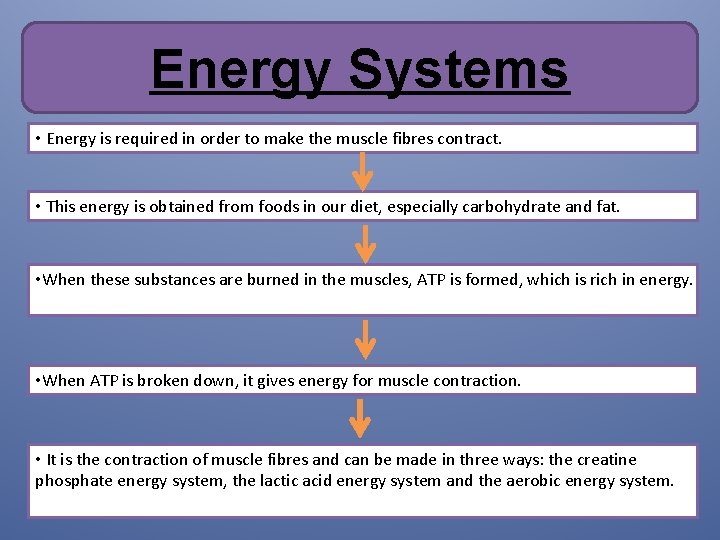
Energy Systems • Energy is required in order to make the muscle fibres contract. • This energy is obtained from foods in our diet, especially carbohydrate and fat. • When these substances are burned in the muscles, ATP is formed, which is rich in energy. • When ATP is broken down, it gives energy for muscle contraction. • It is the contraction of muscle fibres and can be made in three ways: the creatine phosphate energy system, the lactic acid energy system and the aerobic energy system.
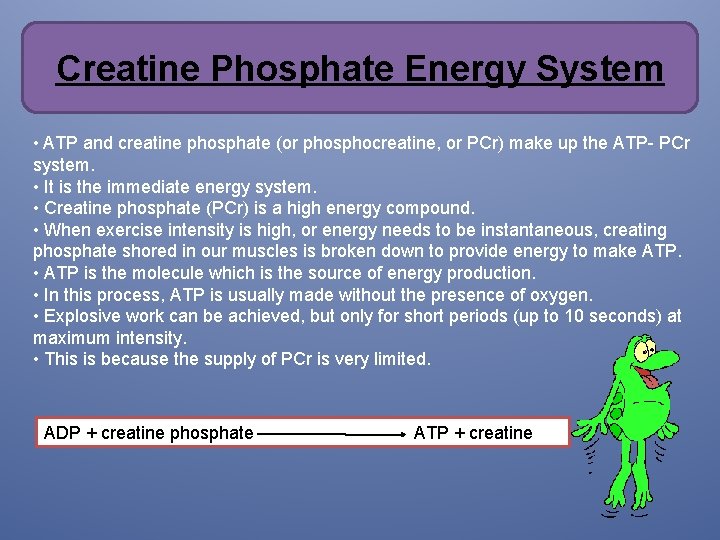
Creatine Phosphate Energy System • ATP and creatine phosphate (or phosphocreatine, or PCr) make up the ATP- PCr system. • It is the immediate energy system. • Creatine phosphate (PCr) is a high energy compound. • When exercise intensity is high, or energy needs to be instantaneous, creating phosphate shored in our muscles is broken down to provide energy to make ATP. • ATP is the molecule which is the source of energy production. • In this process, ATP is usually made without the presence of oxygen. • Explosive work can be achieved, but only for short periods (up to 10 seconds) at maximum intensity. • This is because the supply of PCr is very limited. ADP + creatine phosphate ATP + creatine
Anaerobic Glycolysis • When the ATP- PCr begins to fade at around 10 seconds, the process of aerobic of glycolysis occurs. • This system breaks down glycogen stores in the muscle and liver without the presence of oxygen. • This produces lactic acid. • This limits energy production via this process.
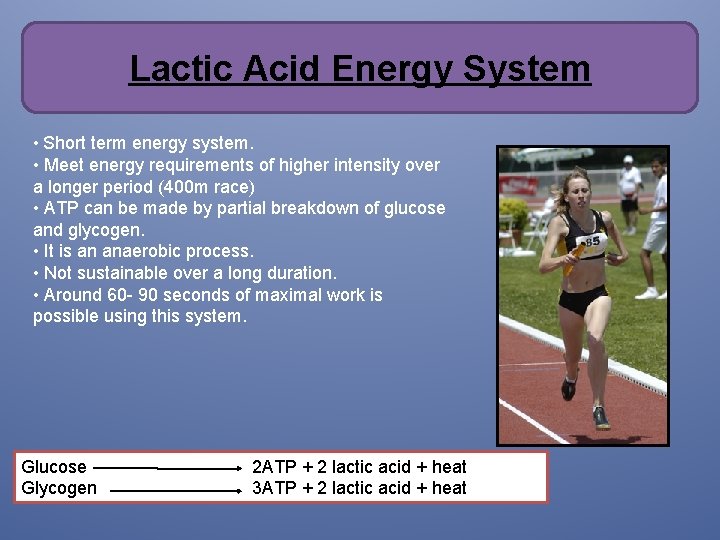
Lactic Acid Energy System • Short term energy system. • Meet energy requirements of higher intensity over a longer period (400 m race) • ATP can be made by partial breakdown of glucose and glycogen. • It is an anaerobic process. • Not sustainable over a long duration. • Around 60 - 90 seconds of maximal work is possible using this system. Glucose Glycogen 2 ATP + 2 lactic acid + heat 3 ATP + 2 lactic acid + heat
Lactic Acid Production • This is the limiting factor of the anaerobic system. • It accumulates and diffuses into the tissue fluid and the blood. • If this substance is not removed by the circulatory system, it builds up. • This causes fatigue.
Aerobic Energy System • This is the long term energy system. • If plenty of oxygen is available, glycogen and fatty acids break down to create large amounts of ATP. • This produces carbon dioxide and water (does affect the muscles ability to contract). • Aerobic energy production occurs in the mitochondria of the cells. • These are the power stations of the cells. • They are responsible for converting food into energy. • The production of energy is slow- it takes a few minutes for the heart to deliver oxygenated blood to the working muscles. • Long, continuous and moderate exercises produces energy using this system. Glucose + oxygen Fatty acids + oxygen 38 ATP + carbon dioxide + water + heat 129 ATP + carbon dioxide + water + heat
Energy Continuum • Important note: ALL 3 ENERGY SYSTEMS OCCUR CONTINUOUSLY, BUT THE PROPORTION OF ENERGY PRODUCED BY EACH SYSTEM CHANGES AS THE EXERCISE CONTINUES. • The intensity and duration of the activities is the main determining factor for which system is predominant.
Energy Continuum • The way energy is provided for a 1500 m race are very specific – “The ATP-PC is the predominant system for supplying energy during the 1 st 10 seconds, after which the lactic acid system becomes dominant for the next minute. The Aerobic System takes over for the middle of the race when the pace settles. There is then a return to the Lactic Acid system for the final sprint finish. ” TASK: Analyse how the energy is provided for the activity you have been given
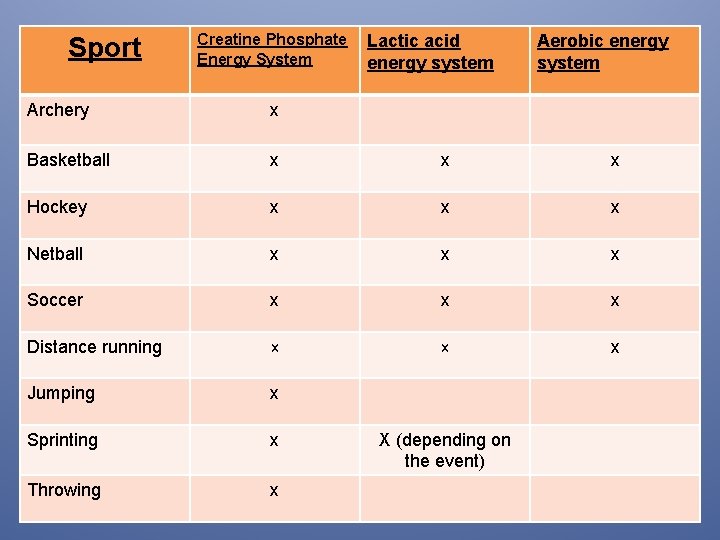
Sport Creatine Phosphate Energy System Lactic acid energy system Aerobic energy system Archery x Basketball x x x Hockey x x x Netball x x x Soccer x x x Distance running x x x Jumping x Sprinting x Throwing x X (depending on the event)