
Energy Storyboard Main point Energy resources are abundantly

Energy Storyboard Main point Energy resources are abundantly more than needed for a thriving planet but industrial era practices of energy use have negative planetary and human impacts Awareness of facts: Awareness of personal role: Awareness of strategies: Energy resources differ in the impact of their use Current energy retrieval and use practices must shift toward renewables High leverage interventions involve shifts in human behavior Renewable v. nonrenewable There are four energy sources Sources create many energy resources Industrialized nations consume non-renewables at disproportionately high rates Energy uses often derive from cultural practices rather than human necessities Non-renewable use drives global climate change and accumulates biotoxins Capture and use from different resources have different impacts This work was made possible by the National Science Foundation’s DUE#0717428 | © Jane Qiong Zhang and Linda Vanasupa Improving efficiency represents incremental change with limited benefits Expanding IPAT equation reveals high-leverage design opportunities

Energy Basics 2
Energy Types of energetic forces Activity (5 minutes) What is the difference between an energy source and an energy resource?

Energy Replenishment timescale for energy resources Historical time scale Log (time) seconds
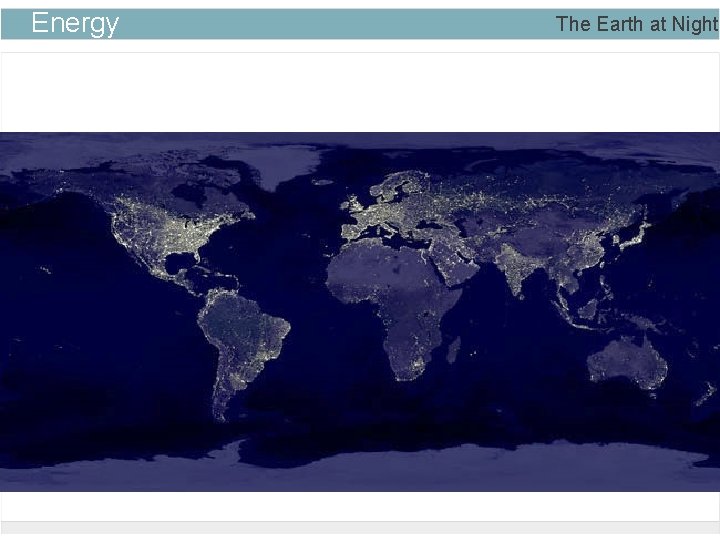
Energy The Earth at Night

Energy Reserves v. Resource base
Energy Use 7
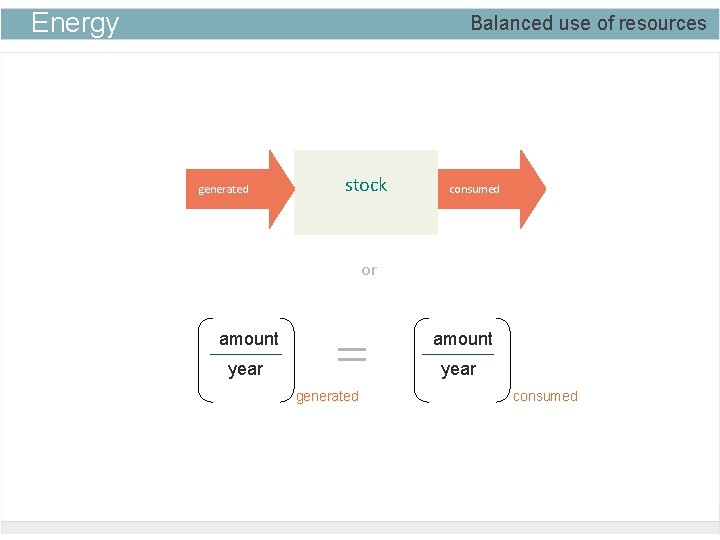
Energy Balanced use of resources generated stock consumed or amount year = generated amount year consumed
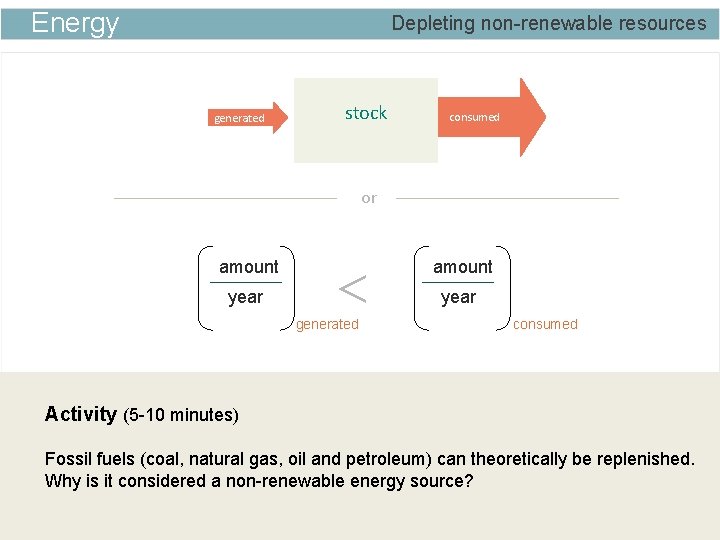
Energy Depleting non-renewable resources generated stock consumed or amount year < generated amount year consumed Activity (5 -10 minutes) Fossil fuels (coal, natural gas, oil and petroleum) can theoretically be replenished. Why is it considered a non-renewable energy source?

Energy Renewable stock (resource) available generated stock consumed or amount year ≥ regenerated amount year consumed Activity (5 -10 minutes) Nuclear energy comes from a radioactive type of Uranium. Would nuclear energy be considered renewable or nonrenewable? Why?
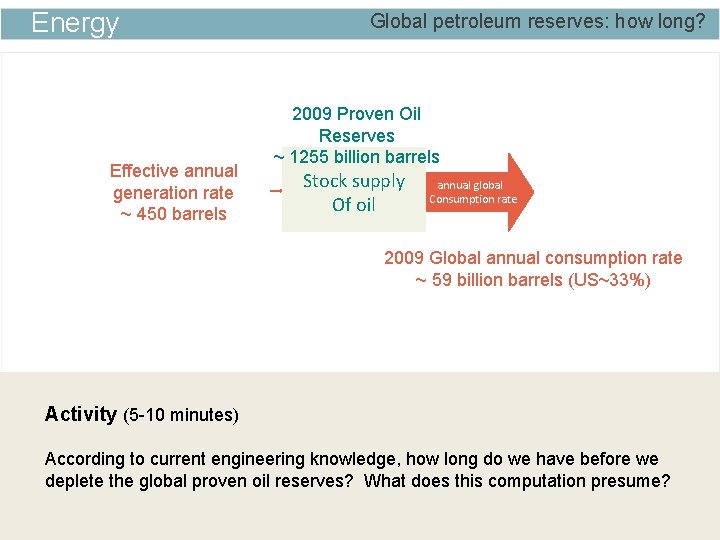
Energy Effective annual generation rate ~ 450 barrels Global petroleum reserves: how long? 2009 Proven Oil Reserves ~ 1255 billion barrels Stock supply Of oil annual global Consumption rate 2009 Global annual consumption rate ~ 59 billion barrels (US~33%) Activity (5 -10 minutes) According to current engineering knowledge, how long do we have before we deplete the global proven oil reserves? What does this computation presume?
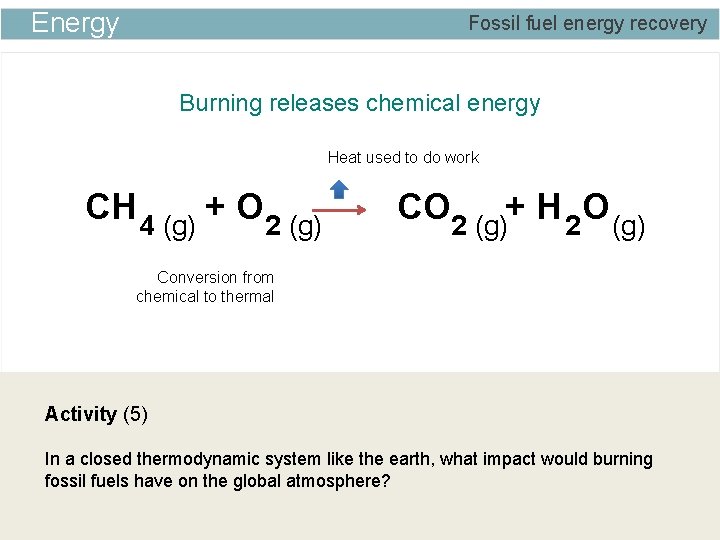
Energy Fossil fuel energy recovery Burning releases chemical energy Heat used to do work CH 4 (g) + O 2 (g) CO 2 (g)+ H 2 O (g) Conversion from chemical to thermal Activity (5) In a closed thermodynamic system like the earth, what impact would burning fossil fuels have on the global atmosphere?
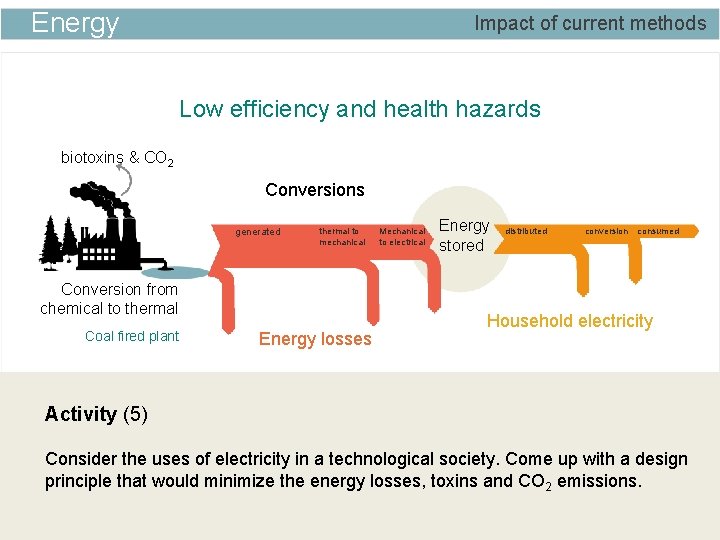
Energy Impact of current methods Low efficiency and health hazards biotoxins & CO 2 Conversions generated thermal to mechanical Conversion from chemical to thermal Coal fired plant Energy losses Mechanical to electrical Energy stored distributed conversion consumed Household electricity Activity (5) Consider the uses of electricity in a technological society. Come up with a design principle that would minimize the energy losses, toxins and CO 2 emissions.
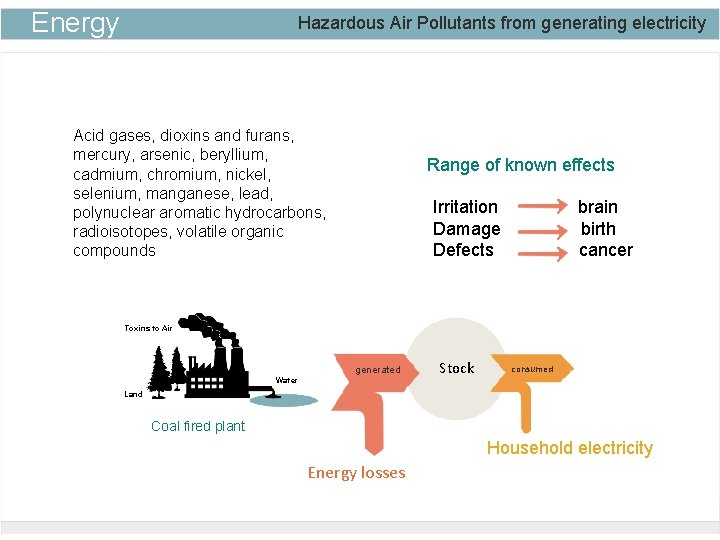
Energy Hazardous Air Pollutants from generating electricity Acid gases, dioxins and furans, mercury, arsenic, beryllium, cadmium, chromium, nickel, selenium, manganese, lead, polynuclear aromatic hydrocarbons, radioisotopes, volatile organic compounds Range of known effects Irritation Damage Defects brain birth cancer Toxins to Air generated Water Stock consumed Land Coal fired plant Household electricity Energy losses
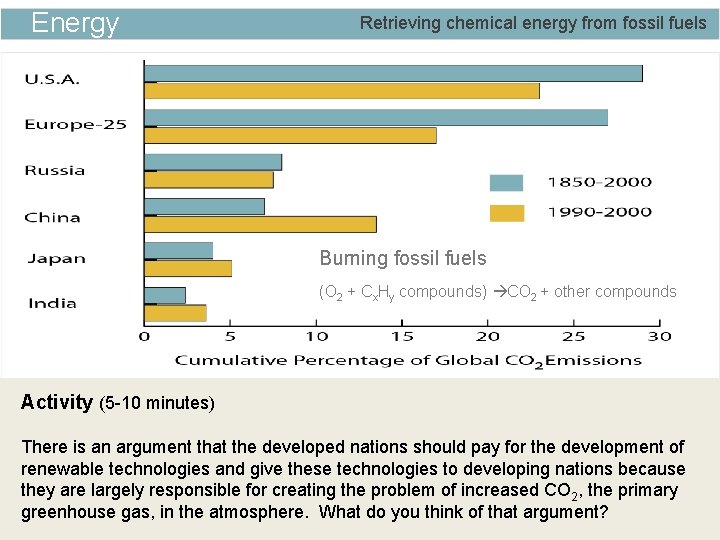
Energy Retrieving chemical energy from fossil fuels Burning fossil fuels (O 2 + Cx. Hy compounds) CO 2 + other compounds Activity (5 -10 minutes) There is an argument that the developed nations should pay for the development of renewable technologies and give these technologies to developing nations because they are largely responsible for creating the problem of increased CO 2, the primary greenhouse gas, in the atmosphere. What do you think of that argument?
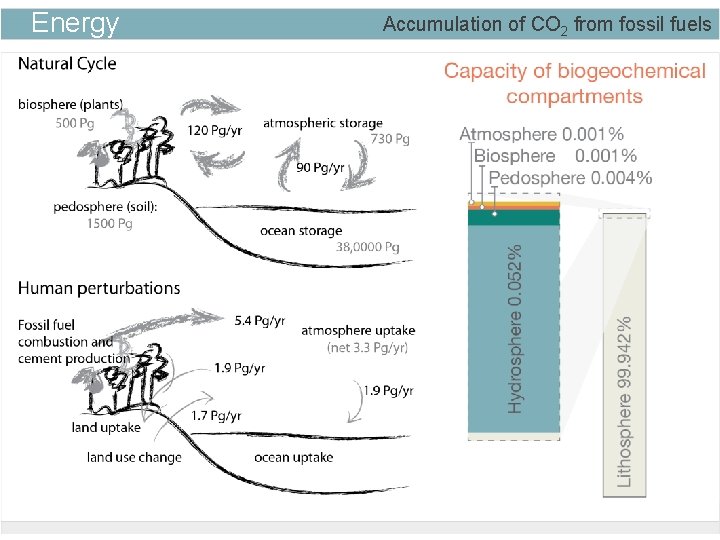
Energy Accumulation of CO 2 from fossil fuels
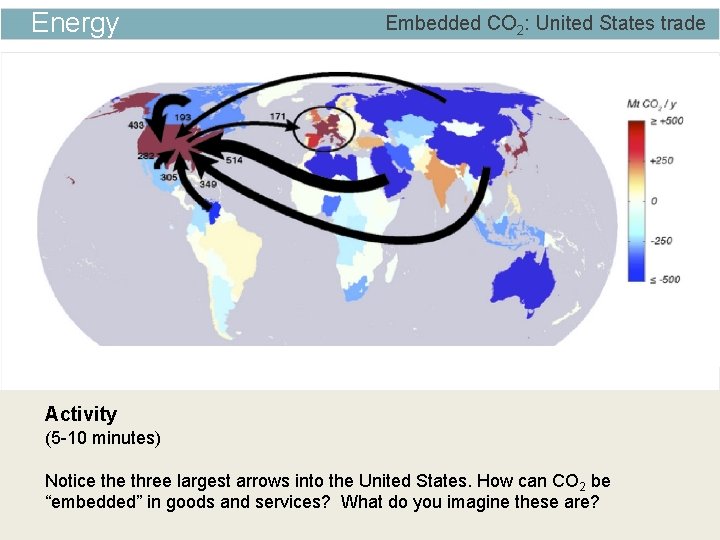
Energy Embedded CO 2: United States trade Activity (5 -10 minutes) Notice three largest arrows into the United States. How can CO 2 be “embedded” in goods and services? What do you imagine these are?
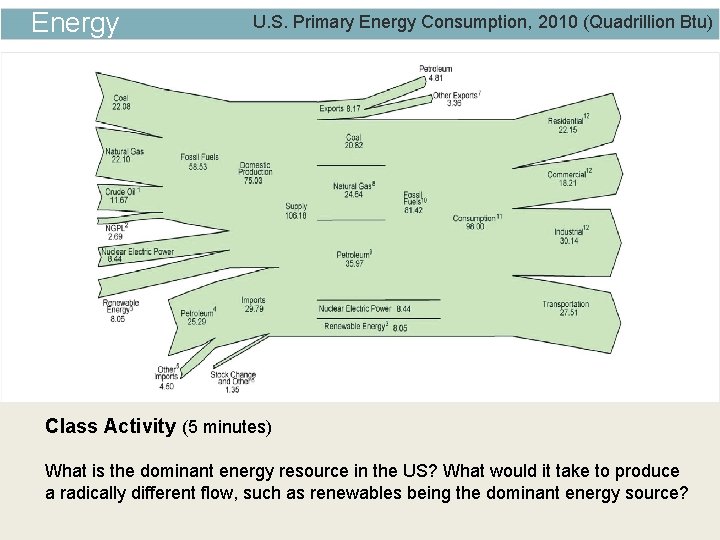
Energy U. S. Primary Energy Consumption, 2010 (Quadrillion Btu) Class Activity (5 minutes) What is the dominant energy resource in the US? What would it take to produce a radically different flow, such as renewables being the dominant energy source?

Energy Ecological footprint: tracking CO 2
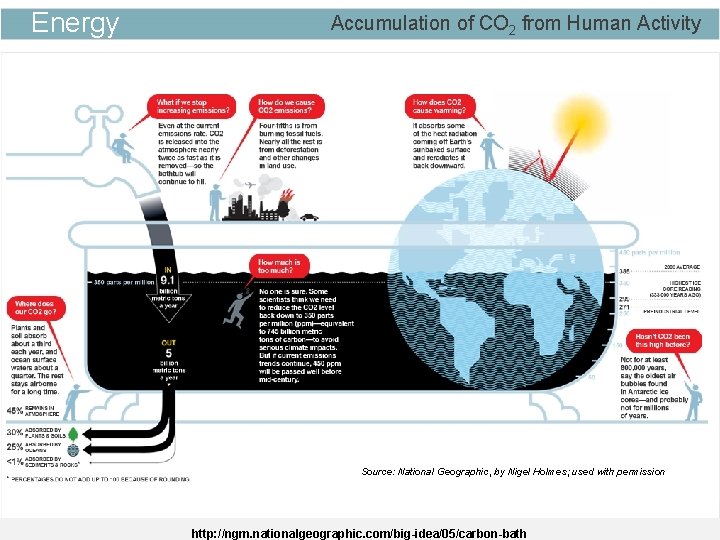
Energy Accumulation of CO 2 from Human Activity Source: National Geographic, by Nigel Holmes; used with permission http: //ngm. nationalgeographic. com/big-idea/05/carbon-bath
Energy Renewable Energy 21

Energy Global Energy Flow Picture 89 x 1015 W Incident Solar Energy on earth surface ~65% fossil fuels Human use ~18 x 1012 W Activity (5 minutes) The rate of anthropogenic energy use of all resources is thousands times smaller than the rate of solar energy incident on accessible land. However only about 10% of the global power comes from incoming solar radiation. Discuss the factors that keep the proportion of global power sources as they are.
Energy Renewable Energy Resources Class Activity (5 -10 minutes) It is said that the only true renewable source of energy for earth is the sun, that in fact the sun is the source of all but geothermal. Critique the accuracy of this statement.

Energy Biomass types Class Activity (5 minutes) Choose one of the biomass fuels and describe the possible unintended consequences of using it on a wide scale or over the long term?
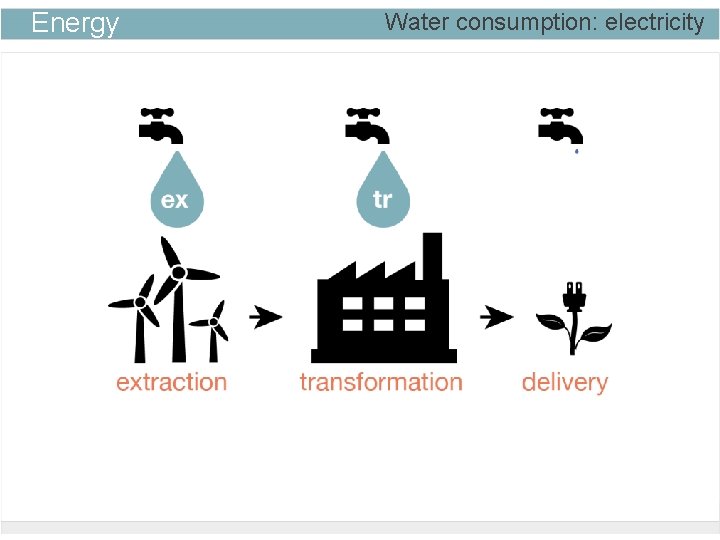
Energy Water consumption: electricity
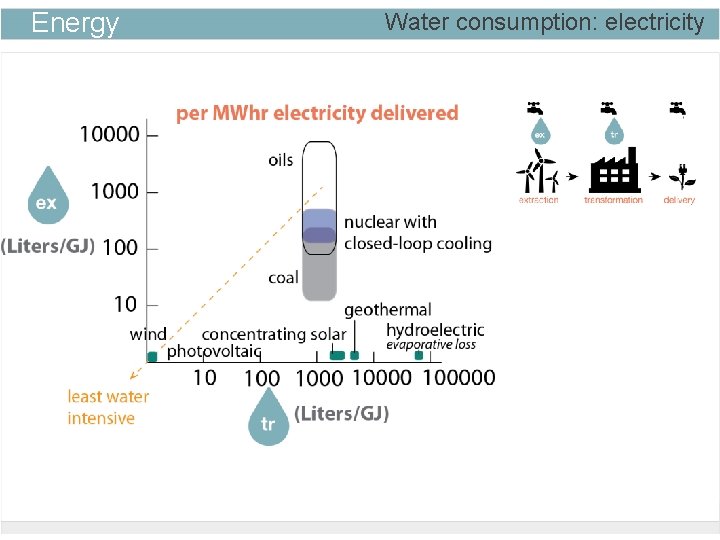
Energy Water consumption: electricity
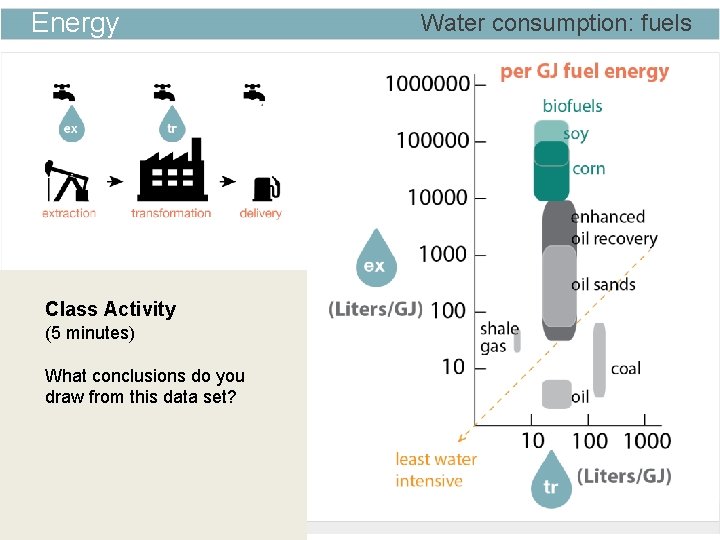
Energy Class Activity (5 minutes) What conclusions do you draw from this data set? Water consumption: fuels

Energy Strategies 28
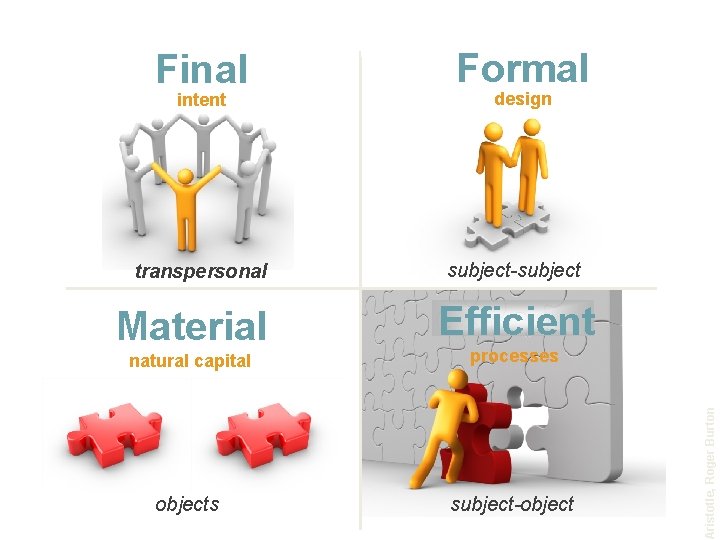
Energy intent transpersonal Material Formal design subject-subject Efficient natural capital processes objects subject-object Aristotle, Roger Burton Final
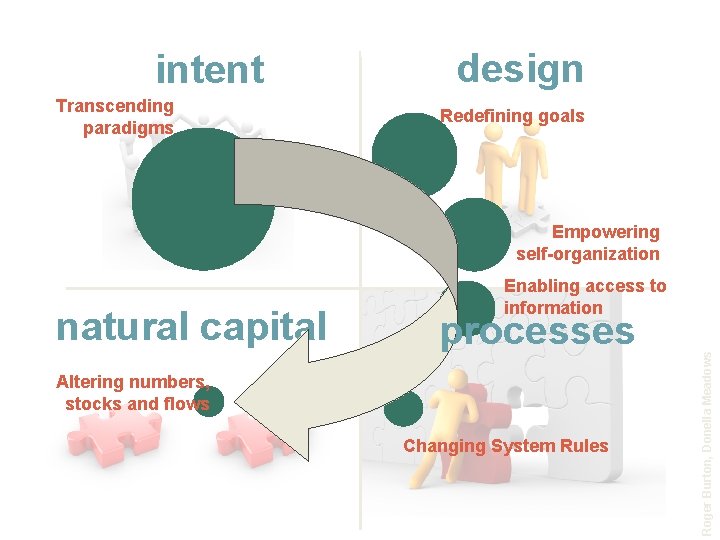
Energy intent Transcending paradigms design Redefining goals Empowering self-organization processes Altering numbers, stocks and flows Changing System Rules Roger Burton, Donella Meadows natural capital Enabling access to information
Energy Meadow’s Hierarchy of interventions
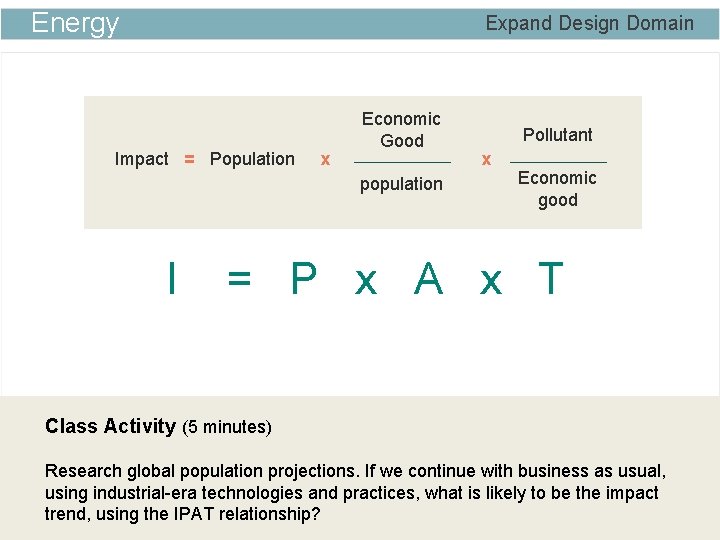
Energy Expand Design Domain Impact = Population x Economic Good population I Pollutant x Economic good = P x A x T Class Activity (5 minutes) Research global population projections. If we continue with business as usual, using industrial-era technologies and practices, what is likely to be the impact trend, using the IPAT relationship?
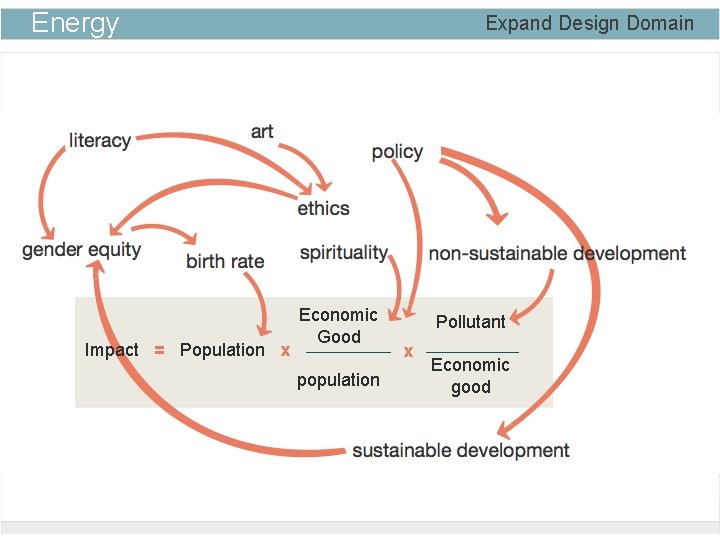
Energy Impact = Population x Expand Design Domain Economic Good population Pollutant x Economic good
Energy Potential technology impacts Cullen, J. M. and Allwood, J. M. (2010) The efficient use of energy: tracing the global flow of energy from fuel to service, Energy Policy, 38 75 -8 Used with permission.

Energy Global energy flow, 2005
- Slides: 35