
Energy Storage as a Solution for Increasing Feeder
- Slides: 11
Energy Storage as a Solution for Increasing Feeder Hosting Capacity: Concepts and Analysis Methods Gaurav SINGH, Jouni PEPPANEN, Arindam MAITRA EPRI, USA Jigar PATEL Hydro One Limited, Canada 20 -6 -3 2020 CIGRE Canada Conference, Toronto ON, October 19 -22
Acknowledgements • The work presented here was funded and supported by Hydro One • Thanks to the distribution team at Hydro One! 20 -6 -3 2020 CIGRE Canada Conference, Toronto ON, October 19 -22
Background • There is a growing interest to consider energy storage (ES) as a non-wires alternative (NWA) to increase distribution capacity to serve load or host DER, increase distribution reliability and resiliency, etc. • Integrating ES as an NWA will require additional considerations and analytics within the distribution planning process that can be complex • This paper presents methods to consider ES as an NWA to increase DER hosting capacity 20 -6 -3 2020 CIGRE Canada Conference, Toronto ON, October 19 -22
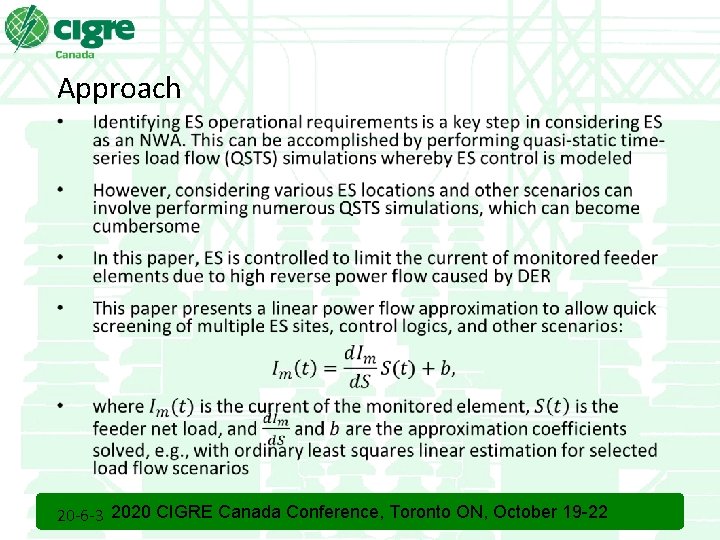
Approach 20 -6 -3 2020 CIGRE Canada Conference, Toronto ON, October 19 -22
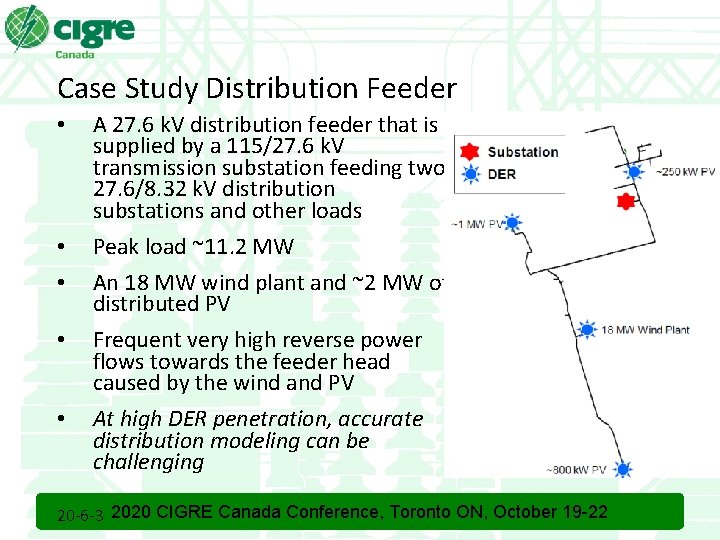
Case Study Distribution Feeder • • • A 27. 6 k. V distribution feeder that is supplied by a 115/27. 6 k. V transmission substation feeding two 27. 6/8. 32 k. V distribution substations and other loads Peak load ~11. 2 MW An 18 MW wind plant and ~2 MW of distributed PV Frequent very high reverse power flows towards the feeder head caused by the wind and PV At high DER penetration, accurate distribution modeling can be challenging 20 -6 -3 2020 CIGRE Canada Conference, Toronto ON, October 19 -22
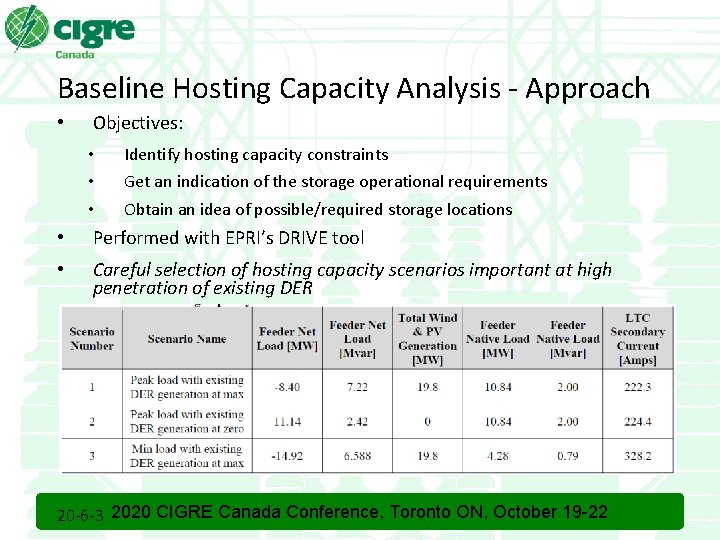
Baseline Hosting Capacity Analysis - Approach • Objectives: • • • Identify hosting capacity constraints Get an indication of the storage operational requirements Obtain an idea of possible/required storage locations • Performed with EPRI’s DRIVE tool • Careful selection of hosting capacity scenarios important at high penetration of existing DER 20 -6 -3 2020 CIGRE Canada Conference, Toronto ON, October 19 -22
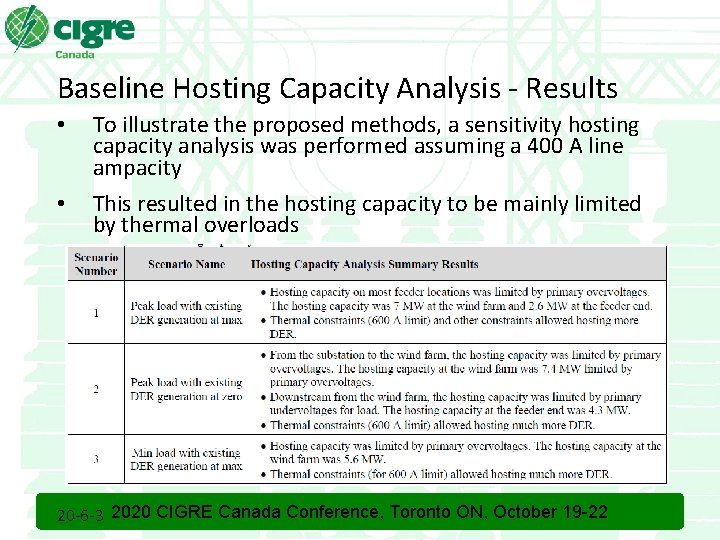
Baseline Hosting Capacity Analysis - Results • • To illustrate the proposed methods, a sensitivity hosting capacity analysis was performed assuming a 400 A line ampacity This resulted in the hosting capacity to be mainly limited by thermal overloads 20 -6 -3 2020 CIGRE Canada Conference, Toronto ON, October 19 -22
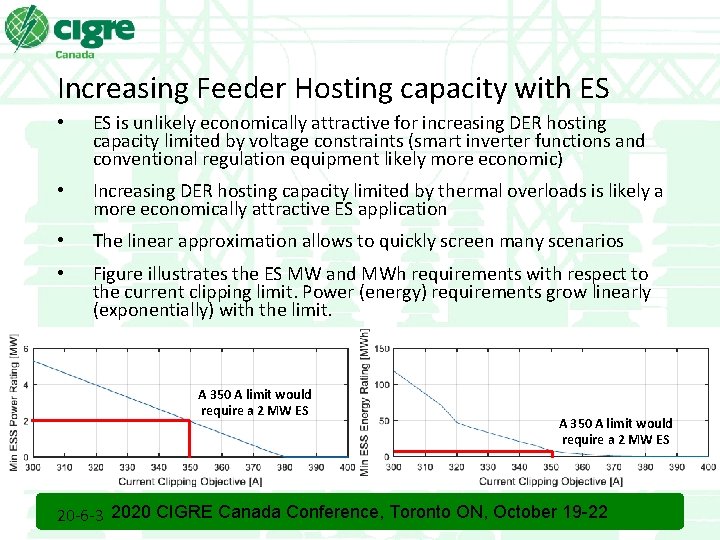
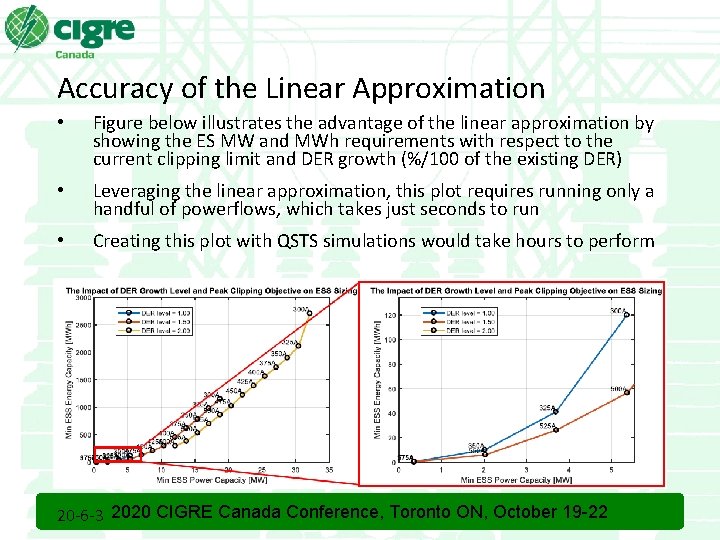
Increasing Feeder Hosting capacity with ES • ES is unlikely economically attractive for increasing DER hosting capacity limited by voltage constraints (smart inverter functions and conventional regulation equipment likely more economic) • Increasing DER hosting capacity limited by thermal overloads is likely a more economically attractive ES application • The linear approximation allows to quickly screen many scenarios • Figure illustrates the ES MW and MWh requirements with respect to the current clipping limit. Power (energy) requirements grow linearly (exponentially) with the limit. A 350 A limit would require a 2 MW ES 20 -6 -3 2020 CIGRE Canada Conference, Toronto ON, October 19 -22
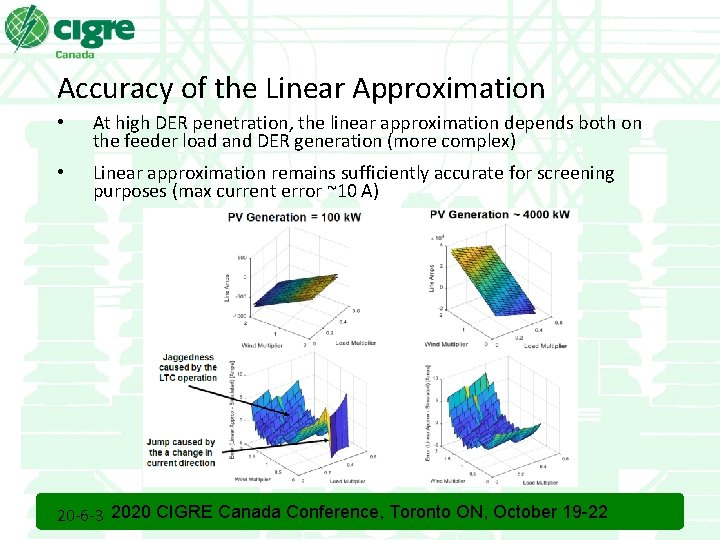
Accuracy of the Linear Approximation • At high DER penetration, the linear approximation depends both on the feeder load and DER generation (more complex) • Linear approximation remains sufficiently accurate for screening purposes (max current error ~10 A) 20 -6 -3 2020 CIGRE Canada Conference, Toronto ON, October 19 -22
Accuracy of the Linear Approximation • Figure below illustrates the advantage of the linear approximation by showing the ES MW and MWh requirements with respect to the current clipping limit and DER growth (%/100 of the existing DER) • Leveraging the linear approximation, this plot requires running only a handful of powerflows, which takes just seconds to run • Creating this plot with QSTS simulations would take hours to perform 20 -6 -3 2020 CIGRE Canada Conference, Toronto ON, October 19 -22
Key Take Away • Selecting hosting capacity scenarios with a high penetration of existing DER can be challenging • This paper shows an approach to leverage the EPRI DRIVE© tool to analyze the feeder hosting capacity, the factors limiting the hosting capacity, and to identify storage operational requirements to increase hosting capacity • It is important to carefully consider the hosting capacity limits and the most cost-effective options to mitigate the constraints • An approach to identify energy storage power and energy capacity requirements leveraging linear approximations was shown. • The linearization must also be performed with respect to the load and DER on the feeder • The linearization becomes more complex when the feeder has multiple types of DER that are considered separately • While the accuracy of the linearized approach depends on several factors, the linearization can be an effective tool to evaluate many storage scenarios 20 -6 -3 2020 CIGRE Canada Conference, Toronto ON, October 19 -22