
Energy Sources Fossil Fuels Coal oil and gas
- Slides: 42
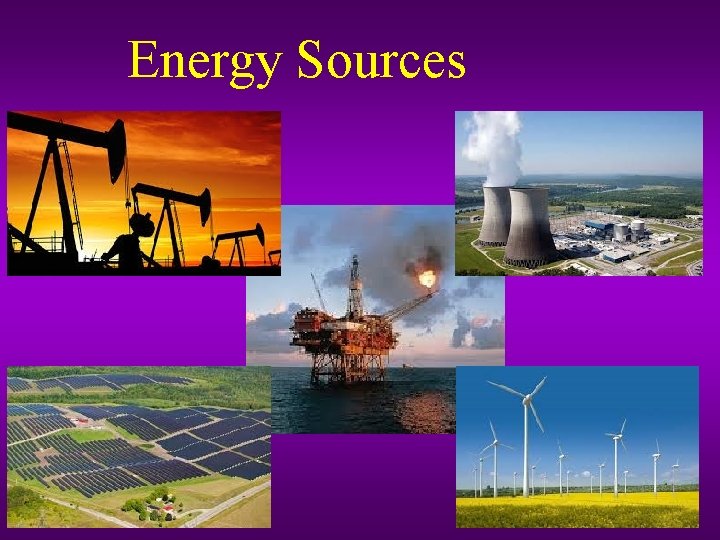
Energy Sources
Fossil Fuels Coal, oil and gas are called "fossil fuels" because they have been formed from the fossilized remains of prehistoric plants and animals. They provide around 66% of the world's electrical energy, and 82% of the USA's total energy demands.
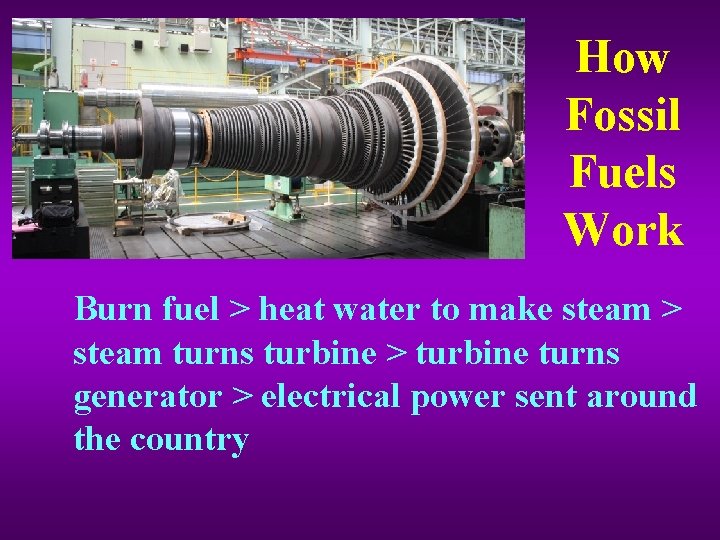
How Fossil Fuels Work Burn fuel > heat water to make steam > steam turns turbine > turbine turns generator > electrical power sent around the country
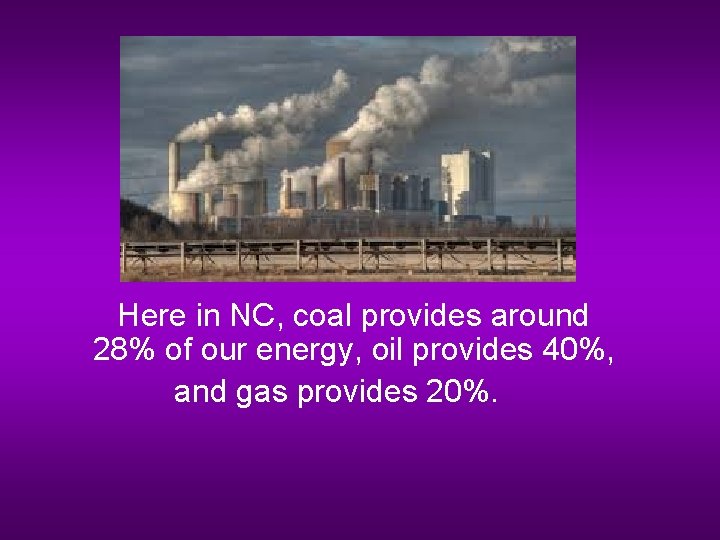
Here in NC, coal provides around 28% of our energy, oil provides 40%, and gas provides 20%.
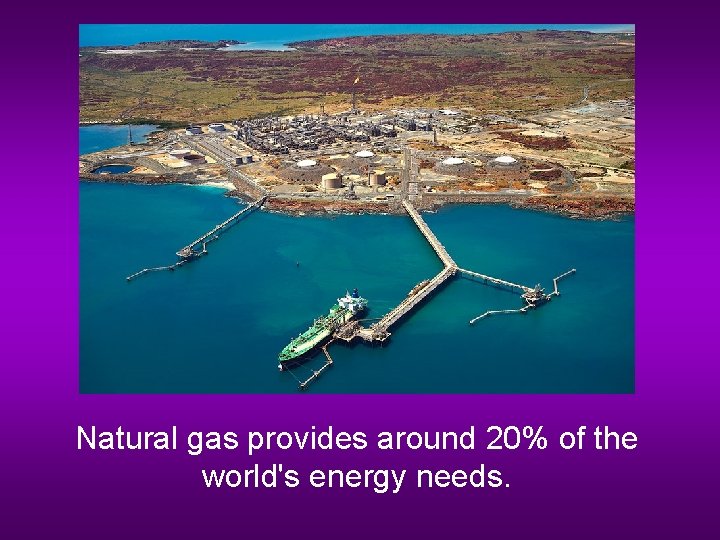
Natural gas provides around 20% of the world's energy needs.
Advantages to Using Fossil Fuels • Energy is generated cheaply and efficiently. • Transporting oil and gas to the power stations is easy. • Large amounts of electricity can be generated in one place using coal, oil, and gas. • A fossil-fueled power station can be built almost anywhere.
Disadvantages of Using Fossil Fuels • • • Pollution. Global warming. Sulfur dioxide → acid rain. The USA imports 55% of its oil. Mining fossil fuels can be difficult and very dangerous.
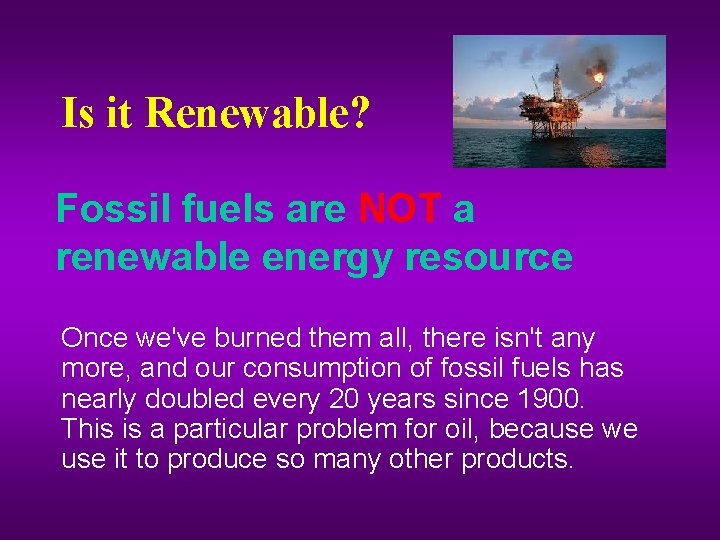
Is it Renewable? Fossil fuels are NOT a renewable energy resource Once we've burned them all, there isn't any more, and our consumption of fossil fuels has nearly doubled every 20 years since 1900. This is a particular problem for oil, because we use it to produce so many other products.
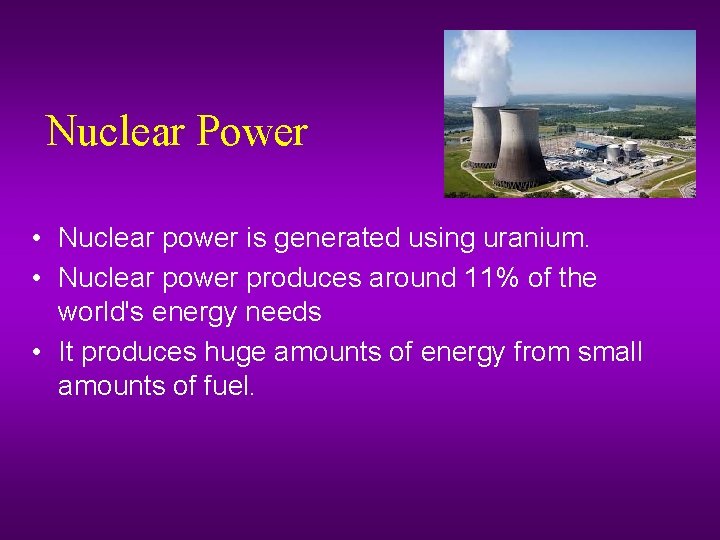
Nuclear Power • Nuclear power is generated using uranium. • Nuclear power produces around 11% of the world's energy needs • It produces huge amounts of energy from small amounts of fuel.
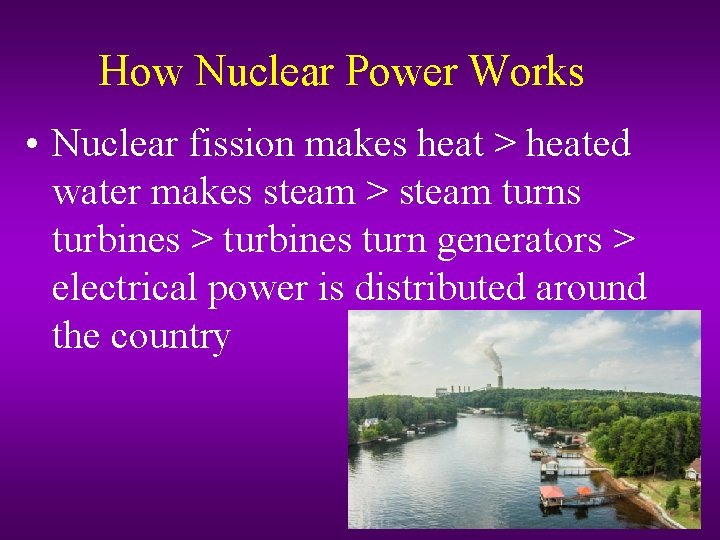
How Nuclear Power Works • Nuclear fission makes heat > heated water makes steam > steam turns turbines > turbines turn generators > electrical power is distributed around the country
Advantages to Using Nuclear Power • Nuclear power costs about the same as coal. • Does not produce smoke or carbon dioxide, so it does not contribute to global warming. • Produces small amounts of waste. • Nuclear power is reliable.
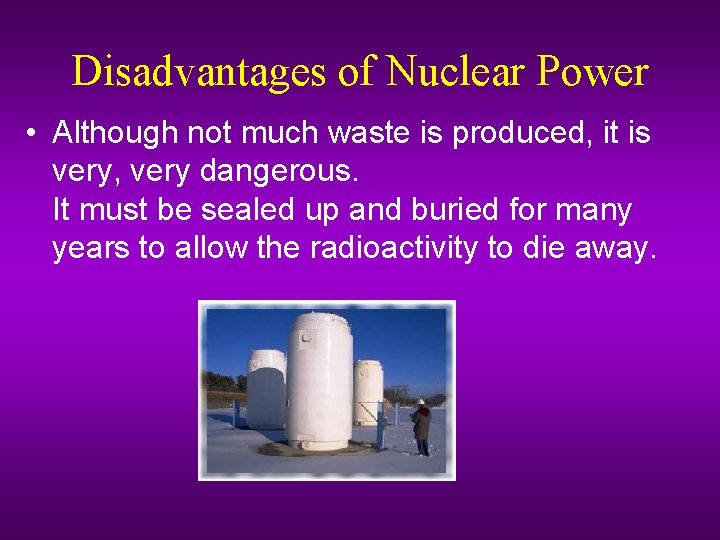
Disadvantages of Nuclear Power • Although not much waste is produced, it is very, very dangerous. It must be sealed up and buried for many years to allow the radioactivity to die away.
Is it Renewable? Nuclear energy from Uranium is NOT renewable. Once we've dug up all the Earth's uranium and used it, there isn't any more.
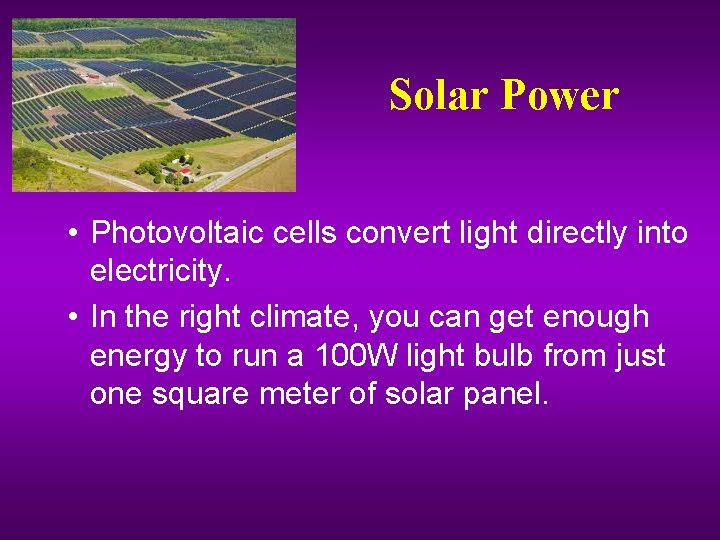
Solar Power • Photovoltaic cells convert light directly into electricity. • In the right climate, you can get enough energy to run a 100 W light bulb from just one square meter of solar panel.
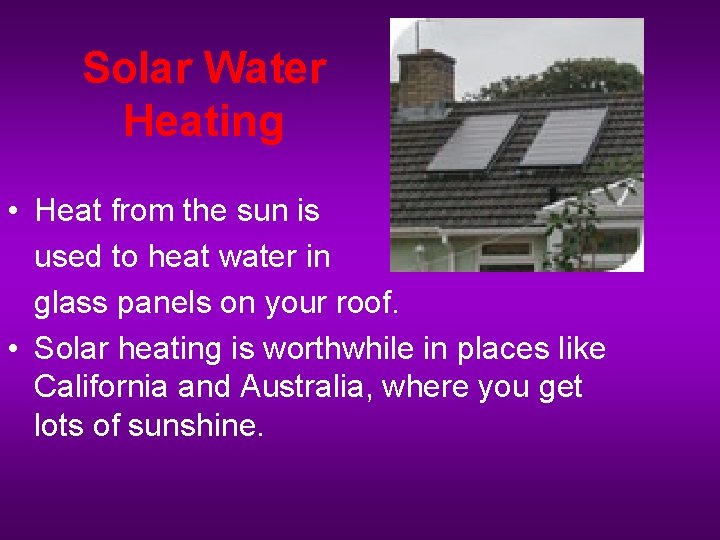
Solar Water Heating • Heat from the sun is used to heat water in glass panels on your roof. • Solar heating is worthwhile in places like California and Australia, where you get lots of sunshine.
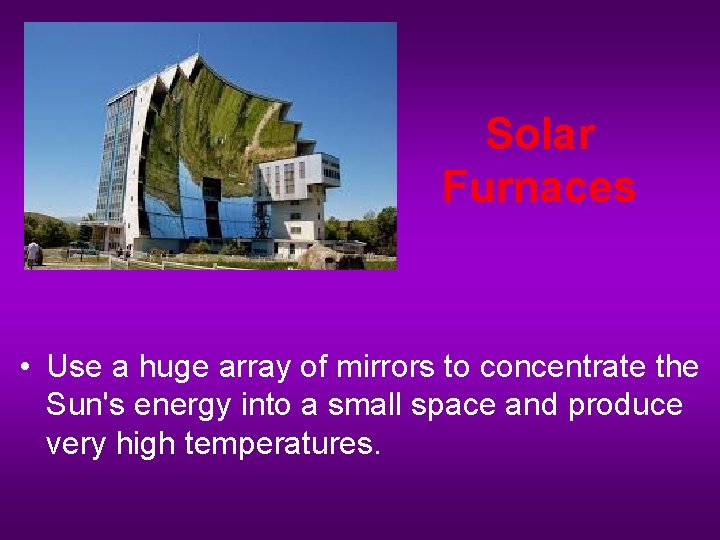
Solar Furnaces • Use a huge array of mirrors to concentrate the Sun's energy into a small space and produce very high temperatures.
Advantages to solar power • Solar energy is free - it needs no fuel and produces no waste or pollution. • In sunny countries, solar power can be used where there is no easy way to get electricity to a remote place. • Handy for low-power uses such as solar powered garden lights and battery chargers
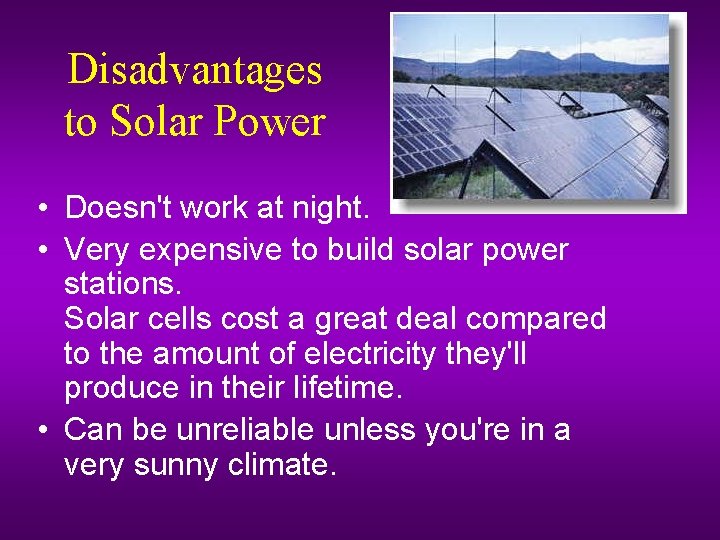
Disadvantages to Solar Power • Doesn't work at night. • Very expensive to build solar power stations. Solar cells cost a great deal compared to the amount of electricity they'll produce in their lifetime. • Can be unreliable unless you're in a very sunny climate.
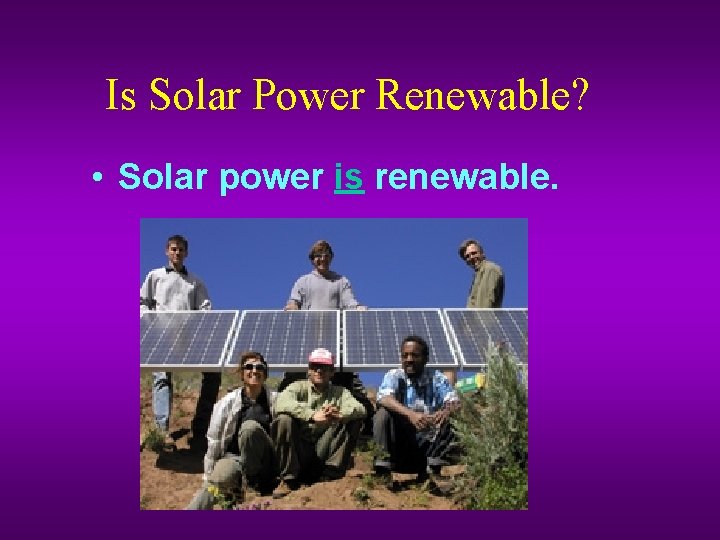
Is Solar Power Renewable? • Solar power is renewable.
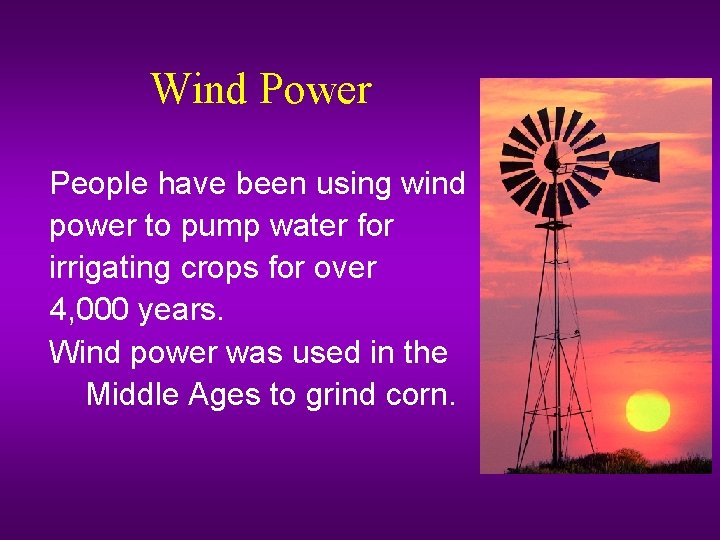
Wind Power People have been using wind power to pump water for irrigating crops for over 4, 000 years. Wind power was used in the Middle Ages to grind corn.
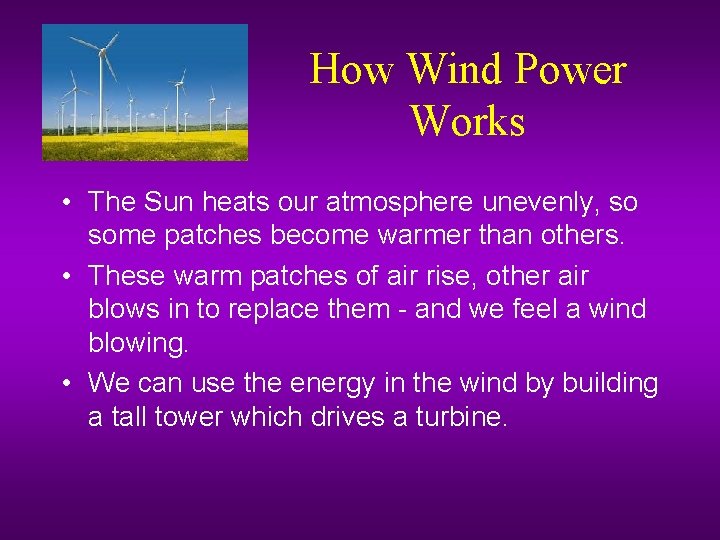
How Wind Power Works • The Sun heats our atmosphere unevenly, so some patches become warmer than others. • These warm patches of air rise, other air blows in to replace them - and we feel a wind blowing. • We can use the energy in the wind by building a tall tower which drives a turbine.
Advantages to Wind power • Wind is free, wind farms need no fuel. • Produces no waste or greenhouse gases. • The land beneath can usually still be used for farming. • Wind farms can be tourist attractions. • A good method of supplying energy to remote areas.
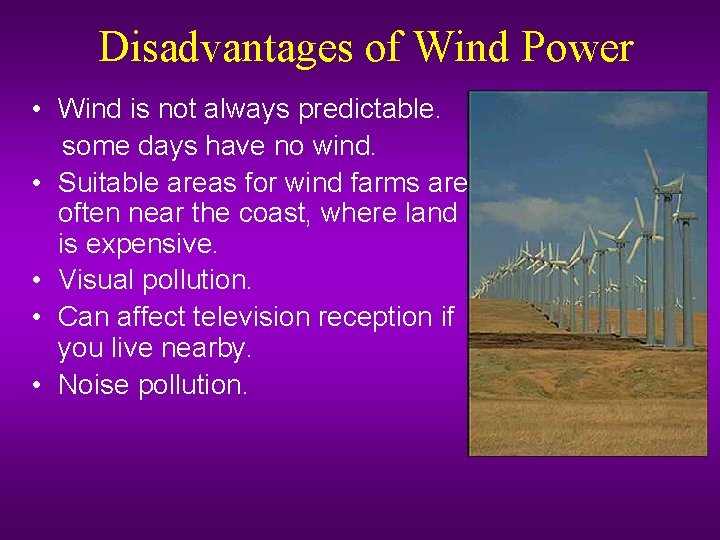
Disadvantages of Wind Power • Wind is not always predictable. some days have no wind. • Suitable areas for wind farms are often near the coast, where land is expensive. • Visual pollution. • Can affect television reception if you live nearby. • Noise pollution.
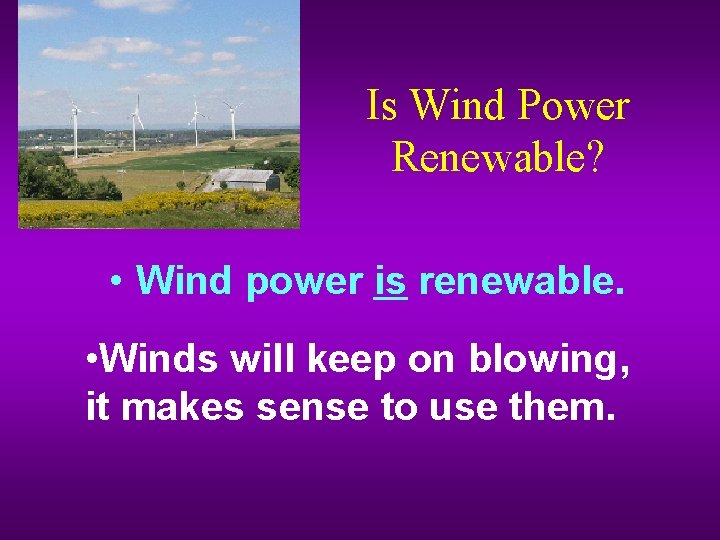
Is Wind Power Renewable? • Wind power is renewable. • Winds will keep on blowing, it makes sense to use them.
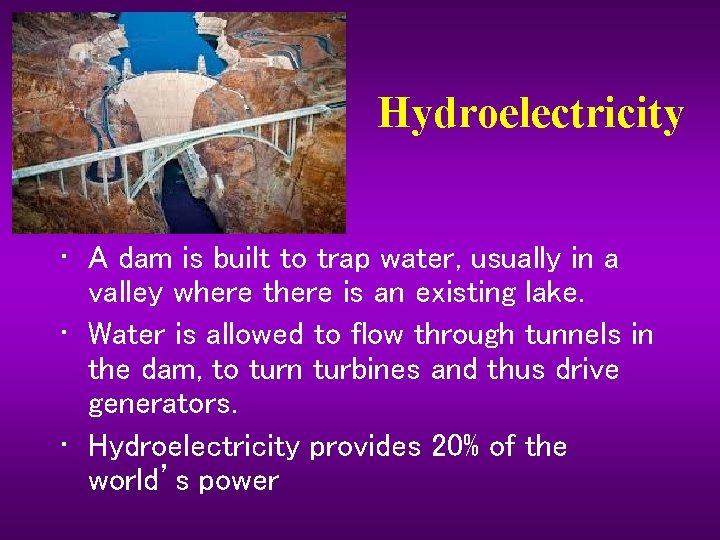
Hydroelectricity • A dam is built to trap water, usually in a valley where there is an existing lake. • Water is allowed to flow through tunnels in the dam, to turn turbines and thus drive generators. • Hydroelectricity provides 20% of the world’s power
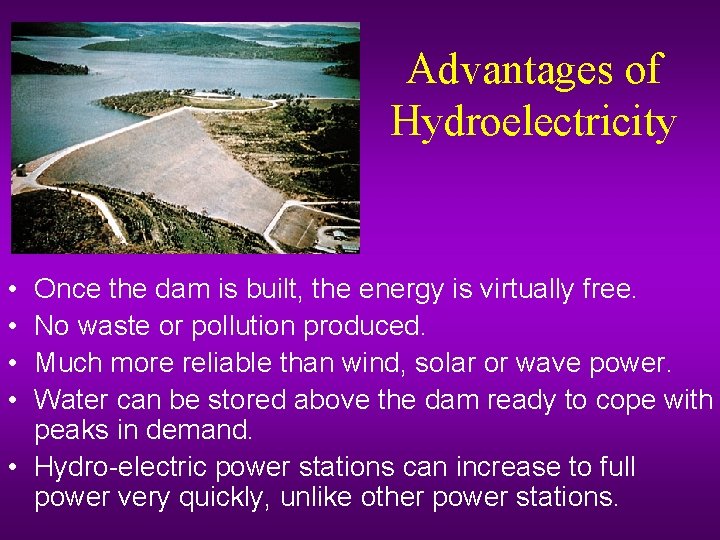
Advantages of Hydroelectricity • • Once the dam is built, the energy is virtually free. No waste or pollution produced. Much more reliable than wind, solar or wave power. Water can be stored above the dam ready to cope with peaks in demand. • Hydro-electric power stations can increase to full power very quickly, unlike other power stations.
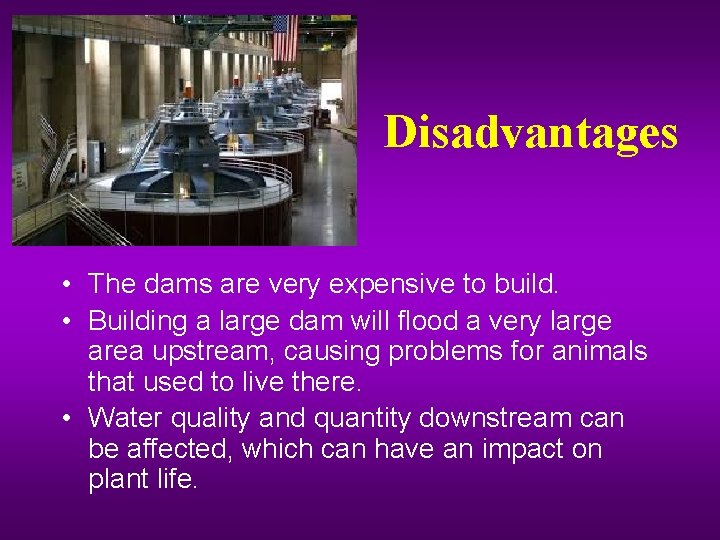
Disadvantages • The dams are very expensive to build. • Building a large dam will flood a very large area upstream, causing problems for animals that used to live there. • Water quality and quantity downstream can be affected, which can have an impact on plant life.
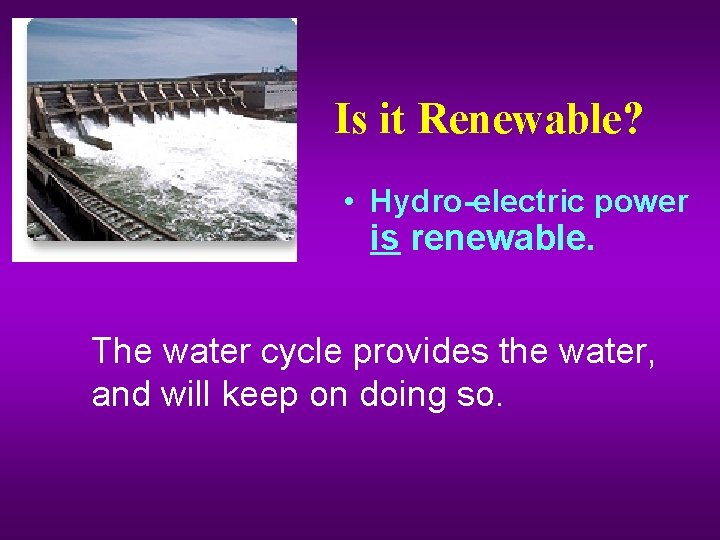
Is it Renewable? • Hydro-electric power is renewable. The water cycle provides the water, and will keep on doing so.
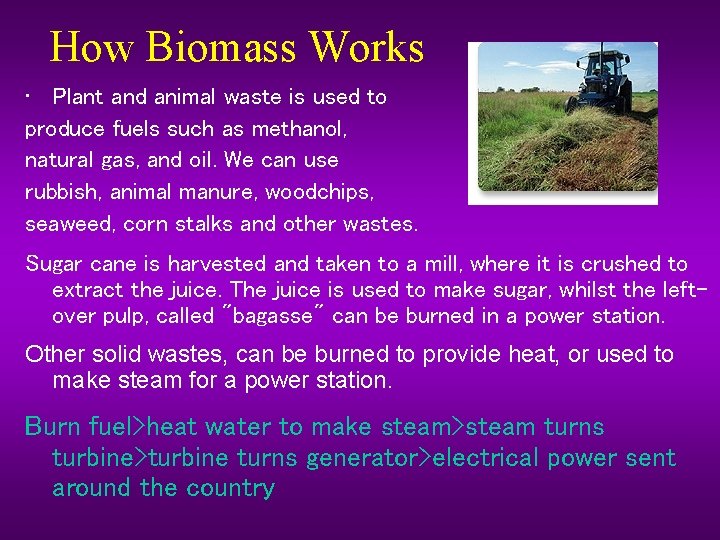
How Biomass Works • Plant and animal waste is used to produce fuels such as methanol, natural gas, and oil. We can use rubbish, animal manure, woodchips, seaweed, corn stalks and other wastes. Sugar cane is harvested and taken to a mill, where it is crushed to extract the juice. The juice is used to make sugar, whilst the leftover pulp, called "bagasse" can be burned in a power station. Other solid wastes, can be burned to provide heat, or used to make steam for a power station. Burn fuel>heat water to make steam>steam turns turbine>turbine turns generator>electrical power sent around the country
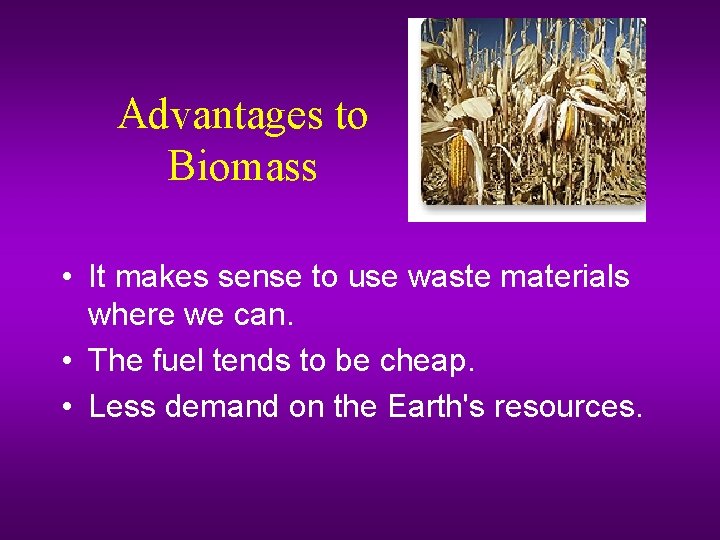
Advantages to Biomass • It makes sense to use waste materials where we can. • The fuel tends to be cheap. • Less demand on the Earth's resources.
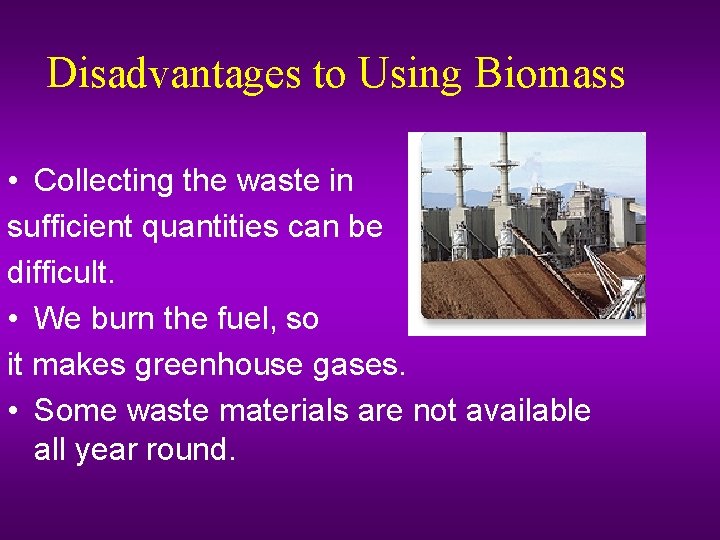
Disadvantages to Using Biomass • Collecting the waste in sufficient quantities can be difficult. • We burn the fuel, so it makes greenhouse gases. • Some waste materials are not available all year round.
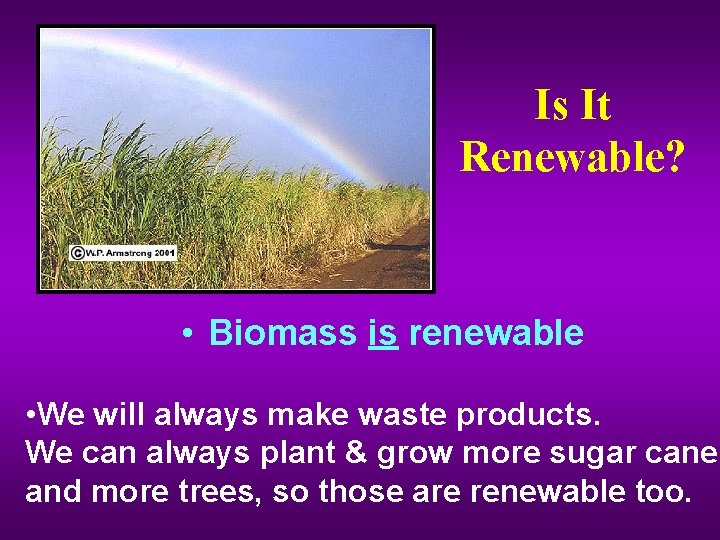
Is It Renewable? • Biomass is renewable • We will always make waste products. We can always plant & grow more sugar cane and more trees, so those are renewable too.
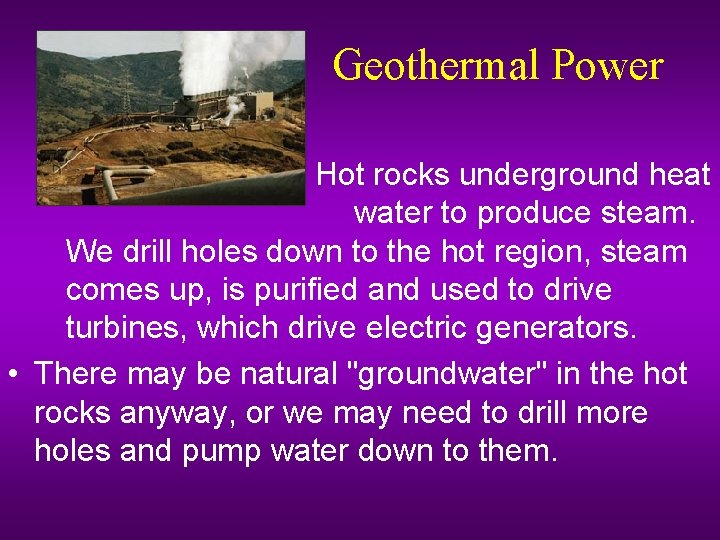
Geothermal Power Hot rocks underground heat water to produce steam. We drill holes down to the hot region, steam comes up, is purified and used to drive turbines, which drive electric generators. • There may be natural "groundwater" in the hot rocks anyway, or we may need to drill more holes and pump water down to them. –
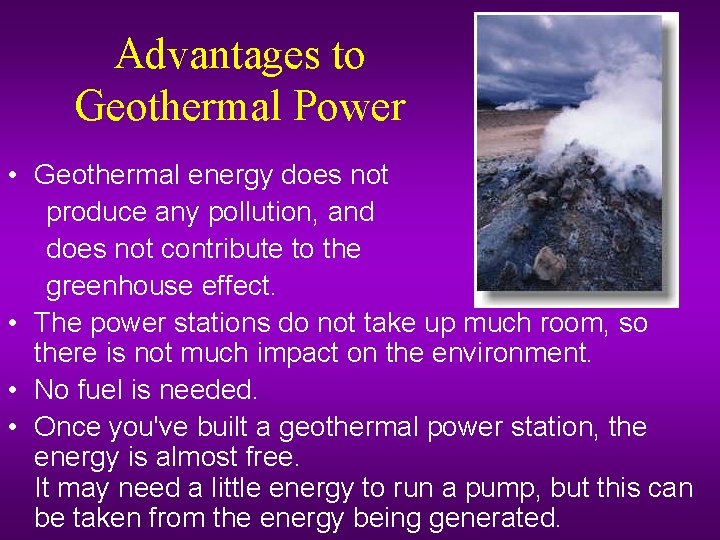
Advantages to Geothermal Power • Geothermal energy does not produce any pollution, and does not contribute to the greenhouse effect. • The power stations do not take up much room, so there is not much impact on the environment. • No fuel is needed. • Once you've built a geothermal power station, the energy is almost free. It may need a little energy to run a pump, but this can be taken from the energy being generated.
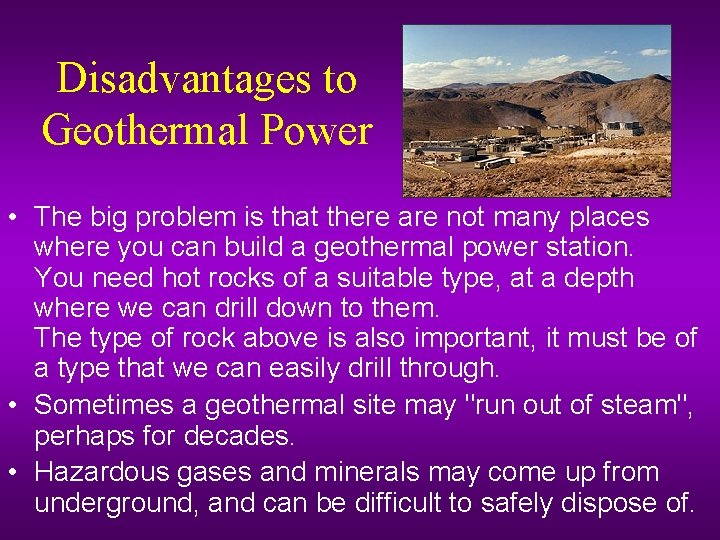
Disadvantages to Geothermal Power • The big problem is that there are not many places where you can build a geothermal power station. You need hot rocks of a suitable type, at a depth where we can drill down to them. The type of rock above is also important, it must be of a type that we can easily drill through. • Sometimes a geothermal site may "run out of steam", perhaps for decades. • Hazardous gases and minerals may come up from underground, and can be difficult to safely dispose of.
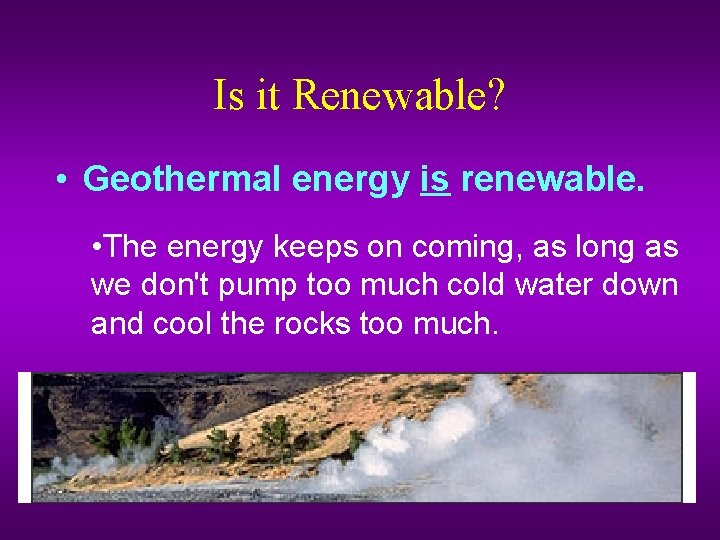
Is it Renewable? • Geothermal energy is renewable. • The energy keeps on coming, as long as we don't pump too much cold water down and cool the rocks too much.
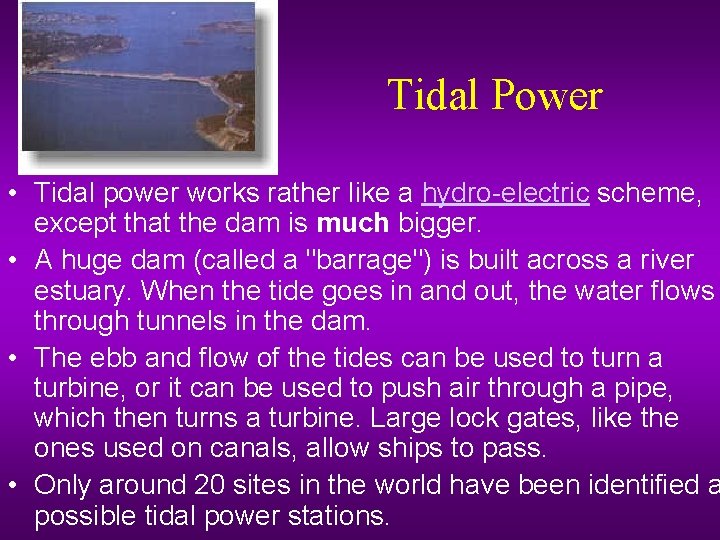
Tidal Power • Tidal power works rather like a hydro-electric scheme, except that the dam is much bigger. • A huge dam (called a "barrage") is built across a river estuary. When the tide goes in and out, the water flows through tunnels in the dam. • The ebb and flow of the tides can be used to turn a turbine, or it can be used to push air through a pipe, which then turns a turbine. Large lock gates, like the ones used on canals, allow ships to pass. • Only around 20 sites in the world have been identified a possible tidal power stations.
Advantages to Tidal Power • Once you've built it, tidal power is free. • It produces no greenhouse gases or other waste. • It needs no fuel. • It produces electricity reliably. • Not expensive to maintain. • Tides are totally predictable.
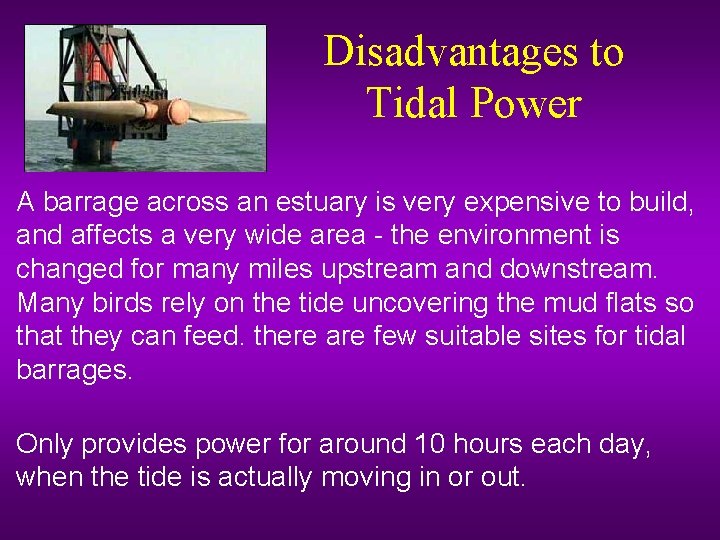
Disadvantages to Tidal Power A barrage across an estuary is very expensive to build, and affects a very wide area - the environment is changed for many miles upstream and downstream. Many birds rely on the tide uncovering the mud flats so that they can feed. there are few suitable sites for tidal barrages. Only provides power for around 10 hours each day, when the tide is actually moving in or out.
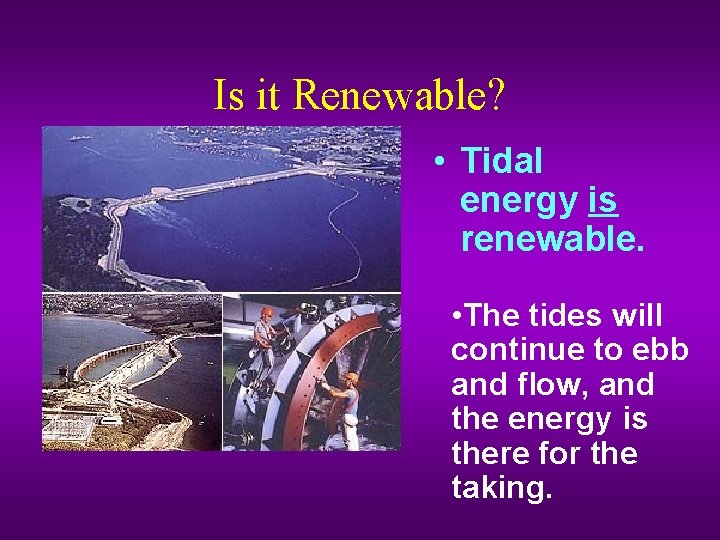
Is it Renewable? • Tidal energy is renewable. • The tides will continue to ebb and flow, and the energy is there for the taking.
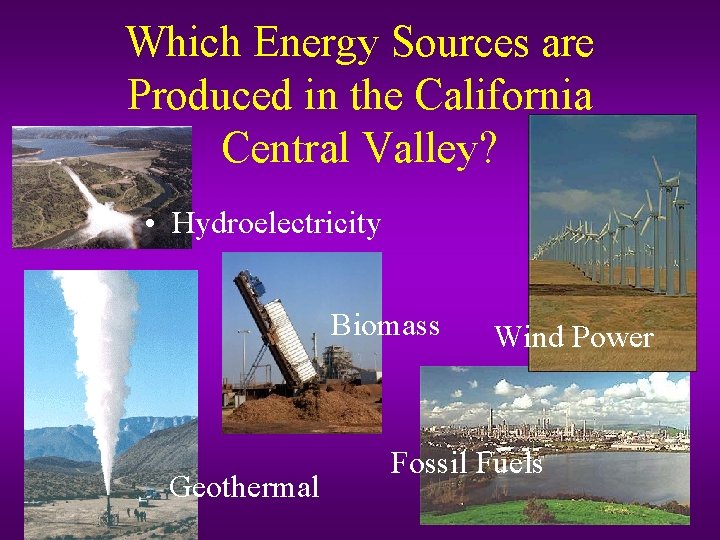
Which Energy Sources are Produced in the California Central Valley? • Hydroelectricity Biomass Geothermal Wind Power Fossil Fuels
sources • http: //www. darvill. clara. net/altenerg/fossil. h tm • http: //www. umich. edu/~gs 265/society/fossil fuels. htm