
Energy resource availability balance between energy security and

Energy resource availability balance between energy security and development of less environment-friendly sources in North America Biogeochemical cycles movement of key elements (e. g. , C, N) Grand Challenges Land use - ecosystem changes (e. g. , deforestation) and implications for biological diversity and biogeochemical cycles Hydrologic cycles – supply and demand, contamination, landscape change Climate patterns - short-term time scales (seasonal, decadal), implications for severe weather events, ocean/atmosphere Global climate system - link together many of the topics on the basis of the most recent modeling for future trends Mineral resource development population, wealth distribution, technology, limited supplies, recycling, waste management Hazard awareness preparation for future natural disasters, predictions, cost/benefits Infectious diseases - environmental factors may affect distribution, transmission, severity of diseases Biological diversity biomes, geological past, implications for future Jones Kershaw, P. , 2005, Creating a disaster resilient America: Grand challenges in science and technology. Summary of a workshop. National Research Council, http: //www. nap. edu/catalog. php? record_id=11274. National Research Council, 2001, Grand Challenges in Environmental Sciences. Washington, D. C. , National Academy Press, 106 p. Zoback, M, 2001, Grand challenges in Earth and Environmental Sciences: Science, stewardship, and service for the Twenty-First Century. GSA Today, December, p. 41 -47.
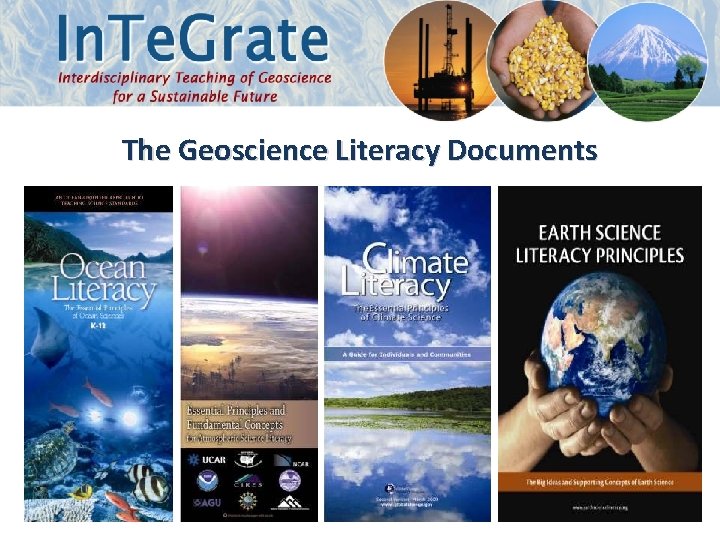
The Geoscience Literacy Documents
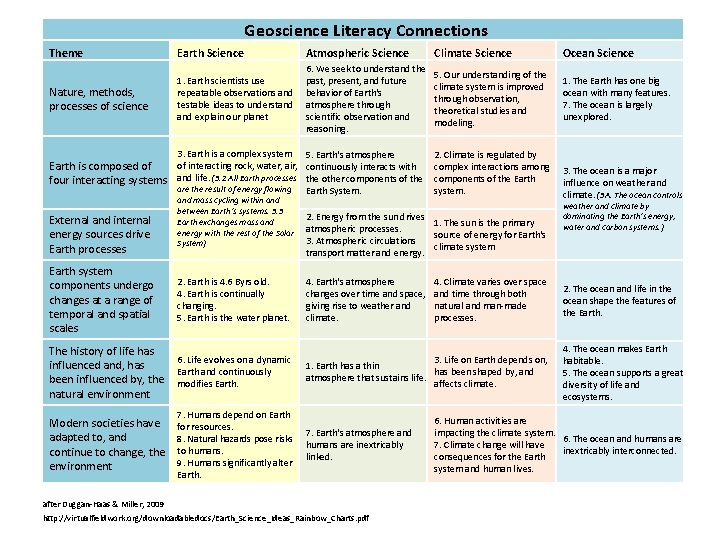
Geoscience Literacy Connections Theme Earth Science Atmospheric Science Climate Science Ocean Science Nature, methods, processes of science 1. Earth scientists use repeatable observations and testable ideas to understand explain our planet 6. We seek to understand the past, present, and future behavior of Earth's atmosphere through scientific observation and reasoning. 5. Our understanding of the climate system is improved through observation, theoretical studies and modeling. 1. The Earth has one big ocean with many features. 7. The ocean is largely unexplored. 3. Earth is a complex system 5. Earth's atmosphere 2. Climate is regulated by of interacting rock, water, air, continuously interacts with Earth is composed of complex interactions among and life. (3. 2 All Earth processes the other components of the Earth four interacting systems are the result of energy flowing and mass cycling within and between Earth’s systems. 3. 3 Earth exchanges mass and energy with the rest of the Solar System) Earth System. Earth system components undergo changes at a range of temporal and spatial scales 2. Earth is 4. 6 Byrs old. 4. Earth is continually changing. 5. Earth is the water planet. 4. Earth's atmosphere changes over time and space, giving rise to weather and climate. The history of life has influenced and, has been influenced by, the natural environment 6. Life evolves on a dynamic Earth and continuously modifies Earth. 3. Life on Earth depends on, 1. Earth has a thin has been shaped by, and atmosphere that sustains life. affects climate. Modern societies have adapted to, and continue to change, the environment 7. Humans depend on Earth for resources. 8. Natural hazards pose risks to humans. 9. Humans significantly alter Earth. 7. Earth's atmosphere and humans are inextricably linked. External and internal energy sources drive Earth processes system. 2. Energy from the sun drives 1. The sun is the primary atmospheric processes. source of energy for Earth's 3. Atmospheric circulations climate system transport matter and energy. after Duggan-Haas & Miller, 2009 http: //virtualfieldwork. org/downloadabledocs/Earth_Science_Ideas_Rainbow_Charts. pdf 4. Climate varies over space and time through both natural and man-made processes. 3. The ocean is a major influence on weather and climate. (3 A. The ocean controls weather and climate by dominating the Earth’s energy, water and carbon systems. ) 2. The ocean and life in the ocean shape the features of the Earth. 4. The ocean makes Earth habitable. 5. The ocean supports a great diversity of life and ecosystems. 6. Human activities are impacting the climate system. 6. The ocean and humans are 7. Climate change will have inextricably interconnected. consequences for the Earth system and human lives.
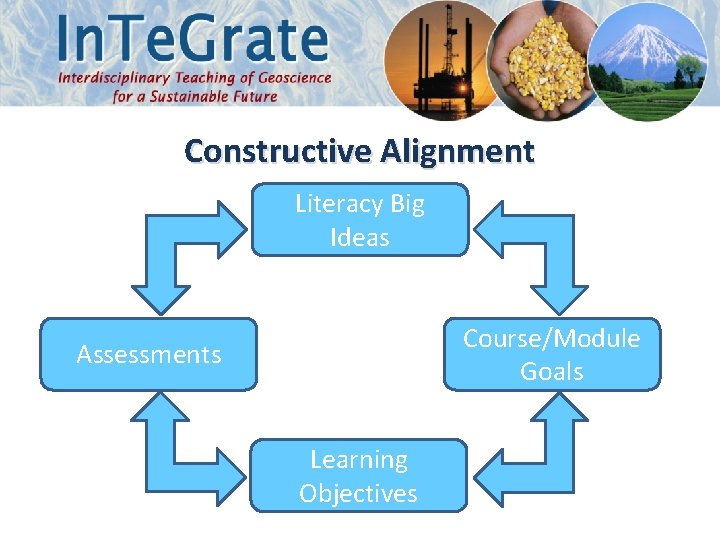
Constructive Alignment Literacy Big Ideas Course/Module Goals Assessments Learning Objectives
- Slides: 4