
ENERGY POWER 8 1 8 4 NON FOSSIL
- Slides: 11
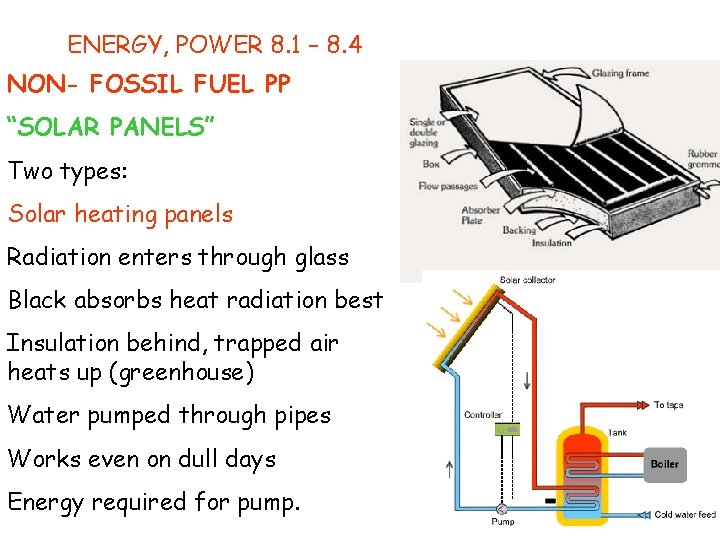
ENERGY, POWER 8. 1 – 8. 4 NON- FOSSIL FUEL PP “SOLAR PANELS” Two types: Solar heating panels Radiation enters through glass Black absorbs heat radiation best Insulation behind, trapped air heats up (greenhouse) Water pumped through pipes Works even on dull days Energy required for pump.
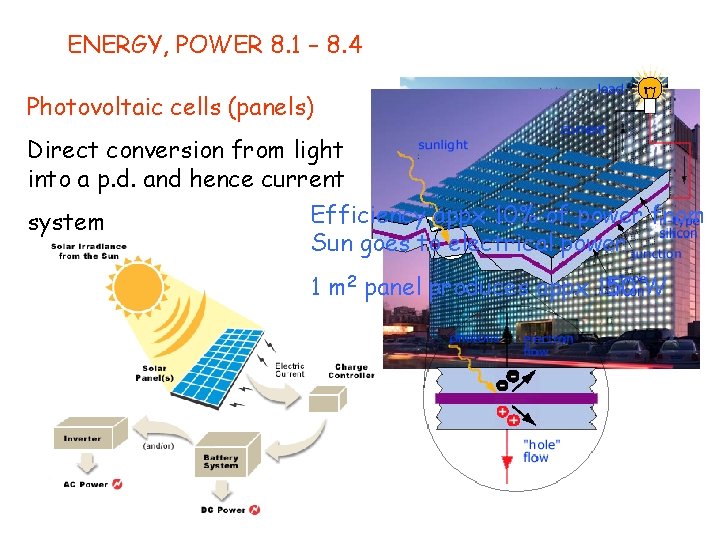
ENERGY, POWER 8. 1 – 8. 4 Photovoltaic cells (panels) Direct conversion from light into a p. d. and hence current Efficiency appx 10% of power from system Sun goes to electrical power 1 m 2 panel produces appx 150 W
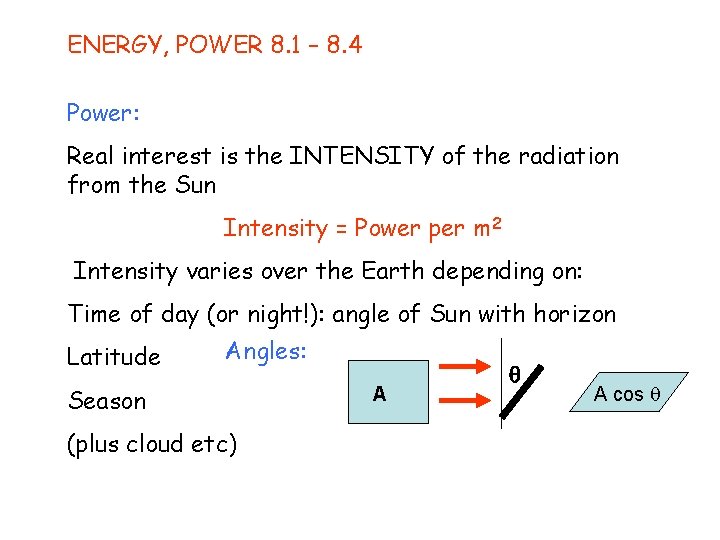
ENERGY, POWER 8. 1 – 8. 4 Power: Real interest is the INTENSITY of the radiation from the Sun Intensity = Power per m 2 Intensity varies over the Earth depending on: Time of day (or night!): angle of Sun with horizon Latitude Angles: Season (plus cloud etc) A q A cos q
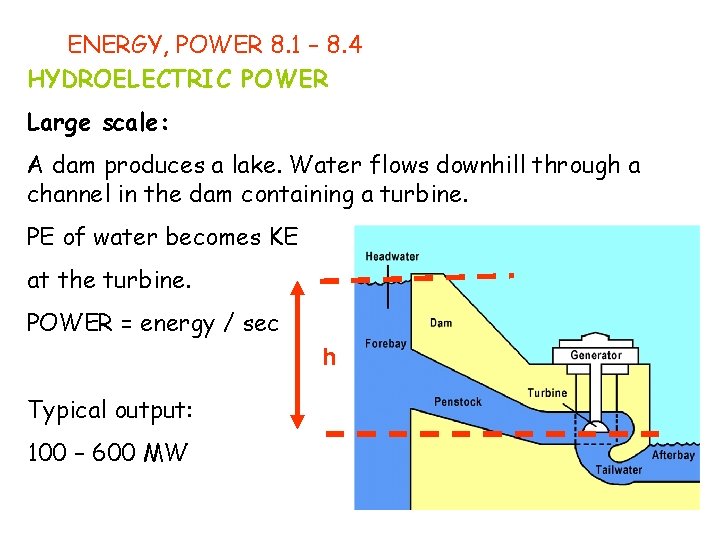
ENERGY, POWER 8. 1 – 8. 4 HYDROELECTRIC POWER Large scale: A dam produces a lake. Water flows downhill through a channel in the dam containing a turbine. PE of water becomes KE at the turbine. POWER = energy / sec h Typical output: 100 – 600 MW
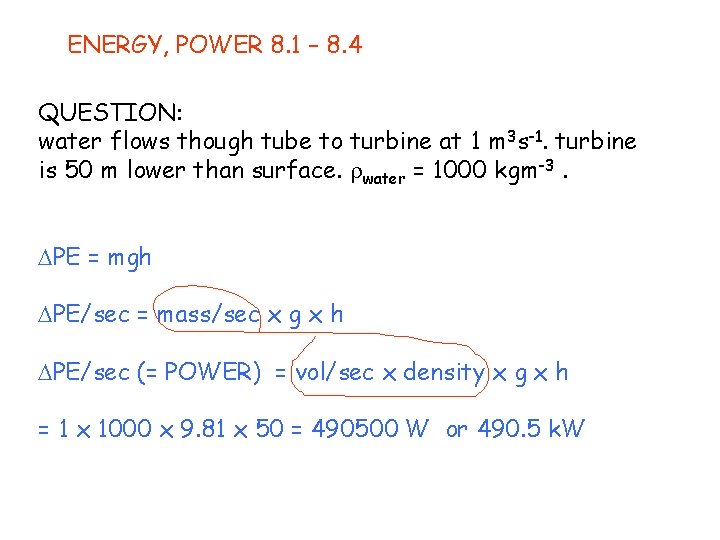
ENERGY, POWER 8. 1 – 8. 4 QUESTION: water flows though tube to turbine at 1 m 3 s-1. turbine is 50 m lower than surface. rwater = 1000 kgm-3. DPE = mgh DPE/sec = mass/sec x g x h DPE/sec (= POWER) = vol/sec x density x g x h = 1 x 1000 x 9. 81 x 50 = 490500 W or 490. 5 k. W
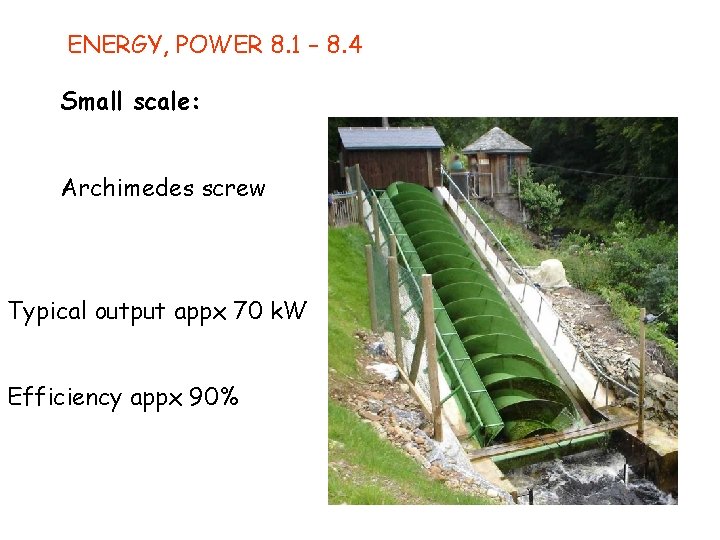
ENERGY, POWER 8. 1 – 8. 4 Small scale: Archimedes screw Typical output appx 70 k. W Efficiency appx 90%
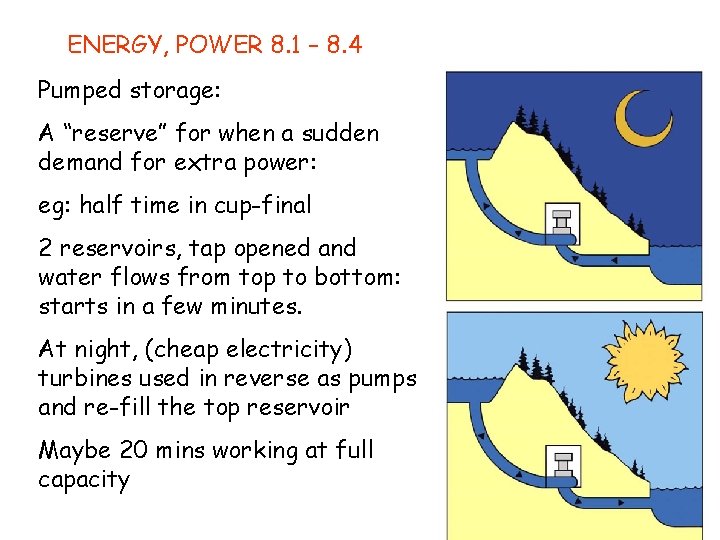
ENERGY, POWER 8. 1 – 8. 4 Pumped storage: A “reserve” for when a sudden demand for extra power: eg: half time in cup-final 2 reservoirs, tap opened and water flows from top to bottom: starts in a few minutes. At night, (cheap electricity) turbines used in reverse as pumps and re-fill the top reservoir Maybe 20 mins working at full capacity
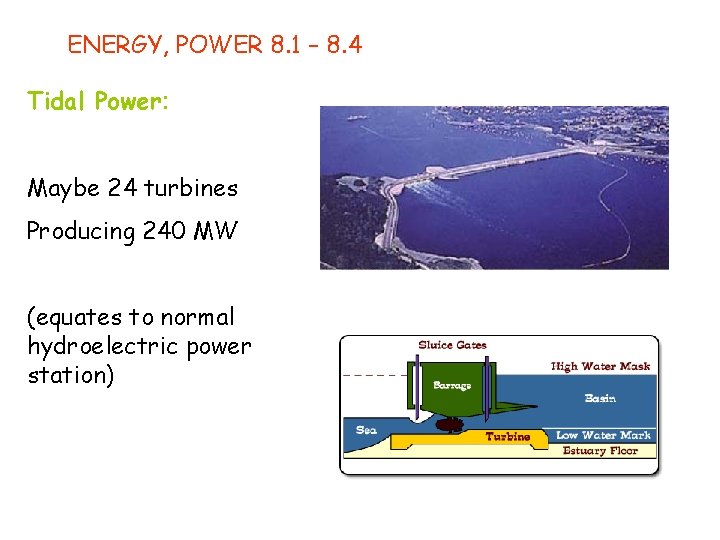
ENERGY, POWER 8. 1 – 8. 4 Tidal Power: Maybe 24 turbines Producing 240 MW (equates to normal hydroelectric power station)
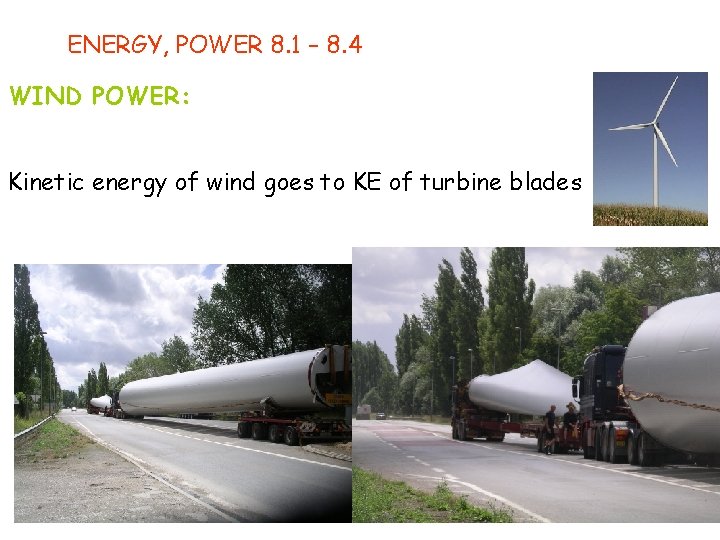
ENERGY, POWER 8. 1 – 8. 4 WIND POWER: Kinetic energy of wind goes to KE of turbine blades
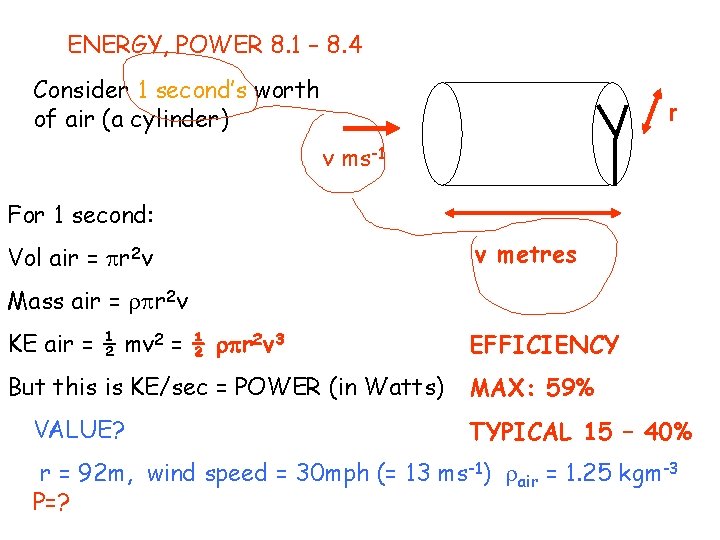
ENERGY, POWER 8. 1 – 8. 4 Consider 1 second’s worth of air (a cylinder) r v ms-1 For 1 second: Vol air = pr 2 v v metres Mass air = rpr 2 v KE air = ½ mv 2 = ½ rpr 2 v 3 EFFICIENCY But this is KE/sec = POWER (in Watts) MAX: 59% VALUE? TYPICAL 15 – 40% r = 92 m, wind speed = 30 mph (= 13 ms-1) rair = 1. 25 kgm-3 P=?
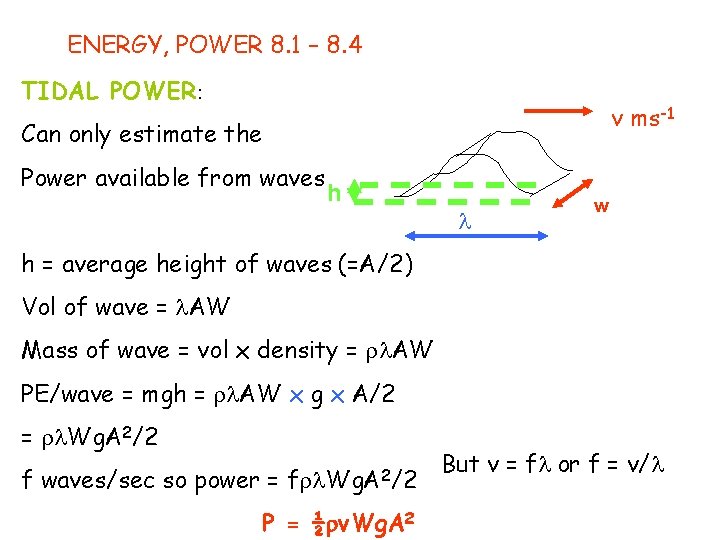
ENERGY, POWER 8. 1 – 8. 4 TIDAL POWER: v ms-1 Can only estimate the Power available from waves h l w h = average height of waves (=A/2) Vol of wave = l. AW Mass of wave = vol x density = rl. AW PE/wave = mgh = rl. AW x g x A/2 = rl. Wg. A 2/2 f waves/sec so power = frl. Wg. A 2/2 P = ½rv. Wg. A 2 But v = fl or f = v/l