
Energy Part 2 Solving Energy Problems Kinetic Energy
Energy Part 2: Solving Energy Problems
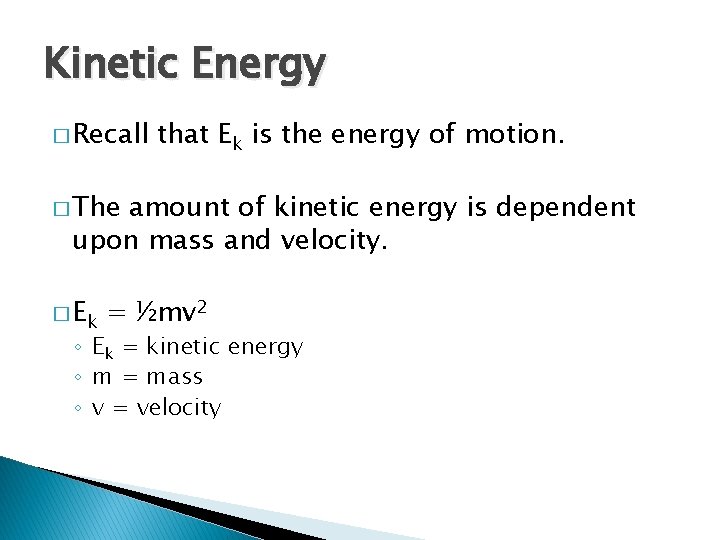
Kinetic Energy � Recall that Ek is the energy of motion. � The amount of kinetic energy is dependent upon mass and velocity. � Ek = ½mv 2 ◦ Ek = kinetic energy ◦ m = mass ◦ v = velocity
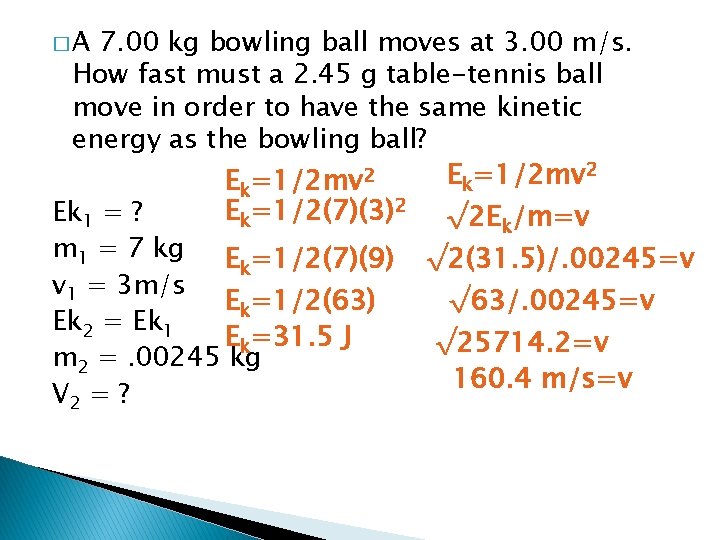
�A 7. 00 kg bowling ball moves at 3. 00 m/s. How fast must a 2. 45 g table-tennis ball move in order to have the same kinetic energy as the bowling ball? 2 2 E =1/2 mv Ek=1/2 mv k Ek=1/2(7)(3)2 √ 2 Ek/m=v Ek 1 = ? m 1 = 7 kg E =1/2(7)(9) √ 2(31. 5)/. 00245=v k v 1 = 3 m/s Ek=1/2(63) √ 63/. 00245=v Ek 2 = Ek 1 Ek=31. 5 J √ 25714. 2=v m 2 =. 00245 kg 160. 4 m/s=v V 2 = ?
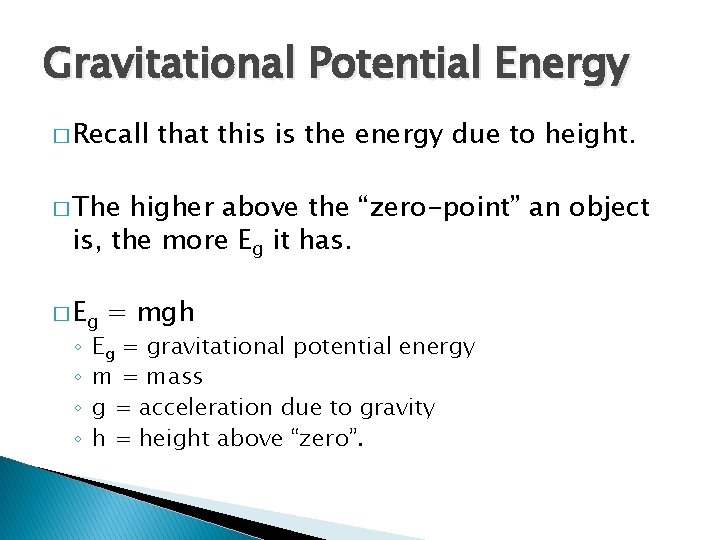
Gravitational Potential Energy � Recall that this is the energy due to height. � The higher above the “zero-point” an object is, the more Eg it has. � Eg ◦ ◦ = mgh Eg = gravitational potential energy m = mass g = acceleration due to gravity h = height above “zero”.
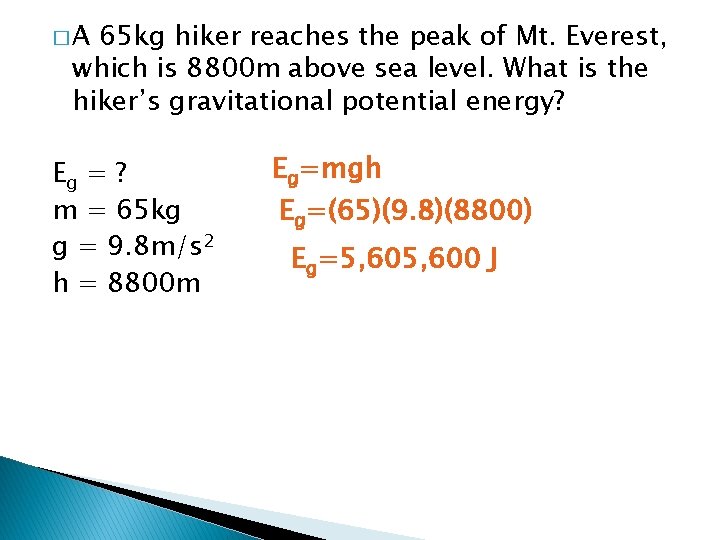
�A 65 kg hiker reaches the peak of Mt. Everest, which is 8800 m above sea level. What is the hiker’s gravitational potential energy? Eg = ? m = 65 kg g = 9. 8 m/s 2 h = 8800 m Eg=mgh Eg=(65)(9. 8)(8800) Eg=5, 600 J
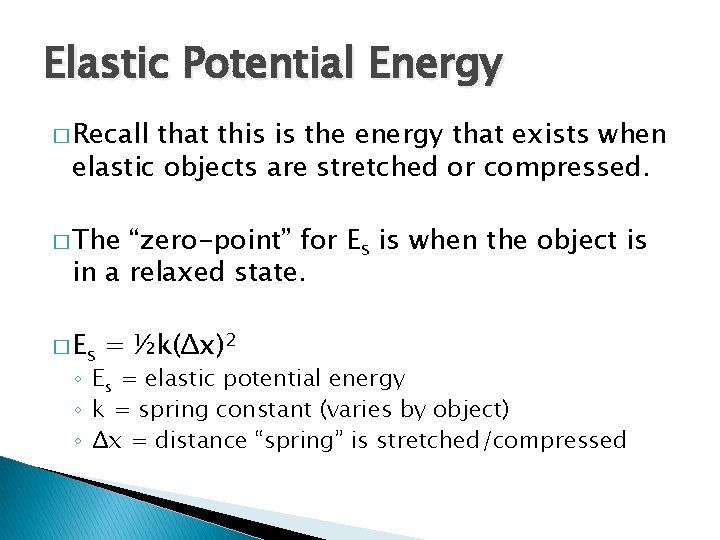
Elastic Potential Energy � Recall that this is the energy that exists when elastic objects are stretched or compressed. � The “zero-point” for Es is when the object is in a relaxed state. � Es = ½k(Δx)2 ◦ Es = elastic potential energy ◦ k = spring constant (varies by object) ◦ Δx = distance “spring” is stretched/compressed
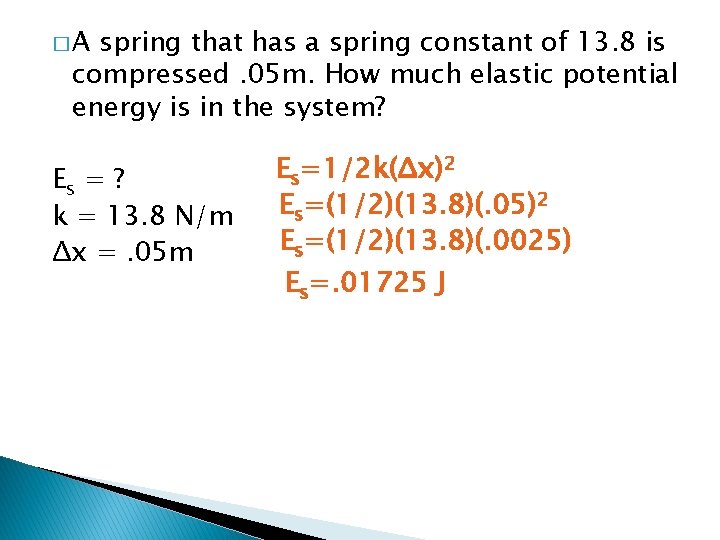
�A spring that has a spring constant of 13. 8 is compressed. 05 m. How much elastic potential energy is in the system? Es = ? k = 13. 8 N/m Δx =. 05 m Es=1/2 k(Δx)2 Es=(1/2)(13. 8)(. 05)2 Es=(1/2)(13. 8)(. 0025) Es=. 01725 J
- Slides: 7