
Energy Motion Gravity Isaac Newton father of classical
- Slides: 22
Energy, Motion, Gravity Isaac Newton, father of classical physics
Galileo’s Experiments on the Motion of Falling Objects �Galileo dropped objects (even from the Tower of Pisa) to see how they fell… �The rate of acceleration of falling objects is a constant. 32 feet/second, or about 9. 8 meters/second �Objects fall at the same rate, regardless of their mass
Aristotle vs. Galileo �Aristotle taught �“gravity – the tendency of heavy things to fall”, and: �heavier objects will faster than lighter objects. �Is this correct?
Feather & Hammer on Moon �You. Tube Feather/Hammer on the Moon
Life of Sir Isaac Newton �Believed the world was mathematical �Discovered that normal light is made of different shades of light � color is a property of light, not of objects �Born prematurely to a widow � father died 3 months earlier � age 3, moved in with grandparents �Attended Trinity College, Cambridge �Rejected the concept of the Trinity! �Invented: � Calculus � Reflecting telescope �Discovered: � Laws of Motion (Mechanics) � Universal Law of Gravity �Wrote “Principia, ” very popular science book
Mass, Inertia, Weight �Mass is a measure of inertia �Inertia is the resistance of an object to a change in its motion �Newton’s First Law: Law of Inertia �Weight is the gravitational force of attraction between an object and its planet �The weight of an object is proportional to its mass: W=mg � 1 Newton ~ the weight of a small apple � 1 pound = 4. 45 Newtons �Higgs’ Boson and inertia…
Forces �Force: Cause of motion; vector quantity capable of causing acceleration �Contact Forces – involve physical contact between objects �Kicking a ball �Pulling a wagon �Compressing a spring �Field forces – don’t involve physical contact between objects �Gravity, electromagnetism
Acceleration �Acceleration = change in velocity/change in time �Three cases: �Change in speed without change in direction �Change in direction without change in speed �Change in both speed and direction �a = (v final – v initial)/t elapsed �v final = v initial + a*t
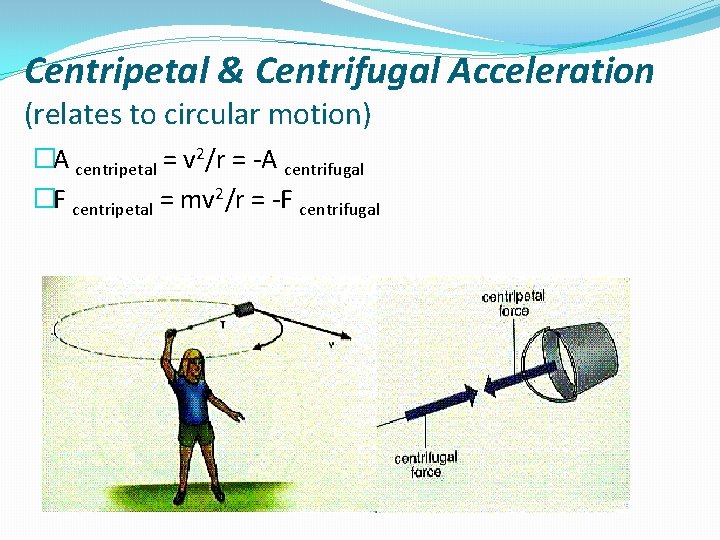
Centripetal & Centrifugal Acceleration (relates to circular motion) �A centripetal = v 2/r = -A centrifugal �F centripetal = mv 2/r = -F centrifugal
Newton’s 3 Laws of Motion �These are more general than gravity. They’re the basis of the branch of physics called… � Mechanics – how objects move when under the influence of forces
Newton’s 1 st Law: Law of Inertia �“An object in motion will stay in (uniform, straight line) motion; an object at rest will stay at rest unless acted on by an outside, unbalanced force. ” �A revolutionary idea at the time, since Aristotle taught, “The natural state of motion of an object is to be at rest” �Newton discovered that moving things will stay moving, and slowing down requires a force to be acting �If net force = zero, velocity = constant
Newton’s 2 nd Law: F = ma �“The acceleration an object experiences is directly proportional to the force acting on it, and inversely proportional to the mass of the object” �Acceleration = Force/Mass �Simply put, heavier things are harder to push up to speed, and the harder you push, the faster it’ll accelerate. �If net force does not equal zero, acceleration = force/mass.
Newton’s 3 rd Law: Law of Equal & Opposite Reactions �Forces between objects are always felt mutually; equal and opposite �“For every action there is an equal & opposite reaction” �Simply put, when you push or pull on something, it will pull or push back equally in the opposite direction � Equal in Magnitude, Opposite in Direction � Action Force = Reaction Force � ma = -ma (absolute values) � Rubber bands � Water in spinning bucket � Real rocket: expanding combustion gases exert force on rocket; rocket exerts force on gases � Balloons
Linear Momentum �Linear Momentum = m*v = p � applies to motion in a straight line � related to inertia if an object has a lot of momentum (like a speeding freight train), it's hard to slow down or change direction. � Examples: speeding bullets, big slow ships � �Conservation of momentum: � In any isolated system where any collision or motion takes place, the total momentum of the system before the collision or motion is the same as the total momentum of the system after the collision or motion. � Total linear momentum of an isolated system remains the same if there is no external, unbalanced force acting on the system. � Examples: man jumping from boat, rockets, balloons…
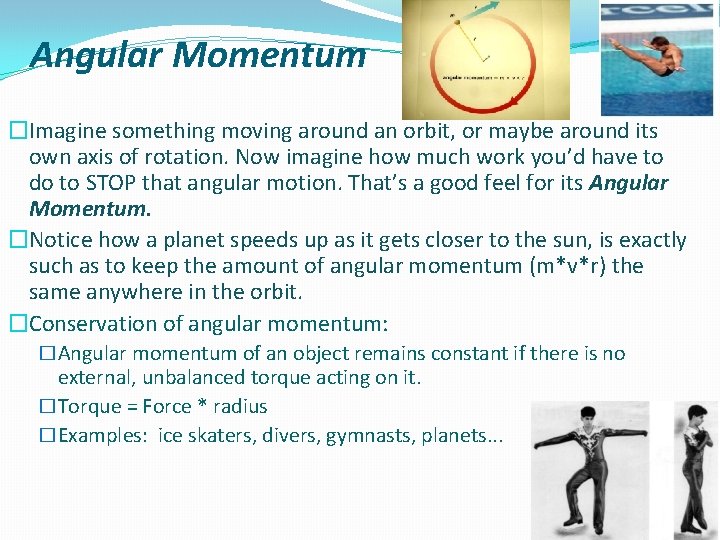
Angular Momentum �Imagine something moving around an orbit, or maybe around its own axis of rotation. Now imagine how much work you’d have to do to STOP that angular motion. That’s a good feel for its Angular Momentum. �Notice how a planet speeds up as it gets closer to the sun, is exactly such as to keep the amount of angular momentum (m*v*r) the same anywhere in the orbit. �Conservation of angular momentum: �Angular momentum of an object remains constant if there is no external, unbalanced torque acting on it. �Torque = Force * radius �Examples: ice skaters, divers, gymnasts, planets. . .
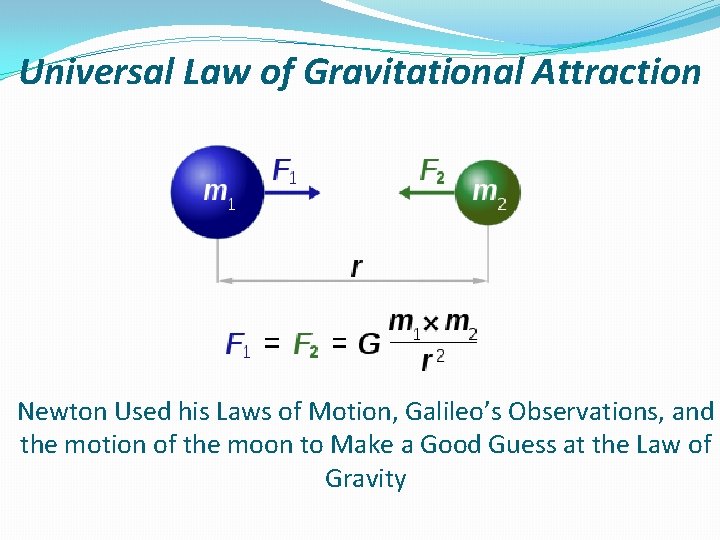
Universal Law of Gravitational Attraction Newton Used his Laws of Motion, Galileo’s Observations, and the motion of the moon to Make a Good Guess at the Law of Gravity
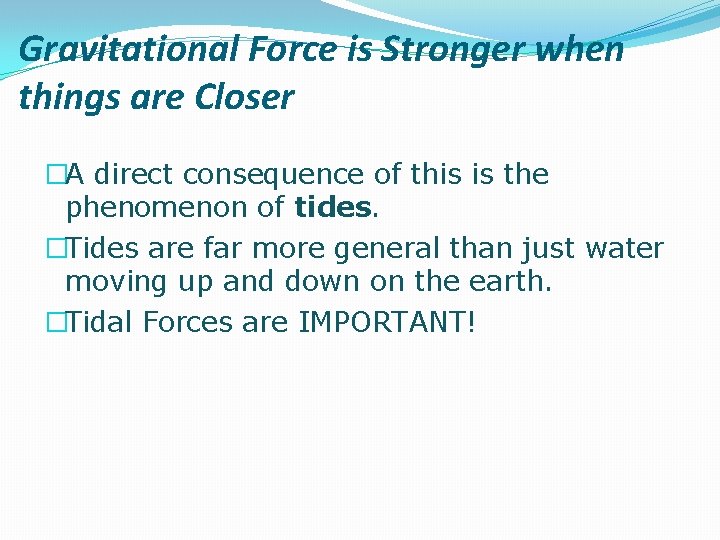
Gravitational Force is Stronger when things are Closer �A direct consequence of this is the phenomenon of tides. �Tides are far more general than just water moving up and down on the earth. �Tidal Forces are IMPORTANT!
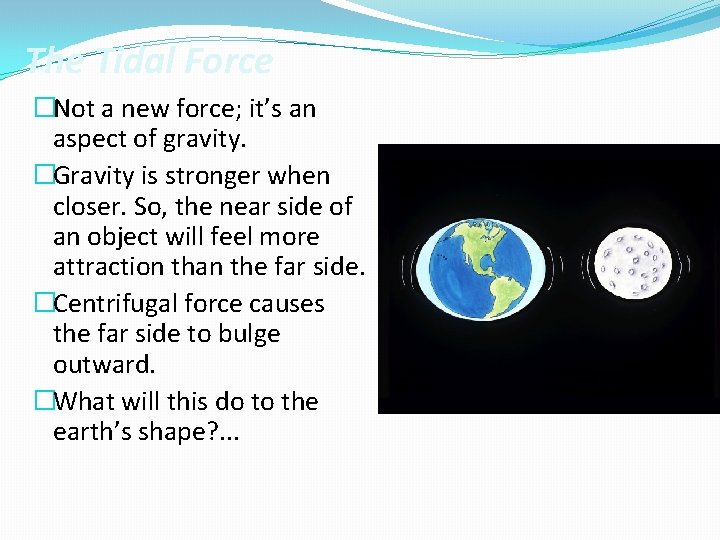
The Tidal Force �Not a new force; it’s an aspect of gravity. �Gravity is stronger when closer. So, the near side of an object will feel more attraction than the far side. �Centrifugal force causes the far side to bulge outward. �What will this do to the earth’s shape? . . .
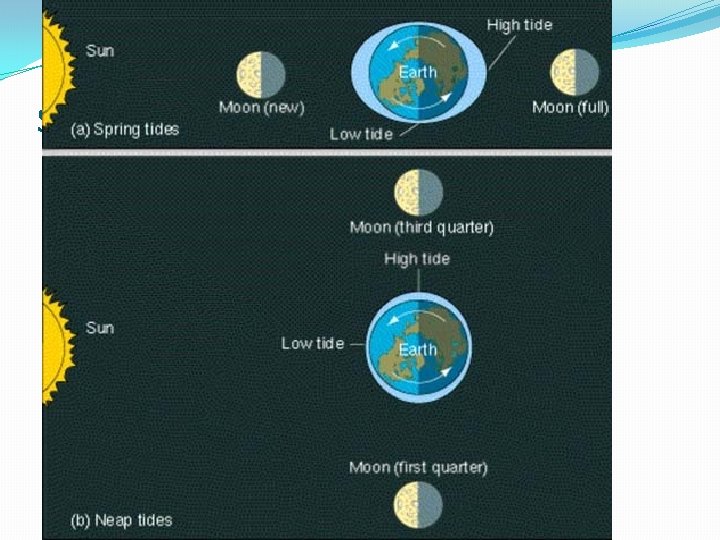
spring. Neap diagram
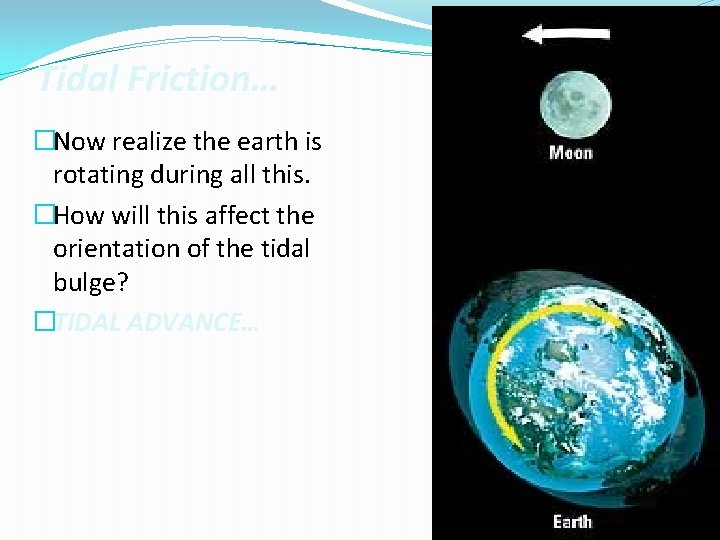
Tidal Friction… �Now realize the earth is rotating during all this. �How will this affect the orientation of the tidal bulge? �TIDAL ADVANCE…
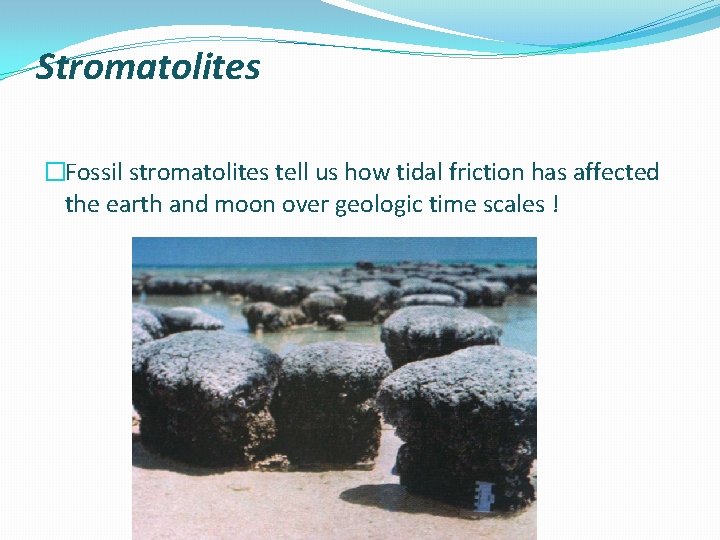
Stromatolites �Fossil stromatolites tell us how tidal friction has affected the earth and moon over geologic time scales !
Earth’s Rotation is Slowing, Moon’s Orbit is Getting Larger �Conclusion: Tidal friction is transferring angular momentum from the earth’s rotational motion to the moon’s orbital motion. �The Earth’s angular momentum is not conserved, and the moon’s angular momentum is not conserved… neither separately is an isolated system. But the Earth-Moon system is fairly well isolated and so the angular momentum of the Earth-Moon system IS conserved. �Tidal friction adds about 3 milliseconds to the length of the day, each century. �That adds up to a full hour after 100 million years (=0. 1 billion years); still small compared to the 4 billion years or so the moon has been around �Tidal stretching from the sun is only 46% that of the moon. Why? Because the sun is 400 times further away than the moon!