
Energy metabolism enzyme and Cofactors 1 Forms of
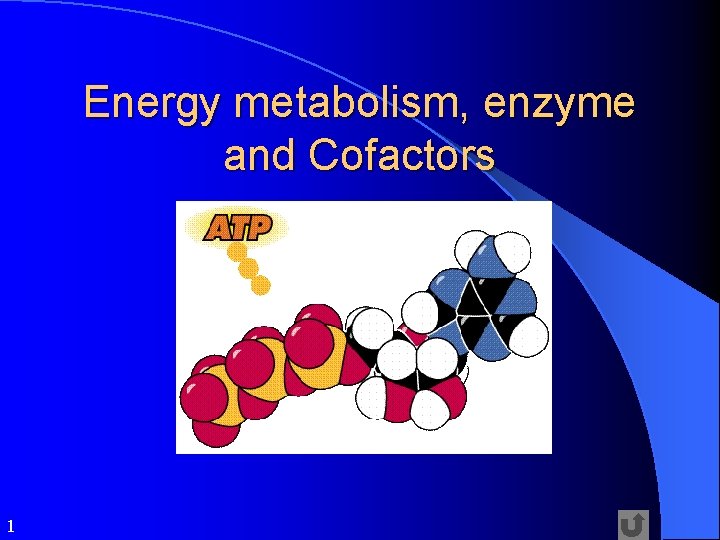
Energy metabolism, enzyme and Cofactors 1
Forms of Energy l l l 3 These forms of energy are important to life: – chemical – radiant (examples: heat, light) – mechanical – electrical Energy can be transformed from one form to another. Chemical energy is the energy contained in the chemical bonds of molecules. Radiant energy travels in waves and is sometimes called electromagnetic energy. An example is visible light. Photosynthesis converts light energy to chemical energy. Energy that is stored is called potential energy.
Laws of Thermodynamics l 1 st law: Energy cannot be created or destroyed. – Energy can be converted from one form to another. The sum of the energy before the conversion is equal to the sum of the energy after the conversion. Example: A light bulb converts electrical energy to light energy and heat energy. Fluorescent bulbs produce more light energy than incandescent bulbs because they produce less heat. l 4 2 nd law: Some usable energy dissipates during transformations and is lost. – During changes from one form of energy to another, some usable energy dissipates, usually as heat. The amount of usable energy therefore decreases.
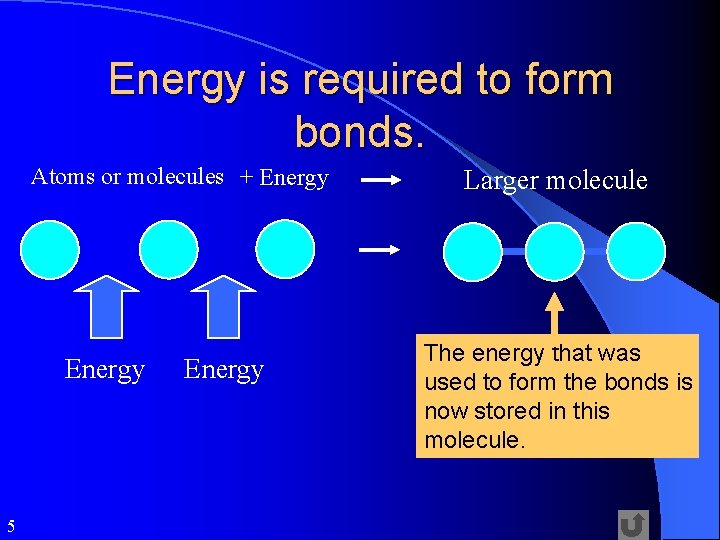
Energy is required to form bonds. Atoms or molecules + Energy 5 Energy Larger molecule The energy that was used to form the bonds is now stored in this molecule.
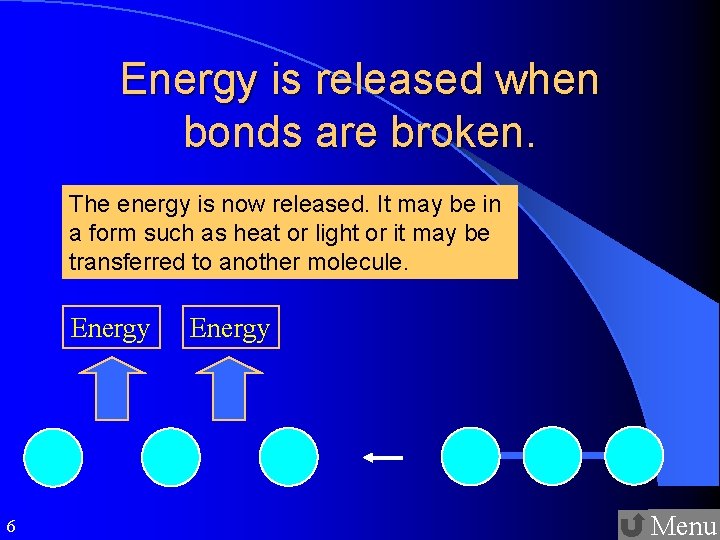
Energy is released when bonds are broken. The energy is now released. It may be in a form such as heat or light or it may be transferred to another molecule. Energy 6 Energy Menu
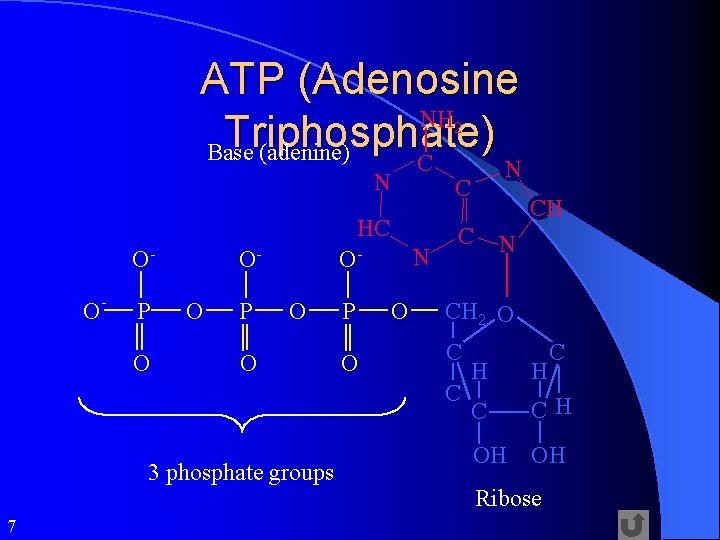
ATP (Adenosine NH Triphosphate) Base (adenine) C 2 OO - P O OO P O O C HC N O- C P O O 7 CH N CH 2 O C C 3 phosphate groups N N C H H C CH OH OH Ribose
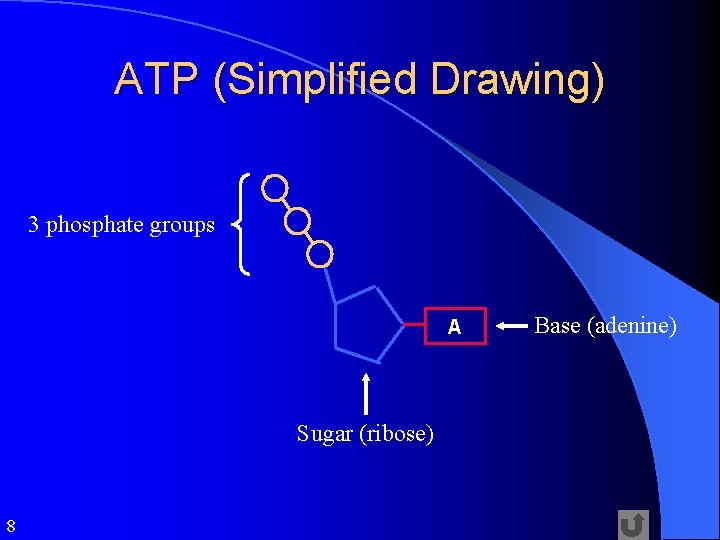
ATP (Simplified Drawing) 3 phosphate groups A Sugar (ribose) 8 Base (adenine)

ATP Stores Energy Breaking the bonds releases the energy. The phosphate bonds are high-energy bonds. Energy A ATP 9 A ADP + Pi + Energy
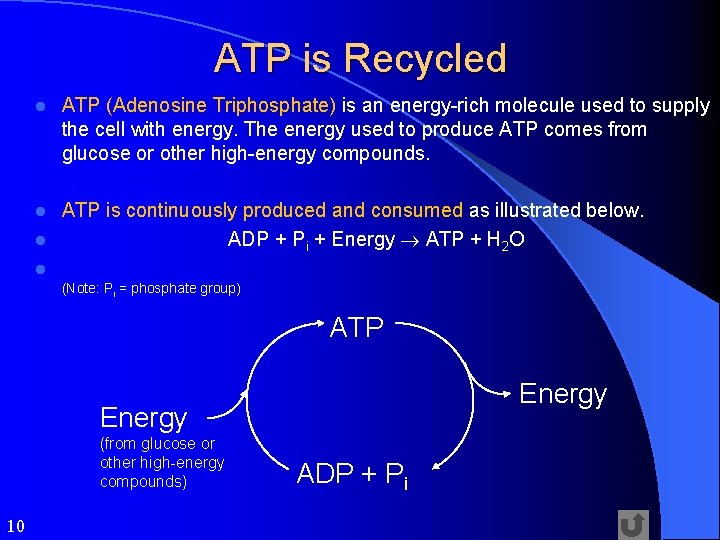
ATP is Recycled l ATP (Adenosine Triphosphate) is an energy-rich molecule used to supply the cell with energy. The energy used to produce ATP comes from glucose or other high-energy compounds. ATP is continuously produced and consumed as illustrated below. l ADP + P i + Energy ATP + H 2 O l l (Note: Pi = phosphate group) ATP Energy (from glucose or other high-energy compounds) 10 ADP + Pi
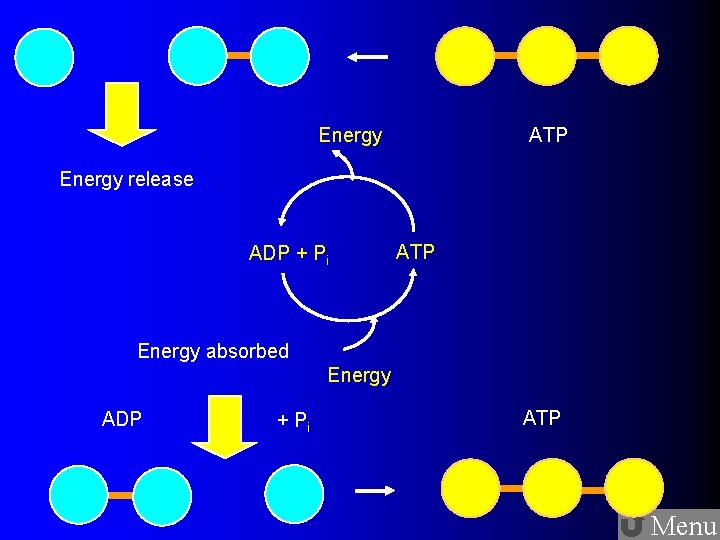
ATP Energy release ADP + Pi ATP Energy absorbed Energy ADP + Pi ATP Menu
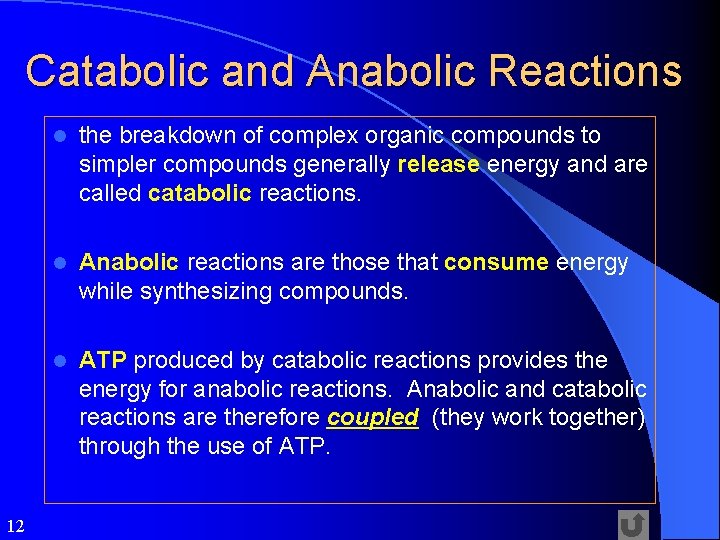
Catabolic and Anabolic Reactions 12 l the breakdown of complex organic compounds to simpler compounds generally release energy and are called catabolic reactions. l Anabolic reactions are those that consume energy while synthesizing compounds. l ATP produced by catabolic reactions provides the energy for anabolic reactions. Anabolic and catabolic reactions are therefore coupled (they work together) through the use of ATP.
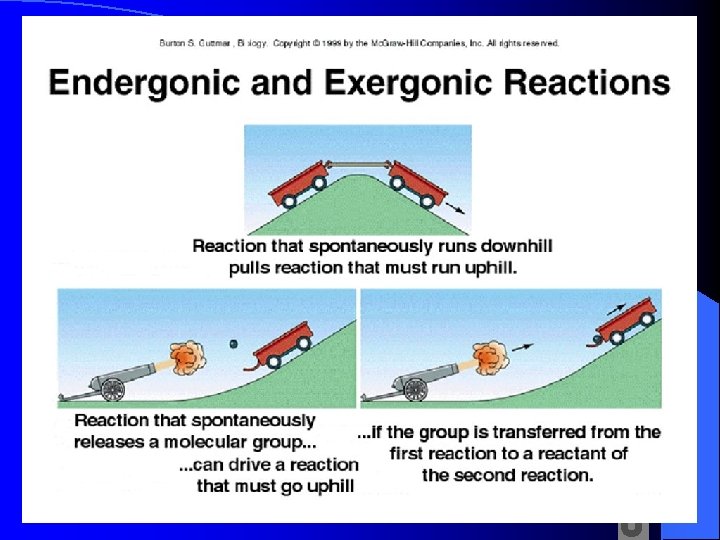
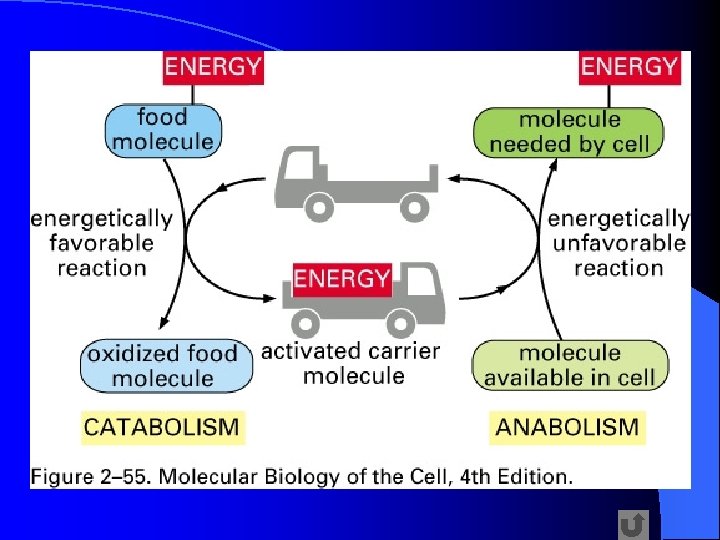
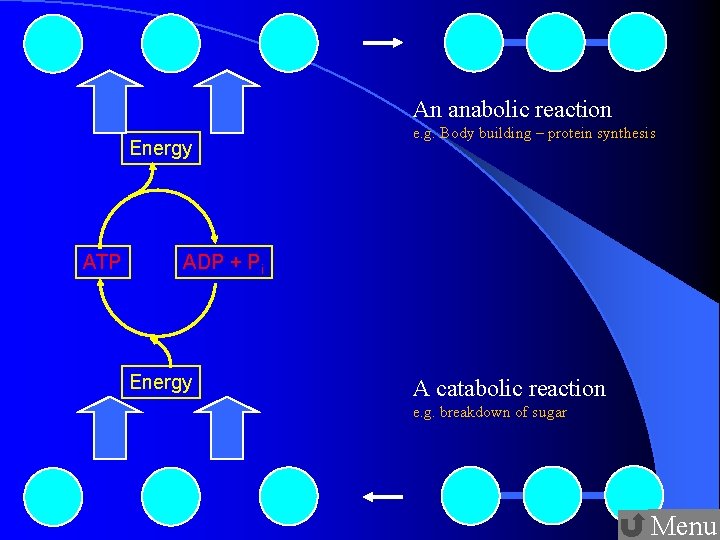
An anabolic reaction Energy ATP e. g. Body building – protein synthesis ADP + Pi Energy A catabolic reaction e. g. breakdown of sugar Menu
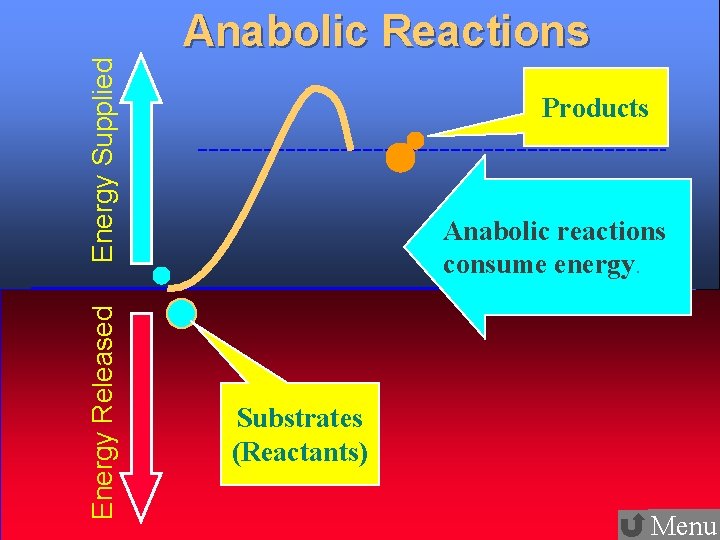
16 Energy Released Energy Supplied Anabolic Reactions Products Anabolic reactions consume energy. Substrates (Reactants) Menu
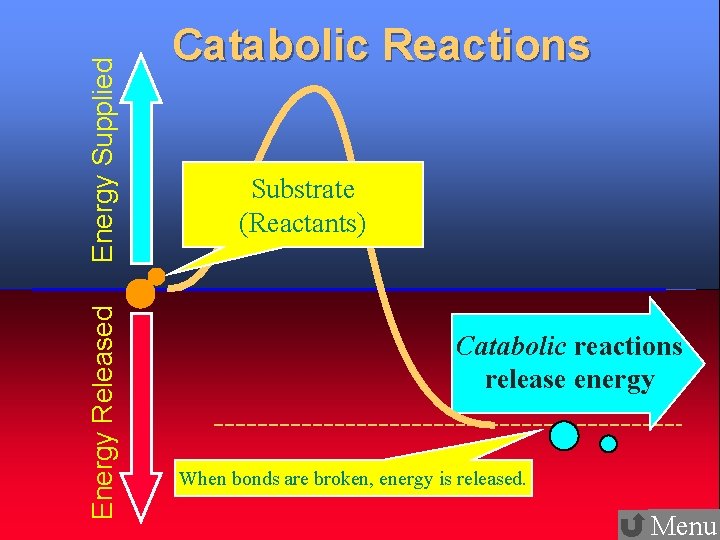
Energy Supplied Energy Released 17 Catabolic Reactions Substrate (Reactants) Catabolic reactions release energy When bonds are broken, energy is released. Menu
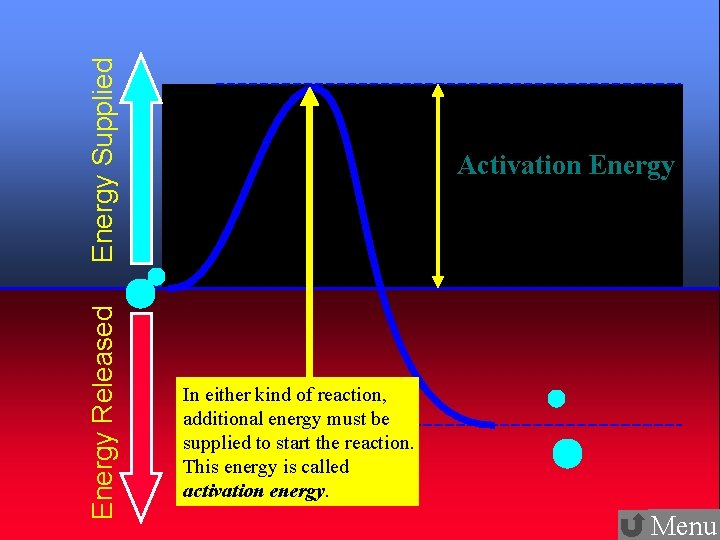
Energy Supplied Energy Released 18 Activation Energy In either kind of reaction, additional energy must be supplied to start the reaction. This energy is called activation energy. Menu
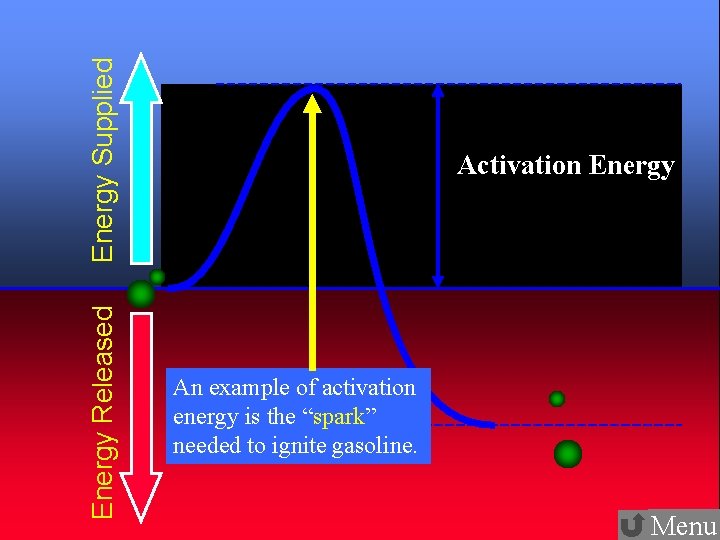
Energy Supplied Energy Released 19 Activation Energy An example of activation energy is the “spark” needed to ignite gasoline. Menu
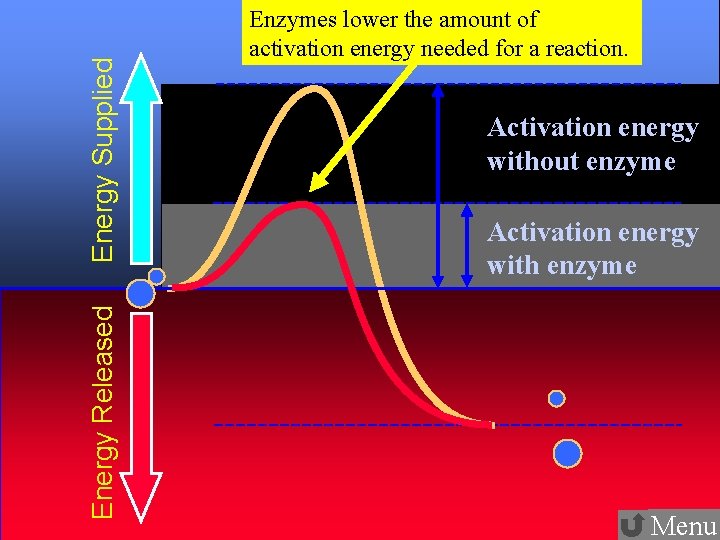
Energy Supplied Energy Released 20 Enzymes lower the amount of activation energy needed for a reaction. Activation energy without enzyme Activation energy with enzyme Menu
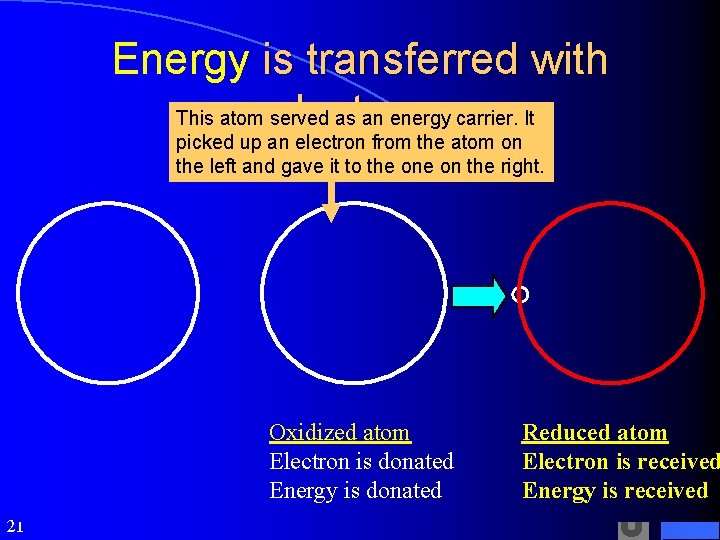
Energy is transferred with This atom served as an energy carrier. It electrons picked up an electron from the atom on the left and gave it to the on the right. Oxidized atom Electron is donated Energy is donated 21 Oxidized Reducedatom Electron is is donated received Energy is is donated received Reduced atom Electron is received Energy is received
Oxidation and Reduction l Oxidation is the loss of electrons or hydrogen atoms. Oxidation reactions release energy. l Reduction is gain of electrons or hydrogen atoms and is associated with a gain of energy. Oxidation and reduction occur together. When a molecule is oxidized, another must be reduced. l These coupled reactions are called oxidation-reduction or redox reactions. l l 22 Food is highly reduced (has many hydrogens). The chemical pathways in cells that produce energy for the cell oxidize the food (remove hydrogens), producing ATP.
Cofactors 23 l Many enzymes require a cofactor to assist in the reaction. These "assistants" are non-protein and may be metal ions such as magnesium (Mg++), potassium (K+), and calcium (Ca++). l The cofactors bind to the enzyme and participate in the reaction by removing electrons, protons , or chemical groups from the substrate.
Coenzymes 24 l Cofactors that are organic molecules are coenzymes. l In oxidation-reduction reactions, coenzymes often remove electrons from the substrate and pass them to different enzymes. l In this way, coenzymes serve to carry energy in the form of electrons (or hydrogen atoms) from one compound to another.
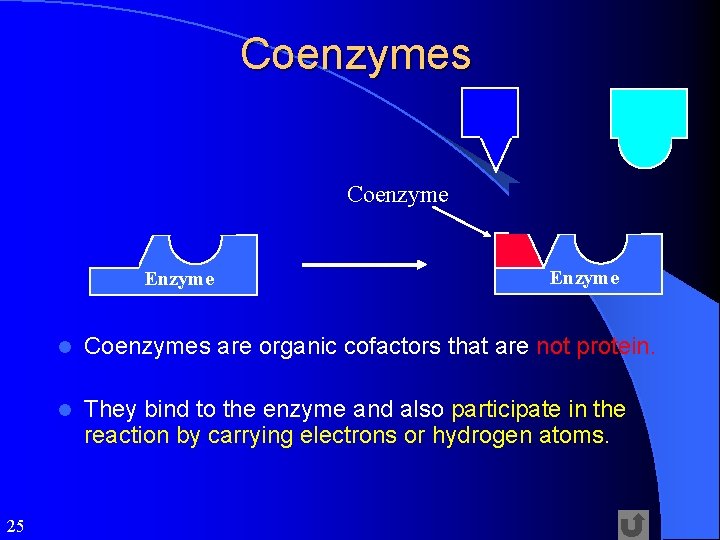
Coenzymes Coenzyme Enzyme l Enzyme Coenzymes are organic cofactors that are not protein. l 25 They bind to the enzyme and also participate in the reaction by carrying electrons or hydrogen atoms.
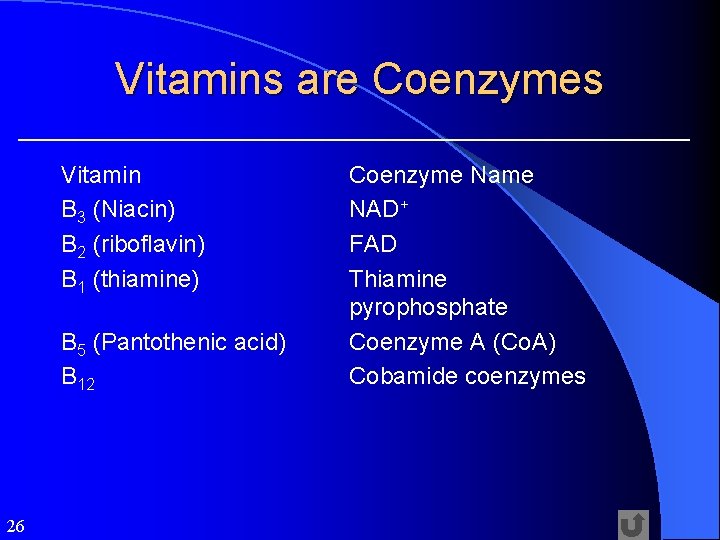
Vitamins are Coenzymes Vitamin B 3 (Niacin) B 2 (riboflavin) B 1 (thiamine) B 5 (Pantothenic acid) B 12 26 Coenzyme Name NAD+ FAD Thiamine pyrophosphate Coenzyme A (Co. A) Cobamide coenzymes
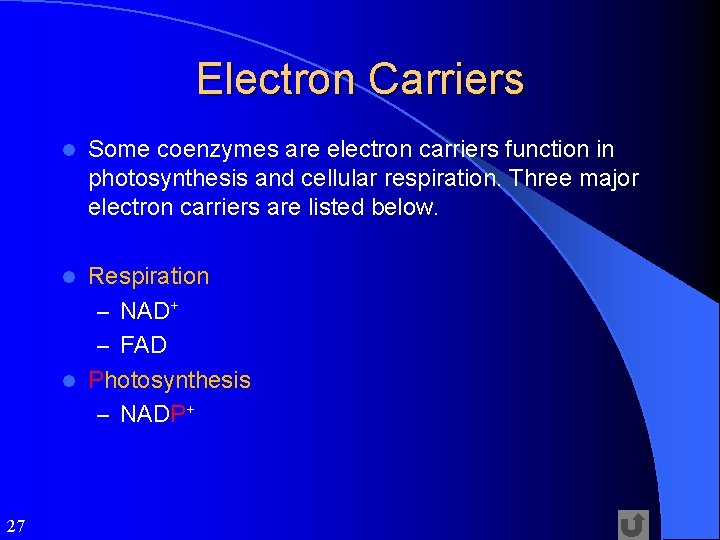
Electron Carriers l Some coenzymes are electron carriers function in photosynthesis and cellular respiration. Three major electron carriers are listed below. Respiration – NAD+ – FAD l Photosynthesis – NADP+ l 27

NAD+
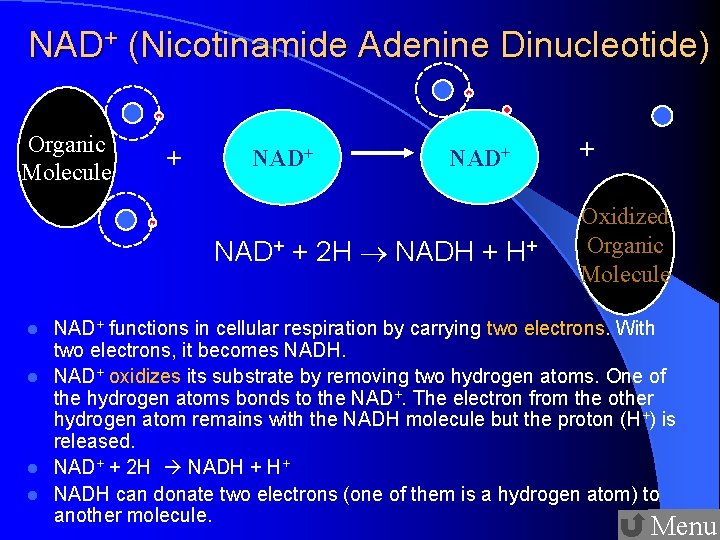
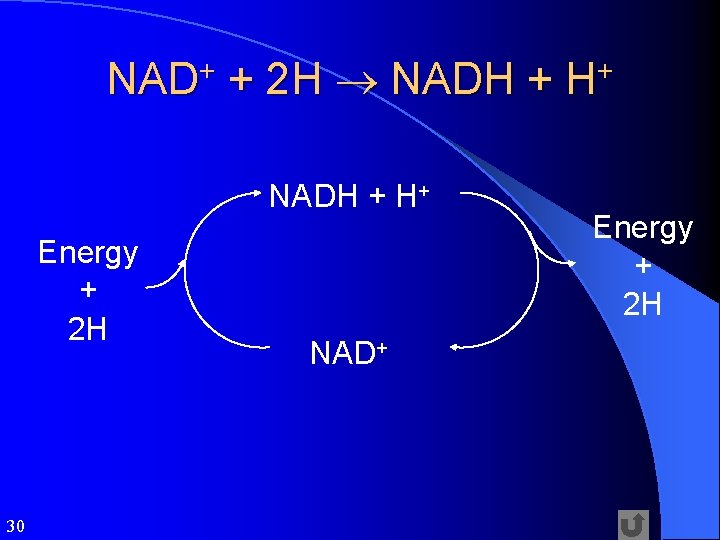
NAD+ (Nicotinamide Adenine Dinucleotide) Organic Molecule + NAD+ + 2 H NADH + H+ + Oxidized Organic Molecule NAD+ functions in cellular respiration by carrying two electrons. With two electrons, it becomes NADH. l NAD+ oxidizes its substrate by removing two hydrogen atoms. One of the hydrogen atoms bonds to the NAD+. The electron from the other hydrogen atom remains with the NADH molecule but the proton (H+) is released. l NAD+ + 2 H NADH + H+ l NADH can donate two electrons (one of them is a hydrogen atom) to another molecule. l Menu
NAD+ + 2 H NADH + H+ Energy + 2 H 30 NAD+ Energy + 2 H
NADP+ + 2 H NADPH + H+ Energy + 2 H 31 NADP+ Energy + 2 H
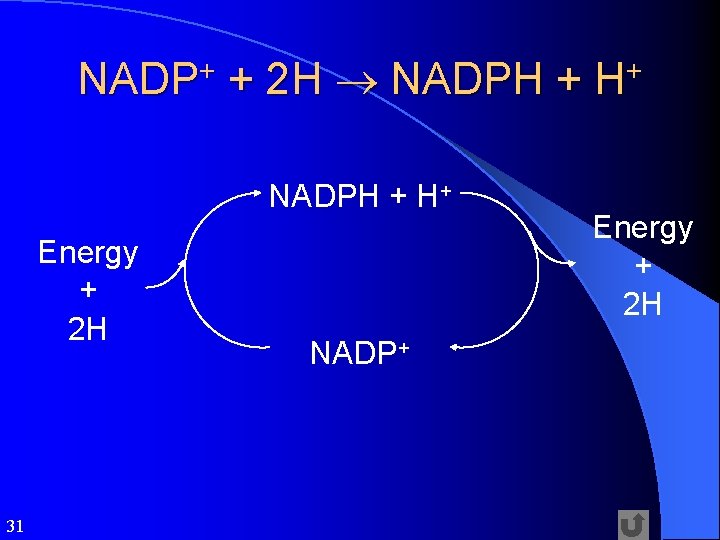
NADP+ (Nicotinamide Adenine Dinucleotide Phosphate) 32 l NADP+ + 2 H NADPH + H+ l NADP+ is similar to NAD+ in that it can carry two electrons, one of them in a hydrogen atom, the other one comes from a hydrogen that is released as a hydrogen ion. (Click here to review NAD+. ) l Electrons carried by NADPH in photosynthesis are ultimately used to reduce CO 2 to carbohydrate.
Phosphorylation 33 l ATP is synthesized from ADP + Pi. The process of synthesizing ATP is called phosphorylation. l Two kinds of phosphorylation are illustrated on the next several slides. – Substrate-Level Phosphorylation – Chemiosmotic Phosphorylation
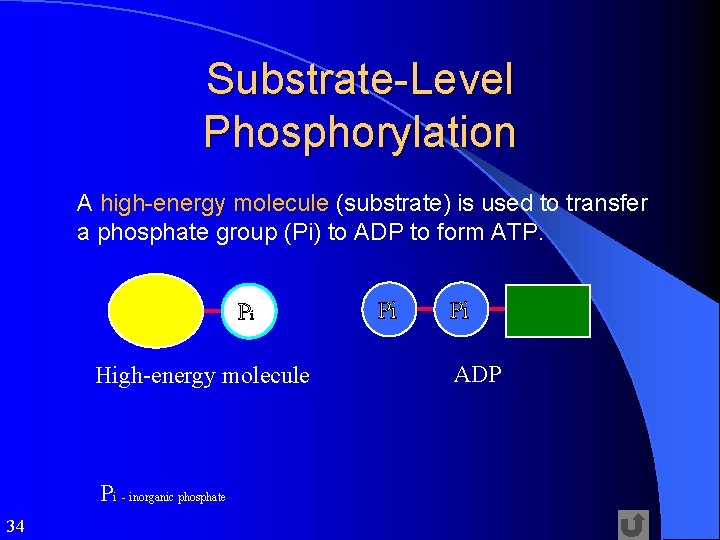
Substrate-Level Phosphorylation A high-energy molecule (substrate) is used to transfer a phosphate group (Pi) to ADP to form ATP. Pi High-energy molecule Pi - inorganic phosphate 34 Pi Pi ADP
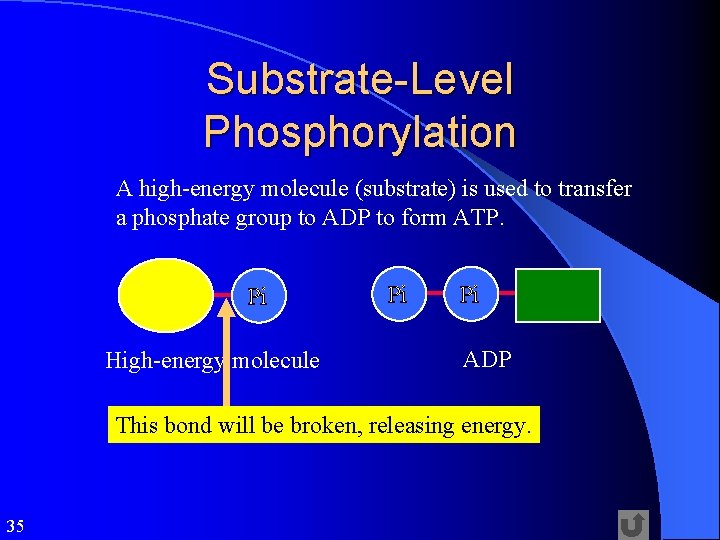
Substrate-Level Phosphorylation A high-energy molecule (substrate) is used to transfer a phosphate group to ADP to form ATP. Pi High-energy molecule Pi Pi ADP This bond will be broken, releasing energy. 35
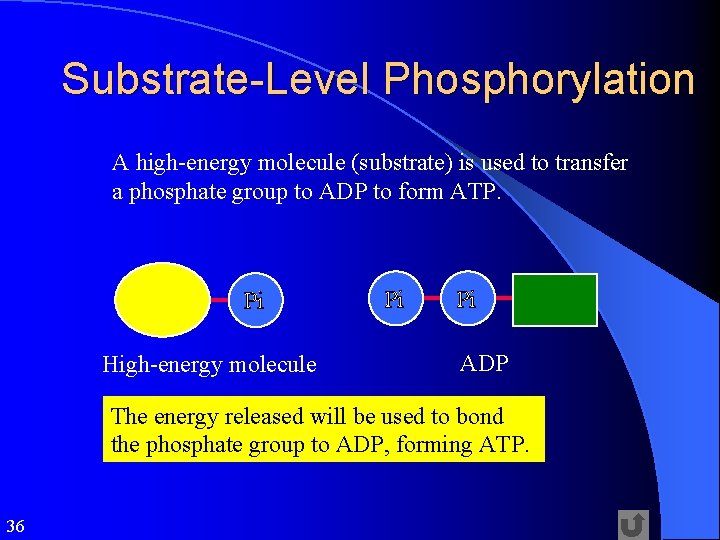
Substrate-Level Phosphorylation A high-energy molecule (substrate) is used to transfer a phosphate group to ADP to form ATP. Pi High-energy molecule Pi Pi ADP The energy released will be used to bond the phosphate group to ADP, forming ATP. 36
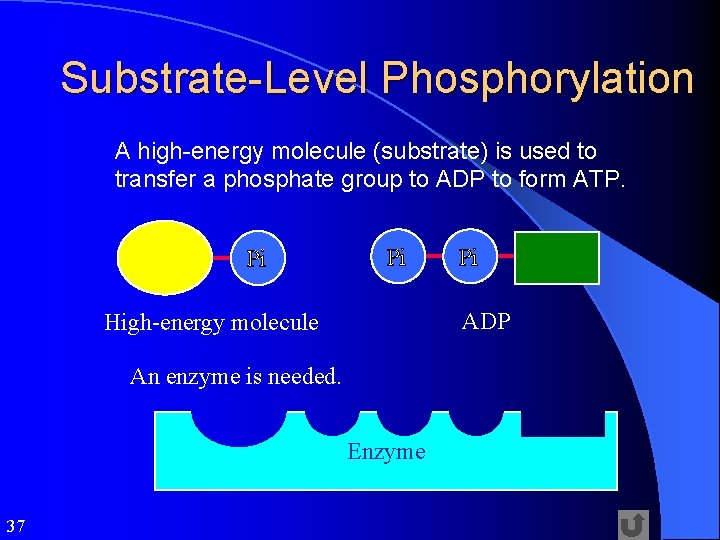
Substrate-Level Phosphorylation A high-energy molecule (substrate) is used to transfer a phosphate group to ADP to form ATP. Pi Pi ADP High-energy molecule An enzyme is needed. Enzyme 37 Pi
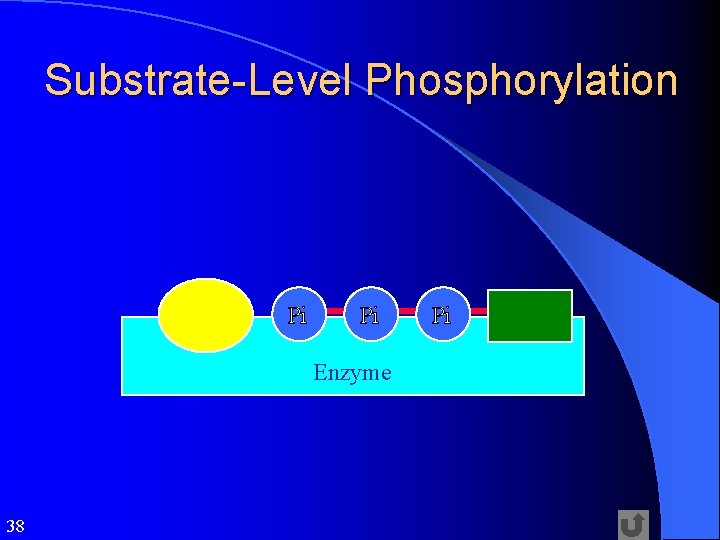
Substrate-Level Phosphorylation Pi Pi Enzyme 38 Pi
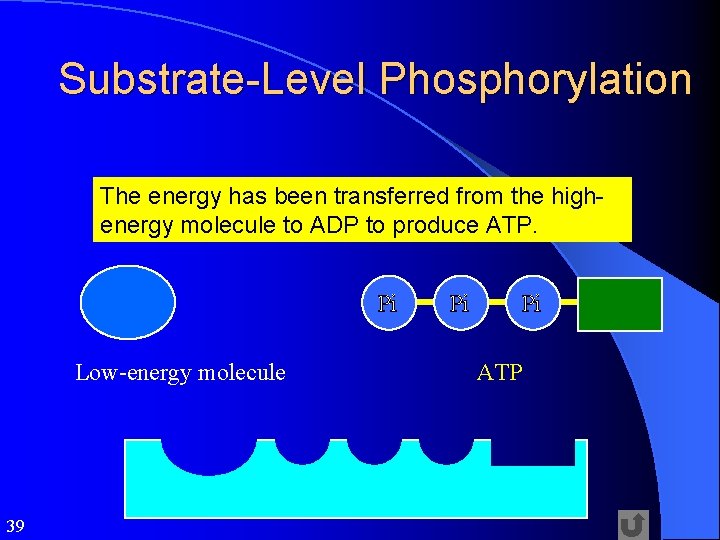
Substrate-Level Phosphorylation The energy has been transferred from the highenergy molecule to ADP to produce ATP. Pi Low-energy molecule 39 Pi Pi ATP
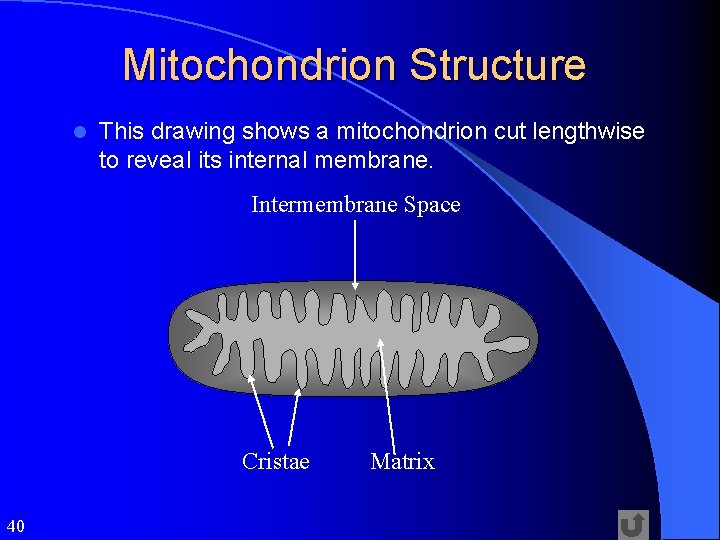
Mitochondrion Structure l This drawing shows a mitochondrion cut lengthwise to reveal its internal membrane. Intermembrane Space Cristae 40 Matrix
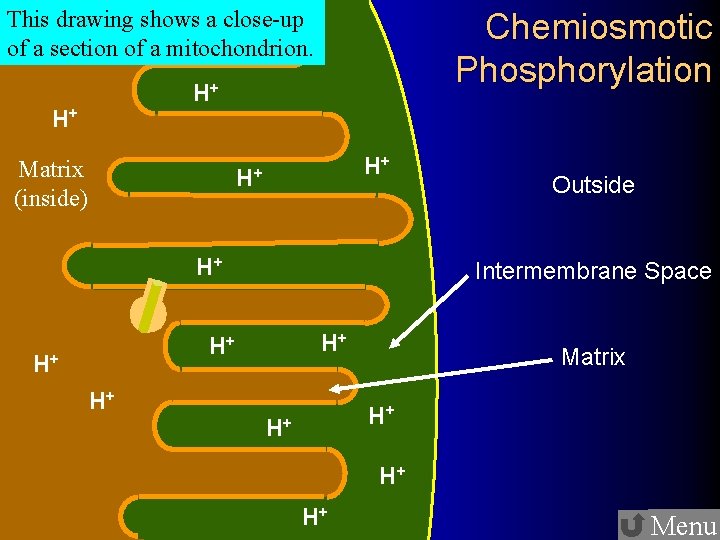
This drawing shows a close-up of a section of a mitochondrion. Chemiosmotic Phosphorylation H+ H+ Matrix (inside) H+ H+ H+ Intermembrane Space H+ H+ H+ Outside H+ Matrix H+ H+ Menu
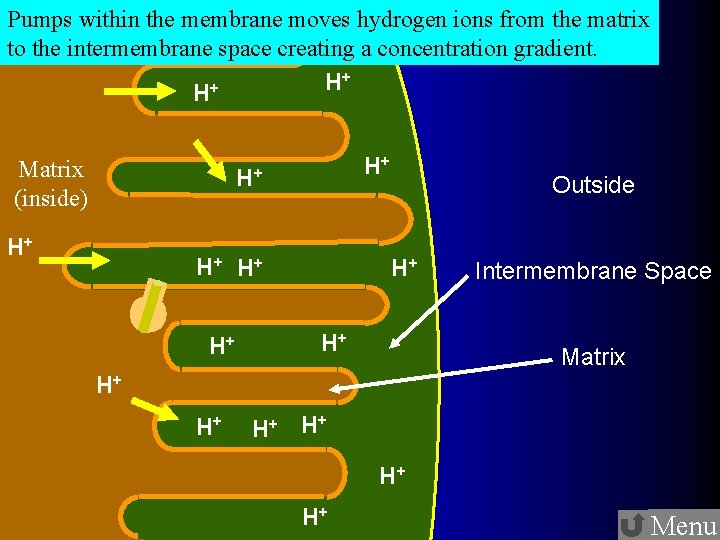
Pumps within the membrane moves hydrogen ions from the matrix to the intermembrane space creating a concentration gradient. + H Matrix (inside) H+ H+ H+ 00 H+ H+ H+ Outside H+ H+ Intermembrane Space Matrix H+ H+ H+ Menu
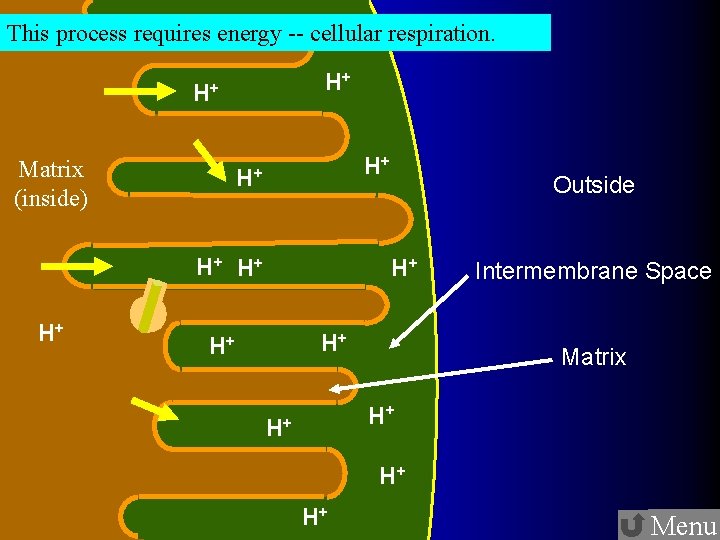
This process requires energy -- cellular respiration. H+ H+ Matrix (inside) H+ H+ H+ Outside H+ H+ H+ Intermembrane Space Matrix H+ H+ Menu
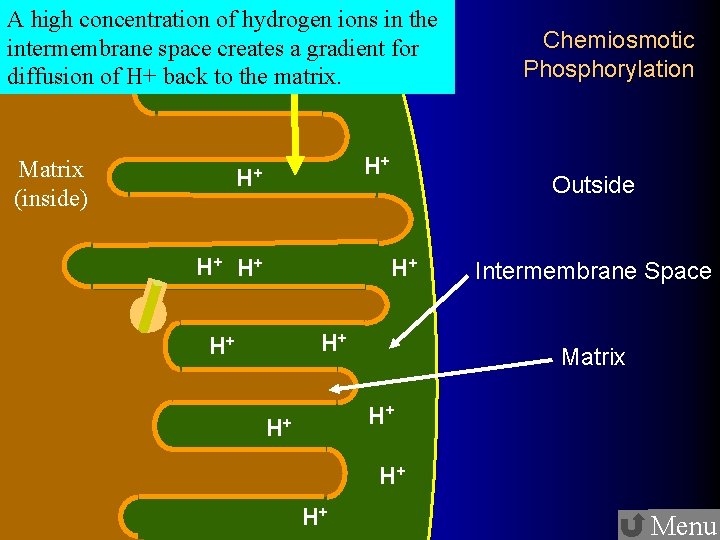
A high concentration of hydrogen ions in the intermembrane space creates a gradient for diffusion of H+ back to the matrix. H+ Matrix (inside) H+ H+ Outside H+ H+ H+ Chemiosmotic Phosphorylation Intermembrane Space Matrix H+ H+ Menu
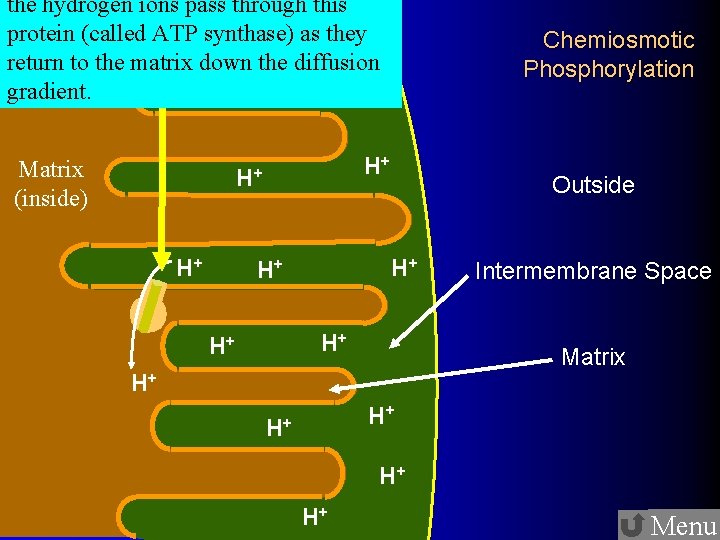
the hydrogen ions pass through this protein (called ATP synthase) as they return to the matrix down the diffusion + H + gradient. H Matrix (inside) H+ H+ H+ Chemiosmotic Phosphorylation Outside H+ H+ Intermembrane Space Matrix H+ H+ H+ Menu
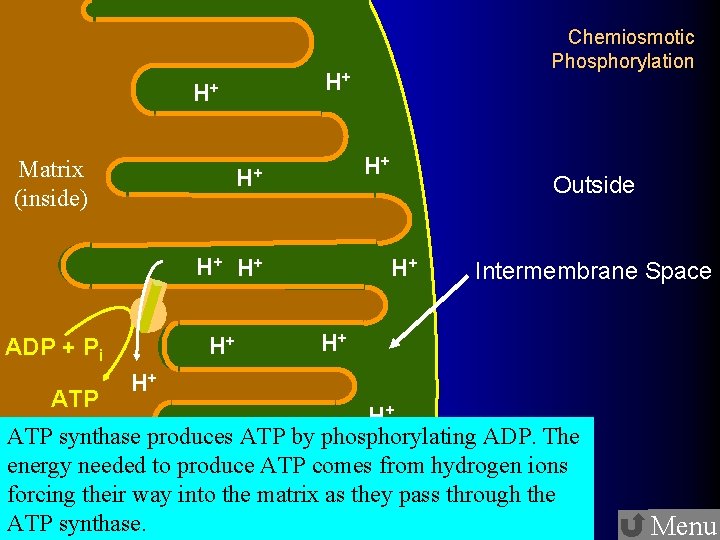
H+ H+ Matrix (inside) H+ H+ ATP Outside H+ Intermembrane Space H+ H+ ADP + Pi Chemiosmotic Phosphorylation H+ H+ ATP synthase produces ATP by phosphorylating ADP. The energy needed to produce ATP comes from H+ hydrogen ions forcing their way into the matrix as they pass through the H+ ATP synthase. H+ Menu
Chemiosmotic Phosphorylation 47 l Chemiosmotic phosphorylation is used by the mitochondrion to produce ATP. The energy needed to initially pump H+ ions into the intermembrane space comes from glucose. The entire process is called cellular respiration. l The chloroplast also produces ATP by chemiosmotic phosphorylation. The energy needed to produce ATP comes from sunlight.
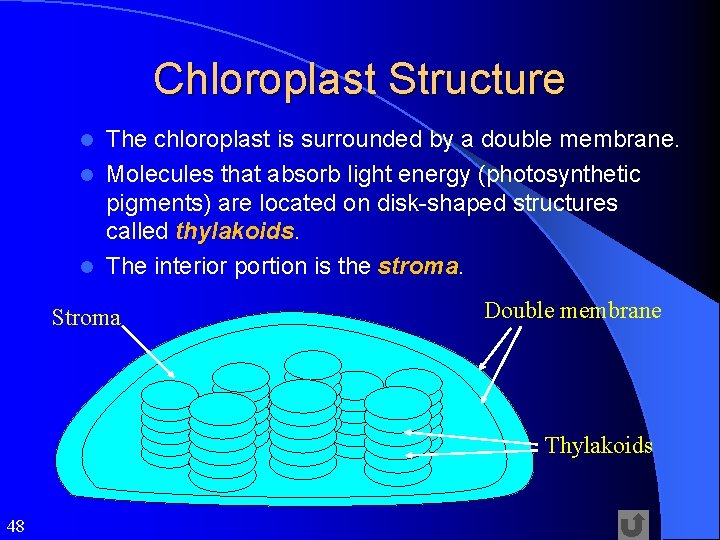
Chloroplast Structure The chloroplast is surrounded by a double membrane. l Molecules that absorb light energy (photosynthetic pigments) are located on disk-shaped structures called thylakoids. l The interior portion is the stroma. l Stroma Double membrane Thylakoids 48
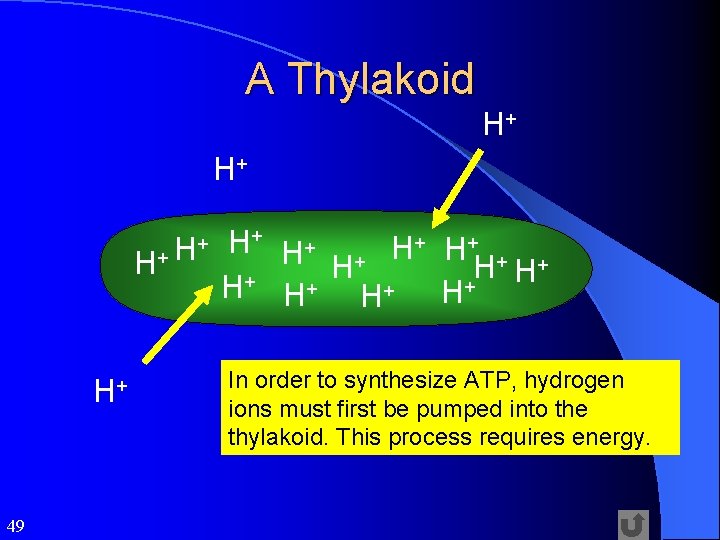
A Thylakoid H+ H+ 49 H+ + H+ H + + + H H H + + H H+ H+ H In order to synthesize ATP, hydrogen ions must first be pumped into the thylakoid. This process requires energy.
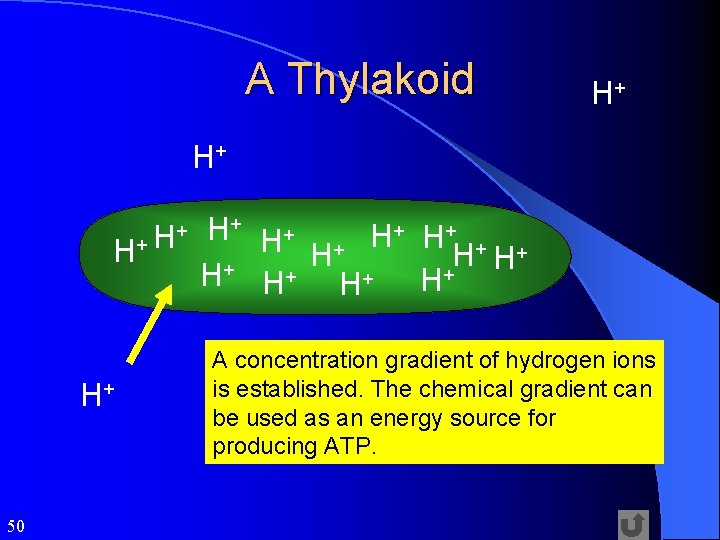
A Thylakoid H+ H+ 50 H+ + H+ H + + + H H H + + H H+ H+ H A concentration gradient of hydrogen ions is established. The chemical gradient can be used as an energy source for producing ATP.
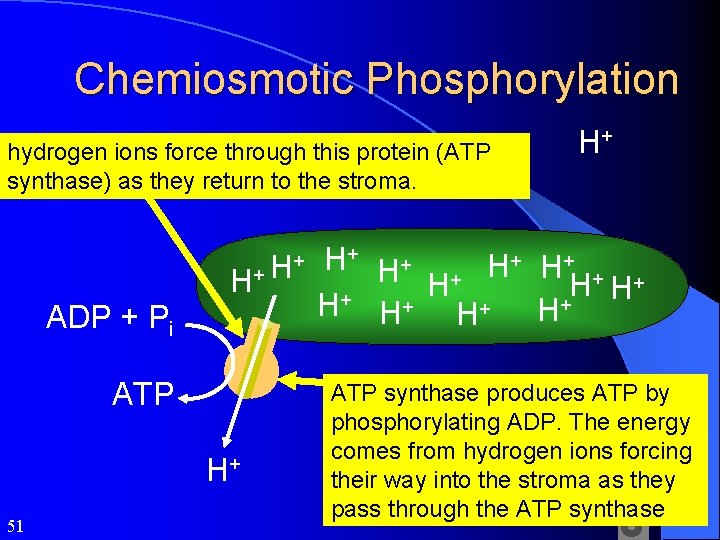
Chemiosmotic Phosphorylation hydrogen ions force through this protein (ATP synthase) as they return to the stroma. H+ H+ ADP + Pi ATP H+ 51 H+ H+ H + + + H H H + + H H+ H+ H ATP synthase produces ATP by phosphorylating ADP. The energy H+ comes from hydrogen ions forcing their way into the stroma as they pass through the ATP synthase
Phosphorylation l We have just discussed two different forms of phosphorylation: – Substrate-level phosphorylation – Chemiosmotic phosphorylation l We saw that chemiosmotic phosphorylation occurred in both the mitochondria (during cellular respiration) and in the chloroplast (during photosynthesis). These two processes are sometimes given separate names: – Oxidative phosphorylation (in mitochondria) – Photophosphorylation (in chloroplast) 52
Chemiosmosis: Chloroplasts vs. Mitochondria Similarities: In both organelles Similarities –Redox reactions of electron transport chains generate a H+ gradient across a membrane –Involves ATP synthase which uses this proton-motive force to make ATP Difference: Difference –use different sources of energy to accomplish this (proton gradient). Chloroplasts use light energy (photophosphorylation) and mitochondria use the chemical energy in organic molecules (oxidative phosphorylation).
The End 54
- Slides: 53