
Energy Machines and Motion Underlying Themes of the




- Slides: 29
Energy Machines and Motion Underlying Themes of the Module Different forms of energy; how forces do work to change energy from one form to another; how machines reduce the force needed to do work; and how forces change the motion of objects
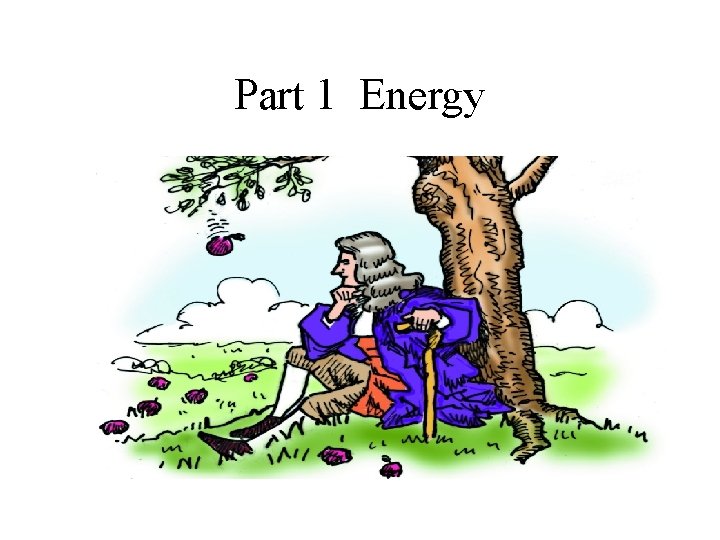
Part 1 Energy
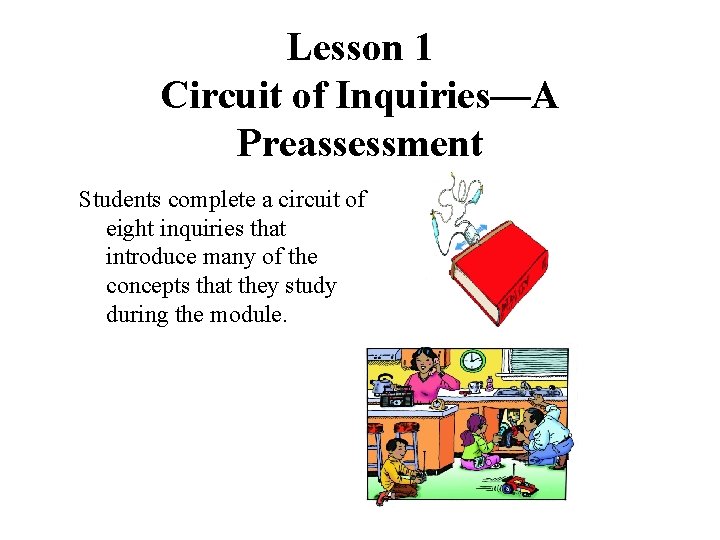
Lesson 1 Circuit of Inquiries—A Preassessment Students complete a circuit of eight inquiries that introduce many of the concepts that they study during the module.
Lesson 2 Making a Battery Concepts: Battery structure and function; supply of energy by a chemical reaction; limited “battery life” Students: • Build a copper-zinc electrode battery • Observe and describe how the battery works
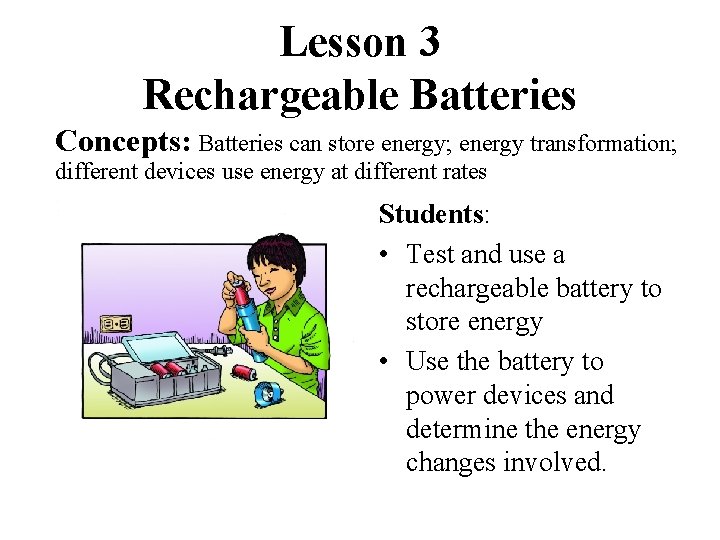
Lesson 3 Rechargeable Batteries Concepts: Batteries can store energy; energy transformation; different devices use energy at different rates Students: • Test and use a rechargeable battery to store energy • Use the battery to power devices and determine the energy changes involved.
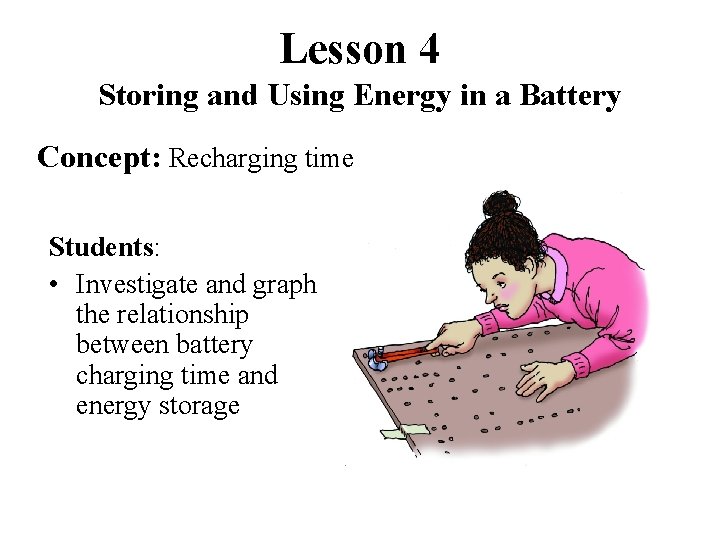
Lesson 4 Storing and Using Energy in a Battery Concept: Recharging time Students: • Investigate and graph the relationship between battery charging time and energy storage
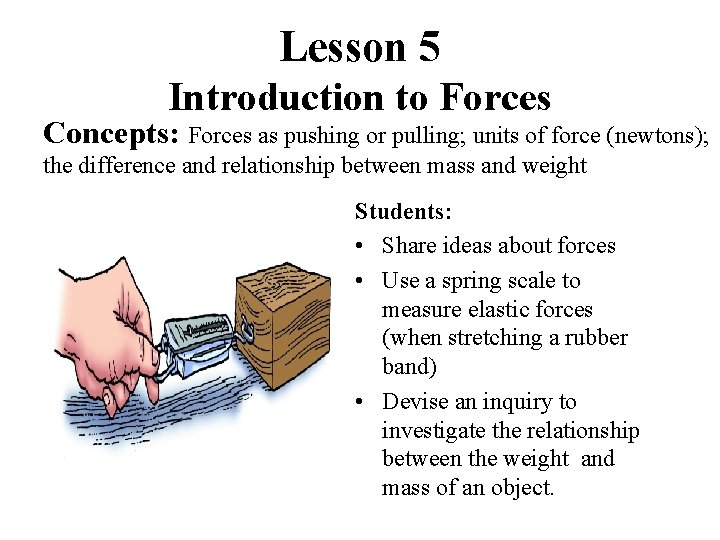
Lesson 5 Introduction to Forces Concepts: Forces as pushing or pulling; units of force (newtons); the difference and relationship between mass and weight Students: • Share ideas about forces • Use a spring scale to measure elastic forces (when stretching a rubber band) • Devise an inquiry to investigate the relationship between the weight and mass of an object.
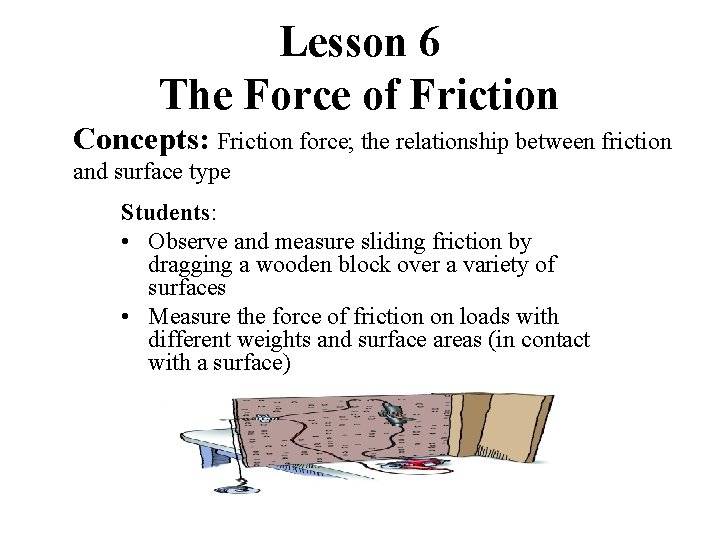
Lesson 6 The Force of Friction Concepts: Friction force; the relationship between friction and surface type Students: • Observe and measure sliding friction by dragging a wooden block over a variety of surfaces • Measure the force of friction on loads with different weights and surface areas (in contact with a surface)
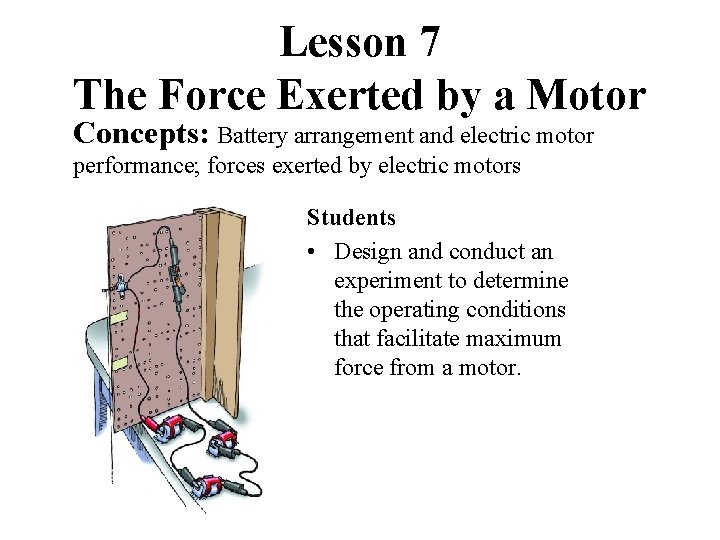
Lesson 7 The Force Exerted by a Motor Concepts: Battery arrangement and electric motor performance; forces exerted by electric motors Students • Design and conduct an experiment to determine the operating conditions that facilitate maximum force from a motor.
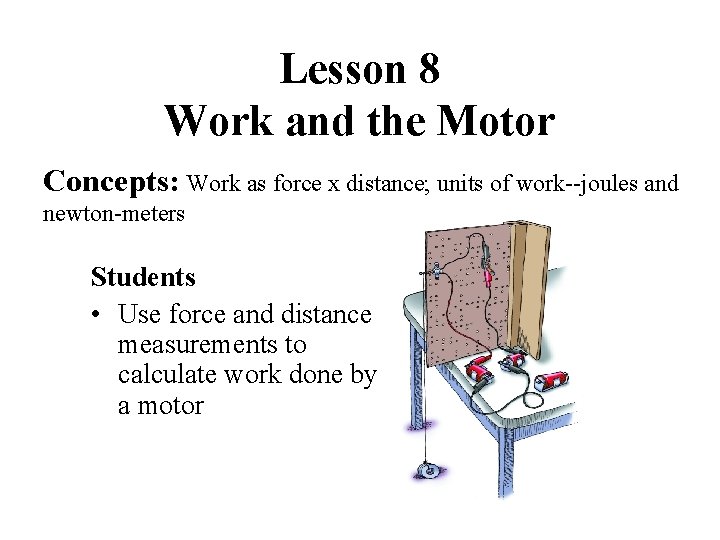
Lesson 8 Work and the Motor Concepts: Work as force x distance; units of work--joules and newton-meters Students • Use force and distance measurements to calculate work done by a motor
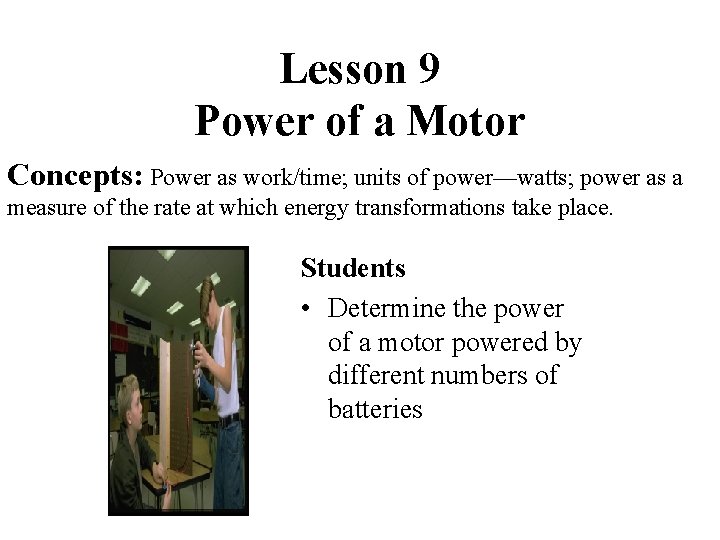
Lesson 9 Power of a Motor Concepts: Power as work/time; units of power—watts; power as a measure of the rate at which energy transformations take place. Students • Determine the power of a motor powered by different numbers of batteries
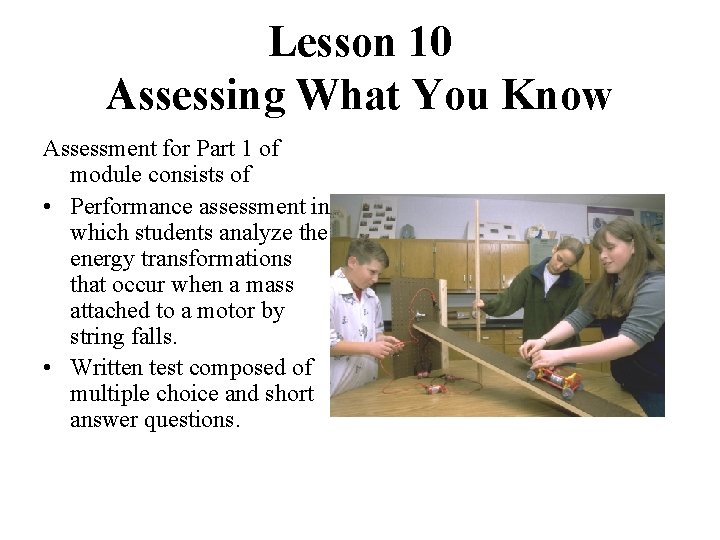
Lesson 10 Assessing What You Know Assessment for Part 1 of module consists of • Performance assessment in which students analyze the energy transformations that occur when a mass attached to a motor by string falls. • Written test composed of multiple choice and short answer questions. Need Grabber photo for this lesson
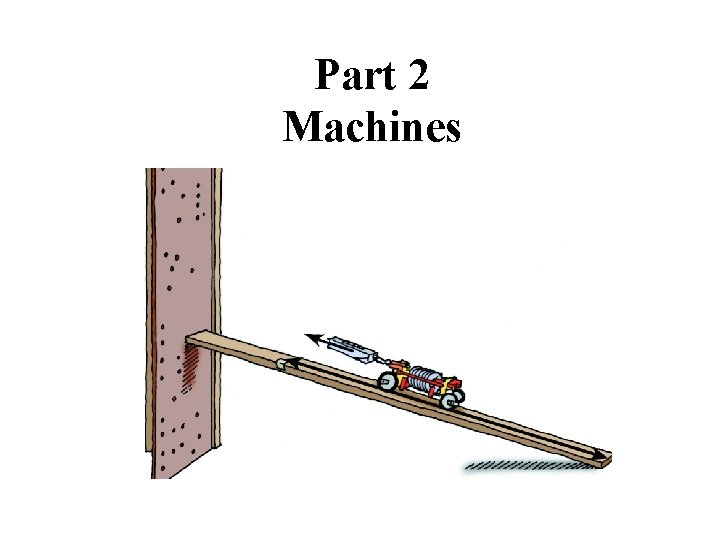
Part 2 Machines
Lesson 11 The Inclined Plane Concepts: Measuring work when lifting; using machines to reduce effort; effect of friction on work Students: • Measure forces on a cart on an inclined plane • Measure work on a cart on an inclined plane • Compare the work done by lifting and raising the same load on an inclined plane
Lesson 12 The Pulley Concept: A pulley as a machine Students: • Explore the use of pulleys • Calculate the work done by different pulley arrangements
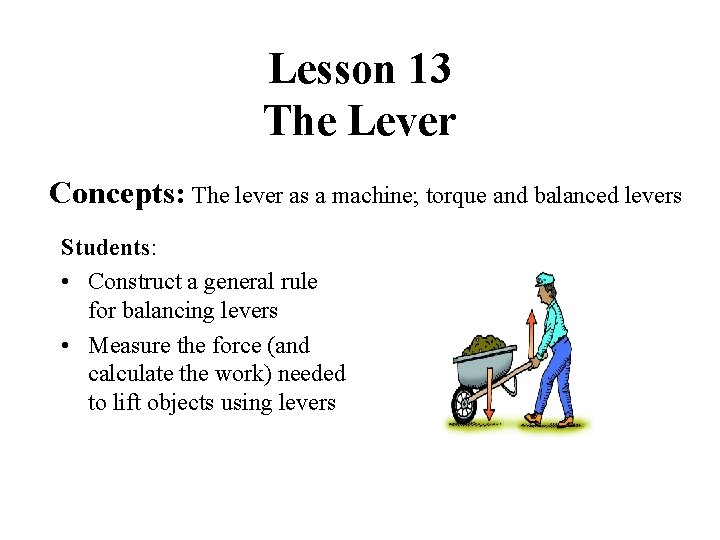
Lesson 13 The Lever Concepts: The lever as a machine; torque and balanced levers Students: • Construct a general rule for balancing levers • Measure the force (and calculate the work) needed to lift objects using levers
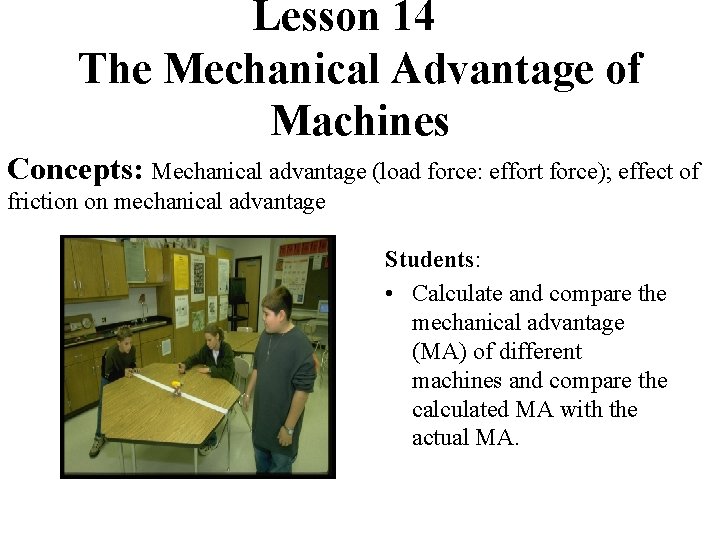
Lesson 14 The Mechanical Advantage of Machines Concepts: Mechanical advantage (load force: effort force); effect of friction on mechanical advantage Students: • Calculate and compare the mechanical advantage (MA) of different machines and compare the calculated MA with the actual MA.
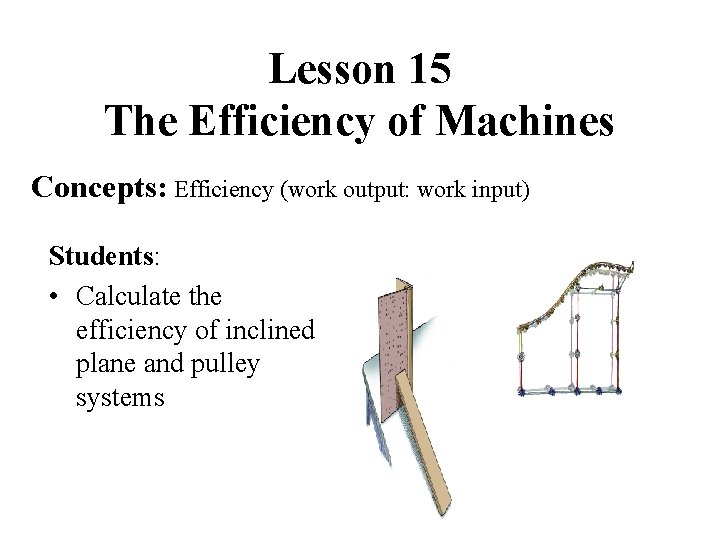
Lesson 15 The Efficiency of Machines Concepts: Efficiency (work output: work input) Students: • Calculate the efficiency of inclined plane and pulley systems
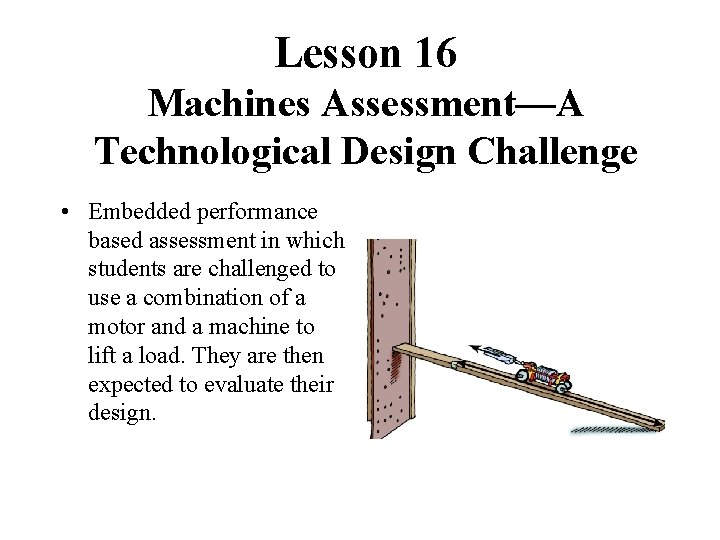
Lesson 16 Machines Assessment—A Technological Design Challenge • Embedded performance based assessment in which students are challenged to use a combination of a motor and a machine to lift a load. They are then expected to evaluate their design.
Part 3 Motion
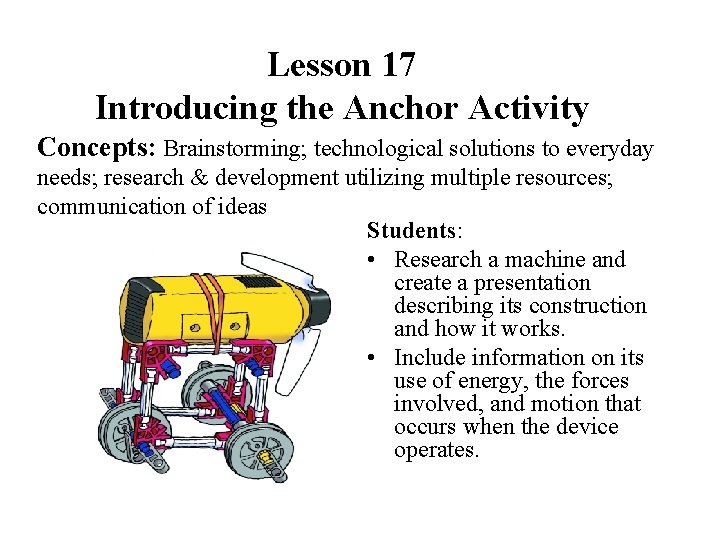
Lesson 17 Introducing the Anchor Activity Concepts: Brainstorming; technological solutions to everyday needs; research & development utilizing multiple resources; communication of ideas Students: • Research a machine and create a presentation describing its construction and how it works. • Include information on its use of energy, the forces involved, and motion that occurs when the device operates.
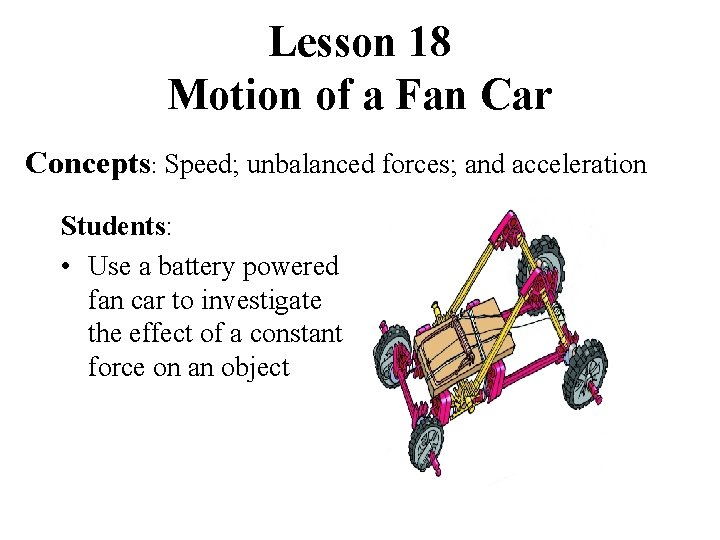
Lesson 18 Motion of a Fan Car Concepts: Speed; unbalanced forces; and acceleration Students: • Use a battery powered fan car to investigate the effect of a constant force on an object
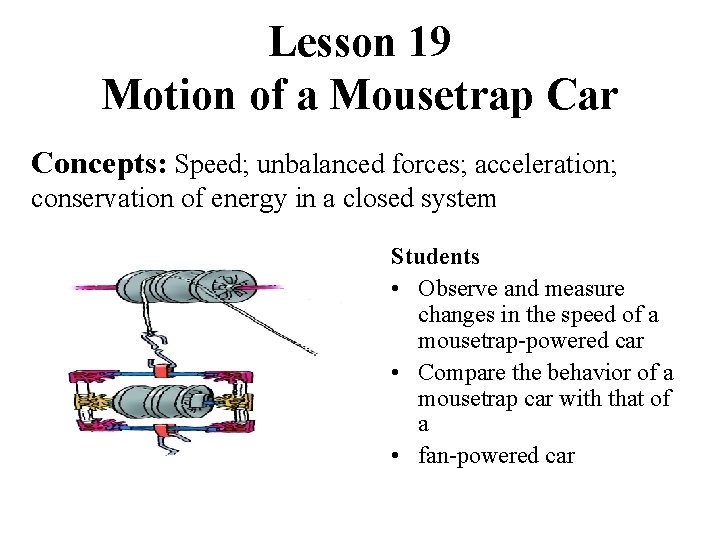
Lesson 19 Motion of a Mousetrap Car Concepts: Speed; unbalanced forces; acceleration; conservation of energy in a closed system Students • Observe and measure changes in the speed of a mousetrap-powered car • Compare the behavior of a mousetrap car with that of a • fan-powered car
Lessons 20 -21 The Roller Coaster and Motion on a Roller Coaster Concepts: Kinetic energy, potential energy (reviews a wide range of earlier concepts) Students: • Build a model roller coaster • Predict, observe, and describe the motion of a model roller coaster car • Measure the speed of a model roller coaster car
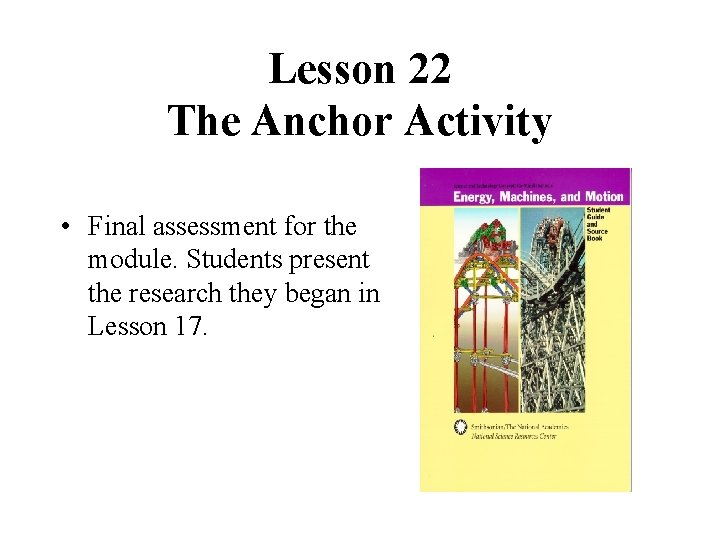
Lesson 22 The Anchor Activity • Final assessment for the module. Students present the research they began in Lesson 17.