
Energy Levels Orbitals Demonstrate and apply knowledge and
Energy Levels & Orbitals Demonstrate and apply knowledge and understanding of: Conventions for representing the distribution of electrons in atomic orbitals – the shapes of s- and porbitals The electronic configuration, using sub-shells and atomic orbitals, of: Atoms from hydrogen to krypton The outer sub-shell structures of s- and p-block elements of other periods
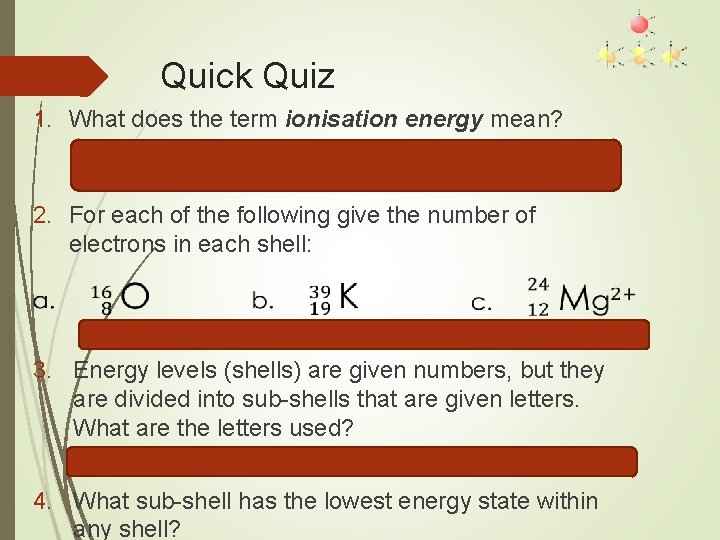
Quick Quiz 1. What does the term ionisation energy mean? The amount of energy required to remove an electron from gaseous atoms. 2. For each of the following give the number of electrons in each shell: 2, 6 – 2, 8, 8, 1 – [2, 8]2+ 3. Energy levels (shells) are given numbers, but they are divided into sub-shells that are given letters. What are the letters used? s, p, d, f. 4. What sub-shell has the lowest energy state within any shell?
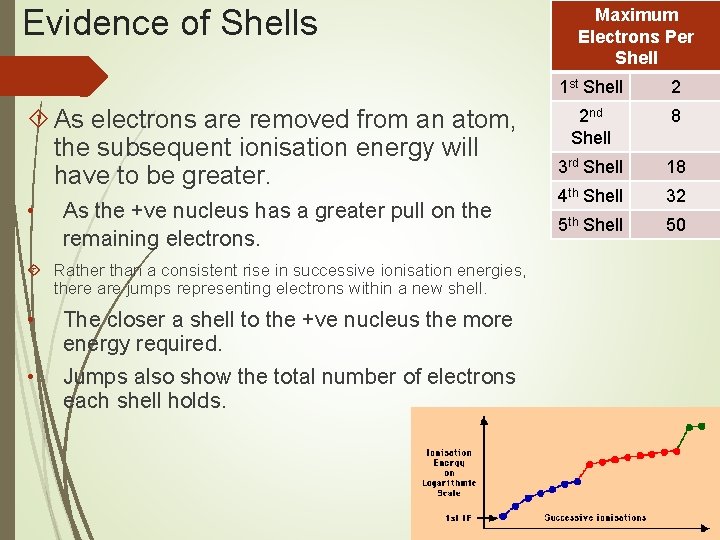
Evidence of Shells As electrons are removed from an atom, the subsequent ionisation energy will have to be greater. • As the +ve nucleus has a greater pull on the remaining electrons. Rather than a consistent rise in successive ionisation energies, there are jumps representing electrons within a new shell. • The closer a shell to the +ve nucleus the more energy required. • Jumps also show the total number of electrons each shell holds. Maximum Electrons Per Shell 1 st Shell 2 2 nd Shell 8 3 rd Shell 18 4 th Shell 32 5 th Shell 50
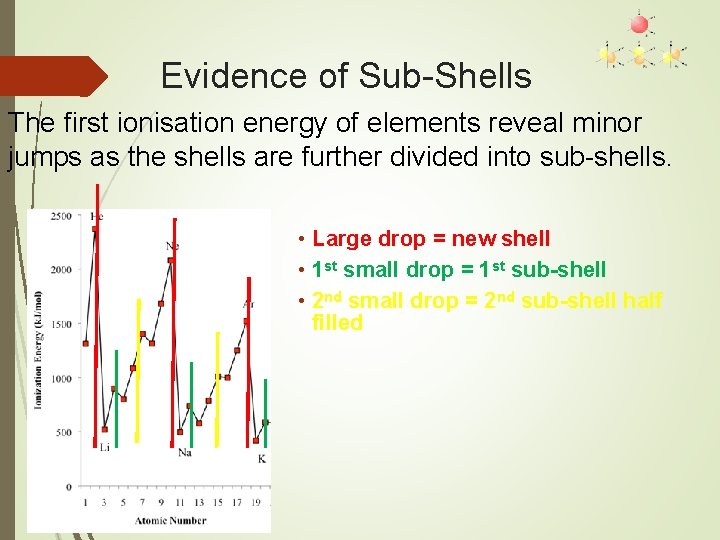
Evidence of Sub-Shells The first ionisation energy of elements reveal minor jumps as the shells are further divided into sub-shells. • Large drop = new shell • 1 st small drop = 1 st sub-shell • 2 nd small drop = 2 nd sub-shell half filled

Energy Levels & Sub-Shells INCREASING ENERGY / DISTANCE FROM NUCLEUS PRINCIPAL ENERGY LEVELS 4 Electrons further from the nucleus are in a higher energy state. SUB LEVELS f d • p So it is better to think of shells as energy levels. s 3 d The lowest energy state in any energy level is the s sub-shell. p • Then p, d and f sub-shells respectively. s ‘Silly people don’t fight. ’ p 2 1 s s Naming sub-shells: e. g. second sub-shell in third energy level would be: 3 p Principle quantum number (energy level) Sub-shell
Modelling Orbitals An orbital is ‘a region around the nucleus that can hold up to two electrons, with opposite spins’. • i. e. where it is likely to find an electron within an energy level. Each sub-shell type contains a different number of orbitals. Subshell Maximum Electrons Number of Orbitals s 2 1 p 6 3 d 10 5 Different types of orbitals also have different shapes. Use balloons to model orbitals and then use them to explain: • How do the same orbital types differ with different principle quantum numbers i. e. 1 s compared 2 s? • How do s- and p-orbital shapes differ? • How 2 p orbitals are arranged.
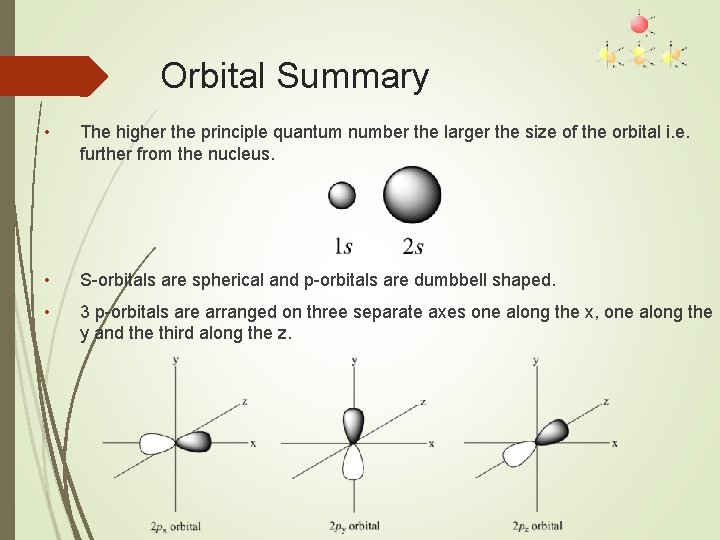
Orbital Summary • The higher the principle quantum number the larger the size of the orbital i. e. further from the nucleus. • S-orbitals are spherical and p-orbitals are dumbbell shaped. • 3 p-orbitals are arranged on three separate axes one along the x, one along the y and the third along the z.
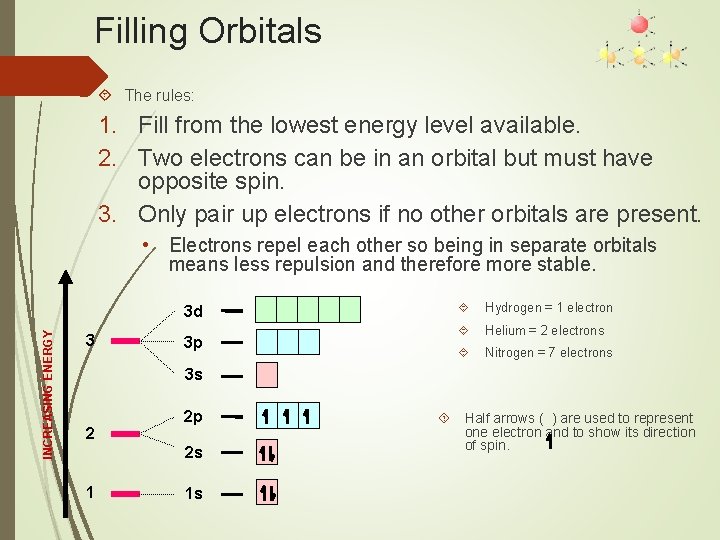
Filling Orbitals The rules: 1. Fill from the lowest energy level available. 2. Two electrons can be in an orbital but must have opposite spin. 3. Only pair up electrons if no other orbitals are present. • Electrons repel each other so being in separate orbitals means less repulsion and therefore more stable. INCREASING ENERGY 3 d 3 3 p Hydrogen = 1 electron Helium = 2 electrons Nitrogen = 7 electrons 3 s 2 2 p 2 s 1 1 s Half arrows ( ) are used to represent one electron and to show its direction of spin.
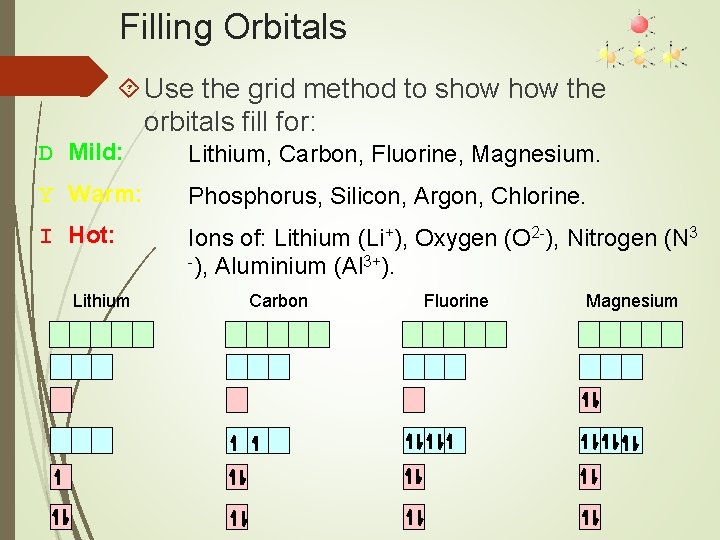
Filling Orbitals Use the grid method to show the orbitals fill for: D Mild: Lithium, Carbon, Fluorine, Magnesium. Y Warm: Phosphorus, Silicon, Argon, Chlorine. I Hot: Ions of: Lithium (Li+), Oxygen (O 2 -), Nitrogen (N 3 -), Aluminium (Al 3+). Lithium Carbon Fluorine Magnesium
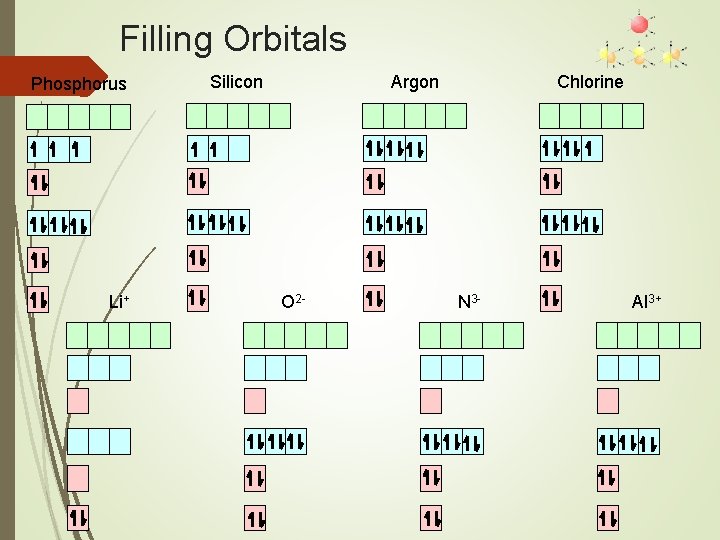
Filling Orbitals Phosphorus Li+ Silicon Argon O 2 - Chlorine N 3 - Al 3+
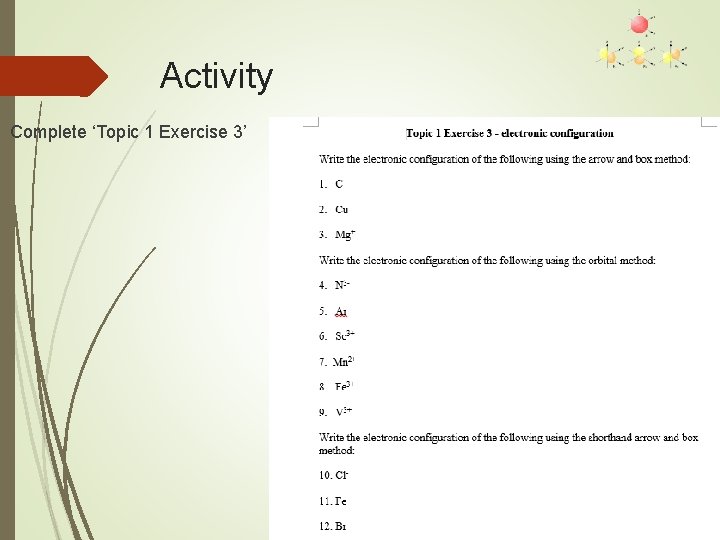
Activity Complete ‘Topic 1 Exercise 3’
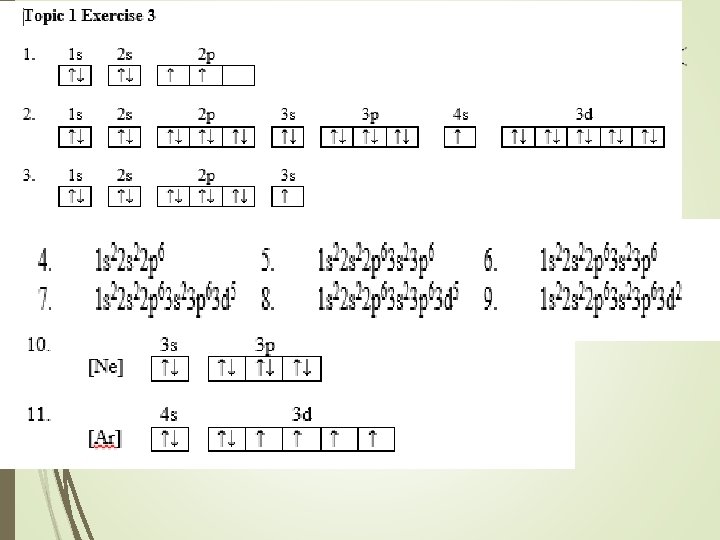
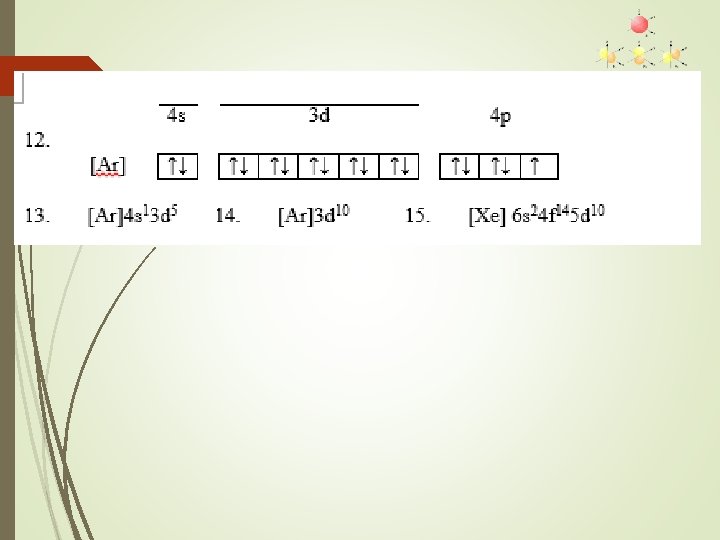
Summary Questions
- Slides: 14