
Energy is the Reason for Everything Calorimetry measurement
- Slides: 11
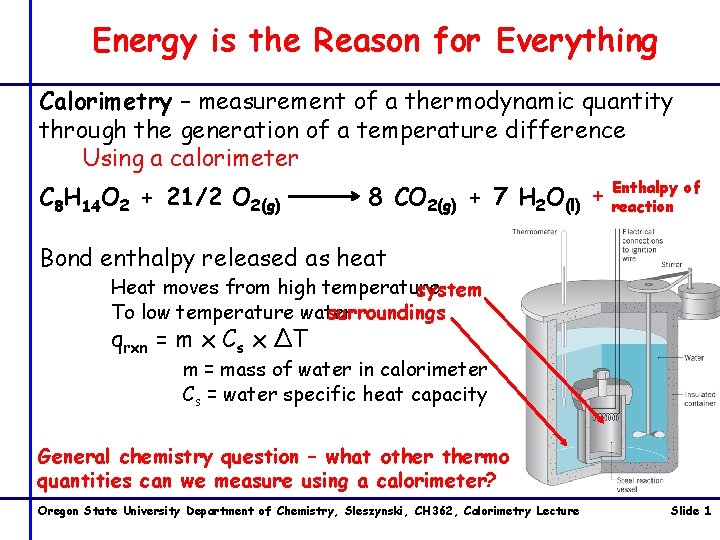
Energy is the Reason for Everything Calorimetry – measurement of a thermodynamic quantity through the generation of a temperature difference Using a calorimeter C 8 H 14 O 2 + 21/2 O 2(g) Enthalpy of 8 CO 2(g) + 7 H 2 O(l) + reaction Bond enthalpy released as heat Heat moves from high temperature system surroundings To low temperature water qrxn = m x Cs x ∆T m = mass of water in calorimeter Cs = water specific heat capacity General chemistry question – what othermo quantities can we measure using a calorimeter? Oregon State University Department of Chemistry, Sleszynski, CH 362, Calorimetry Lecture Slide 1
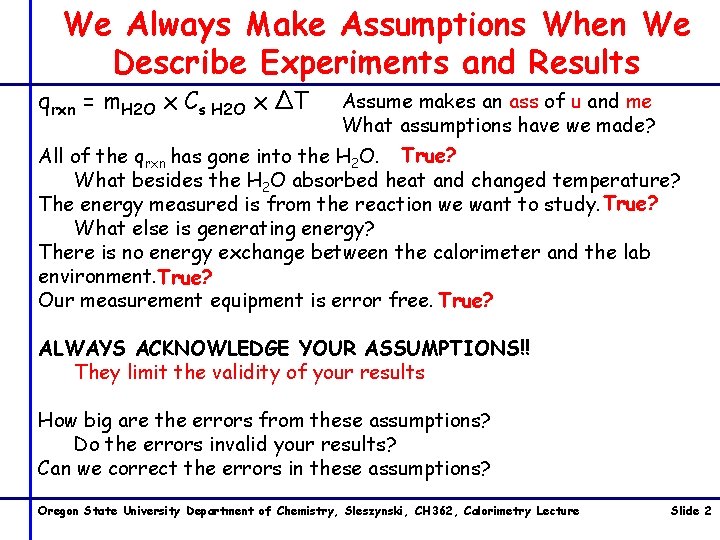
We Always Make Assumptions When We Describe Experiments and Results qrxn = m. H 2 O x Cs H 2 O x ∆T Assume makes an ass of u and me What assumptions have we made? All of the qrxn has gone into the H 2 O. True? What besides the H 2 O absorbed heat and changed temperature? The energy measured is from the reaction we want to study. True? What else is generating energy? There is no energy exchange between the calorimeter and the lab environment. True? Our measurement equipment is error free. True? ALWAYS ACKNOWLEDGE YOUR ASSUMPTIONS!! They limit the validity of your results How big are the errors from these assumptions? Do the errors invalid your results? Can we correct the errors in these assumptions? Oregon State University Department of Chemistry, Sleszynski, CH 362, Calorimetry Lecture Slide 2
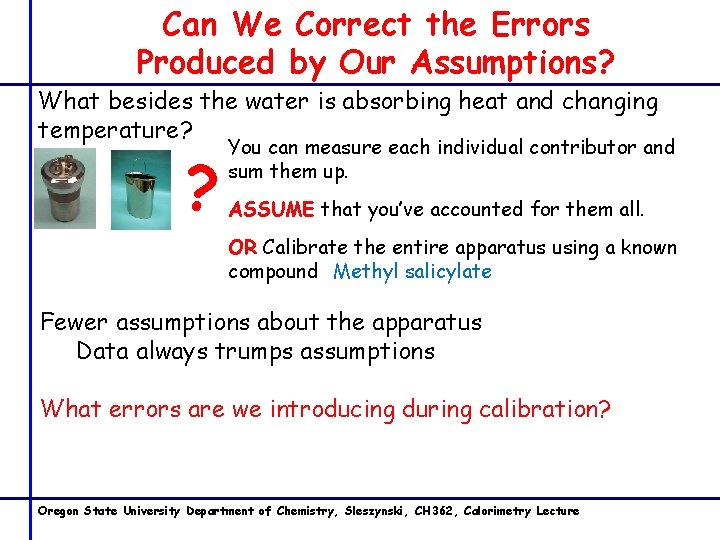
Can We Correct the Errors Produced by Our Assumptions? What besides the water is absorbing heat and changing temperature? ? You can measure each individual contributor and sum them up. ASSUME that you’ve accounted for them all. OR Calibrate the entire apparatus using a known compound Methyl salicylate Fewer assumptions about the apparatus Data always trumps assumptions What errors are we introducing during calibration? Oregon State University Department of Chemistry, Sleszynski, CH 362, Calorimetry Lecture
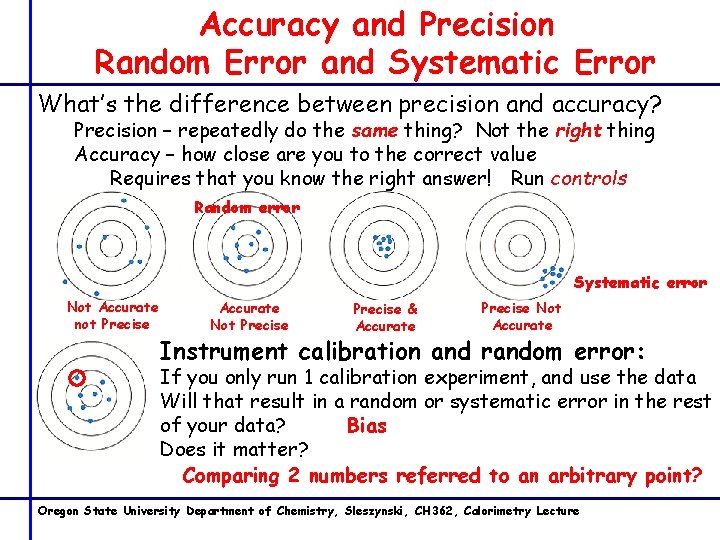
Accuracy and Precision Random Error and Systematic Error What’s the difference between precision and accuracy? Precision – repeatedly do the same thing? Not the right thing Accuracy – how close are you to the correct value Requires that you know the right answer! Run controls Random error Systematic error Not Accurate not Precise Accurate Not Precise & Accurate Precise Not Accurate Instrument calibration and random error: If you only run 1 calibration experiment, and use the data Will that result in a random or systematic error in the rest of your data? Bias Does it matter? Comparing 2 numbers referred to an arbitrary point? Oregon State University Department of Chemistry, Sleszynski, CH 362, Calorimetry Lecture
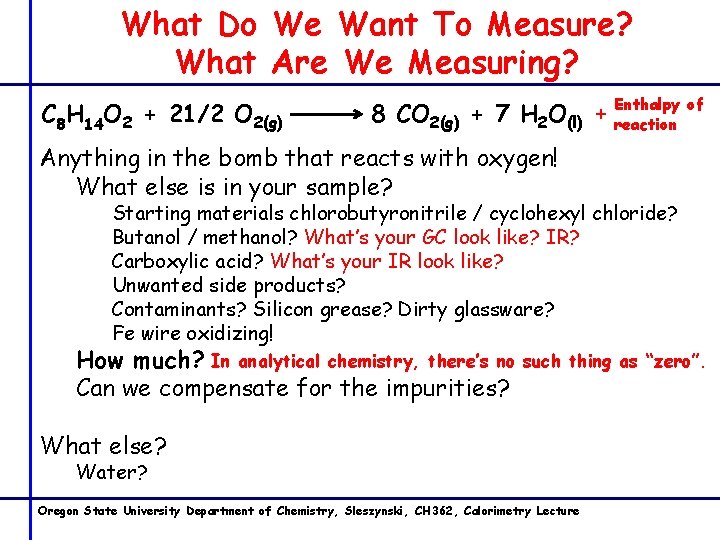
What Do We Want To Measure? What Are We Measuring? C 8 H 14 O 2 + 21/2 O 2(g) Enthalpy of 8 CO 2(g) + 7 H 2 O(l) + reaction Anything in the bomb that reacts with oxygen! What else is in your sample? Starting materials chlorobutyronitrile / cyclohexyl chloride? Butanol / methanol? What’s your GC look like? IR? Carboxylic acid? What’s your IR look like? Unwanted side products? Contaminants? Silicon grease? Dirty glassware? Fe wire oxidizing! How much? In analytical chemistry, there’s no Can we compensate for the impurities? such thing as “zero”. What else? Water? Oregon State University Department of Chemistry, Sleszynski, CH 362, Calorimetry Lecture
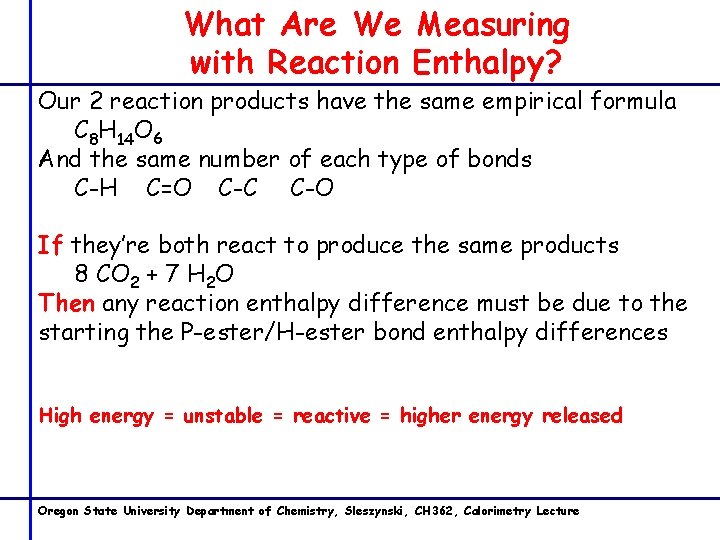
What Are We Measuring with Reaction Enthalpy? Our 2 reaction products have the same empirical formula C 8 H 14 O 6 And the same number of each type of bonds C-H C=O C-C C-O If they’re both react to produce the same products 8 CO 2 + 7 H 2 O Then any reaction enthalpy difference must be due to the starting the P-ester/H-ester bond enthalpy differences High energy = unstable = reactive = higher energy released Oregon State University Department of Chemistry, Sleszynski, CH 362, Calorimetry Lecture
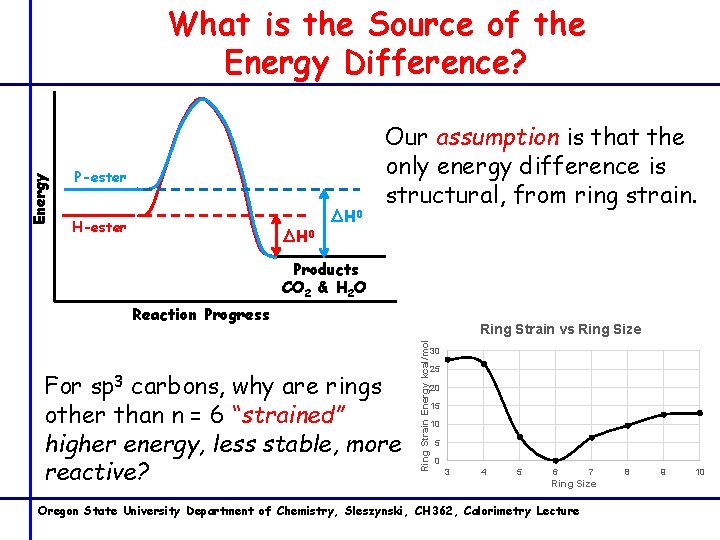
Energy What is the Source of the Energy Difference? P-ester H-ester ∆H 0 Our assumption is that the only energy difference is structural, from ring strain. Products CO 2 & H 2 O Reaction Progress For carbons, why are rings other than n = 6 “strained” higher energy, less stable, more reactive? Ring Strain Energy kcal/mol sp 3 Ring Strain vs Ring Size 30 25 20 15 10 5 0 3 4 5 6 7 Ring Size Oregon State University Department of Chemistry, Sleszynski, CH 362, Calorimetry Lecture 8 9 10
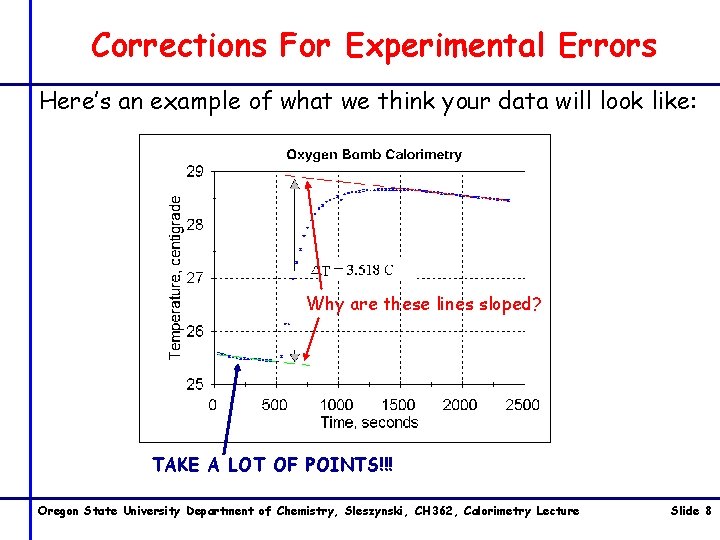
Corrections For Experimental Errors Here’s an example of what we think your data will look like: Why are these lines sloped? TAKE A LOT OF POINTS!!! Oregon State University Department of Chemistry, Sleszynski, CH 362, Calorimetry Lecture Slide 8
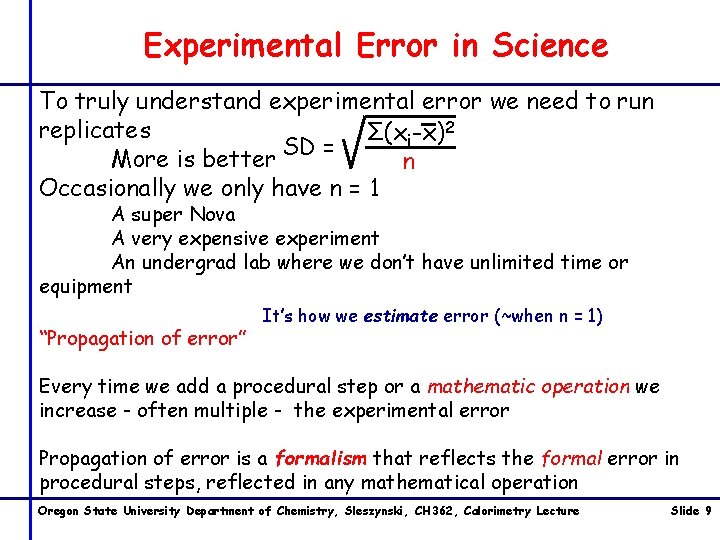
Experimental Error in Science To truly understand experimental error we need to run replicates Σ(xi-x)2 More is better SD = n Occasionally we only have n = 1 A super Nova A very expensive experiment An undergrad lab where we don’t have unlimited time or equipment “Propagation of error” It’s how we estimate error (~when n = 1) Every time we add a procedural step or a mathematic operation we increase - often multiple - the experimental error Propagation of error is a formalism that reflects the formal error in procedural steps, reflected in any mathematical operation Oregon State University Department of Chemistry, Sleszynski, CH 362, Calorimetry Lecture Slide 9
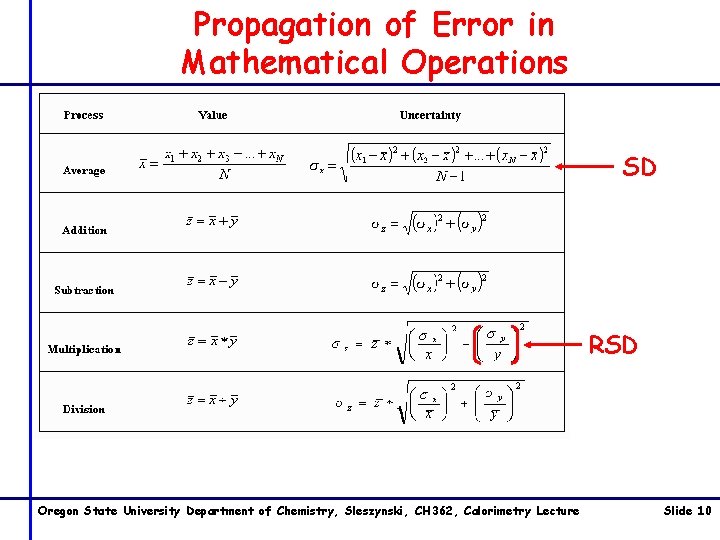
Propagation of Error in Mathematical Operations SD RSD Oregon State University Department of Chemistry, Sleszynski, CH 362, Calorimetry Lecture Slide 10
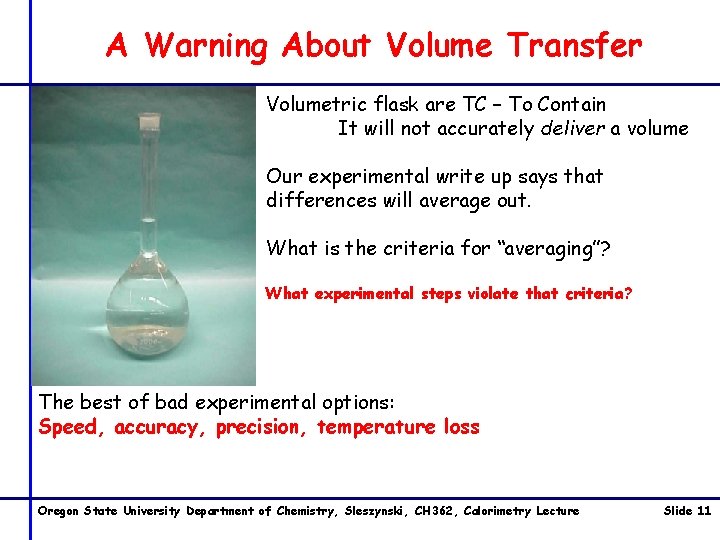
A Warning About Volume Transfer Volumetric flask are TC – To Contain It will not accurately deliver a volume Our experimental write up says that differences will average out. What is the criteria for “averaging”? What experimental steps violate that criteria? The best of bad experimental options: Speed, accuracy, precision, temperature loss Oregon State University Department of Chemistry, Sleszynski, CH 362, Calorimetry Lecture Slide 11