
Energy Insecurity Energy Justice Diana Hernndez Ph D

- Slides: 20
Energy Insecurity, Energy Justice Diana Hernández, Ph. D Assistant Professor of Sociomedical Sciences, Mailman School of Public Health, Columbia University JPB Environmental Health Fellow, Chan School of Public Health, Harvard University
Energy as a Basic Need “Energy is essential to meet our basic needs: cooking, boiling water, lighting and heating. It is also a prerequisite for good health - a reality that has been largely ignored by the world community. ” (World Health Organization, 2006)
“Naming, Blaming, Claiming” • “Naming, Blaming Claiming” framework describes the process of the emergence and transformation of disputes • Felstiner, Abel and Sarat (1980) argue that disputes surface when: • Injurious experiences are perceived (naming) • Grievances are stated (blaming) • Disputes are initiated (claiming) along with subsequent transformations (i. e. shifts in social norms) • Before we can blame or claim, we must NAME!
The Problem- Energy Insecurity • “A household experiences energy insecurity when it lacks consistent access to the amount or the kind of energy needed for a healthy and safe life for its members. ” • “An inability to adequately meet basic household energy needs” • Merits of Energy Insecurity • US-focused • takes into account housing experiences of the poor in the US • Multi-dimensional • Factors in economic, physical and behavioral aspects of household energy • Appreciates varied consequences associated with this phenomenon (beyond financial hardship) Cook et al. , Pediatrics, 2008; Hernández, AJPH, 2013; Hernández, SSM, 2016
What is known about energy hardship in the US? ü Affects ~16 -37 million U. S. households (Power, 2006; Dept of Energy, 2017) ü Race/ethnicity and immigration status matter (Hernández et al. 2014, 2016) ü Households with children and elderly members at greater risk (Hernández et al. 2014 and 2016) ü Renters and owners are differently burdened (Hernández and Bird, 2010; Bird and Hernández, 2012; Hernández et al. 2014 and 2016) ü Energy Efficiency (or lack thereof) contributes to higher costs (Reames, 2016) ü Geographic disparities exist by region and metro areas (Hernández et al. 2014 and 2016; ACEEE, 2016) ü A hidden source of hardship (Hernández, 2013 and 2016)
Understanding Energy Insecurity
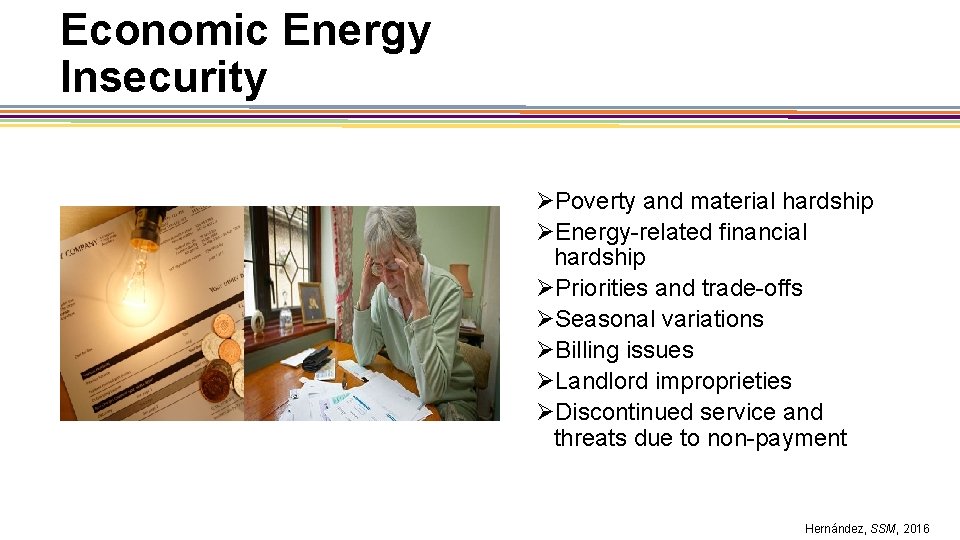
Economic Energy Insecurity ØPoverty and material hardship ØEnergy-related financial hardship ØPriorities and trade-offs ØSeasonal variations ØBilling issues ØLandlord improprieties ØDiscontinued service and threats due to non-payment Hernández, SSM, 2016
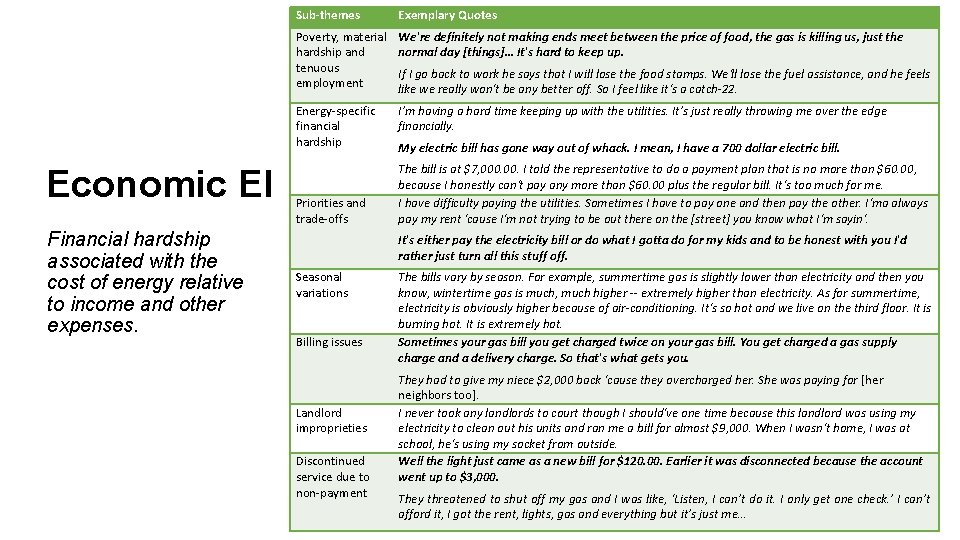
Economic EI Financial hardship associated with the cost of energy relative to income and other expenses. Sub-themes Exemplary Quotes Poverty, material hardship and tenuous employment We're definitely not making ends meet between the price of food, the gas is killing us, just the normal day [things]… It's hard to keep up. If I go back to work he says that I will lose the food stamps. We'll lose the fuel assistance, and he feels like we really won't be any better off. So I feel like it's a catch-22. Energy-specific financial hardship I’m having a hard time keeping up with the utilities. It’s just really throwing me over the edge financially. My electric bill has gone way out of whack. I mean, I have a 700 dollar electric bill. The bill is at $7, 000. I told the representative to do a payment plan that is no more than $60. 00, because I honestly can't pay any more than $60. 00 plus the regular bill. It's too much for me. I have difficulty paying the utilities. Sometimes I have to pay one and then pay the other. I'ma always pay my rent 'cause I'm not trying to be out there on the [street] you know what I'm sayin'. It's either pay the electricity bill or do what I gotta do for my kids and to be honest with you I'd rather just turn all this stuff off. Priorities and trade-offs Seasonal variations Billing issues Landlord improprieties Discontinued service due to non-payment The bills vary by season. For example, summertime gas is slightly lower than electricity and then you know, wintertime gas is much, much higher -- extremely higher than electricity. As for summertime, electricity is obviously higher because of air-conditioning. It's so hot and we live on the third floor. It is burning hot. It is extremely hot. Sometimes your gas bill you get charged twice on your gas bill. You get charged a gas supply charge and a delivery charge. So that's what gets you. They had to give my niece $2, 000 back ‘cause they overcharged her. She was paying for [her neighbors too]. I never took any landlords to court though I should've one time because this landlord was using my electricity to clean out his units and ran me a bill for almost $9, 000. When I wasn't home, I was at school, he's using my socket from outside. Well the light just came as a new bill for $120. 00. Earlier it was disconnected because the account went up to $3, 000. They threatened to shut off my gas and I was like, ‘Listen, I can’t do it. I only get one check. ’ I can’t afford it, I got the rent, lights, gas and everything but it’s just me…
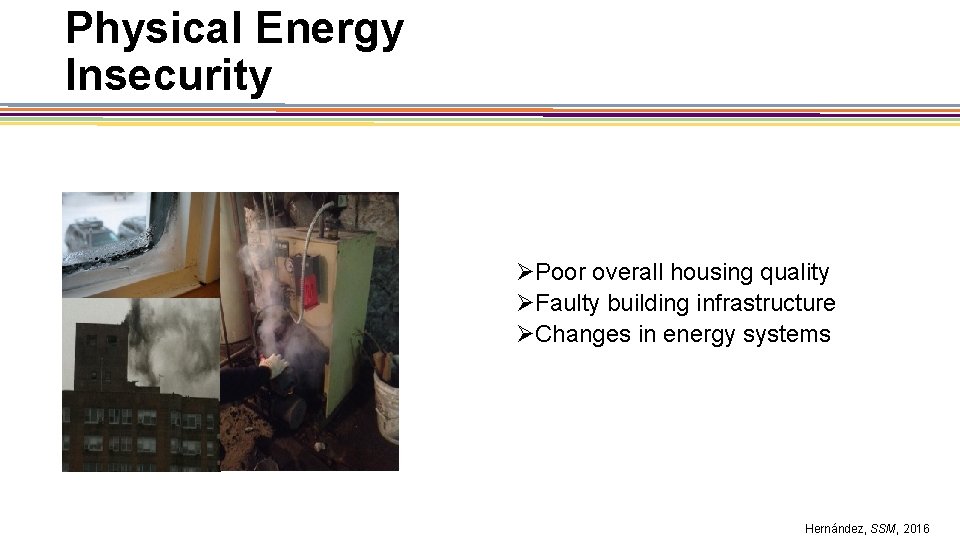
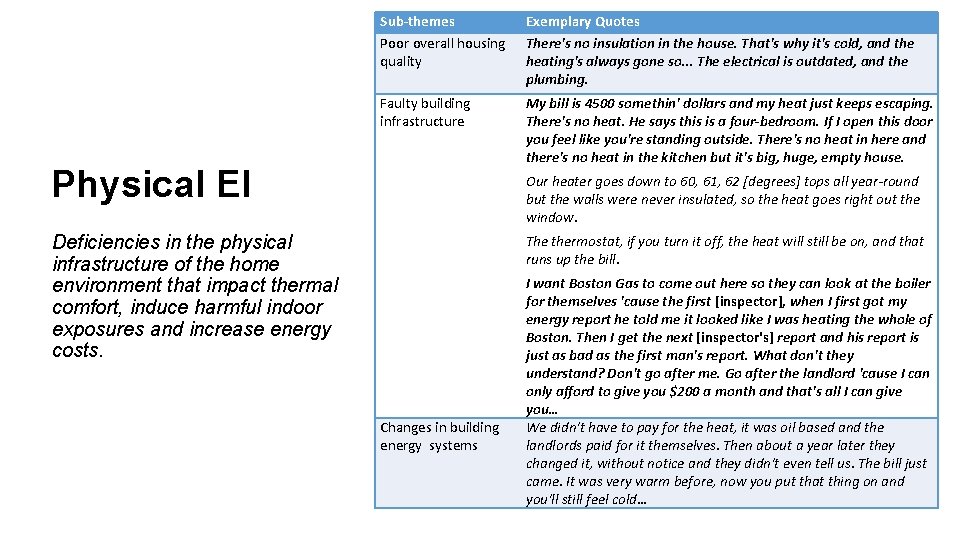
Physical Energy Insecurity ØPoor overall housing quality ØFaulty building infrastructure ØChanges in energy systems Hernández, SSM, 2016
Sub-themes Poor overall housing quality Exemplary Quotes There's no insulation in the house. That's why it's cold, and the heating's always gone so. . . The electrical is outdated, and the plumbing. Faulty building infrastructure My bill is 4500 somethin' dollars and my heat just keeps escaping. There's no heat. He says this is a four-bedroom. If I open this door you feel like you're standing outside. There's no heat in here and there's no heat in the kitchen but it's big, huge, empty house. Our heater goes down to 60, 61, 62 [degrees] tops all year-round but the walls were never insulated, so the heat goes right out the window. The thermostat, if you turn it off, the heat will still be on, and that runs up the bill. I want Boston Gas to come out here so they can look at the boiler for themselves 'cause the first [inspector], when I first got my energy report he told me it looked like I was heating the whole of Boston. Then I get the next [inspector's] report and his report is just as bad as the first man's report. What don't they understand? Don't go after me. Go after the landlord 'cause I can only afford to give you $200 a month and that's all I can give you… We didn't have to pay for the heat, it was oil based and the landlords paid for it themselves. Then about a year later they changed it, without notice and they didn't even tell us. The bill just came. It was very warm before, now you put that thing on and you'll still feel cold… Physical EI Deficiencies in the physical infrastructure of the home environment that impact thermal comfort, induce harmful indoor exposures and increase energy costs. Changes in building energy systems
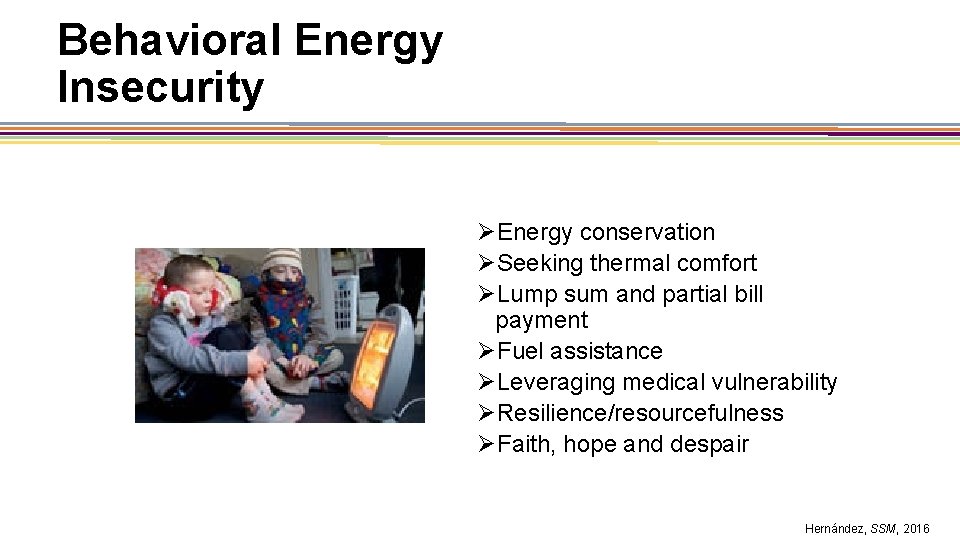
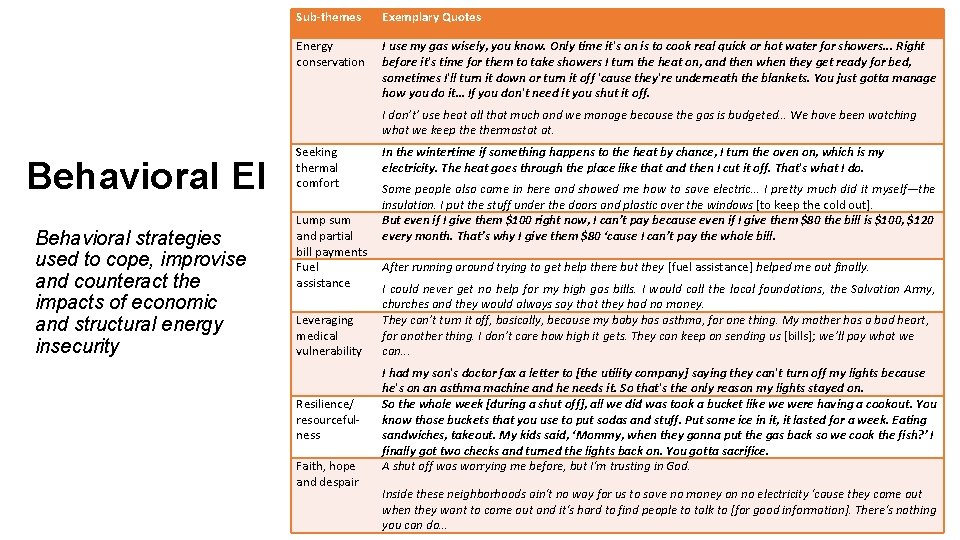
Behavioral Energy Insecurity ØEnergy conservation ØSeeking thermal comfort ØLump sum and partial bill payment ØFuel assistance ØLeveraging medical vulnerability ØResilience/resourcefulness ØFaith, hope and despair Hernández, SSM, 2016
Behavioral EI Behavioral strategies used to cope, improvise and counteract the impacts of economic and structural energy insecurity Sub-themes Exemplary Quotes Energy conservation I use my gas wisely, you know. Only time it's on is to cook real quick or hot water for showers. . . Right before it's time for them to take showers I turn the heat on, and then when they get ready for bed, sometimes I'll turn it down or turn it off 'cause they're underneath the blankets. You just gotta manage how you do it… If you don't need it you shut it off. I don’t’ use heat all that much and we manage because the gas is budgeted… We have been watching what we keep thermostat at. In the wintertime if something happens to the heat by chance, I turn the oven on, which is my electricity. The heat goes through the place like that and then I cut it off. That's what I do. Some people also came in here and showed me how to save electric… I pretty much did it myself—the insulation. I put the stuff under the doors and plastic over the windows [to keep the cold out]. But even if I give them $100 right now, I can’t pay because even if I give them $80 the bill is $100, $120 every month. That’s why I give them $80 ‘cause I can’t pay the whole bill. Seeking thermal comfort Lump sum and partial bill payments Fuel assistance Leveraging medical vulnerability Resilience/ resourcefulness Faith, hope and despair After running around trying to get help there but they [fuel assistance] helped me out finally. I could never get no help for my high gas bills. I would call the local foundations, the Salvation Army, churches and they would always say that they had no money. They can’t turn it off, basically, because my baby has asthma, for one thing. My mother has a bad heart, for another thing. I don’t care how high it gets. They can keep on sending us [bills]; we’ll pay what we can. . . I had my son's doctor fax a letter to [the utility company] saying they can't turn off my lights because he's on an asthma machine and he needs it. So that's the only reason my lights stayed on. So the whole week [during a shut off], all we did was took a bucket like we were having a cookout. You know those buckets that you use to put sodas and stuff. Put some ice in it, it lasted for a week. Eating sandwiches, takeout. My kids said, ‘Mommy, when they gonna put the gas back so we cook the fish? ’ I finally got two checks and turned the lights back on. You gotta sacrifice. A shut off was worrying me before, but I'm trusting in God. Inside these neighborhoods ain't no way for us to save no money on no electricity 'cause they come out when they want to come out and it's hard to find people to talk to [for good information]. There's nothing you can do…
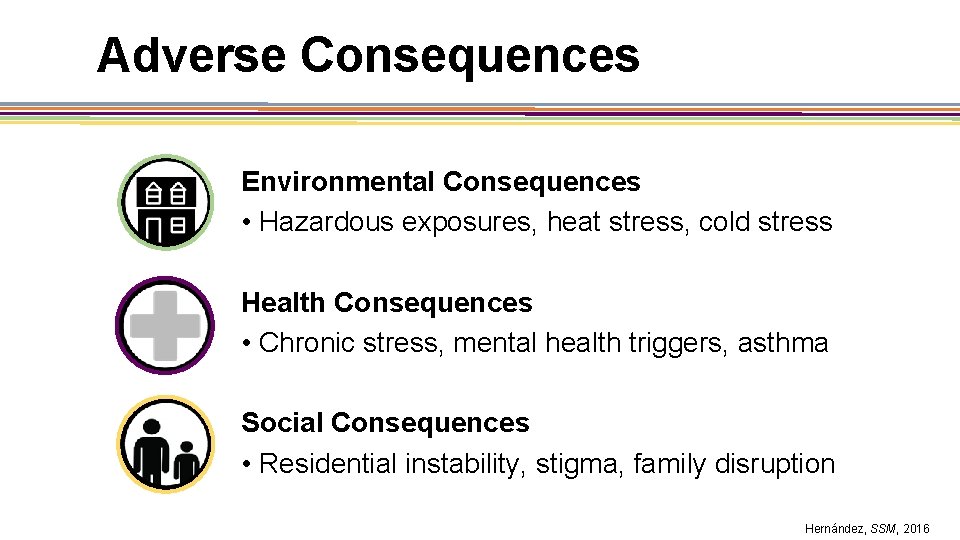
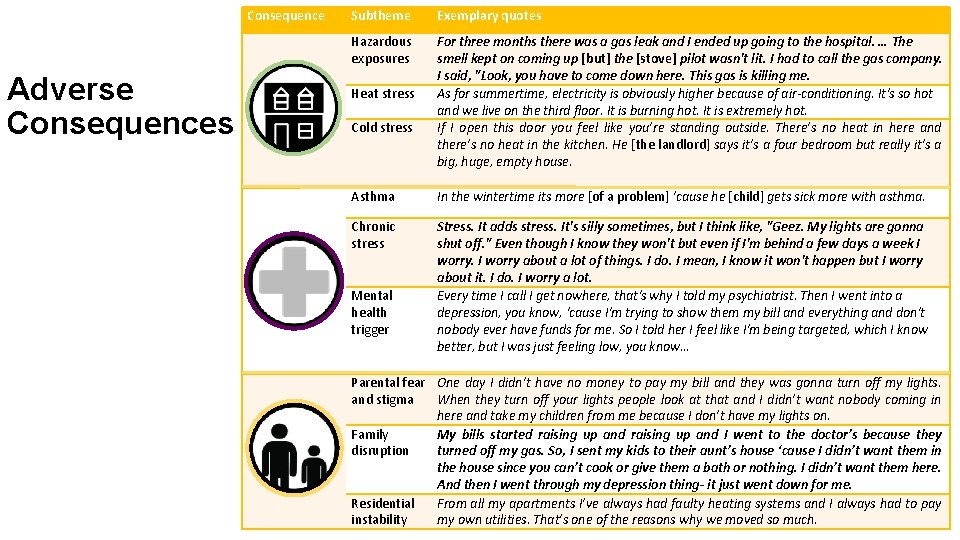
Adverse Consequences Environmental Consequences • Hazardous exposures, heat stress, cold stress Health Consequences • Chronic stress, mental health triggers, asthma Social Consequences • Residential instability, stigma, family disruption Hernández, SSM, 2016
Consequence Adverse Consequences Subtheme Exemplary quotes Hazardous exposures Heat stress For three months there was a gas leak and I ended up going to the hospital. … The smell kept on coming up [but] the [stove] pilot wasn't lit. I had to call the gas company. I said, "Look, you have to come down here. This gas is killing me. As for summertime, electricity is obviously higher because of air-conditioning. It's so hot and we live on the third floor. It is burning hot. It is extremely hot. If I open this door you feel like you’re standing outside. There’s no heat in here and there’s no heat in the kitchen. He [the landlord] says it’s a four bedroom but really it’s a big, huge, empty house. Cold stress Asthma In the wintertime its more [of a problem] ‘cause he [child] gets sick more with asthma. Chronic stress Stress. It adds stress. It's silly sometimes, but I think like, "Geez. My lights are gonna shut off. " Even though I know they won't but even if I'm behind a few days a week I worry about a lot of things. I do. I mean, I know it won't happen but I worry about it. I do. I worry a lot. Every time I call I get nowhere, that's why I told my psychiatrist. Then I went into a depression, you know, 'cause I'm trying to show them my bill and everything and don't nobody ever have funds for me. So I told her I feel like I'm being targeted, which I know better, but I was just feeling low, you know… Mental health trigger Parental fear One day I didn’t have no money to pay my bill and they was gonna turn off my lights. and stigma When they turn off your lights people look at that and I didn’t want nobody coming in here and take my children from me because I don’t have my lights on. Family My bills started raising up and I went to the doctor’s because they disruption turned off my gas. So, I sent my kids to their aunt’s house ‘cause I didn’t want them in the house since you can’t cook or give them a bath or nothing. I didn’t want them here. And then I went through my depression thing- it just went down for me. Residential From all my apartments I’ve always had faulty heating systems and I always had to pay instability my own utilities. That’s one of the reasons why we moved so much.
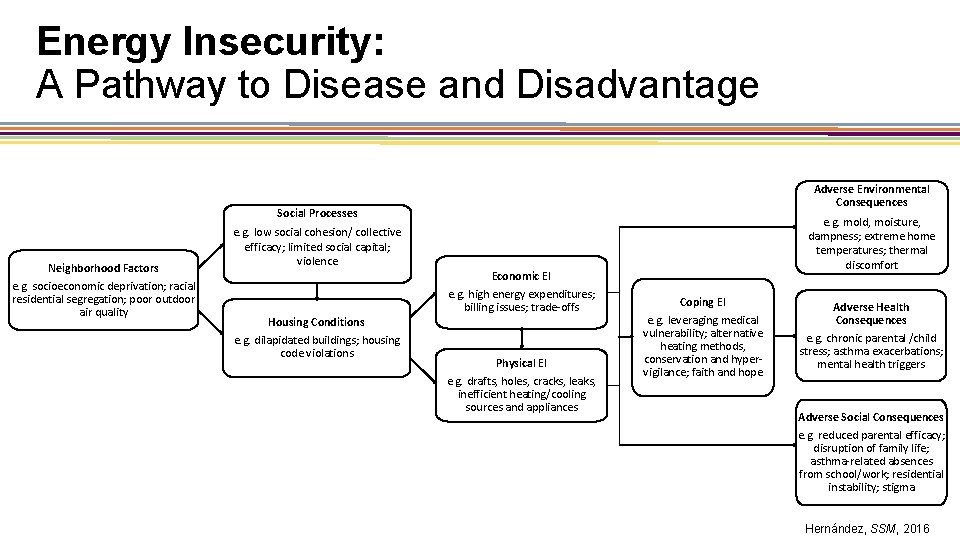
Energy Insecurity: A Pathway to Disease and Disadvantage Adverse Environmental Consequences Social Processes Neighborhood Factors e. g. socioeconomic deprivation; racial residential segregation; poor outdoor air quality e. g. mold, moisture, dampness; extreme home temperatures; thermal discomfort e. g. low social cohesion/ collective efficacy; limited social capital; violence Economic EI e. g. high energy expenditures; billing issues; trade-offs Housing Conditions e. g. dilapidated buildings; housing code violations Physical EI e. g. drafts, holes, cracks, leaks, inefficient heating/cooling sources and appliances Coping EI e. g. leveraging medical vulnerability; alternative heating methods, conservation and hypervigilance; faith and hope Adverse Health Consequences e. g. chronic parental /child stress; asthma exacerbations; mental health triggers Adverse Social Consequences e. g. reduced parental efficacy; disruption of family life; asthma-related absences from school/work; residential instability; stigma Hernández, SSM, 2016
ENERGY JUSTICE
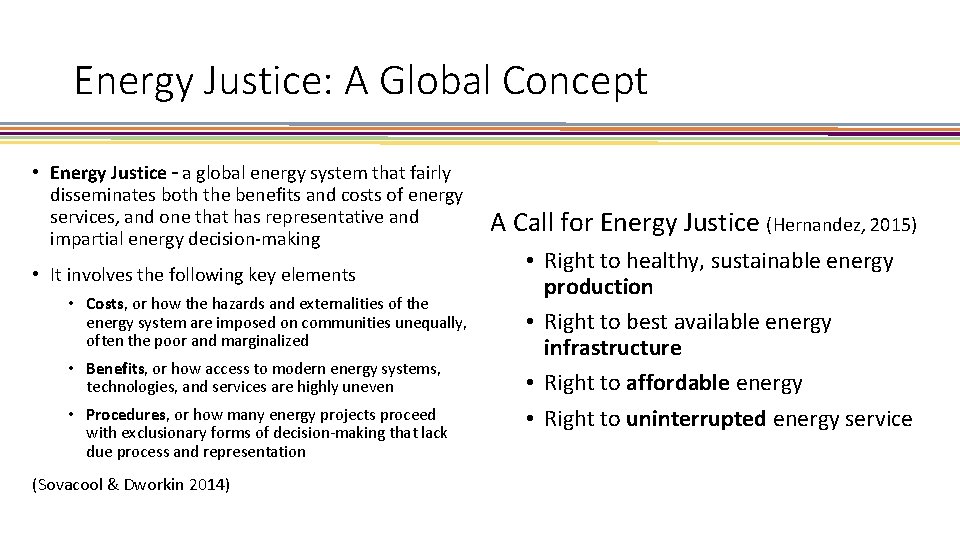
Energy Justice: A Global Concept • Energy Justice – a global energy system that fairly disseminates both the benefits and costs of energy services, and one that has representative and impartial energy decision-making • It involves the following key elements • Costs, or how the hazards and externalities of the energy system are imposed on communities unequally, often the poor and marginalized • Benefits, or how access to modern energy systems, technologies, and services are highly uneven • Procedures, or how many energy projects proceed with exclusionary forms of decision-making that lack due process and representation (Sovacool & Dworkin 2014) A Call for Energy Justice (Hernandez, 2015) • Right to healthy, sustainable energy production • Right to best available energy infrastructure • Right to affordable energy • Right to uninterrupted energy service
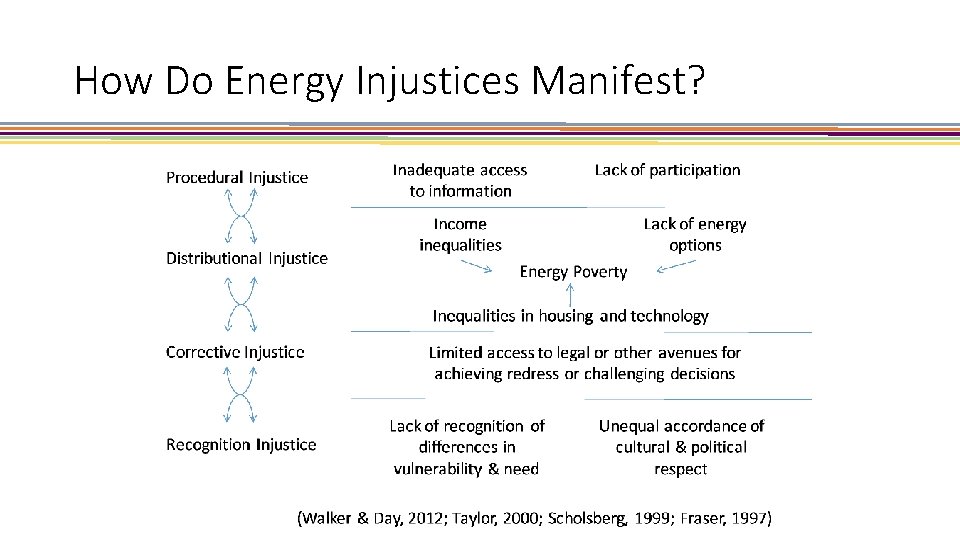
How Do Energy Injustices Manifest?
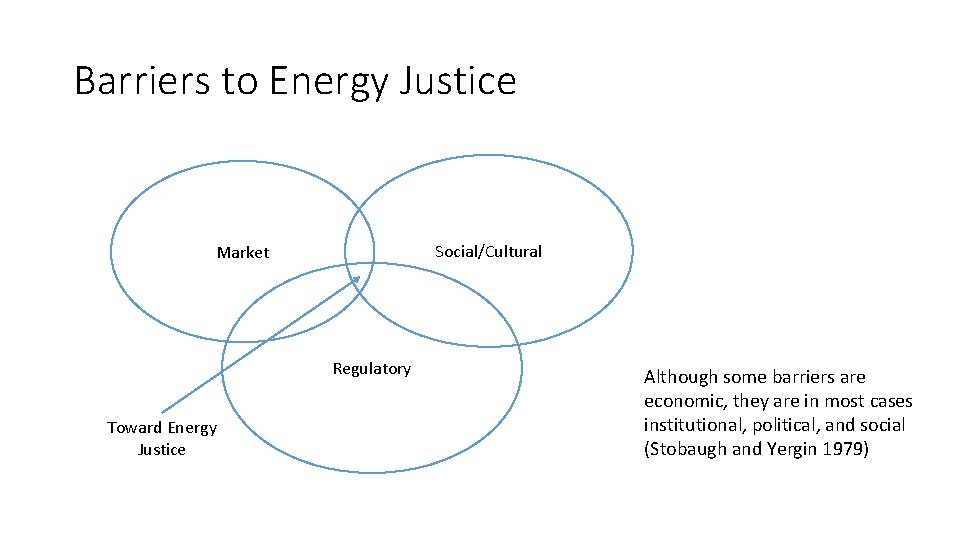
Barriers to Energy Justice Social/Cultural Market Regulatory Toward Energy Justice Although some barriers are economic, they are in most cases institutional, political, and social (Stobaugh and Yergin 1979)
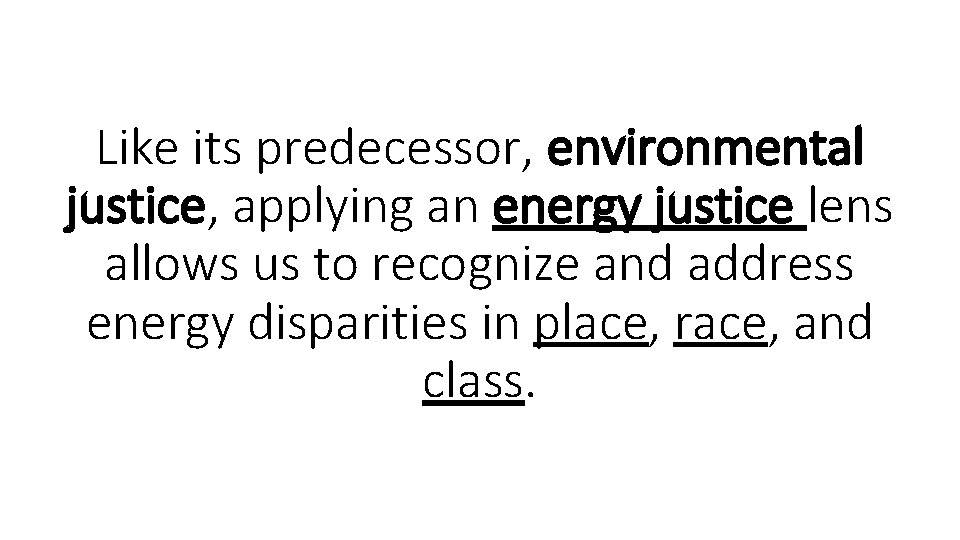
Like its predecessor, environmental justice, applying an energy justice lens allows us to recognize and address energy disparities in place, race, and class.