
Energy in Waves and Fluids OSCILLATIONS MECHANICAL WAVES


- Slides: 53
Energy in Waves and Fluids OSCILLATIONS MECHANICAL WAVES SOUND WAVES FLUIDS
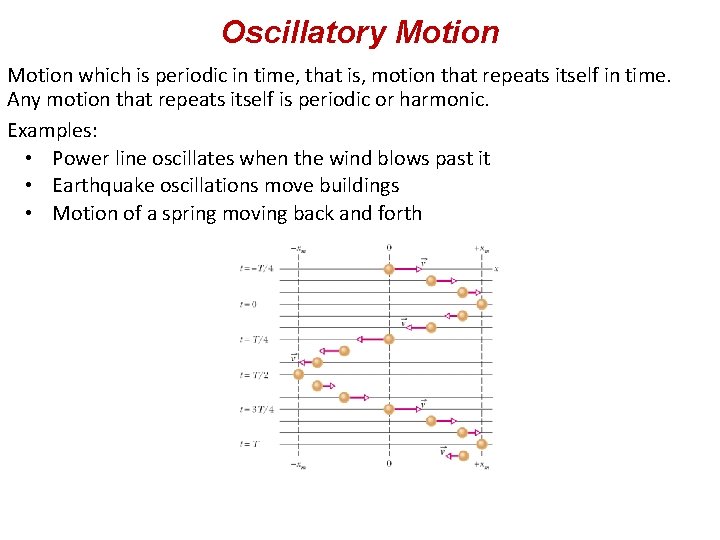
Oscillatory Motion which is periodic in time, that is, motion that repeats itself in time. Any motion that repeats itself is periodic or harmonic. Examples: • Power line oscillates when the wind blows past it • Earthquake oscillations move buildings • Motion of a spring moving back and forth
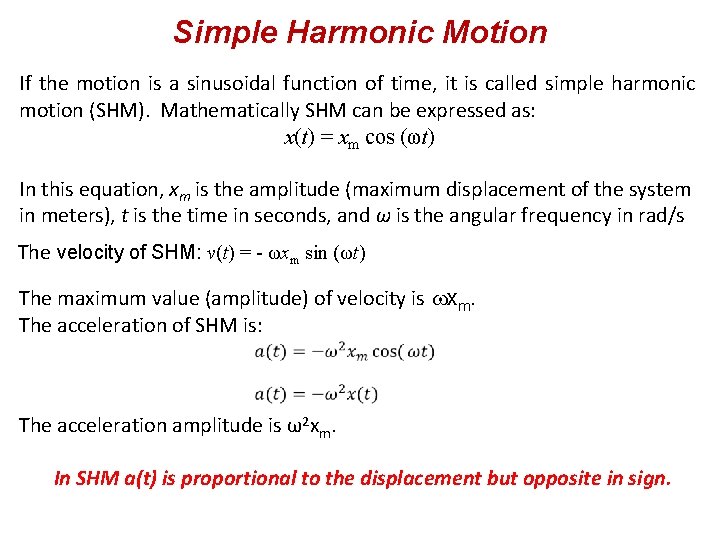
Simple Harmonic Motion If the motion is a sinusoidal function of time, it is called simple harmonic motion (SHM). Mathematically SHM can be expressed as: x(t) = xm cos (ωt) In this equation, xm is the amplitude (maximum displacement of the system in meters), t is the time in seconds, and ω is the angular frequency in rad/s The velocity of SHM: v(t) = - ωxm sin (ωt) The maximum value (amplitude) of velocity is wxm. The acceleration of SHM is: The acceleration amplitude is ω2 xm. In SHM a(t) is proportional to the displacement but opposite in sign.
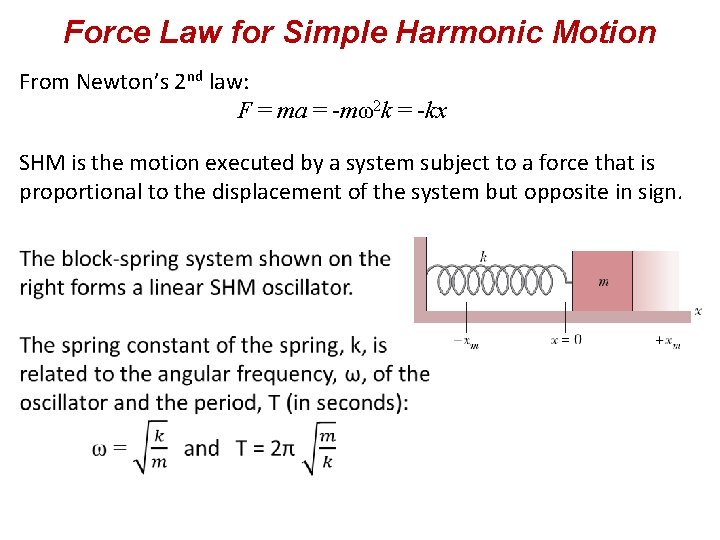
Force Law for Simple Harmonic Motion From Newton’s 2 nd law: F = ma = -mω2 k = -kx SHM is the motion executed by a system subject to a force that is proportional to the displacement of the system but opposite in sign.
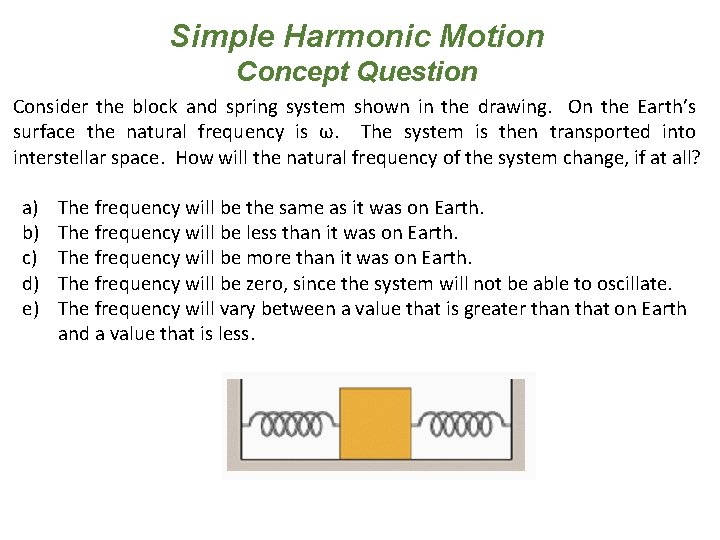
Simple Harmonic Motion Concept Question Consider the block and spring system shown in the drawing. On the Earth’s surface the natural frequency is ω. The system is then transported into interstellar space. How will the natural frequency of the system change, if at all? a) b) c) d) e) The frequency will be the same as it was on Earth. The frequency will be less than it was on Earth. The frequency will be more than it was on Earth. The frequency will be zero, since the system will not be able to oscillate. The frequency will vary between a value that is greater than that on Earth and a value that is less.
Example Problem A block of mass 10 kg is attached to a spring that has a spring constant of k = 1000 Nm. What is the period of the oscillation and the angular frequency of the oscillation?
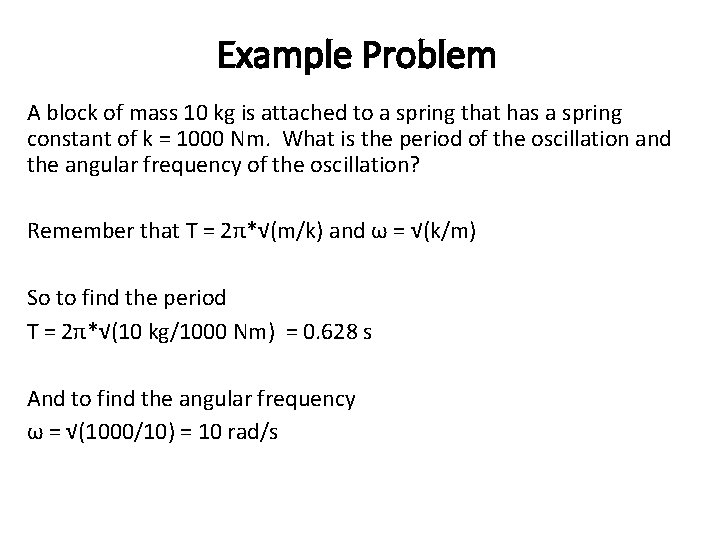
Example Problem A block of mass 10 kg is attached to a spring that has a spring constant of k = 1000 Nm. What is the period of the oscillation and the angular frequency of the oscillation? Remember that T = 2π*√(m/k) and ω = √(k/m) So to find the period T = 2π*√(10 kg/1000 Nm) = 0. 628 s And to find the angular frequency ω = √(1000/10) = 10 rad/s
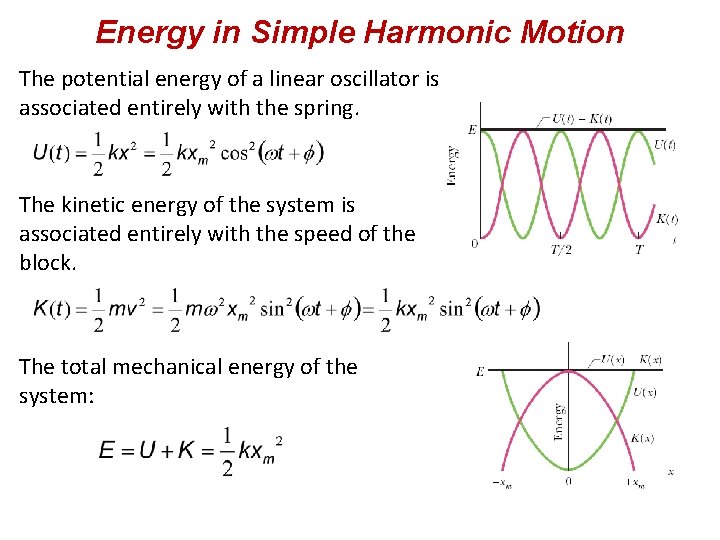
Energy in Simple Harmonic Motion The potential energy of a linear oscillator is associated entirely with the spring. The kinetic energy of the system is associated entirely with the speed of the block. The total mechanical energy of the system:
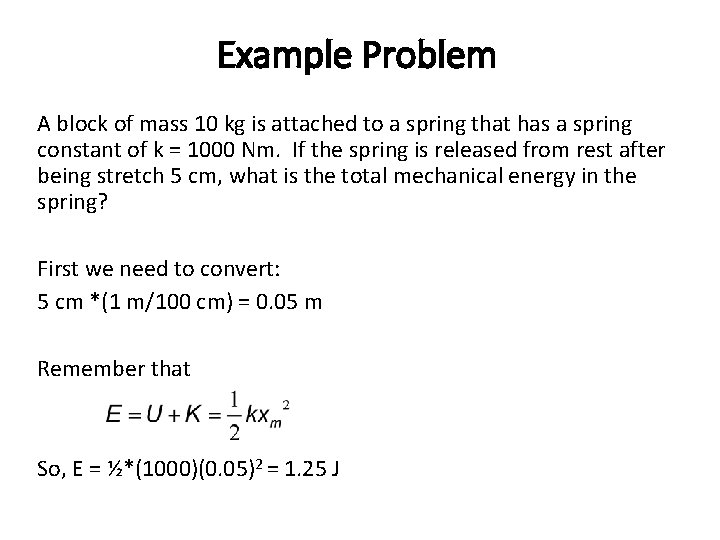
Example Problem A block of mass 10 kg is attached to a spring that has a spring constant of k = 1000 Nm. If the spring is released from rest after being stretch 5 cm, what is the total mechanical energy in the spring?
Example Problem A block of mass 10 kg is attached to a spring that has a spring constant of k = 1000 Nm. If the spring is released from rest after being stretch 5 cm, what is the total mechanical energy in the spring? First we need to convert: 5 cm *(1 m/100 cm) = 0. 05 m Remember that So, E = ½*(1000)(0. 05)2 = 1. 25 J
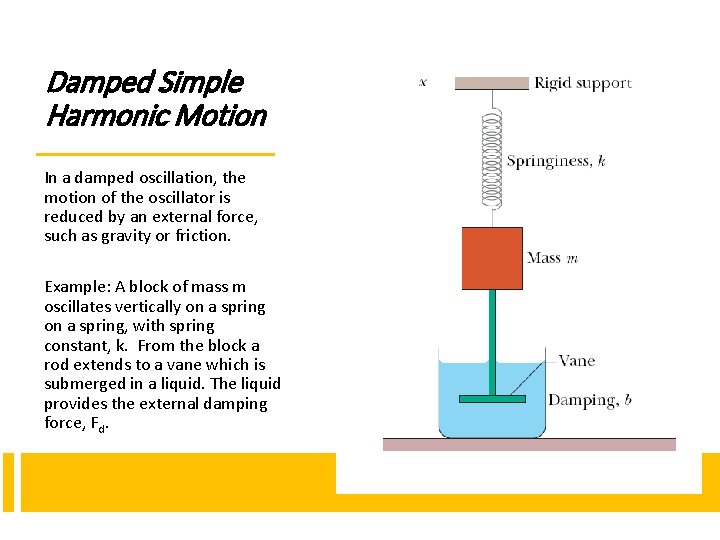
Damped Simple Harmonic Motion In a damped oscillation, the motion of the oscillator is reduced by an external force, such as gravity or friction. Example: A block of mass m oscillates vertically on a spring, with spring constant, k. From the block a rod extends to a vane which is submerged in a liquid. The liquid provides the external damping force, Fd.
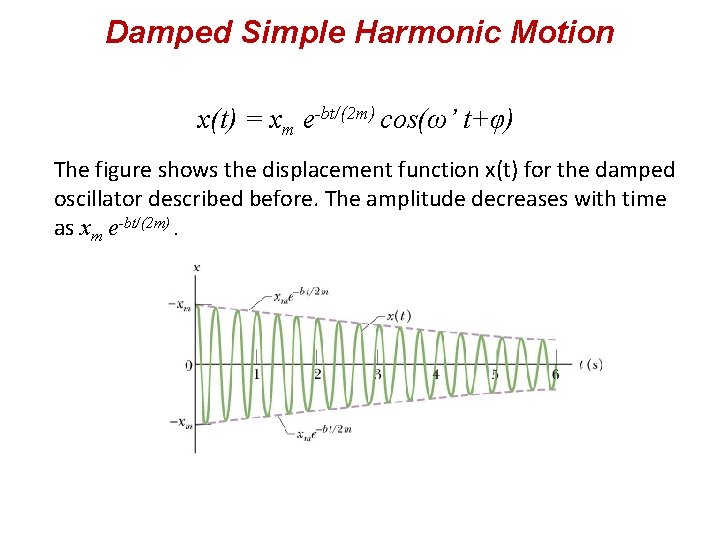
Damped Simple Harmonic Motion x(t) = xm e-bt/(2 m) cos(ω’ t+φ) The figure shows the displacement function x(t) for the damped oscillator described before. The amplitude decreases with time as xm e-bt/(2 m).
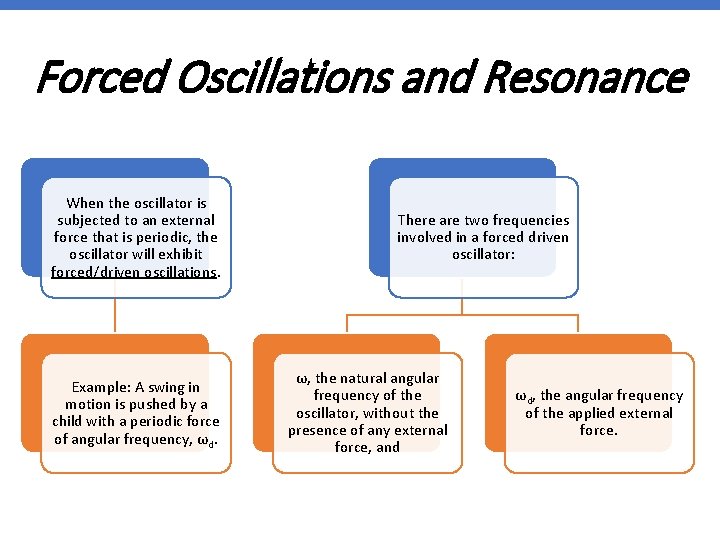
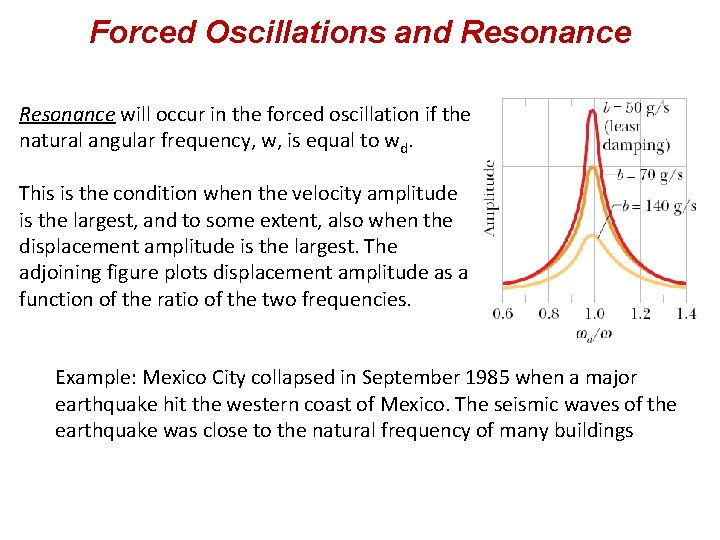
Forced Oscillations and Resonance When the oscillator is subjected to an external force that is periodic, the oscillator will exhibit forced/driven oscillations. Example: A swing in motion is pushed by a child with a periodic force of angular frequency, ωd. There are two frequencies involved in a forced driven oscillator: ω, the natural angular frequency of the oscillator, without the presence of any external force, and ωd, the angular frequency of the applied external force.
Forced Oscillations and Resonance will occur in the forced oscillation if the natural angular frequency, w, is equal to wd. This is the condition when the velocity amplitude is the largest, and to some extent, also when the displacement amplitude is the largest. The adjoining figure plots displacement amplitude as a function of the ratio of the two frequencies. Example: Mexico City collapsed in September 1985 when a major earthquake hit the western coast of Mexico. The seismic waves of the earthquake was close to the natural frequency of many buildings
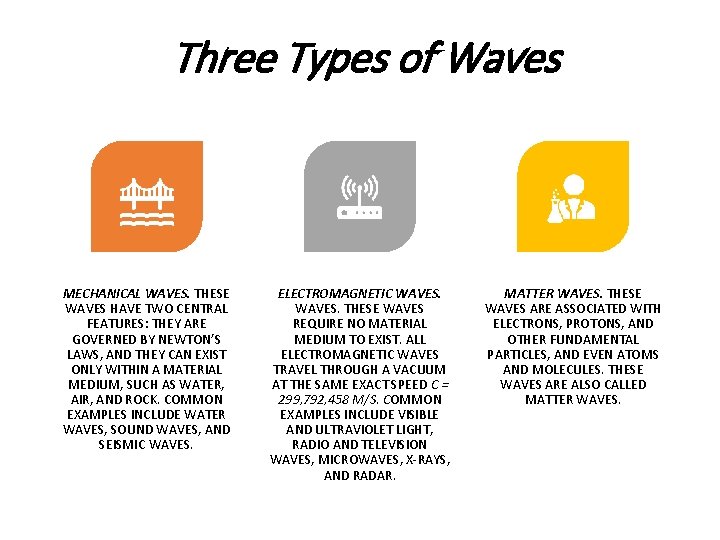
Three Types of Waves MECHANICAL WAVES. THESE WAVES HAVE TWO CENTRAL FEATURES: THEY ARE GOVERNED BY NEWTON’S LAWS, AND THEY CAN EXIST ONLY WITHIN A MATERIAL MEDIUM, SUCH AS WATER, AIR, AND ROCK. COMMON EXAMPLES INCLUDE WATER WAVES, SOUND WAVES, AND SEISMIC WAVES. ELECTROMAGNETIC WAVES. THESE WAVES REQUIRE NO MATERIAL MEDIUM TO EXIST. ALL ELECTROMAGNETIC WAVES TRAVEL THROUGH A VACUUM AT THE SAME EXACT SPEED C = 299, 792, 458 M/S. COMMON EXAMPLES INCLUDE VISIBLE AND ULTRAVIOLET LIGHT, RADIO AND TELEVISION WAVES, MICROWAVES, X-RAYS, AND RADAR. MATTER WAVES. THESE WAVES ARE ASSOCIATED WITH ELECTRONS, PROTONS, AND OTHER FUNDAMENTAL PARTICLES, AND EVEN ATOMS AND MOLECULES. THESE WAVES ARE ALSO CALLED MATTER WAVES.
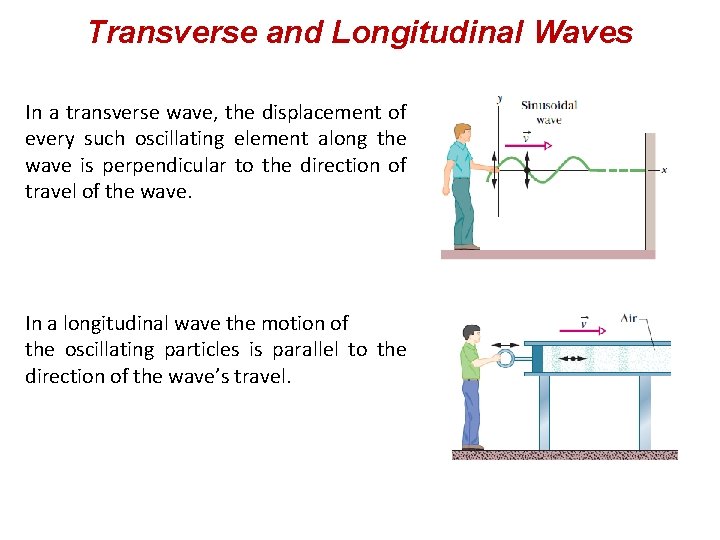
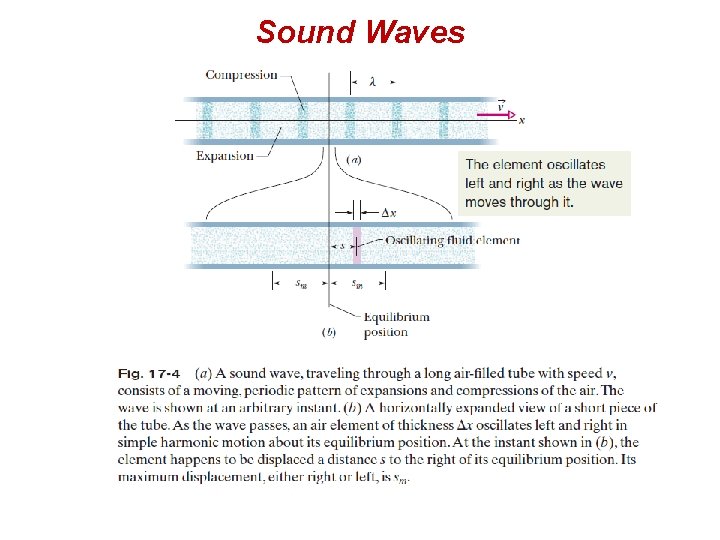
Transverse and Longitudinal Waves In a transverse wave, the displacement of every such oscillating element along the wave is perpendicular to the direction of travel of the wave. In a longitudinal wave the motion of the oscillating particles is parallel to the direction of the wave’s travel.
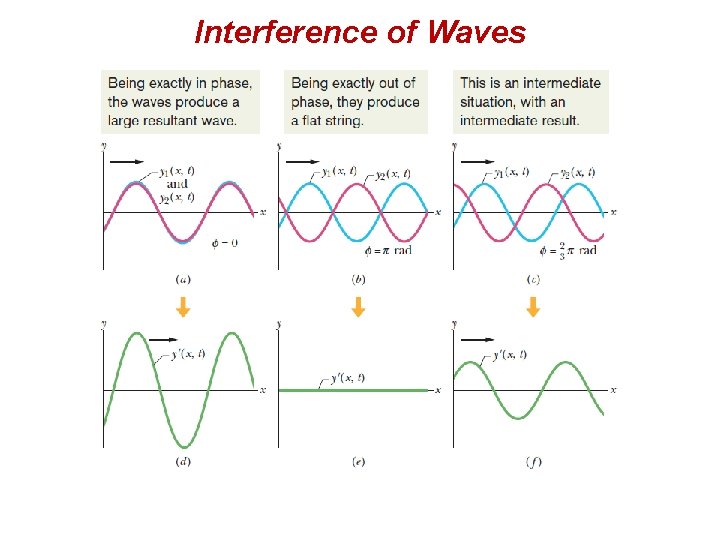
Interference of Waves
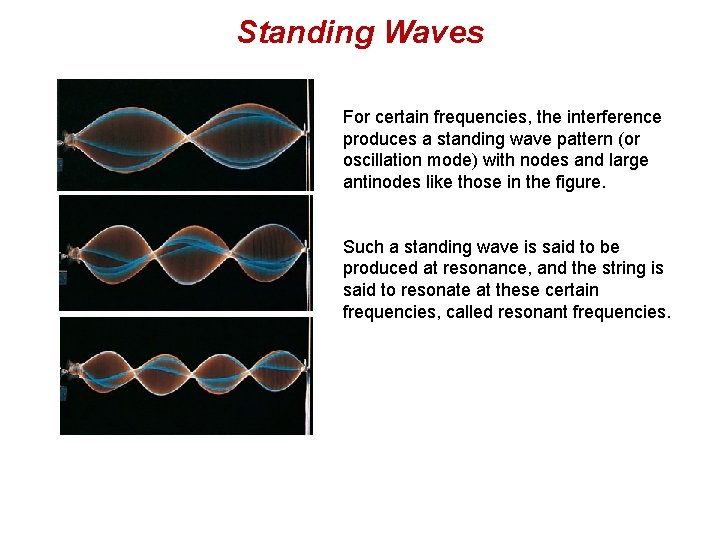
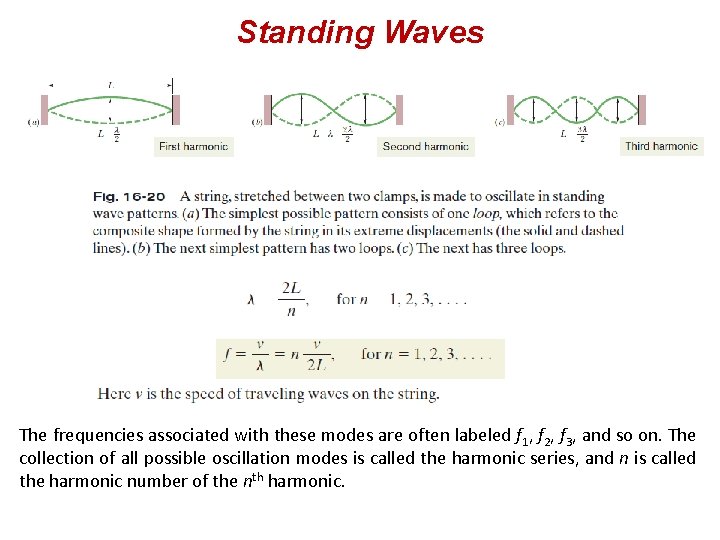
Standing Waves For certain frequencies, the interference produces a standing wave pattern (or oscillation mode) with nodes and large antinodes like those in the figure. Such a standing wave is said to be produced at resonance, and the string is said to resonate at these certain frequencies, called resonant frequencies.
Standing Waves The frequencies associated with these modes are often labeled f 1, f 2, f 3, and so on. The collection of all possible oscillation modes is called the harmonic series, and n is called the harmonic number of the nth harmonic.
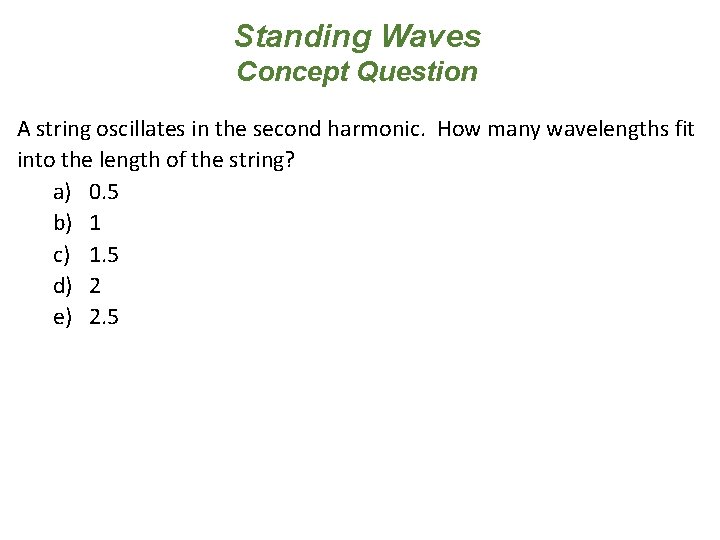
Standing Waves Concept Question A string oscillates in the second harmonic. How many wavelengths fit into the length of the string? a) 0. 5 b) 1 c) 1. 5 d) 2 e) 2. 5
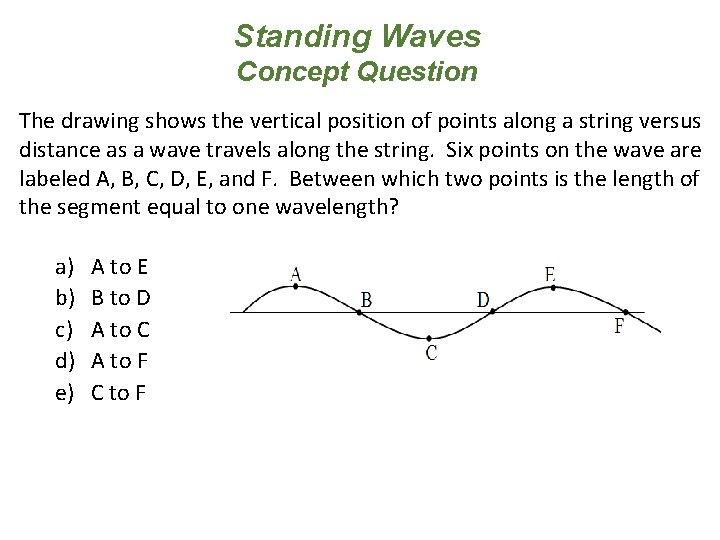
Standing Waves Concept Question The drawing shows the vertical position of points along a string versus distance as a wave travels along the string. Six points on the wave are labeled A, B, C, D, E, and F. Between which two points is the length of the segment equal to one wavelength? a) b) c) d) e) A to E B to D A to C A to F C to F
Sound Waves
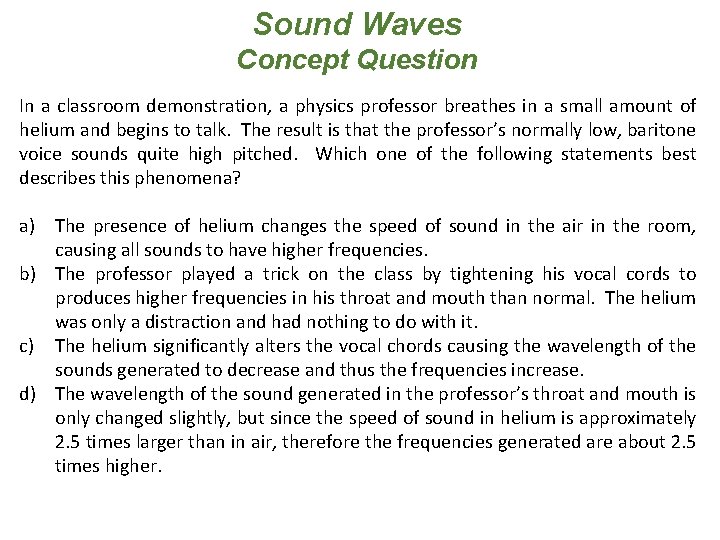
Sound Waves Concept Question In a classroom demonstration, a physics professor breathes in a small amount of helium and begins to talk. The result is that the professor’s normally low, baritone voice sounds quite high pitched. Which one of the following statements best describes this phenomena? a) The presence of helium changes the speed of sound in the air in the room, causing all sounds to have higher frequencies. b) The professor played a trick on the class by tightening his vocal cords to produces higher frequencies in his throat and mouth than normal. The helium was only a distraction and had nothing to do with it. c) The helium significantly alters the vocal chords causing the wavelength of the sounds generated to decrease and thus the frequencies increase. d) The wavelength of the sound generated in the professor’s throat and mouth is only changed slightly, but since the speed of sound in helium is approximately 2. 5 times larger than in air, therefore the frequencies generated are about 2. 5 times higher.
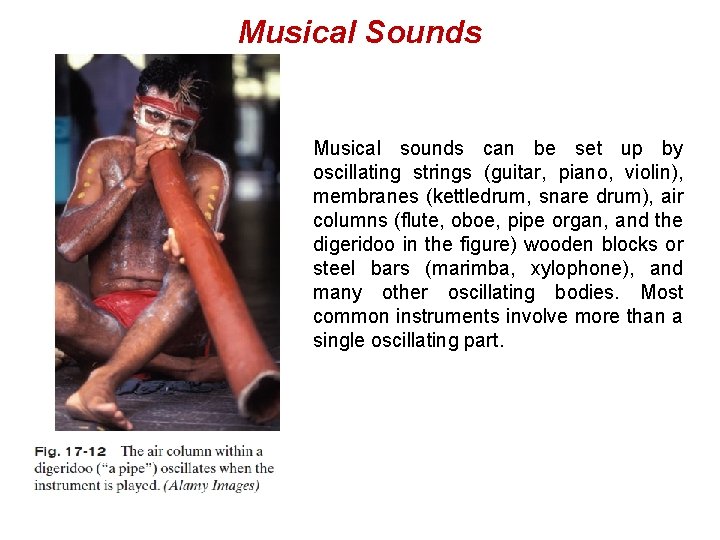
Musical Sounds Musical sounds can be set up by oscillating strings (guitar, piano, violin), membranes (kettledrum, snare drum), air columns (flute, oboe, pipe organ, and the digeridoo in the figure) wooden blocks or steel bars (marimba, xylophone), and many other oscillating bodies. Most common instruments involve more than a single oscillating part.
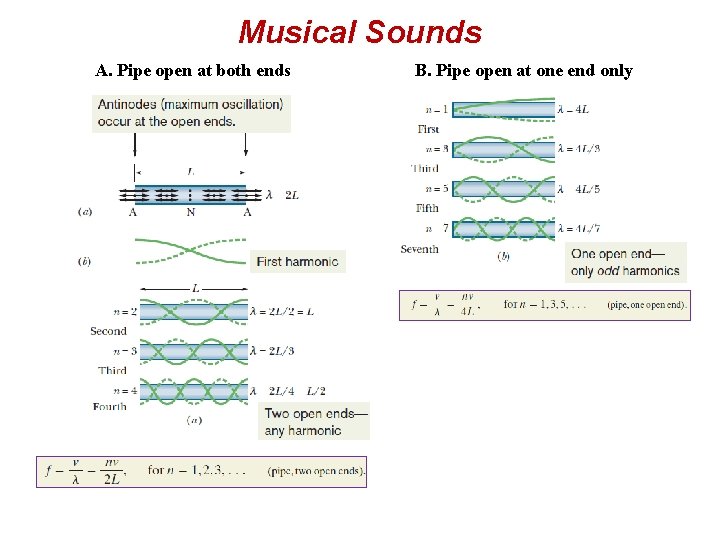
Musical Sounds A. Pipe open at both ends B. Pipe open at one end only
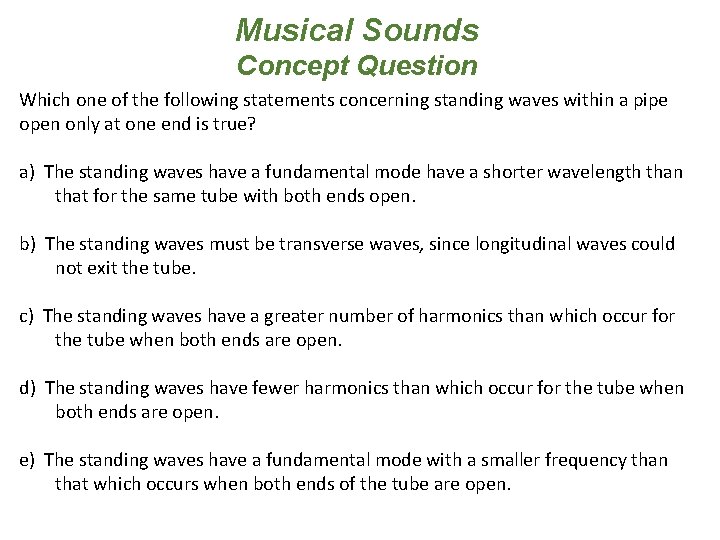
Musical Sounds Concept Question Which one of the following statements concerning standing waves within a pipe open only at one end is true? a) The standing waves have a fundamental mode have a shorter wavelength than that for the same tube with both ends open. b) The standing waves must be transverse waves, since longitudinal waves could not exit the tube. c) The standing waves have a greater number of harmonics than which occur for the tube when both ends are open. d) The standing waves have fewer harmonics than which occur for the tube when both ends are open. e) The standing waves have a fundamental mode with a smaller frequency than that which occurs when both ends of the tube are open.
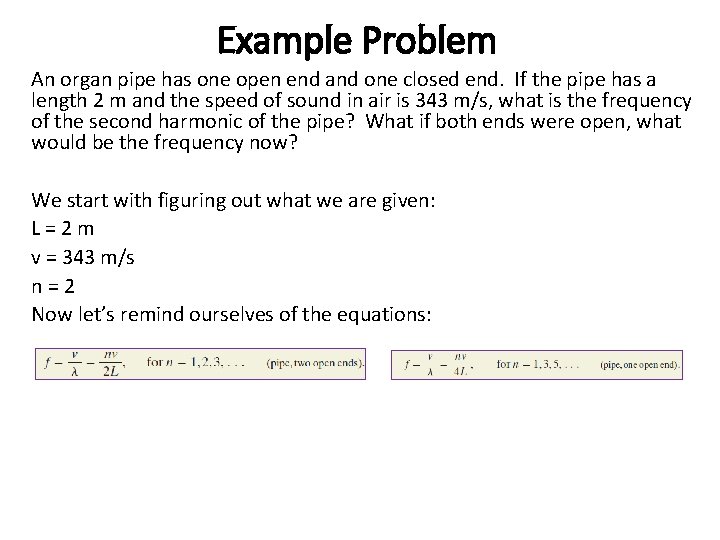
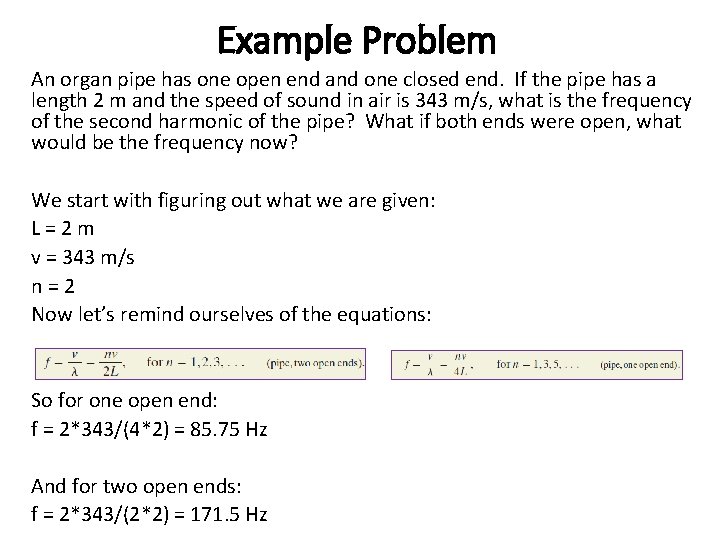
Example Problem An organ pipe has one open end and one closed end. If the pipe has a length 2 m and the speed of sound in air is 343 m/s, what is the frequency of the second harmonic of the pipe? What if both ends were open, what would be the frequency now? We start with figuring out what we are given: L=2 m v = 343 m/s n=2 Now let’s remind ourselves of the equations: So for one open end: f = 2*343/(4*2) = 85. 75 Hz And for two open ends: f = 2*343/(2*2) = 171. 5 Hz
Example Problem An organ pipe has one open end and one closed end. If the pipe has a length 2 m and the speed of sound in air is 343 m/s, what is the frequency of the second harmonic of the pipe? What if both ends were open, what would be the frequency now? We start with figuring out what we are given: L=2 m v = 343 m/s n=2 Now let’s remind ourselves of the equations: So for one open end: f = 2*343/(4*2) = 85. 75 Hz And for two open ends: f = 2*343/(2*2) = 171. 5 Hz
Example Problem An organ pipe has one open end and one closed end. If the pipe has a length 2 m and the speed of sound in air is 343 m/s, what is the frequency of the second harmonic of the pipe? What if both ends were open, what would be the frequency now? We start with figuring out what we are given: L=2 m v = 343 m/s n=2 Now let’s remind ourselves of the equations: So for one open end: f = 2*343/(4*2) = 85. 75 Hz And for two open ends: f = 2*343/(2*2) = 171. 5 Hz
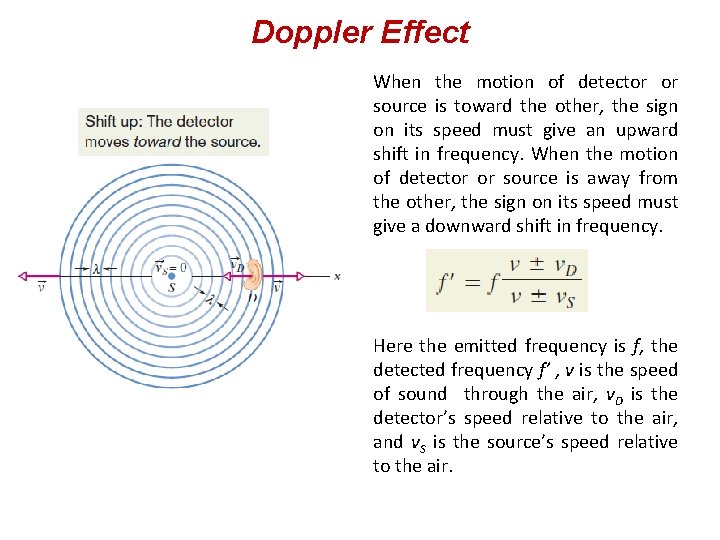
Doppler Effect When the motion of detector or source is toward the other, the sign on its speed must give an upward shift in frequency. When the motion of detector or source is away from the other, the sign on its speed must give a downward shift in frequency. Here the emitted frequency is f, the detected frequency f’ , v is the speed of sound through the air, v. D is the detector’s speed relative to the air, and v. S is the source’s speed relative to the air.
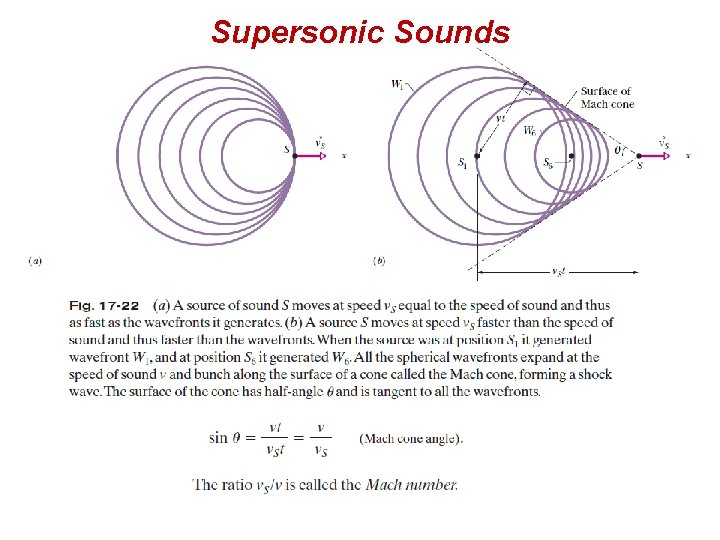
Supersonic Sounds
What is a Fluid? A fluid, in contrast to a solid, is a substance that can flow like a liquid, gas, or plasma. Fluids conform to the boundaries of any container in which we put them. They do so because a fluid cannot sustain a force that is tangential to its surface. That is, a fluid is a substance that flows because it cannot withstand a shearing stress. It can, however, exert a force in the direction perpendicular to its surface.
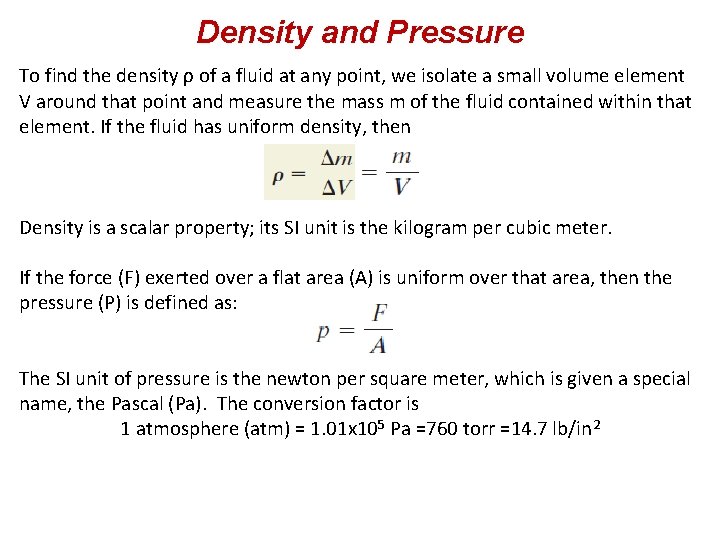
Density and Pressure To find the density ρ of a fluid at any point, we isolate a small volume element V around that point and measure the mass m of the fluid contained within that element. If the fluid has uniform density, then Density is a scalar property; its SI unit is the kilogram per cubic meter. If the force (F) exerted over a flat area (A) is uniform over that area, then the pressure (P) is defined as: The SI unit of pressure is the newton per square meter, which is given a special name, the Pascal (Pa). The conversion factor is 1 atmosphere (atm) = 1. 01 x 105 Pa =760 torr =14. 7 lb/in 2
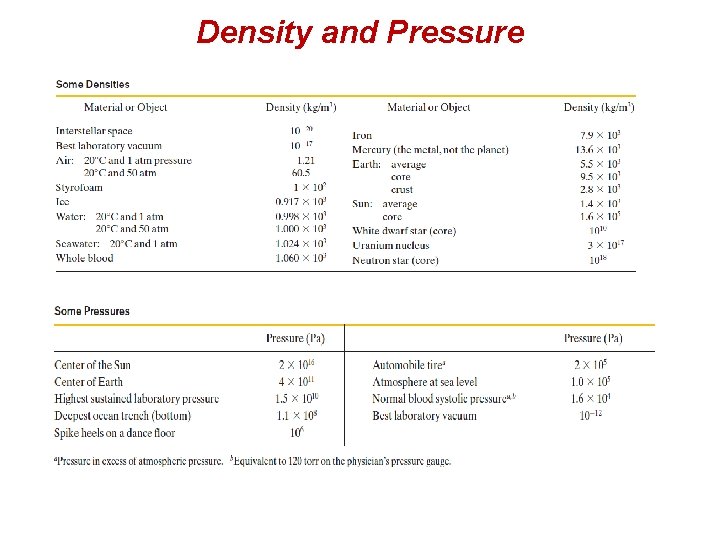
Density and Pressure
Density and Pressure Concept Question A girl fills the two tires of her bicycle to the pressure specified on the side wall of the tires. She then gets onto her bicycle and notices that the bottoms of the tires look flatter than before she mounted the bicycle. What happens to the pressure in the tires when she is on the bicycle compared to when she was off the bicycle? a. The pressure inside the tire increases. b. The pressure inside the tire decreases. c. The pressure inside the tire has the same value.
Density and Pressure Concept Question A swimmer is swimming underwater in a large pool. The force on the back of the swimmer’s hand is about 1000 Newtons. The swimmer doesn’t notice this force. Why not? a) This force is actually smaller than the force exerted by the atmosphere. b) The force is large, but the pressure on the back of the hand is small. c) The force is exerted on all sides equally. d) The swimmer is pushing on the water with the same force. e) I do not know, but I’m sure I would feel that kind of force.
Example Problem A block of mass 10 kg has a volume of 1. 5 m 3, what is it’s density? Remember that ρ = m/V ρ = 10 kg / 1. 5 m 3 = 15 kg/m 3 Another block has a density of ρ = 150 kg/m 3 and a mass of 20 kg. What is the volume of the block? Rearranging the equation for density to solve for V we get V = m/ρ V = m/ ρ = 20 kg /150 kg/m 3 = 0. 133 m 3 A pressure of 35 Pa is applied to the same block over an area of 1. 25 m 2. What force does this pressure produce on the block? P = F/A so F = P*A = 35 Pa * 1. 25 m 2 = 43. 75 N
Example Problem A block of mass 10 kg has a volume of 1. 5 m 3, what is it’s density? Remember that ρ = m/V ρ = 10 kg / 1. 5 m 3 = 15 kg/m 3 Another block has a density of ρ = 150 kg/m 3 and a mass of 20 kg. What is the volume of the block? Rearranging the equation for density to solve for V we get V = m/ρ V = m/ ρ = 20 kg /150 kg/m 3 = 0. 133 m 3 A pressure of 35 Pa is applied to the same block over an area of 1. 25 m 2. What force does this pressure produce on the block? P = F/A so F = P*A = 35 Pa * 1. 25 m 2 = 43. 75 N
Example Problem A block of mass 10 kg has a volume of 1. 5 m 3, what is it’s density? Remember that ρ = m/V ρ = 10 kg / 1. 5 m 3 = 15 kg/m 3 Another block has a density of ρ = 150 kg/m 3 and a mass of 20 kg. What is the volume of the block? Rearranging the equation for density to solve for V we get V = m/ρ V = m/ ρ = 20 kg /150 kg/m 3 = 0. 133 m 3 A pressure of 35 Pa is applied to the same block over an area of 1. 25 m 2. What force does this pressure produce on the block? P = F/A so F = P*A = 35 Pa * 1. 25 m 2 = 43. 75 N
Example Problem A block of mass 10 kg has a volume of 1. 5 m 3, what is it’s density? Remember that ρ = m/V ρ = 10 kg / 1. 5 m 3 = 15 kg/m 3 Another block has a density of ρ = 150 kg/m 3 and a mass of 20 kg. What is the volume of the block? Rearranging the equation for density to solve for V we get V = m/ρ V = m/ ρ = 20 kg /150 kg/m 3 = 0. 133 m 3 A pressure of 35 Pa is applied to the same block over an area of 1. 25 m 2. What force does this pressure produce on the block? P = F/A so F = P*A = 35 Pa * 1. 25 m 2 = 43. 75 N
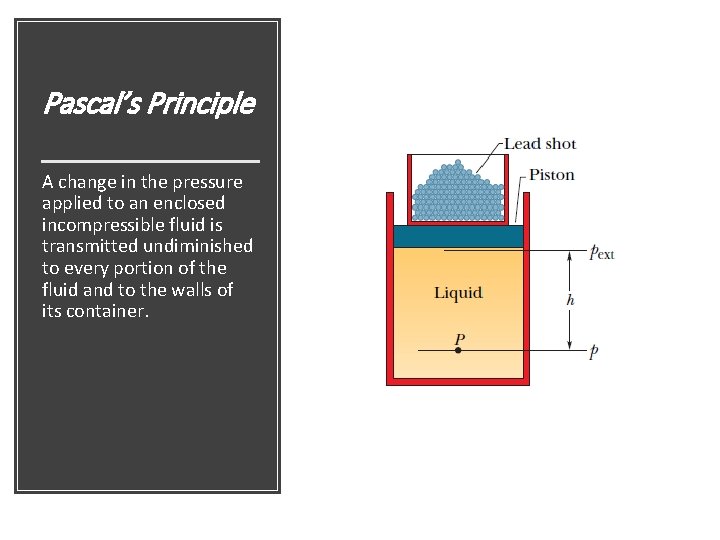
Pascal’s Principle A change in the pressure applied to an enclosed incompressible fluid is transmitted undiminished to every portion of the fluid and to the walls of its container.
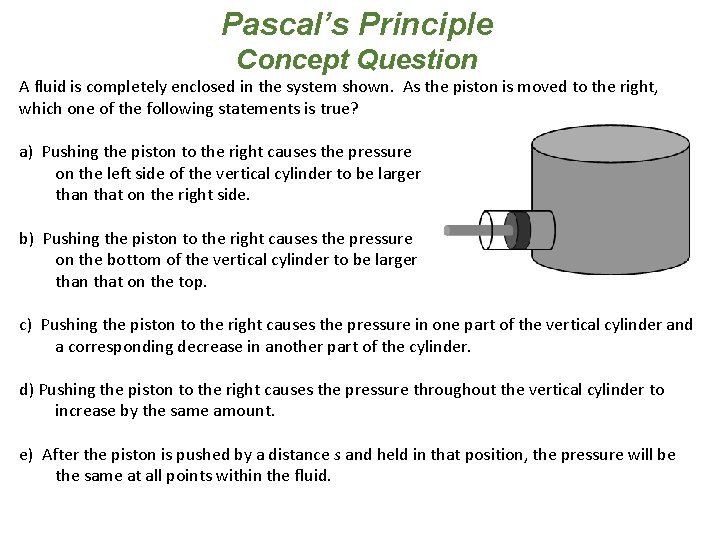
Pascal’s Principle Concept Question A fluid is completely enclosed in the system shown. As the piston is moved to the right, which one of the following statements is true? a) Pushing the piston to the right causes the pressure on the left side of the vertical cylinder to be larger than that on the right side. b) Pushing the piston to the right causes the pressure on the bottom of the vertical cylinder to be larger than that on the top. c) Pushing the piston to the right causes the pressure in one part of the vertical cylinder and a corresponding decrease in another part of the cylinder. d) Pushing the piston to the right causes the pressure throughout the vertical cylinder to increase by the same amount. e) After the piston is pushed by a distance s and held in that position, the pressure will be the same at all points within the fluid.
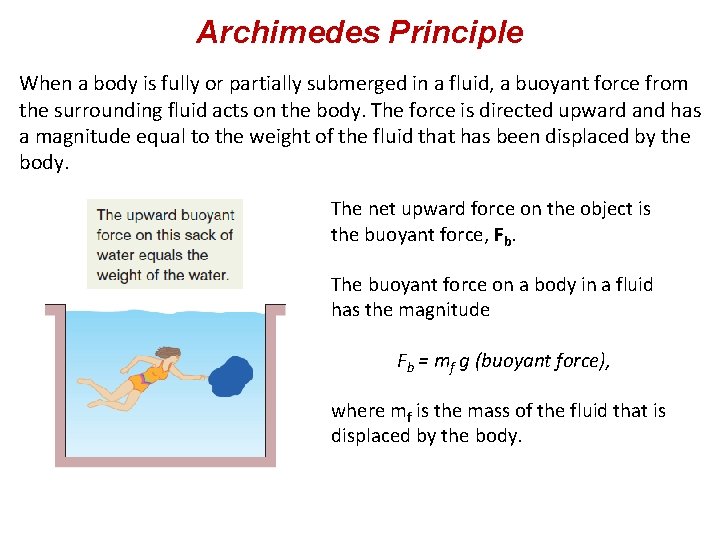
Archimedes Principle When a body is fully or partially submerged in a fluid, a buoyant force from the surrounding fluid acts on the body. The force is directed upward and has a magnitude equal to the weight of the fluid that has been displaced by the body. The net upward force on the object is the buoyant force, Fb. The buoyant force on a body in a fluid has the magnitude Fb = mf g (buoyant force), where mf is the mass of the fluid that is displaced by the body.
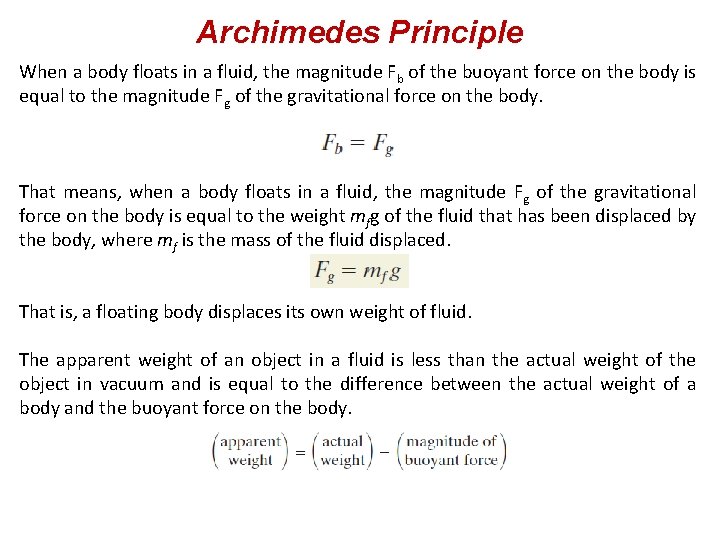
Archimedes Principle When a body floats in a fluid, the magnitude Fb of the buoyant force on the body is equal to the magnitude Fg of the gravitational force on the body. That means, when a body floats in a fluid, the magnitude Fg of the gravitational force on the body is equal to the weight mfg of the fluid that has been displaced by the body, where mf is the mass of the fluid displaced. That is, a floating body displaces its own weight of fluid. The apparent weight of an object in a fluid is less than the actual weight of the object in vacuum and is equal to the difference between the actual weight of a body and the buoyant force on the body.
Example Problem A 25 N block is submerged in water. If the mass of the fluid displaced is 2 kg, what is the apparent weight of the block?
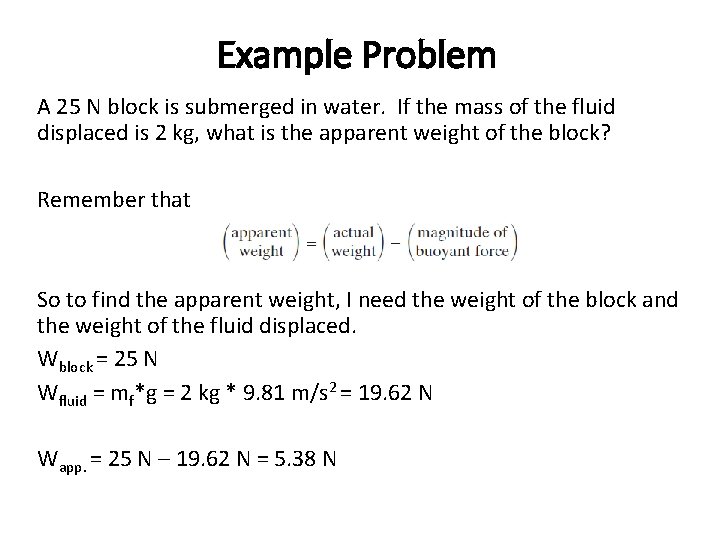
Example Problem A 25 N block is submerged in water. If the mass of the fluid displaced is 2 kg, what is the apparent weight of the block? Remember that So to find the apparent weight, I need the weight of the block and the weight of the fluid displaced. Wblock = 25 N Wfluid = mf*g = 2 kg * 9. 81 m/s 2 = 19. 62 N Wapp. = 25 N – 19. 62 N = 5. 38 N
Ideal Fluids in Motion 1. Steady flow: In steady (or laminar) flow, the velocity of the moving fluid at any fixed point does not change with time. 2. Incompressible flow: We assume, as for fluids at rest, that our ideal fluid is incompressible; that is, its density has a constant, uniform value. 3. Nonviscous flow: The viscosity of a fluid is a measure of how resistive the fluid is to flow; viscosity is the fluid analog of friction between solids. An object moving through a nonviscous fluid would experience no viscous drag force—that is, no resistive force due to viscosity; it could move at constant speed through the fluid. 4. Irrotational flow: In irrotational flow a test body suspended in the fluid will not rotate about an axis through its own center of mass.
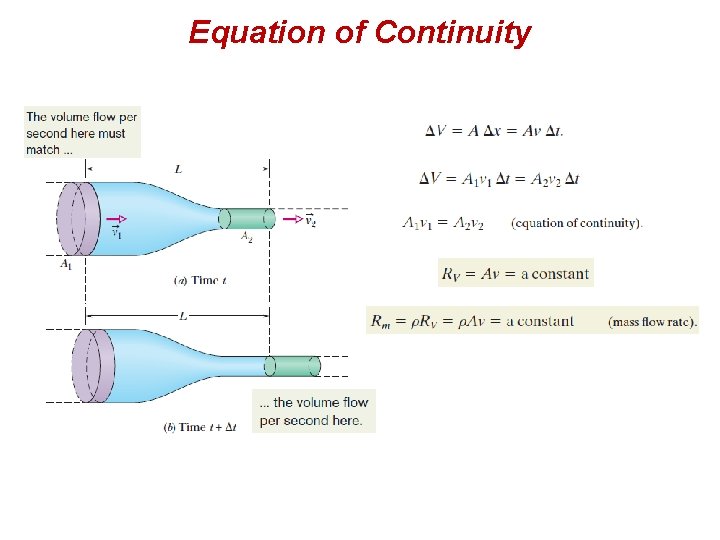
Equation of Continuity
Example Problem Water is flowing through a garden hose at 2 m/s that has a cross sectional area of a pipe if 1 m 2. If you place your finger of the end of the hose to reduce it to 0. 5 m 2, what is the new velocity of the water? What would be the velocity if you reduced it even further to 0. 25 m 2? The continuity equation says A 1*v 1 = A 2*v 2 Rearranging to find v 2 we get v 2 = (A 1*v 1)/A 2 For the first question we find v 2 = (1 m 2 * 2 m/s) / 0. 5 m 2 = 4 m/s For the second question we find v 2 = (1 m 2 * 2 m/s) / 0. 25 m 2 = 8 m/s
Example Problem Water is flowing through a garden hose at 2 m/s that has a cross sectional area of a pipe if 1 m 2. If you place your finger of the end of the hose to reduce it to 0. 5 m 2, what is the new velocity of the water? What would be the velocity if you reduced it even further to 0. 25 m 2? The continuity equation says A 1*v 1 = A 2*v 2 Rearranging to find v 2 we get v 2 = (A 1*v 1)/A 2 For the first question we find v 2 = (1 m 2 * 2 m/s) / 0. 5 m 2 = 4 m/s For the second question we find v 2 = (1 m 2 * 2 m/s) / 0. 25 m 2 = 8 m/s
Example Problem Water is flowing through a garden hose at 2 m/s that has a cross sectional area of a pipe if 1 m 2. If you place your finger of the end of the hose to reduce it to 0. 5 m 2, what is the new velocity of the water? What would be the velocity if you reduced it even further to 0. 25 m 2? The continuity equation says A 1*v 1 = A 2*v 2 Rearranging to find v 2 we get v 2 = (A 1*v 1)/A 2 For the first question we find v 2 = (1 m 2 * 2 m/s) / 0. 5 m 2 = 4 m/s For the second question we find v 2 = (1 m 2 * 2 m/s) / 0. 25 m 2 = 8 m/s
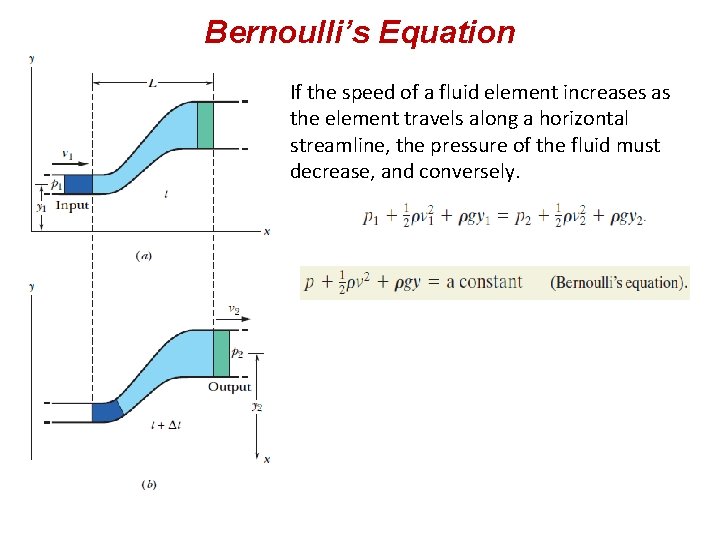
Bernoulli’s Equation If the speed of a fluid element increases as the element travels along a horizontal streamline, the pressure of the fluid must decrease, and conversely.
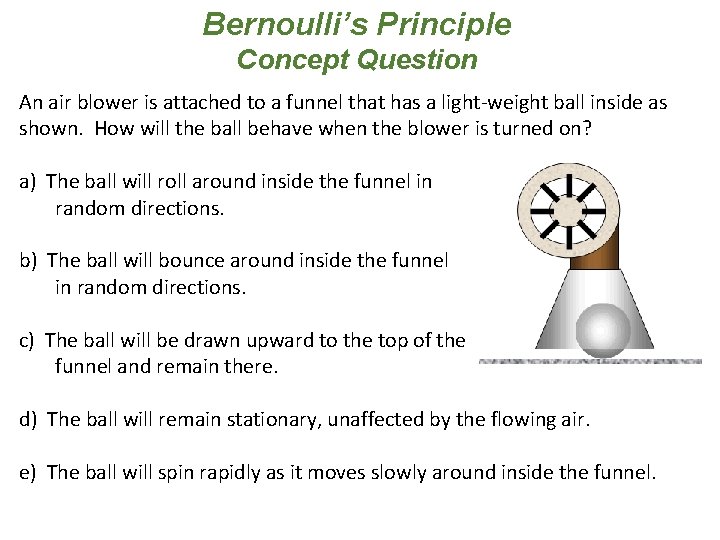
Bernoulli’s Principle Concept Question An air blower is attached to a funnel that has a light-weight ball inside as shown. How will the ball behave when the blower is turned on? a) The ball will roll around inside the funnel in random directions. b) The ball will bounce around inside the funnel in random directions. c) The ball will be drawn upward to the top of the funnel and remain there. d) The ball will remain stationary, unaffected by the flowing air. e) The ball will spin rapidly as it moves slowly around inside the funnel.