
Energy Generation Transmission and Distribution Competency Model What
Energy Generation, Transmission and Distribution Competency Model What You Need to Know Webinar: May 14, 2008 1

Welcome! • Moderator/Presenter: Dana Berkheimer, Educational Consultant, Center for Energy Workforce Development (CEWD) • Presenter: Pam Frugoli, O*NET/Competency Assessment Team Lead, USDOL Employment and Training Administration 2
Today’s Goal n To share the competencies required to work in the energy industry and how they can be used by energy companies, educators and workforce investment systems 3
Who is here today? • Investor-owned, municipal and cooperative electric, gas and nuclear companies • Representatives of the Public Workforce Investment System • Workforce Investment Board (WIB) Director and/or staff member • One-Stop Career Center staff, • State WIB member and or State staff • Federal Employees 4
Learning Objectives Define competencies and competency model and how they can be used by employers, schools and workforce systems n Describe why energy companies need to understand the competency model n Navigate the Competency Model Clearinghouse to get the most out of the information contained there n 5
Energy Generation, Transmission and Distribution Competency Model • What’s the issue? – By 2012 the following job classifications will have large numbers of employees eligible to retire: • More than half of all non-nuclear power plant operators • 52% of generation technicians • 40% of line workers • 46% of engineers – Increased demand for electricity and natural gas will require new construction to be built requiring new workers – Aging infrastructure (some equipment is over 50 years old) will require upgrades 6
Energy Generation, Transmission and Distribution Competency Model • What’s the Solution? – New workers must be brought into the pipeline now, giving older, more experienced workers an opportunity to transfer knowledge and training before they move on. – To accomplish that, potential candidates must understand the work done in the industry, the skills and competencies required to perform that work and where the job opportunities are. 7
Energy Generation, Transmission and Distribution Competency Model • Solution – The Energy Generation, Transmission and Distribution Competency Model is one tool that can be used to help the industry, educational institutions, labor, One Stop Career centers and workforce investment systems understand the skills required to work in the energy industry. 8
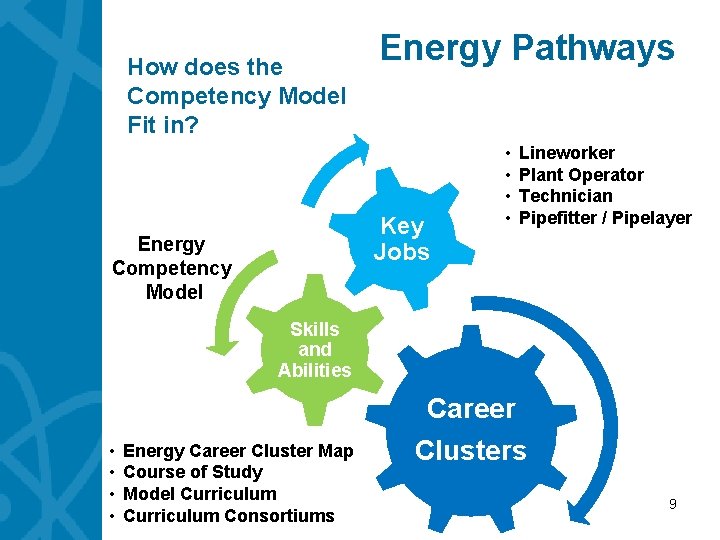
How does the Competency Model Fit in? Energy Pathways Key Jobs Energy Competency Model • • Lineworker Plant Operator Technician Pipefitter / Pipelayer Skills and Abilities Career • • Energy Career Cluster Map Course of Study Model Curriculum Consortiums Clusters 9
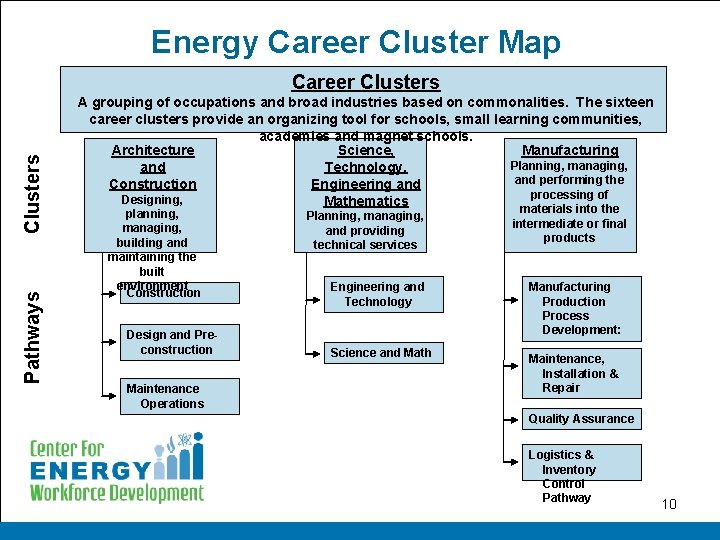
Energy Career Cluster Map Pathways Clusters Career Clusters A grouping of occupations and broad industries based on commonalities. The sixteen career clusters provide an organizing tool for schools, small learning communities, academies and magnet schools. Architecture Science, Manufacturing Planning, managing, and Technology, and performing the Construction Engineering and processing of Designing, Mathematics planning, managing, building and maintaining the built environment Construction Design and Preconstruction Maintenance Operations Planning, managing, and providing technical services materials into the intermediate or final products Engineering and Technology Manufacturing Production Process Development: Science and Math Maintenance, Installation & Repair Quality Assurance Logistics & Inventory Control Pathway 10
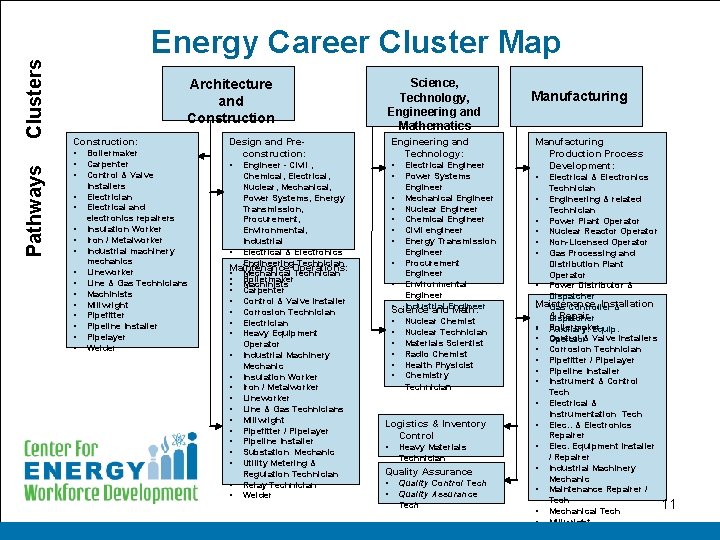
Clusters Pathways Energy Career Cluster Map Architecture and Construction: • • • • Boilermaker Carpenter Control & Valve Installers Electrician Electrical and electronics repairers Insulation Worker Iron / Metalworker Industrial machinery mechanics Lineworker Line & Gas Technicians Machinists Millwright Pipefitter Pipeline Installer Pipelayer Welder Science, Technology, Engineering and Mathematics Design and Preconstruction: Engineering and Technology: • • • Engineer - Civil , Chemical, Electrical, Nuclear, Mechanical, Power Systems, Energy Transmission, Procurement, Environmental, Industrial • Electrical & Electronics Engineering Technician Maintenance Operations: • Mechanical Technician • Boilermaker • Machinists • Carpenter • Control & Valve Installer • Corrosion Technician • Electrician • Heavy Equipment Operator • Industrial Machinery Mechanic • Insulation Worker • Iron / Metalworker • Line & Gas Technicians • Millwright • Pipefitter / Pipelayer • Pipeline Installer • Substation Mechanic • Utility Metering & Regulation Technician • Relay Technician • Welder • • Electrical Engineer Power Systems Engineer Mechanical Engineer Nuclear Engineer Chemical Engineer Civil engineer Energy Transmission Engineer Procurement Engineer Environmental Engineer Industrial Engineer • Science and Math: • • • Nuclear Chemist Nuclear Technician Materials Scientist Radio Chemist Health Physicist Chemistry Technician Logistics & Inventory Control • Heavy Materials Technician Quality Assurance • • Quality Control Tech Quality Assurance Tech Manufacturing Production Process Development: • Electrical & Electronics Technician • Engineering & related Technician • Power Plant Operator • Nuclear Reactor Operator • Non-Licensed Operator • Gas Processing and Distribution Plant Operator • Power Distributor & Dispatcher Maintenance, Installation • Gas Controller & & Repair Dispatcher • Boilermaker Auxiliary. Equip. • Control Operator& Valve Installers • Corrosion Technician • Pipefitter / Pipelayer • Pipeline Installer • Instrument & Control Tech • Electrical & Instrumentation Tech • Elec. . & Electronics Repairer • Elec. Equipment Installer / Repairer • Industrial Machinery Mechanic • Maintenance Repairer / Tech • Mechanical Tech • Millwright • Welder 11
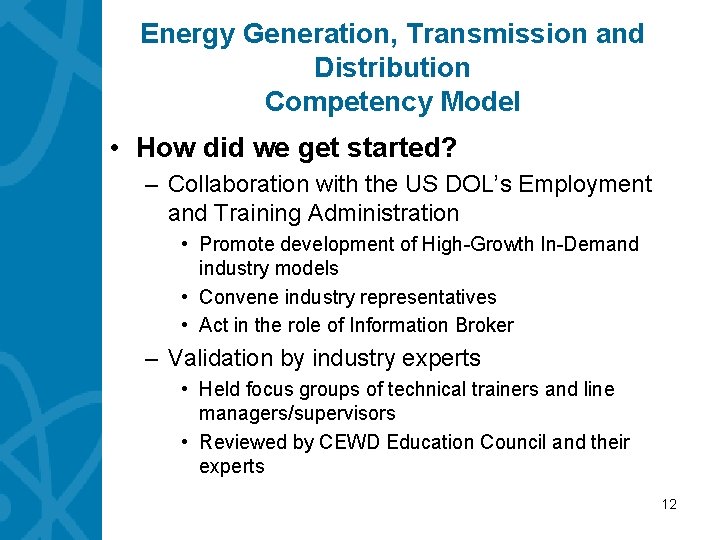
Energy Generation, Transmission and Distribution Competency Model • How did we get started? – Collaboration with the US DOL’s Employment and Training Administration • Promote development of High-Growth In-Demand industry models • Convene industry representatives • Act in the role of Information Broker – Validation by industry experts • Held focus groups of technical trainers and line managers/supervisors • Reviewed by CEWD Education Council and their experts 12
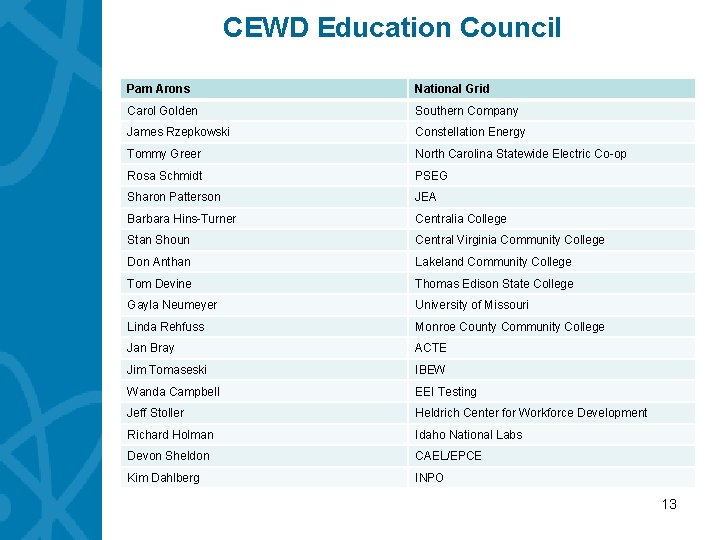
CEWD Education Council Pam Arons National Grid Carol Golden Southern Company James Rzepkowski Constellation Energy Tommy Greer North Carolina Statewide Electric Co-op Rosa Schmidt PSEG Sharon Patterson JEA Barbara Hins-Turner Centralia College Stan Shoun Central Virginia Community College Don Anthan Lakeland Community College Tom Devine Thomas Edison State College Gayla Neumeyer University of Missouri Linda Rehfuss Monroe County Community College Jan Bray ACTE Jim Tomaseski IBEW Wanda Campbell EEI Testing Jeff Stoller Heldrich Center for Workforce Development Richard Holman Idaho National Labs Devon Sheldon CAEL/EPCE Kim Dahlberg INPO 13
Pam Frugoli, O*NET/Competency Assessment Team Lead USDOL Employment & Training Administration 14
Energy Generation, Transmission and Distribution Industry Competency Initiative Tools for Talent Development 15
Competency Model Objectives • To develop a dynamic, industry-driven framework for the foundational competencies that are necessary for entry level workers across all industry sectors. • To develop a model framework which allows for – consistency across the industry. – easy customization within sectors. – and uncomplicated updating to accommodate changing technology and business practices. • To reduce duplication of efforts. • To equip American workers with the higher-level skills demanded by today’s globally-competitive regional economies. 16
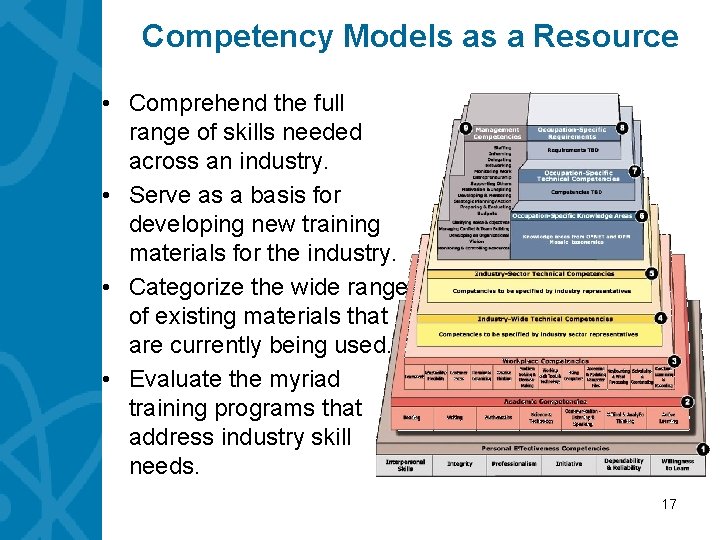
Competency Models as a Resource • Comprehend the full range of skills needed across an industry. • Serve as a basis for developing new training materials for the industry. • Categorize the wide range of existing materials that are currently being used. • Evaluate the myriad training programs that address industry skill needs. 17
How Can Competency Models Be Used? • Develop sector-specific competencies that flow from foundational competencies. • Develop competency-based curriculum and training models. • Develop industry-defined performance indicators and measurement criteria for each competency area in the context of a common framework. • Develop position descriptions and hiring criteria for industry. • Develop assessment and testing instruments • Provide guidance for government investments in workforce preparation strategies in the retail industry. 18
Who Benefits? • Business needs to know they are hiring workers who can succeed in the 21 st century economy. • Prospective workers need to know what skills they must have to take the first steps toward a successful career in a high-growth industry. • Educators and training providers need to know what competencies to train to, and that they are directly relevant to industry requirements. • Government and workforce professionals need to know that the training programs they are supporting and referring customers to are producing workers who will find employment. 19
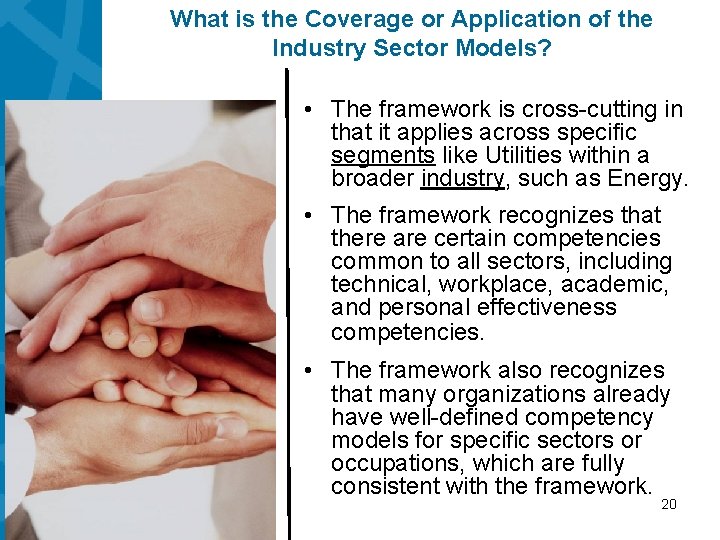
What is the Coverage or Application of the Industry Sector Models? • The framework is cross-cutting in that it applies across specific segments like Utilities within a broader industry, such as Energy. • The framework recognizes that there are certain competencies common to all sectors, including technical, workplace, academic, and personal effectiveness competencies. • The framework also recognizes that many organizations already have well-defined competency models for specific sectors or occupations, which are fully consistent with the framework. 20
How Does the Model Relate to Existing Resources? • The framework does not compete with existing standards or provide new standards • The framework is a tool to compare standards and curricula to evaluate their strengths and gaps in addressing requirements for entry-level workers. 21
What is a Competency? A competency is a specific, identifiable, definable, and measurable skill or characteristic that is essential for the performance of an activity within a specific business or industry context. Examples • Safety Awareness • Critical and Analytical Thinking • Problem Solving/Decision Making • Communication • Teamwork 22
What is a Competency Model? A competency model is a clear description of what a person needs to know and be able to do – the knowledge, skills, and abilities to perform well in a specific job, occupation, or industry. 23
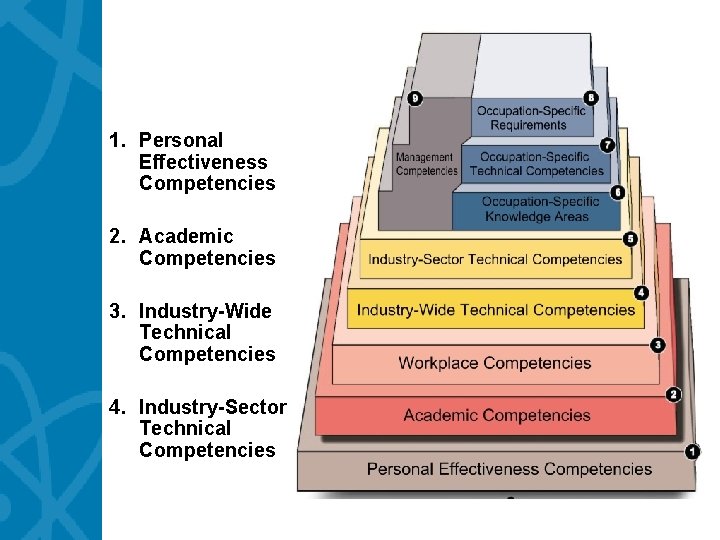
1. Personal Effectiveness Competencies 2. Academic Competencies 3. Industry-Wide Technical Competencies 4. Industry-Sector Technical Competencies
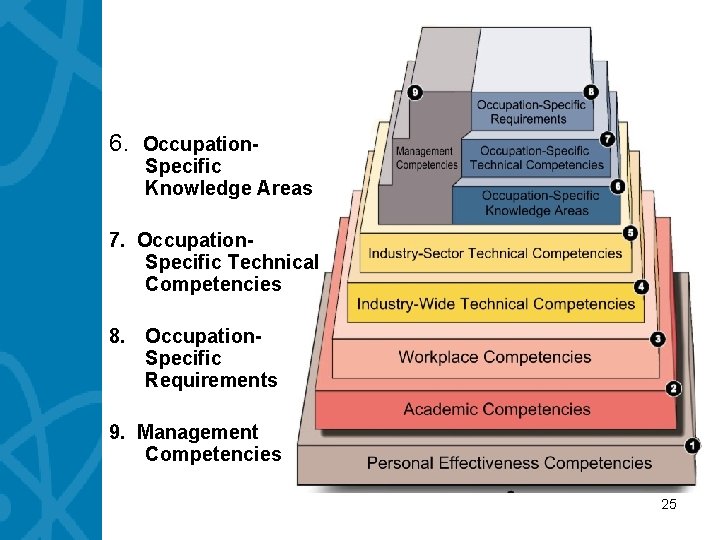
Tiers 6. Occupation- Specific Knowledge Areas 7. Occupation. Specific Technical Competencies 8. Occupation. Specific Requirements 9. Management Competencies 25
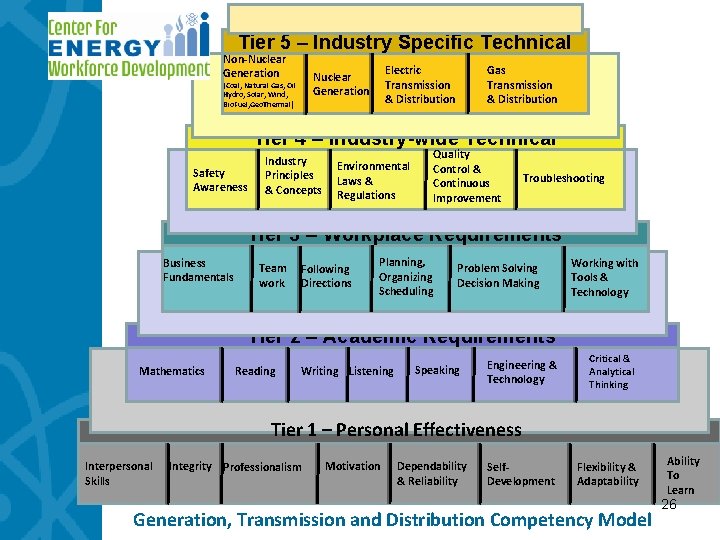
Tier 5 – Industry Specific Technical Non-Nuclear Generation Electric Transmission & Distribution Nuclear Generation (Coal, Natural Gas, Oil Hydro, Solar, Wind, Bio. Fuel, Geo. Thermal) Gas Transmission & Distribution Tier 4 – Industry-wide Technical Safety Awareness Industry Principles & Concepts Environmental Laws & Regulations Quality Control & Continuous Improvement Troubleshooting Tier 3 – Workplace Requirements Business Fundamentals Team work Following Directions Planning, Organizing Scheduling Problem Solving Decision Making Working with Tools & Technology Tier 2 – Academic Requirements Mathematics Reading Writing Listening Speaking Engineering & Technology Critical & Analytical Thinking Tier 1 – Personal Effectiveness Interpersonal Skills Integrity Professionalism Motivation Dependability & Reliability Self. Development Flexibility & Adaptability Generation, Transmission and Distribution Competency Model Ability To Learn 26
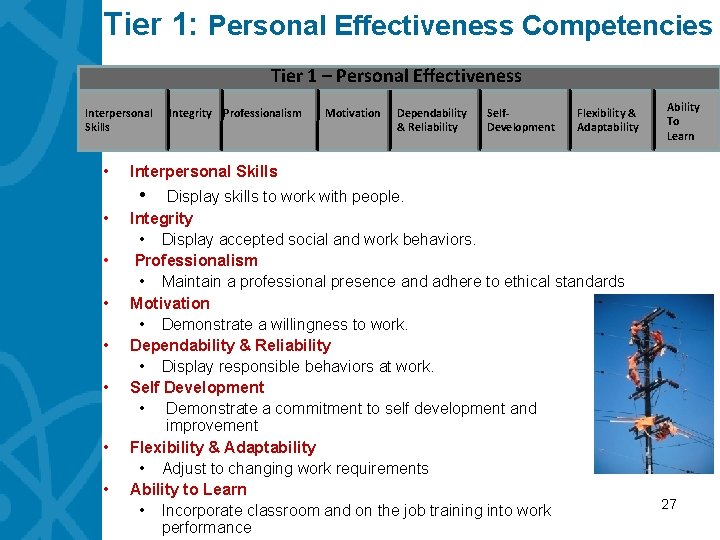
Tier 1: Personal Effectiveness Competencies Tier 1 – Personal Effectiveness Interpersonal Skills • Integrity Professionalism Motivation Dependability & Reliability Self. Development Flexibility & Adaptability Ability To Learn Interpersonal Skills • • Display skills to work with people. Integrity • Display accepted social and work behaviors. Professionalism • Maintain a professional presence and adhere to ethical standards Motivation • Demonstrate a willingness to work. Dependability & Reliability • Display responsible behaviors at work. Self Development • Demonstrate a commitment to self development and improvement Flexibility & Adaptability • Adjust to changing work requirements Ability to Learn • Incorporate classroom and on the job training into work performance 27
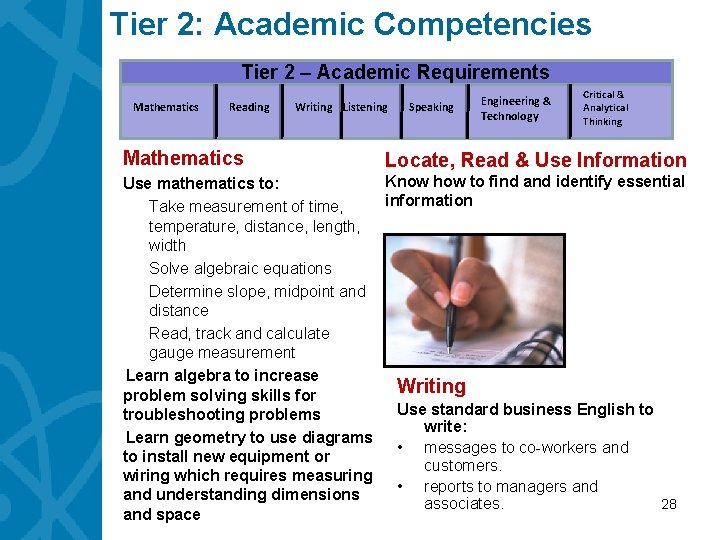
Tier 2: Academic Competencies Tier 2 – Academic Requirements Mathematics Reading • Mathematics Writing Listening Speaking Engineering & Technology Critical & Analytical Thinking Locate, Read & Use Information Know how to find and identify essential – Use mathematics to: information • Take measurement of time, temperature, distance, length, width • Solve algebraic equations • Determine slope, midpoint and distance • Read, track and calculate gauge measurement ―Learn algebra to increase Writing problem solving skills for Use standard business English to troubleshooting problems write: ―Learn geometry to use diagrams • messages to co-workers and to install new equipment or customers. wiring which requires measuring • reports to managers and understanding dimensions 28 associates. and space
Tier 2: Academic Competencies (Continued) • Communication, Listening & Speaking – Listen carefully in order to incorporate information into work activities – Communicate in spoken English well enough to be understood by supervisors, co-workers and customers to ensure a safe work environment for you and your co-workers • Engineering & Technology • Possess an appropriate mastery of knowledge, techniques, skills, modern tools and advanced technology • Critical & Analytical Thinking • Use logical thought processes to analyze information and draw conclusions 29
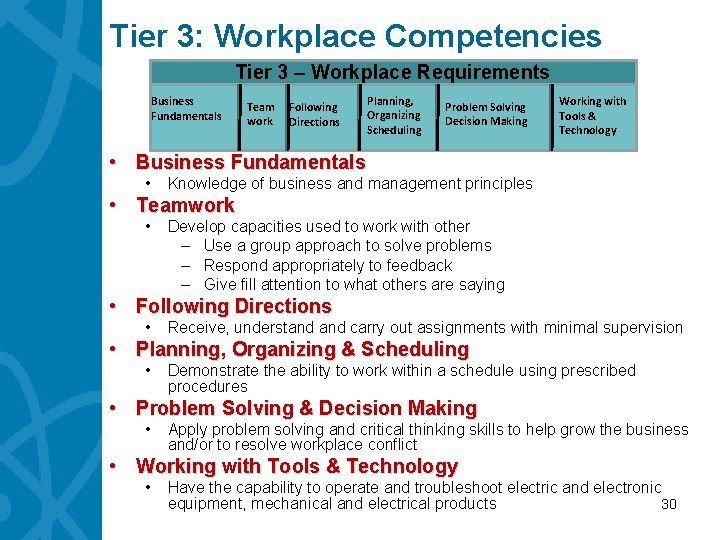
Tier 3: Workplace Competencies Tier 3 – Workplace Requirements Business Fundamentals Team work Following Directions Planning, Organizing Scheduling Problem Solving Decision Making Working with Tools & Technology • Business Fundamentals • Knowledge of business and management principles • Teamwork • Develop capacities used to work with other – Use a group approach to solve problems – Respond appropriately to feedback – Give fill attention to what others are saying • Following Directions • Receive, understand carry out assignments with minimal supervision • Planning, Organizing & Scheduling • Demonstrate the ability to work within a schedule using prescribed procedures • Problem Solving & Decision Making • Apply problem solving and critical thinking skills to help grow the business and/or to resolve workplace conflict • Working with Tools & Technology • Have the capability to operate and troubleshoot electric and electronic equipment, mechanical and electrical products 30
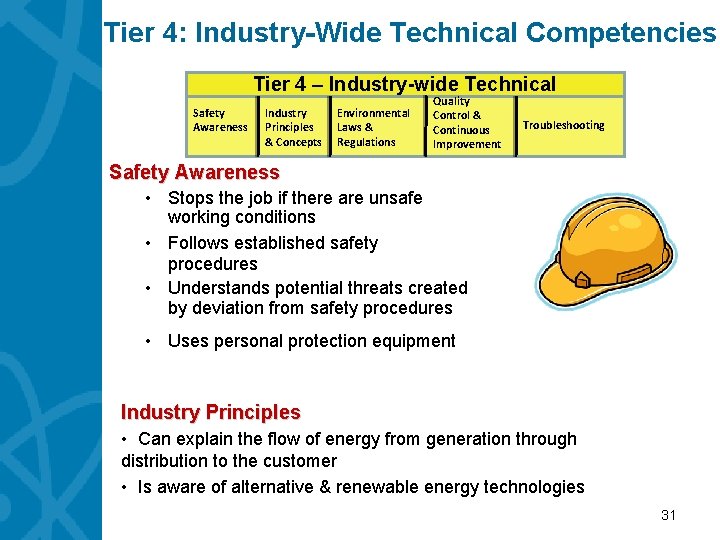
Tier 4: Industry-Wide Technical Competencies Tier 4 – Industry-wide Technical Safety Awareness Industry Principles & Concepts Environmental Laws & Regulations Quality Control & Continuous Improvement Troubleshooting Safety Awareness • Stops the job if there are unsafe working conditions • Follows established safety procedures • Understands potential threats created by deviation from safety procedures • Uses personal protection equipment Industry Principles • Can explain the flow of energy from generation through distribution to the customer • Is aware of alternative & renewable energy technologies 31
Tier 4: Industry-Wide Technical Competencies (Continued) Environmental Laws & Regulations – Follows energy standards produced by industry organizations –Complies with all relevant environmental laws issued by federal agencies including EPA Quality Control & Continuous Improvement – Conducts tests and inspections to evaluate quality or performance – Incorporates new information into both current and future problem solving and decision making – Determines how a system should work and how changes in conditions, operations and the environment will affect outcomes Troubleshooting – Determines causes of operating errors, decides what to do about them and knows when to notify more senior personnel 32
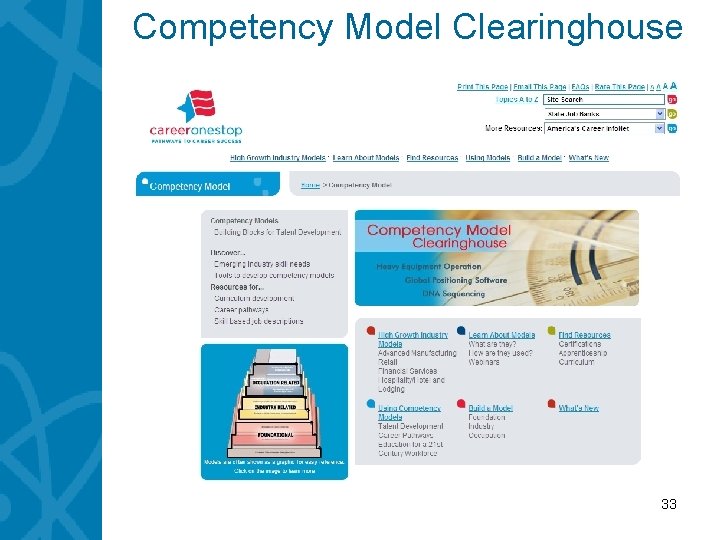
Competency Model Clearinghouse 33
Competency Model Clearinghouse Visit the Web site to: • Access high-growth industry models. • Learn about competency models. • Discover new uses of competency models. • Find competency model resources. – Searchable database • Build or customize a competency model. Go to: www. careeronestop. org/Competency. Model 34
Question & Answer Segment To ask a question of the presenters, click the down arrow on the Questions box. Type your question under “Enter a Question for the Staff” then press “Send. ” 35
Thank you for your participation! Please complete the program evaluation form to help us plan other Quick Solutions programs. n You should receive an email with the survey link. n 36
- Slides: 36