
Energy Ethics Overview From the Ethics of Energy
![Serge Latouche “The planned demise of the [energy] growth society would not necessarily be](https://slidetodoc.com/presentation_image_h2/467cdbaab78448642636671db2e07ce0/image-13.jpg "Serge Latouche “The planned demise of the [energy] growth society would not necessarily be")
![Back to Klare The Deepwater Horizon explosion [we are told] was an unfortunate fluke:](https://slidetodoc.com/presentation_image_h2/467cdbaab78448642636671db2e07ce0/image-29.jpg "Back to Klare The Deepwater Horizon explosion [we are told] was an unfortunate fluke:")
- Slides: 47
Energy Ethics Overview: From the Ethics of Energy to the Energy of Ethics Carl Mitcham Colorado School of Mines University of the Basque Country Center for Science and Technology Policy Research (CU-Boulder) European Graduate School 1
Putting Energy Ethics on the Intellectual Agenda • Prior to the CEES “Energy Ethics in Science and Engineering” project ENERGY ETHICS scarcely existed. • To be commended for breaking new ground: – Rachelle Hollander – Clark Miller – Joseph Herkert – et al. 2
Three Overlapping Project Activities • Scholarly research – 2011 “Energy Transitions” workshop (NAE) – 2012 “Humanist Narratives” scenario planning (ASU) • Teaching and learning – 2012 & 2013 biofuels and solar energy grad student seminars – Student video creation contest • Public outreach and engagements – 2011 consensus conference on “Arizona’s Energy Future” 3
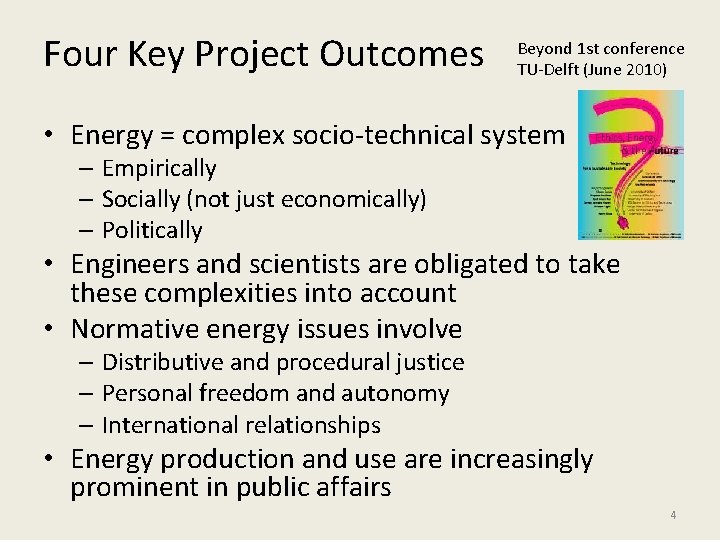
Four Key Project Outcomes Beyond 1 st conference TU-Delft (June 2010) • Energy = complex socio-technical system – Empirically – Socially (not just economically) – Politically • Engineers and scientists are obligated to take these complexities into account • Normative energy issues involve – Distributive and procedural justice – Personal freedom and autonomy – International relationships • Energy production and use are increasingly prominent in public affairs 4
In Homage Having learned from and in homage to the project, this presentation offers: 1. An overview of the historico-philosophical emergence of energy ethics 2. An analytic distinction between two basic types of energy ethics 3. A challenge to the extreme energy desires of our individualistic, technoscientific culture 5
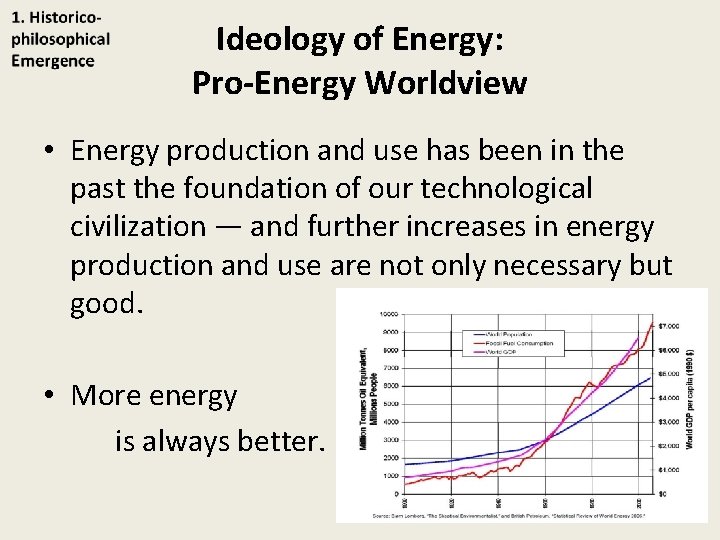
Ideology of Energy: Pro-Energy Worldview • Energy production and use has been in the past the foundation of our technological civilization ― and further increases in energy production and use are not only necessary but good. • More energy is always better. 6
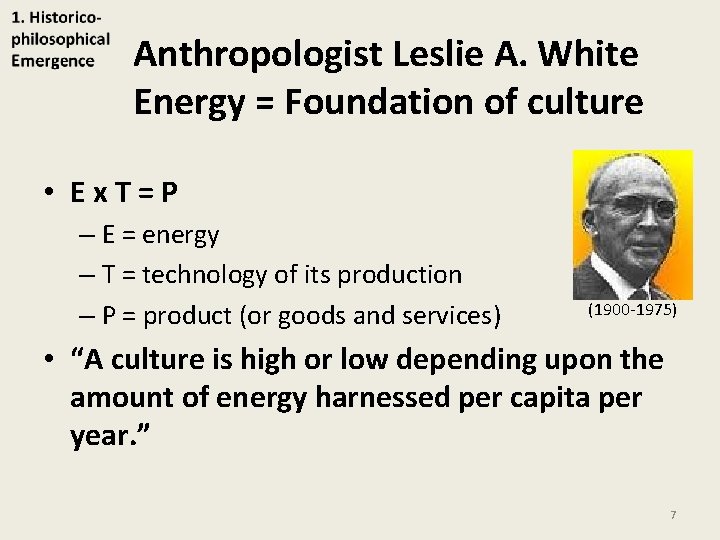
Anthropologist Leslie A. White Energy = Foundation of culture • Ex. T=P – E = energy – T = technology of its production – P = product (or goods and services) (1900 -1975) • “A culture is high or low depending upon the amount of energy harnessed per capita per year. ” 7
White’s Law of Cultural Development “Culture advances as the amount of energy harnessed per capita per year increases, or as the efficiency or economy of the means of controlling energy is increased, or both. ” – Leslie A. White, The Evolution of Culture: The Development of Civilization to the Fall of Rome (1959) 8
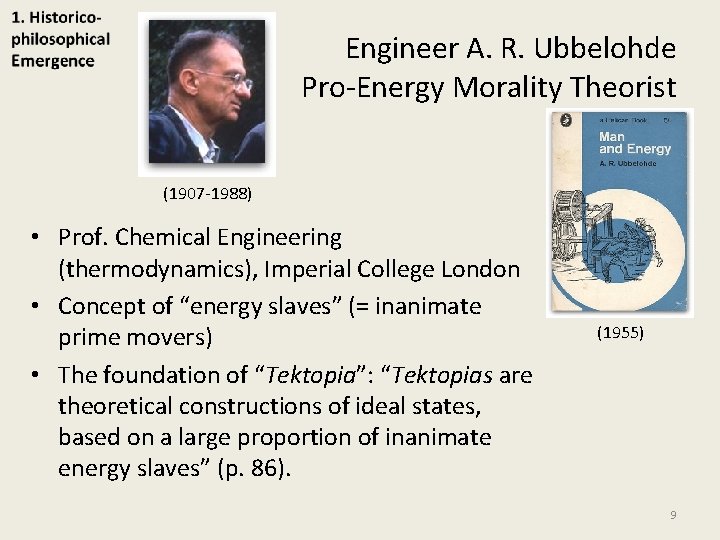
Engineer A. R. Ubbelohde Pro-Energy Morality Theorist (1907 -1988) • Prof. Chemical Engineering (thermodynamics), Imperial College London • Concept of “energy slaves” (= inanimate prime movers) • The foundation of “Tektopia”: “Tektopias are theoretical constructions of ideal states, based on a large proportion of inanimate energy slaves” (p. 86). (1955) 9
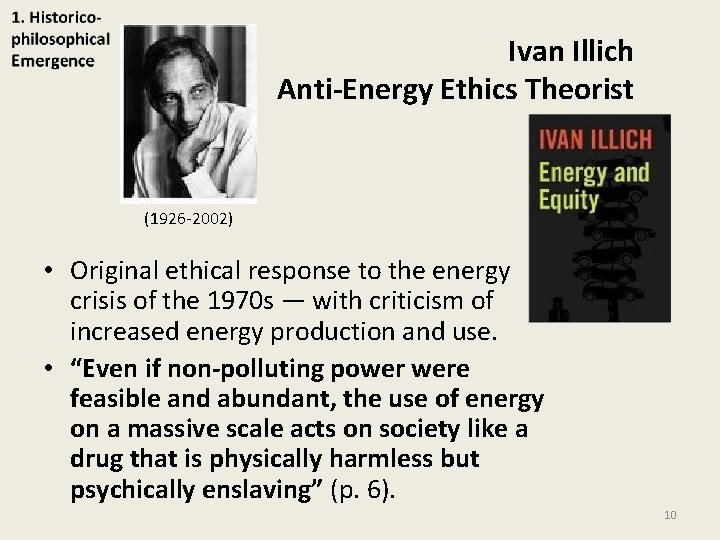
Ivan Illich Anti-Energy Ethics Theorist (1926 -2002) • Original ethical response to the energy crisis of the 1970 s ― with criticism of increased energy production and use. • “Even if non-polluting power were feasible and abundant, the use of energy on a massive scale acts on society like a drug that is physically harmless but psychically enslaving” (p. 6). 10
For Emphasis “Below a threshold of per capita wattage, motors improve the conditions for social progress. Above this threshold, energy grows at the expense of equity. Further energy affluence then means decreased distribution of control over that energy. ” (p. 5) 11
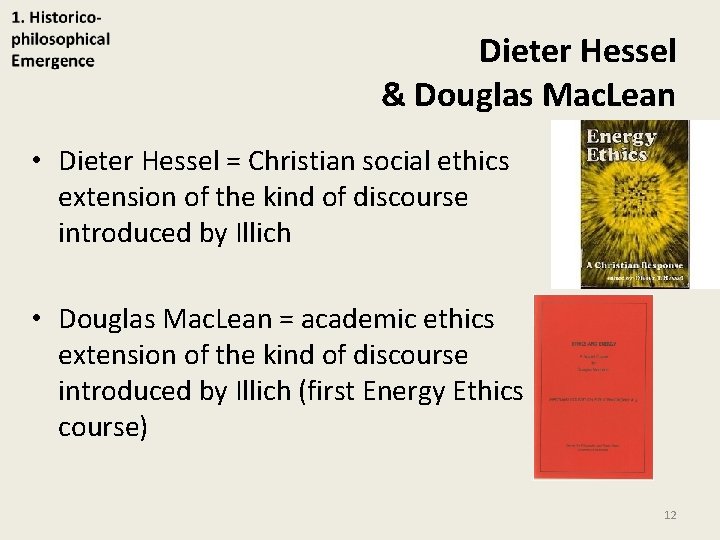
Dieter Hessel & Douglas Mac. Lean • Dieter Hessel = Christian social ethics extension of the kind of discourse introduced by Illich • Douglas Mac. Lean = academic ethics extension of the kind of discourse introduced by Illich (first Energy Ethics course) 12
Serge Latouche “The planned demise of the [energy] growth society would not necessarily be grim. Ivan Illich once wrote that it wasn’t just to avoid the negative sideeffects of an otherwise good thing that we had to renounce our current lifestyle, as though choosing between the pleasure of a tasty dish and its risks. The dish itself was intrinsically disgusting and we would be happier without it. We need to live differently to live better. ” 13
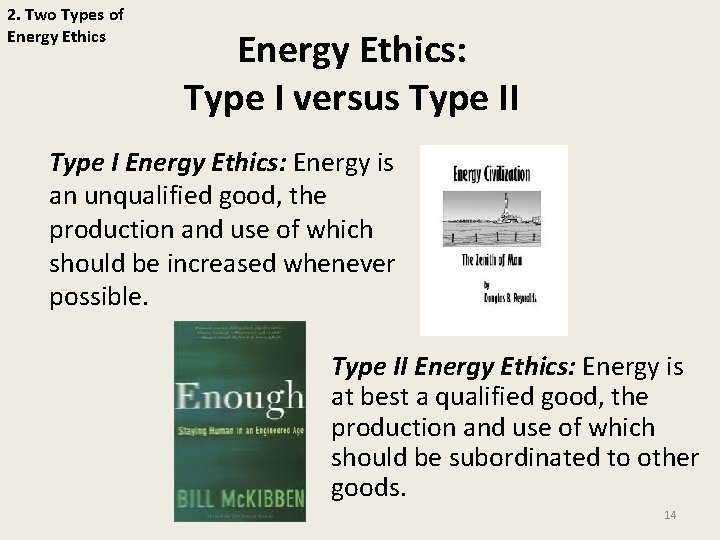
2. Two Types of Energy Ethics: Type I versus Type II Type I Energy Ethics: Energy is an unqualified good, the production and use of which should be increased whenever possible. Type II Energy Ethics: Energy is at best a qualified good, the production and use of which should be subordinated to other goods. 14
Type I: Pro-Energy Ethics Justifications • Energy = unqualified good / necessary for life • Energy production expands human power / raises quality of life (utilitarian) • Increasing energy use by humans is natural (teleological ethics / virtue ethics) • Human beings are obligated to increase energy availability (deontology) • History = increasing energy production + use • Energy is beautiful 15
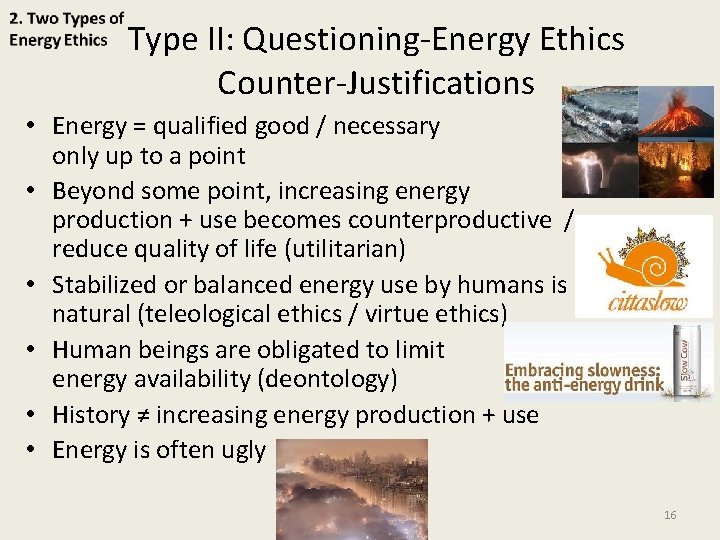
Type II: Questioning-Energy Ethics Counter-Justifications • Energy = qualified good / necessary only up to a point • Beyond some point, increasing energy production + use becomes counterproductive / reduce quality of life (utilitarian) • Stabilized or balanced energy use by humans is natural (teleological ethics / virtue ethics) • Human beings are obligated to limit energy availability (deontology) • History ≠ increasing energy production + use • Energy is often ugly 16
Type I Energy Ethics Concerns Accepts the pro-energy worldview identification energy = the good ― and undertakes ethical assessments of specific forms of production and use. Criticizes energy production and use, e. g. , in terms of • Efficiency • Sustainability • Risk • Social justice 17
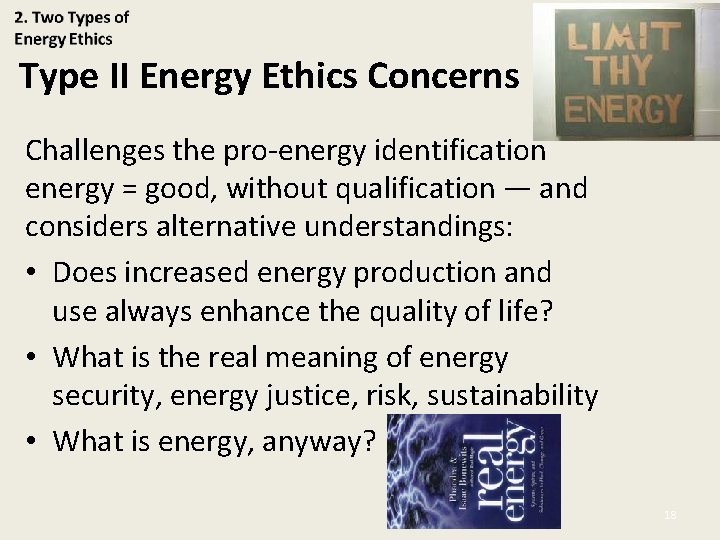
Type II Energy Ethics Concerns Challenges the pro-energy identification energy = good, without qualification ― and considers alternative understandings: • Does increased energy production and use always enhance the quality of life? • What is the real meaning of energy security, energy justice, risk, sustainability • What is energy, anyway? 18
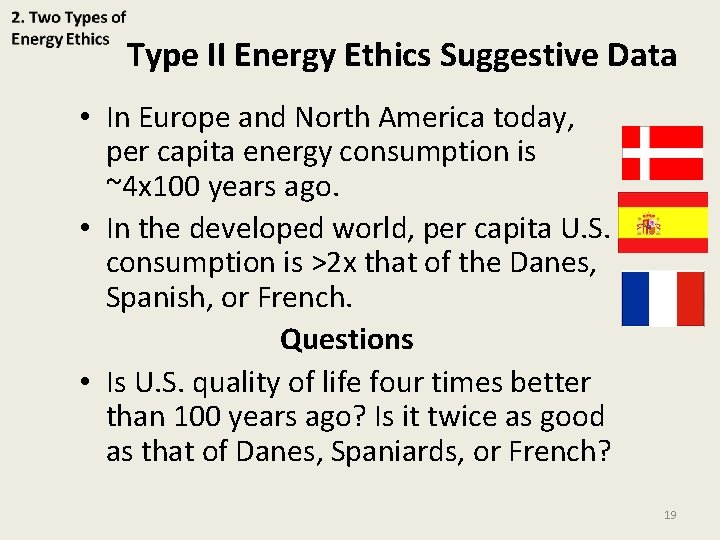
Type II Energy Ethics Suggestive Data • In Europe and North America today, per capita energy consumption is ~4 x 100 years ago. • In the developed world, per capita U. S. consumption is >2 x that of the Danes, Spanish, or French. Questions • Is U. S. quality of life four times better than 100 years ago? Is it twice as good as that of Danes, Spaniards, or French? 19
Qualifier • Type II ethics should also include Type I ethical considerations • Type II ethics should not ignore issues of – Efficiency – Sustainability – Risk – Social justice 20
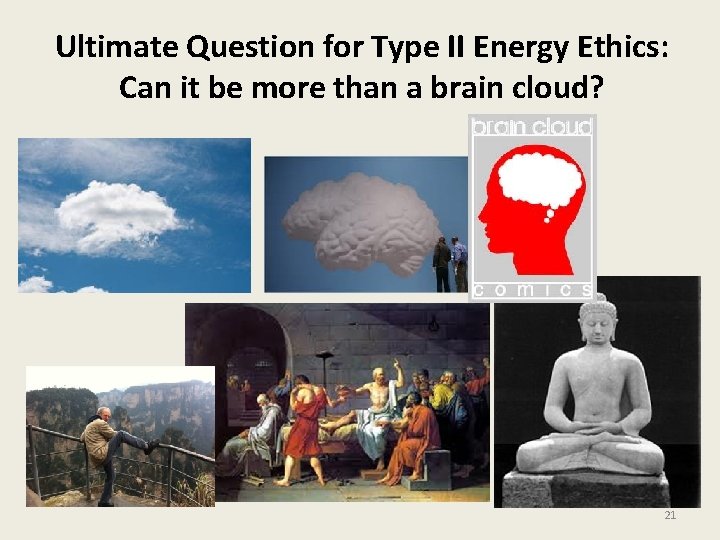
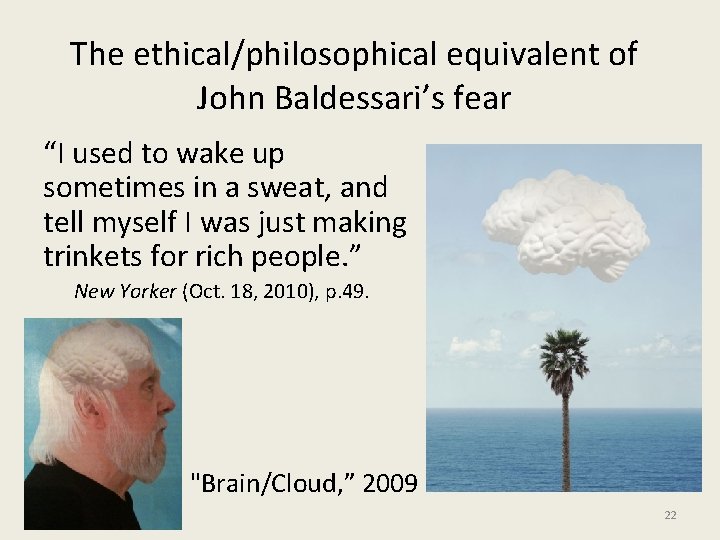
Ultimate Question for Type II Energy Ethics: Can it be more than a brain cloud? 21
The ethical/philosophical equivalent of John Baldessari’s fear “I used to wake up sometimes in a sweat, and tell myself I was just making trinkets for rich people. ” New Yorker (Oct. 18, 2010), p. 49. "Brain/Cloud, ” 2009 22
3. Challenges Response (provisional) Challenges of Need and Possibility • Practical need: The challenge of extreme energy • Idealistic possibility: The challenge of ethics 23
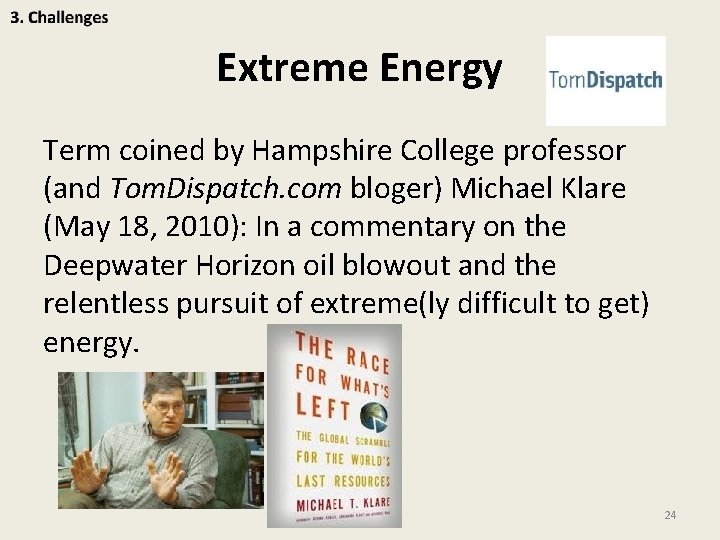
Extreme Energy Term coined by Hampshire College professor (and Tom. Dispatch. com bloger) Michael Klare (May 18, 2010): In a commentary on the Deepwater Horizon oil blowout and the relentless pursuit of extreme(ly difficult to get) energy. 24
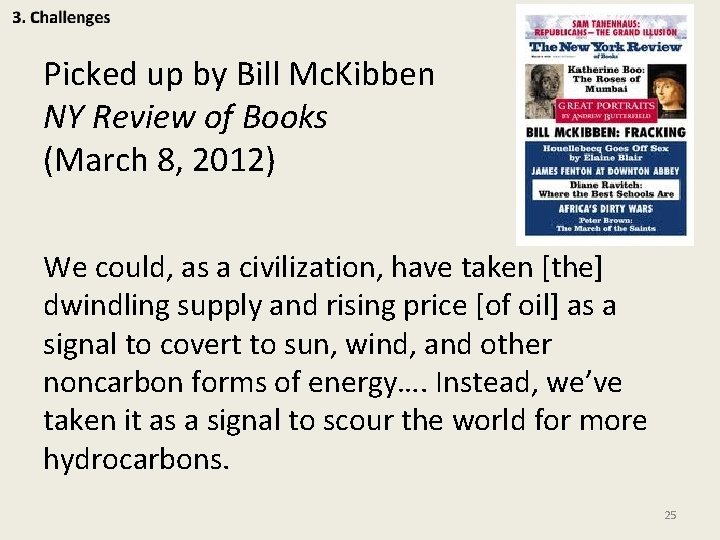
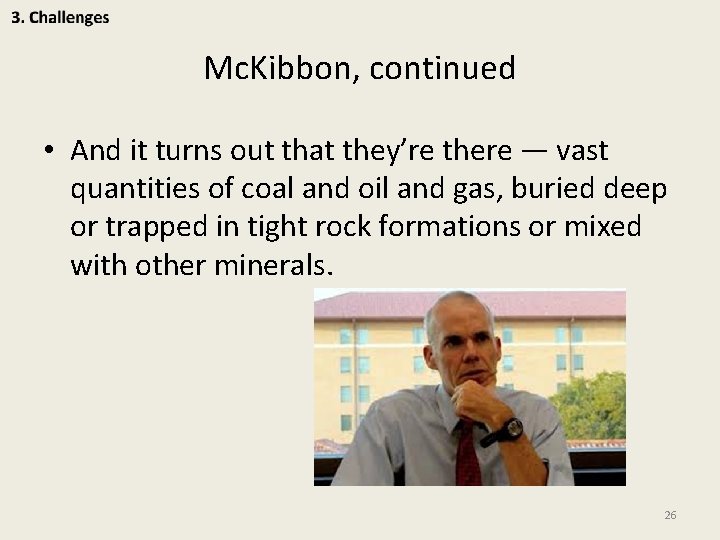
Picked up by Bill Mc. Kibben NY Review of Books (March 8, 2012) We could, as a civilization, have taken [the] dwindling supply and rising price [of oil] as a signal to covert to sun, wind, and other noncarbon forms of energy…. Instead, we’ve taken it as a signal to scour the world for more hydrocarbons. 25
Mc. Kibbon, continued • And it turns out that they’re there ― vast quantities of coal and oil and gas, buried deep or trapped in tight rock formations or mixed with other minerals. 26
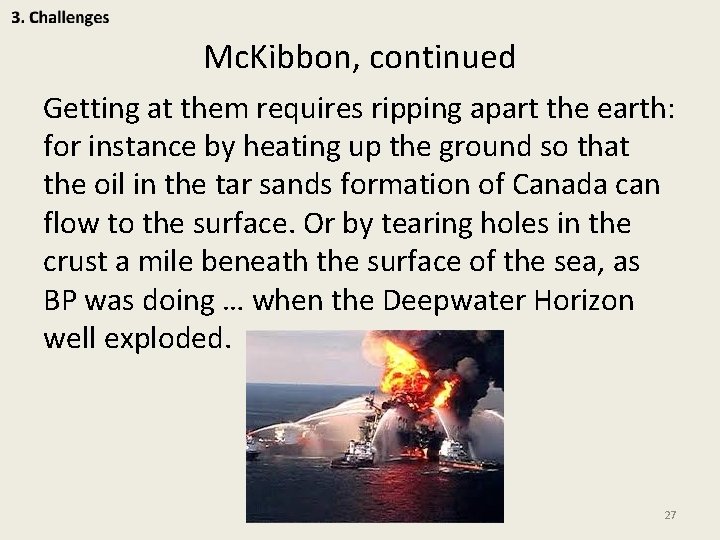
Mc. Kibbon, continued Getting at them requires ripping apart the earth: for instance by heating up the ground so that the oil in the tar sands formation of Canada can flow to the surface. Or by tearing holes in the crust a mile beneath the surface of the sea, as BP was doing … when the Deepwater Horizon well exploded. 27
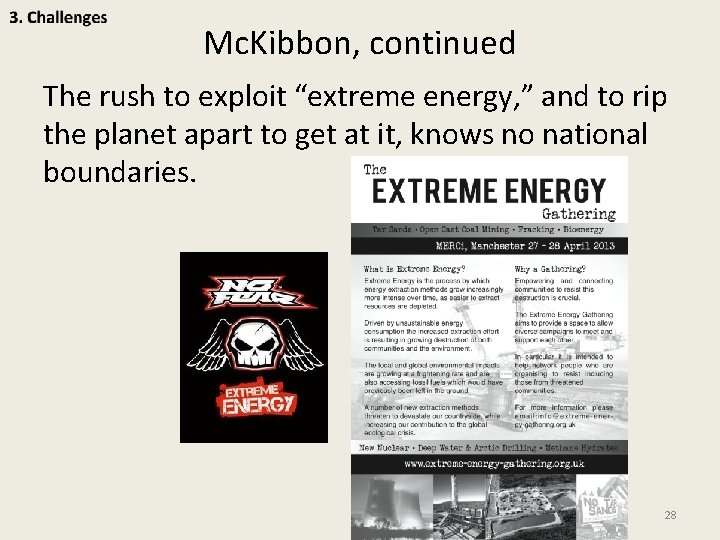
Mc. Kibbon, continued The rush to exploit “extreme energy, ” and to rip the planet apart to get at it, knows no national boundaries. 28
Back to Klare The Deepwater Horizon explosion [we are told] was an unfortunate fluke: a confluence of improper management and faculty equipment. With tightened oversight, [we are assured, ] such accidents can be averted…. 29
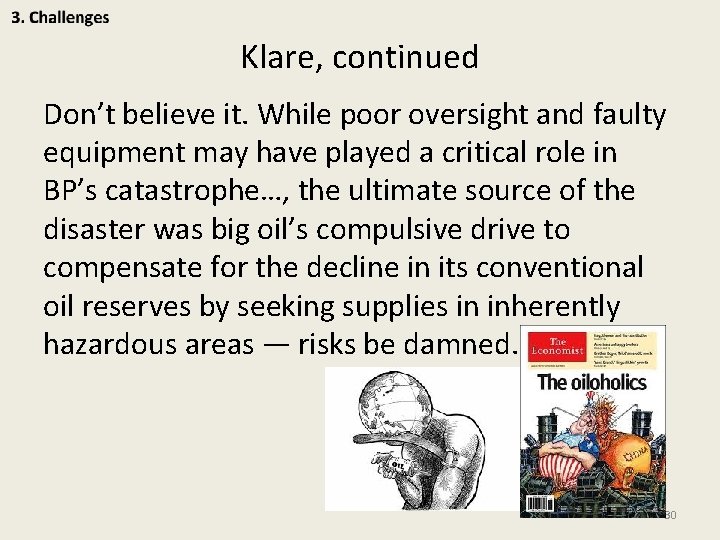
Klare, continued Don’t believe it. While poor oversight and faulty equipment may have played a critical role in BP’s catastrophe…, the ultimate source of the disaster was big oil’s compulsive drive to compensate for the decline in its conventional oil reserves by seeking supplies in inherently hazardous areas ― risks be damned. 30
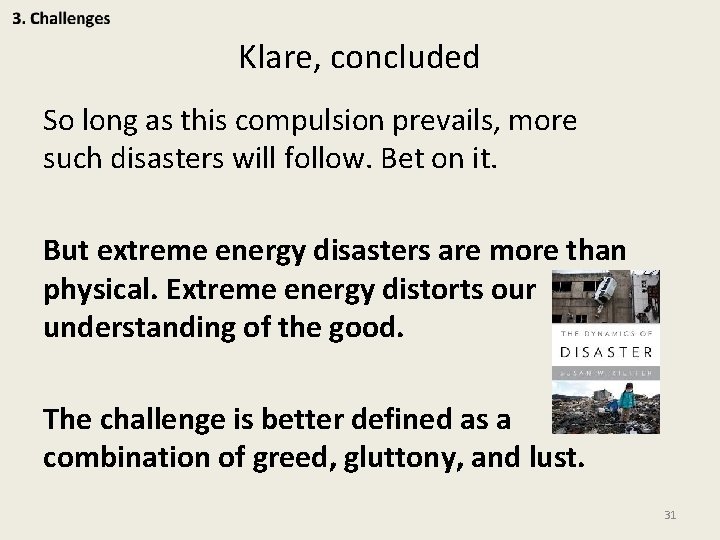
Klare, concluded So long as this compulsion prevails, more such disasters will follow. Bet on it. But extreme energy disasters are more than physical. Extreme energy distorts our understanding of the good. The challenge is better defined as a combination of greed, gluttony, and lust. 31
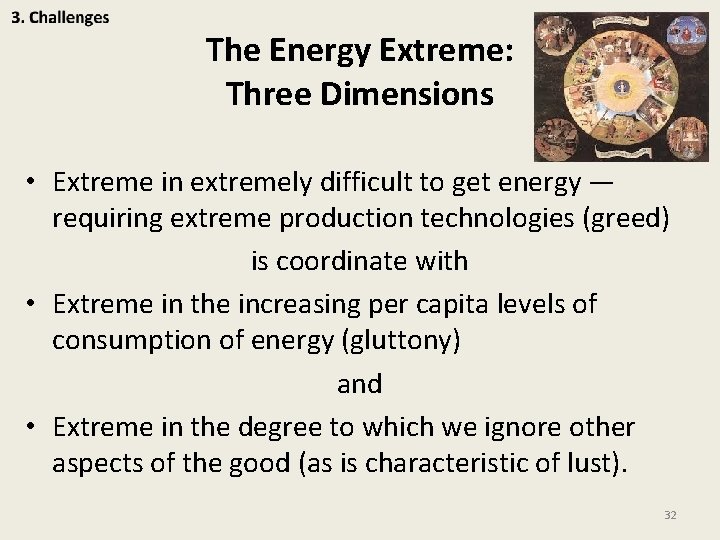
The Energy Extreme: Three Dimensions • Extreme in extremely difficult to get energy ― requiring extreme production technologies (greed) is coordinate with • Extreme in the increasing per capita levels of consumption of energy (gluttony) and • Extreme in the degree to which we ignore other aspects of the good (as is characteristic of lust). 32
Again, Extreme Energy • Through our extreme production+use of energy we are approaching an extreme situation that calls for ethical analysis and response. • The contrast between Type I and Type II energy ethics is one contribution to this analysis and response. 33
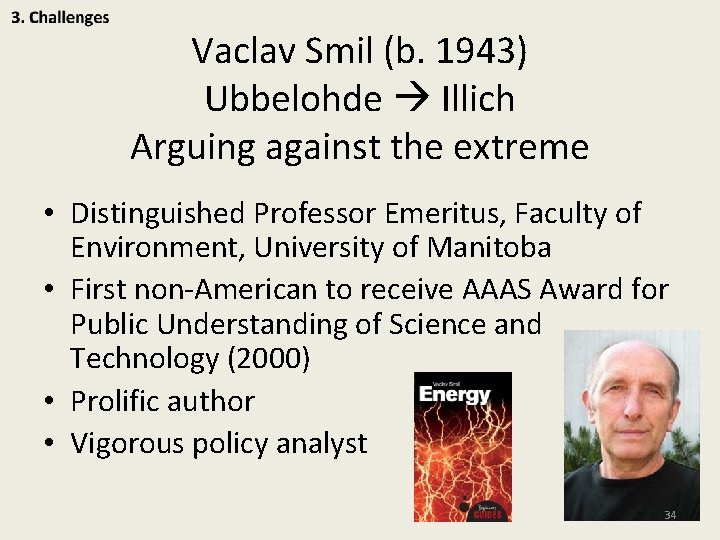
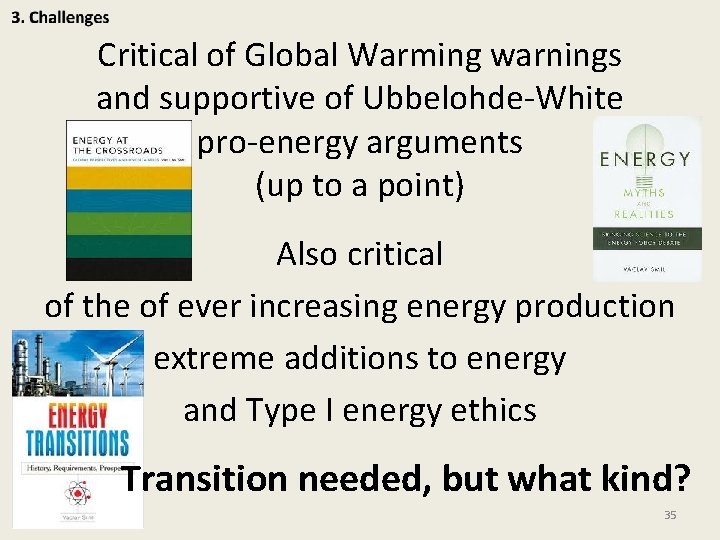
Vaclav Smil (b. 1943) Ubbelohde Illich Arguing against the extreme • Distinguished Professor Emeritus, Faculty of Environment, University of Manitoba • First non-American to receive AAAS Award for Public Understanding of Science and Technology (2000) • Prolific author • Vigorous policy analyst 34
Critical of Global Warming warnings and supportive of Ubbelohde-White pro-energy arguments (up to a point) Also critical of the of ever increasing energy production extreme additions to energy and Type I energy ethics Transition needed, but what kind? 35
Smil argument - 1 It is impossible to extend the high-energy society model of North America (330 giga-joules per capita for ~330 million persons) to the other seven billion people on the planet. The attempt would require more than five times the available global supply. Plus fossil fuel use at the required rate would cause CO 2 emissions with catastrophic ecological impacts. 36
Smil argument - 2 Standard proposed solutions to the challenges of social justice and negative ecological impact are false hopes. (1) Increased energy efficiency is undermined by Jevons’ paradox. (2) Renewable energies are undermined by factors of scale, power density, and alternative negative ecological impacts. 37
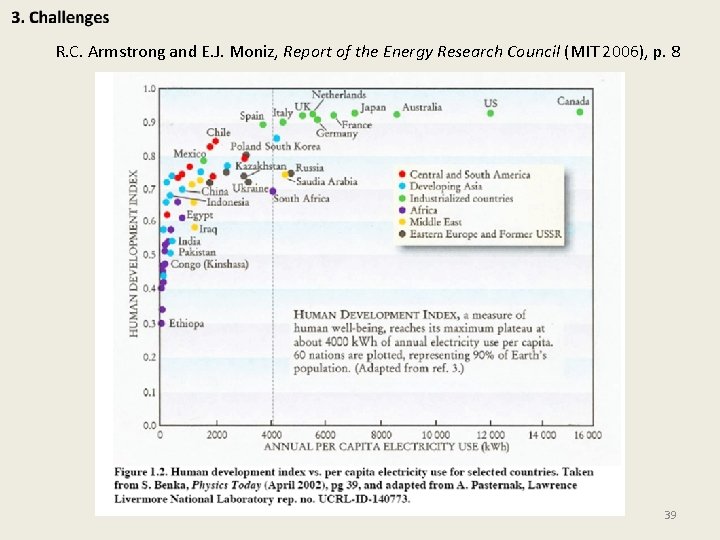
Smil argument - 3 The only reasonable response is a “quest for limited energy consumption. ” Moreover, “the quest for ever higher energy throughputs has entered a decidedly counterproductive stage, insofar as further increases of per capita energy use are not associated with any important gains in physical quality of life or with great security, probity, freedom, or happiness” (“Science, Energy, Ethics, and Civilization, ” 2010, p. 722). 38
R. C. Armstrong and E. J. Moniz, Report of the Energy Research Council (MIT 2006), p. 8 39
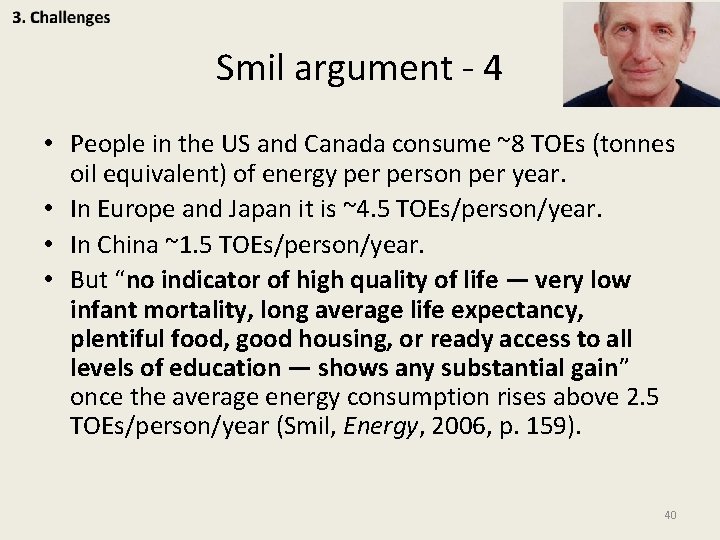
Smil argument - 4 • People in the US and Canada consume ~8 TOEs (tonnes oil equivalent) of energy person per year. • In Europe and Japan it is ~4. 5 TOEs/person/year. • In China ~1. 5 TOEs/person/year. • But “no indicator of high quality of life — very low infant mortality, long average life expectancy, plentiful food, good housing, or ready access to all levels of education — shows any substantial gain” once the average energy consumption rises above 2. 5 TOEs/person/year (Smil, Energy, 2006, p. 159). 40
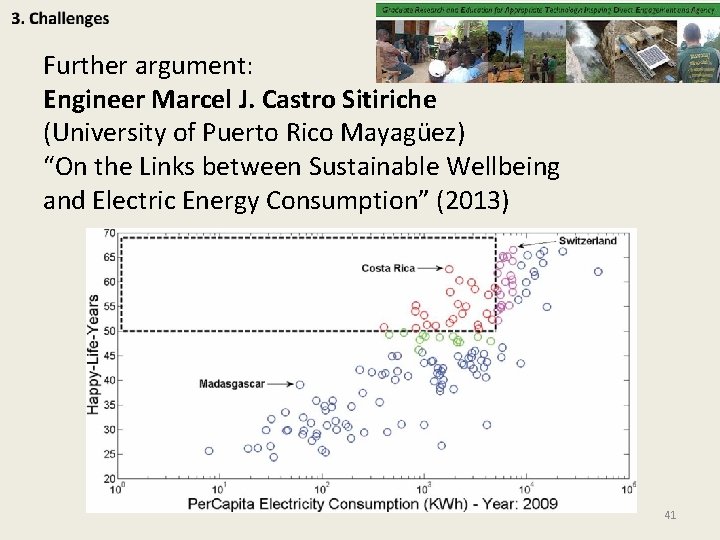
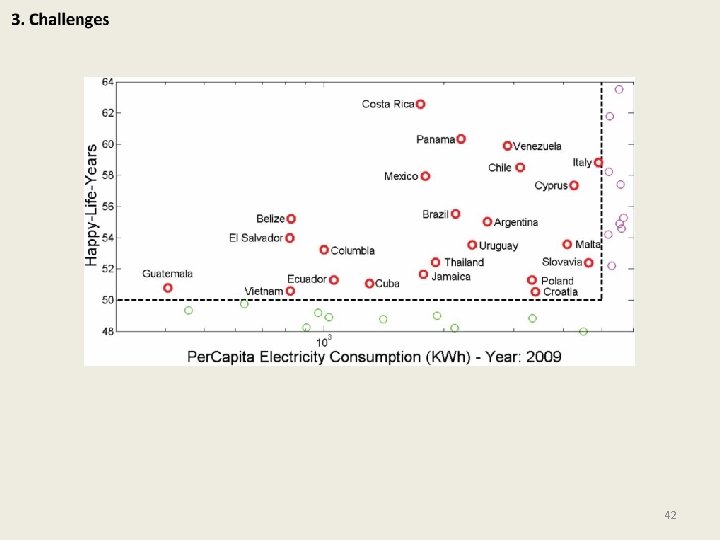
Further argument: Engineer Marcel J. Castro Sitiriche (University of Puerto Rico Mayagüez) “On the Links between Sustainable Wellbeing and Electric Energy Consumption” (2013) 41
42
Coda Invoking the Energy of Ethics • The deepest transition is not from carbon to renewables • It is from extreme energy to disciplining our desires ― to producing and consuming less energy, even when it is renewable. 43
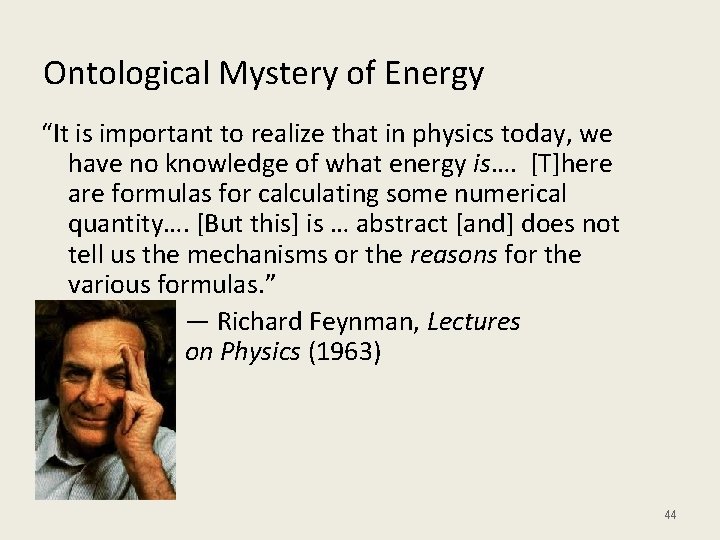
Ontological Mystery of Energy “It is important to realize that in physics today, we have no knowledge of what energy is…. [T]here are formulas for calculating some numerical quantity…. [But this] is … abstract [and] does not tell us the mechanisms or the reasons for the various formulas. ” — Richard Feynman, Lectures on Physics (1963) 44
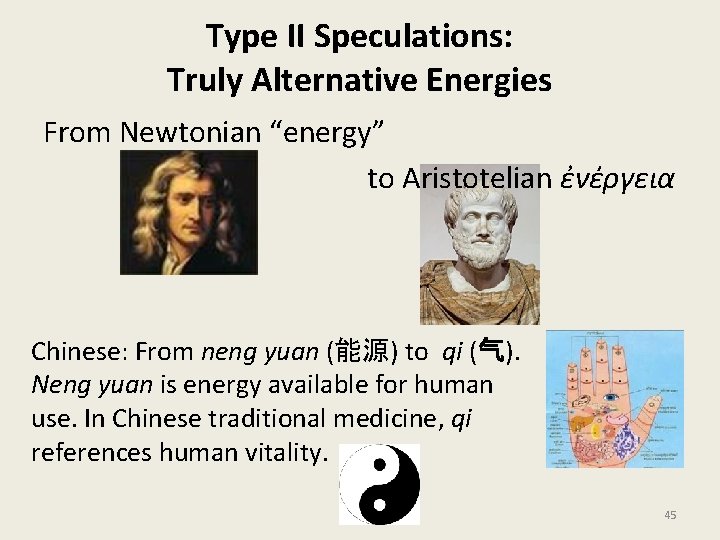
Type II Speculations: Truly Alternative Energies From Newtonian “energy” to Aristotelian ἐνέργεια Chinese: From neng yuan (能源) to qi (气). Neng yuan is energy available for human use. In Chinese traditional medicine, qi references human vitality. 45
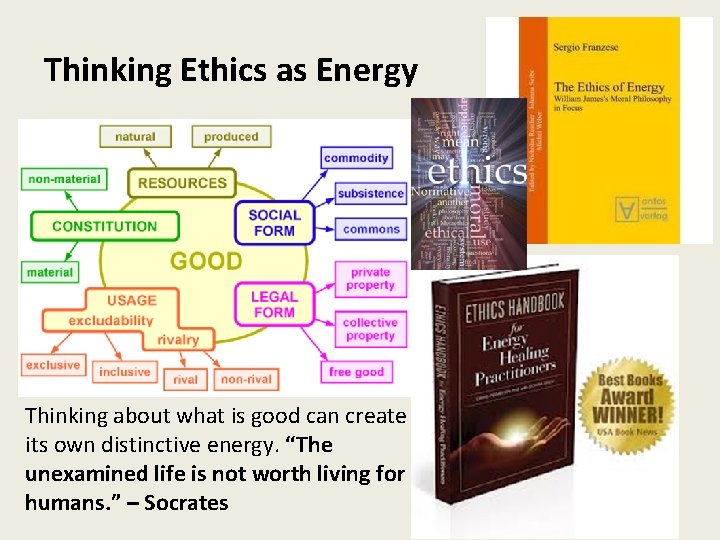
Thinking Ethics as Energy Thinking about what is good can create its own distinctive energy. “The unexamined life is not worth living for humans. ” – Socrates 46
Conclusion Of course, this is precisely what the CEES project on “Energy Ethics in Science and Engineering” has been working to do. • Honored to have been modestly involved. • Look forward to learning more. 47