
Energy environment and climate assessment using the MARKAL
- Slides: 1
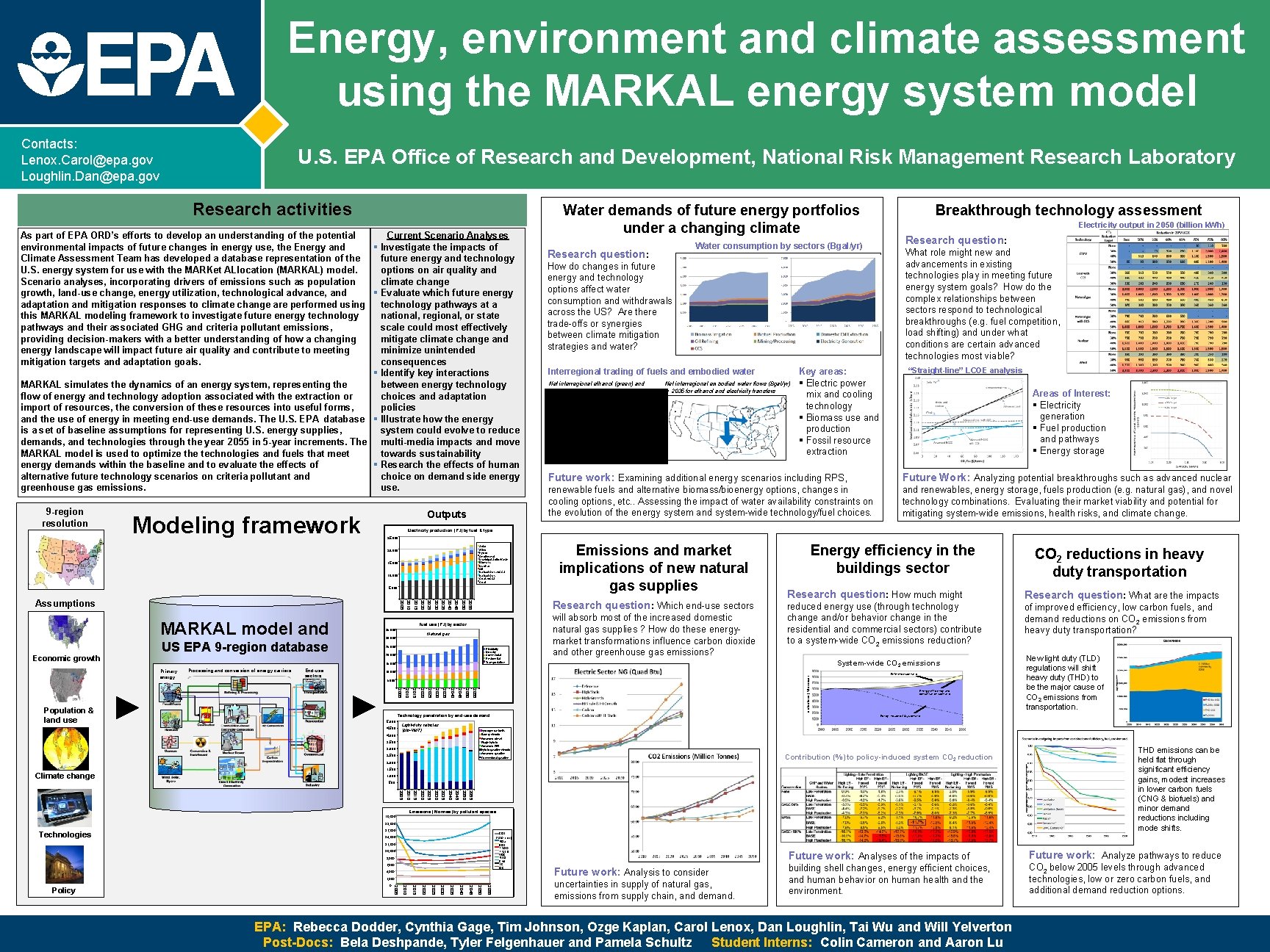
Energy, environment and climate assessment using the MARKAL energy system model Contacts: Lenox. Carol@epa. gov Loughlin. Dan@epa. gov U. S. EPA Office of Research and Development, National Risk Management Research Laboratory Research activities As part of EPA ORD’s efforts to develop an understanding of the potential Current Scenario Analyses environmental impacts of future changes in energy use, the Energy and § Investigate the impacts of Climate Assessment Team has developed a database representation of the future energy and technology U. S. energy system for use with the MARKet ALlocation (MARKAL) model. options on air quality and Scenario analyses, incorporating drivers of emissions such as population climate change growth, land-use change, energy utilization, technological advance, and § Evaluate which future energy adaptation and mitigation responses to climate change are performed using technology pathways at a this MARKAL modeling framework to investigate future energy technology national, regional, or state pathways and their associated GHG and criteria pollutant emissions, scale could most effectively providing decision-makers with a better understanding of how a changing mitigate climate change and energy landscape will impact future air quality and contribute to meeting minimize unintended mitigation targets and adaptation goals. consequences § Identify key interactions MARKAL simulates the dynamics of an energy system, representing the between energy technology flow of energy and technology adoption associated with the extraction or choices and adaptation import of resources, the conversion of these resources into useful forms, policies and the use of energy in meeting end-use demands. The U. S. EPA database § Illustrate how the energy is a set of baseline assumptions for representing U. S. energy supplies, system could evolve to reduce demands, and technologies through the year 2055 in 5 -year increments. The multi-media impacts and move MARKAL model is used to optimize the technologies and fuels that meet towards sustainability energy demands within the baseline and to evaluate the effects of § Research the effects of human alternative future technology scenarios on criteria pollutant and choice on demand side energy greenhouse gas emissions. use. 9 -region resolution Modeling framework Outputs Solar Wind Hydro Geothermal Municipal Solid Waste Biomass Nuclear Oil Natural Gas w/CCS Natural Gas Coal w/CCS Coal 10, 000 5, 000 2055 2050 2045 2040 2035 2030 2025 Natural gas 30, 000 Electricity Industry Commercial Residential Transportation 20, 000 15, 000 Baseline scenario CO 2 target and lightduty vehicle electrification Interregional trading of fuels and embodied water Net interregional ethanol (green) and electricity (red) flows (PJ) in 2035 Net interregional embodied water flows (Bgal/yr) in 2035 for ethanol and electricity transfers Key areas: § Electric power mix and cooling technology § Biomass use and production § Fossil resource extraction Research question: What role might new and advancements in existing technologies play in meeting future energy system goals? How do the complex relationships between sectors respond to technological breakthroughs (e. g. fuel competition, load shifting) and under what conditions are certain advanced technologies most viable? “Straight-line” LCOE analysis Areas of Interest: § Electricity generation § Fuel production and pathways § Energy storage Future work: Examining additional energy scenarios including RPS, Future Work: Analyzing potential breakthroughs such as advanced nuclear renewable fuels and alternative biomass/bioenergy options, changes in cooling options, etc. . Assessing the impact of water availability constraints on the evolution of the energy system and system-wide technology/fuel choices. and renewables, energy storage, fuels production (e. g. natural gas), and novel technology combinations. Evaluating their market viability and potential for mitigating system-wide emissions, health risks, and climate change. Emissions and market implications of new natural gas supplies will absorb most of the increased domestic natural gas supplies ? How do these energymarket transformations influence carbon dioxide and other greenhouse gas emissions? Energy efficiency in the buildings sector Research question: How much might reduced energy use (through technology change and/or behavior change in the residential and commercial sectors) contribute to a system-wide CO 2 emissions reduction? System-wide CO 2 emissions 10, 000 Reference scenario Reference Scenario Emissions (Mtonnes) End-use sectors How do changes in future energy and technology options affect water consumption and withdrawals across the US? Are there trade-offs or synergies between climate mitigation strategies and water? Research question: Which end-use sectors Fuel use (PJ) by sector 5, 000 2055 2050 2045 2040 2035 2030 2025 2020 2015 2010 2005 - Population & land use 2020 25, 000 2015 US EPA 9 -region database 2010 MARKAL model and 35, 000 2005 - Assumptions Processing and conversion of energy carriers Research question: Electricity output in 2050 (billion k. Wh) Electricity production (PJ) by fuel & type 15, 000 Primary energy Water consumption by sectors (Bgal/yr) Breakthrough technology assessment 25, 000 20, 000 Economic growth Water demands of future energy portfolios under a changing climate Technology penetration by end-use demand 5, 000 4, 500 Light-duty vehicles (bln-VMT) 3, 500 3, 000 2, 500 Contribution (%) to policy-induced system CO 2 reduction 2, 000 1, 500 Climate change 1, 000 500 2055 2050 2045 2040 2035 2030 2025 2020 2015 2010 2005 - Emissions (Ktonnes) by pollutant species 20, 000 18, 000 Technologies 16, 000 CO 2 (Mtonnes) NOx SO 2 PM 10 PM 2. 5 VOC N 2 O CH 4 BC OC 14, 000 12, 000 10, 000 8, 000 6, 000 4, 000 2055 2050 2045 2040 2035 2030 2025 2020 2015 2010 0 2005 Policy Research question: What are the impacts of improved efficiency, low carbon fuels, and demand reductions on CO 2 emissions from heavy duty transportation? New light duty (TLD) regulations will shift heavy duty (THD) to be the major cause of CO 2 emissions from transportation. Policy Induced CO 2 Policy-induced COReduction 2 scenario Hydrogen fuel cells Battery electric Advanced diesel Plugin hybrid Advanced E 85 Hybrid gasoline-electric Advanced gasoline Conventional gasoline 4, 000 Energy Efficiency Energy efficiency and Conservation Scenario conservation scenario CO 2 reductions in heavy duty transportation Future work: Analysis to consider uncertainties in supply of natural gas, emissions from supply chain, and demand. THD emissions can be held flat through significant efficiency gains, modest increases in lower carbon fuels (CNG & biofuels) and minor demand reductions including mode shifts. Future work: Analyses of the impacts of Future work: Analyze pathways to reduce building shell changes, energy efficient choices, and human behavior on human health and the environment. CO 2 below 2005 levels through advanced technologies, low or zero carbon fuels, and additional demand reduction options. EPA: Rebecca Dodder, Cynthia Gage, Tim Johnson, Ozge Kaplan, Carol Lenox, Dan Loughlin, Tai Wu and Will Yelverton Post-Docs: Bela Deshpande, Tyler Felgenhauer and Pamela Schultz Student Interns: Colin Cameron and Aaron Lu