
ENERGY EFFICIENT TIME SYNCHRONIZATION PROTOCOL FOR MOBILE UNDERWATER
ENERGY EFFICIENT TIME SYNCHRONIZATION PROTOCOL FOR MOBILE UNDERWATER ACOUSTIC SENSOR NETWORKS Under the Guidance of Mr. P. Mukunthan, AP/CSE Submitted by A. Hussain
Agenda • • • Introduction Abstract Literature survey Problem formulation Objective Architecture Algorithm System requirements Result and discussion Communicated Conclusion References
Introduction • Wireless sensor networks (WSN) refers to a group of dedicated sensors for monitoring and recording the physical conditions of the environment. • WSN can not apply directly to underwater. • Underwater sensor networks (UWSN) uses acoustic communications. • UWSNs enable a wide range of aquatic applications, including coastal surveillance, environmental monitoring, undersea exploration and disaster prevention.
Abstract Time synchronization is an important requirement for many services provider in distributed networks. Many time synchronization protocols have been proposed for terrestrial Wireless Sensor Network (WSN). However, they cannot be applied to Under Water Sensor Network (UWSN). A time synchronization algorithm for UWSN must consider additional factors such as long propagation delays and sensor node mobility. A novel time synchronization protocol namely Acoustic Agreement Time Synchronization Protocol (AATSP). In AATSP, each sensor node synchronizes to a super node using time information flooded by super node as well as synchronizes to its neighbouring nodes using the agreement protocol.
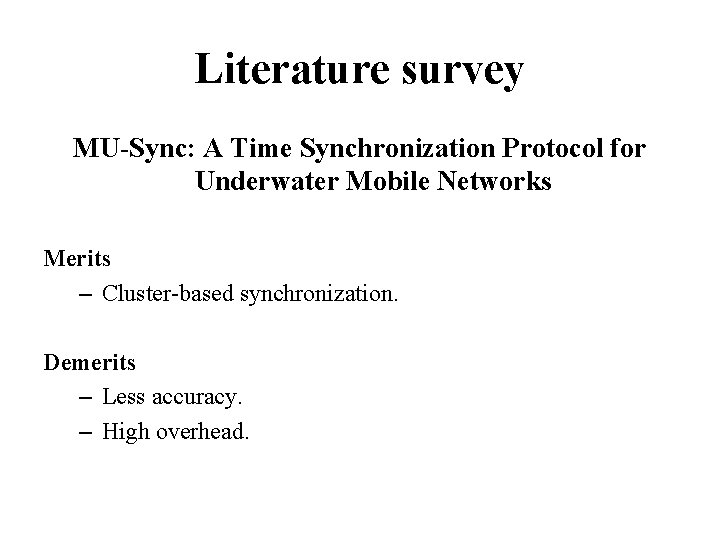
Literature survey MU-Sync: A Time Synchronization Protocol for Underwater Mobile Networks Merits – Cluster-based synchronization. Demerits – Less accuracy. – High overhead.
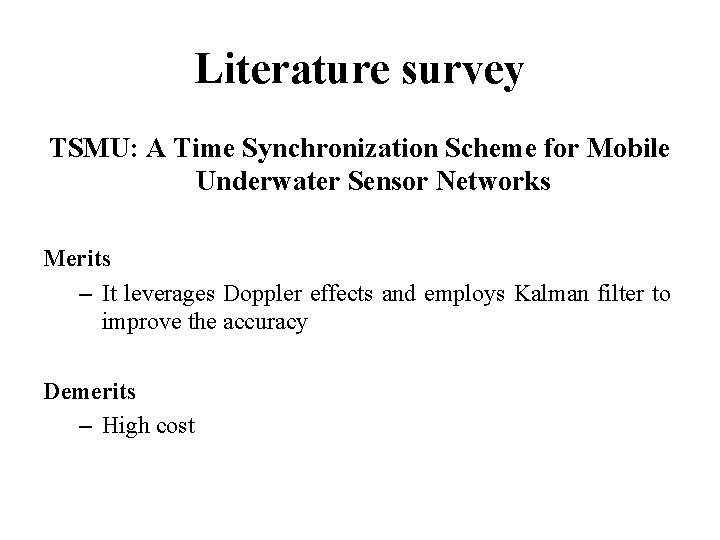
Literature survey TSMU: A Time Synchronization Scheme for Mobile Underwater Sensor Networks Merits – It leverages Doppler effects and employs Kalman filter to improve the accuracy Demerits – High cost
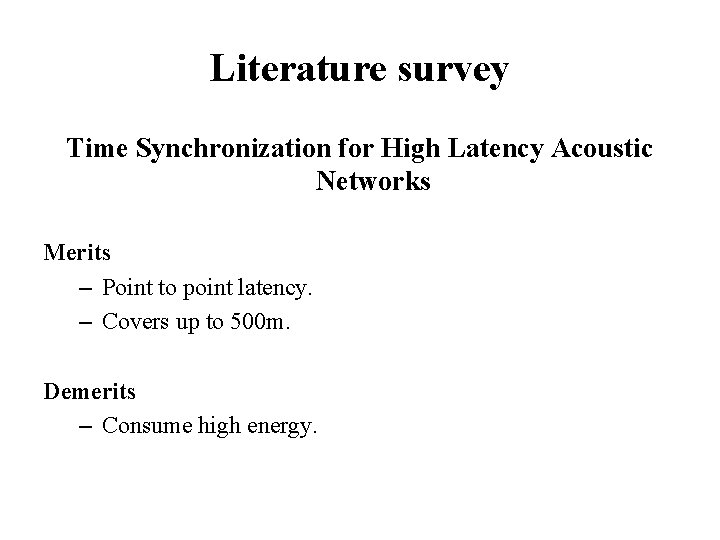
Literature survey Time Synchronization for High Latency Acoustic Networks Merits – Point to point latency. – Covers up to 500 m. Demerits – Consume high energy.
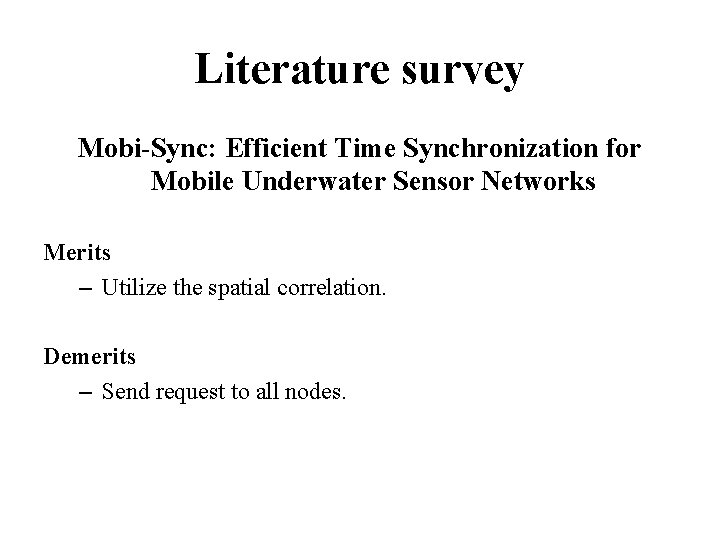
Literature survey Mobi-Sync: Efficient Time Synchronization for Mobile Underwater Sensor Networks Merits – Utilize the spatial correlation. Demerits – Send request to all nodes.
Problem formulation • A synchronization algorithm for UWSN must consider additional factors such as long propagation delays from the use of acoustic communication and sensor node mobility. • Most previous algorithms on time synchronization use a method that chooses a particular node and gives priority to transmitting a beacon signal to that node. • Batteries of underwater sensor nodes are difficult to recharge. • The UWSN will need to be energy efficient.
Objective • The UWSN must be energy efficient this can be achieved by acoustic agreement time synchronization protocol by employing agreement protocol between the sensor nodes.

Architecture
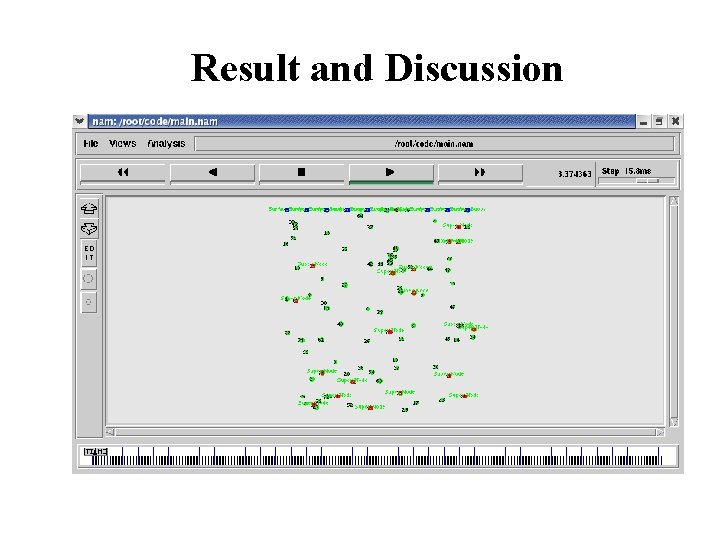
Architectural Design • 100 sensor nodes are randomly deployed in 1000 m X 1000 m region.
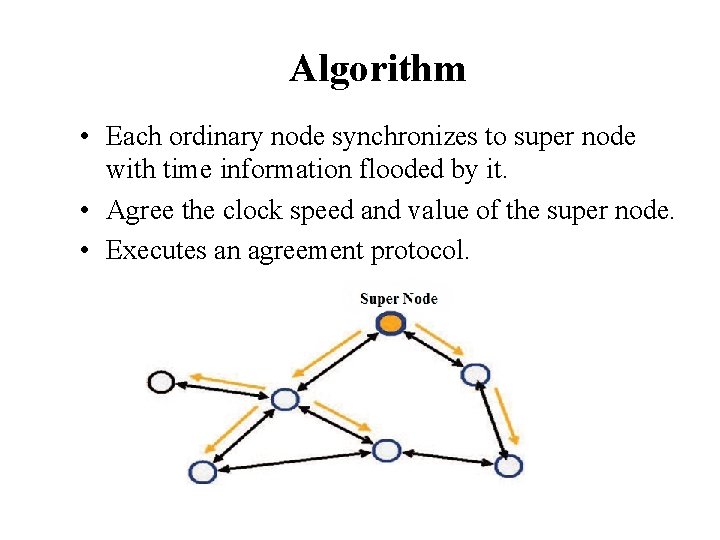
Algorithm • Each ordinary node synchronizes to super node with time information flooded by it. • Agree the clock speed and value of the super node. • Executes an agreement protocol.
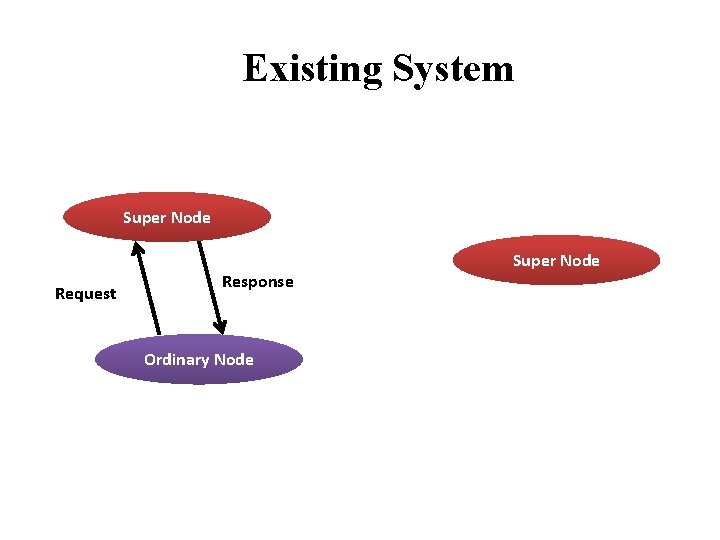
Existing System Super Node Request Response Ordinary Node Super Node
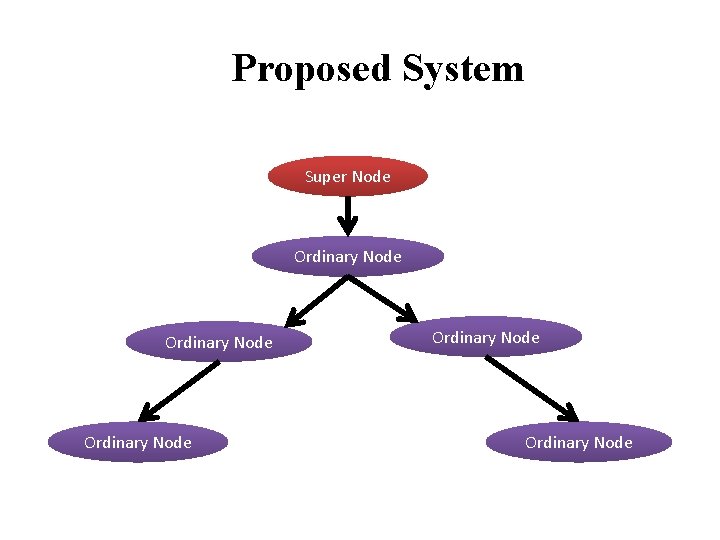
Proposed System Super Node Ordinary Node Ordinary Node
![Synchronization Super node T 1[1] Ordinary node t 2[1] Time m 0[2] P 1[2]](http://slidetodoc.com/presentation_image_h2/8fc311b9cd35eee40eb6372e7912dcca/image-16.jpg "Synchronization Super node T 1[1] Ordinary node t 2[1] Time m 0[2] P 1[2]")
Synchronization Super node T 1[1] Ordinary node t 2[1] Time m 0[2] P 1[2] P[1] Ordinary node t 2[2] T 3[2] Ordinary node P 2[2] m 1[2] Time P[1] ≠ P 1[2] ≠ P 2[2] Due to node mobility t 4[2]
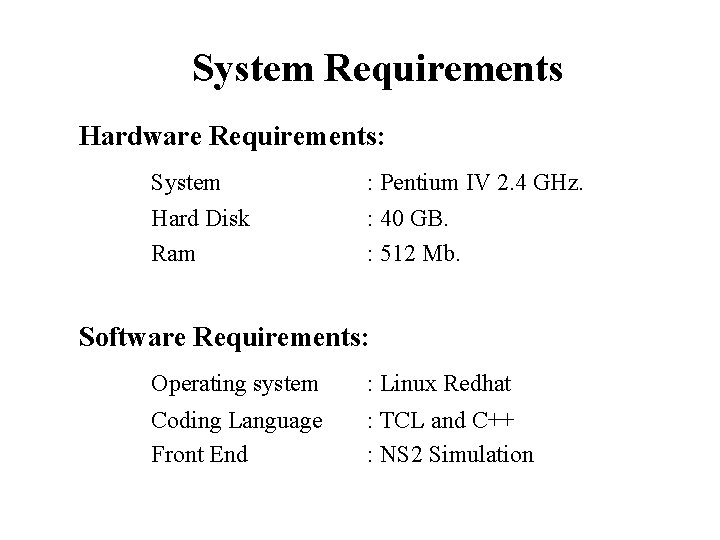
System Requirements Hardware Requirements: System : Pentium IV 2. 4 GHz. Hard Disk Ram : 40 GB. : 512 Mb. Software Requirements: Operating system : Linux Redhat Coding Language Front End : TCL and C++ : NS 2 Simulation
Result and Discussion
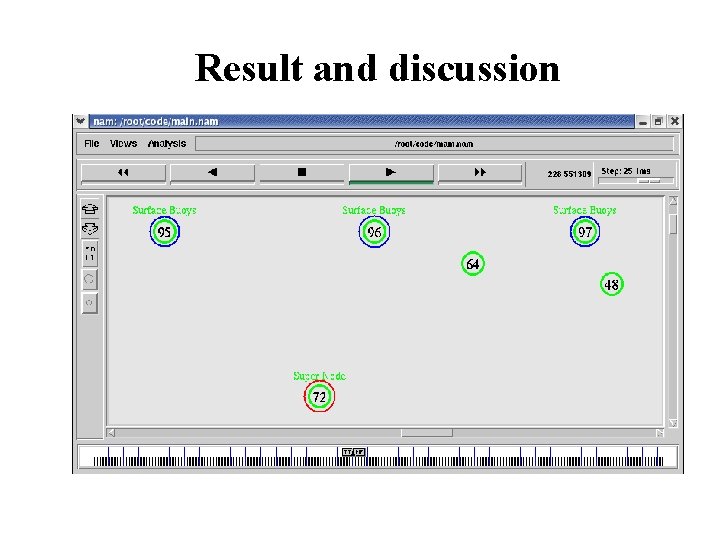
Result and discussion
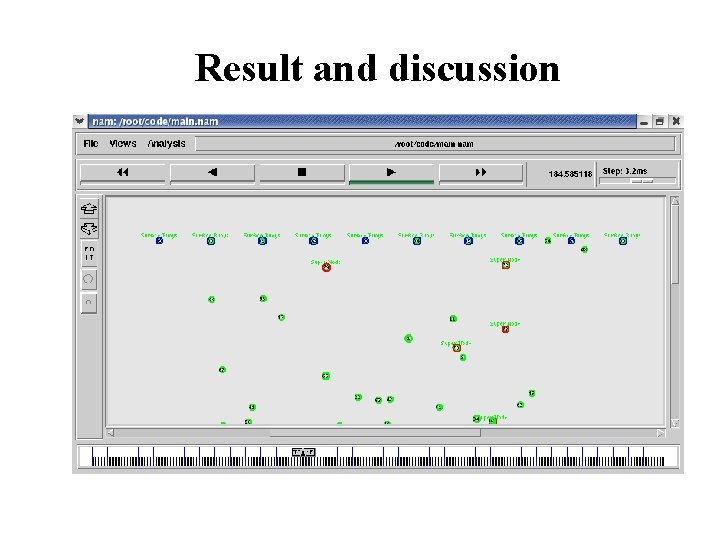
Result and discussion
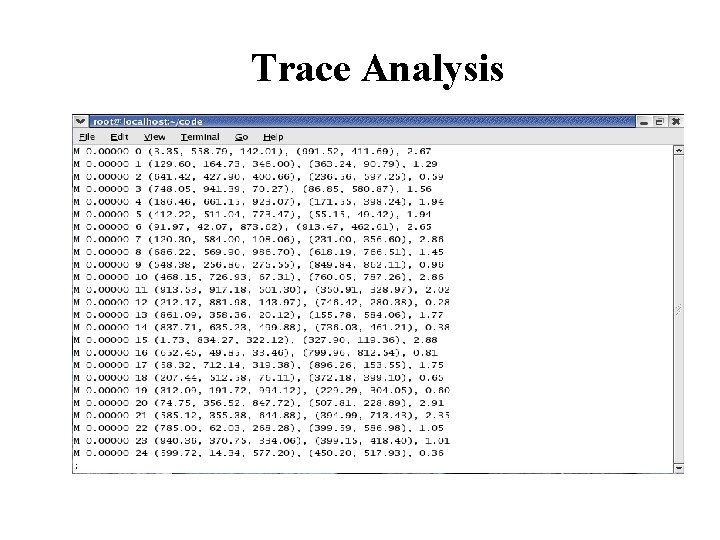
Trace Analysis
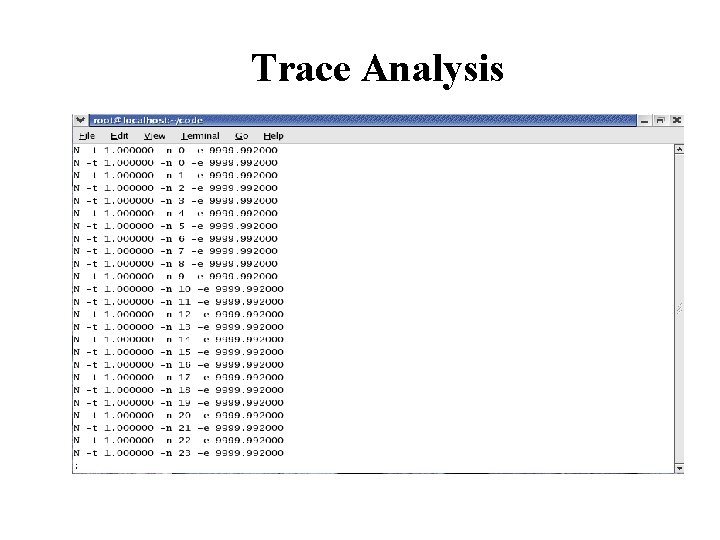
Trace Analysis
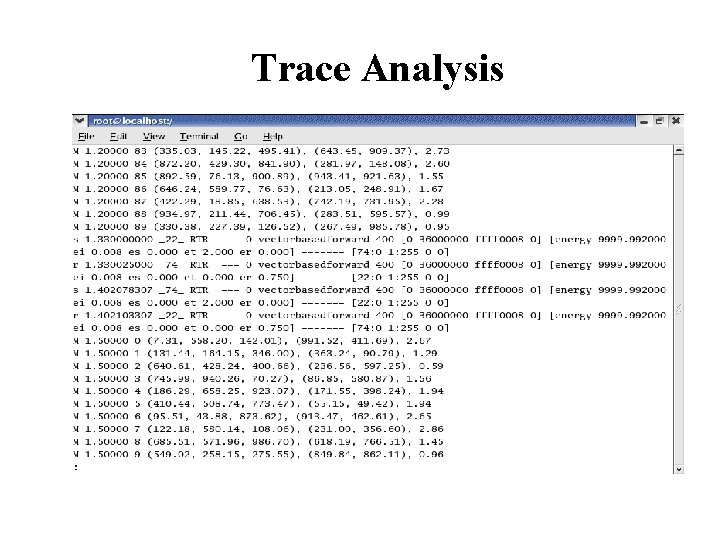
Trace Analysis
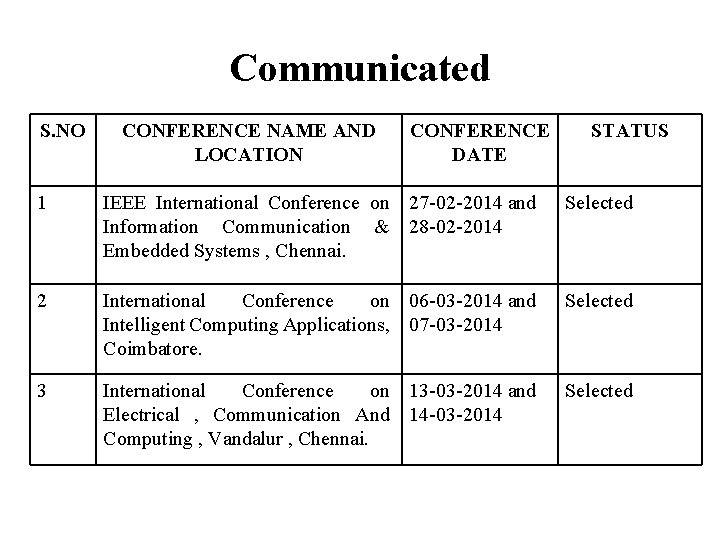
Communicated S. NO CONFERENCE NAME AND LOCATION CONFERENCE DATE STATUS 1 IEEE International Conference on 27 -02 -2014 and Information Communication & 28 -02 -2014 Embedded Systems , Chennai. Selected 2 International Conference on 06 -03 -2014 and Intelligent Computing Applications, 07 -03 -2014 Coimbatore. Selected 3 International Conference on 13 -03 -2014 and Electrical , Communication And 14 -03 -2014 Computing , Vandalur , Chennai. Selected
Conclusion • AATSP aims to provide tight synchronization between neighbouring nodes while synchronizing them to the clock of a reference node at the same time. • All sensor nodes agree on the clock speed and the clock value of the reference node by using the time information flooded by reference node by applying an agreement protocol.
![References [1] Jun Liu, Zhong Zhou, Zheng Peng, Jun-hong Cui, Michael Zuba And Lance](http://slidetodoc.com/presentation_image_h2/8fc311b9cd35eee40eb6372e7912dcca/image-26.jpg "References [1] Jun Liu, Zhong Zhou, Zheng Peng, Jun-hong Cui, Michael Zuba And Lance")
References [1] Jun Liu, Zhong Zhou, Zheng Peng, Jun-hong Cui, Michael Zuba And Lance Fiondella, “Mobi-sync: Efficient Time Synchronization For Mobile Underwater Sensor Networks”, IEEE Transactions On Parallel And Distributed Systems, USA , Vol. 24, No. 2, pp. 406 – 416, Febuary 2013. [2] N. Chirdchoo, W. -S. Soh And K. C. Chua, “Mu-sync: A Time Synchronization Protocol For Underwater Mobile Networks”, Proceedings of Third Acm International Workshop on Underwater Networks, USA, pp. 34 – 42, June 2008. [3] Min Kyoung Park, And Volkan Rodoplu, “UWAN-MAC: An Energy-efficient Mac Protocol For Underwater Acoustic Wireless Sensor Networks”, IEEE Journal Of Oceanic Engineering, California, Santa Barbara, Vol. 32, No. 3, pp. 710 -720, August 2007. [4] Xing Tan And Jian Li, “Cooperative Positioning In Underwater Sensor Networks”, IEEE Transactions on Signal Processing, USA, Vol. 58, No. 11, pp. 5860 – 5871, April 2010. [5] A. Syed And J. Heidemann, “Time Synchronization For High Latency Acoustic Networks”, Proceedings on IEEE Information communication, USA, pp. 1 – 12, July 2006.

Thank You
- Slides: 27