
ENERGY EFFICIENT TECHNOLOGIES USE IN INDIA AN OVERVIEW

- Slides: 33
ENERGY EFFICIENT TECHNOLOGIES USE IN INDIA – AN OVERVIEW V. S. VERMA DIRECTOR GENERAL BUREAU OF ENERGY EFFICIENCY 20 th August, 2004 Bureau of Energy Efficiency
Economic growth is desirable for developing countries, and energy is essential for economic growth. If India is to achieve the targeted growth in GDP, it would need commensurate input of energy, mainly commercial energy in the form of coal, oil, gas and electricity. India’s fossil fuel reserves are limited. The known reserves of oil and natural gas may last hardly for 18 and 26 years respectively at the current reserves to production ratio. India has huge proven coal reserves (84 billion tonnes) may last for about 200 years but the increasing ash content in Indian Coal as well as associated greenhouse gas emission are the major concern. In the business as usual scenario, the exploitable coal may last for about less than. Bureau 100 years of Energy Efficiency
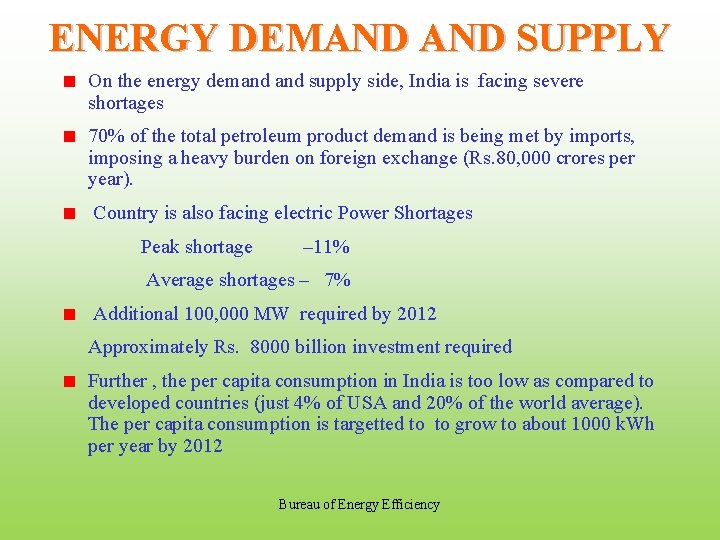
ENERGY DEMAND SUPPLY On the energy demand supply side, India is facing severe shortages 70% of the total petroleum product demand is being met by imports, imposing a heavy burden on foreign exchange (Rs. 80, 000 crores per year). Country is also facing electric Power Shortages Peak shortage – 11% Average shortages – 7% Additional 100, 000 MW required by 2012 Approximately Rs. 8000 billion investment required Further , the per capita consumption in India is too low as compared to developed countries (just 4% of USA and 20% of the world average). The per capita consumption is targetted to to grow to about 1000 k. Wh per year by 2012 Bureau of Energy Efficiency
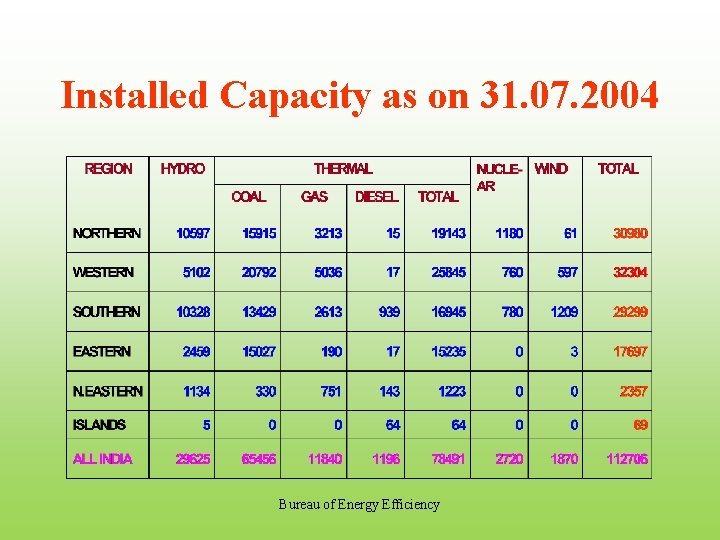
Installed Capacity as on 31. 07. 2004 Bureau of Energy Efficiency
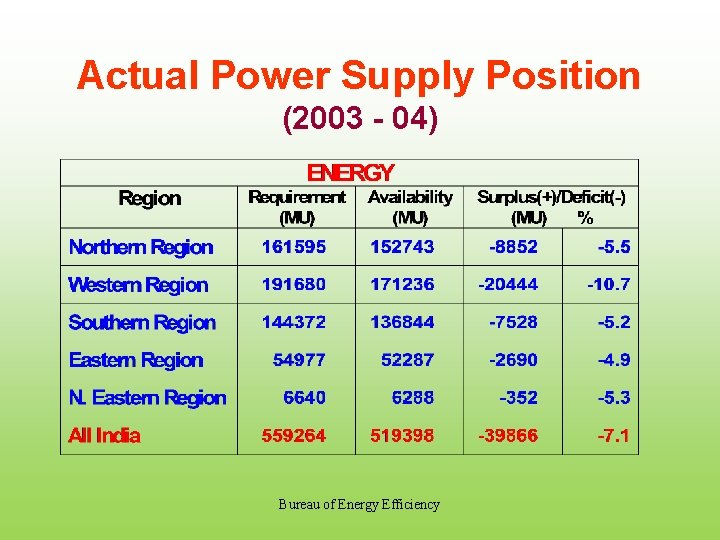
Actual Power Supply Position (2003 - 04) Bureau of Energy Efficiency
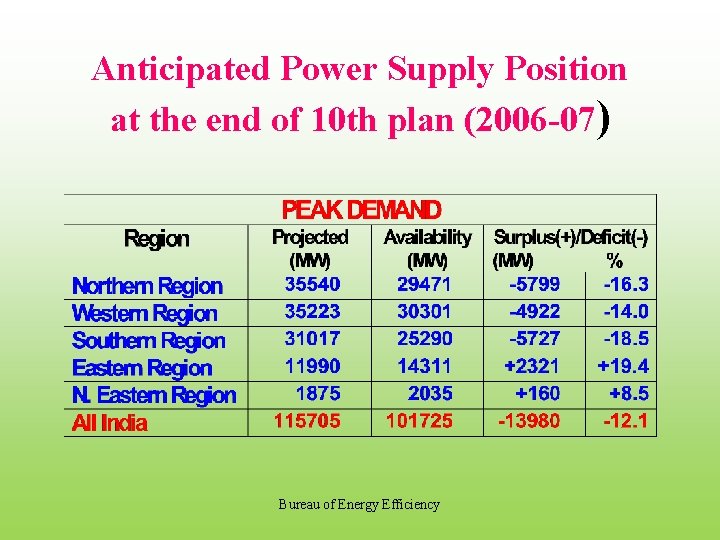
Anticipated Power Supply Position at the end of 10 th plan (2006 -07) Bureau of Energy Efficiency
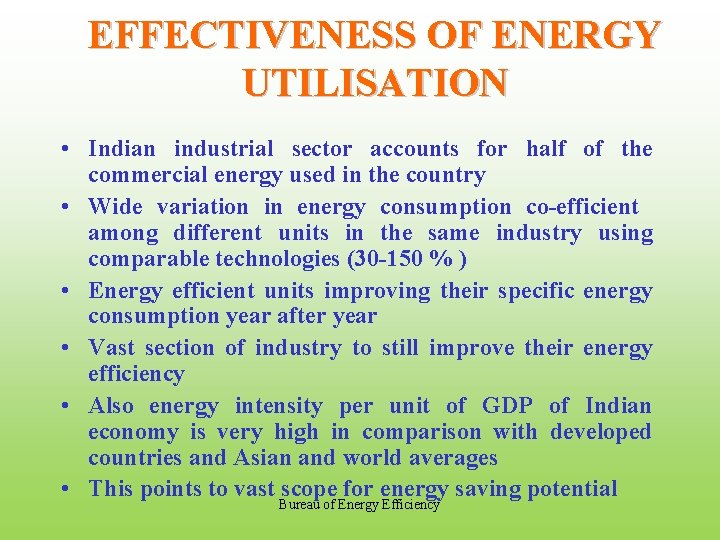
EFFECTIVENESS OF ENERGY UTILISATION • Indian industrial sector accounts for half of the commercial energy used in the country • Wide variation in energy consumption co-efficient among different units in the same industry using comparable technologies (30 -150 % ) • Energy efficient units improving their specific energy consumption year after year • Vast section of industry to still improve their energy efficiency • Also energy intensity per unit of GDP of Indian economy is very high in comparison with developed countries and Asian and world averages • This points to vast scope for energy saving potential Bureau of Energy Efficiency
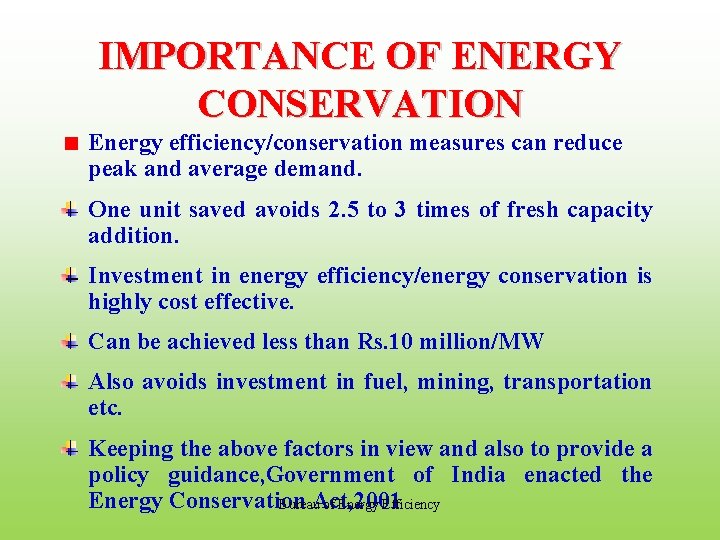
IMPORTANCE OF ENERGY CONSERVATION Energy efficiency/conservation measures can reduce peak and average demand. One unit saved avoids 2. 5 to 3 times of fresh capacity addition. Investment in energy efficiency/energy conservation is highly cost effective. Can be achieved less than Rs. 10 million/MW Also avoids investment in fuel, mining, transportation etc. Keeping the above factors in view and also to provide a policy guidance, Government of India enacted the Energy Conservation Act, 2001 Bureau of Energy Efficiency
Enacted in October 2001 Become effective from 1 st March 2002 Bureau of Energy Efficiency (BEE) operationalized from 1 st March 2002. Bureau of Energy Efficiency 9
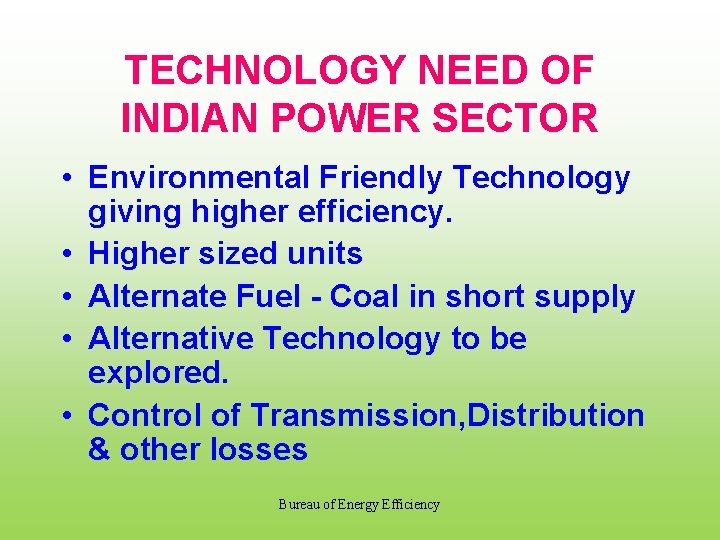
TECHNOLOGY NEED OF INDIAN POWER SECTOR • Environmental Friendly Technology giving higher efficiency. • Higher sized units • Alternate Fuel - Coal in short supply • Alternative Technology to be explored. • Control of Transmission, Distribution & other losses Bureau of Energy Efficiency
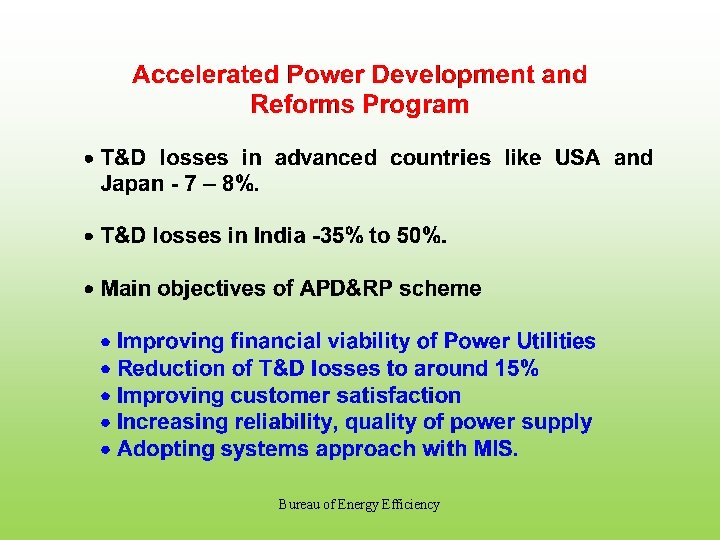
Bureau of Energy Efficiency
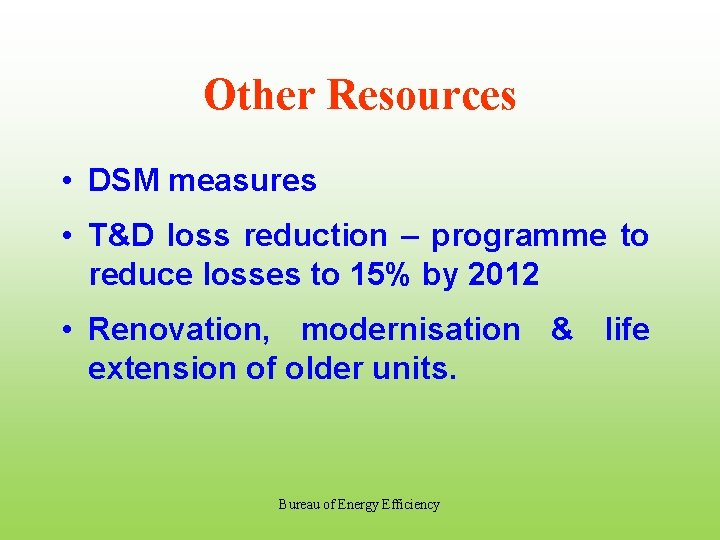
Other Resources • DSM measures • T&D loss reduction – programme to reduce losses to 15% by 2012 • Renovation, modernisation & life extension of older units. Bureau of Energy Efficiency
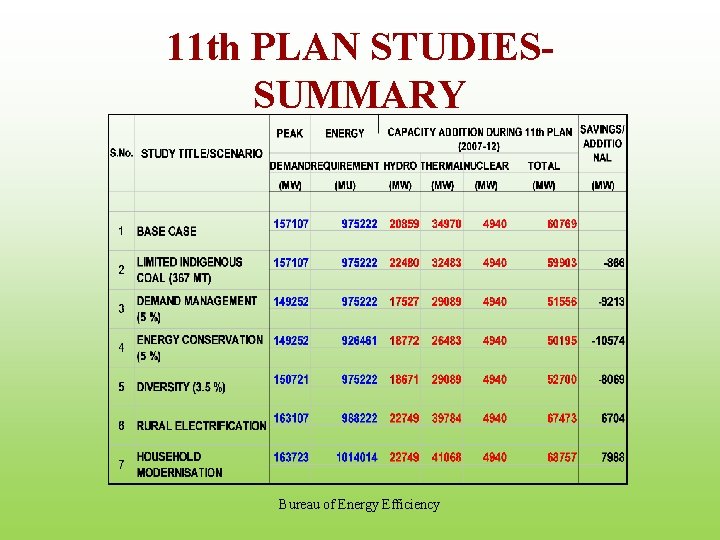
11 th PLAN STUDIESSUMMARY Bureau of Energy Efficiency
Bureau of Energy Efficiency
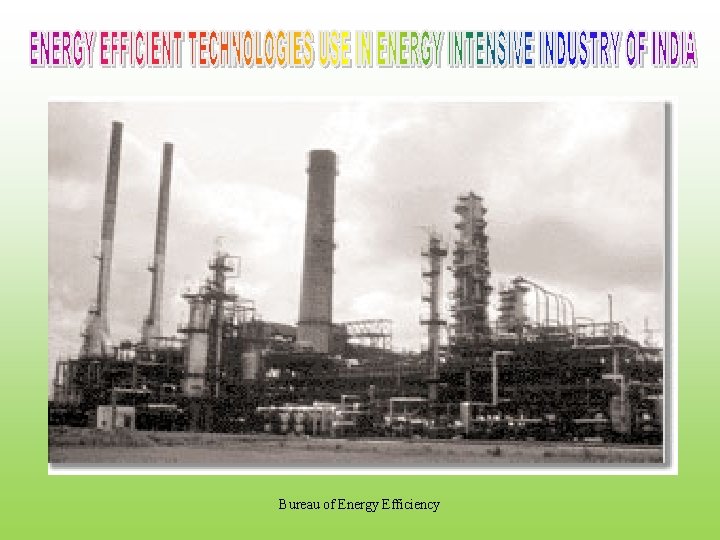
Industry is the major energy consumer utilising about 50% of the total commercial energy use in India The six key industries – namely aluminium, cement, fertilizers, pulp& paper, petrochemicals and steel - consumes about 65% of the total energy use in India The energy intensity in some of these industries is reported to be higher than the industries in developed countries One of the main reasons for higher energy use is the presence of obsolete and energy inefficient technologies in some of these sectors To promote faster penetration of energy efficient technologies, they are planned to be notified as designated consumers under the Energy Conservation Act. By complying with various provisions of EC Act, as applicable to designated consumers- namely meeting specific energy consumption norms, conduct of regular energy audits and implementation of techno economic viable recommendations and establishment of energy management system through appointment of certified energy manager -is expected to boost adoption of energy efficient technologies Bureau of Energy Efficiency
1. ALUMINIUM Production of aluminium is extremely power intensive. On an average, Indian smelters consume 15, 000 -16, 500 KWH per ton of aluminium as against 14, 000 -14, 500 KWH per ton consumed by global smelters. . Aluminium industry consumes more than 15% of electricity consumed by Industry in abroad. Energy accounts for nearly 40% of aluminium production costs. Smelting process accounts for more than 90% of the total electricity consumption The annual energy cost in terms of the sales turnover of the units ranges from 40 to 50%. High electrical energy saving potential exists in the smelter section for the production of aluminium. The technologies adopted both in India and abroad are same but they differ in energy efficiency as some of the units are still using self-baking anodes instead of multiple prebaked anodes. Bureau of Energy Efficiency
Technology Penetration (Aluminium) The technology improvements made in India and practiced in developed countries are listed below. High degree of mechanization and scientific operating practices such as automation in cell operation by introducing microprocessor control and computers, for energy efficiency. Multiple prebaked anodes used in Hall – Heroult Process. Improved anode design and increasing anode area by redesigning the existing cell. Improved techniques in cathode lining and cell design. Efficient gas cleaning system and recovery of fluorides for dry gas-scrubbing system. New energy efficient technologies such as ALCOA, Carbothermic are being tested abroad R&D efforts are being carried out to improve existing process operations, development of new processes, quality improvement, and environment management. Bureau of Energy Efficiency
2. CEMENT Cement industry accounts for around 10 % of the coal and 6 % of the electricity consumed by the Indian industrial sector. In general, to produce 1 tonne of cement, 120 to 150 kg of imported coal or 200 to 220 kg of domestic coal is needed. Power consumption for the same is 65 to 90 k. Wh in new and 95 to 120 k. Wh in old plants The new generation plants installed in India have excellent energy efficiency norms comparable with the best and most energy efficient plants in the World. This shows the deep penetration of advanced technologies in India. The best specific electrical energy consumption reported is in the range of 60 to 70 k. Wh/ tonne where as the specific thermal energy consumption is 690 to 700 Kcal/ kg of clinker. The annual energy cost in terms of the sales turnover of the units ranges from 20 to 60%. Bureau of Energy Efficiency
• Technology Penetration (Cement) The technology penetration is very high and the energy efficiency norms are comparable to the best energy efficient plants in the World. Following is the list of energy efficient technology penetrations made in India for improved dry process: Raw material preparation section – gyratory crushers and mobile crushers, VRM (Vertical Roller Mills), external recirculation systems in VRM’s, adoption of roller press technology and high efficiency separators in the grinding circuits. Cement grinding – VRM with high efficiency separators and highpressure roller press in various modes of operation, static V separators along with dynamic separators. Pyro processing Section – Installation of precalcinators and 5/6 stage preheaters with low pressure drop cyclones, short kilns having lower L/D ratio, new generation coolers having better heat recovery potential. _ Low pressure drop suspension preheaters (5~6 stages). Multi channel burners. High efficiency separators and vertical roller mills. Waste heat utilisation systems. Computerized process control. Oxygen rich air for combustion. Secondary firing system. R&D efforts are high to improve the energy efficiency levels, product Bureau of Energy Efficiency improvements, etc.
3. FERTILIZERS There are mainly four types of fertilizer’s, namely nitrogenous, phosphatic, potassic and complex. Of the total fertilizer production in India, nitrogenous fertilizers constitute more than 80 % and phosphatic fertilizers account for most of the remaining 20%. Urea, ammonium sulphate (AS), calcium ammonium nitrate (CAN) and ammonium chloride (ACl. ) are some of the important nitrogenous fertilizers. Of these, urea occupies the largest share of nearly 82. 9%. India does not produce potassic fertilisers. Ammonia (NH 3) is the basic raw material used in nitrogenous fertiliser production and is synthesized from hydrocarbon feedstock. The feedstock for the production of Ammonia and Urea varies from naphtha to natural gas to furnace oil/LSHS to the combination of above and hence; the specific consumption norms vary accordingly. The specific electrical energy consumption for the furnace oil/LSHS is in the range of 360 to 375 k. Wh/tonne and thermal energy consumption is in the range of 4 to 7 M. k. Cal/tonne. The specific electrical energy consumption for the Naphtha /Natural gas or mixed feedstock is in the range of 90 to 200 k. Wh/tonne. Bureau of Energy Efficiency
The thermal energy cost contributes the major share in the total energy cost and the total energy cost based on the furnace oil/LSHS or naphtha alone as feedstock is much higher than natural gas based plants or the combination of natural gas and naphtha based plants. The annual energy cost in terms of the sales turnover of the units ranges from 40 to 85%. The wide range is due to the type of feedstock and the product range. The level of awareness on energy conservation in this sector is high Bureau of Energy Efficiency
Technology Penetration (Fertilizers) The technology penetration is improving considerably due to recent advances in process technologies and catalysts Internal heat recovery system have resulted in lower energy intensity and most of the technologies available abroad are already in operation in India. The various energy efficient technologies available for this sector are as follows Ammonia plants Reformer tubes of superior material Adiabatic pre-reformer Low steam/carbon ratio Purge gas recovery unit Make up gas chiller at suction Synthesis converter revamp Computer control and Optimisation for process Urea plants Urea hydrolyses stripper Trays inside the reactor Coils to feed the reactants from the top of the reactor Internal heat recovery system Vacuum pre-concentrator R&D is mainly focused on the new processes, simulation models and in the development of bio-fertilizers. Bureau of Energy Efficiency.
4. IRON AND STEEL • The iron and steel industry is the largest consumer of energy in the Indian industrial sector consuming about 10% of electricity and 27% of coal consumed by the Indian industry. • The energy costs constitute nearly 30 to 35% of this sector's production costs. • The primary sources of energy for the ISPs are coking coal, non-coking coal, liquid hydrocarbons and electricity, of which coking coal accounts for around 65 to 80%. The process of making iron in blast furnaces accounts for nearly 70% of the total energy consumption at the plant. Bureau of Energy Efficiency
• The technological performance of the Indian steel plants is considerably lower than existing international standards. This is due to the inefficient use of technology, obsolete technology, and incompatibility of Indian input materials with imported technology • Indian industries consume nearly 7. 2 ~ 8. 2 Million k. Cal to produce one tonne of steel, while industries in the West take around 5 Mk. Cal. The thermal energy cost contributes the maximum to the total energy cost. • Some of the Indian Steel plants are already undergoing a process of modernization and are adopting more energy efficient practices • The annual energy cost in terms of the sales turnover of the units ranges from 25 to 30%. Bureau of Energy Efficiency
Technology Penetration (Iron &Steel ) • The technology penetration is quite progressive in this sector and various energy efficient practices being followed are as follows. • Basic oxygen furnace (BOFs) are replacing the Open hearth (OH) based method of steel production. • Continuous Casting (CC) is replacing traditional ingot casting. • SAIL already produces 70% of steel through the BOF and 20% through the CC route. It is expected that after the ongoing modernization, about 80% of SAIL steel will be produced through BOF and 55% by the CC route. • The technology improvement progress in Indian industry is positive and the steel making process employs many technologies for coke making, sintering, pre reduction, smelting, casting, rolling and annealing processes. Bureau of Energy Efficiency
• Furnaces consume the maximum amount of energy in the steel making process. Apart from replacement of OH furnaces by the BOFs, other improvements incorporated in the Integrated Steel Plant are listed as follows: -Replacing ingot casting with continuous casting -Improvement in sinter quality and its use up to 80% in the blast furnace burden - Improvements in blast furnace practices like coal dust injection -Increased blast pressure and temperatures -Several improvements in the rolling mills like direct charging of hot slabs, automation, rolling to strict tolerances, controlled cooling and automatic gauge control. • R&D efforts are good in the areas of coal utilisation, new grades of steel and many technology improvements have been carried out. Bureau of Energy Efficiency
5. PETROCHEMICALS • Petrochemical industry is a capital intensive and high volumes industry. The minimum economic size of an integrated plant is around 1 mn TPA of end product, which entails an investment of Rs 100 billion. • The industry is a technology intensive industry. The obsolescence of technology is quite rapid. Plants should have the adaptability to absorb new technology and should be upgraded and/or modernized constantly. • The demand for petrochemicals is directly related with the economic growth of the country. Polymers which drive 70% of the demand, have grown at 14% in 90's • The demand elasticity is high in petrochemicals. With the fall in prices of petrochemicals the demand increases and vice-versa. • The product range is wide and includes petrochemicals, polymers, and other specialty chemicals and hence, the production capacities vary widely Bureau of Energy Efficiency
. The specific electrical energy consumption is in the range of 350 to 1, 380 k. Wh/tonne and the specific thermal energy consumption is in the range of 1. 1 to 5. 5 M. k. Cal/tonne deponding upon the type of product manufactured. The annual energy cost in terms of the sales turnover of the units ranges from 5 to 20%. Most of the energy conservation measures have been implemented in the process section. Many of the technologies are sourced from abroad mainly from US and U. K and import substitution has been made on many of the products. R&D efforts are very specific to product-wise development. Bureau of Energy Efficiency
6. PULP AND PAPER The Indian pulp and paper industry is the sixth largest energy consumer in the Indian industrial sector and its energy cost accounts for about 30% of the total manufacturing cost. In order to produce one ton of dried pulp, around 0. 215 Mk. Cal of power & 6. 5 tonne of steam is used in the Kraft with black liquor recovery process while 1. 45 tonne of steam and around 3. 5 Mk. Cal Power is used in the Acid Sulphite Process. Paper is made from wood, agricultural residues or waste paper. The present share of these technologies is 37%, 31%, and 32% respectively. The production of pulp and paper involves three major stepspulping, bleaching and paper productions. The type of pulping and amount of bleaching used depend on the nature of the feedstock and the desired quality of the product. Kraft (Sulphate) pulping and Sulphite pulping are the two main pulping processes. Kraft pulping is the most widely used process. This is because of the long fibres in Kraft pulp and the fact that the chemicals used are not so harsh in their action, that make possible the production of very strong paper. Sulphite process is a newer process. It is used in the manufacture of some of the finest papers, including bond. The sulphite pulp is easy to bleach but the fibres are weak Bureau of Energy Efficiency
• The specific electrical energy consumption of writing and printing is in the range of 1, 010 to 1, 650 k. Wh/ tonne, 1, 298 to 1, 728 k. Wh/tonne for Paper and Board, 1, 884 to 2, 138 k. Wh/tonne for News Print and 659 to 1, 014 k. Wh for Kraft units. • The thermal energy consumption of the units are in the range of 7. 8 to 7. 9 M. k. Cal/tonne for Kraft, 4. 7 to 8 for Writing and Printing, 4. 3 to 4. 8 for Paper board, 2. 4 to 3. 5 for News print units. • The reported National best value for electrical and thermal energy is in the range of 1, 092 k. Wh/tonne and 4. 32 M. k. Cal/tonne, whereas the International values are around 650 k. Wh/tonne and 2. 9 M. k. Cal/tonne respectively. • Electrical energy cost contributes the maximum to the total energy cost • The annual energy cost in terms of the sales turnover of the units ranges from 10 to 25% • There is an international shift towards the use of wastepaper whereas wood still continues to be the basic raw material for the Indian industry. Bureau of Energy Efficiency
Technology Penetration (Pulp & paper) • Technology updating is positive in the Indian paper sector with a variety product range, which is classified as paper and paperboard segment and newsprint segment. There are various technical options, which can improve the energy efficiency of the paper industry and details are mentioned below: -Continuous digesters instead of present batch digesters for the digestion of wood -Displacement bleaching system for bleaching of pulp -Falling film type evaporators in the conversion of pulp into paper • R&D efforts were carried out mainly to improve the quality of the product and environment. Bureau of Energy Efficiency
CONCLUSIONS Energy is in short supply in India, and is expensive, especially for industry. Energy-guzzling production procedures further push up costs. With use of more energy efficient technologies, many businesses could cut their energy consumption by up to 20 %. . Adoption of energy efficient technology is picking up the pace, particularly in the energy intensive industry of India. Cement sector is one of the glaring example in this regard, where adoption of the technology is almost at par with the world. Energy efficient technologies can help protect the global climate, especially since fossil fuels, which are responsible for the greenhouse effect, will almost certainly continue to generate a large percentage of our energy for a long time to come Bureau of Energy Efficiency
Bureau of Energy Efficiency 33