
Energy Efficiency Guidelines Developed by Brahm Segal Power

Energy Efficiency Guidelines Developed by: Brahm Segal Power Correction Systems, Inc. 1800 S. Robertson Blvd. PMB 419, Los Angeles, CA 90035 Phone: 310 247 -4848 Fax: 310 273 -7719 www. activeharmonicfilters. com
Energy Efficiency Guidelines • • • ENERGY COST RELIABILITY COMPETITION ENVIRONMENT GREENHOUSE GASES SOCIAL ISSUES SHAREHOLDRS EMPLOYEES CUSTOMERS SUSSTAINIBILITY BUSINESS ADVANTAGE Power Correction Systems, Inc.
Energy Efficiency Guidelines Companies shall be committed to energy excellence to realize a competitive advantage in their businesses and establish an energy conservation program to attain: Efficient energy use Reduced energy emissions Power facilities renewal Power Correction Systems, Inc.
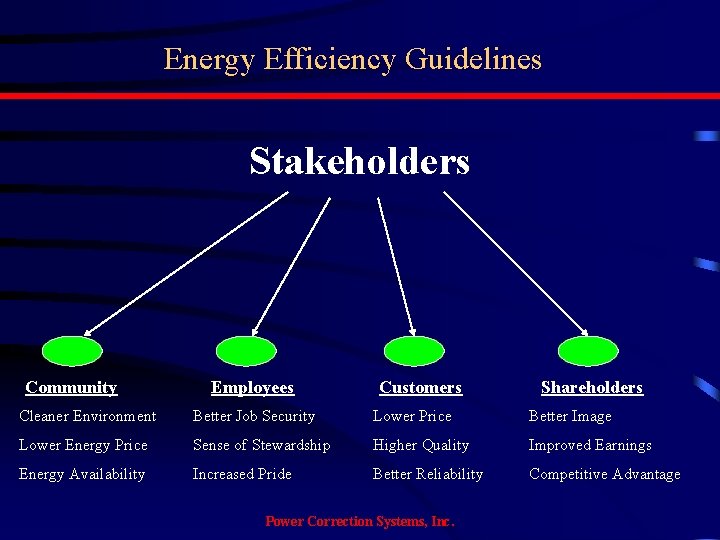
Energy Efficiency Guidelines Stakeholders Community Employees Customers Shareholders Cleaner Environment Better Job Security Lower Price Better Image Lower Energy Price Sense of Stewardship Higher Quality Improved Earnings Energy Availability Increased Pride Better Reliability Competitive Advantage Power Correction Systems, Inc.
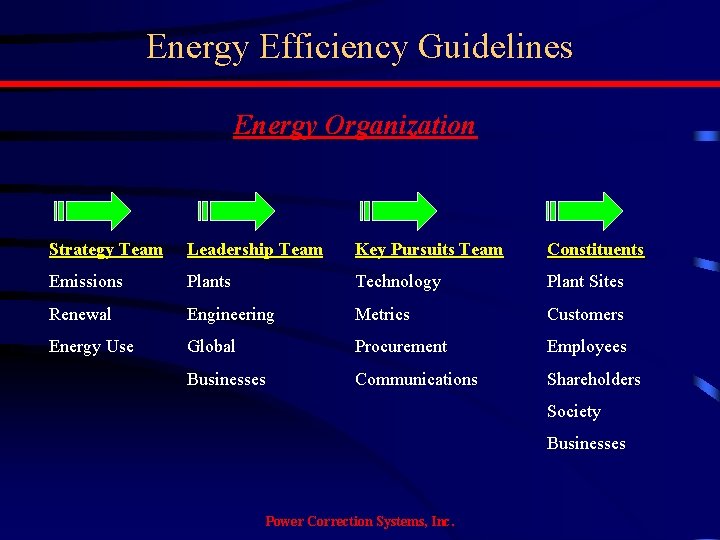
Energy Efficiency Guidelines Energy Organization Strategy Team Leadership Team Key Pursuits Team Constituents Emissions Plants Technology Plant Sites Renewal Engineering Metrics Customers Energy Use Global Procurement Employees Businesses Communications Shareholders Society Businesses Power Correction Systems, Inc.
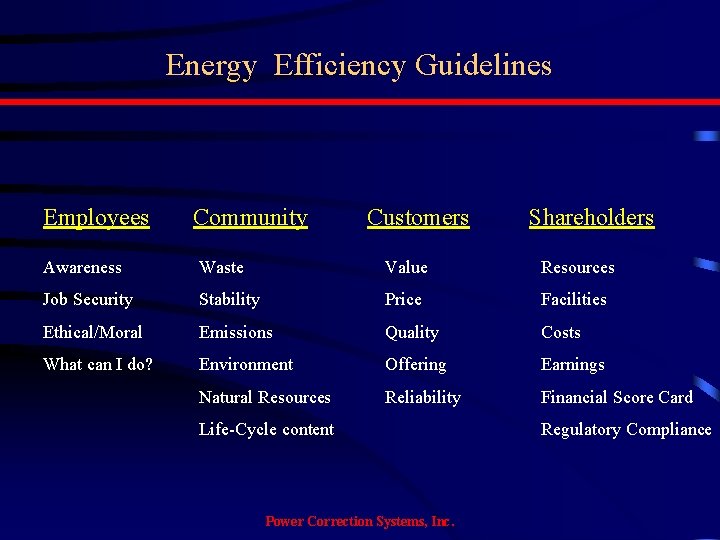
Energy Efficiency Guidelines Employees Community Customers Shareholders Awareness Waste Value Resources Job Security Stability Price Facilities Ethical/Moral Emissions Quality Costs What can I do? Environment Offering Earnings Natural Resources Reliability Financial Score Card Life-Cycle content Power Correction Systems, Inc. Regulatory Compliance
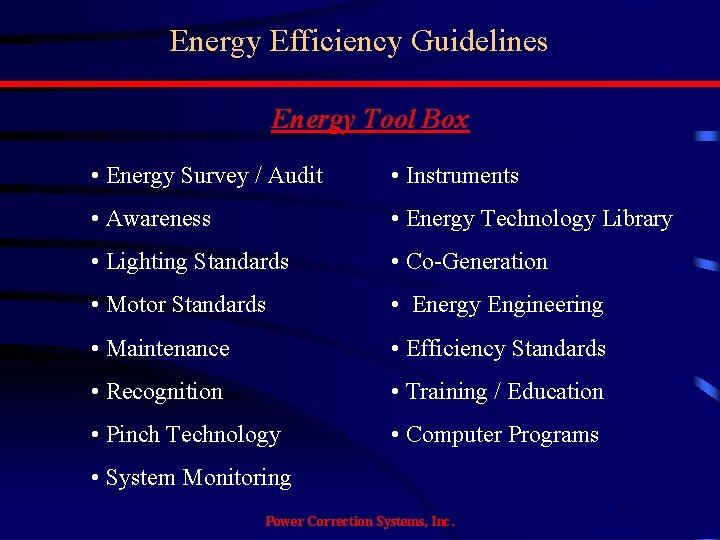
Energy Efficiency Guidelines Energy Tool Box • Energy Survey / Audit • Instruments • Awareness • Energy Technology Library • Lighting Standards • Co-Generation • Motor Standards • Energy Engineering • Maintenance • Efficiency Standards • Recognition • Training / Education • Pinch Technology • Computer Programs • System Monitoring Power Correction Systems, Inc.
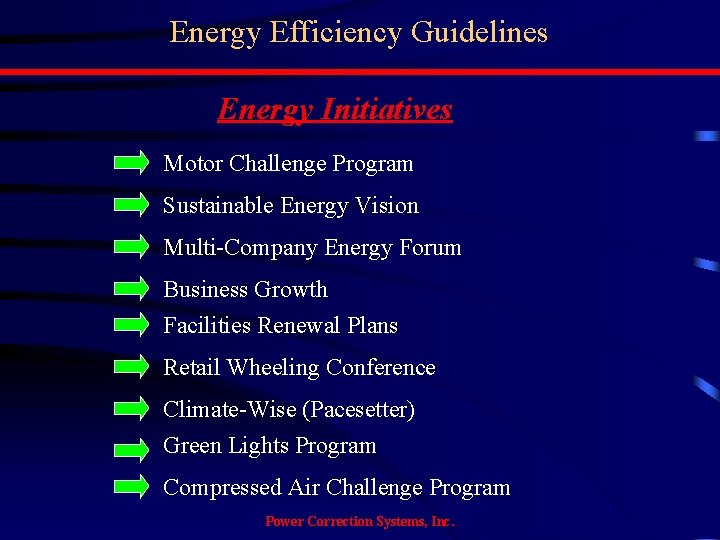
Energy Efficiency Guidelines Energy Initiatives Motor Challenge Program Sustainable Energy Vision Multi-Company Energy Forum Business Growth Facilities Renewal Plans Retail Wheeling Conference Climate-Wise (Pacesetter) Green Lights Program Compressed Air Challenge Program Power Correction Systems, Inc.
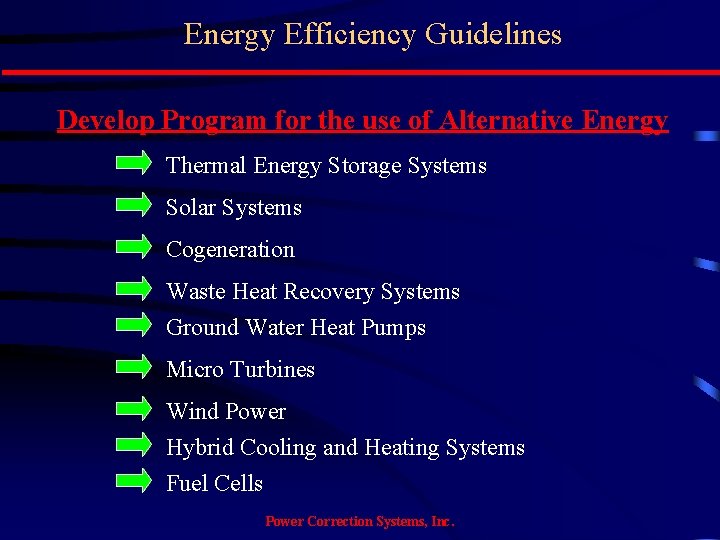
Energy Efficiency Guidelines Develop Program for the use of Alternative Energy Thermal Energy Storage Systems Solar Systems Cogeneration Waste Heat Recovery Systems Ground Water Heat Pumps Micro Turbines Wind Power Hybrid Cooling and Heating Systems Fuel Cells Power Correction Systems, Inc.
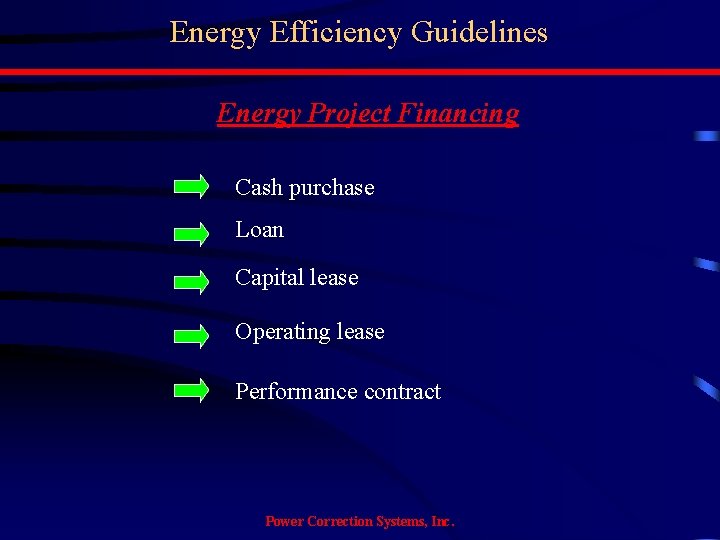
Energy Efficiency Guidelines Energy Project Financing Cash purchase Loan Capital lease Operating lease Performance contract Power Correction Systems, Inc.
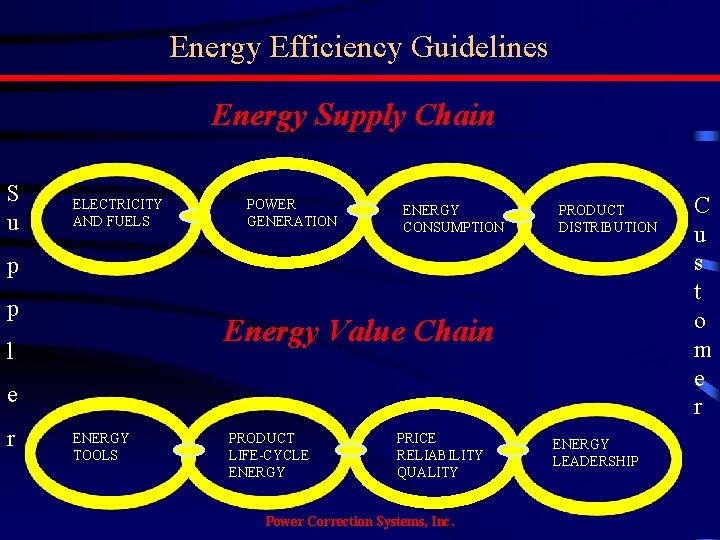
Energy Efficiency Guidelines Energy Supply Chain S u ELECTRICITY AND FUELS POWER GENERATION ENERGY CONSUMPTION PRODUCT DISTRIBUTION p p Energy Value Chain l e r ENERGY TOOLS PRODUCT LIFE-CYCLE ENERGY PRICE RELIABILITY QUALITY Power Correction Systems, Inc. ENERGY LEADERSHIP C u s t o m e r
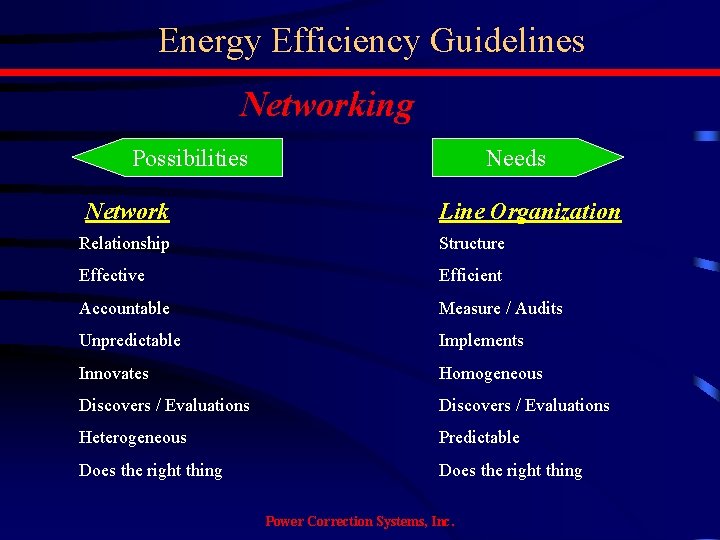
Energy Efficiency Guidelines Networking Possibilities Network Needs Line Organization Relationship Structure Effective Efficient Accountable Measure / Audits Unpredictable Implements Innovates Homogeneous Discovers / Evaluations Heterogeneous Predictable Does the right thing Power Correction Systems, Inc.
Energy Efficiency Guidelines Develop an Effective Energy Management Program Identifying Electric Use-Power Monitoring System • Allocating and managing energy costs • Submeter system architecture and services • Metering instruments for collecting and analyzing data • Evolution of metering technology Power Correction Systems, Inc.
Energy Efficiency Guidelines Develop an Effective Energy Management Program Energy Audits a Key Management Tool • Type of audits • Identifying energy conservation measures • Survey instrumentation • Data collection and trending using a personal computer • Identifying baselines and variable loads Power Correction Systems, Inc.
Energy Efficiency Guidelines Develop an Effective Energy Management Program Developing a Facility Energy Index • Utility bill analysis • Energy accounting • End-use profiles • External benchmarking • Database resources available to establish target indices Power Correction Systems, Inc.
Energy Efficiency Guidelines Develop an Effective Energy Management Program Plant Level Energy Management Process • Forecasting energy consumption • How to evaluate energy management performance • Analysis techniques • Benchmark data for plant efficiency comparison • Maintaining the effectiveness of energy management programs Power Correction Systems, Inc.
Energy Efficiency Guidelines Develop an Effective Energy Management Program Measurements and Verification of Savings • Standards and protocols • Methods for measurements - engineering calculations - computer models - measurements vs. monitoring • Practical considerations - expenses vs. benefits - accuracy - instrumentation Power Correction Systems, Inc.
Energy Efficiency Guidelines Develop an Effective Energy Management Program Purchase of Energy Resources • Natural gas transportation - economics, operation regulatory issues - balancing and bypass • Electricity wheeling-obstacles • Electric deregulation initiatives • Cogeneration opportunities • Water and sewer Power Correction Systems, Inc.
Energy Efficiency Guidelines Power Factor Correction Group Compensation • Eliminates k. VA surcharge • Increases service panel capacity Substation Compensation • Eliminates k. VA surcharge • Increases service panel capacity • Partial reduction in line losses • Partial increase in plant distribution capacity Power Correction Systems, Inc.
Energy Efficiency Guidelines Power Factor Correction Individual Compensation • Eliminates k. VA surcharge • Increases service panel capacity • Maximizes reduction of line losses • Improves voltage unbalance between phases • Increases life expectancy of motors • Adds flexibility for future expansion and changes Power Correction Systems, Inc.
Energy Efficiency Guidelines Improving Lighting Performance • Changes in recent years including T-8 lamps, T 5 - lamps, electronic ballast's, new dimming technologies, occupancy sensors, and pulsestart HID lamps and ballast's. • Implement these new technologies with the ability to control and shed loads on demand. This will be driven by utility deregulation's. Rate plans will provide attractive discounts for facilities they can control and shed loads during peak times Power Correction Systems, Inc.
Energy Efficiency Guidelines Improving Lighting Performance • Energy cost for lighting $75 Billion in the US for commercial buildings (Source DOE) • Modern lighting technology and products can bring savings in energy cost • for commercial and industrial facilities of up to 15 to 40% • Energy managers can lower their electrical costs without lowering the quality of light, on quality of life Power Correction Systems, Inc.
Energy Efficiency Guidelines Improving HVAC Performance Reduce Energy and Operating Cost Improve Air Quality Standards Improve Comfort Requirements Reduce Maintenance Cost Develop Program for Measurements of HVAC Equipment Energy use and Performance Power Correction Systems, Inc.
Energy Efficiency Guidelines Improving HVAC Performance Develop Program to Reduce HVAC Generating Costs • Heat Recovery • Reduce Scale and Corrosion • Load Management • Select Optimum Prime Mover / Fuel • Improve Characteristics of Working Fluid • High Efficiency Motors • Variable Speed Drives • Energy Management Monitoring Program Power Correction Systems, Inc.
Energy Efficiency Guidelines Improving HVAC Performance Develop Program to Reduce HVAC Generating Costs • Heat Recovery • Reduce Scale and Corrosion • Load Management • Select Optimum Prime Mover / Fuel • Improve Characteristics of Working Fluid • High Efficiency Motors • Variable Speed Drives • Energy Management Monitoring Program Power Correction Systems, Inc.
Energy Efficiency Guidelines Improving HVAC Performance Develop Program to Reduce HVAC Generating Costs • Control Chilled Water Flow Rate • Control Chilled Water Temperature • Improve Cooling Tower Performance • Control Condenser Water Temperature • High Efficiency Chillers • Improve Pumping Performance • Tower Free Cooling • Control Air Flow Power Correction Systems, Inc.
Energy Efficiency Guidelines Improving HVAC Performance Develop Program to Reduce HVAC Distribution Costs • Control Outside Air • Control Ventilation • Balance Air Handling Systems • Insulate • Control Supply Air Temperature • Avoid Simultaneous Heating / Cooling • Use Economizer Control • Use Air Quality Sensors • Use Air Pressure Control Power Correction Systems, Inc.
Energy Efficiency Guidelines Energy Benchmarks Heating BTU/SQFT Cooling TON/SQFT Heating cost per square foot Cooling cost per square foot Electrical cost per square foot Total Utility cost per square foot Lighting cost per square foot Water & sewer cost per square foot Power Correction Systems, Inc.
Energy Efficiency Guidelines Improving Compressed Air Performance Develop a system block diagram Create a system pressure profile Address point-of-use issues • Investigate and reduce point-of-use pressure requirements • Determine actual air quality requirements and treat air appropriately • Investigate and address high-volume, intermittent applications Develop a compressed air system maintenance program Power Correction Systems, Inc.
Energy Efficiency Guidelines Improving Compressed Air Performance Analyze existing compressor(s) and system control, and implement an effective control strategy Align supply-side with demand-side operation Implement strategies to maintain system alignment Power Correction Systems, Inc.
Energy Efficiency Guidelines Improving Compressed Air Performance • Perform a plant wide air leakage survey, using an ultrasonic leak detector device • Develop a compressed air load management system • Study compressed air distribution piping for pressure drops • Develop an education and training program for all employees • Investigate whether supply air pressure can be lowered • Check and analyze the operating pressure requirements for each system • Evaluate changing the specification for new equipment to a lower operating pressure Power Correction Systems, Inc.
Energy Efficiency Guidelines Additional Recommendations for Energy Management Improvements • Develop a plant wide computerized energy accounting management program • Replace standard V-belts with high efficiency type V-belts • Develop an automatic shutdown capability for utility and process equipment not in use • Develop a plant wide survey program for lighting levels • Develop a program for annual performance, efficiency and capacity testing for process and utility equipment Power Correction Systems, Inc.
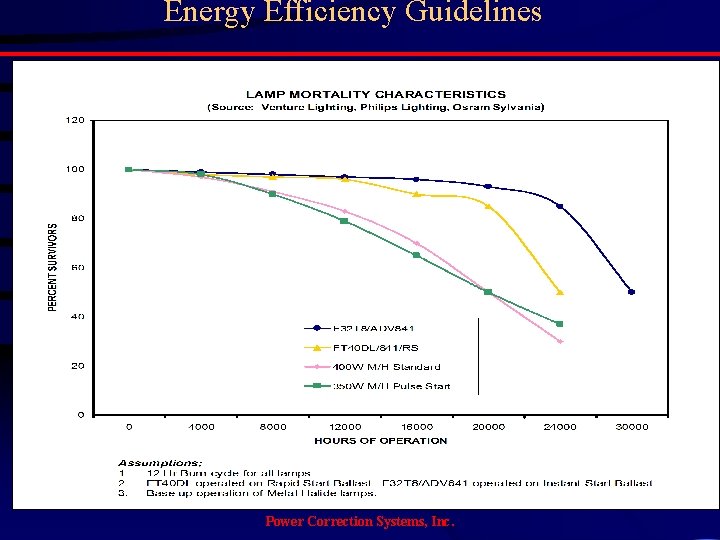
Energy Efficiency Guidelines Power Correction Systems, Inc.
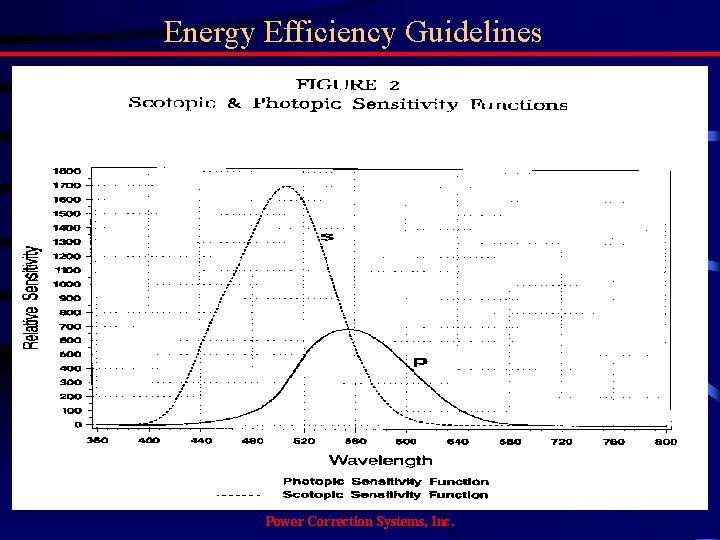
Energy Efficiency Guidelines Power Correction Systems, Inc.
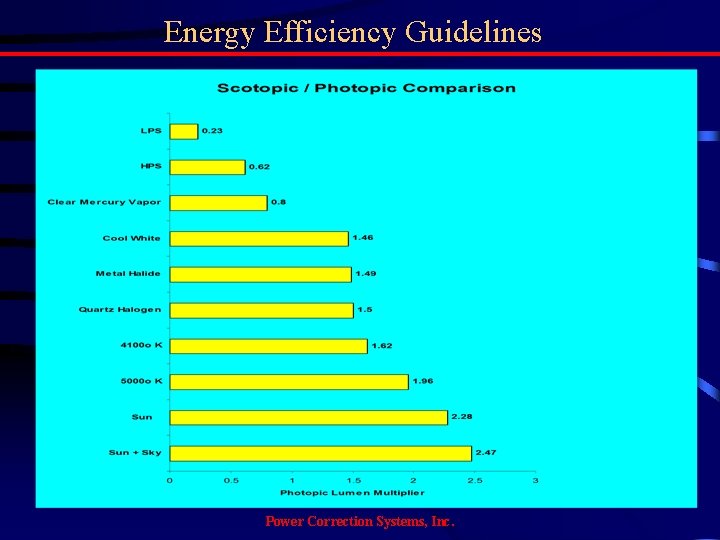
Energy Efficiency Guidelines Power Correction Systems, Inc.
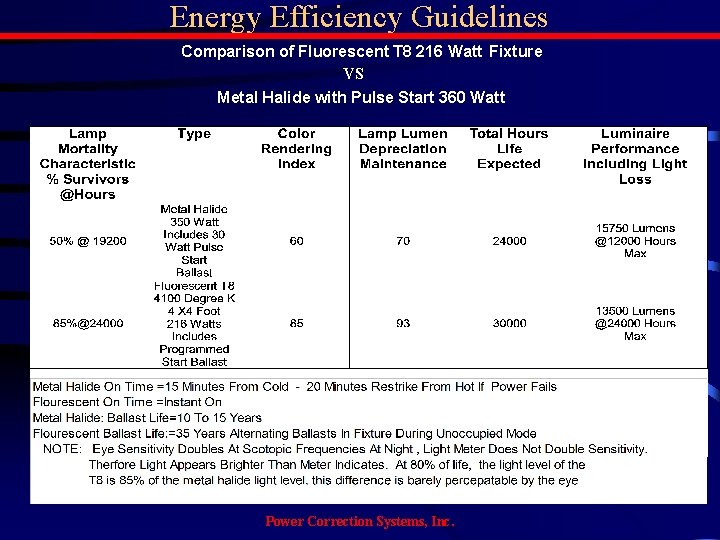
Energy Efficiency Guidelines Comparison of Fluorescent T 8 216 Watt Fixture VS Metal Halide with Pulse Start 360 Watt Power Correction Systems, Inc.
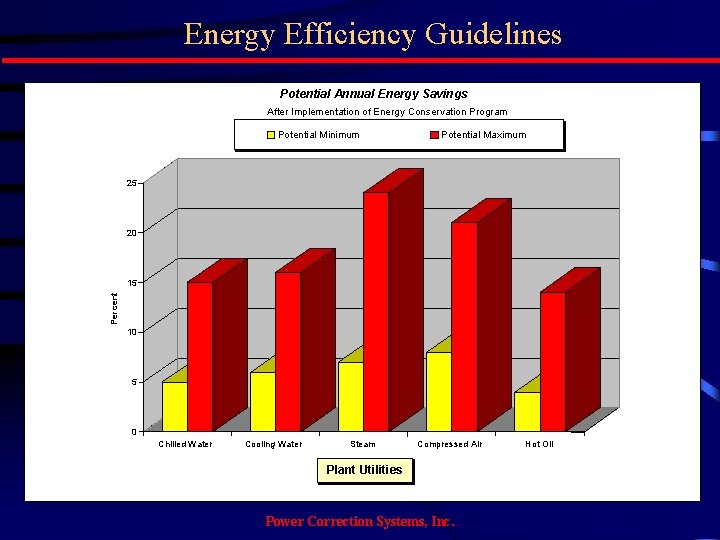
Energy Efficiency Guidelines Potential Annual Energy Savings After Implementation of Energy Conservation Program Potential Minimum Potential Maximum 25 20 Percent 15 10 5 0 Chilled Water Cooling Water Steam Compressed Air Plant Utilities Power Correction Systems, Inc. Hot Oil
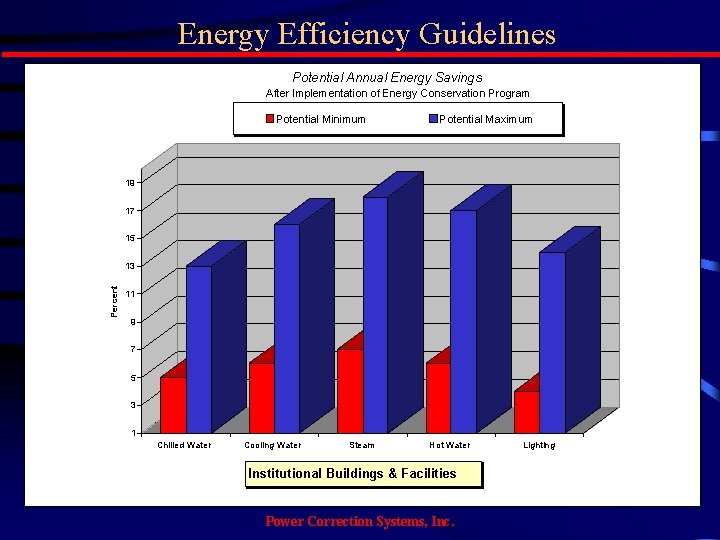
Energy Efficiency Guidelines Potential Annual Energy Savings After Implementation of Energy Conservation Program Potential Minimum Potential Maximum 19 17 15 Percent 13 11 9 7 5 3 1 Chilled Water Cooling Water Steam Hot Water Institutional Buildings & Facilities Power Correction Systems, Inc. Lighting
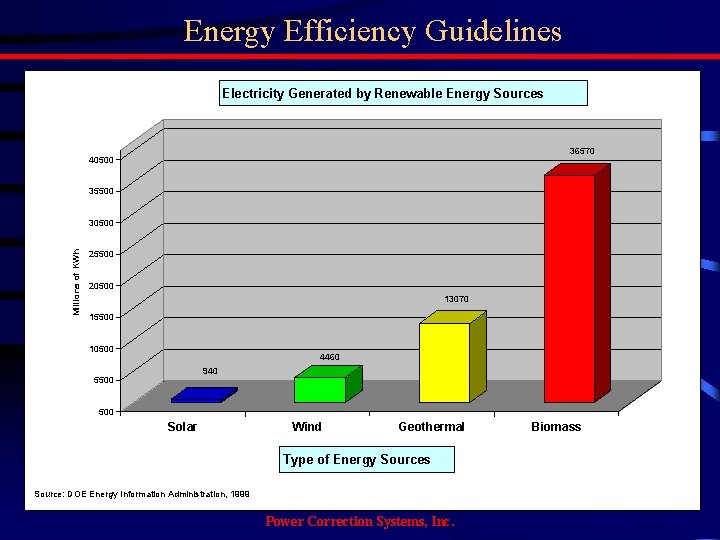
Energy Efficiency Guidelines Electricity Generated by Renewable Energy Sources 36570 40500 35500 Millions of KWh 30500 25500 20500 13070 15500 10500 4460 940 5500 Solar Wind Geothermal Type of Energy Sources Source: DOE Energy Information Administration, 1999 Power Correction Systems, Inc. Biomass
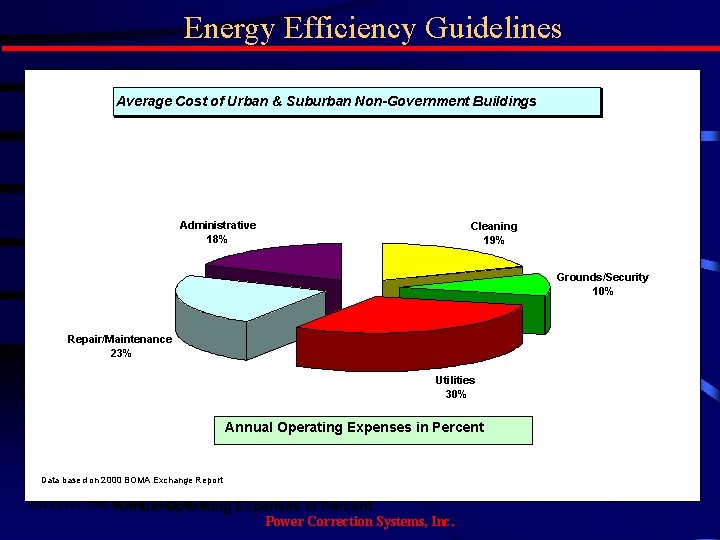
Energy Efficiency Guidelines Average Cost of Urban & Suburban Non-Government Buildings Administrative 18% Cleaning 19% Grounds/Security 10% Repair/Maintenance 23% Utilities 30% Annual Operating Expenses in Percent Data based on 2000 BOMA Exchange Report Annual Operating Expenses in Percent Power Correction Systems, Inc.
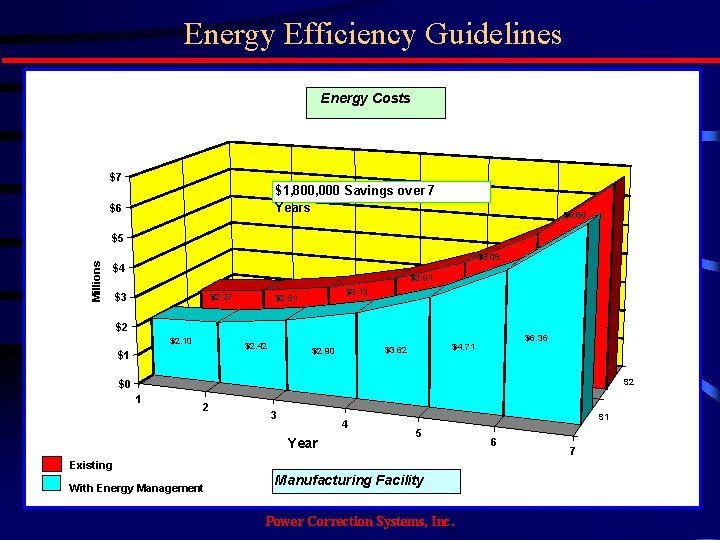
Energy Efficiency Guidelines Energy Costs $7 $1, 800, 000 Savings over 7 Years $6 $6. 86 Millions $5 $5. 08 $4 $3. 91 $2. 27 $3 $3. 13 $2. 61 $2 $2. 10 $2. 42 $1 $6. 36 $4. 71 $3. 62 $2. 90 S 2 $0 1 2 3 4 Year S 1 5 Existing With Energy Management Manufacturing Facility Power Correction Systems, Inc. 6 7
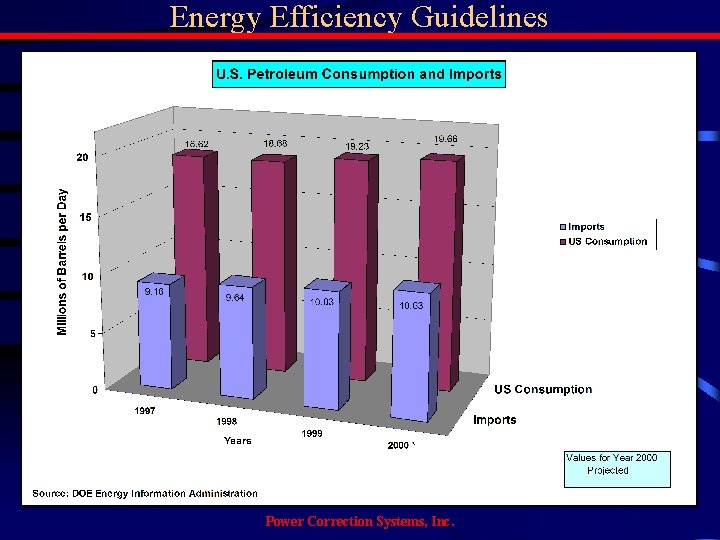
Energy Efficiency Guidelines Power Correction Systems, Inc.
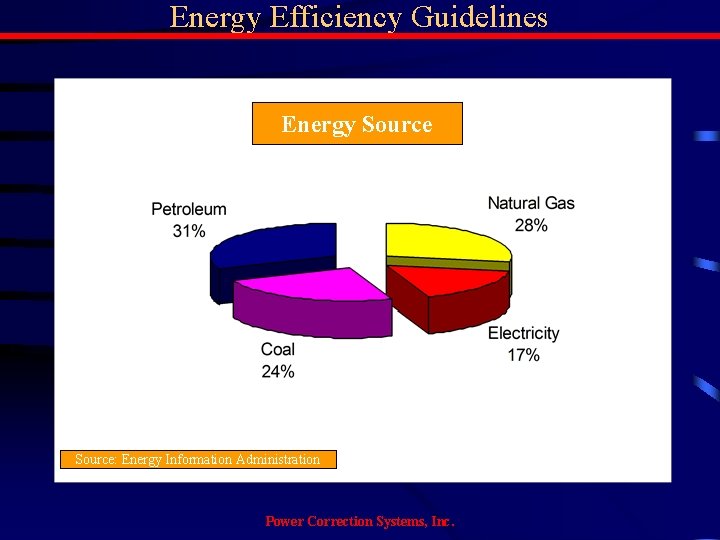
Energy Efficiency Guidelines Energy Source: Energy Information Administration Power Correction Systems, Inc.
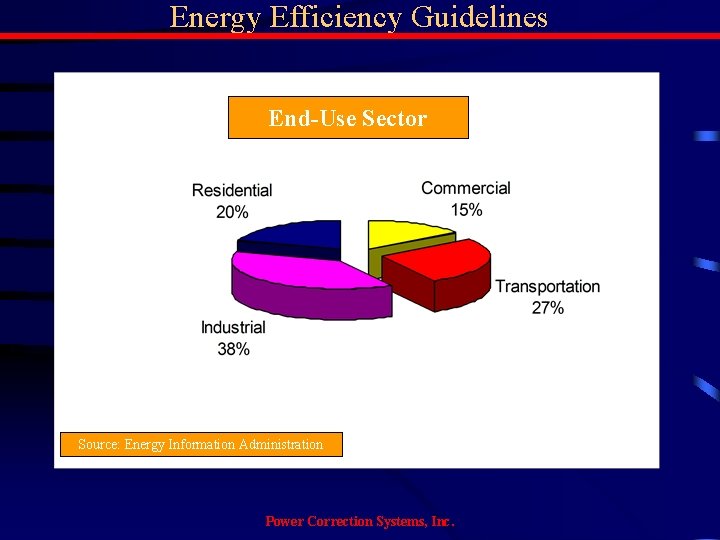
Energy Efficiency Guidelines End-Use Sector Source: Energy Information Administration Power Correction Systems, Inc.
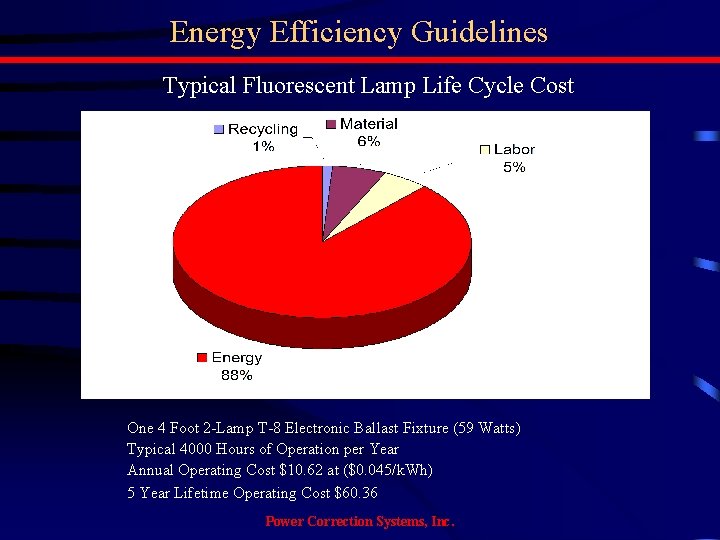
Energy Efficiency Guidelines Typical Fluorescent Lamp Life Cycle Cost One 4 Foot 2 -Lamp T-8 Electronic Ballast Fixture (59 Watts) Typical 4000 Hours of Operation per Year Annual Operating Cost $10. 62 at ($0. 045/k. Wh) 5 Year Lifetime Operating Cost $60. 36 Power Correction Systems, Inc.
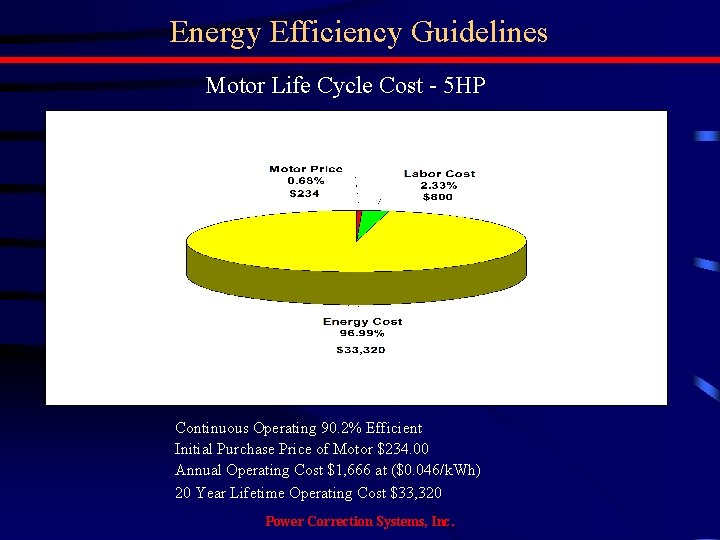
Energy Efficiency Guidelines Motor Life Cycle Cost - 5 HP Continuous Operating 90. 2% Efficient Initial Purchase Price of Motor $234. 00 Annual Operating Cost $1, 666 at ($0. 046/k. Wh) 20 Year Lifetime Operating Cost $33, 320 Power Correction Systems, Inc.
Energy Efficiency Guidelines Thank You ! For your time and interest in Power Correction Systems 1800 S. Robertson Blvd. PMB 419, Los Angeles, CA 90035 Phone: 310 247 -4848 Fax: 310 273 -7719 E-mail: bsegal@activeharmonicfilters. com Brahm Segal; Power Correction Systems, Inc.
- Slides: 48