
Energy Codes and the Building Envelope Civil Engineering
Energy Codes and the Building Envelope Civil Engineering and Architecture © 2010 Project Lead The Way, Inc.
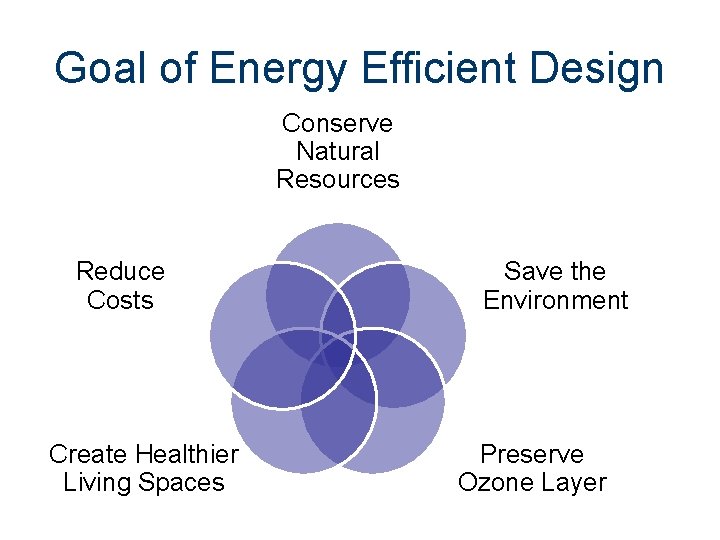
Goal of Energy Efficient Design Conserve Natural Resources Reduce Costs Create Healthier Living Spaces Save the Environment Preserve Ozone Layer
A Few Acronyms ASHREA = American Society of Heating, Refrigerating, and Air-Conditioning Engineers ICC = International Code Council IECC = International Energy Conservation Code
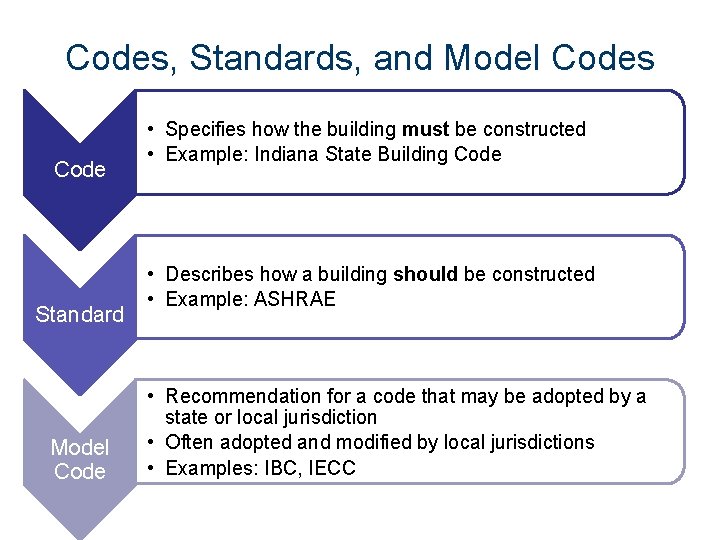
Codes, Standards, and Model Codes Code Standard Model Code • Specifies how the building must be constructed • Example: Indiana State Building Code • Describes how a building should be constructed • Example: ASHRAE • Recommendation for a code that may be adopted by a state or local jurisdiction • Often adopted and modified by local jurisdictions • Examples: IBC, IECC
Commercial Energy Usage • Office, retail, and service buildings are the largest consumers of energy in the United States • About half of this energy is consumed by lighting • Energy Codes and Standards set a minimum level of energy performance with which the building must comply
Commercial Energy Codes Commercial energy codes apply to all buildings EXCEPT: • One- and two-family residential buildings • Multi-unit residential buildings three stories or less in height
Energy Codes • Codes and standards may be enforced at the state, local, or jurisdictional level • Voluntary Energy-Efficiency Programs – – Home Energy Rating System (HERS) ENERGY STAR Good Cents LEED
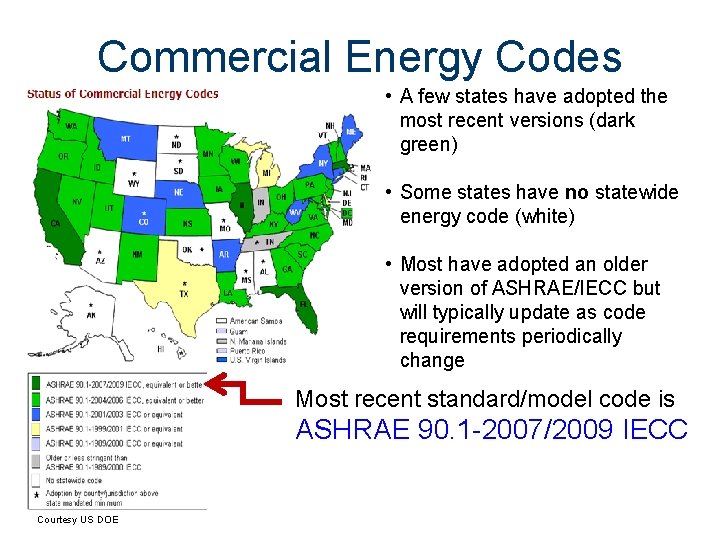
Commercial Energy Codes • A few states have adopted the most recent versions (dark green) • Some states have no statewide energy code (white) • Most have adopted an older version of ASHRAE/IECC but will typically update as code requirements periodically change Most recent standard/model code is ASHRAE 90. 1 -2007/2009 IECC Courtesy US DOE
We’ll Look at • ASHRAE/IESNA Standard 90. 1 -2007 • Chapter 5 of the IECC General Prescriptive Approach • Use for ≤ 40% of gross wall area in vertical fenestration • Use for ≤ 3% of gross roof area in skylights
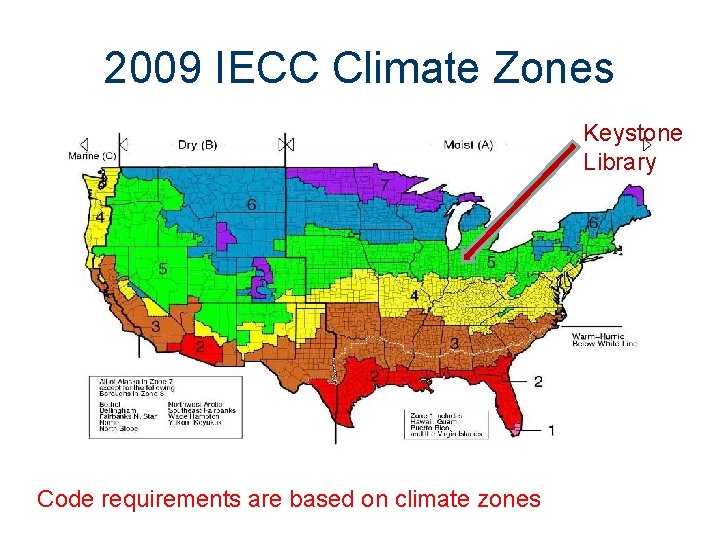
2009 IECC Climate Zones Keystone Library Code requirements are based on climate zones
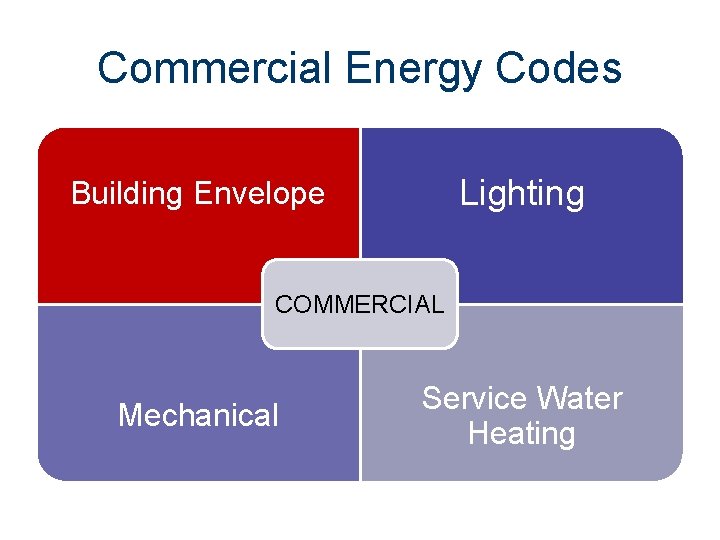
Commercial Energy Codes Lighting Building Envelope COMMERCIAL Mechanical Service Water Heating
What is a Building Envelope? • • • Roof/ceiling Exterior walls Vertical fenestration (glazing) and skylights Lowest floor Slab edge Below grade walls
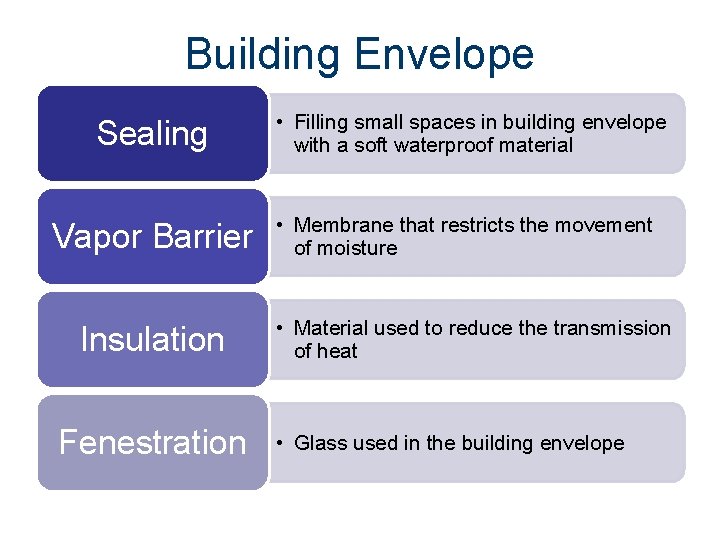
Building Envelope Sealing Vapor Barrier Insulation Fenestration • Filling small spaces in building envelope with a soft waterproof material • Membrane that restricts the movement of moisture • Material used to reduce the transmission of heat • Glass used in the building envelope
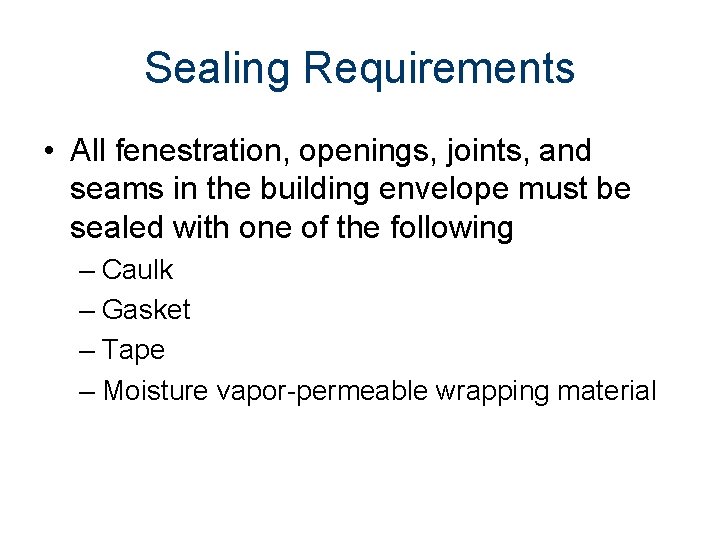
Sealing Requirements • All fenestration, openings, joints, and seams in the building envelope must be sealed with one of the following – Caulk – Gasket – Tape – Moisture vapor-permeable wrapping material
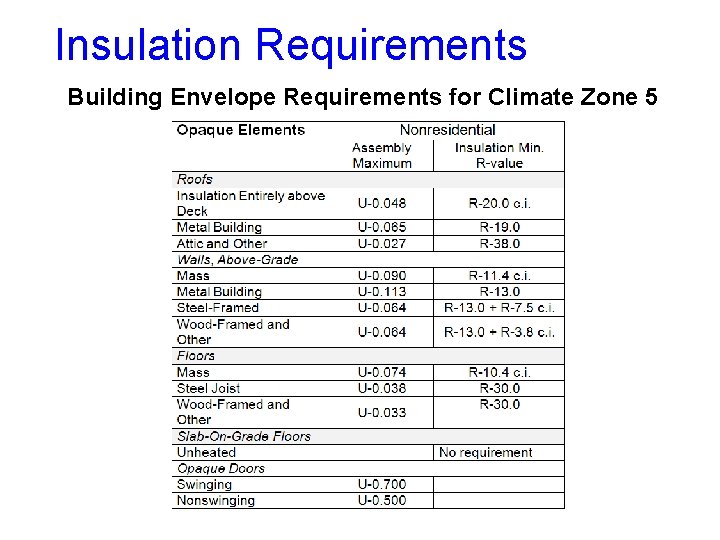
Insulation Requirements Building Envelope Requirements for Climate Zone 5
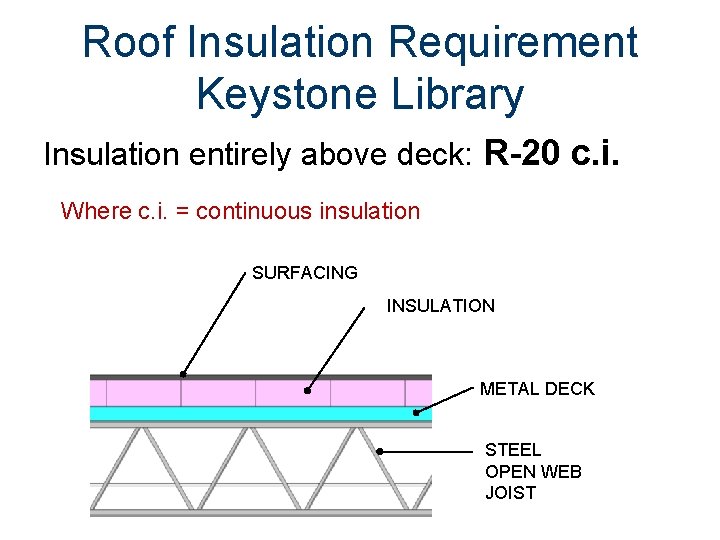
Roof Insulation Requirement Keystone Library Insulation entirely above deck: R-20 c. i. Where c. i. = continuous insulation SURFACING INSULATION METAL DECK STEEL OPEN WEB JOIST
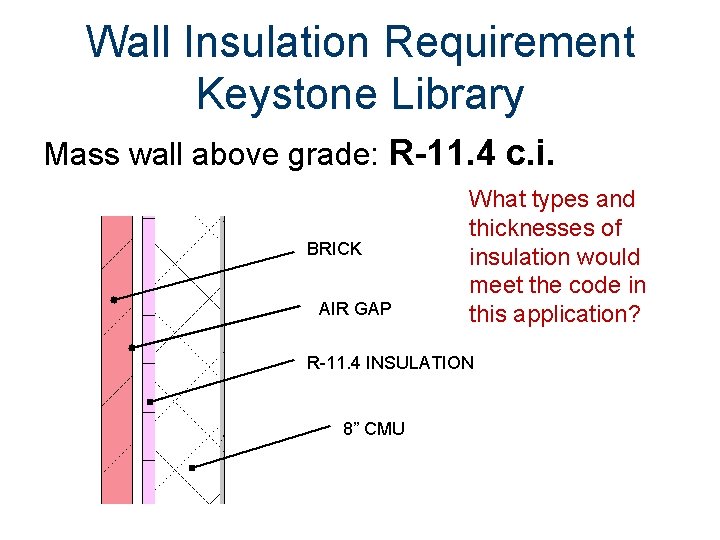
Wall Insulation Requirement Keystone Library Mass wall above grade: R-11. 4 c. i. BRICK AIR GAP What types and thicknesses of insulation would meet the code in this application? R-11. 4 INSULATION 8” CMU
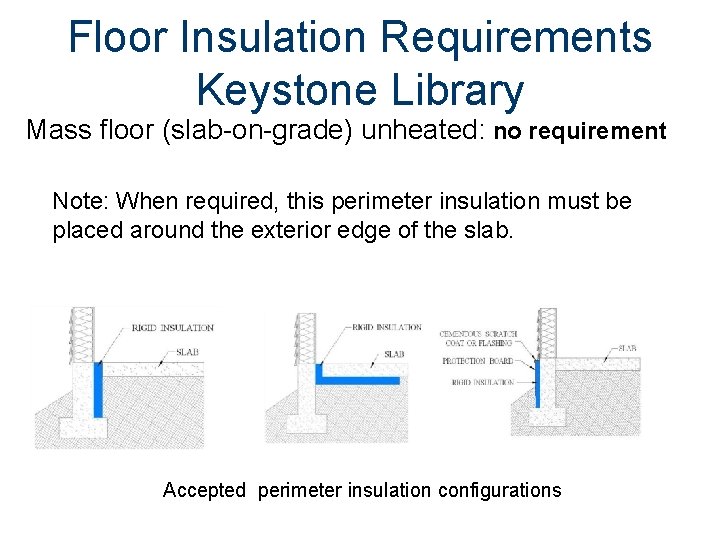
Floor Insulation Requirements Keystone Library Mass floor (slab-on-grade) unheated: no requirement Note: When required, this perimeter insulation must be placed around the exterior edge of the slab. Accepted perimeter insulation configurations
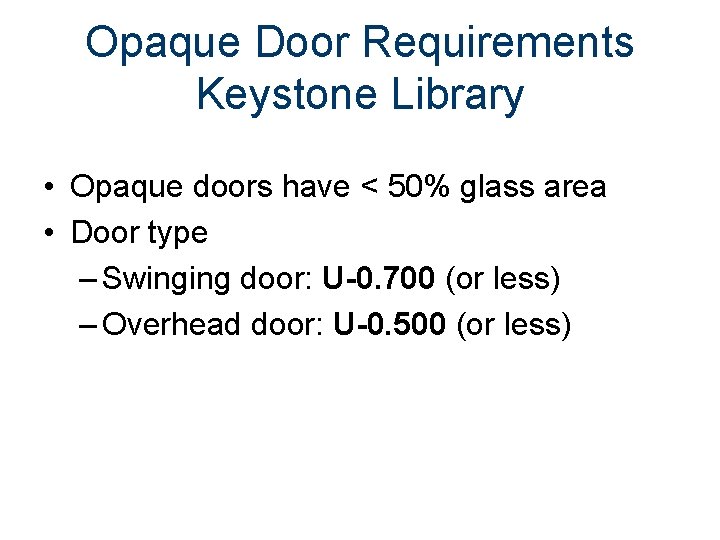
Opaque Door Requirements Keystone Library • Opaque doors have < 50% glass area • Door type – Swinging door: U-0. 700 (or less) – Overhead door: U-0. 500 (or less)
Reminder: U-Factor The rate of heat loss through the window The lower the U-factor, the less heat is lost Reciprocal of R-value (1/R)
Fenestration • All areas (including the frames) in the building envelope that let in light – Examples include windows, plastic panels, clerestories, skylights, glass doors that are more than one-half glass, and glass block walls • A skylight is a fenestration surface having a slope of less than 60 degrees from the horizontal plane
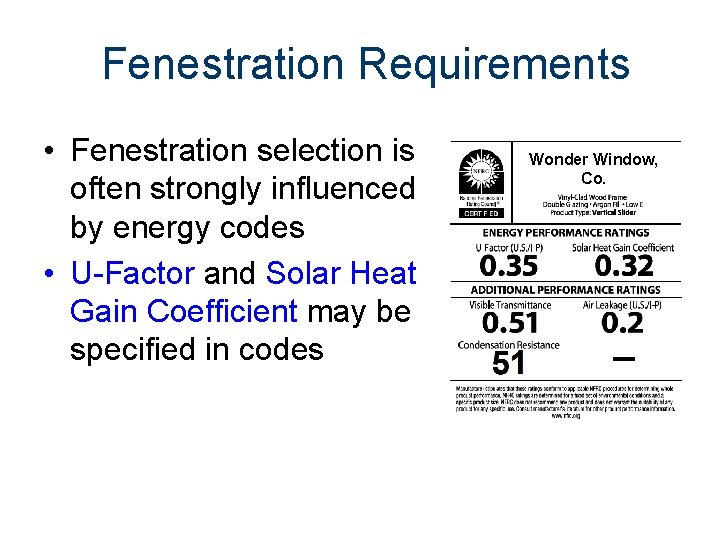
Fenestration Requirements • Fenestration selection is often strongly influenced by energy codes • U-Factor and Solar Heat Gain Coefficient may be specified in codes Wonder Window, Co.
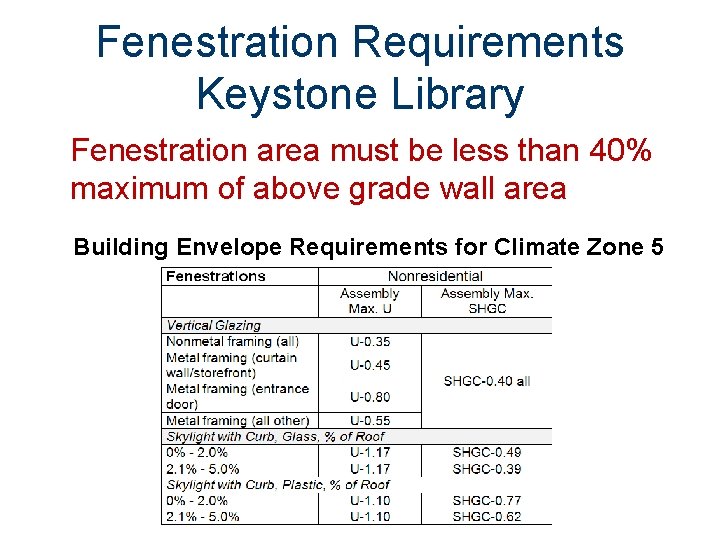
Fenestration Requirements Keystone Library Fenestration area must be less than 40% maximum of above grade wall area Building Envelope Requirements for Climate Zone 5
Fenestration Requirements Definitions Curtain Wall – Fenestration products used to create an external non-load bearing wall that is designed to separate the exterior and interior environments Storefront – A nonresidential system of doors and windows mulled as a composite fenestration structure that has been designed to withstand heavy use Entrance Door – Fenestration products used for ingress, egress, and access in nonresidential buildings, including but not limited to, exterior entrances that utilize latching hardware and automatic closers that contain over 50% glass specifically designed to withstand heavy use and possible abuse
Solar Heat Gain Coefficient (SHGC) The fraction of incident solar radiation admitted through a window Expressed as a number between 0 and 1 The lower a window's solar heat gain coefficient, the less solar heat it transmits
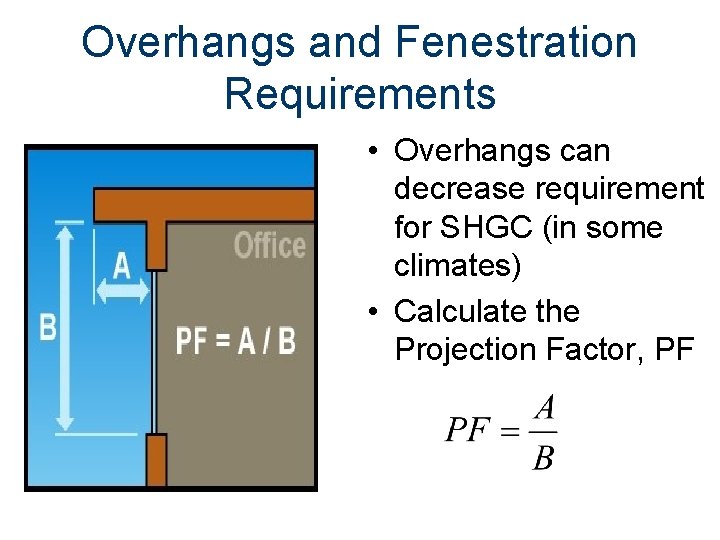
Overhangs and Fenestration Requirements • Overhangs can decrease requirement for SHGC (in some climates) • Calculate the Projection Factor, PF
Solar Heat Gain Coefficient (SHGC) • Southern climates with high cooling loads – SHGC is more important than the U-factor in promoting energy efficiency – Choose lowest SHGC possible • Northern climates with insignificant cooling loads – Choose highest SHGC to promote solar heat gain during cold weather
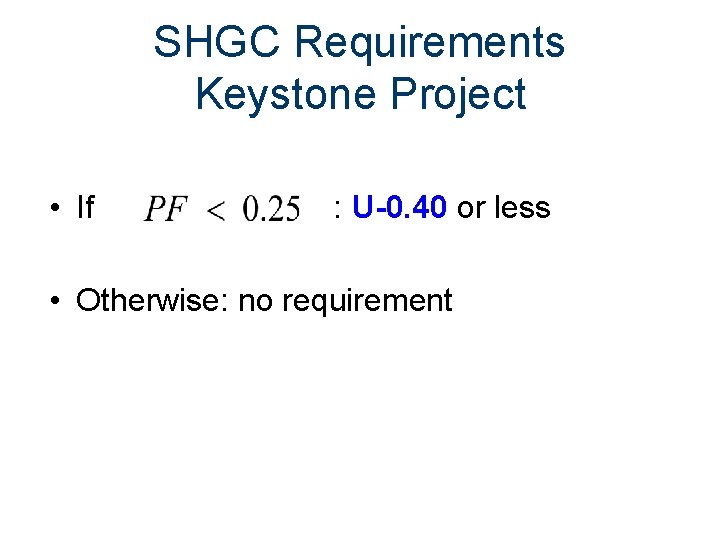
SHGC Requirements Keystone Project • If : U-0. 40 or less • Otherwise: no requirement
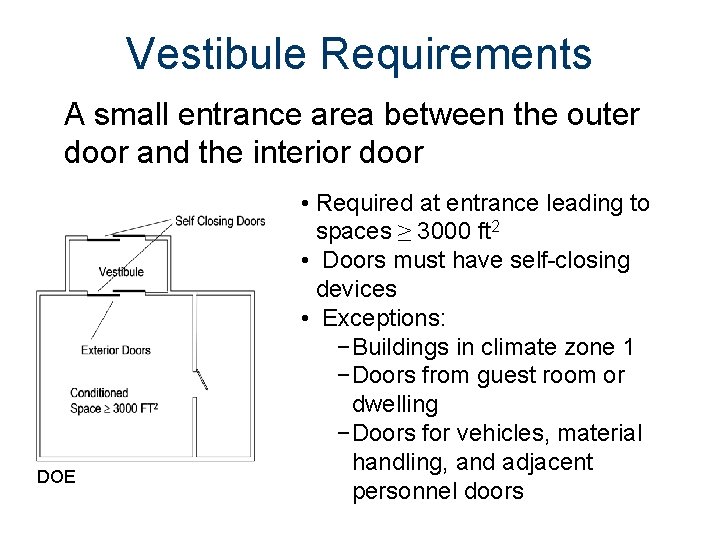
Vestibule Requirements A small entrance area between the outer door and the interior door DOE • Required at entrance leading to spaces ≥ 3000 ft 2 • Doors must have self-closing devices • Exceptions: −Buildings in climate zone 1 −Doors from guest room or dwelling −Doors for vehicles, material handling, and adjacent personnel doors
Resources Barlett, R. , Halverson, M. A. , & Shankle, D. L. (year). Understanding building energy codes and standards. Publication no. PNNL-14235: U. S. Efficient Windows Collaborative. (n. d. ). Retrieved December 15, 2009, from http: //www. efficientwindows. org/ Department of Energy. (n. d). Building energy codes program. Retrieved December 15, 2009, from http: //www. energycodes. gov/implement/ International Code Council (2009). International energy conservation code and ANSI/ASHRAE/IESNA standard 90. 1 2007 energy standard for buildings except low rise residential buildings. Country Club Hills, IL: Author.
- Slides: 30