
Energy Bar Graphs How to represent the role
Energy Bar Graphs How to represent the role of energy in physical change © Modeling Chemistry 2005
Constructing an Energy Bar Graph Diagram Consider this example A cup of hot coffee cools as it sits on the table. n 1. Determine what is in the system cup coffee n Everything else makes up the surroundings
Decide whether Ech is involved In this case, you start with coffee and end with coffee; particles are not rearranged to form new substances n So, ignore Ech for now. n
Assign values to Ei n n Due to interactions between particles, the energy stored due to the arrangement of particles is ranked: solids < liquids < gases We choose to represent these phases by using: n n n Solids = 1 bar Liquids = 2 bars Gases = 4 bars
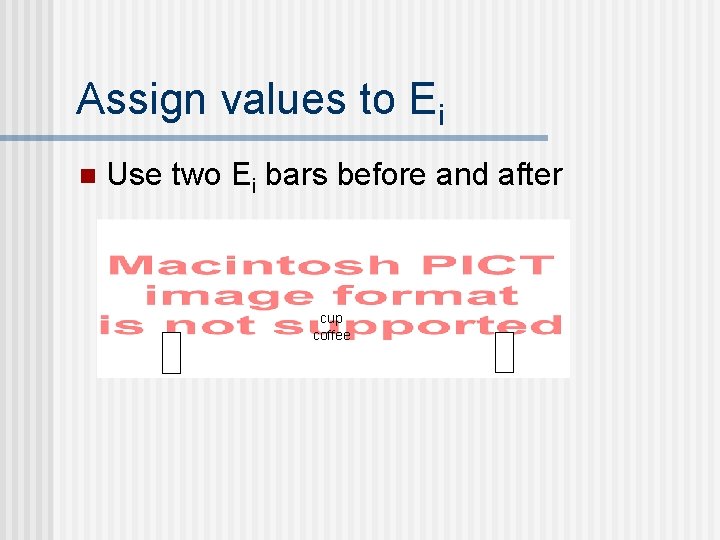
Assign values to Ei n Use two Ei bars before and after cup coffee
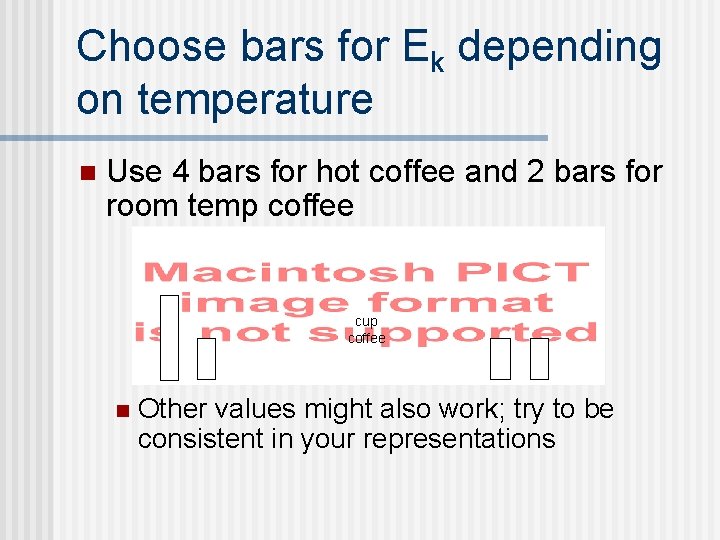
Choose bars for Ek depending on temperature n Use 4 bars for hot coffee and 2 bars for room temp coffee cup coffee n Other values might also work; try to be consistent in your representations
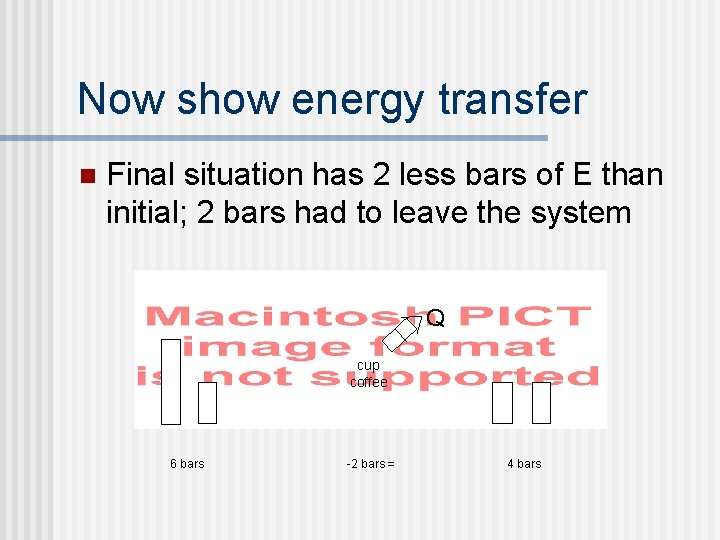
Now show energy transfer n Final situation has 2 less bars of E than initial; 2 bars had to leave the system Q cup coffee 6 bars -2 bars = 4 bars
Now, consider phase change A tray of ice cubes (-8 ˚C) is placed on the counter and becomes water at room temperature What do we know about the situation? n n n n The system is the tray of ice cubes. The solid water turns to liquid water - no change in Ech The Ei increases (solid liquid) The Ek increases (temp rises) Now represent these changes in bar graph.
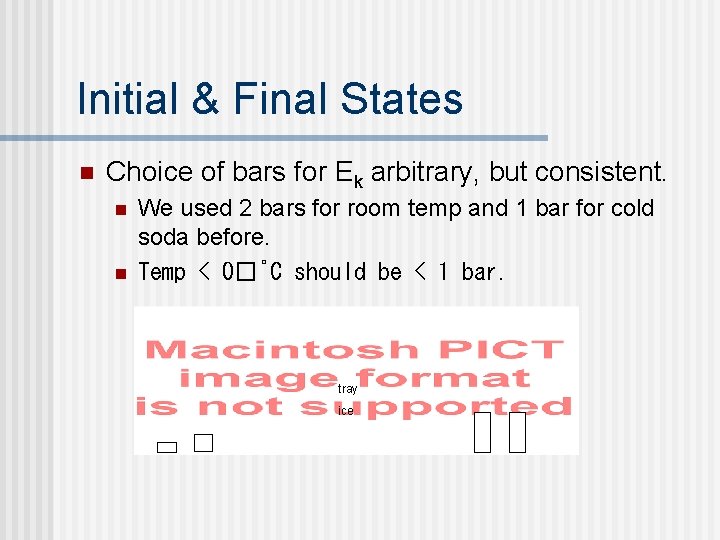
Initial & Final States n Choice of bars for Ek arbitrary, but consistent. n n We used 2 bars for room temp and 1 bar for cold soda before. Temp < 0�˚C should be < 1 bar. tray ice
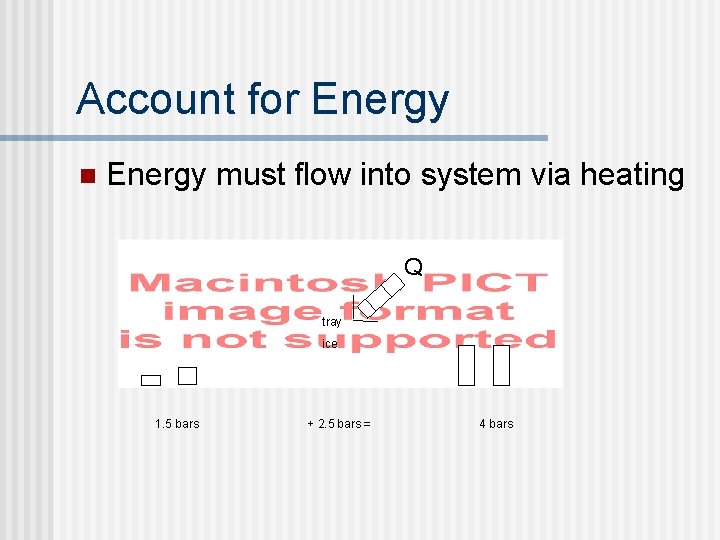
Account for Energy n Energy must flow into system via heating Q tray ice 1. 5 bars + 2. 5 bars = 4 bars
- Slides: 10