
Energy and Work Part 2 What is Work

- Slides: 12
Energy and Work Part 2
What is Work is the transfer of energy through motion – When force acts over a distance in the direction of an object’s motion W=Fx. D W = Work F = Force D = Distance Measured in Joules (J) J = N x m
Example A dancer lifts a 400 N ballerina overhead a distance of 1. 4 m and holds her there for several seconds. How much work is done during the lift? W=Fx. D F = 400 N D = 1. 4 m W = 400 N x 1. 4 m W= 560 J or 560 N x m How much work was being done while the ballerina was overhead?
Why was no work being done while the ballerina was overhead? Work – transfer of energy through motion If the ballerina is not moving what type of energy does she represent – Potential What if she was dropped. What type of energy would she represent? – Kinetic
Conservation of Energy Law of Conservation of Energy – Energy may change form but it cannot be created nor destroyed under ordinary conditions
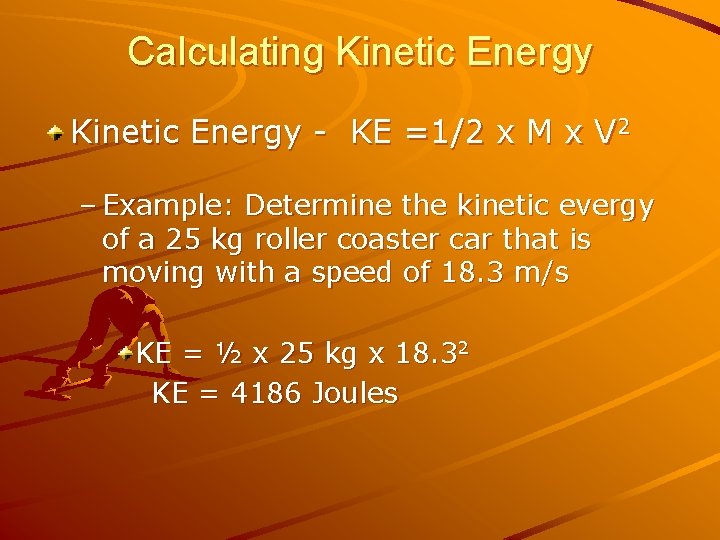
Calculating Kinetic Energy - KE =1/2 x M x V 2 – Example: Determine the kinetic evergy of a 25 kg roller coaster car that is moving with a speed of 18. 3 m/s KE = ½ x 25 kg x 18. 32 KE = 4186 Joules
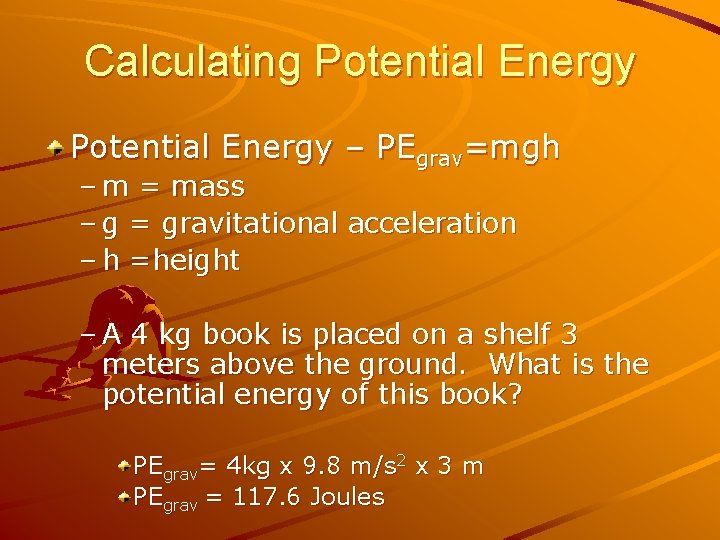
Calculating Potential Energy – PEgrav=mgh – m = mass – g = gravitational acceleration – h =height – A 4 kg book is placed on a shelf 3 meters above the ground. What is the potential energy of this book? PEgrav= 4 kg x 9. 8 m/s 2 x 3 m PEgrav = 117. 6 Joules
Mechanical Energy – is the total amount of kinetic and potential energy in a system
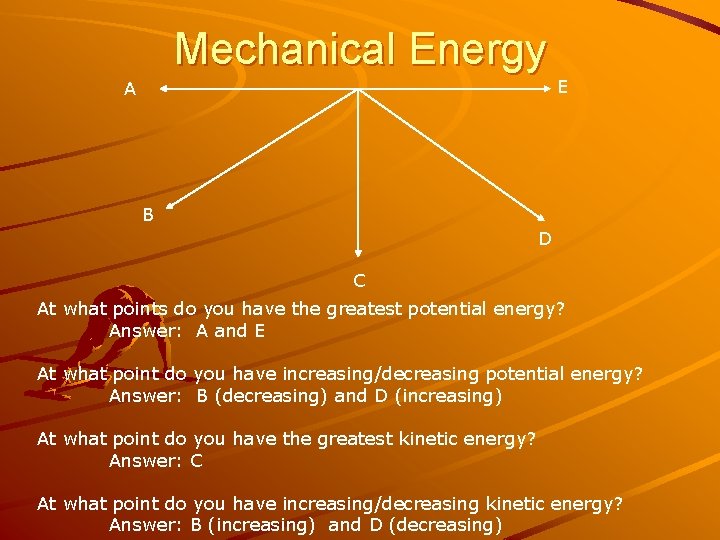
Mechanical Energy A E B D C At what points do you have the greatest potential energy? Answer: A and E At what point do you have increasing/decreasing potential energy? Answer: B (decreasing) and D (increasing) At what point do you have the greatest kinetic energy? Answer: C At what point do you have increasing/decreasing kinetic energy? Answer: B (increasing) and D (decreasing)
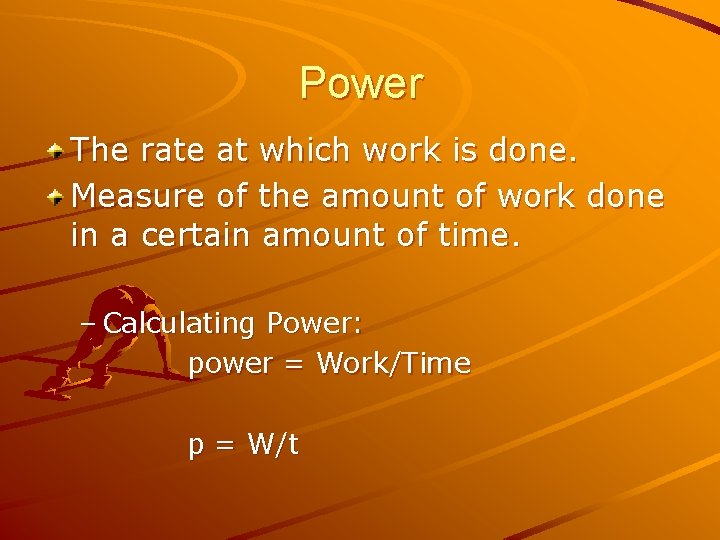
Power The rate at which work is done. Measure of the amount of work done in a certain amount of time. – Calculating Power: power = Work/Time p = W/t
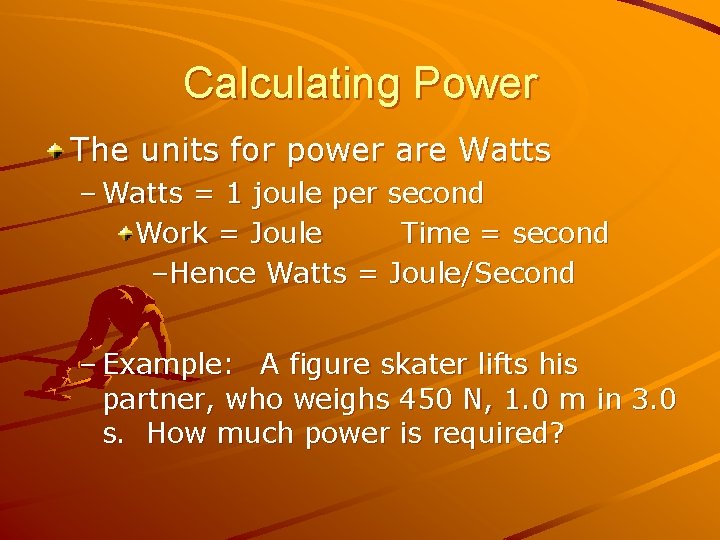
Calculating Power The units for power are Watts – Watts = 1 joule per second Work = Joule Time = second –Hence Watts = Joule/Second – Example: A figure skater lifts his partner, who weighs 450 N, 1. 0 m in 3. 0 s. How much power is required?
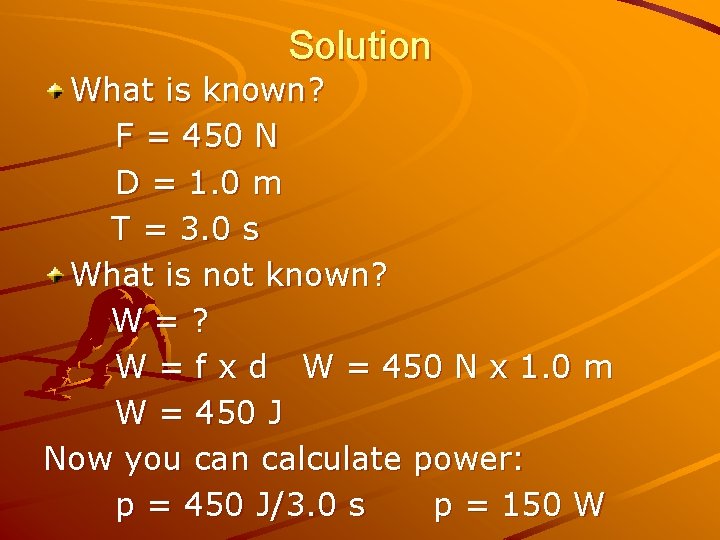
Solution What is known? F = 450 N D = 1. 0 m T = 3. 0 s What is not known? W=? W = f x d W = 450 N x 1. 0 m W = 450 J Now you can calculate power: p = 450 J/3. 0 s p = 150 W