
ENERGY and the ROLLER COASTER Key Questions What
- Slides: 15
ENERGY and the ROLLER COASTER
Key Questions § What happens to the motion of a marble on a hilly track? § How is energy conserved on a roller coaster?
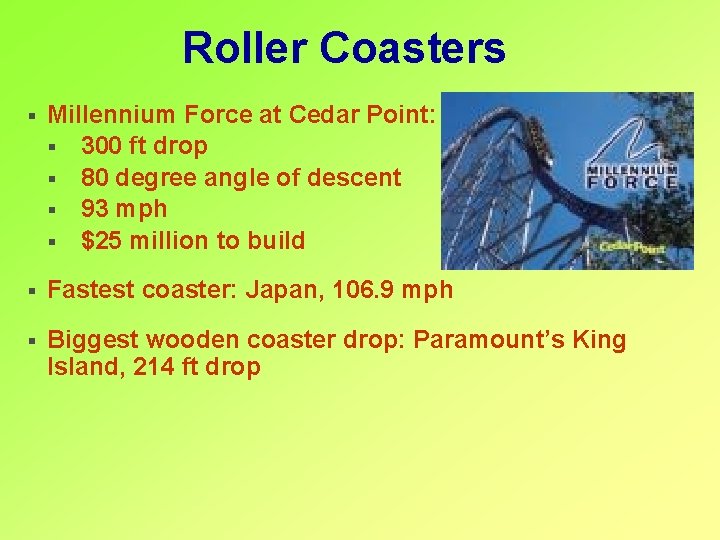
Roller Coasters § Millennium Force at Cedar Point: § 300 ft drop § 80 degree angle of descent § 93 mph § $25 million to build § Fastest coaster: Japan, 106. 9 mph § Biggest wooden coaster drop: Paramount’s King Island, 214 ft drop
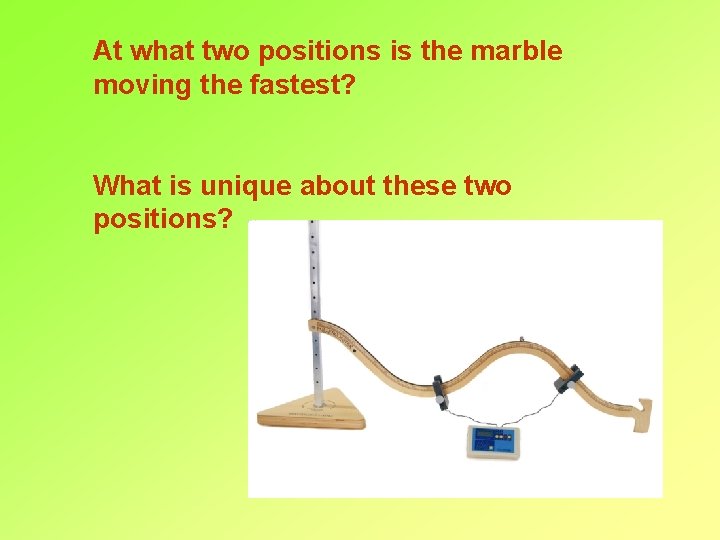
Where does the marble move the fastest?
At what two positions is the marble moving the fastest? What is unique about these two positions?
§ How does the speed of marble 1 compare to the speed of marble 2? § How does the time it takes each marble to reach this point compare?
ENERGY n. Is WORK the ability to do n. Force x Distance work. n. Unit – joules n. Is stored work n. Any object that has n. Unit - joules energy has the ability to create a force
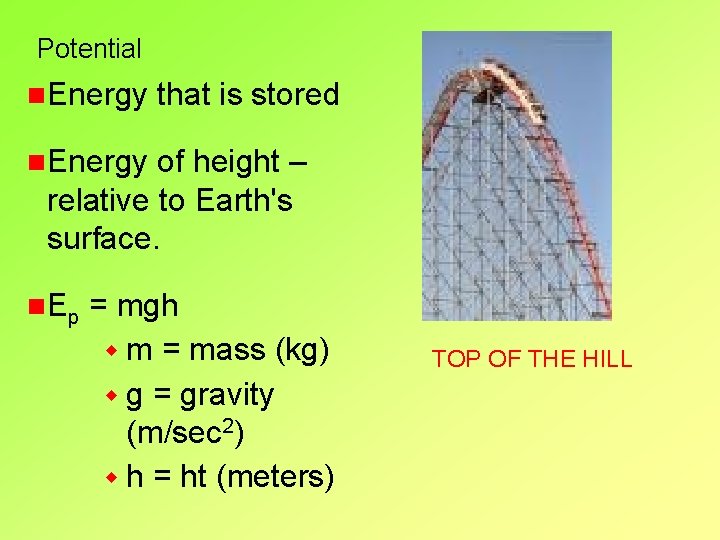
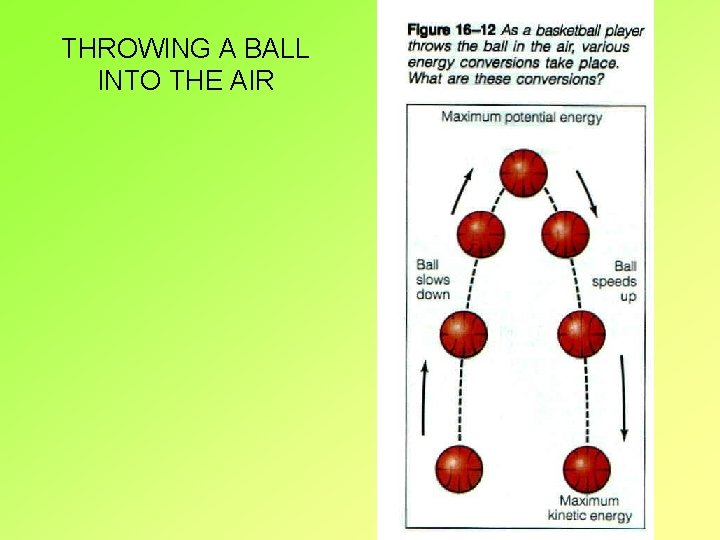
Potential n. Energy that is stored n. Energy of height – relative to Earth's surface. n Ep = mgh w m = mass (kg) w g = gravity (m/sec 2) w h = ht (meters) TOP OF THE HILL
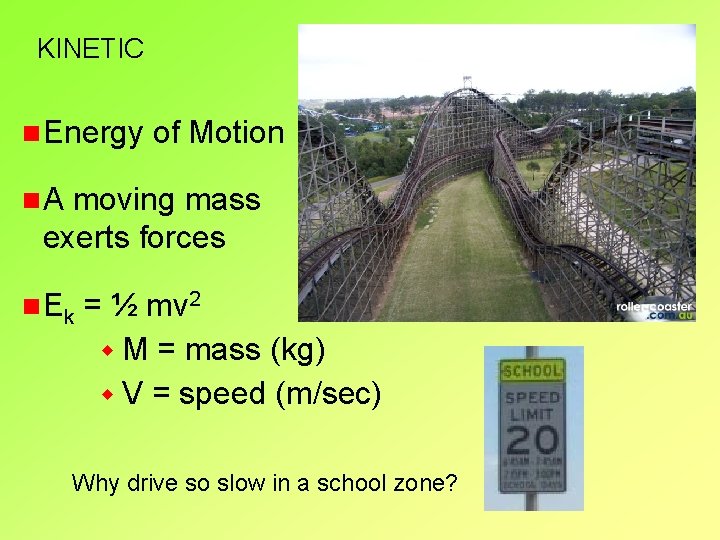
KINETIC n. Energy of Motion n. A moving mass exerts forces n Ek = ½ mv 2 w M = mass (kg) w V = speed (m/sec) Why drive so slow in a school zone?
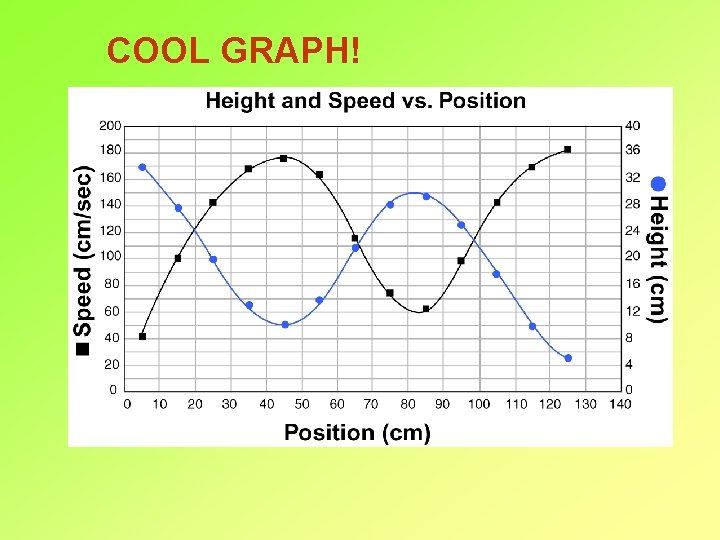
Investigate the relationship between speed and height more closely § Find the speed of the marble for each of 12 different positions on the coaster § Whn finished, please complete the speed vs. position graph
Input vs. Output n. Work Output is always less than Work Input l Where does it go? w Friction – thermal energy n. Efficiency (%) l A machine is 100% efficient when input = output work. l Wo / Wi x 100
The Work – Energy Theorem n. The total amount of Work that can be done is equal to the total amount of Energy available. n. Objects cannot do Work without Energy n. Energy can be stored for later use
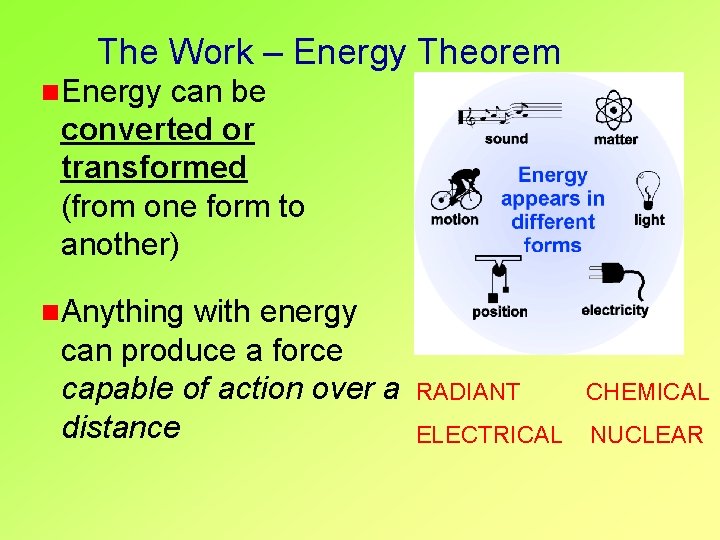
The Work – Energy Theorem n. Energy can be converted or transformed (from one form to another) n. Anything with energy can produce a force capable of action over a distance RADIANT CHEMICAL ELECTRICAL NUCLEAR
COOL GRAPH!
THROWING A BALL INTO THE AIR