
Energy and matter in the ecosystem By Bella
Energy and matter in the ecosystem By Bella Xu Sarunyu Umbumroong Justin Lee Devin Lu
Key Term 1. 2. 3. 4. 5. Carnivore-an animal that eats only meat Decomposer-an organism that decomposes organic material Herbivore-an animal that eats only eats plants Omnivores-an organism that eats both producers and consumers Food chain-a hierarchical series of organisms each dependent on the next as a source of food 6. Producer-organism that makes its own energy, usually plants 7. Predator-an organism that eats other organisms 8. Parasite-an organism that hurts or kills other organisms for their own benefit 9. Consumer-an organism that eats to survive 10. Scavengers-organisms that search for food that is dead or almost dead
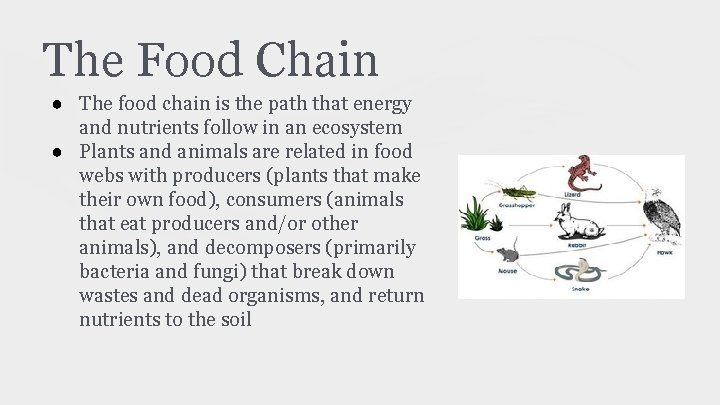
The Food Chain ● The food chain is the path that energy and nutrients follow in an ecosystem ● Plants and animals are related in food webs with producers (plants that make their own food), consumers (animals that eat producers and/or other animals), and decomposers (primarily bacteria and fungi) that break down wastes and dead organisms, and return nutrients to the soil

The Food Chain Tertiary Consumer Secondary Consumer ● a hierarchical series of organisms each dependent on the next as a source of food. Primary Consumer Producer
Herbivore, Carnivore and Omnivore Animals Let’s learn about these animals
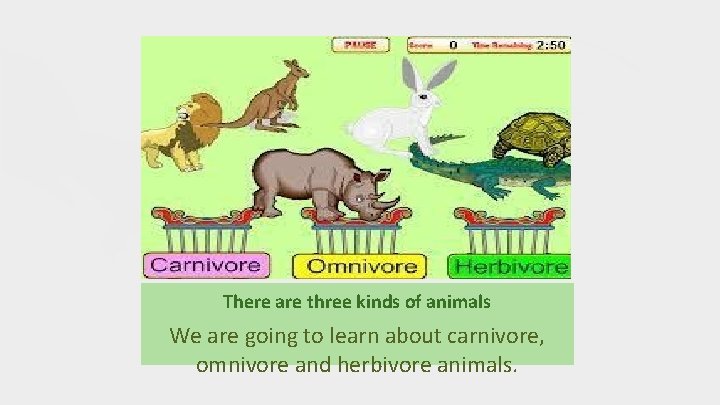
There are three kinds of animals We are going to learn about carnivore, omnivore and herbivore animals.
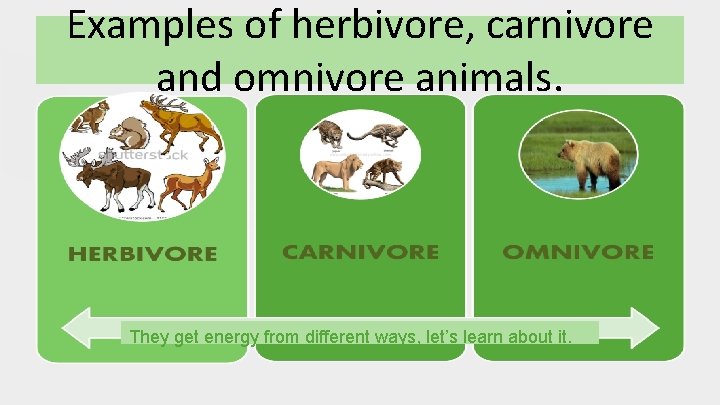
Examples of herbivore, carnivore and omnivore animals. They get energy from different ways, let’s learn about it.
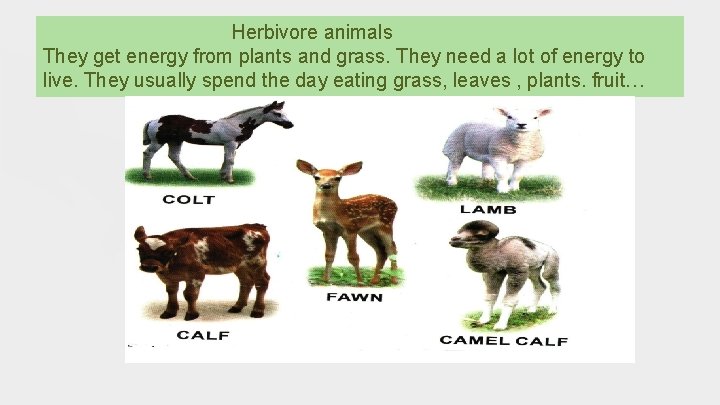
Herbivore animals They get energy from plants and grass. They need a lot of energy to live. They usually spend the day eating grass, leaves , plants. fruit…
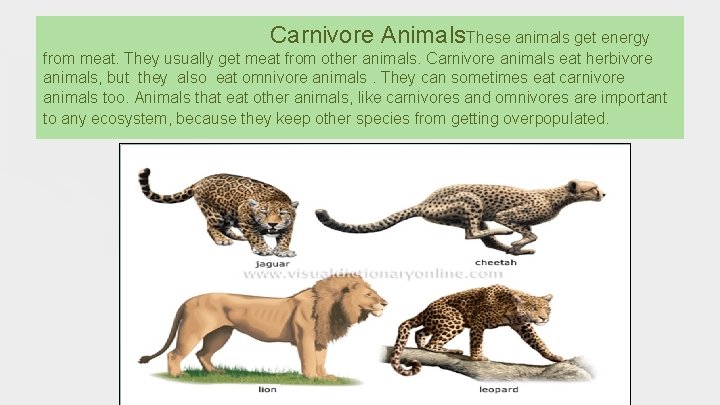
Carnivore Animals. These animals get energy from meat. They usually get meat from other animals. Carnivore animals eat herbivore animals, but they also eat omnivore animals. They can sometimes eat carnivore animals too. Animals that eat other animals, like carnivores and omnivores are important to any ecosystem, because they keep other species from getting overpopulated.
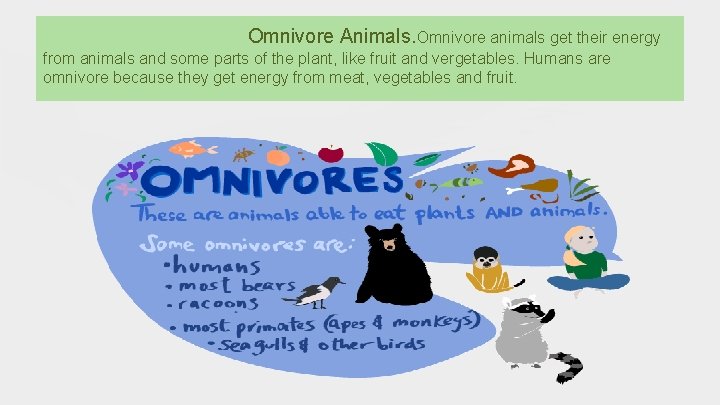
Omnivore Animals. Omnivore animals get their energy from animals and some parts of the plant, like fruit and vergetables. Humans are omnivore because they get energy from meat, vegetables and fruit.

All these animals are importart in our Ecosystem. If one of them disappears, it will alter the rest of the food chain life. We have to protect our planet. It is so important to keep our Ecosystem healthy and full of life.
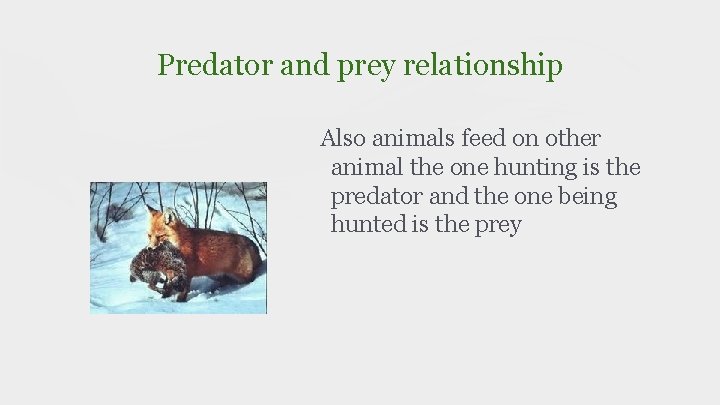
Predator and prey relationship Also animals feed on other animal the one hunting is the predator and the one being hunted is the prey
Key terms 1. Prey -an animal that is hunted and killed by another food 2. symbiosis-interaction between two different organisms living in close physical association, typically to the advantage of both. 3. energy pyramid- a graphical model of energy flow in a community. 4. commensalism-when one species benefits and the other neither benefits or is harmed 5. parasitism-a relationship that involves one organism living with, on, or inside another organism and harming it. 6. mutualism-A relationship in which both species benefit 7. predation-the preying of one animal on others 8. amensalism-a relationship between two species of organisms in which the individuals of one species adversely affect those of the other and are unaffected themselves. 9. host-the one being harmed in parasitism 10. parasite-the organism (the one doing the harm) that benefits in parasitsm
Symbiosis
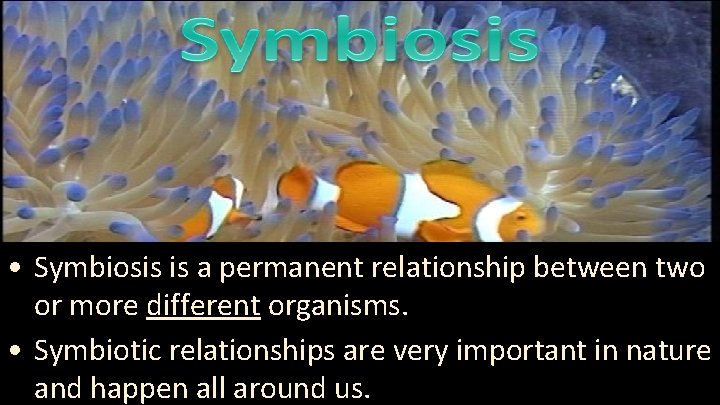
• Symbiosis is a permanent relationship between two or more different organisms. • Symbiotic relationships are very important in nature and happen all around us.
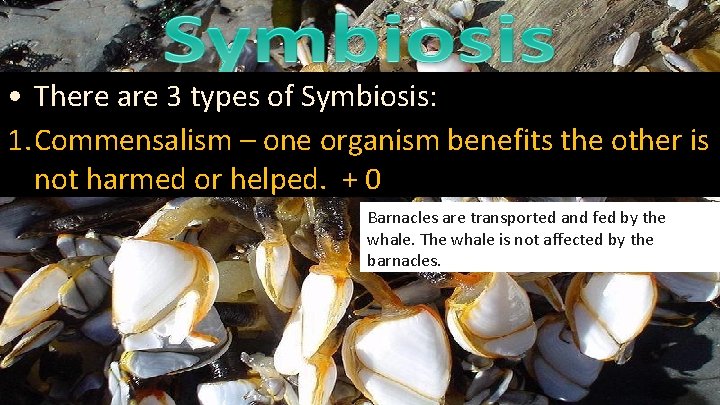
• There are 3 types of Symbiosis: 1. Commensalism – one organism benefits the other is not harmed or helped. + 0 Barnacles are transported and fed by the whale. The whale is not affected by the barnacles.
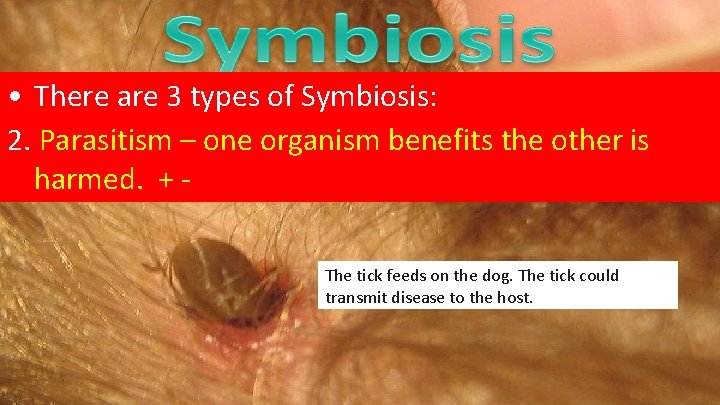
• There are 3 types of Symbiosis: 2. Parasitism – one organism benefits the other is harmed. + The tick feeds on the dog. The tick could transmit disease to the host.
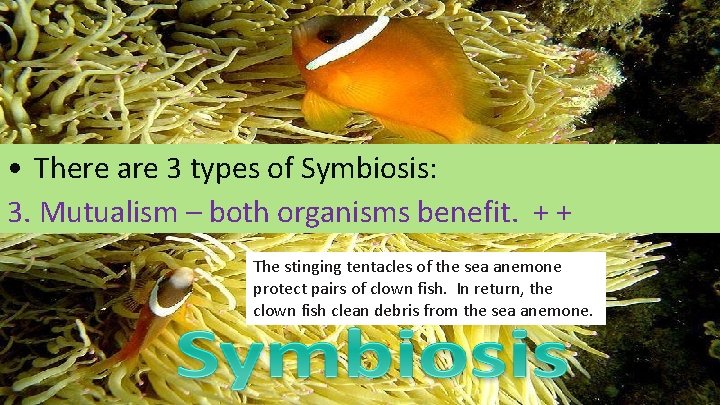
• There are 3 types of Symbiosis: 3. Mutualism – both organisms benefit. + + The stinging tentacles of the sea anemone protect pairs of clown fish. In return, the clown fish clean debris from the sea anemone.
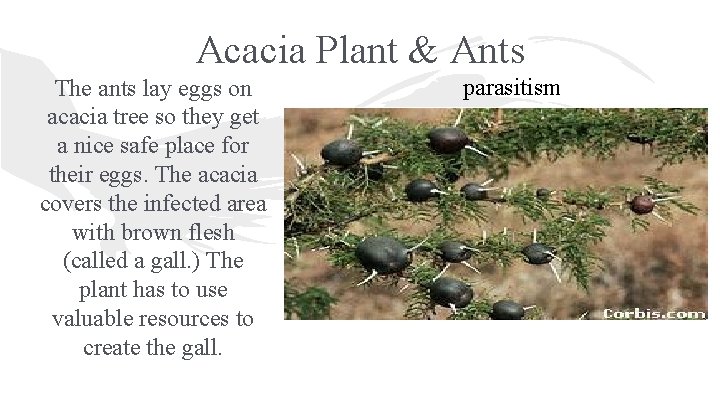
Acacia Plant & Ants The ants lay eggs on acacia tree so they get a nice safe place for their eggs. The acacia covers the infected area with brown flesh (called a gall. ) The plant has to use valuable resources to create the gall. parasitism
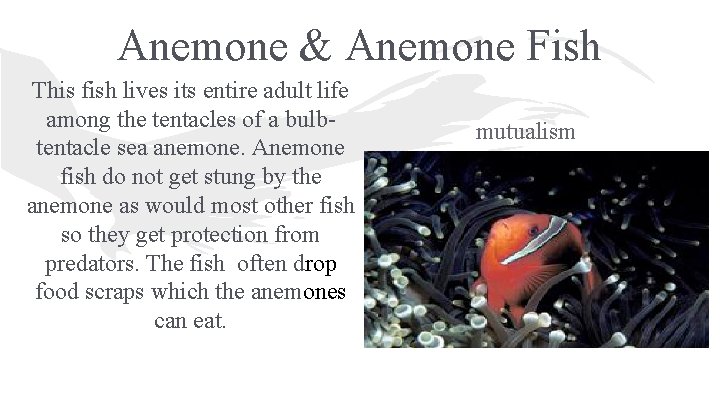
Anemone & Anemone Fish This fish lives its entire adult life among the tentacles of a bulbtentacle sea anemone. Anemone fish do not get stung by the anemone as would most other fish so they get protection from predators. The fish often drop food scraps which the anemones can eat. mutualism
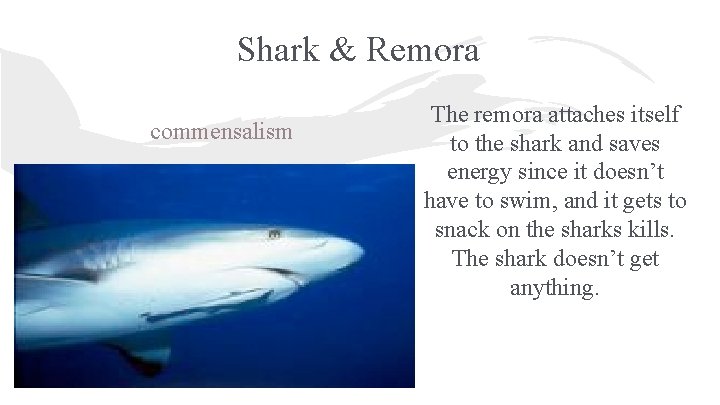
Shark & Remora commensalism The remora attaches itself to the shark and saves energy since it doesn’t have to swim, and it gets to snack on the sharks kills. The shark doesn’t get anything.
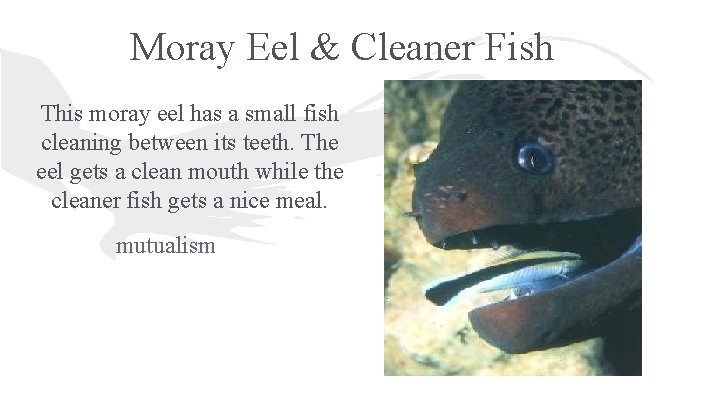
Moray Eel & Cleaner Fish This moray eel has a small fish cleaning between its teeth. The eel gets a clean mouth while the cleaner fish gets a nice meal. mutualism
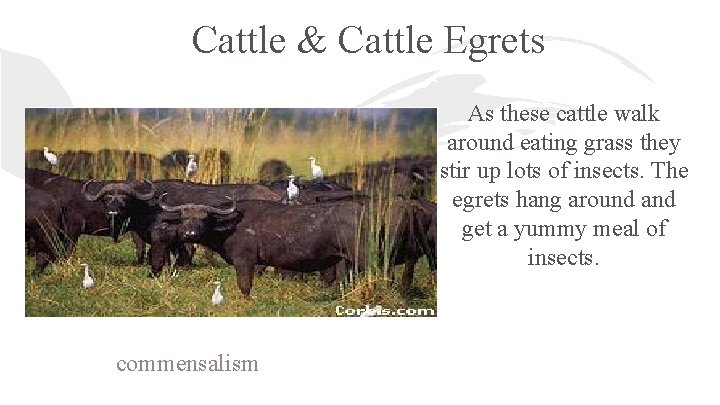
Cattle & Cattle Egrets As these cattle walk around eating grass they stir up lots of insects. The egrets hang around and get a yummy meal of insects. commensalism
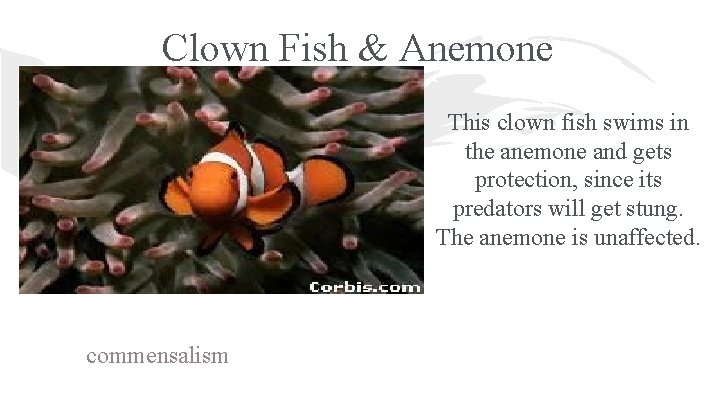
Clown Fish & Anemone This clown fish swims in the anemone and gets protection, since its predators will get stung. The anemone is unaffected. commensalism
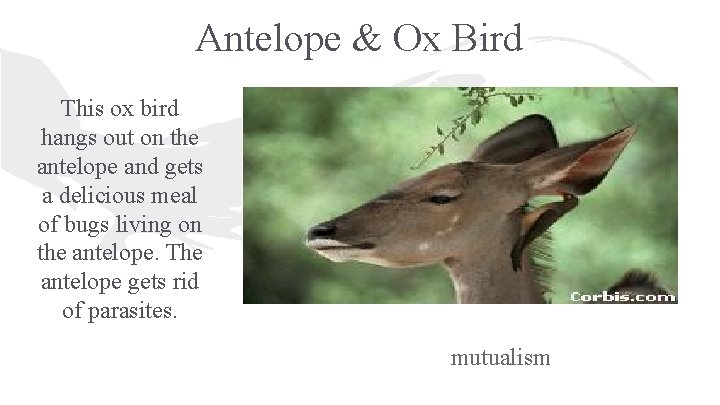
Antelope & Ox Bird This ox bird hangs out on the antelope and gets a delicious meal of bugs living on the antelope. The antelope gets rid of parasites. mutualism
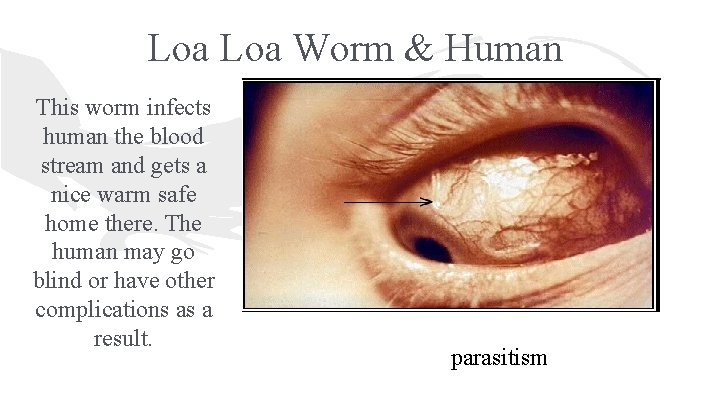
Loa Worm & Human This worm infects human the blood stream and gets a nice warm safe home there. The human may go blind or have other complications as a result. parasitism
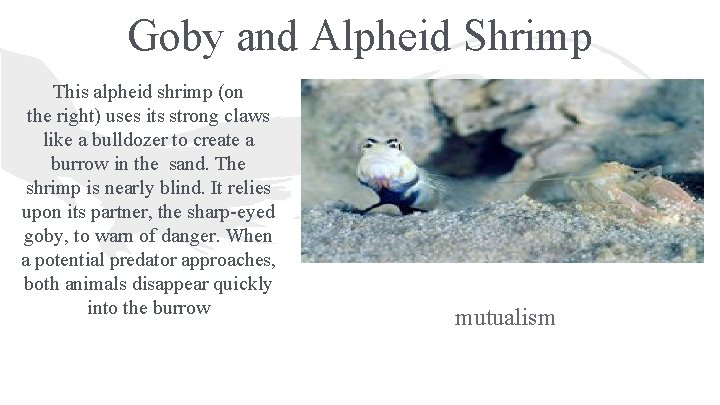
Goby and Alpheid Shrimp This alpheid shrimp (on the right) uses its strong claws like a bulldozer to create a burrow in the sand. The shrimp is nearly blind. It relies upon its partner, the sharp-eyed goby, to warn of danger. When a potential predator approaches, both animals disappear quickly into the burrow mutualism
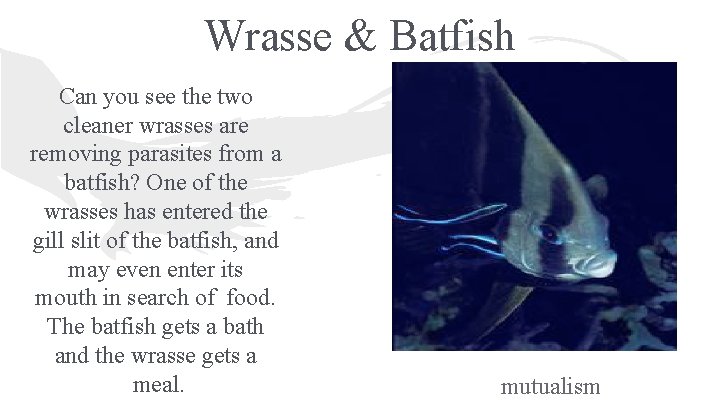
Wrasse & Batfish Can you see the two cleaner wrasses are removing parasites from a batfish? One of the wrasses has entered the gill slit of the batfish, and may even enter its mouth in search of food. The batfish gets a bath and the wrasse gets a meal. mutualism
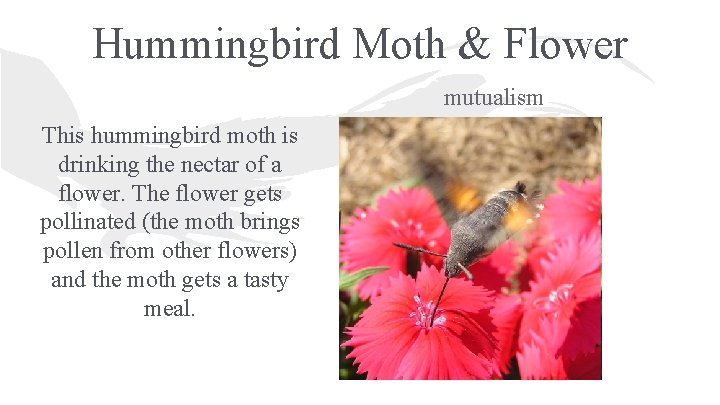
Hummingbird Moth & Flower mutualism This hummingbird moth is drinking the nectar of a flower. The flower gets pollinated (the moth brings pollen from other flowers) and the moth gets a tasty meal.
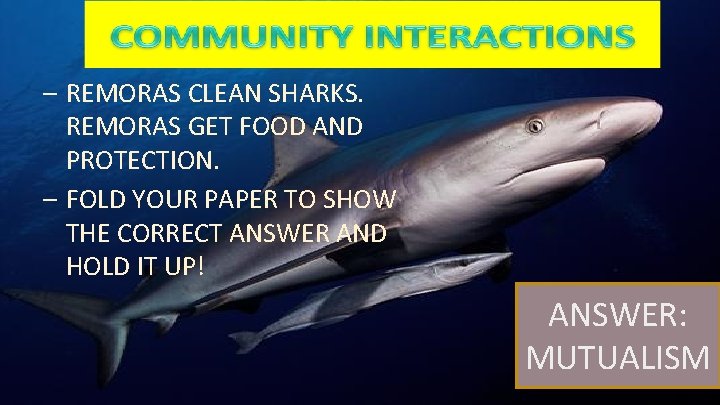
– REMORAS CLEAN SHARKS. REMORAS GET FOOD AND PROTECTION. – FOLD YOUR PAPER TO SHOW THE CORRECT ANSWER AND HOLD IT UP! ANSWER: MUTUALISM
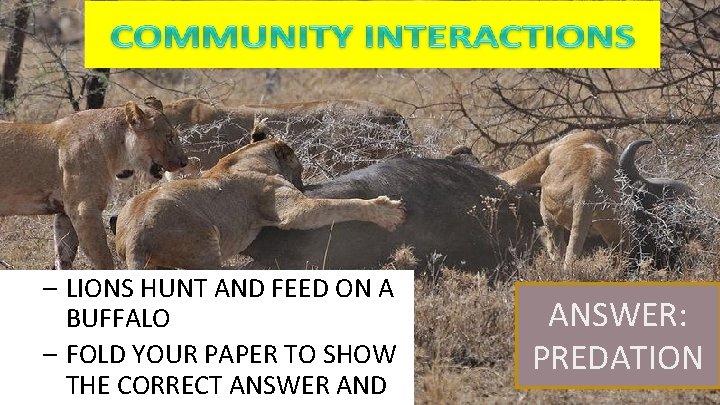
– LIONS HUNT AND FEED ON A BUFFALO – FOLD YOUR PAPER TO SHOW THE CORRECT ANSWER AND ANSWER: PREDATION
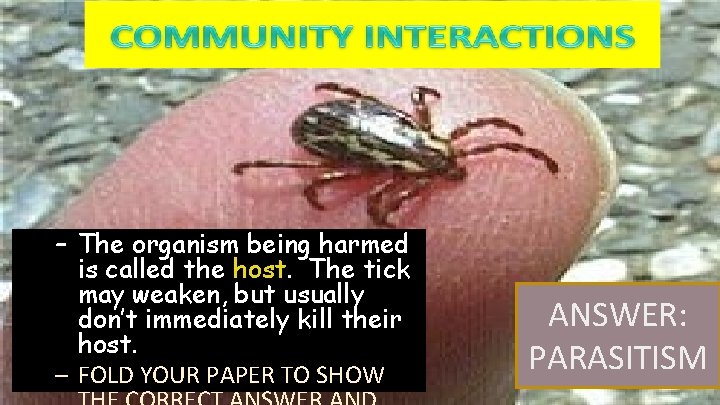
– The organism being harmed is called the host. The tick may weaken, but usually don’t immediately kill their host. – FOLD YOUR PAPER TO SHOW ANSWER: PARASITISM
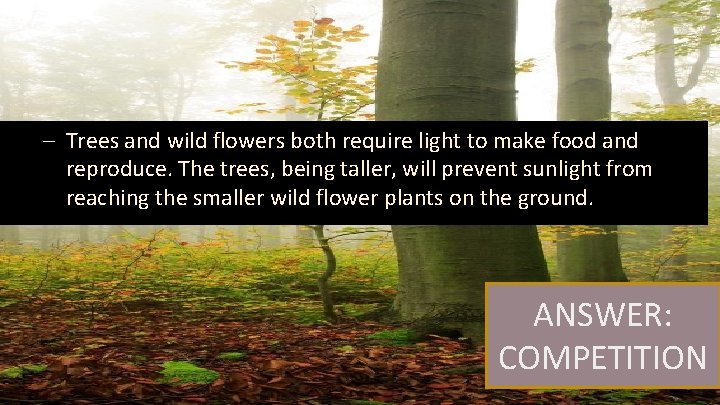
– Trees and wild flowers both require light to make food and reproduce. The trees, being taller, will prevent sunlight from reaching the smaller wild flower plants on the ground. ANSWER: COMPETITION
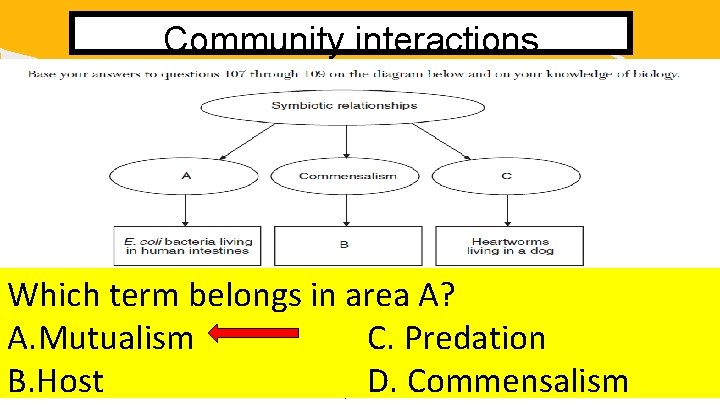
Community interactions Which term belongs in area A? A. Mutualism C. Predation B. Host D. Commensalism
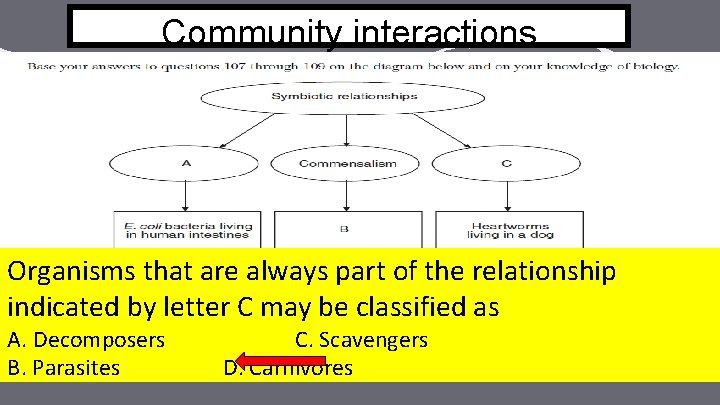
Community interactions Organisms that are always part of the relationship indicated by letter C may be classified as A. Decomposers B. Parasites C. Scavengers D. Carnivores
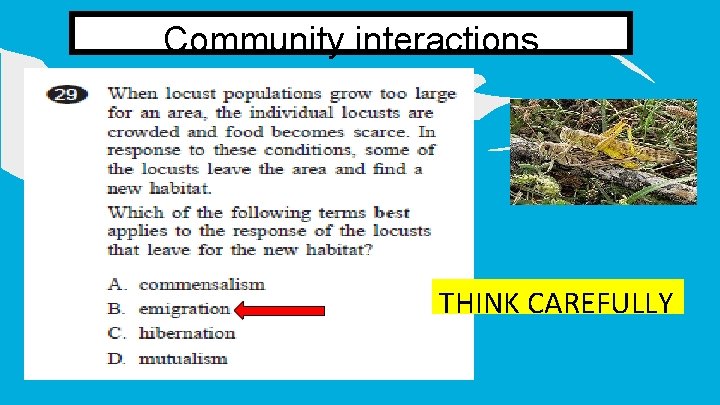
Community interactions THINK CAREFULLY
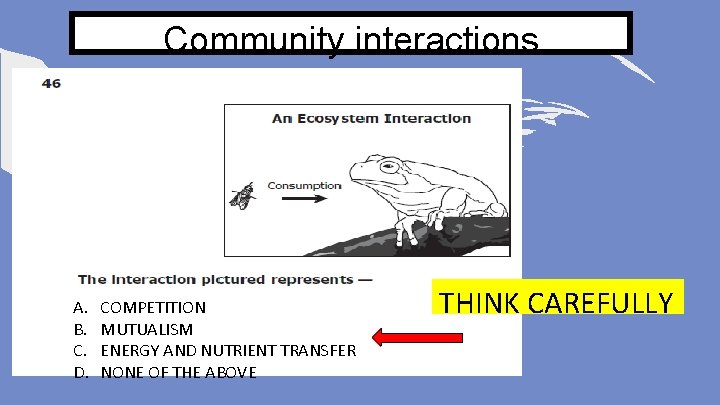
Community interactions A. B. C. D. COMPETITION MUTUALISM ENERGY AND NUTRIENT TRANSFER NONE OF THE ABOVE THINK CAREFULLY
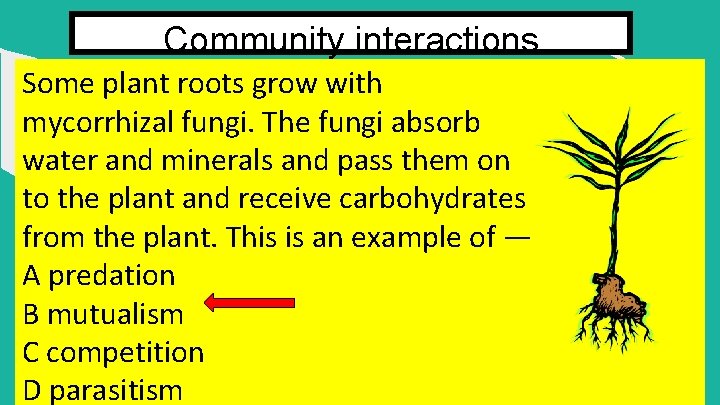
Community interactions Some plant roots grow with mycorrhizal fungi. The fungi absorb water and minerals and pass them on to the plant and receive carbohydrates from the plant. This is an example of — A predation B mutualism C competition D parasitism
Key terms 1. transpiration plants give off water from their stomata in this process 2. nitrogen cycle-ammonia is a useable form of an atmospheric gas that bacteria in the soil fix as part of this 3. precipitation-rain snow and sleet are forms of 4. water cycle-precipitation such as rain snow and sleet is part of the 5. carbon dioxide-oxygen cycle-plants give off carbon dioxide and oxygen into the atmosphere as part of this cycle 6. nitrogen gas-the environment stores many materials. The atmosphere stores a lot of _________. 7. planting trees-what human activity dosn't cause an increase of carbon dioxide in the atmosphere 8. glaciers-where is most of the fresh water on earth 9. transpiration-plant give off water during _____ 10. bacteria-most nitrogen is fixed by ______
The Water Cycle
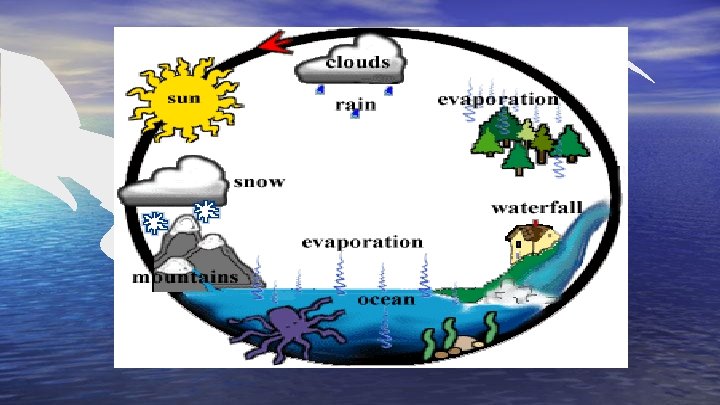
Water never leaves the Earth. It is constantly being cycled through the atmosphere, ocean, and land. This process, known as the water cycle, is driven by energy from the sun. The water cycle is crucial to the existence of life on our planet.
The Water Cycle
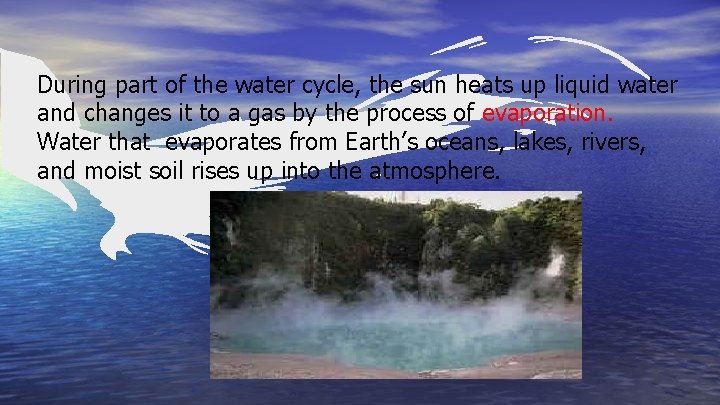
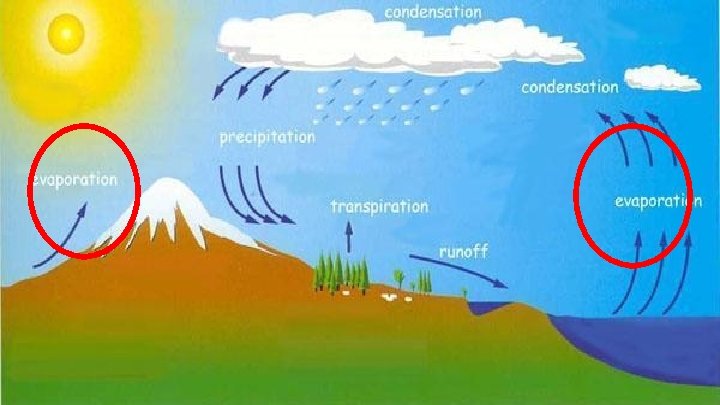
During part of the water cycle, the sun heats up liquid water and changes it to a gas by the process of evaporation. Water that evaporates from Earth’s oceans, lakes, rivers, and moist soil rises up into the atmosphere.
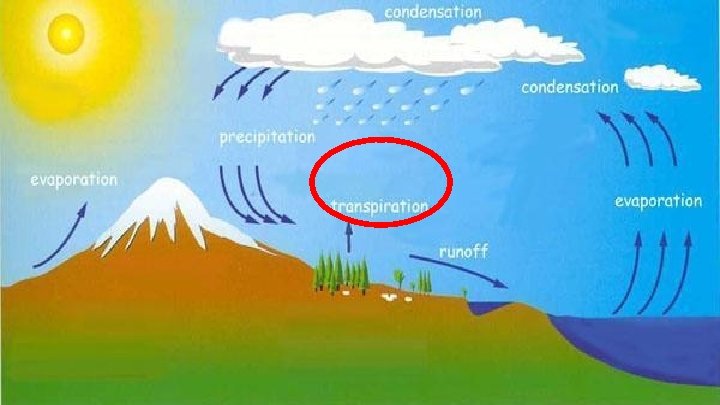
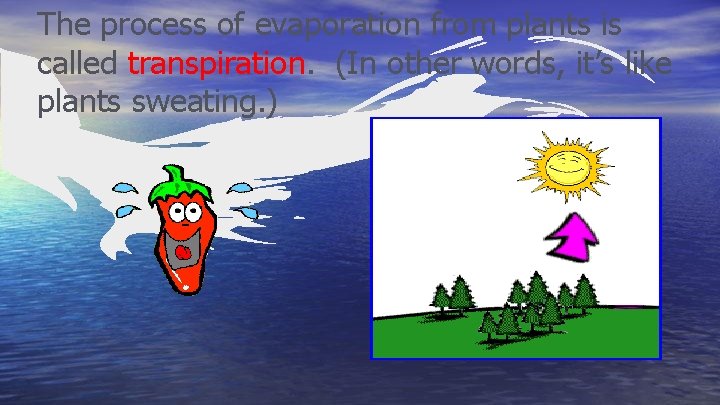
The process of evaporation from plants is called transpiration. (In other words, it’s like plants sweating. )
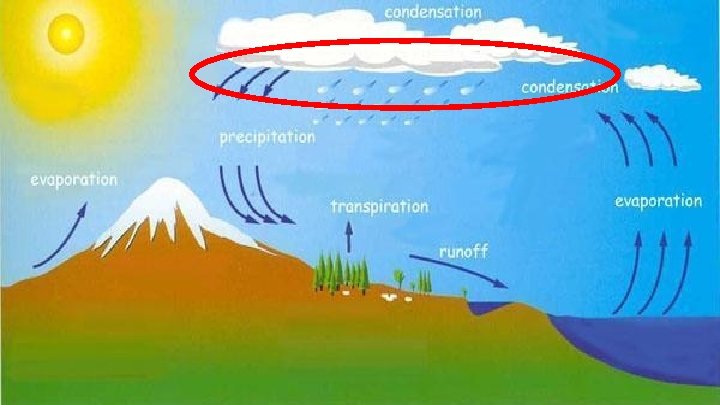
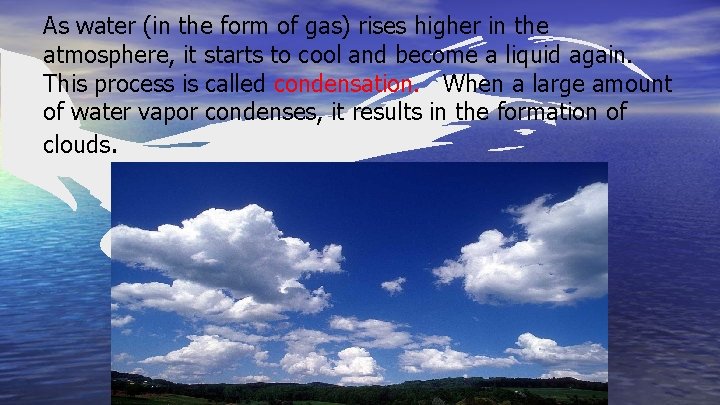
As water (in the form of gas) rises higher in the atmosphere, it starts to cool and become a liquid again. This process is called condensation. When a large amount of water vapor condenses, it results in the formation of clouds.
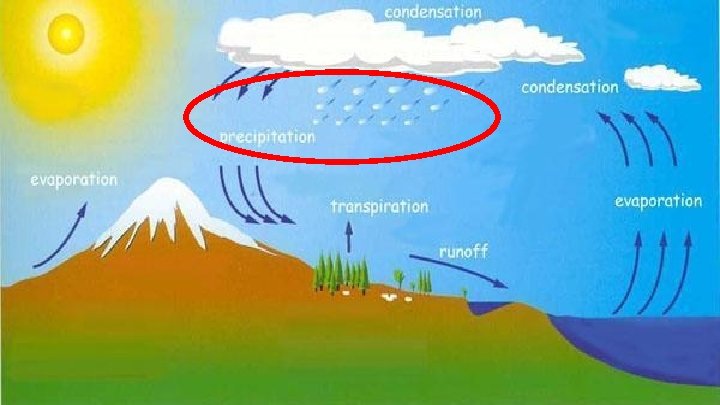
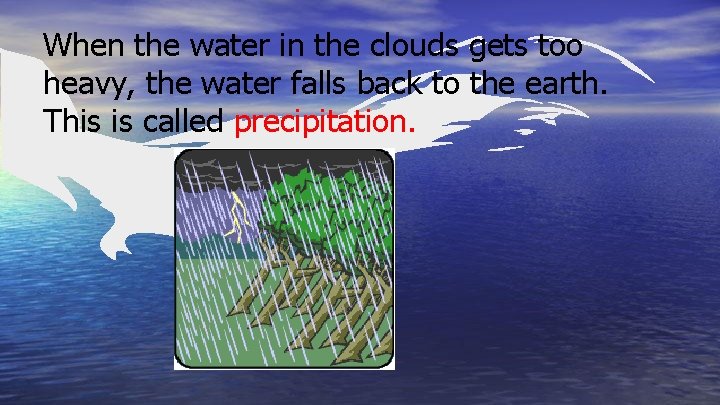
When the water in the clouds gets too heavy, the water falls back to the earth. This is called precipitation.
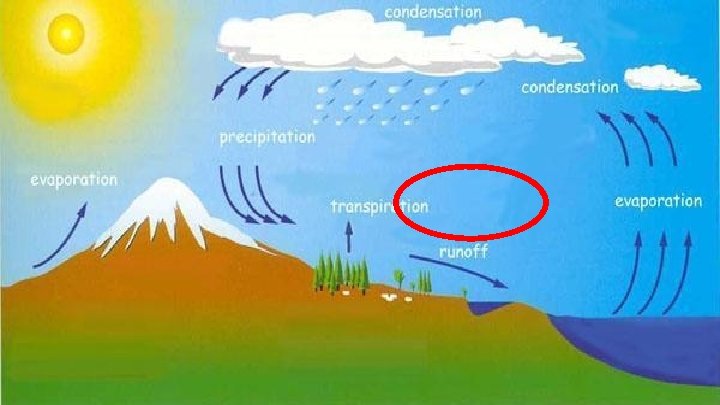
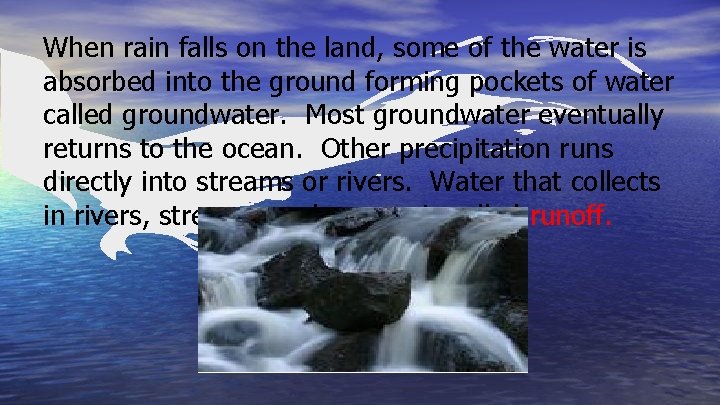
When rain falls on the land, some of the water is absorbed into the ground forming pockets of water called groundwater. Most groundwater eventually returns to the ocean. Other precipitation runs directly into streams or rivers. Water that collects in rivers, streams, and oceans is called runoff.
Key term 1. Photosynthesis-the process in which plants and some other organisms use the energy in sunlight to make food 2. Chlorophyll- a green pigment that traps energy from the sum 3. Chloroplasts-an organelle in a plant cell that turns energy from the sun into chemical energy for the plant to use 4. carbon dioxide-a waste product made by cells of the body; a gas in the air made of carbon and oxygen atoms 5. chloroplast-leaf cells contain more______ than do cells in other parts of the plants 6. pigment-the green color comes from________ ( colored chemicals compounds that absorb light) 7. chlorophyll-the main pigment found in the chloroplasts of plants is ______
What is photosynthesis? • Process plants use to make their own food • Plants’ leaves contain chlorophyll • Chlorophyll (green color) makes photosynthesis possible
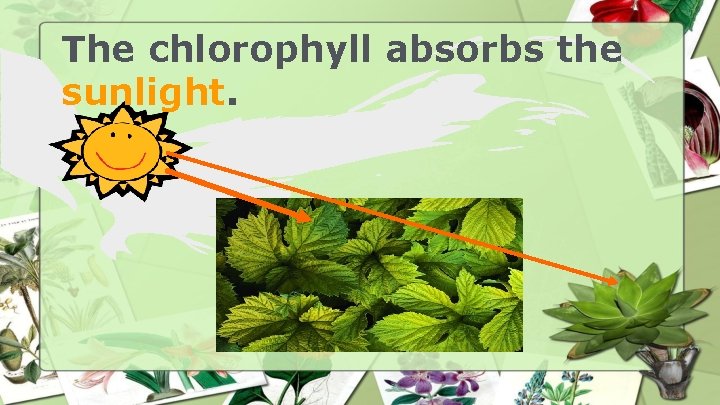
The chlorophyll absorbs the sunlight.
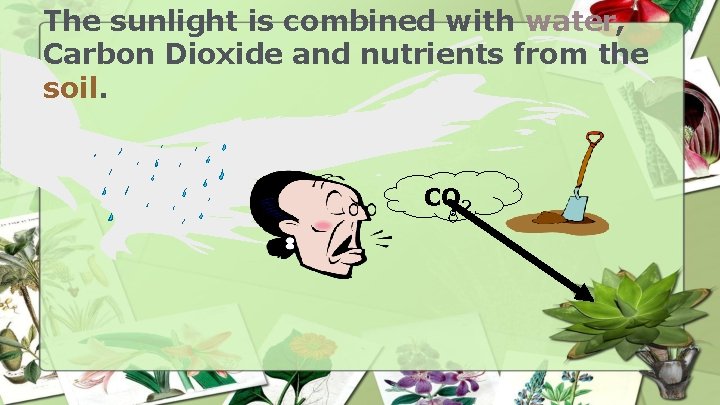
The sunlight is combined with water, Carbon Dioxide and nutrients from the soil. CO 2
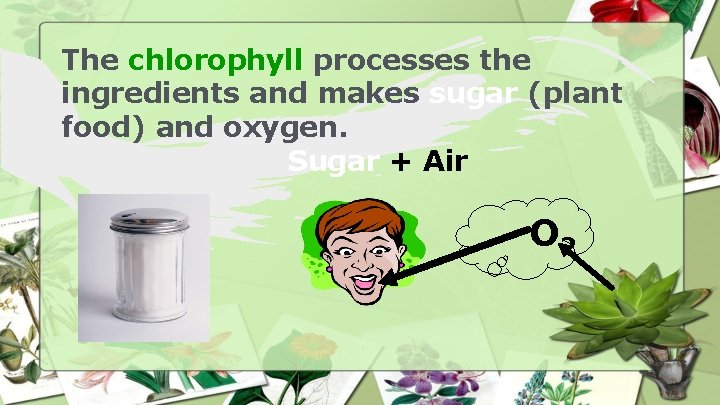
The chlorophyll processes the ingredients and makes sugar (plant food) and oxygen. Sugar + Air O 2
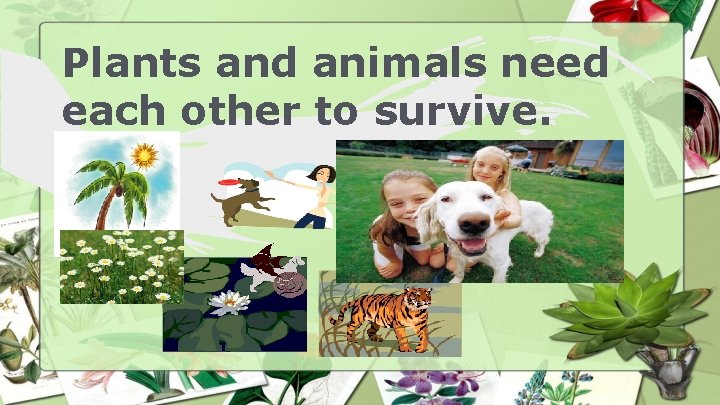
Plants and animals need each other to survive.
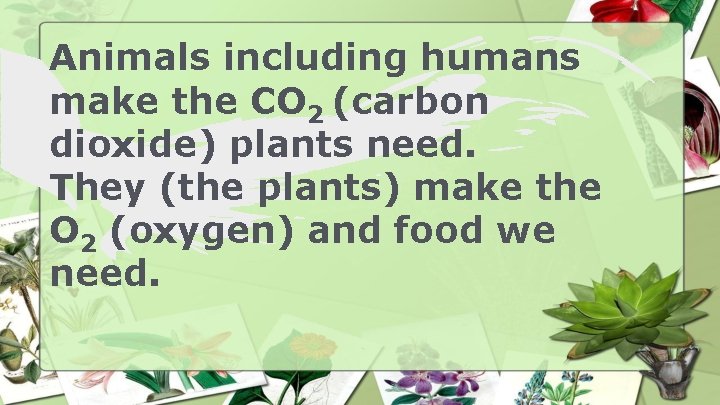
Animals including humans make the CO 2 (carbon dioxide) plants need. They (the plants) make the O 2 (oxygen) and food we need.
Photosynthesis is ▪ conversion of light energy into chemical energy that is stored in organic compounds (carbohydrates > glucose) Used by autotrophs such as: Plants Algae Some bacteria (prokaryotes)
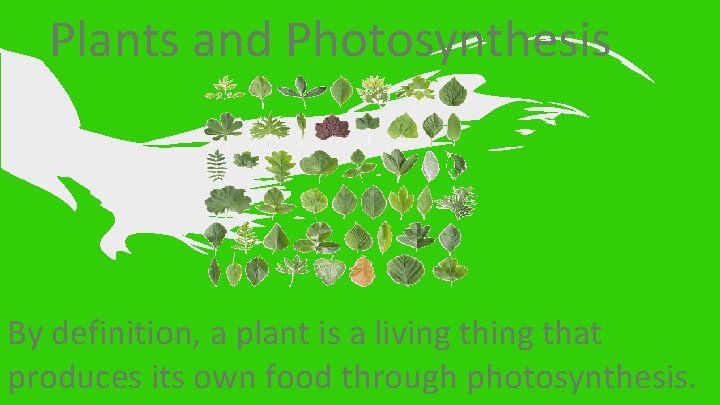
Plants and Photosynthesis By definition, a plant is a living that produces its own food through photosynthesis.
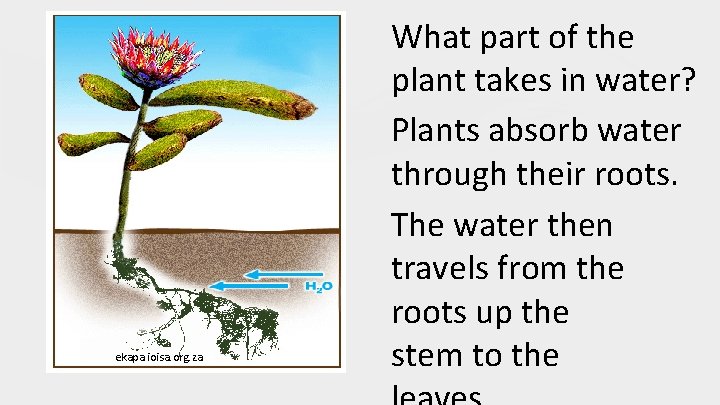
ekapa. ioisa. org. za What part of the plant takes in water? Plants absorb water through their roots. The water then travels from the roots up the stem to the
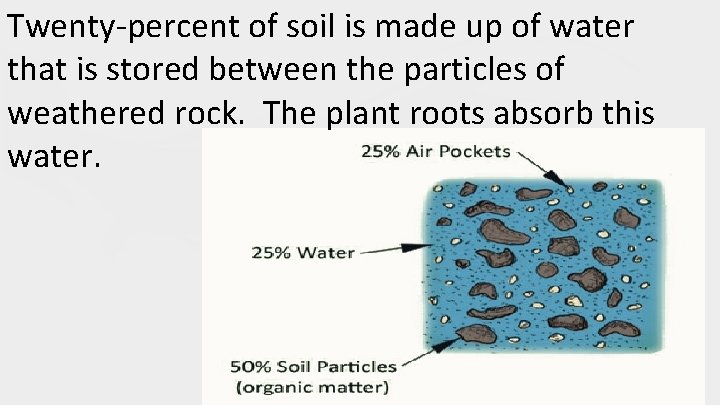
Twenty-percent of soil is made up of water that is stored between the particles of weathered rock. The plant roots absorb this water.
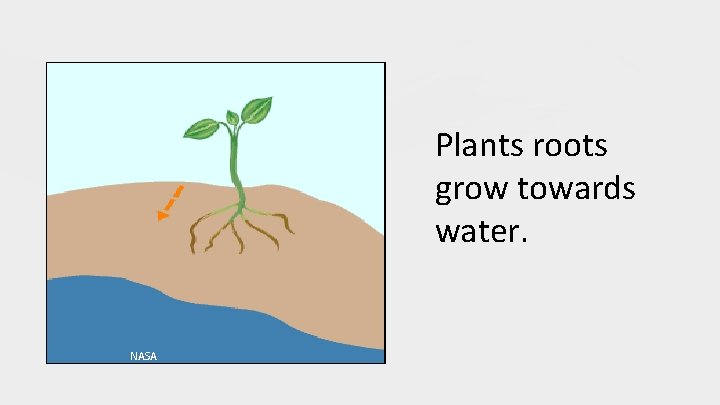
Plants roots grow towards water. NASA
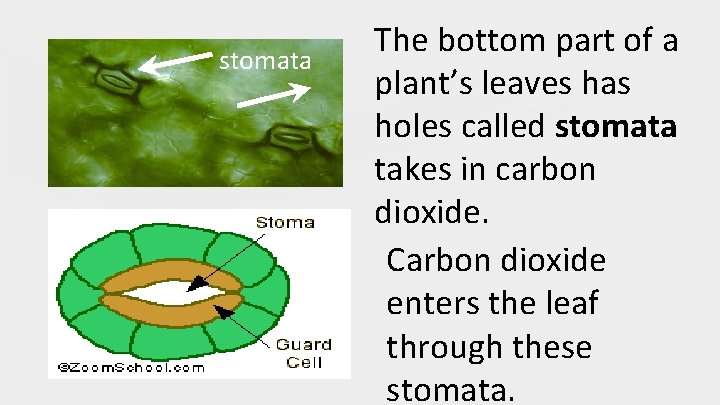
stomata The bottom part of a plant’s leaves has holes called stomata takes in carbon dioxide. Carbon dioxide enters the leaf through these stomata.
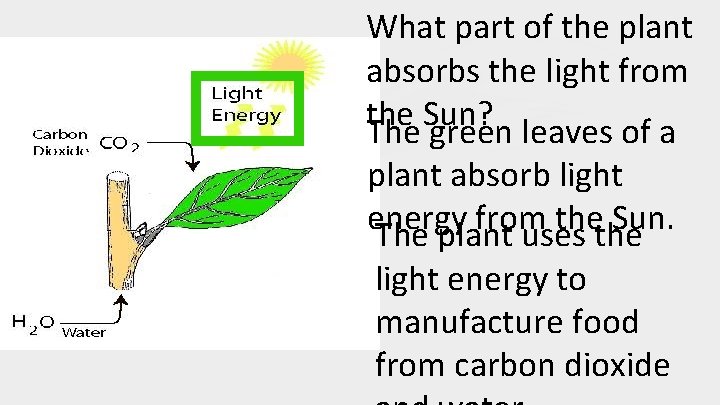
What part of the plant absorbs the light from the Sun? The green leaves of a plant absorb light energy from the Sun. The plant uses the light energy to manufacture food from carbon dioxide
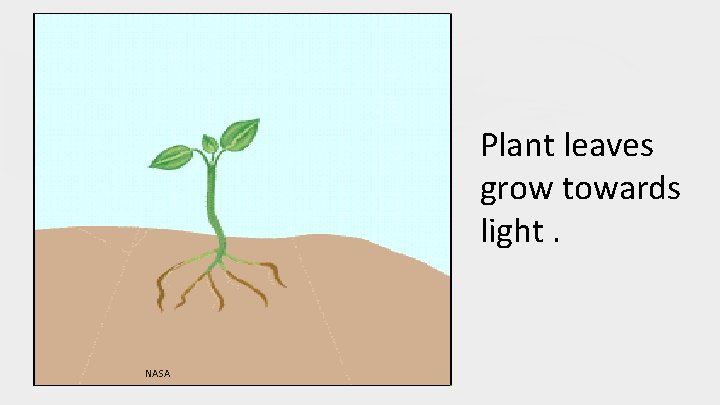
Plant leaves grow towards light. NASA
When plants make food in their leaves, the “waste” product is oxygen—the gas we must breathe in to stay alive. The plant gives off oxygen through the stomata in its leaves.
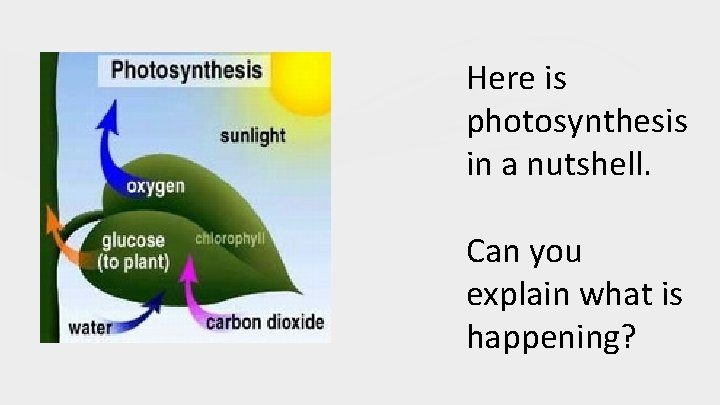
Here is photosynthesis in a nutshell. Can you explain what is happening?
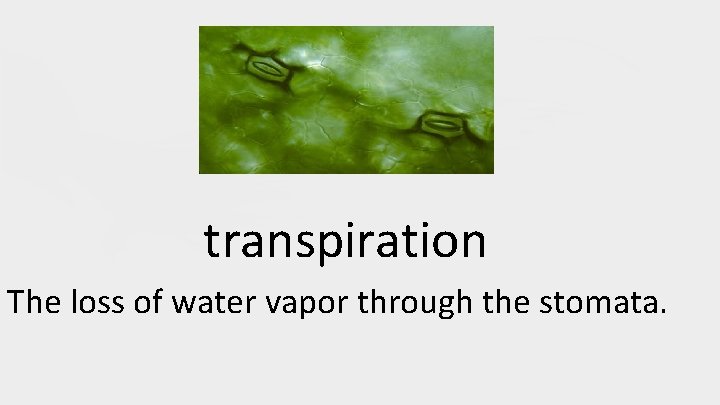
transpiration The loss of water vapor through the stomata.
As usual, things are not as simple as it may seem. Plants do not make food for animals. They make it for themselves so that they can grow and carry out their life processes. Like animals they need to absorb oxygen. Plants take oxygen in through the stomata and through their roots and use it to burn their food for energy. The process of using oxygen to burn food for energy is called respiration.
Why are plants green?
▪ pigment a compound that absorbs light ▪ different pigments absorb different wavelengths of white light. ▪ chlorophyll is a pigment that absorbs red & blue light (photons) so green is reflected or transmitted. ▪ Chlorophyll is located in the thylakoid membranes So, Plants are green because the green wavelength is reflected, not absorbed.
2 types of chlorophyll ▪ Chlorophyll a – involved in light reactions ▪ Chlorophyll b – assists in capturing light energy – accessory pigment Carotenoids – accessory pigments – captures more light energy Red, orange & yellow
During the fall, what causes the leaves to change colors?
Fall Colors ▪ In addition to the chlorophyll pigments, there are other pigments present ▪ During the fall, the green chlorophyll pigments are greatly reduced revealing the other pigments ▪ Carotenoids are pigments that are either red, orange, or yellow
Key Terms 1. gas-state of matter that has no volume or shape 2. solid-a state of matter characterized by particles arranged such that their shape and volume are relatively stable 3. liquid-flowing freely but of constant volume such as water and oil. 4. evaporation-when a liquid becomes a gas 5. condensation-when a gas becomes a liquid 6. transpiration-process where moisture on leaves of plants changes to vapor 7. precipitation-rain, snow, sleet, or hail that falls to the ground. 8. melting-make or become liquefied by heat
THE THREE STATES OFMATTER
What is matter? Matter is anything that has mass and takes up space.
Properties of Matter ● How It Looks (Shiny , Dull, Color, etc. ) ● How It Feels (Hard, Soft, Rough , Smooth, etc. ) ● How It Smells (Sweet, Sharp, Terrible, No Smell, etc. ) ● How It Sounds (Loud, Soft, Echo, No Sound, etc. ) ● What It Does (Bounce, Stretch, Tear, Break, Magnetism etc. )
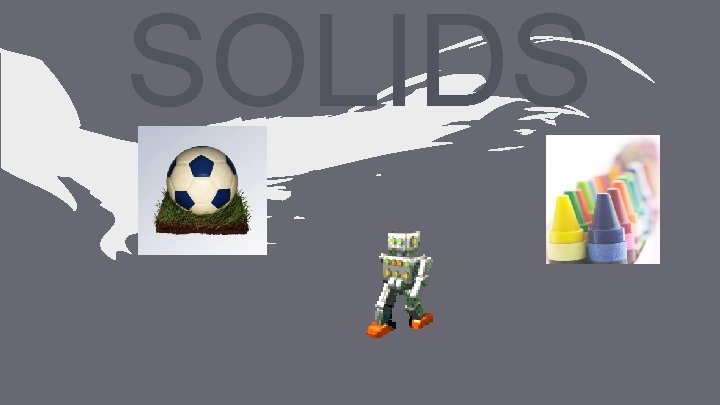
SOLIDS
SOLID A solid is matter that has definite size and shape. Example: Put a sneaker in a box. It stays the same.
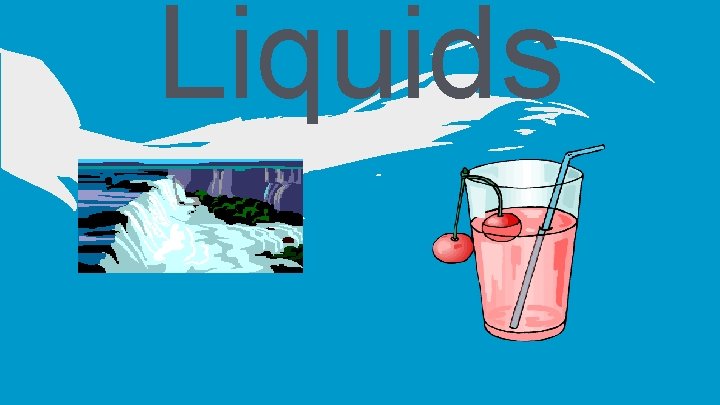
Liquids
LIQUID A liquid takes the shape of any container. Example: Pour juice into a glass. The juice will take on the shape of the glass.
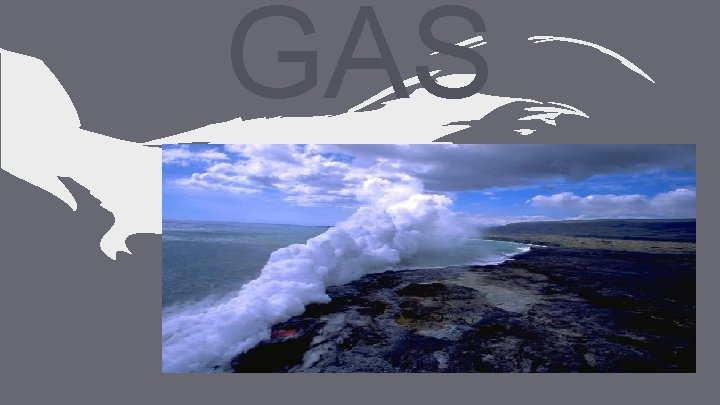
GAS
Gas is matter that has no definite shape. Gases take the shape of whatever container they are in. Example: The air all around us is a gas.
Physical changes in matter A Physical change is a change in how matter looks, but not the kind of matter is it is. ● ● ● ● ● Tear Cut Folded Written Liquid Solid Gas Mixture Solution
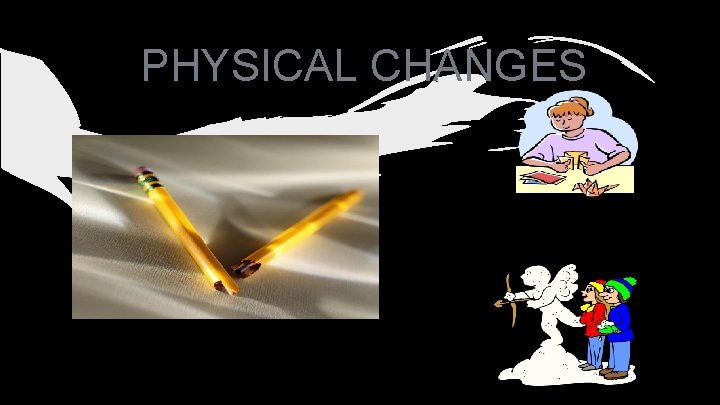
PHYSICAL CHANGES
Chemical changes in matter New Matter is formed. ● ● ● Burning Rusting Cooking
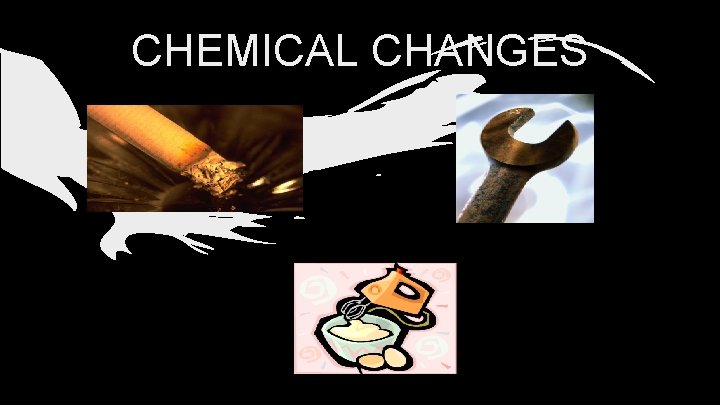
CHEMICAL CHANGES
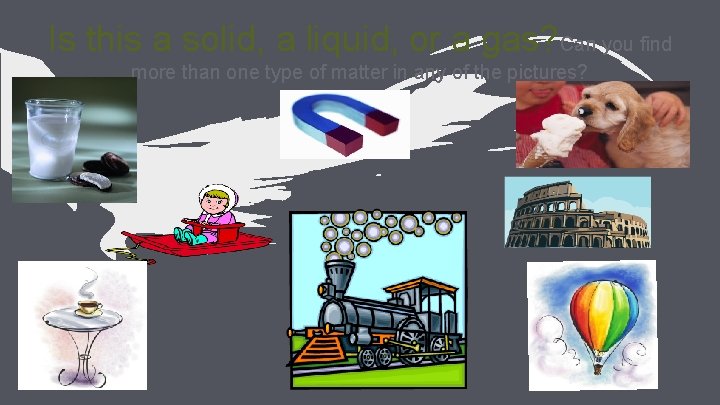
Is this a solid, a liquid, or a gas? Can you find more than one type of matter in any of the pictures?
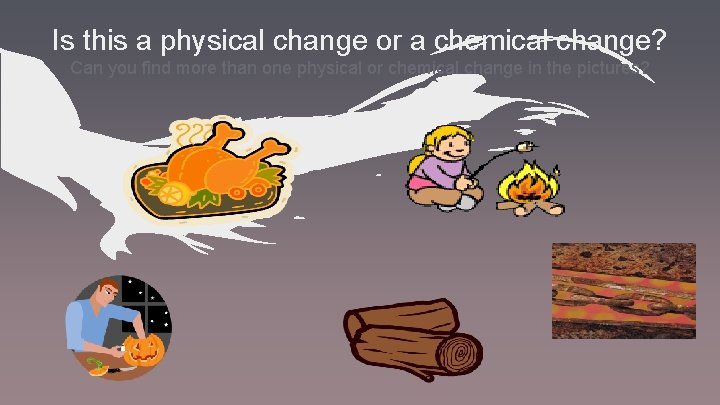
Is this a physical change or a chemical change? Can you find more than one physical or chemical change in the pictures?
- Slides: 92