
Energy Analysis in Size Reduction Equipments Dr J
- Slides: 11
Energy Analysis in Size Reduction Equipments Dr. J. Badshah Dairy Engineering Department Sanjay Gandhi Institute of Dairy Technology
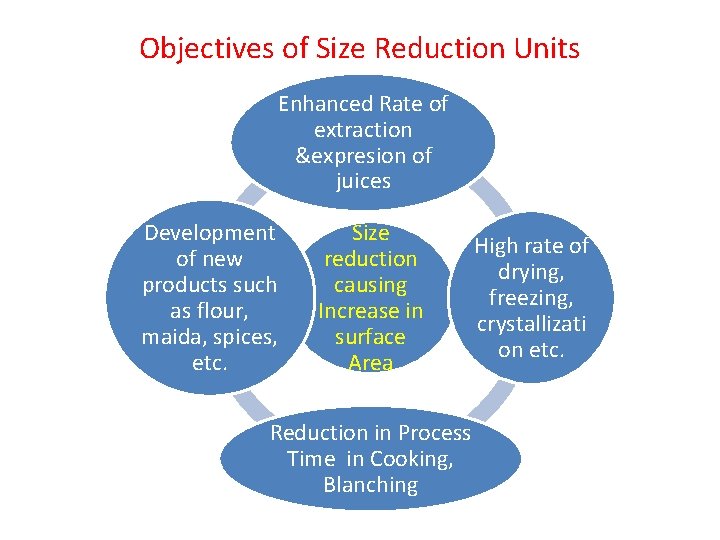
Objectives of Size Reduction Units Enhanced Rate of extraction &expresion of juices Development of new products such as flour, maida, spices, etc. Size reduction causing Increase in surface Area Reduction in Process Time in Cooking, Blanching High rate of drying, freezing, crystallizati on etc.
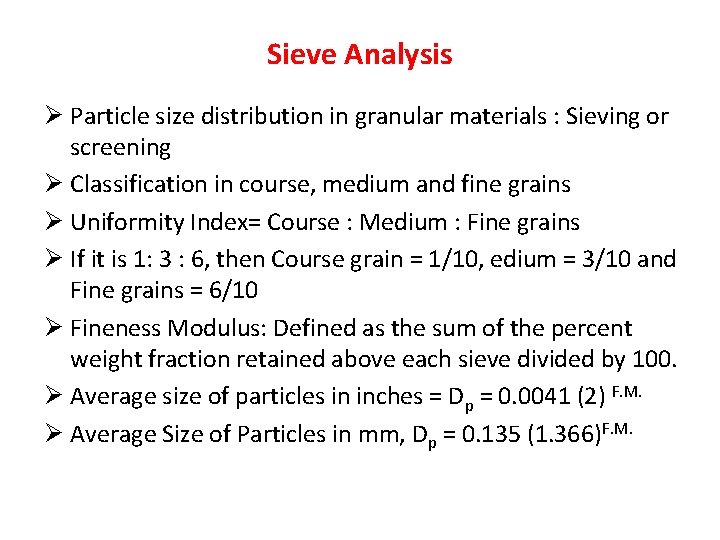
Sieve Analysis Ø Particle size distribution in granular materials : Sieving or screening Ø Classification in course, medium and fine grains Ø Uniformity Index= Course : Medium : Fine grains Ø If it is 1: 3 : 6, then Course grain = 1/10, edium = 3/10 and Fine grains = 6/10 Ø Fineness Modulus: Defined as the sum of the percent weight fraction retained above each sieve divided by 100. Ø Average size of particles in inches = Dp = 0. 0041 (2) F. M. Ø Average Size of Particles in mm, Dp = 0. 135 (1. 366)F. M.
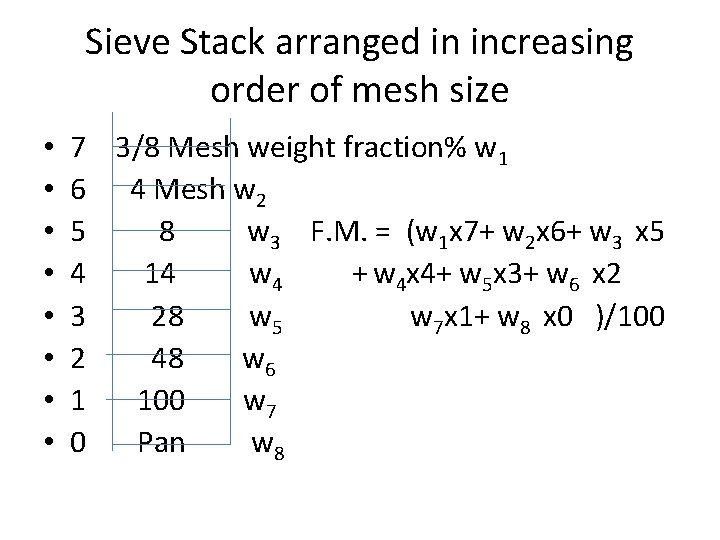
Sieve Stack arranged in increasing order of mesh size • • 7 3/8 Mesh weight fraction% w 1 6 4 Mesh w 2 5 8 w 3 F. M. = (w 1 x 7+ w 2 x 6+ w 3 x 5 4 14 w 4 + w 4 x 4+ w 5 x 3+ w 6 x 2 3 28 w 5 w 7 x 1+ w 8 x 0 )/100 2 48 w 6 1 100 w 7 0 Pan w 8
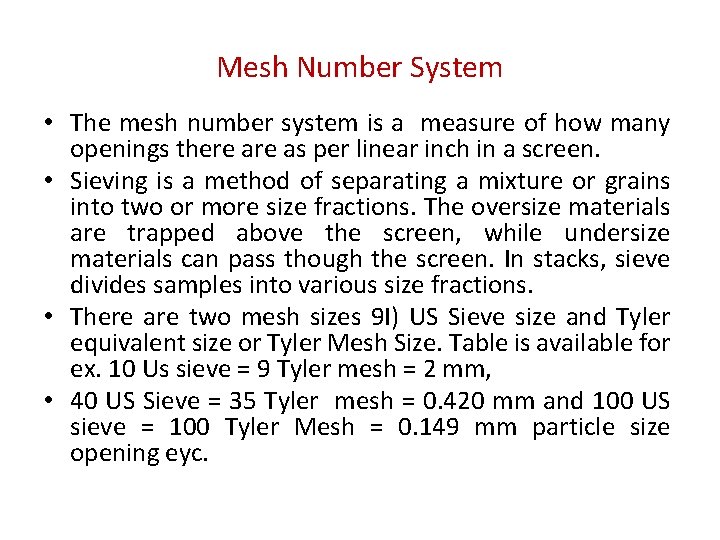
Mesh Number System • The mesh number system is a measure of how many openings there as per linear inch in a screen. • Sieving is a method of separating a mixture or grains into two or more size fractions. The oversize materials are trapped above the screen, while undersize materials can pass though the screen. In stacks, sieve divides samples into various size fractions. • There are two mesh sizes 9 I) US Sieve size and Tyler equivalent size or Tyler Mesh Size. Table is available for ex. 10 Us sieve = 9 Tyler mesh = 2 mm, • 40 US Sieve = 35 Tyler mesh = 0. 420 mm and 100 US sieve = 100 Tyler Mesh = 0. 149 mm particle size opening eyc.
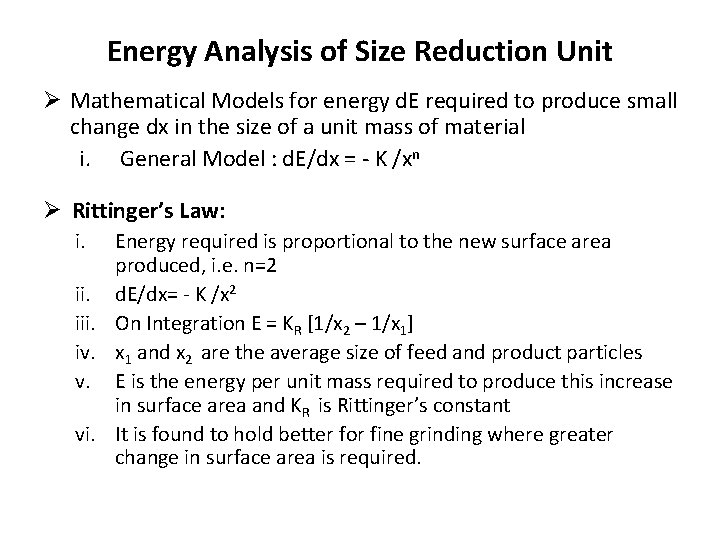
Energy Analysis of Size Reduction Unit Ø Mathematical Models for energy d. E required to produce small change dx in the size of a unit mass of material i. General Model : d. E/dx = - K /xn Ø Rittinger’s Law: i. Energy required is proportional to the new surface area produced, i. e. n=2 ii. d. E/dx= - K /x 2 iii. On Integration E = KR [1/x 2 – 1/x 1] iv. x 1 and x 2 are the average size of feed and product particles v. E is the energy per unit mass required to produce this increase in surface area and KR is Rittinger’s constant vi. It is found to hold better for fine grinding where greater change in surface area is required.
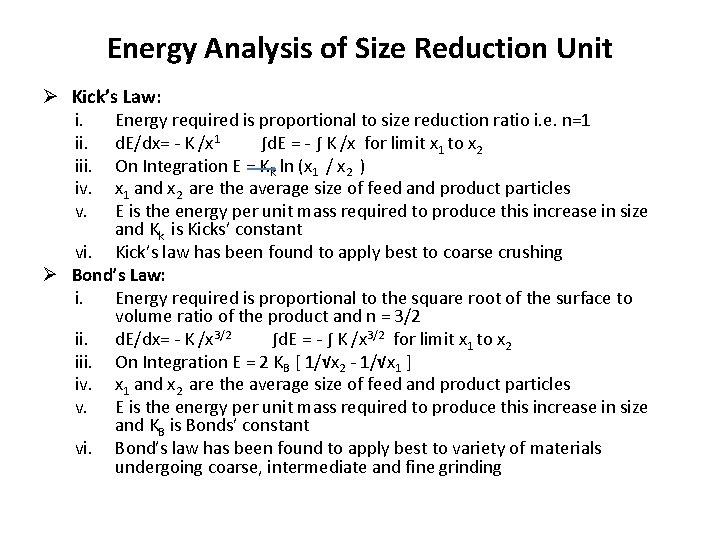
Energy Analysis of Size Reduction Unit Ø Kick’s Law: i. Energy required is proportional to size reduction ratio i. e. n=1 ii. d. E/dx= - K /x 1 ∫d. E = - ∫ K /x for limit x 1 to x 2 iii. On Integration E = Kk ln (x 1 / x 2 ) iv. x 1 and x 2 are the average size of feed and product particles v. E is the energy per unit mass required to produce this increase in size and Kk is Kicks’ constant vi. Kick’s law has been found to apply best to coarse crushing Ø Bond’s Law: i. Energy required is proportional to the square root of the surface to volume ratio of the product and n = 3/2 ii. d. E/dx= - K /x 3/2 ∫d. E = - ∫ K /x 3/2 for limit x 1 to x 2 iii. On Integration E = 2 KB [ 1/√x 2 - 1/√x 1 ] iv. x 1 and x 2 are the average size of feed and product particles v. E is the energy per unit mass required to produce this increase in size and KB is Bonds’ constant vi. Bond’s law has been found to apply best to variety of materials undergoing coarse, intermediate and fine grinding
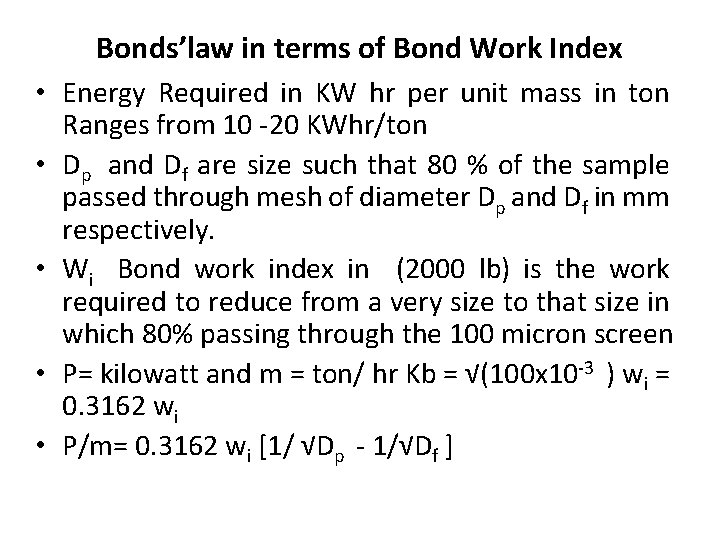
Bonds’law in terms of Bond Work Index • Energy Required in KW hr per unit mass in ton Ranges from 10 -20 KWhr/ton • Dp and Df are size such that 80 % of the sample passed through mesh of diameter Dp and Df in mm respectively. • Wi Bond work index in (2000 lb) is the work required to reduce from a very size to that size in which 80% passing through the 100 micron screen • P= kilowatt and m = ton/ hr Kb = √(100 x 10 -3 ) wi = 0. 3162 wi • P/m= 0. 3162 wi [1/ √Dp - 1/√Df ]
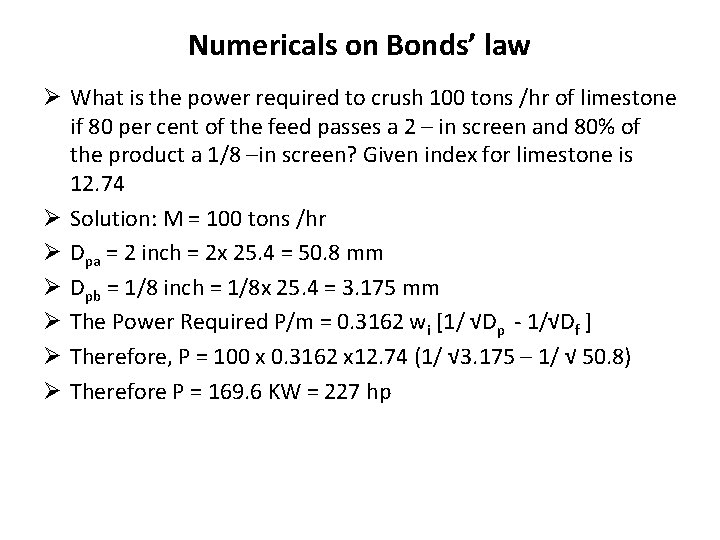
Numericals on Bonds’ law Ø What is the power required to crush 100 tons /hr of limestone if 80 per cent of the feed passes a 2 – in screen and 80% of the product a 1/8 –in screen? Given index for limestone is 12. 74 Ø Solution: M = 100 tons /hr Ø Dpa = 2 inch = 2 x 25. 4 = 50. 8 mm Ø Dpb = 1/8 inch = 1/8 x 25. 4 = 3. 175 mm Ø The Power Required P/m = 0. 3162 wi [1/ √Dp - 1/√Df ] Ø Therefore, P = 100 x 0. 3162 x 12. 74 (1/ √ 3. 175 – 1/ √ 50. 8) Ø Therefore P = 169. 6 KW = 227 hp
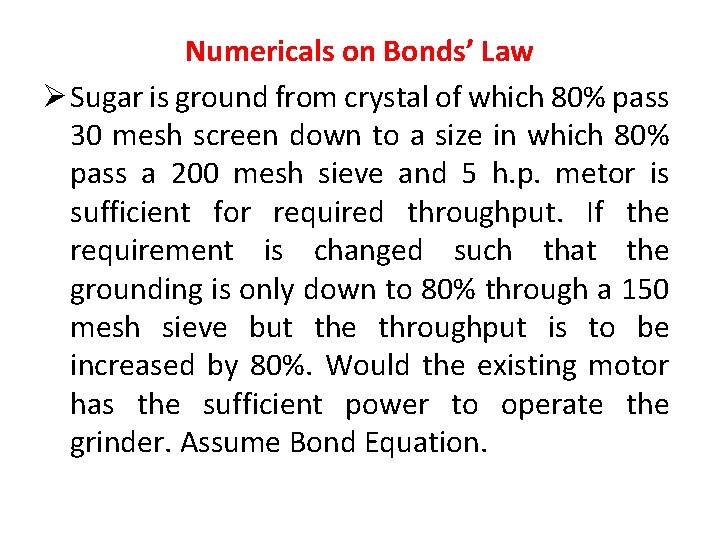
Numericals on Bonds’ Law Ø Sugar is ground from crystal of which 80% pass 30 mesh screen down to a size in which 80% pass a 200 mesh sieve and 5 h. p. metor is sufficient for required throughput. If the requirement is changed such that the grounding is only down to 80% through a 150 mesh sieve but the throughput is to be increased by 80%. Would the existing motor has the sufficient power to operate the grinder. Assume Bond Equation.
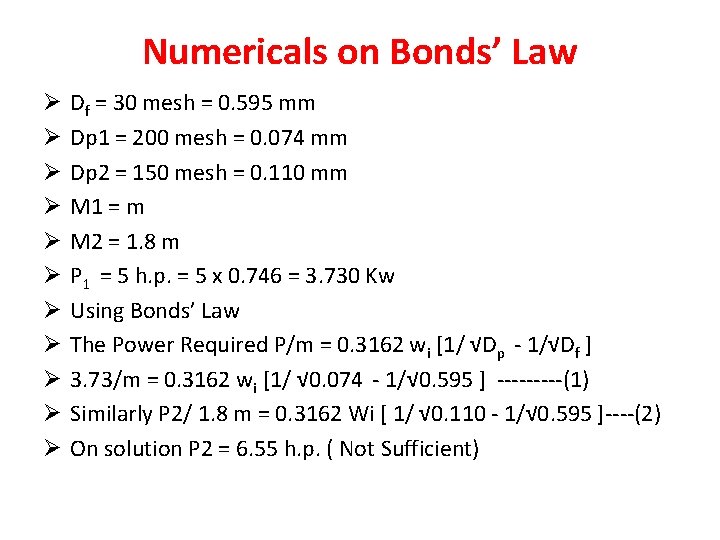
Numericals on Bonds’ Law Ø Ø Ø Df = 30 mesh = 0. 595 mm Dp 1 = 200 mesh = 0. 074 mm Dp 2 = 150 mesh = 0. 110 mm M 1 = m M 2 = 1. 8 m P 1 = 5 h. p. = 5 x 0. 746 = 3. 730 Kw Using Bonds’ Law The Power Required P/m = 0. 3162 wi [1/ √Dp - 1/√Df ] 3. 73/m = 0. 3162 wi [1/ √ 0. 074 - 1/√ 0. 595 ] -----(1) Similarly P 2/ 1. 8 m = 0. 3162 Wi [ 1/ √ 0. 110 - 1/√ 0. 595 ]----(2) On solution P 2 = 6. 55 h. p. ( Not Sufficient)