
ENERGY 211 CME 211 Lecture 19 November 3
ENERGY 211 / CME 211 Lecture 19 November 3, 2008 1

Containers • Standard C++ Library provides classes that implement containers of objects • Can store any object that can be copied • Types of containers: – Sequence containers, for ordered collections of elements – Associative containers, for unordered collections • elements identified by other means • examples: sets and maps 2
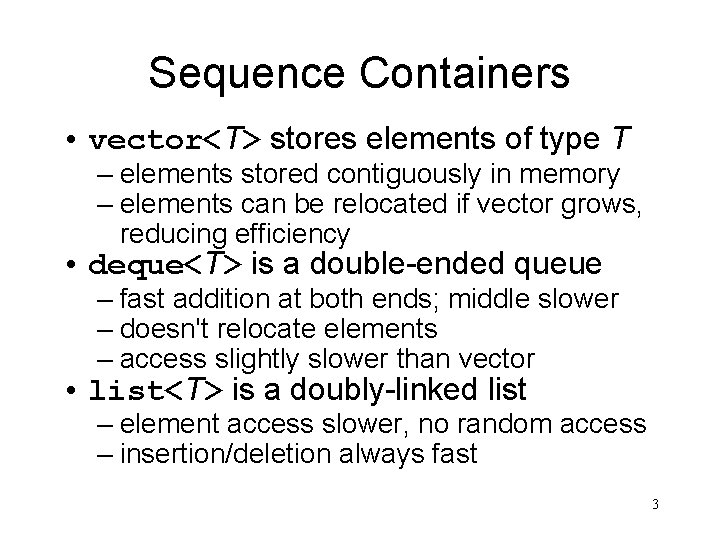
Sequence Containers • vector<T> stores elements of type T – elements stored contiguously in memory – elements can be relocated if vector grows, reducing efficiency • deque<T> is a double-ended queue – fast addition at both ends; middle slower – doesn't relocate elements – access slightly slower than vector • list<T> is a doubly-linked list – element access slower, no random access – insertion/deletion always fast 3
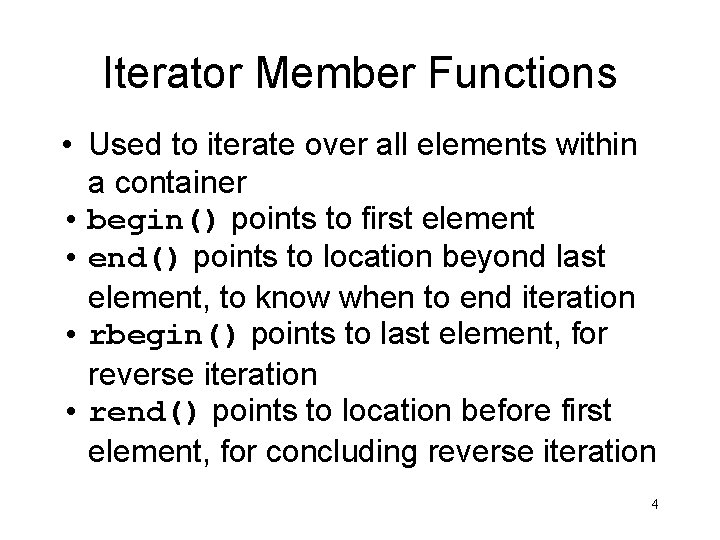
Iterator Member Functions • Used to iterate over all elements within a container • begin() points to first element • end() points to location beyond last element, to know when to end iteration • rbegin() points to last element, for reverse iteration • rend() points to location before first element, for concluding reverse iteration 4

Iterator Types • For defining your own iterators • Iterator type names preceded by container type and : : • Types: iterator forward iteration, reverse_iterator for backward • For const containers, precede iterator type name with const_ • Can initialize iterators from container member functions like begin() • Then, can use ++, *, etc. on iterator 5
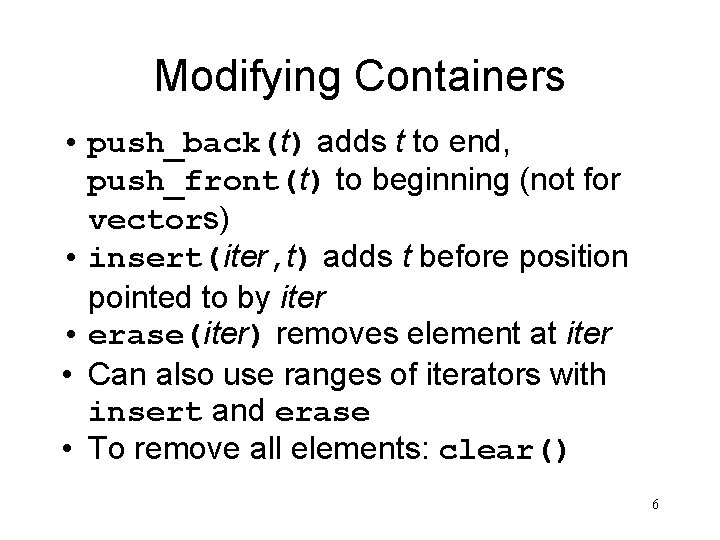
Modifying Containers • push_back(t) adds t to end, push_front(t) to beginning (not for vectors) • insert(iter, t) adds t before position pointed to by iter • erase(iter) removes element at iter • Can also use ranges of iterators with insert and erase • To remove all elements: clear() 6
Sizing Containers • Can declare sequential containers with an unsigned int initializer to preallocate that number of elements • Can use resize(unsigned int) member function to change size later • In both cases, can add argument of value type to initialize pre-allocated elements • Always pre-allocate if possible, for efficiency 7
More string Operations • Strings are containers too • Additional string-specific overloads of insert and erase available • Use assign to replace a string with another or replace to replace a portion of a string • substr extracts a portion of a string • Use find, rfind to search within a string, compare to compare strings • Many more! See cppreference. com 8
Stacks and Queues • A stack is a sequence in which elements are added/removed in a LIFO (last in/first out) manner • A queue uses FIFO (first in/first out) • A priority_queue orders elements by a given priority • Use push(item) to add element, pop() to remove first element • Use top() for first element (for queue, use front(), back() to get first, last) 9
Next Time • All about Associative Containers 10
- Slides: 10