
ENE 428 Microwave Engineering Lecture 8 Rectangular waveguides

- Slides: 39
ENE 428 Microwave Engineering Lecture 8 Rectangular waveguides and cavity resonator 1
TM waves in rectangular waveguides • Finding E and H components in terms of z, WG geometry, and modes. From Expanding for z-propagating field for the lossless WG gets where 2
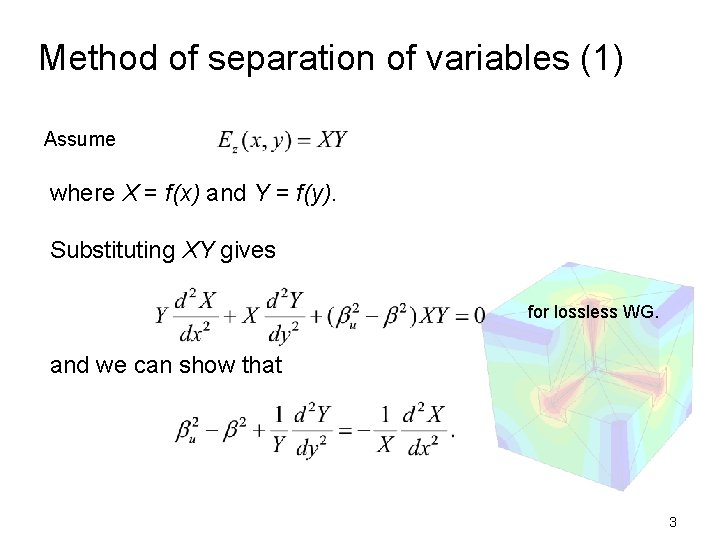
Method of separation of variables (1) Assume where X = f(x) and Y = f(y). Substituting XY gives for lossless WG. and we can show that 3
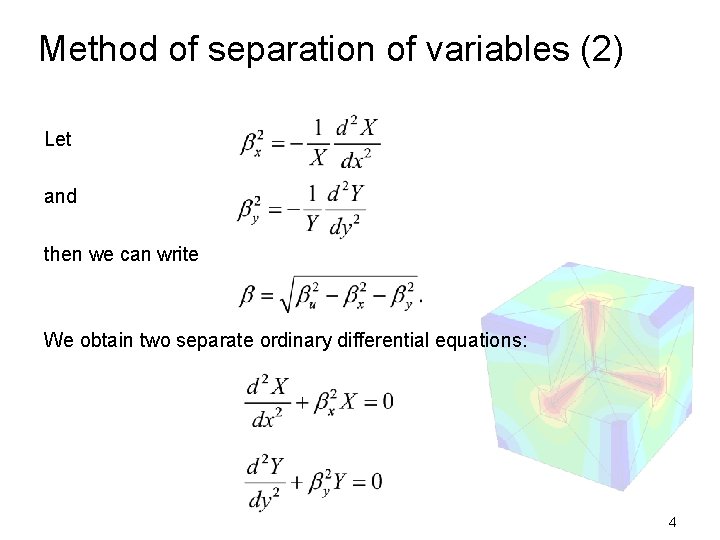
Method of separation of variables (2) Let and then we can write We obtain two separate ordinary differential equations: 4
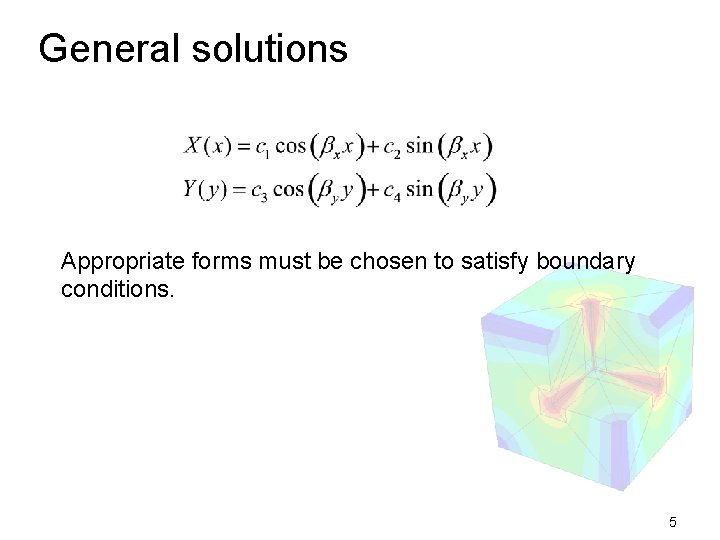
General solutions Appropriate forms must be chosen to satisfy boundary conditions. 5
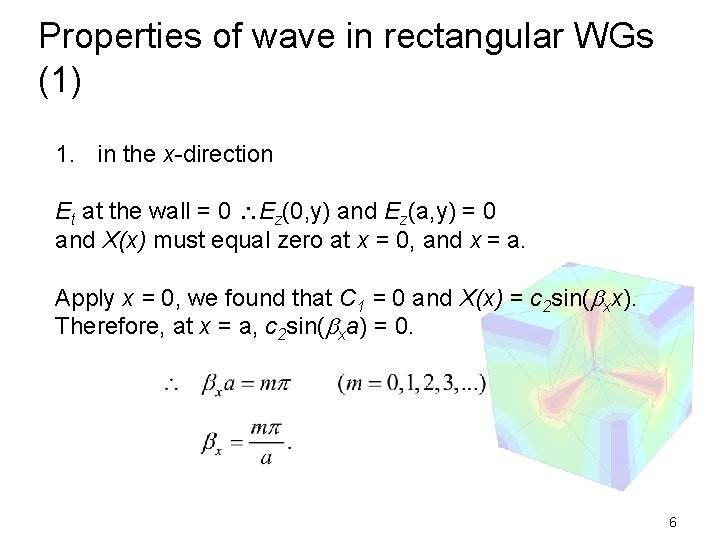
Properties of wave in rectangular WGs (1) 1. in the x-direction Et at the wall = 0 Ez(0, y) and Ez(a, y) = 0 and X(x) must equal zero at x = 0, and x = a. Apply x = 0, we found that C 1 = 0 and X(x) = c 2 sin( xx). Therefore, at x = a, c 2 sin( xa) = 0. 6
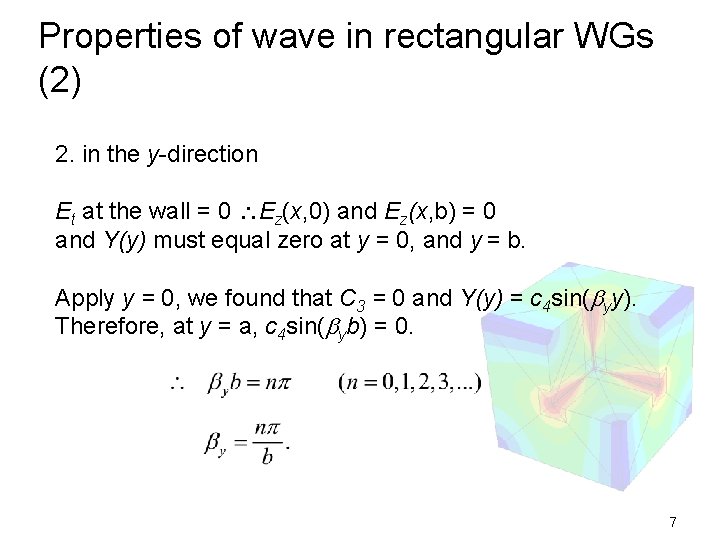
Properties of wave in rectangular WGs (2) 2. in the y-direction Et at the wall = 0 Ez(x, 0) and Ez(x, b) = 0 and Y(y) must equal zero at y = 0, and y = b. Apply y = 0, we found that C 3 = 0 and Y(y) = c 4 sin( yy). Therefore, at y = a, c 4 sin( yb) = 0. 7
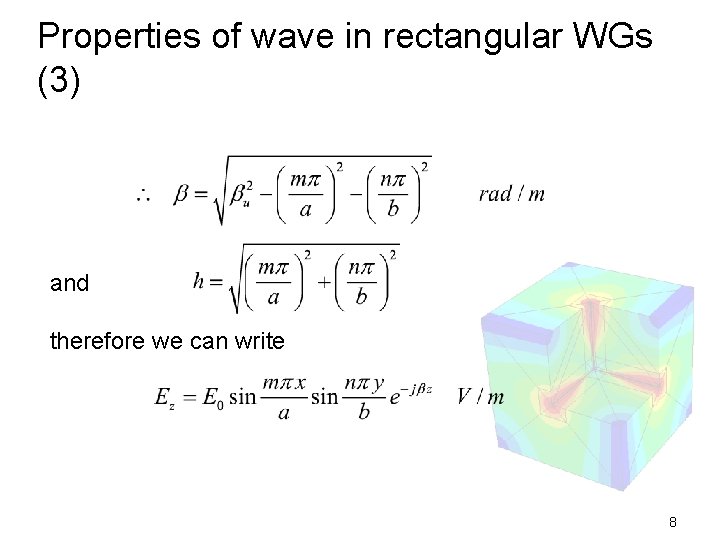
Properties of wave in rectangular WGs (3) and therefore we can write 8
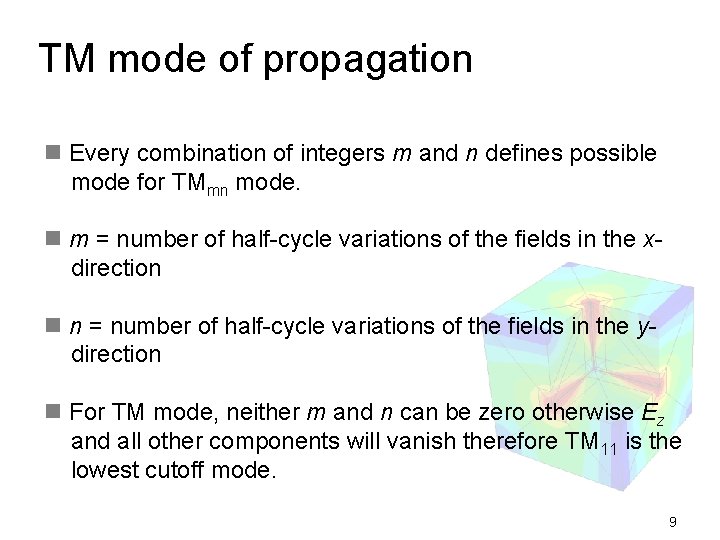
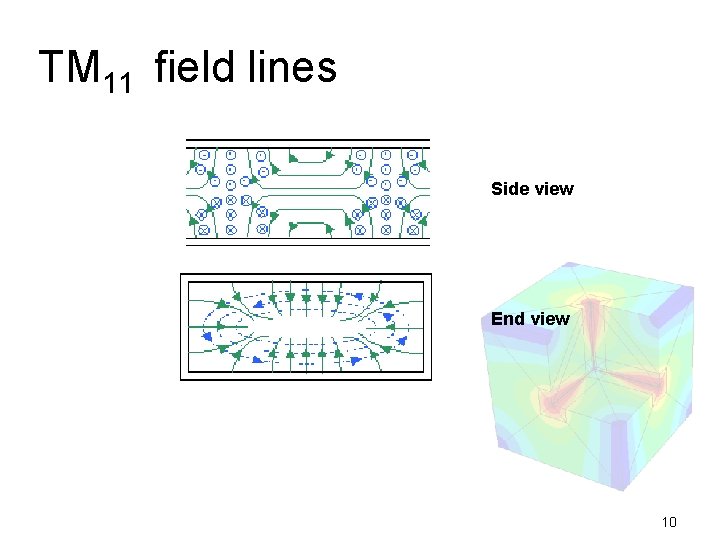
TM mode of propagation n Every combination of integers m and n defines possible mode for TMmn mode. n m = number of half-cycle variations of the fields in the xdirection n n = number of half-cycle variations of the fields in the ydirection n For TM mode, neither m and n can be zero otherwise Ez and all other components will vanish therefore TM 11 is the lowest cutoff mode. 9
TM 11 field lines Side view End view 10
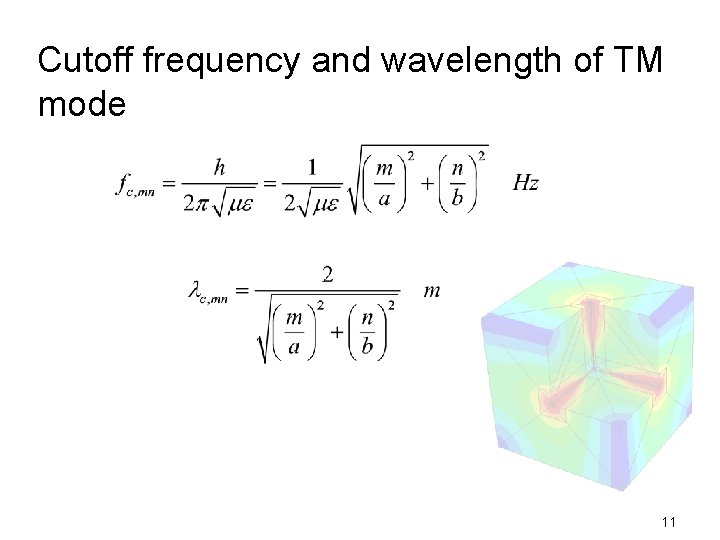
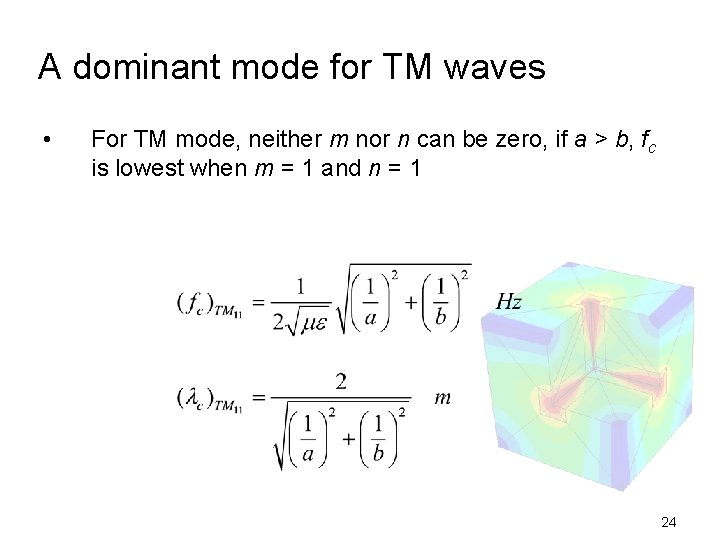
Cutoff frequency and wavelength of TM mode 11
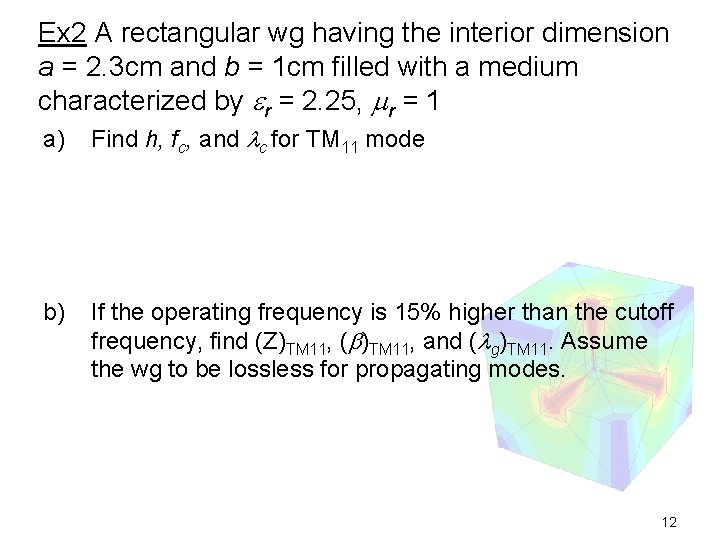
Ex 2 A rectangular wg having the interior dimension a = 2. 3 cm and b = 1 cm filled with a medium characterized by r = 2. 25, r = 1 a) Find h, fc, and c for TM 11 mode b) If the operating frequency is 15% higher than the cutoff frequency, find (Z)TM 11, ( )TM 11, and ( g)TM 11. Assume the wg to be lossless for propagating modes. 12
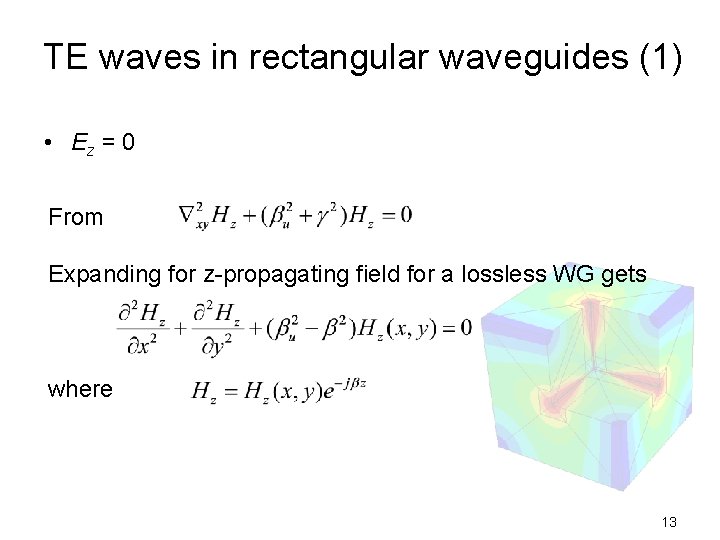
TE waves in rectangular waveguides (1) • Ez = 0 From Expanding for z-propagating field for a lossless WG gets where 13
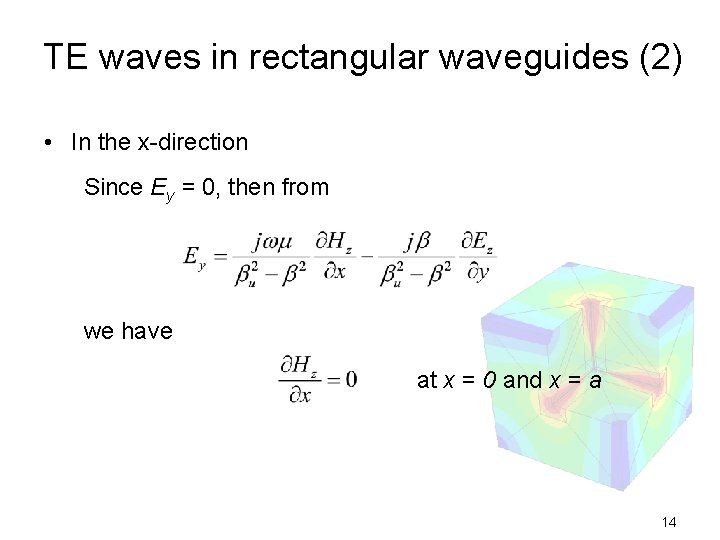
TE waves in rectangular waveguides (2) • In the x-direction Since Ey = 0, then from we have at x = 0 and x = a 14
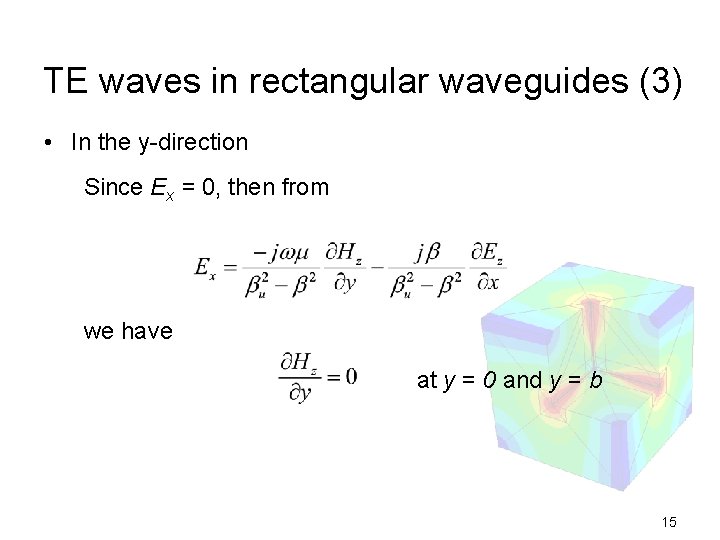
TE waves in rectangular waveguides (3) • In the y-direction Since Ex = 0, then from we have at y = 0 and y = b 15
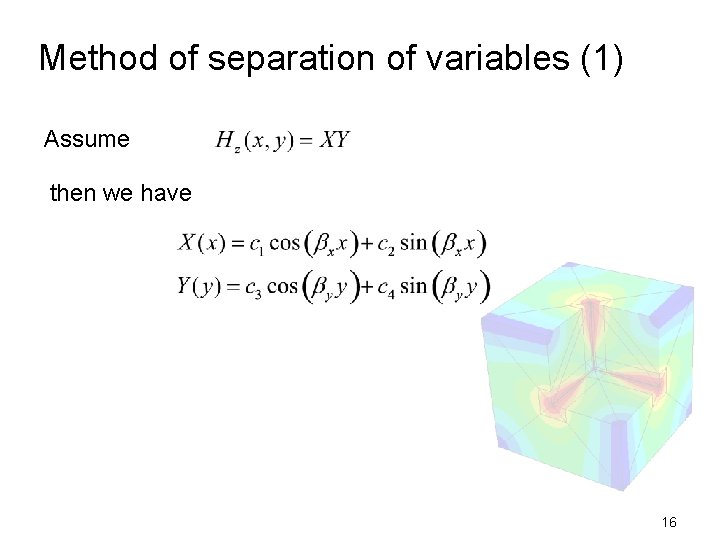
Method of separation of variables (1) Assume then we have 16
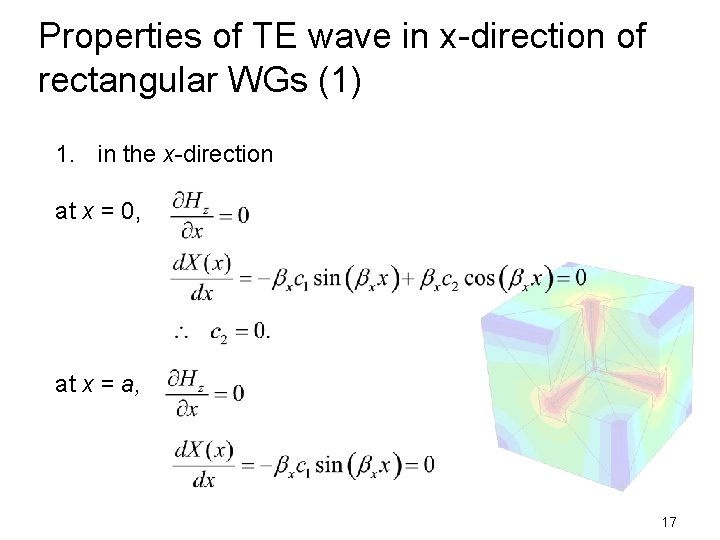
Properties of TE wave in x-direction of rectangular WGs (1) 1. in the x-direction at x = 0, at x = a, 17
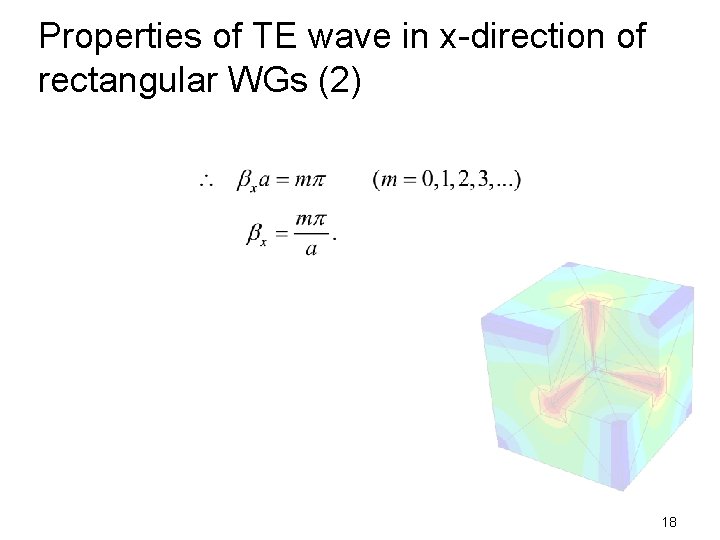
Properties of TE wave in x-direction of rectangular WGs (2) 18
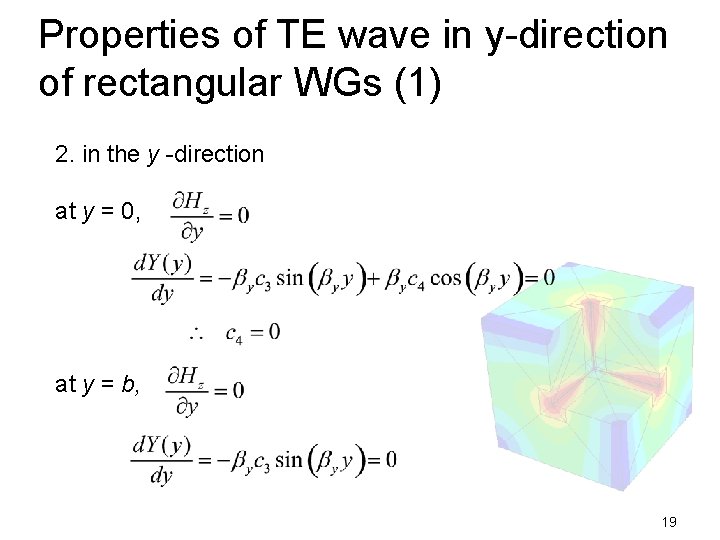
Properties of TE wave in y-direction of rectangular WGs (1) 2. in the y -direction at y = 0, at y = b, 19
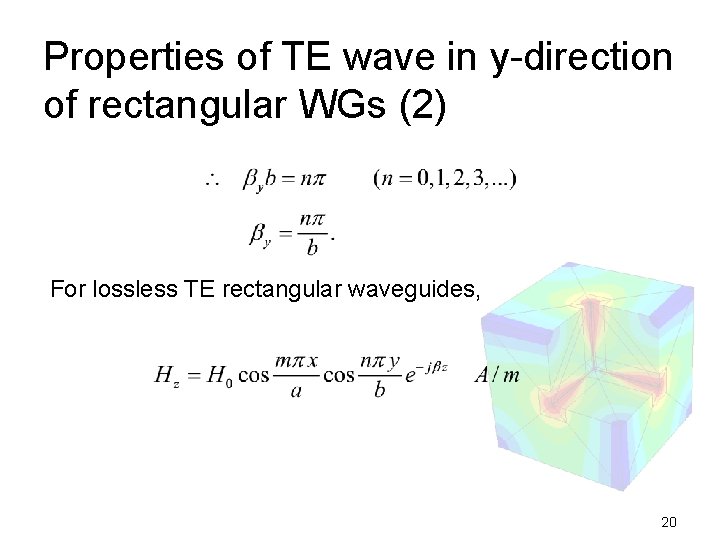
Properties of TE wave in y-direction of rectangular WGs (2) For lossless TE rectangular waveguides, 20
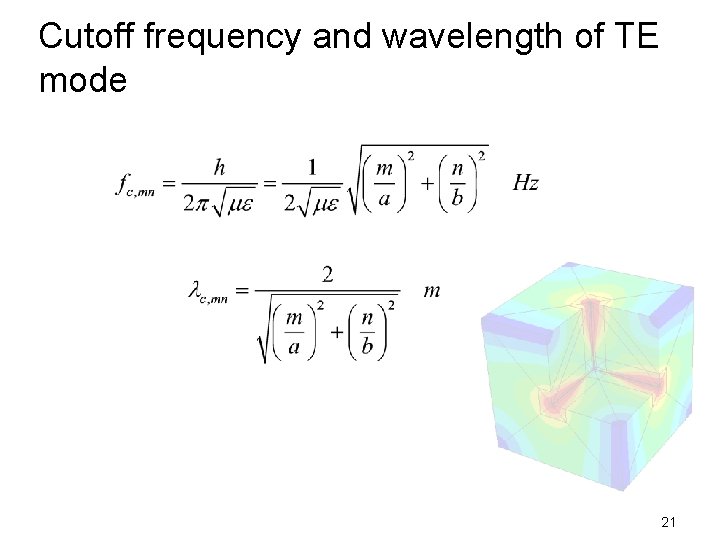
Cutoff frequency and wavelength of TE mode 21
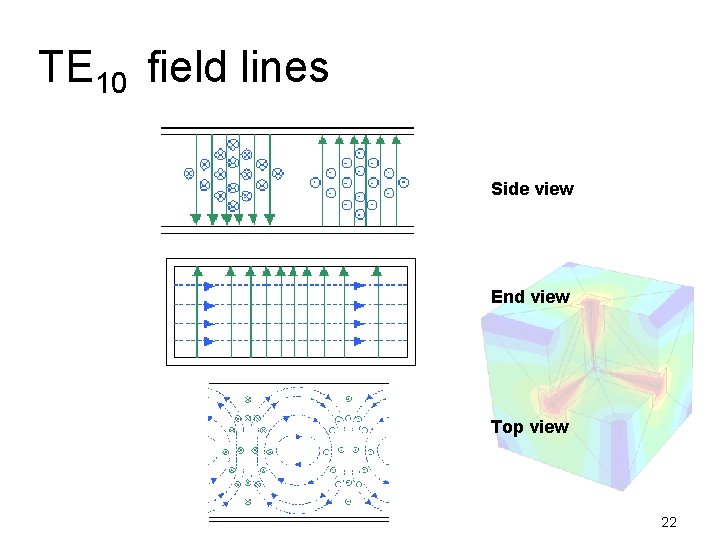
TE 10 field lines Side view End view Top view 22
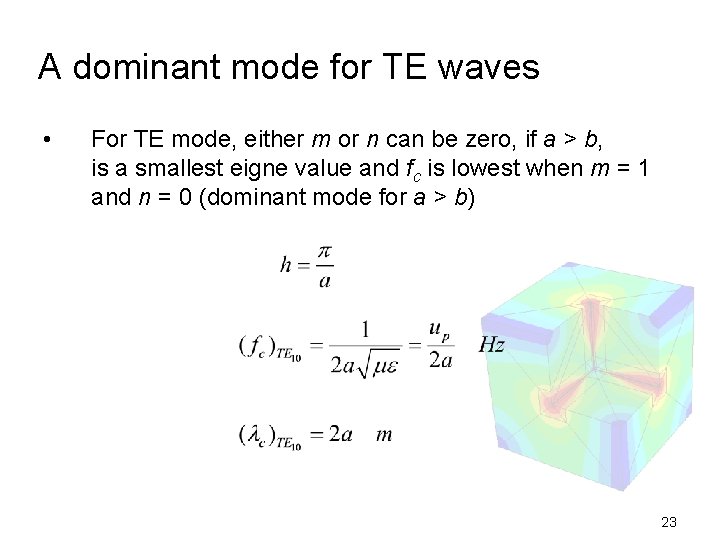
A dominant mode for TE waves • For TE mode, either m or n can be zero, if a > b, is a smallest eigne value and fc is lowest when m = 1 and n = 0 (dominant mode for a > b) 23
A dominant mode for TM waves • For TM mode, neither m nor n can be zero, if a > b, fc is lowest when m = 1 and n = 1 24
Ex 1 a) What is the dominant mode of an axb rectangular WG if a < b and what is its cutoff frequency? b) What are the cutoff frequencies in a square WG (a = b) for TM 11, TE 20, and TE 01 modes? 25
Ex 2 Which TM and TE modes can propagate in the polyethylene-filled rectangular WG ( r = 2. 25, r = 1) if the operating frequency is 19 GHz given a = 1. 5 cm and b = 0. 6 cm? 26
27
28
Rectangular cavity resonators (1) n At microwave frequencies, circuits with the dimension comparable to the operating wavelength become efficient radiators n An enclose cavity is preferred to confine EM field, provide large areas for current flow. n These enclosures are called ‘cavity resonators’. There are both TE and TM modes but not unique. b d a 29
Rectangular cavity resonators (2) n z-axis is chosen as the reference. n “mnp” subscript is needed to designate a TM or TE standing wave pattern in a cavity resonator. 30
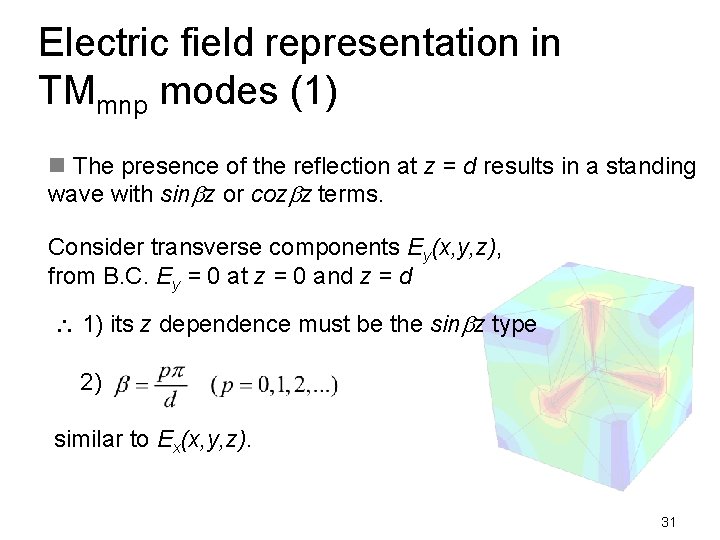
Electric field representation in TMmnp modes (1) n The presence of the reflection at z = d results in a standing wave with sin z or coz z terms. Consider transverse components Ey(x, y, z), from B. C. Ey = 0 at z = 0 and z = d 1) its z dependence must be the sin z type 2) similar to Ex(x, y, z). 31
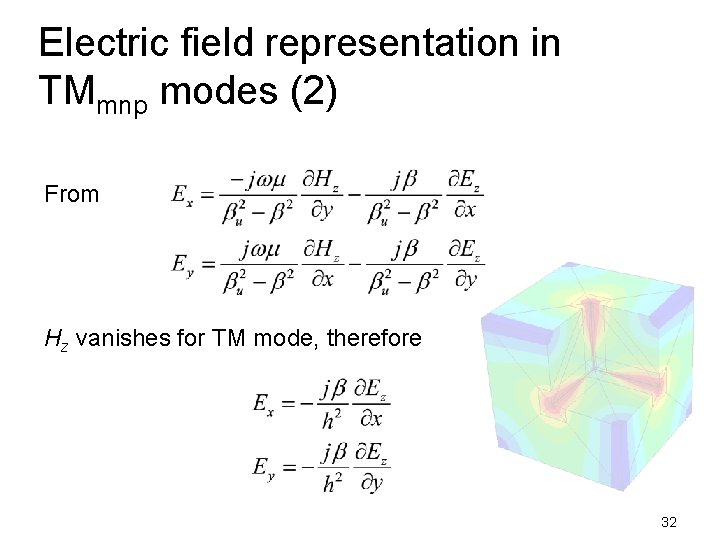
Electric field representation in TMmnp modes (2) From Hz vanishes for TM mode, therefore 32
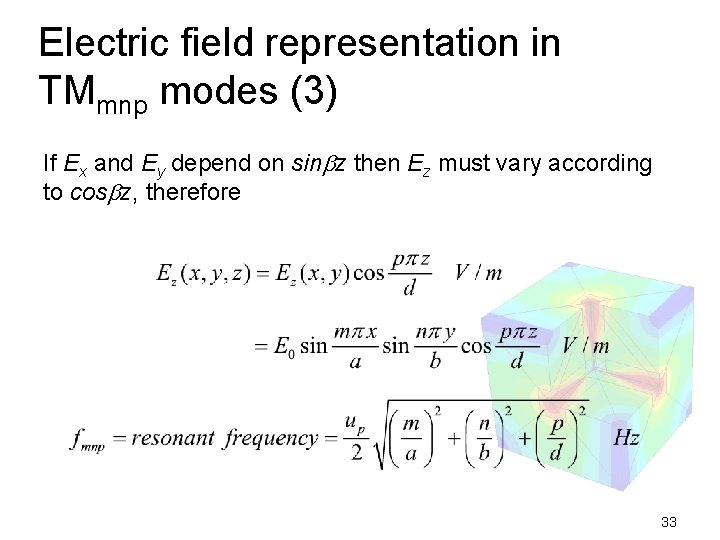
Electric field representation in TMmnp modes (3) If Ex and Ey depend on sin z then Ez must vary according to cos z, therefore 33
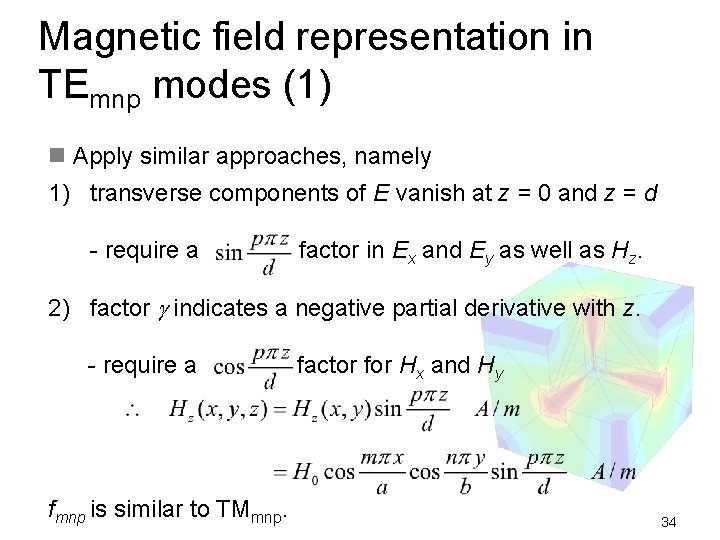
Magnetic field representation in TEmnp modes (1) n Apply similar approaches, namely 1) transverse components of E vanish at z = 0 and z = d - require a factor in Ex and Ey as well as Hz. 2) factor indicates a negative partial derivative with z. - require a fmnp is similar to TMmnp. factor for Hx and Hy 34
Dominant mode • The mode with a lowest resonant frequency is called ‘dominant mode’. • Different modes having the same fmnp are called degenerate modes. 35
Resonator excitation (1) For a particular mode, we need to 1) place an inner conductor of the coaxial cable where the electric field is maximum. 2) introduce a small loop at a location where the flux of the desired mode linking the loop is maximum. source frequency = resonant frequency 36
Resonator excitation (2) For example, TE 101 mode, only 3 non-zero components are Ey, Hx, and Hz. n insert a probe in the center region of the top or bottom face where Ey is maximum or place a loop to couple Hx maximum inside a front or back face. n Best location is affected by impedance matching requirements of the microwave circuit of which the resonator is a part. 37
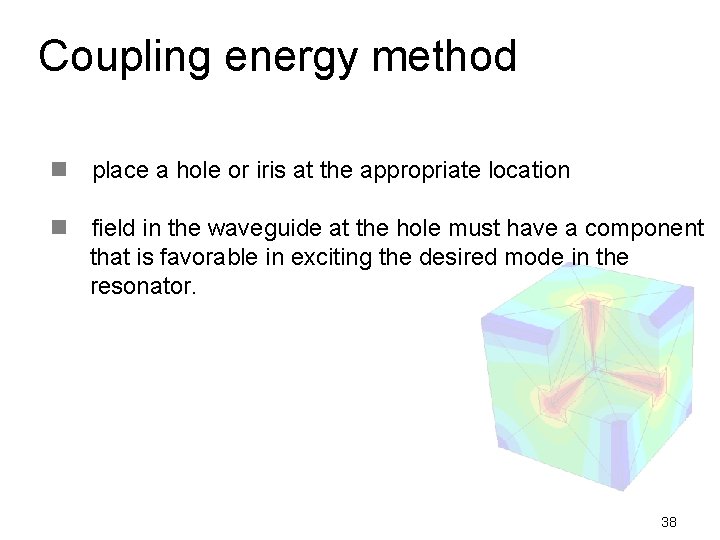
Coupling energy method n place a hole or iris at the appropriate location n field in the waveguide at the hole must have a component that is favorable in exciting the desired mode in the resonator. 38
Ex 3 Determine the dominant modes and their frequencies in an air-filled rectangular cavity resonator for a) a>b>d b) a>d>b c) a=b=d 39