
Enduring Themes of Social Studies Conflict and Change
- Slides: 24
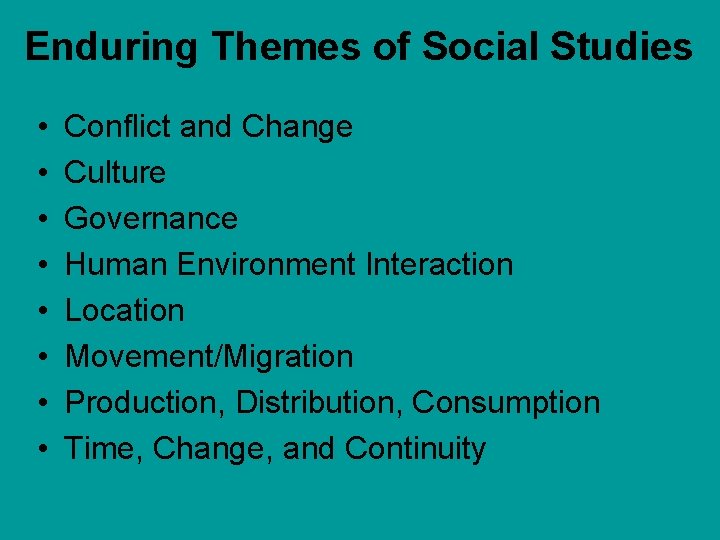
Enduring Themes of Social Studies • • Conflict and Change Culture Governance Human Environment Interaction Location Movement/Migration Production, Distribution, Consumption Time, Change, and Continuity
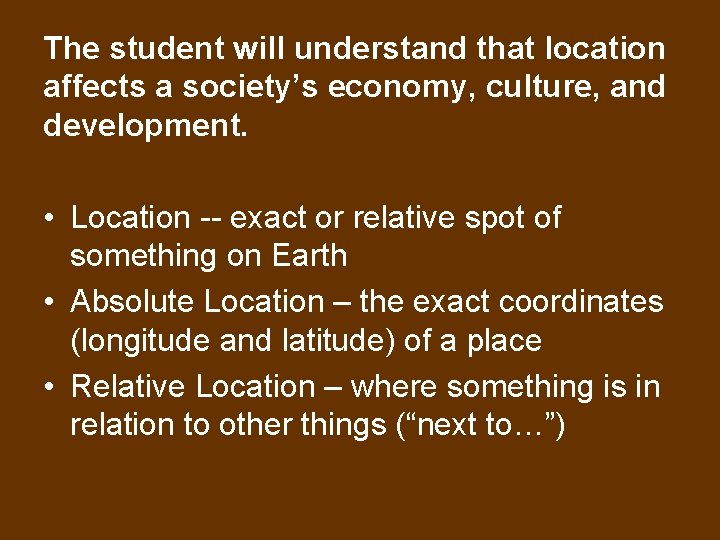
The student will understand that location affects a society’s economy, culture, and development. • Location -- exact or relative spot of something on Earth • Absolute Location – the exact coordinates (longitude and latitude) of a place • Relative Location – where something is in relation to other things (“next to…”)
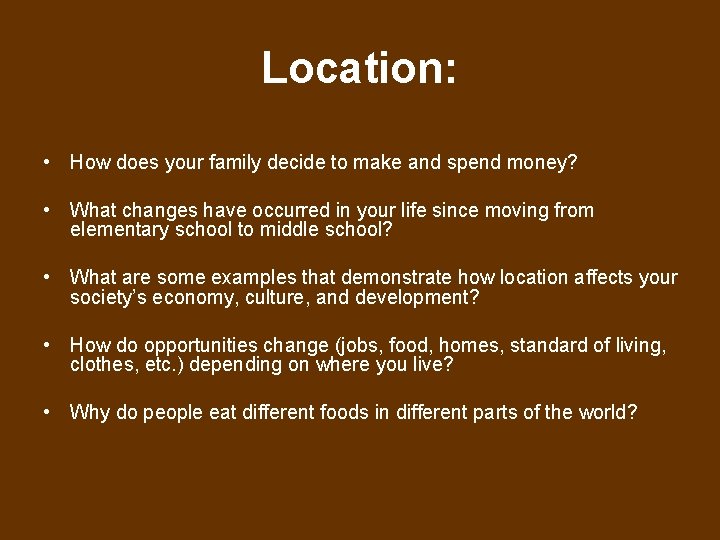
Location: • How does your family decide to make and spend money? • What changes have occurred in your life since moving from elementary school to middle school? • What are some examples that demonstrate how location affects your society’s economy, culture, and development? • How do opportunities change (jobs, food, homes, standard of living, clothes, etc. ) depending on where you live? • Why do people eat different foods in different parts of the world?
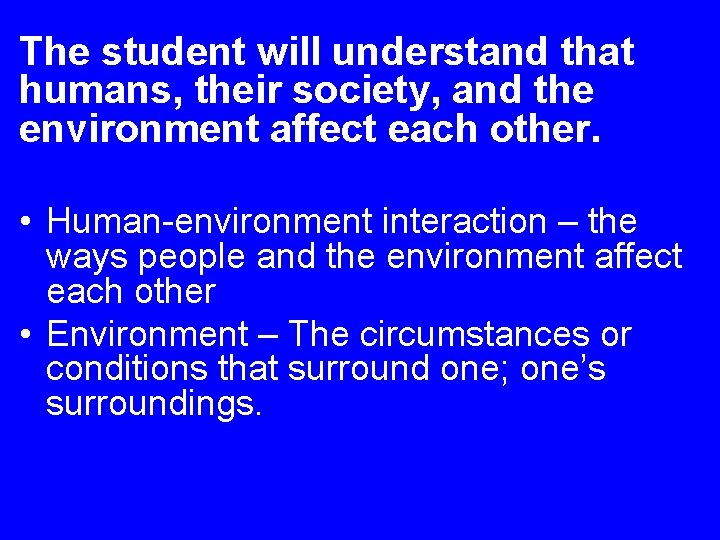
The student will understand that humans, their society, and the environment affect each other. • Human-environment interaction – the ways people and the environment affect each other • Environment – The circumstances or conditions that surround one; one’s surroundings.
Human Environmental Interaction: • How is the landscape changed when neighborhoods are built? • What jobs are available or unavailable because of the physical geography near you? • What are the positive and negative consequences of human environment interaction? • How does the environment affect food choice?
The student will understand that the culture of a society is the product of the religion, beliefs, customs, traditions, and government of that society. • Culture – the beliefs, customs, and ways of living shared by a group of people. Learned behavior of a group of people, which includes their belief systems and languages, their social relationships, their institutions and organizations, and their material goods such as food, clothing, buildings, tools and machines.
Culture: • How do you describe your family’s culture? • How do government actions affect your culture? • Should schools try to influence or reflect the students’ cultures? • What cultural conflicts have you seen in your school or the US?
The student will understand that the movement or migration of people and ideas affects all societies involved. • Migration – movement of people within own country or across borders • Movement – how people and ideas change locations and how goods are traded • Interdependence – the effect that one part of the world has on another (countries depending on other countries for resources, goods, and services) • Immigration – movement into a country • Emigration – movement exiting a country
Movement/Migration • How have your ideas, opinions, likes and dislikes changed since going from sixth grade to seventh? • What are some of the cultural differences (language/slang, foods, accents, sports, clothes, etc. ) within different regions of the United States? • What are some of the reasons that people move? • How do people change when they move from one place to another?
The student will understand that as a society increases in complexity and interacts with other societies, the complexity of the government also increases. • Government – the people and groups that make and carry out laws for a society • Governance – The act, process, or power of governing; government; The state of being governed. • Interact – to communicate or work together: to be or become involved in communication, social activity, or work with somebody else or one another
Governance • How have your responsibilities changed as your family has changed or as you have gotten older? • In what ways do the rules in sports get more complicated at different levels? (i. e. tee ball through the Major Leagues) • How have society and government adapted to each other’s growing complexities?
WARM UP: Economy • What is production? • What is distribution? • What is consumption? • How are production, distribution, and consumption of good and services produced by the society affected by the location, customs, beliefs, and laws of the society?
Production, Distribution, Consumption: Economy • Warm Up: on ppt • EQ: on notes sheet • Mini-lesson: Economy and Time, change and Continuity • Work Session: notes sheets • Closing: Discussion of Economy • Homework: Prepare for Unit 1 Test on Friday • LOTS: Production, Distribution, Consumption, Goods, Services, Location, Customs, Beliefs, Society, Continuity, Structure • The student will understand that the production, distribution, and consumption of goods/services produced by the society are affected by the location, customs, beliefs, and laws of the society.
The student will understand that the production, distribution, and consumption of goods/services produced by the society are affected by the location, customs, beliefs, and laws of the society. • Consumption – The purchase and/or use of goods and services. (“buying stuff”) • Distribution – the commercial activity of transporting and selling goods from a producer to a consumer (“selling stuff”) • Production – The creation of value or wealth by producing goods and services. (“Making stuff”)
Production, Distribution, Consumption: • What are the elements that make up an economy? • How are things you want to buy produced? • How do stores get the things you want to buy? • How do you decide what to buy? • What factors determine the price of the things you want to buy?
The student will understand that when there is conflict between or within societies, change is the result. • Conflict – a difference; a disagreement or clash between ideas, principles, or people Examples: war, fighting with friends, with yourself, etc.
Conflict & Change • When you have conflicts with your friends does it change your friendship? If so, how? • Why do you make changes in your life? • Why does change always follow conflict?
The student will understand that while change occurs over time, there is continuity to the basic structure of that society. • Continuity – The state or quality of being continuous. An uninterrupted succession or flow; a coherent whole. (when things stay the same)
Time, Change, and Continuity • How has school changed and stayed the same since kindergarten? • How can a society change but have its basic components remain the same over time? • Why do some things remain the same when society is always changing?
• Conflict – a difference; a disagreement or clash between ideas, principles, or people • Culture – the beliefs, customs, and ways of living shared by a group of people. Learned behavior of a group of people, which includes their belief systems and languages, their social relationships, their institutions and organizations, and their material goods such as food, clothing, buildings, tools and machines.
• Human-environment interaction – the ways people and the environment affect each other • Environment – The circumstances or conditions that surround one; one’s surroundings. • Migration – movement of people within own country or across borders • Movement – how people and ideas change locations and how goods are traded • Interdependence – the effect that one part of the world has on another (countries depending on other countries for resources, goods, and services) • Immigration – movement into a country • Emigration – movement exiting a country
• Location -- exact or relative spot of something on Earth • Absolute Location – the exact coordinates (longitude and latitude) of a place • Relative Location – where something is in relation to other things (“next to…”)
• Continuity – The state or quality of being continuous. An uninterrupted succession or flow; a coherent whole. (when things stay the same) • Government – the people and groups that make and carry out laws for a society • Governance – The act, process, or power of governing; government; The state of being governed.
• Consumption – The purchase and/or use of goods and services. (“buying stuff”) • Distribution – the commercial activity of transporting and selling goods from a producer to a consumer (“selling stuff”) • Production – The creation of value or wealth by producing goods and services. (“Making stuff”)