
Endurin g Appalachian Dialect Features Adapted from Unvernacular
- Slides: 16
Endurin g Appalachian Dialect Features Adapted from Unvernacular Appalachia: an empirical perspective on West Virginia dialect variation by Kirk Hazen, Paige Butcher, and Ashley King
Pronouns. Big Ideas: Pleonastic Pronouns are used as the subjects of finite clauses and also serve to sum up a preceding noun phrase. Although thy are present throughout English dialects in the US, they are usually identified as vernacular. Most times, long noun phrases usually come along with Pleonastic Pronouns. However, in West Virginia, short noun phrases do, as well. Usually, the shorter the noun phrase, the more vernacular the feature is. Ex: 1. My brother, he lifted for a long time. 2. But my baby brother who was a minister down at the little church down in Osage, he was stricken with cancer, so I came home to take care of him
Listen up. Pleonastic Pronoun Ex. #1: because I’m the youngest, and then the oldest, my sister, she is caught sort of in between Pleonastic Pronoun Ex. #2: but my baby brother who was a minister down at the little church down in Osage, he was stricken with cancer.
Quotative like. Ex: She was like, “What’s going on? ” Big Ideas: Quotative like is simply using be like to introduce a quote. This is a new feature: it started in the US in the 1970 s and gained popularity throughout the 1980 s. In the study conducted in WV, Quotative like was used by younger speakers 50% of the time.
Listen up. Quotative like Ex. #1: I was like, “Mom, please let me in. ” Quotative like Ex. #2: And I’m going home this weekend, so I was like, “Oh, I hope they come back. ” And she’s like, “Well, they probably will because they don’t do too much in college. ”
Consonant Cluster Reduction. Big Ideas: Ex: past pas’ In most varieties of English, final consonants are deleted before words beginning with a consonant. However, in some vernacular varieties, final consonants are also deleted before vowels. Ex: past over pas’ over According to the study conducted in WV, CCR doesn’t seem to be a stigmatized feature.
Consonant Cluster Reduction. CCR Activity Sheet Sound File:
Listen up. CCR Ex. #1: Well, in between Cassville, West Virginia and Mount Morris, Pennsylvania. CCR Ex. #2: Well, he worked in the woods, coal mine, anything he could get a hold of.
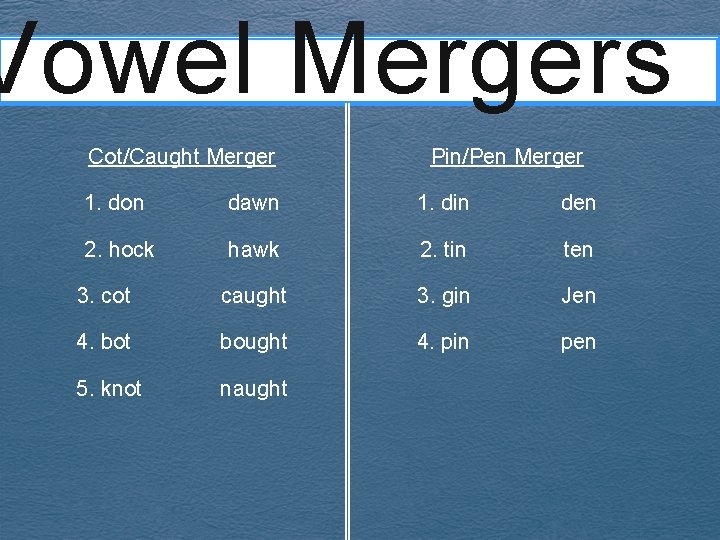
Vowel Mergers. Cot/Caught Merger Pin/Pen Merger 1. don dawn 1. din den 2. hock hawk 2. tin ten 3. cot caught 3. gin Jen 4. bot bought 4. pin pen 5. knot naught
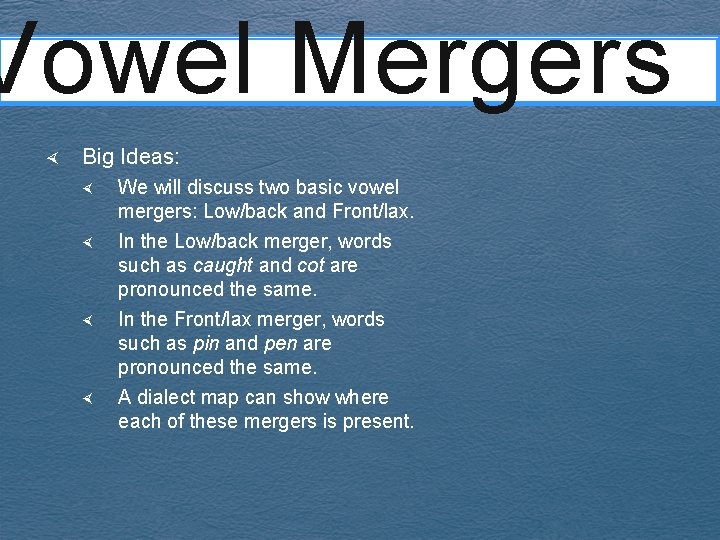
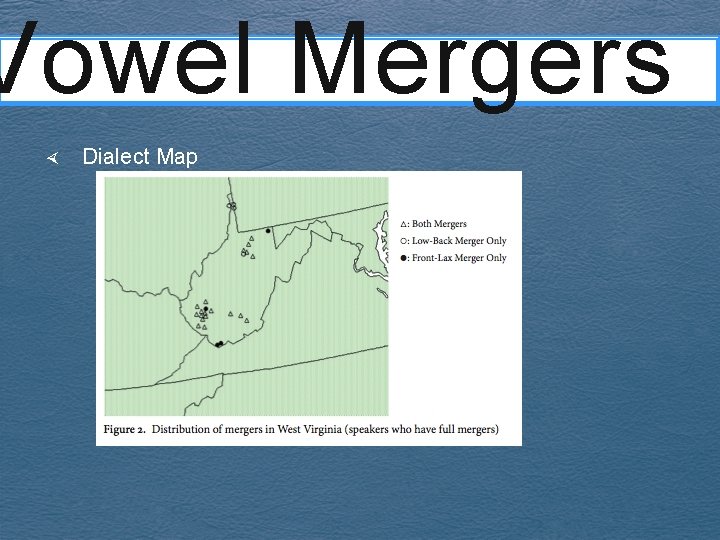
Vowel Mergers Big Ideas: We will discuss two basic vowel mergers: Low/back and Front/lax. In the Low/back merger, words such as caught and cot are pronounced the same. In the Front/lax merger, words such as pin and pen are pronounced the same. A dialect map can show where each of these mergers is present.
Listen up. Vowel Merger Ex. #1: caught, cot, pin, pen Vowel Merger Ex. #2: caught, cot, pin, pen
Vowel Mergers Dialect Map
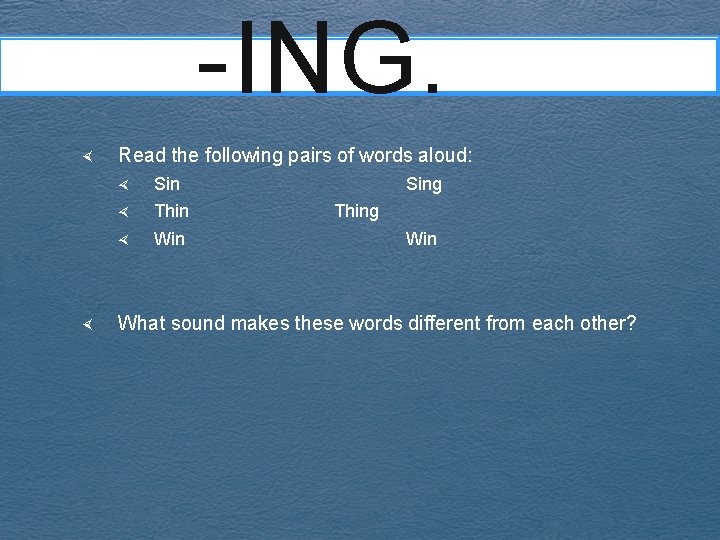
-ING. Read the following pairs of words aloud: Sin Thin Win Sing Thing Win What sound makes these words different from each other?
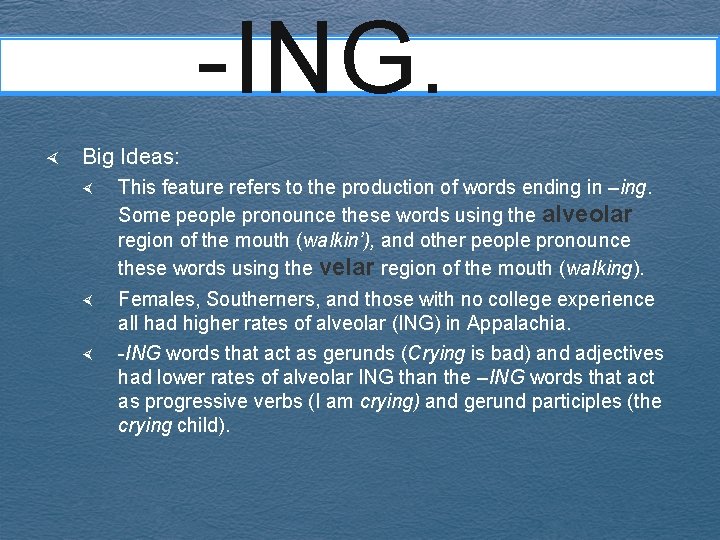
-ING. Big Ideas: This feature refers to the production of words ending in –ing. Some people pronounce these words using the alveolar region of the mouth (walkin’), and other people pronounce these words using the velar region of the mouth (walking). Females, Southerners, and those with no college experience all had higher rates of alveolar (ING) in Appalachia. -ING words that act as gerunds (Crying is bad) and adjectives had lower rates of alveolar ING than the –ING words that act as progressive verbs (I am crying) and gerund participles (the crying child).
Listen up. ING Ex. #1: I don't guess I even really thought about being a West Virginian until I went away to school, and then it was everyone asking me where I was from. ING Ex. #2: I was thinking about the, uh.
Writing Language Activity: Gil 1 Sound File Log 2 Sound File