
EndtoEnd Principle Brad Karp UCL Computer Science CS
End-to-End Principle Brad Karp UCL Computer Science CS 6007/GC 15/GA 07 20 th February, 2008
Motivation: End-to-End Argument • 7 layers in OSI model • 7 places to solve many of same problems: – In-order delivery – Duplicate-free delivery – Reliable delivery (retransmission) after corruption or loss – Encryption – Authentication • In which layer(s) should a particular function be implemented? 2
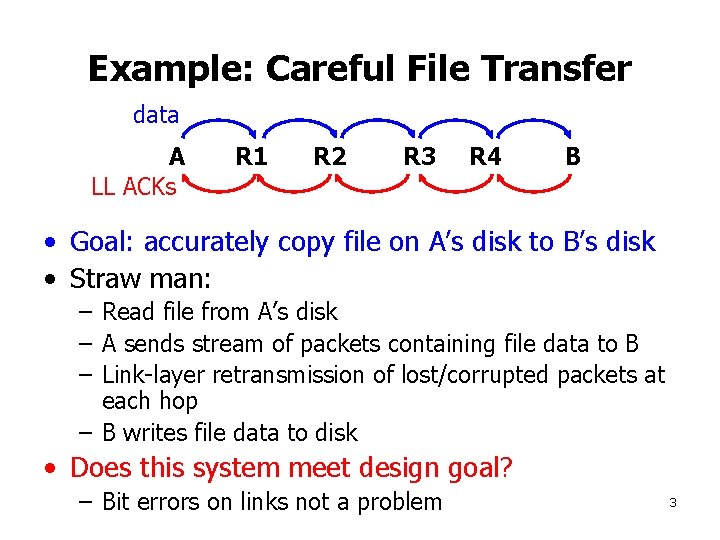
Example: Careful File Transfer data A LL ACKs R 1 R 2 R 3 R 4 B • Goal: accurately copy file on A’s disk to B’s disk • Straw man: – Read file from A’s disk – A sends stream of packets containing file data to B – Link-layer retransmission of lost/corrupted packets at each hop – B writes file data to disk • Does this system meet design goal? – Bit errors on links not a problem 3
Where Can Errors Happen? • • On A’s or B’s disk In A’s or B’s RAM or CPU In A’s or B’s software In the RAM, CPU, or software of any router that forwards packet (MIT example!) • Why might errors be likely? – Drive for CPU speed and storage density: pushes hardware to EE limits, engineered to tight tolerances – e. g. , today’s disks return data that are the output of an MLE! 4
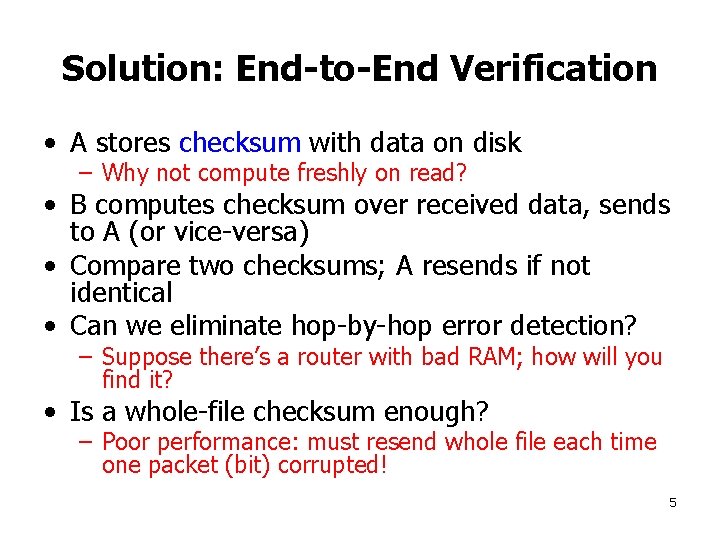
Solution: End-to-End Verification • A stores checksum with data on disk – Why not compute freshly on read? • B computes checksum over received data, sends to A (or vice-versa) • Compare two checksums; A resends if not identical • Can we eliminate hop-by-hop error detection? – Suppose there’s a router with bad RAM; how will you find it? • Is a whole-file checksum enough? – Poor performance: must resend whole file each time one packet (bit) corrupted! 5
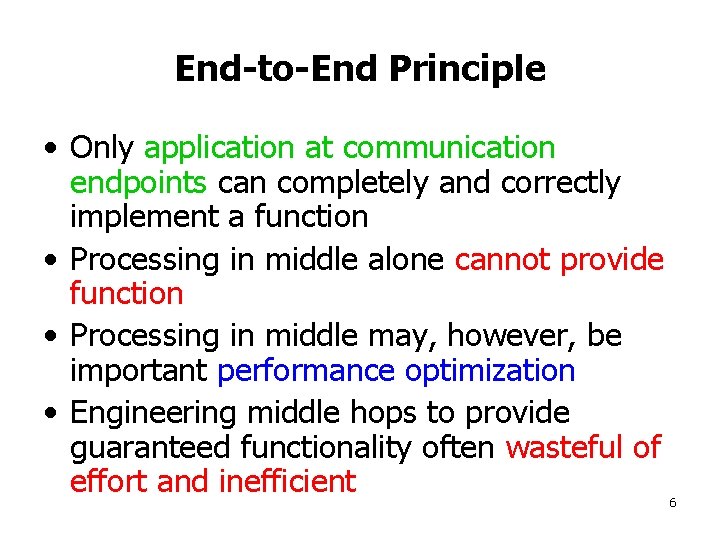
End-to-End Principle • Only application at communication endpoints can completely and correctly implement a function • Processing in middle alone cannot provide function • Processing in middle may, however, be important performance optimization • Engineering middle hops to provide guaranteed functionality often wasteful of effort and inefficient 6
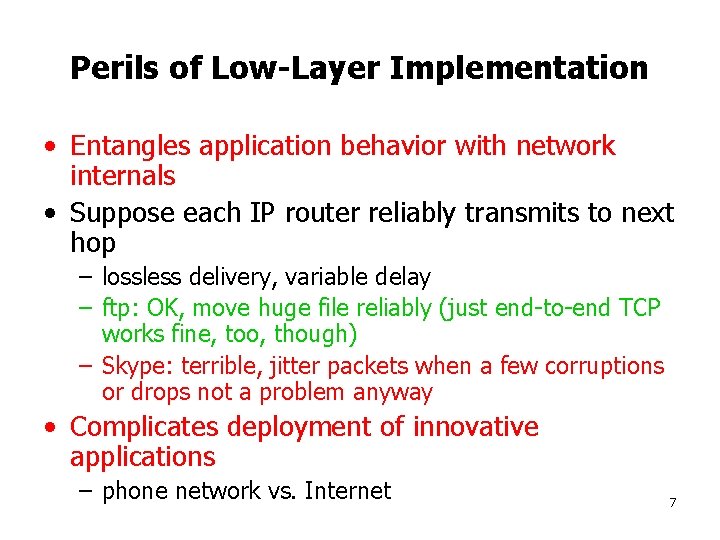
Perils of Low-Layer Implementation • Entangles application behavior with network internals • Suppose each IP router reliably transmits to next hop – lossless delivery, variable delay – ftp: OK, move huge file reliably (just end-to-end TCP works fine, too, though) – Skype: terrible, jitter packets when a few corruptions or drops not a problem anyway • Complicates deployment of innovative applications – phone network vs. Internet 7
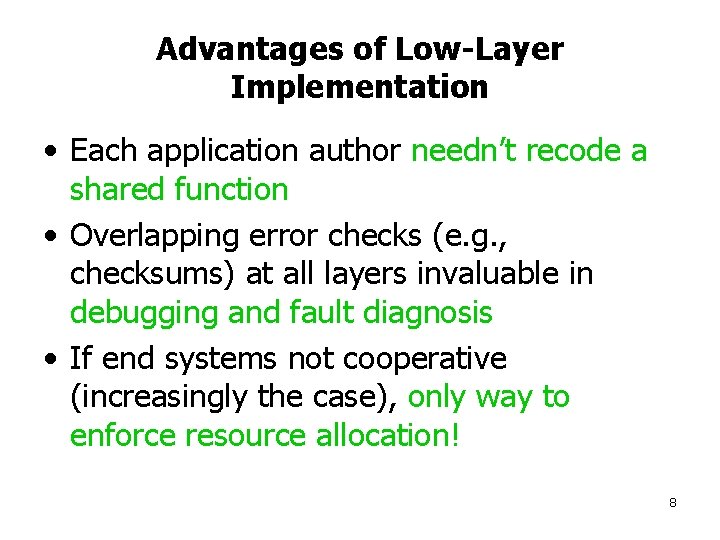
Advantages of Low-Layer Implementation • Each application author needn’t recode a shared function • Overlapping error checks (e. g. , checksums) at all layers invaluable in debugging and fault diagnosis • If end systems not cooperative (increasingly the case), only way to enforce resource allocation! 8
Challenge: End-to-End Authentication and Encryption • Use a public PC to check your email using IMAP & SSL – Authenticates server to you and you to server robustly – Encrypts between you robustly • Key security consideration: threat model – which attacks are you explicitly defending against? – which are you ignoring? – what does it cost your adversary to mount an attack? • What are you trusting? – mail reading application (could be trojaned) – OS (could also be trojaned) – hardware (e. g. , "fake ATM" cases) • End-to-end notion of security must consider integrity of software and hardware at endpoints, possibly even of users! 9
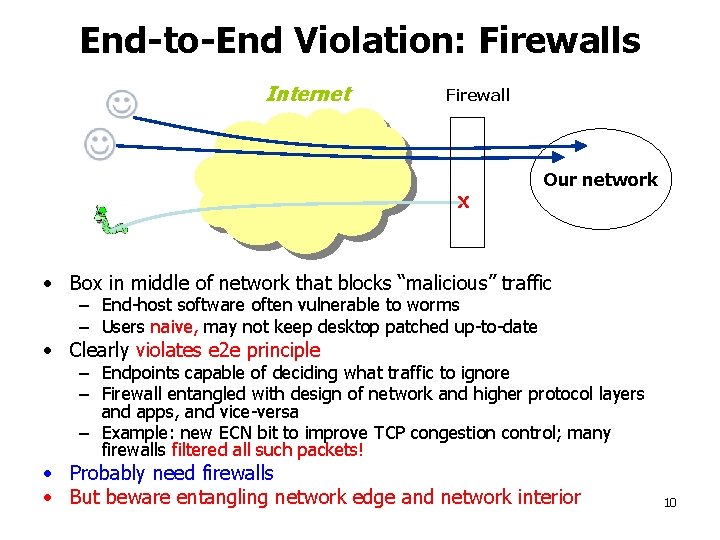
End-to-End Violation: Firewalls Internet Firewall Our network X • Box in middle of network that blocks “malicious” traffic – End-host software often vulnerable to worms – Users naive, may not keep desktop patched up-to-date • Clearly violates e 2 e principle – Endpoints capable of deciding what traffic to ignore – Firewall entangled with design of network and higher protocol layers and apps, and vice-versa – Example: new ECN bit to improve TCP congestion control; many firewalls filtered all such packets! • Probably need firewalls • But beware entangling network edge and network interior 10

Summary: End-to-End Principle • Many functions must be implemented at application endpoints to provide desired behavior, even if implemented in “middle” of network • End-to-end approach decouples design of components in network interior from design of applications at edges • Some functions still benefit from implementation in network interior; at cost of entangling interior and core – Performance (e. g. , link-layer retransmission) – Security (e. g. , firewalls) – Scalability (e. g. , routing) • End-to-end principle is not sacred; it’s a way to think critically about design choices in communication systems 11
- Slides: 11