
Endtoend Data Integrity for File Systems From ZFS

- Slides: 31
End-to-end Data Integrity for File Systems - From ZFS to 2 Z FS Yupu Zhang yupu@cs. wisc. edu 10/22/2021 1
Data Integrity In Reality • Preserving data integrity is a challenge • Imperfect components – Disk, firmware, controllers [Bairavasundaram 07, Anderson 03] • Techniques to maintain data integrity – Checksums [Stein 01, Bartlett 04], RAID [Patternson 88] • Enough about disk. What about memory? 10/22/2021 2
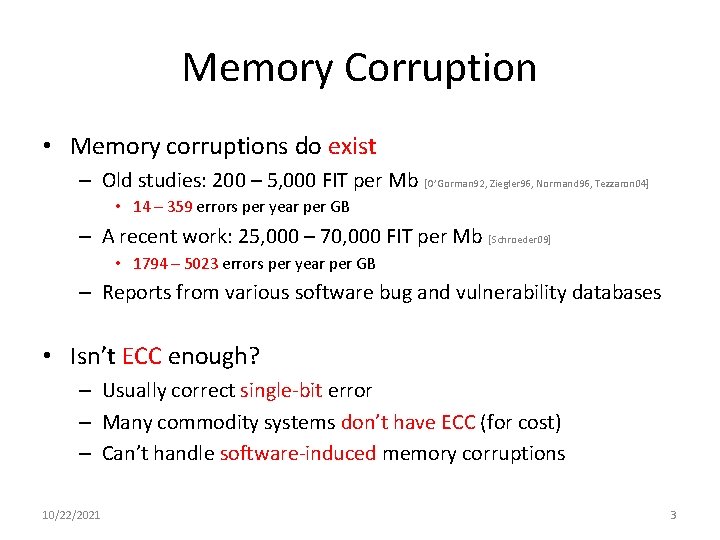
Memory Corruption • Memory corruptions do exist – Old studies: 200 – 5, 000 FIT per Mb [O’Gorman 92, Ziegler 96, Normand 96, Tezzaron 04] • 14 – 359 errors per year per GB – A recent work: 25, 000 – 70, 000 FIT per Mb [Schroeder 09] • 1794 – 5023 errors per year per GB – Reports from various software bug and vulnerability databases • Isn’t ECC enough? – Usually correct single-bit error – Many commodity systems don’t have ECC (for cost) – Can’t handle software-induced memory corruptions 10/22/2021 3
The Problem • File systems cache a large amount of data in memory for performance – Memory capacity is growing • File systems may cache data for a long time – Susceptible to memory corruptions • How robust are modern file systems to memory corruptions? 10/22/2021 4
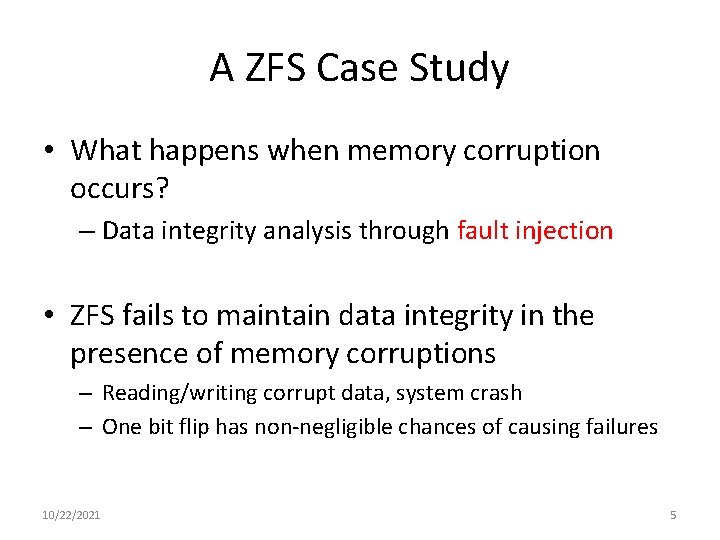
A ZFS Case Study • What happens when memory corruption occurs? – Data integrity analysis through fault injection • ZFS fails to maintain data integrity in the presence of memory corruptions – Reading/writing corrupt data, system crash – One bit flip has non-negligible chances of causing failures 10/22/2021 5
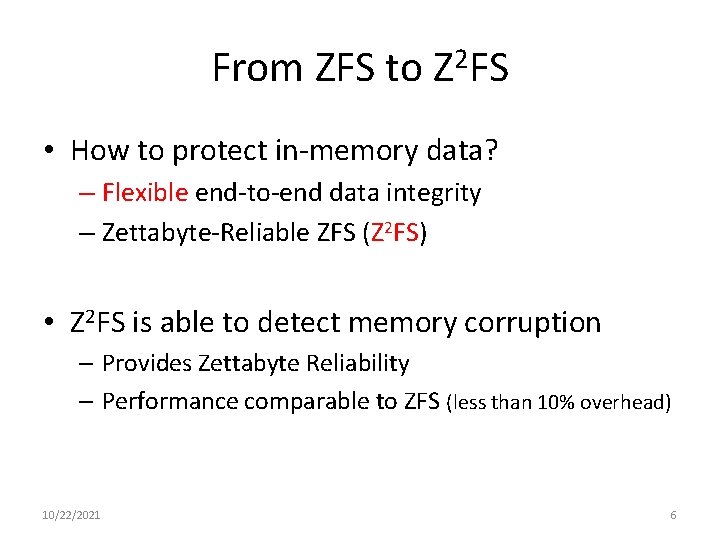
From ZFS to Z 2 FS • How to protect in-memory data? – Flexible end-to-end data integrity – Zettabyte-Reliable ZFS (Z 2 FS) • Z 2 FS is able to detect memory corruption – Provides Zettabyte Reliability – Performance comparable to ZFS (less than 10% overhead) 10/22/2021 6
Outline • Introduction • Data Integrity Analysis of ZFS – Random Test – Controlled Test • Zettabyte-Reliable ZFS (Z 2 FS) – Flexible End-to-end Data Integrity – Design and Implementation of Z 2 FS – Evaluation • Conclusion 10/22/2021 7
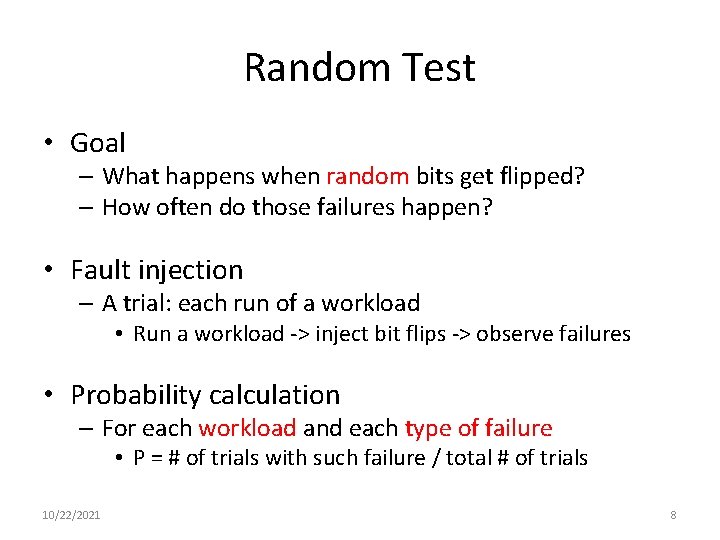
Random Test • Goal – What happens when random bits get flipped? – How often do those failures happen? • Fault injection – A trial: each run of a workload • Run a workload -> inject bit flips -> observe failures • Probability calculation – For each workload and each type of failure • P = # of trials with such failure / total # of trials 10/22/2021 8
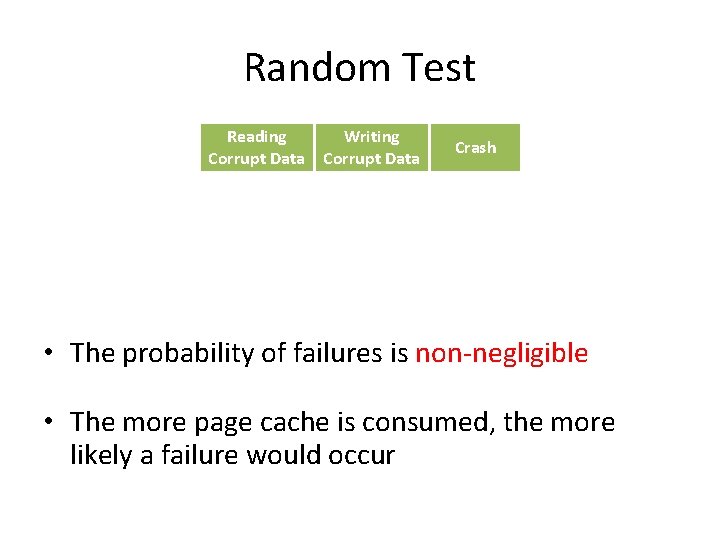
Random Test Reading Corrupt Data Writing Corrupt Data Crash Page Cache varmail 0. 6% 0. 0% 0. 3% 31 MB oltp 1. 9% 0. 1% 129 MB webserver 0. 7% 1. 4% 1. 3% 441 MB fileserver 7. 1% 3. 6% 1. 6% 915 MB Workload • The probability of failures is non-negligible • The more page cache is consumed, the more likely a failure would occur
Controlled Test • Goal – Why do those failures happen in ZFS? – How does ZFS react to memory corruptions? • Fault injection – Metadata: field by field – Data: a random bit in a data block • Workload – For global metadata: the “zfs” command – For file system level metadata and data: POSIX API 10/22/2021 10
Controlled Test • Data blocks in memory are not protected – Checksum is only used at the disk boundary • Metadata is critical – Bad data is returned, system crashes, or operations fail • In-mem data integrity is not preserved 10/22/2021 11
Outline • Introduction • Data Integrity Analysis of ZFS – Random Test – Controlled Test • Zettabyte-Reliable ZFS (Z 2 FS) – Flexible End-to-end Data Integrity – Design and Implementation of Z 2 FS – Evaluation • Conclusion 10/22/2021 12
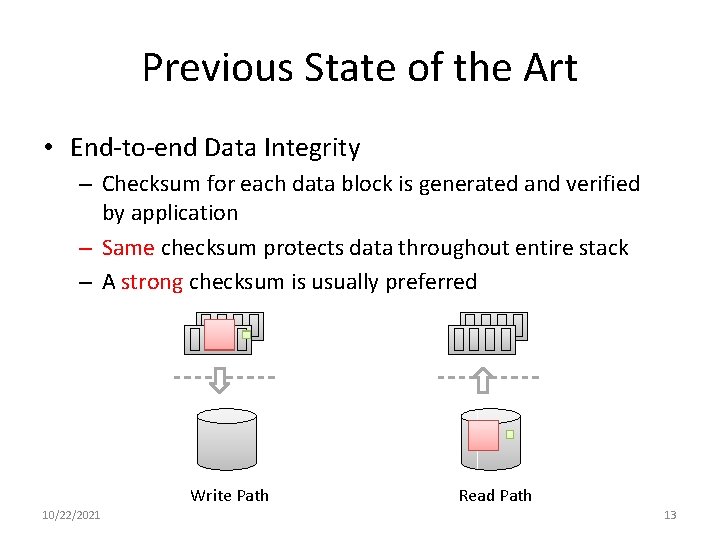
Previous State of the Art • End-to-end Data Integrity – Checksum for each data block is generated and verified by application – Same checksum protects data throughout entire stack – A strong checksum is usually preferred Write Path 10/22/2021 Read Path 13
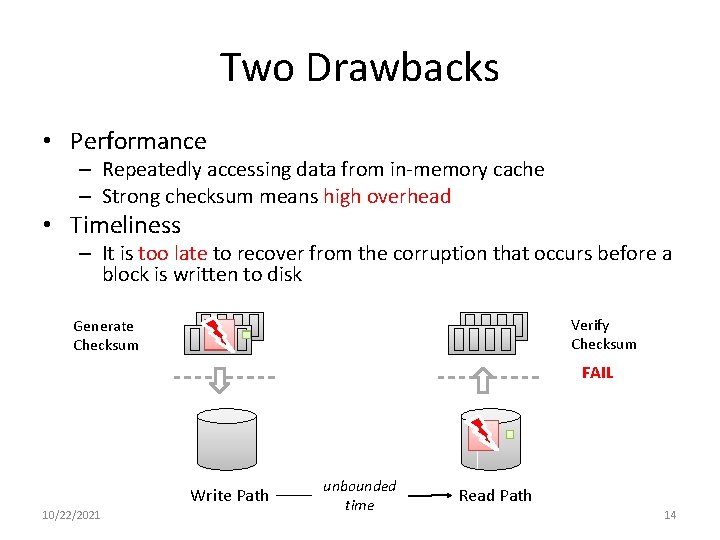
Two Drawbacks • Performance – Repeatedly accessing data from in-memory cache – Strong checksum means high overhead • Timeliness – It is too late to recover from the corruption that occurs before a block is written to disk Verify Checksum Generate Checksum FAIL Write Path 10/22/2021 unbounded time Read Path 14
Flexible End-to-end Data Integrity • Goal: balance performance and reliability – Change checksum across components or over time – Maintain Zettabyte Reliability • at most one undetected corruption per Zettabyte read • Performance – Fast but weaker checksum for in-memory data – Slow but stronger checksum for on-disk data • Timeliness – Each component is aware of the checksum – Verification catch corruption in time 10/22/2021 15
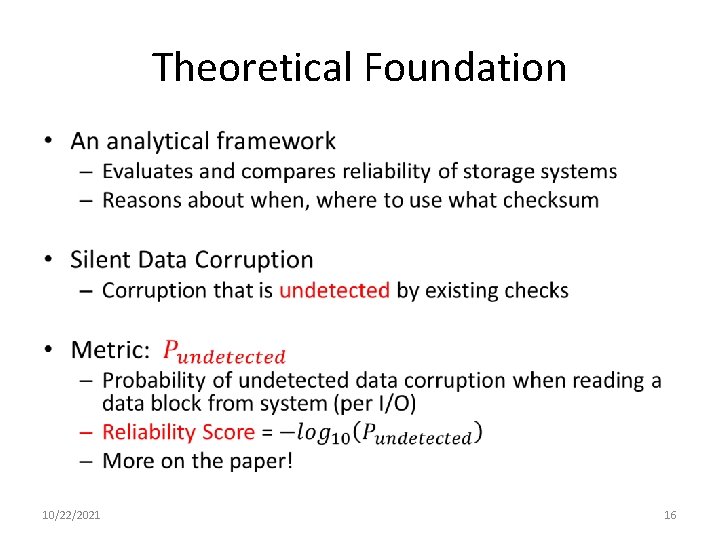
Theoretical Foundation • 10/22/2021 16
Outline • Introduction • Data Integrity Analysis of ZFS – Random Test – Controlled Test • Zettabyte-Reliable ZFS (Z 2 FS) – Flexible End-to-end Data Integrity – Design and Implementation of Z 2 FS – Evaluation • Conclusion 10/22/2021 17
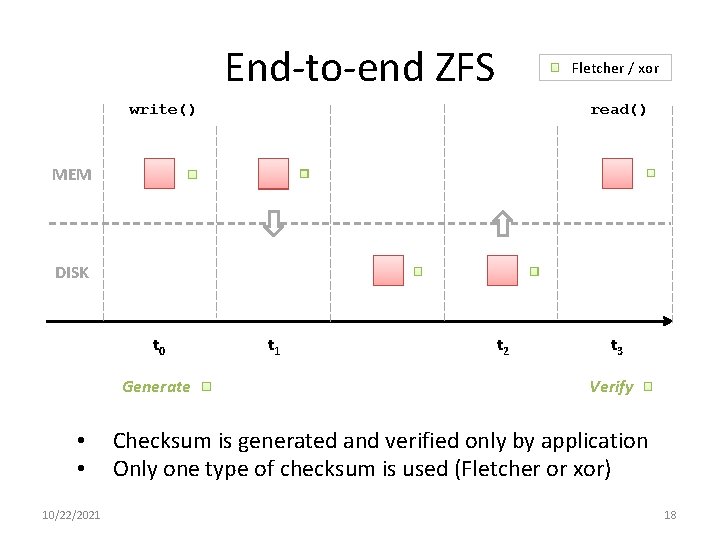
End-to-end ZFS Fletcher / xor write() read() MEM DISK t 0 Generate • • 10/22/2021 t 2 t 3 Verify Checksum is generated and verified only by application Only one type of checksum is used (Fletcher or xor) 18
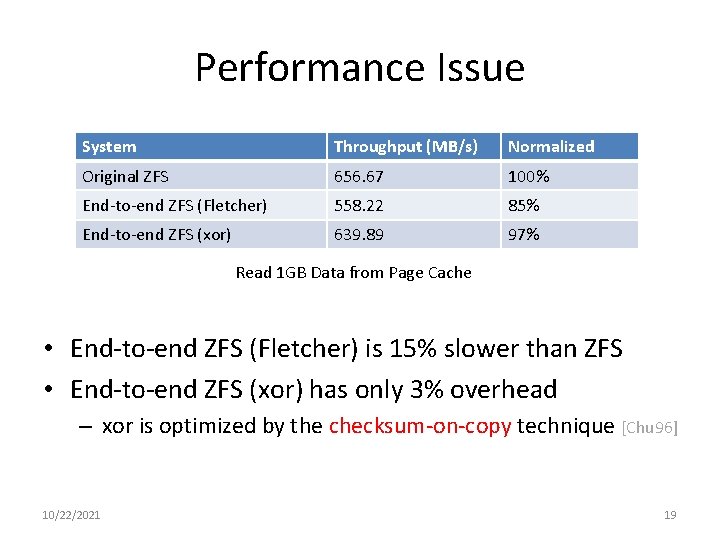
Performance Issue System Throughput (MB/s) Normalized Original ZFS 656. 67 100% End-to-end ZFS (Fletcher) 558. 22 85% End-to-end ZFS (xor) 639. 89 97% Read 1 GB Data from Page Cache • End-to-end ZFS (Fletcher) is 15% slower than ZFS • End-to-end ZFS (xor) has only 3% overhead – xor is optimized by the checksum-on-copy technique [Chu 96] 10/22/2021 19
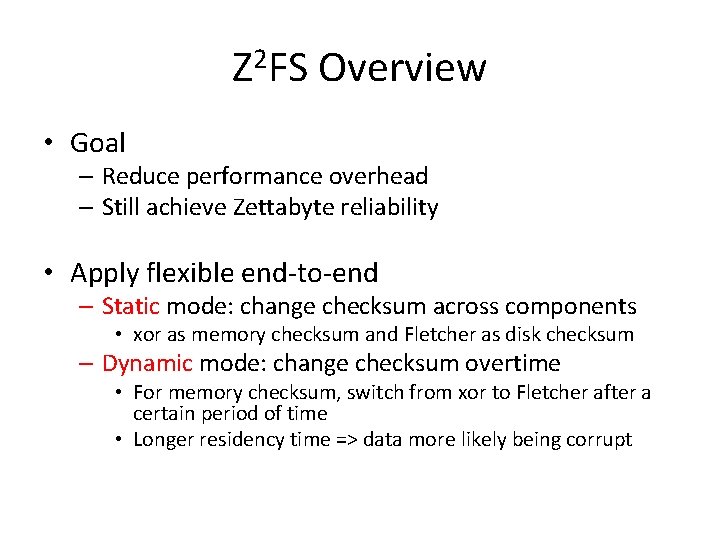
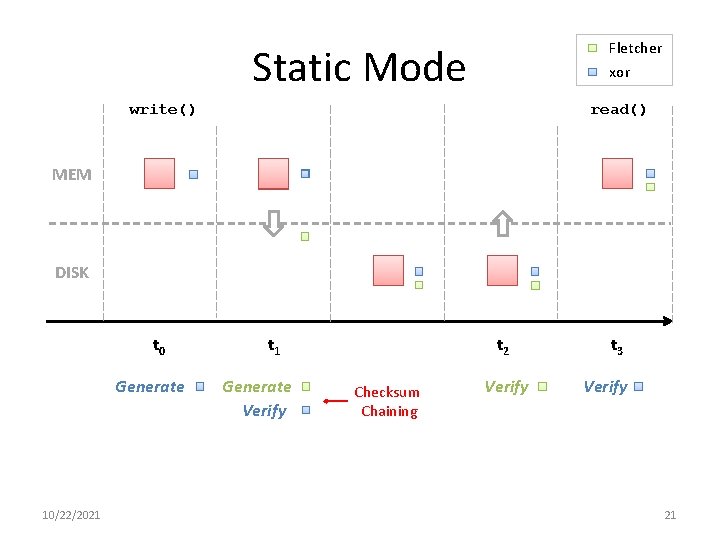
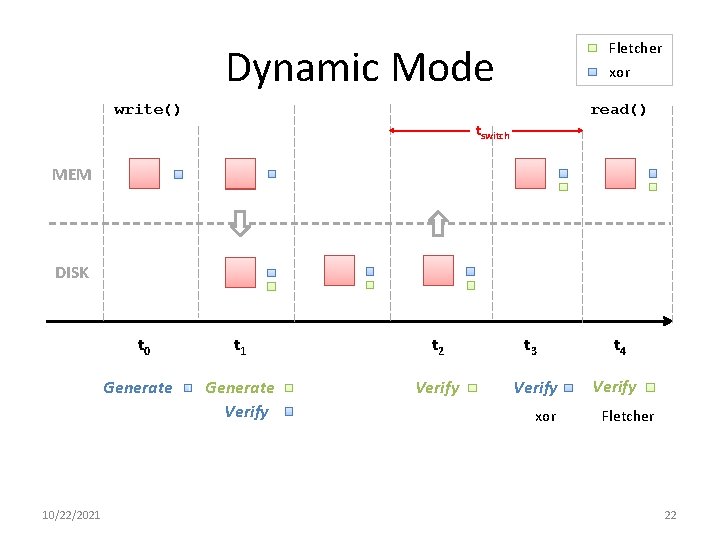
Z 2 FS Overview • Goal – Reduce performance overhead – Still achieve Zettabyte reliability • Apply flexible end-to-end – Static mode: change checksum across components • xor as memory checksum and Fletcher as disk checksum – Dynamic mode: change checksum overtime • For memory checksum, switch from xor to Fletcher after a certain period of time • Longer residency time => data more likely being corrupt
Fletcher xor Static Mode write() read() MEM DISK t 0 Generate 10/22/2021 t 1 Generate Verify t 2 Checksum Chaining Verify t 3 Verify 21
Fletcher xor Dynamic Mode write() read() tswitch MEM DISK t 0 Generate 10/22/2021 t 2 t 3 Generate Verify xor t 4 Verify Fletcher 22
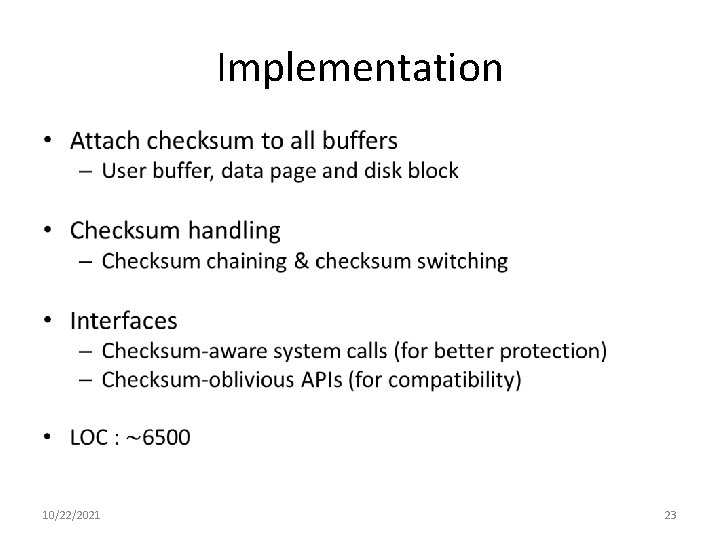
Implementation • 10/22/2021 23
Outline • Introduction • Data Integrity Analysis of ZFS – Random Test – Controlled Test • Zettabyte-Reliable ZFS (Z 2 FS) – Flexible End-to-end Data Integrity – Design and Implementation of Z 2 FS – Evaluation • Conclusion 10/22/2021 24
Evaluation • Q 1: How does Z 2 FS handle memory corruption? – Fault injection experiment • Q 2: What’s the overall performance of Z 2 FS? – Micro and macro benchmarks 10/22/2021 25
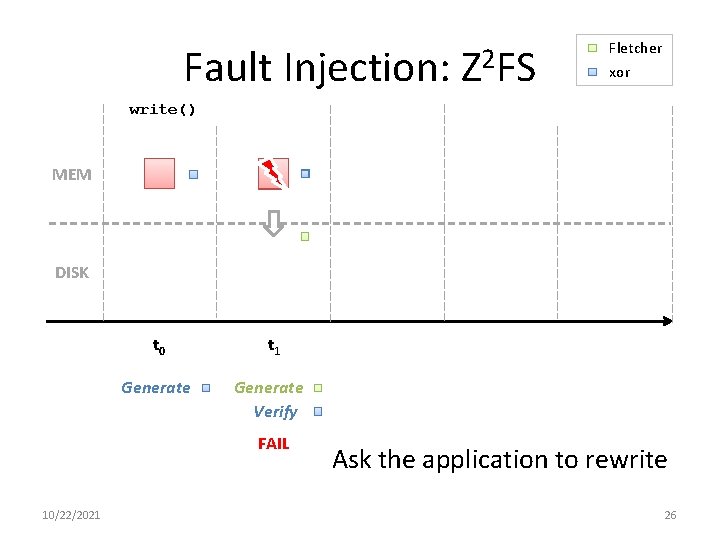
Fault Injection: Z 2 FS Fletcher xor write() MEM DISK t 0 t 1 Generate Verify FAIL 10/22/2021 Ask the application to rewrite 26
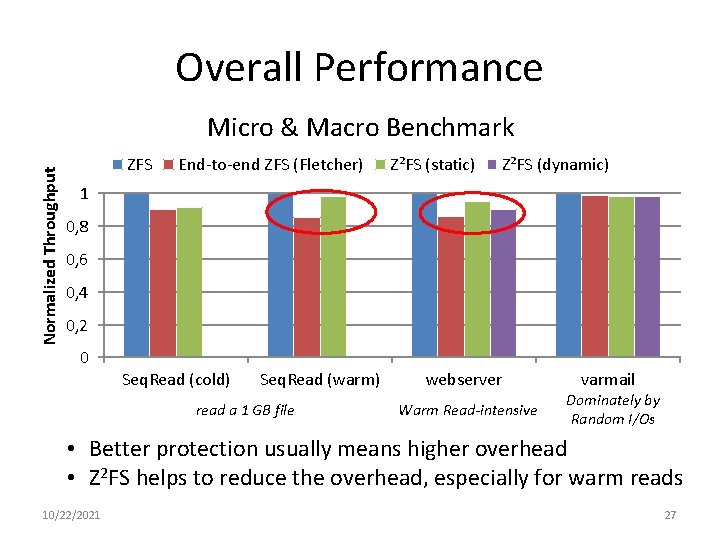
Overall Performance Normalized Throughput Micro & Macro Benchmark ZFS End-to-end ZFS (Fletcher) Z²FS (static) Z²FS (dynamic) 1 0, 8 0, 6 0, 4 0, 2 0 Seq. Read (cold) Seq. Read (warm) read a 1 GB file webserver Warm Read-intensive varmail Dominately by Random I/Os • Better protection usually means higher overhead • Z 2 FS helps to reduce the overhead, especially for warm reads 10/22/2021 27
Outline • Introduction • Data Integrity Analysis of ZFS – Random Test – Controlled Test • Flexible End-to-end Data Integrity – Overview – Design and Implementation – Evaluation • Conclusion 10/22/2021 28
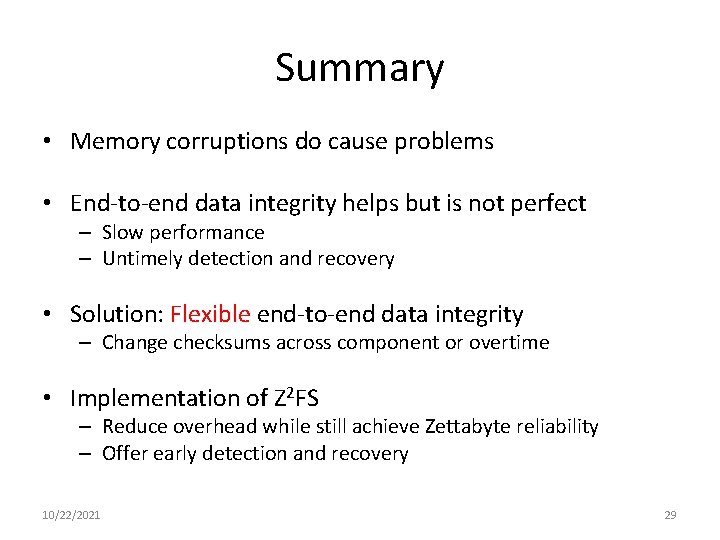
Summary • Memory corruptions do cause problems • End-to-end data integrity helps but is not perfect – Slow performance – Untimely detection and recovery • Solution: Flexible end-to-end data integrity – Change checksums across component or overtime • Implementation of Z 2 FS – Reduce overhead while still achieve Zettabyte reliability – Offer early detection and recovery 10/22/2021 29
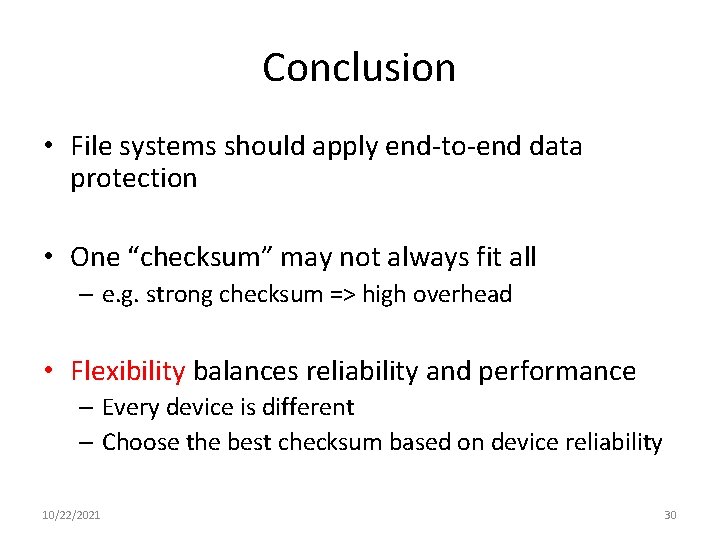
Conclusion • File systems should apply end-to-end data protection • One “checksum” may not always fit all – e. g. strong checksum => high overhead • Flexibility balances reliability and performance – Every device is different – Choose the best checksum based on device reliability 10/22/2021 30
Thank you! Questions? Advanced Systems Lab (ADSL) University of Wisconsin-Madison http: //www. cs. wisc. edu/adsl Wisconsin Institute on Software-defined Datacenters in Madison http: //wisdom. cs. wisc. edu/ 10/22/2021 31