
Endothermic Reactions Today you will be 1 learning
Endothermic Reactions Today you will be 1. learning about 2. endothermic reactions and their 3. uses. Starter Questions on Combustion Give an example of a combustion reaction? What type of reaction is this exothermic or endothermic? Explain why this reaction releases energy? 4. Suggest why these reactions changed the world? KEYWORDS: Exothermic, Endothermic, Energy level Profile
Learning Outcomes Grade 4– Describe the difference between exothermic and endothermic reactions. Grade 6 – Explain how energy change from a chemical reaction can be used. Grade 8 – Evaluate uses and applications of exothermic and endothermic reactions given appropriate information.
Homework • Homework: Students should research selfheating cans and find out the risks of using them to heat food. • Complete by the next lesson.
Exothermic Reactions An exothermic reaction is one that transfers energy FROM the reacting chemicals TO the surroundings. More simply, it’s a reaction that gives off heat LO: Understand exothermic and endothermic reactions

Exothermic Examples • Burning fuels • Neutralisation • Respiration http: //www. bbc. co. uk/learni ngzone/clips/exothermicchemicalreaction/10863. html LO: Understand exothermic and endothermic reactions
Endothermic Reactions An endothermic reaction is one that TAKES IN energy from the surroundings. These reactions are a lot less common than exothermic reactions http: //www. bbc. co. uk/learningzone/clips/endothermic -exothermic/13509. html LO: Understand exothermic and endothermic reactions

Practical – Endothermic reaction Aim: To investigate the temperature change during an endothermic reaction Method: 1. Measure out 20 cm³ of citric acid and place in a conical flask 2. Measure the initial temperature of the acid 3. Add three spatulas of sodium hydrogencarbonate and stir 4. Measure the temperature every 30 s for 4 minutes LO: Understand exothermic and endothermic reactions
Practical – Endothermic reaction Make a conclusion for how you know the reaction was an endothermic reaction. Use results from your experiment to back up your conclusion LO: Understand exothermic and endothermic reactions
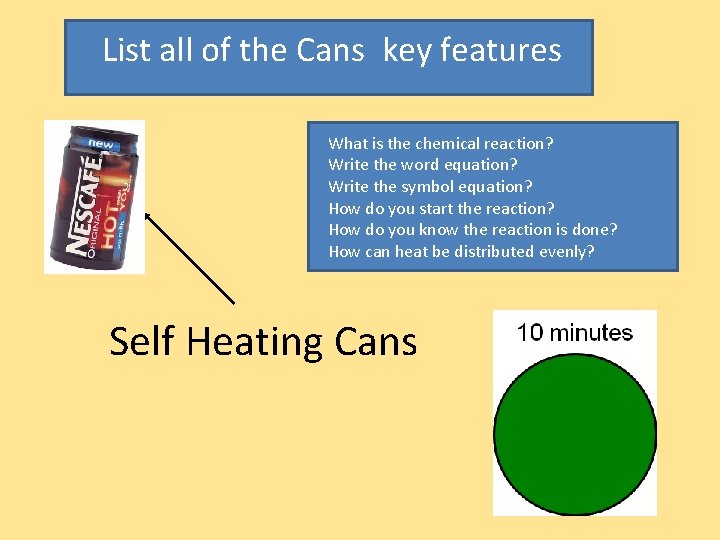
List all of the Cans key features What is the chemical reaction? Write the word equation? Write the symbol equation? How do you start the reaction? How do you know the reaction is done? How can heat be distributed evenly? Self Heating Cans

Hand warmers and self heating cans Reusable 1. Sodium ethanoate solution is dissolved in water, until no more will dissolve. 2. A small disc in the warmer is pressed, this scratches the metal and small metal particles are scraped off. 3. These metal particles “seed” the crystallisation. 4. This reaction gives off energy as heat. Boiling will reverse the change so it can be reused Single use 1. Iron oxidises to form iron (III) oxide. 2. This reaction releases energy as heat. 3. Sodium chloride is used as a catalyst to speed up the reaction. These types of hand warmers last a long time but they cannot be used again.
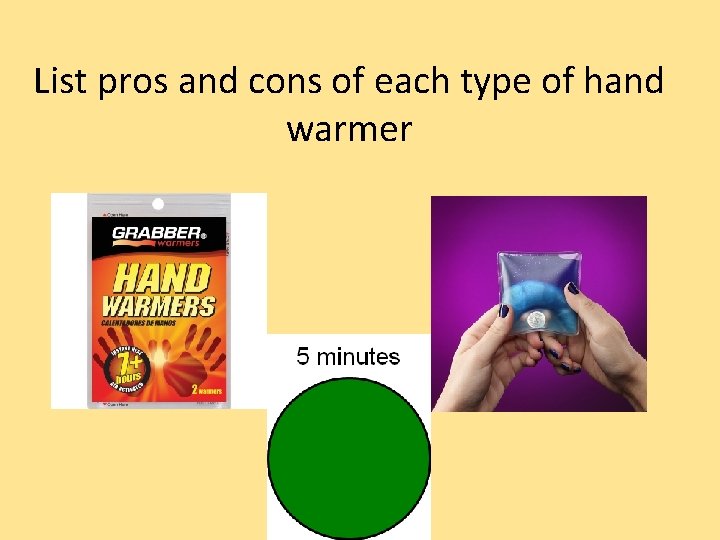
List pros and cons of each type of hand warmer
KNOWLEDGE CHECK 7 8 State what is meant by an exothermic and endothermic reaction Give two examples of exothermic reactions Start Timer 10 Minutes 10 8 6 4 9 Explain how chemical hand warmers work 2 0
- Slides: 12