
Endogenous Repair and Regeneration of Injured Articular Cartilage
- Slides: 1
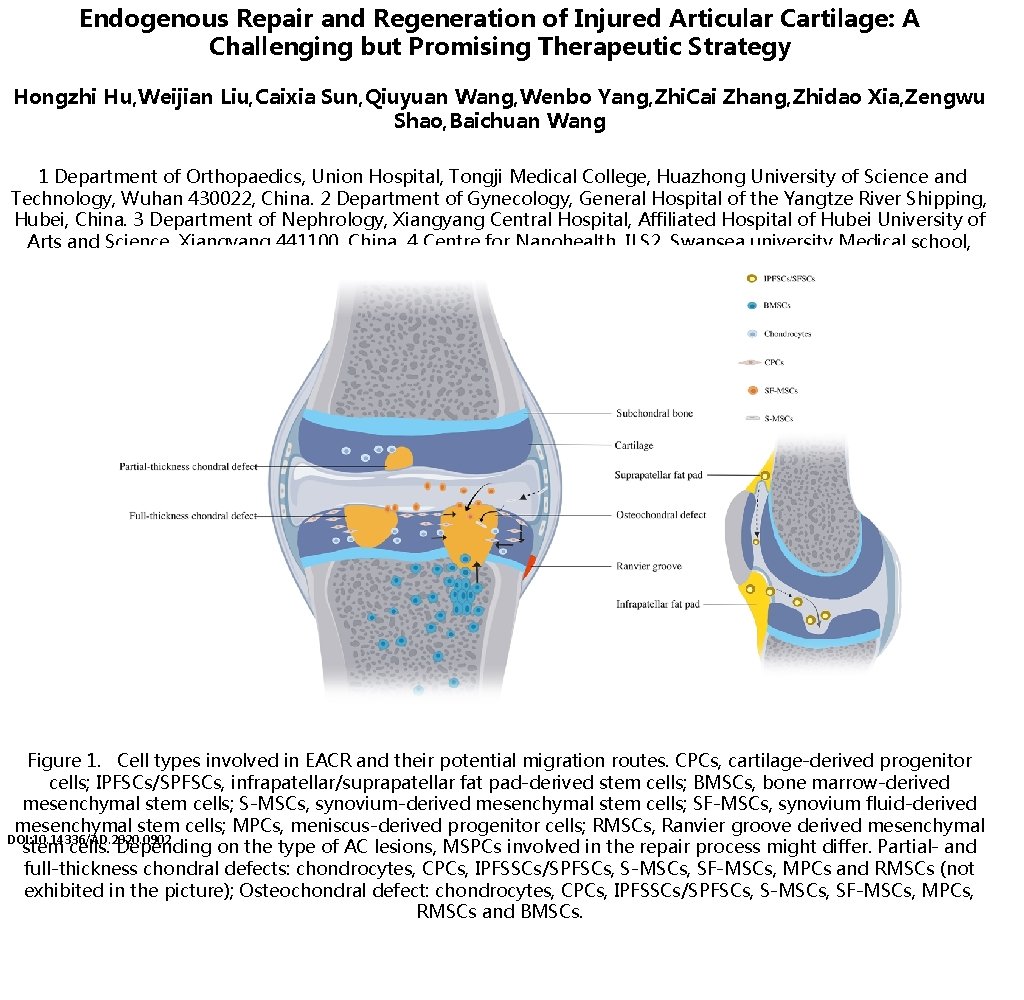
Endogenous Repair and Regeneration of Injured Articular Cartilage: A Challenging but Promising Therapeutic Strategy Hongzhi Hu, Weijian Liu, Caixia Sun, Qiuyuan Wang, Wenbo Yang, Zhi. Cai Zhang, Zhidao Xia, Zengwu Shao, Baichuan Wang 1 Department of Orthopaedics, Union Hospital, Tongji Medical College, Huazhong University of Science and Technology, Wuhan 430022, China. 2 Department of Gynecology, General Hospital of the Yangtze River Shipping, Hubei, China. 3 Department of Nephrology, Xiangyang Central Hospital, Affiliated Hospital of Hubei University of Arts and Science, Xiangyang 441100, China. 4 Centre for Nanohealth, ILS 2, Swansea university Medical school, Swansea, SA 213 8 PP, UK. Figure 1. Cell types involved in EACR and their potential migration routes. CPCs, cartilage-derived progenitor cells; IPFSCs/SPFSCs, infrapatellar/suprapatellar fat pad-derived stem cells; BMSCs, bone marrow-derived mesenchymal stem cells; S-MSCs, synovium-derived mesenchymal stem cells; SF-MSCs, synovium fluid-derived mesenchymal stem cells; MPCs, meniscus-derived progenitor cells; RMSCs, Ranvier groove derived mesenchymal DOI: 10. 14336/AD. 2020. 0902 stem cells. Depending on the type of AC lesions, MSPCs involved in the repair process might differ. Partial- and full-thickness chondral defects: chondrocytes, CPCs, IPFSSCs/SPFSCs, S-MSCs, SF-MSCs, MPCs and RMSCs (not exhibited in the picture); Osteochondral defect: chondrocytes, CPCs, IPFSSCs/SPFSCs, S-MSCs, SF-MSCs, MPCs, RMSCs and BMSCs.