
Endocrinology of the Epididymis and Sperm Maturation John
- Slides: 38
Endocrinology of the Epididymis and Sperm Maturation John Parrish Department of Animal Sciences References: The Physiology of Reproduction, Knobil and Neill, 2006; Chapter on the Epididymis by Robaire
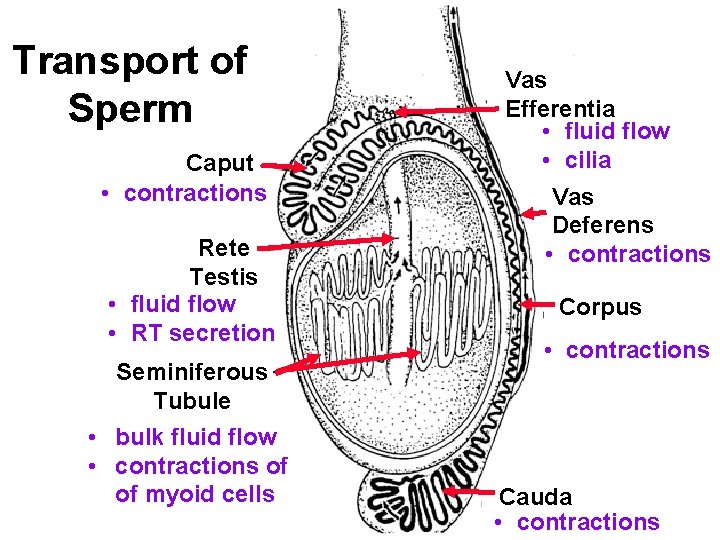
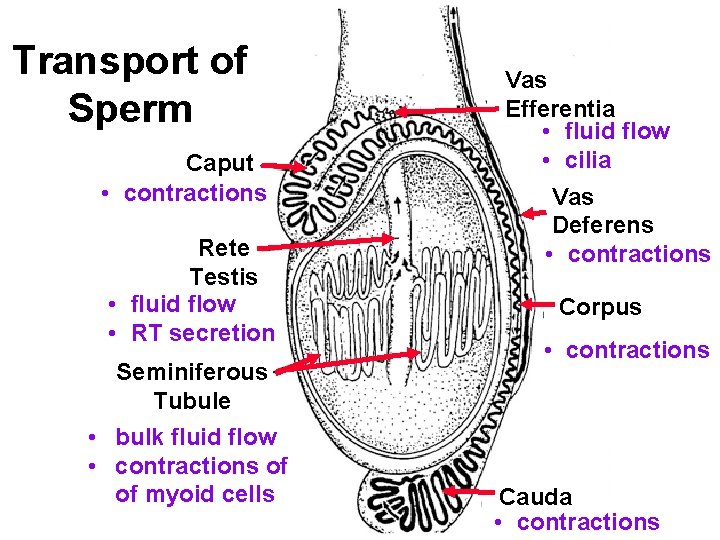
Transport of Sperm Caput • contractions Rete Testis • fluid flow • RT secretion Seminiferous Tubule • bulk fluid flow • contractions of of myoid cells Vas Efferentia • fluid flow • cilia Vas Deferens • contractions Corpus • contractions Cauda • contractions
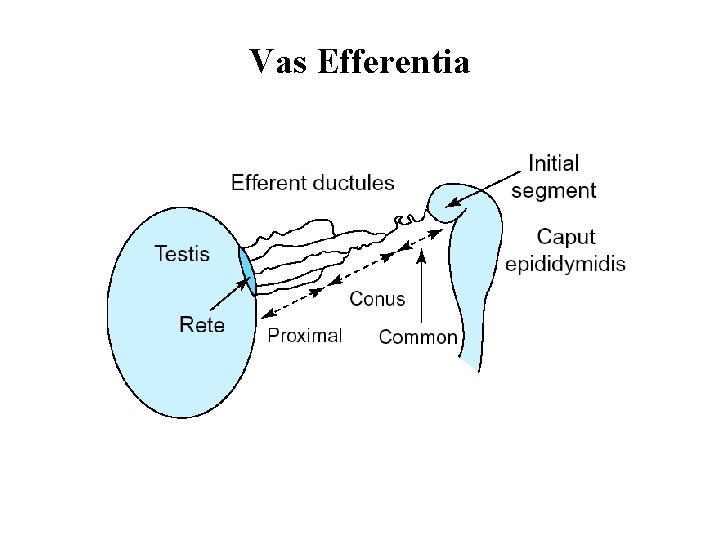
Vas Efferentia
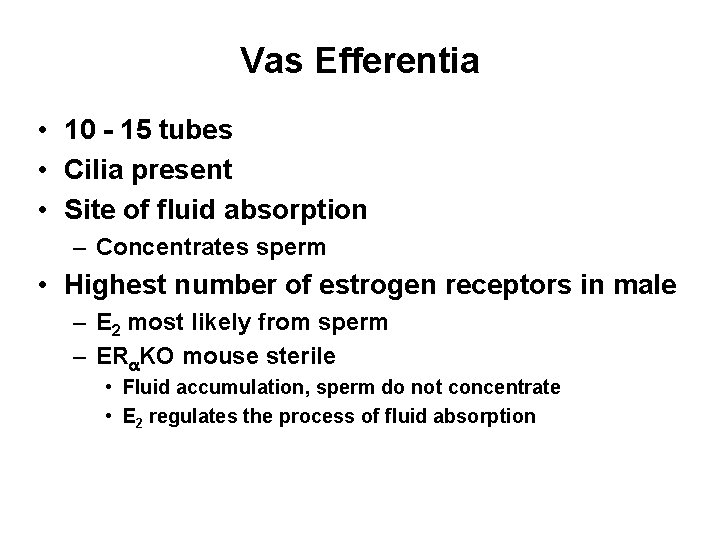
Vas Efferentia • 10 - 15 tubes • Cilia present • Site of fluid absorption (90%) – Concentrates sperm • Highest number of estrogen receptors in male
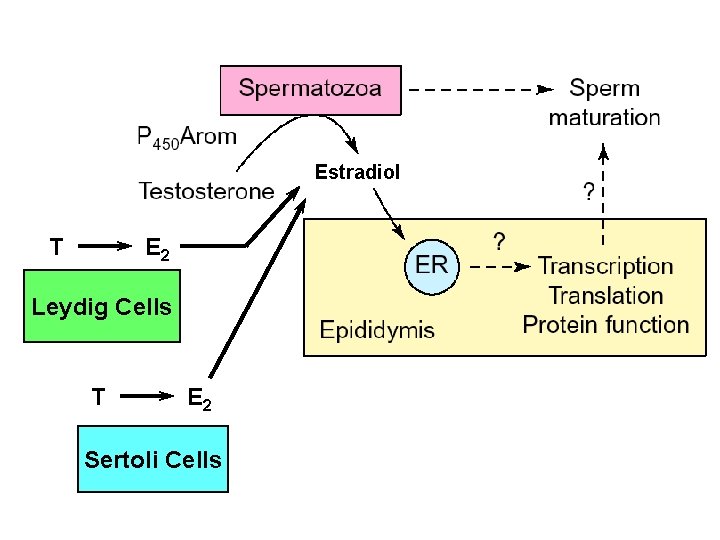
Estradiol T E 2 Leydig Cells T E 2 Sertoli Cells
Vas Efferentia • 10 - 15 tubes • Cilia present • Site of fluid absorption – Concentrates sperm • Highest number of estrogen receptors in male – E 2 most likely from sperm – ER KO mouse sterile • Fluid accumulation, sperm do not concentrate • E 2 regulates the process of fluid absorption
Transport of Sperm Caput • contractions Rete Testis • fluid flow • RT secretion Seminiferous Tubule • bulk fluid flow • contractions of of myoid cells Vas Efferentia • fluid flow • cilia Vas Deferens • contractions Corpus • contractions Cauda • contractions
Epididymis • Originally not thought to affect sperm but was only a holding tube. • Requires 10 -14 days for sperm to transit – Sperm maturation was only an aging effect • Numerous studies have shown though that the epididymis is actively involved in sperm maturation.
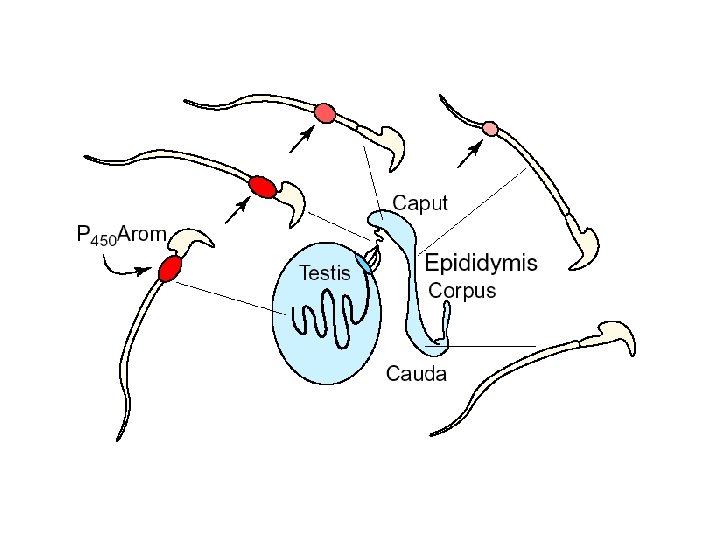
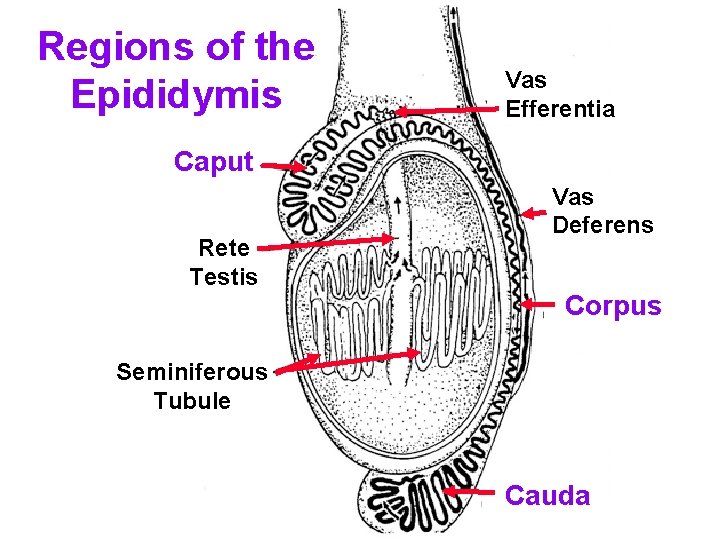
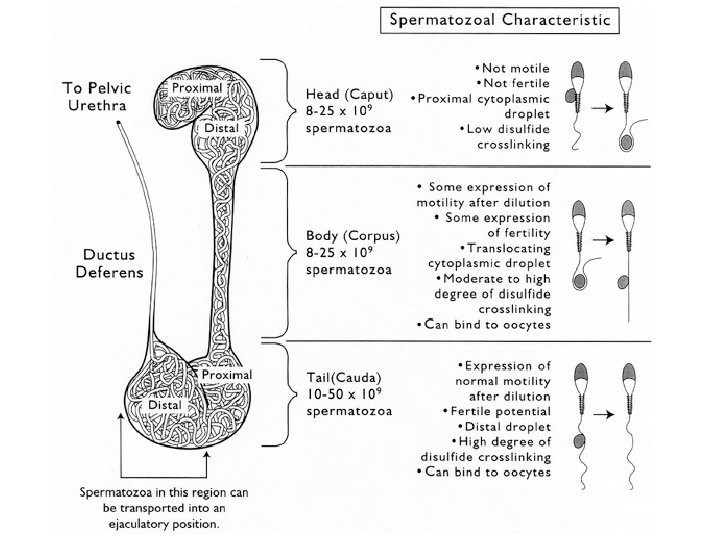
Epididymal Structure • caput – receives sperm from efferent ducts • corpus – connects caput to cauda • cauda – stores sperm before ejaculation
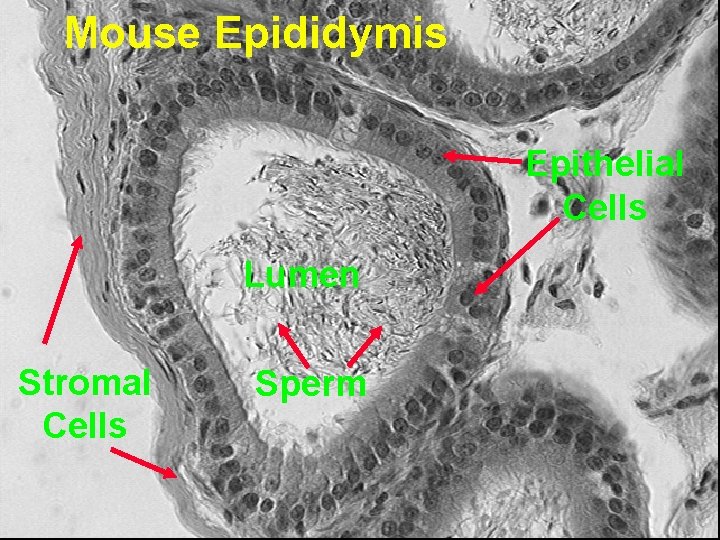
Mouse Epididymis Epithelial Cells Lumen Stromal Cells Sperm
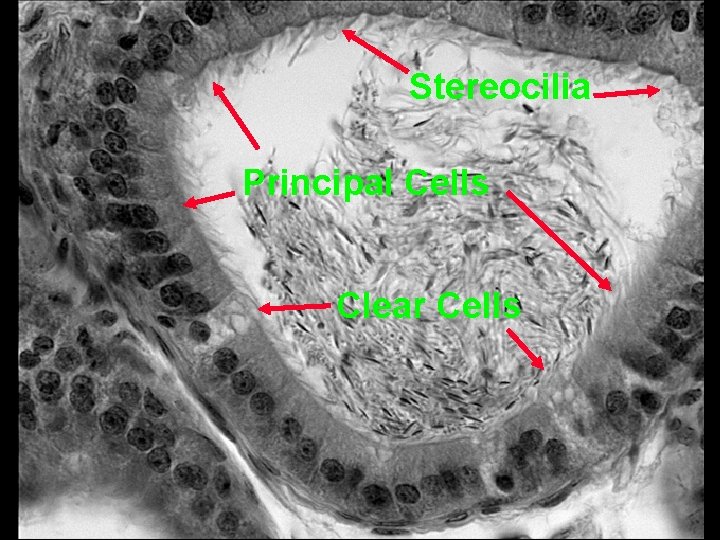
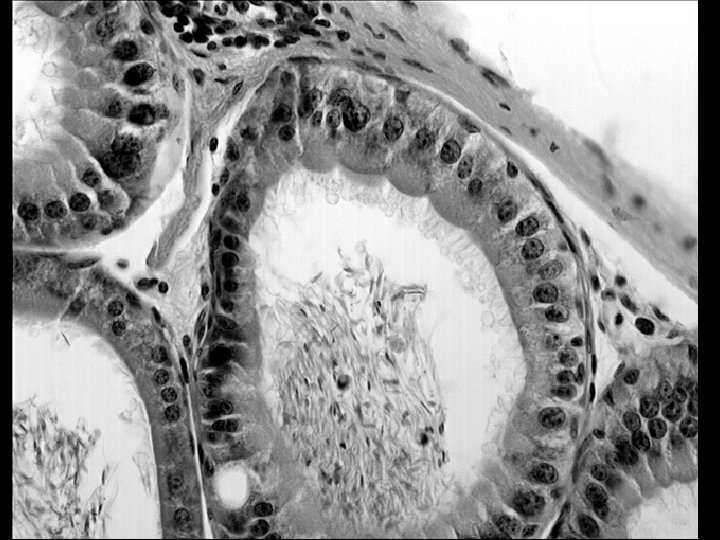
Epithelial Cells of the Epididymis • Surrounded by stromal layer • Epithelium - Psuedostratified – Principal cells (59%) • • tall columnar and with stereocilia secretion, transport and absorption the height varies with epididymal segment only cells that express 5 -Reductase (5 -Rx)
Stereocilia Principal Cells Clear Cells
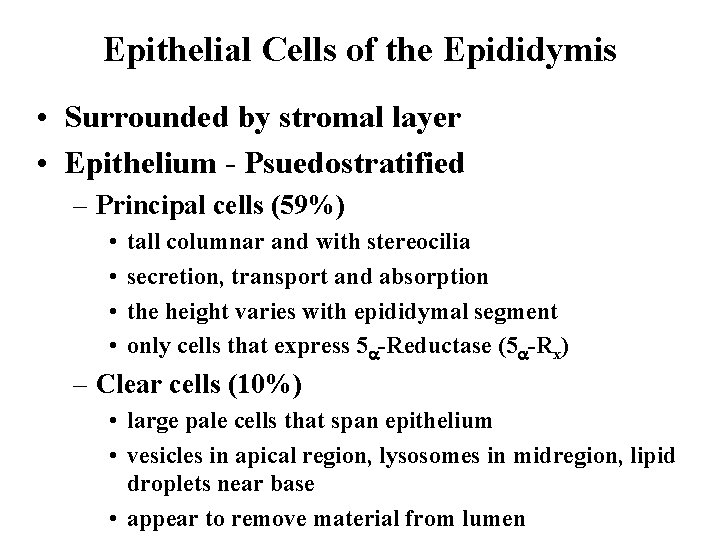
Epithelial Cells of the Epididymis • Surrounded by stromal layer • Epithelium - Psuedostratified – Principal cells (59%) • • tall columnar and with stereocilia secretion, transport and absorption the height varies with epididymal segment only cells that express 5 -Reductase (5 -Rx) – Clear cells (10%) • large pale cells that span epithelium • vesicles in apical region, lysosomes in midregion, lipid droplets near base • appear to remove material from lumen
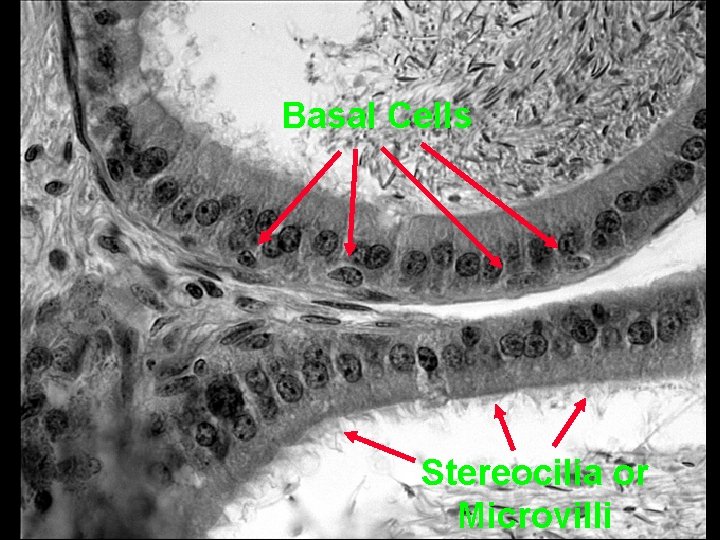
Basal Cells Stereocilia or Microvilli
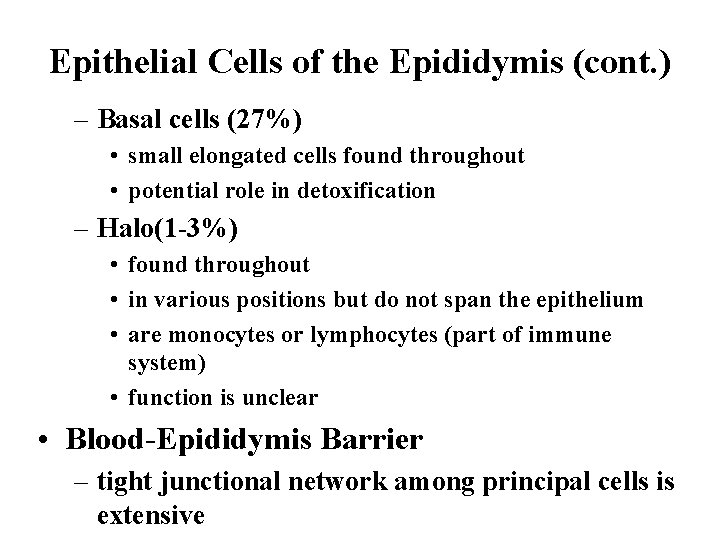
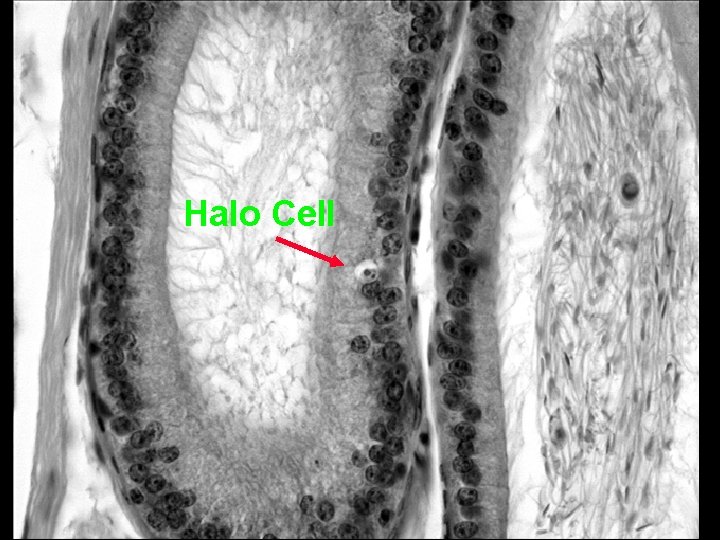
Epithelial Cells of the Epididymis (cont. ) – Basal cells (27%) • small elongated cells found throughout • potential role in detoxification – Halo(1 -3%) • found throughout • in various positions but do not span the epithelium • are monocytes or lymphocytes (part of immune system) • function is unclear • Blood-Epididymis Barrier – tight junctional network among principal cells is extensive
Halo Cell
Epithelial Cells of the Epididymis (cont. ) – Basal cells (27%) • small elongated cells found throughout • potential role in detoxification – Halo(1 -3%) • found throughout • in various positions but do not span the epithelium • are monocytes or lymphocytes (part of immune system) • function is unclear • Blood-Epididymis Barrier – tight junctional network among principal cells is extensive
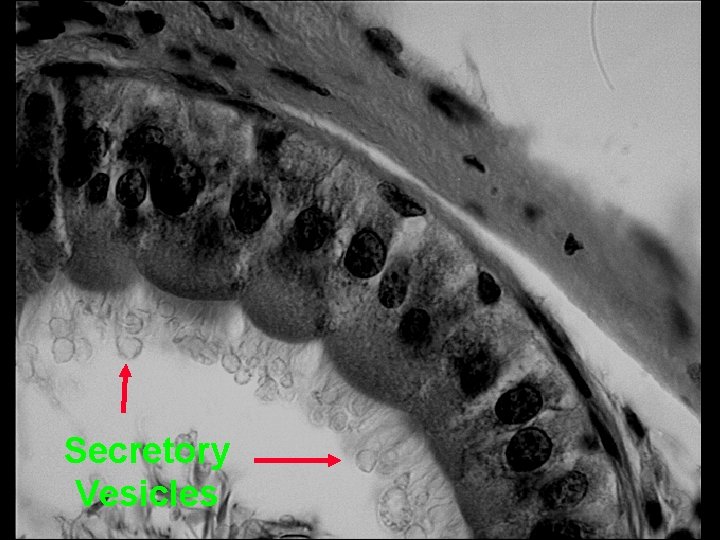
Secretory Vesicles
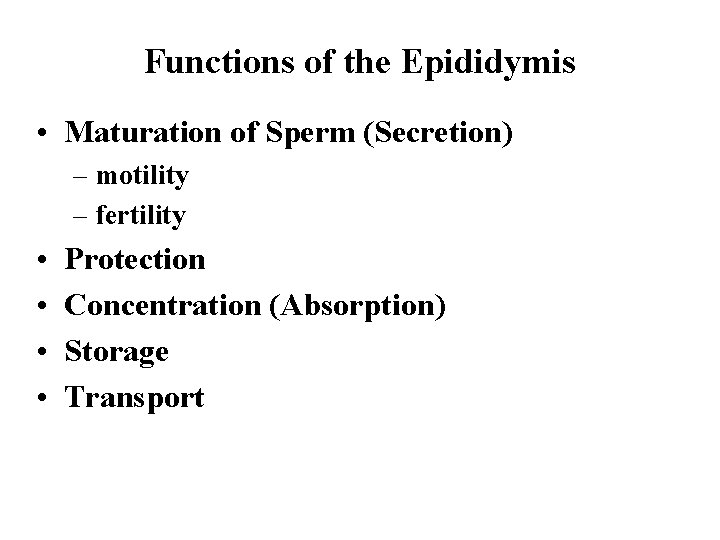
Functions of the Epididymis • Maturation of Sperm (Secretion) – motility – fertility • • Protection Concentration (Absorption) Storage Transport
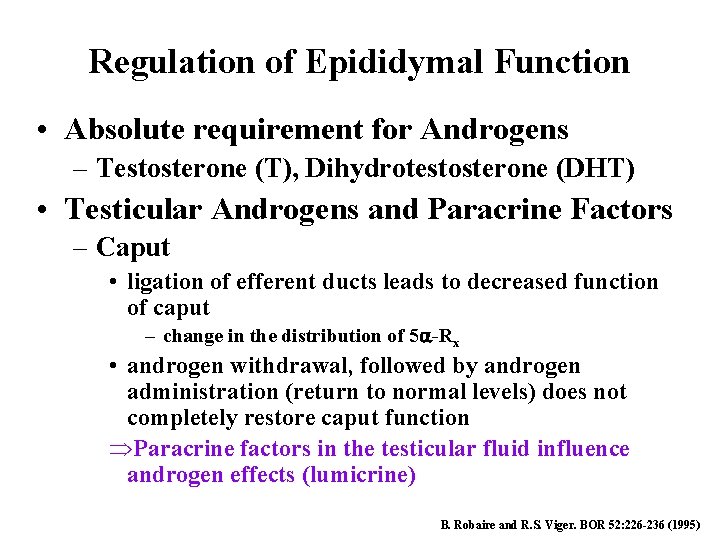
Regulation of Epididymal Function • Absolute requirement for Androgens – Testosterone (T), Dihydrotestosterone (DHT) • Testicular Androgens and Paracrine Factors – Caput • ligation of efferent ducts leads to decreased function of caput – change in the distribution of 5 -Rx • androgen withdrawal, followed by androgen administration (return to normal levels) does not completely restore caput function Paracrine factors in the testicular fluid influence androgen effects (lumicrine) B. Robaire and R. S. Viger. BOR 52: 226 -236 (1995)
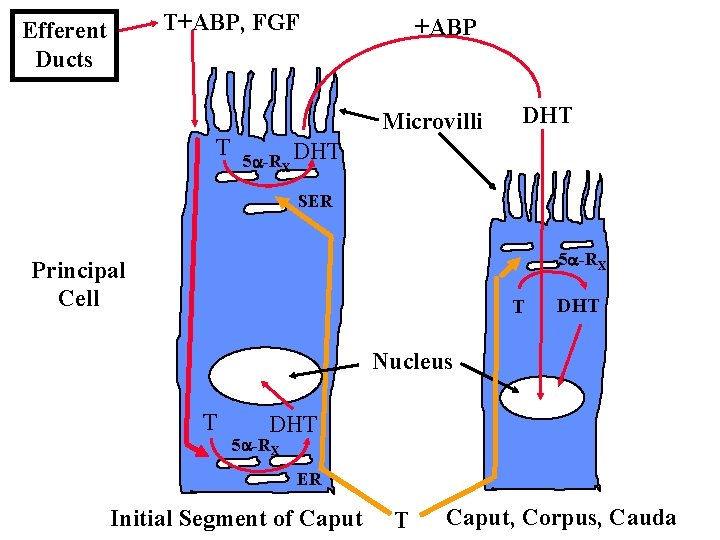
T+ABP, FGF Efferent Ducts T +ABP Microvilli DHT 5 -RX DHT SER 5 -RX Principal Cell T DHT Nucleus T DHT 5 -RX ER Initial Segment of Caput T Caput, Corpus, Cauda
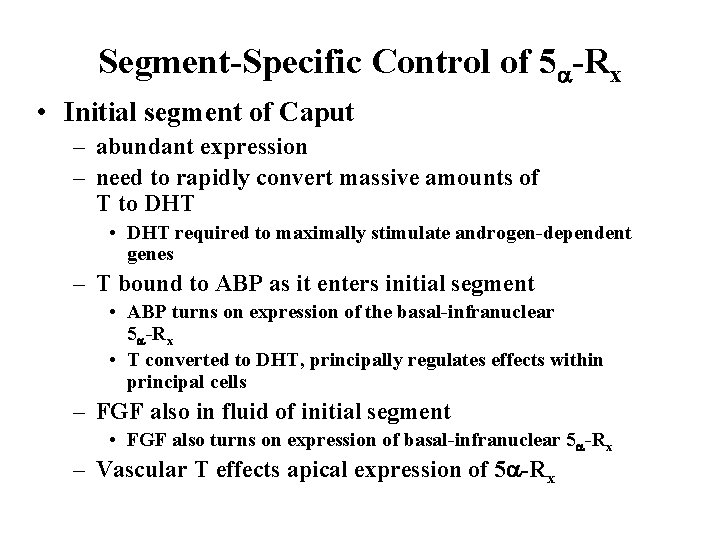
Segment-Specific Control of 5 -Rx • Initial segment of Caput – abundant expression – need to rapidly convert massive amounts of T to DHT • DHT required to maximally stimulate androgen-dependent genes – T bound to ABP as it enters initial segment • ABP turns on expression of the basal-infranuclear 5 -Rx • T converted to DHT, principally regulates effects within principal cells – FGF also in fluid of initial segment • FGF also turns on expression of basal-infranuclear 5 -Rx – Vascular T effects apical expression of 5 -Rx
Segment-Specific Control of 5 -Rx (cont. ) • Proximal and Distal Caput, Corpus, Cauda – Vascular T effects apical expression of 5 -Rx
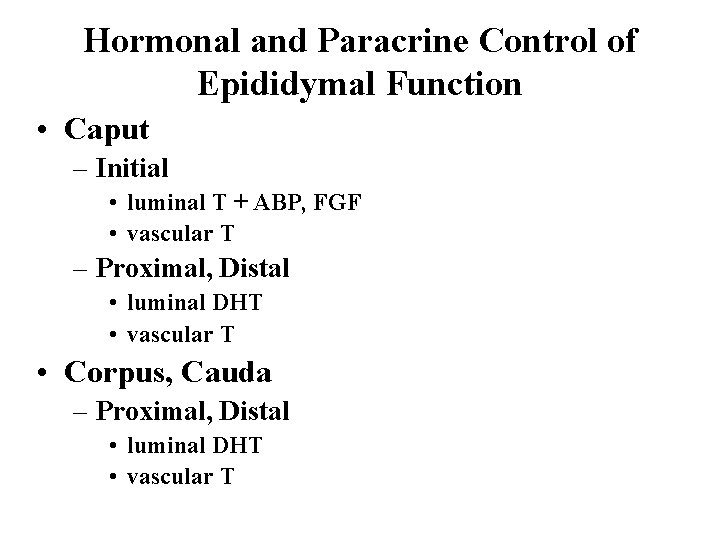
Hormonal and Paracrine Control of Epididymal Function • Caput – Initial • luminal T + ABP, FGF • vascular T – Proximal, Distal • luminal DHT • vascular T • Corpus, Cauda – Proximal, Distal • luminal DHT • vascular T
Functions of the Epididymis • Maturation of Sperm (Secretion) – motility – fertility • • Protection Concentration Storage Transport
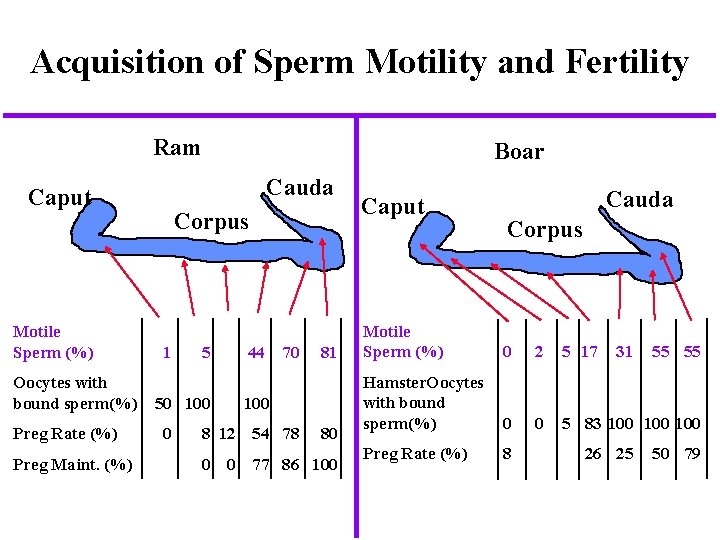
Acquisition of Sperm Motility and Fertility Ram Cauda Caput Motile Sperm (%) Oocytes with bound sperm(%) Preg Rate (%) Preg Maint. (%) Boar Corpus 1 5 50 100 0 44 70 81 100 8 12 54 78 80 0 0 77 86 100 Caput Cauda Corpus Motile Sperm (%) 0 2 5 17 Hamster. Oocytes with bound sperm(%) 0 0 5 83 100 100 Preg Rate (%) 8 31 26 25 55 55 50 79
Functions of the Epididymis • Maturation of Sperm (Secretion) – motility – fertility • • Protection Concentration Storage Transport
Protection • Blood-epididymis barrier • Role of epididymal proteins – Protease inhibitors – Compliment mediated cell lysis inhibitor, clusterin • Oxidative stress – superoxide dismutase, catalase, glutathione peroxidase
Functions of the Epididymis • Maturation of Sperm (Secretion) – motility – fertility • • Protection Concentration Storage Transport
Concentration • Absorption of fluid in the initial and proximal caput – principal cells are involved • take on shape of water transporting epithelium such as in the kidney • tall columnar epithelium • presence of tight junctions among principal cells to form blood-epididymal barrier
Functions of the Epididymis • Maturation of Sperm (Secretion) – motility – fertility • • Protection Concentration Storage Transport
Energy Metabolism • Lipids – ability to utilize lipids develops during epididymal maturation – carnitine is taken up by sperm during epididymal passage – metabolism of lipid leads to acetylation of carnitine that is then transported into mitochondria and is involved in respiration. – lipids utilized are likely not of structural importance – there is uptake of fatty acids secreted by the principal cells
Energy Metabolism • Lactate – secreted by epithelial cells and can be utilized by sperm – was primary energy source for spermatids • Glucose – usually not present • Amino acids – don’t appear to use very much
Functions of the Epididymis • Maturation of Sperm (Secretion) – motility – fertility • • Protection Concentration Storage Transport – fluid flow – muscle contractions
Regions of the Epididymis Vas Efferentia Caput Rete Testis Vas Deferens Corpus Seminiferous Tubule Cauda