
Endocrine Glands Part 1 Introduction Many thyroid disorders
- Slides: 6
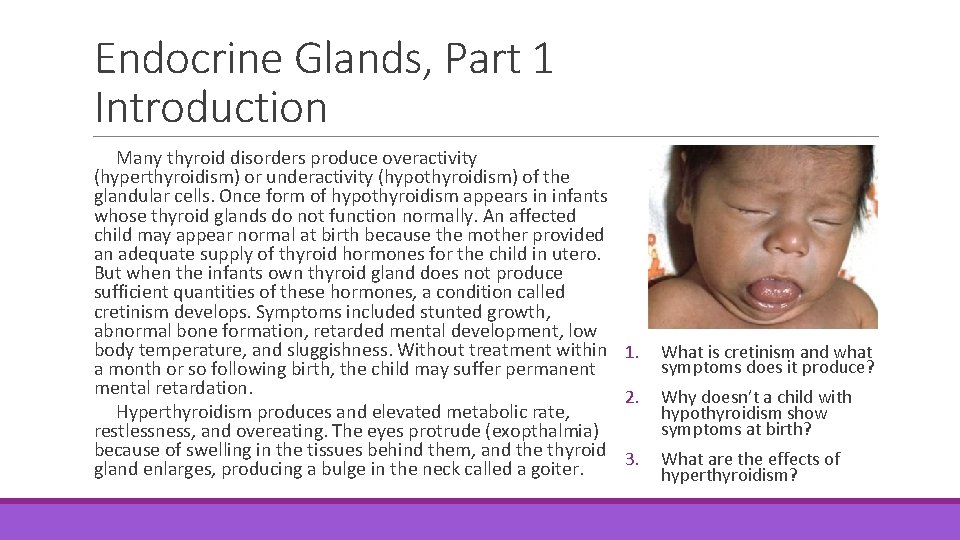
Endocrine Glands, Part 1 Introduction Many thyroid disorders produce overactivity (hyperthyroidism) or underactivity (hypothyroidism) of the glandular cells. Once form of hypothyroidism appears in infants whose thyroid glands do not function normally. An affected child may appear normal at birth because the mother provided an adequate supply of thyroid hormones for the child in utero. But when the infants own thyroid gland does not produce sufficient quantities of these hormones, a condition called cretinism develops. Symptoms included stunted growth, abnormal bone formation, retarded mental development, low body temperature, and sluggishness. Without treatment within 1. a month or so following birth, the child may suffer permanent mental retardation. 2. Hyperthyroidism produces and elevated metabolic rate, restlessness, and overeating. The eyes protrude (exopthalmia) because of swelling in the tissues behind them, and the thyroid 3. gland enlarges, producing a bulge in the neck called a goiter. What is cretinism and what symptoms does it produce? Why doesn’t a child with hypothyroidism show symptoms at birth? What are the effects of hyperthyroidism?
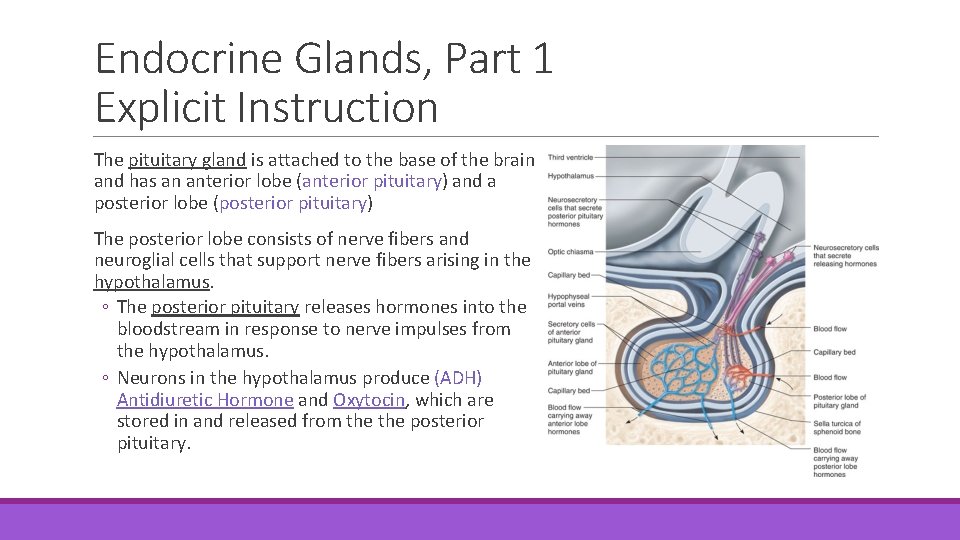
Endocrine Glands, Part 1 Explicit Instruction The pituitary gland is attached to the base of the brain and has an anterior lobe (anterior pituitary) and a posterior lobe (posterior pituitary) The posterior lobe consists of nerve fibers and neuroglial cells that support nerve fibers arising in the hypothalamus. ◦ The posterior pituitary releases hormones into the bloodstream in response to nerve impulses from the hypothalamus. ◦ Neurons in the hypothalamus produce (ADH) Antidiuretic Hormone and Oxytocin, which are stored in and released from the posterior pituitary.
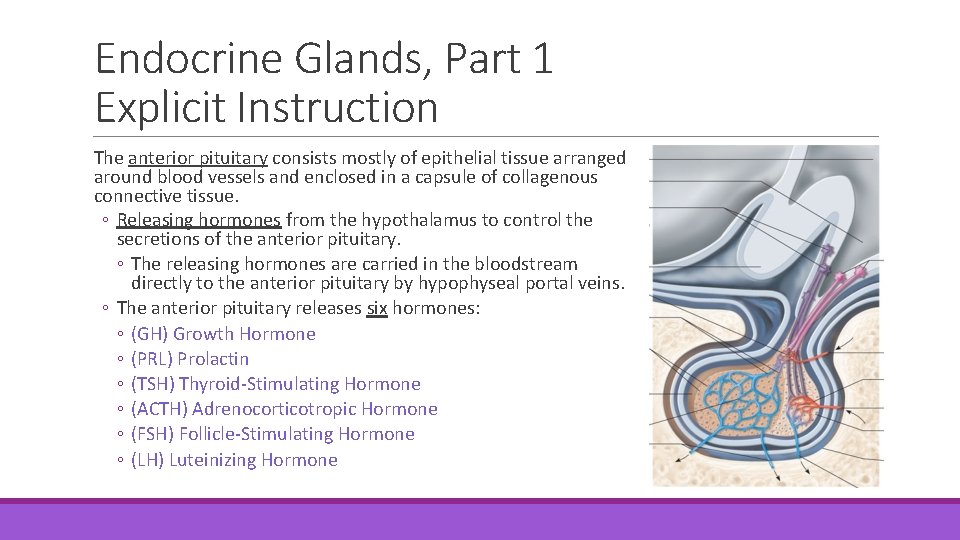
Endocrine Glands, Part 1 Explicit Instruction The anterior pituitary consists mostly of epithelial tissue arranged around blood vessels and enclosed in a capsule of collagenous connective tissue. ◦ Releasing hormones from the hypothalamus to control the secretions of the anterior pituitary. ◦ The releasing hormones are carried in the bloodstream directly to the anterior pituitary by hypophyseal portal veins. ◦ The anterior pituitary releases six hormones: ◦ (GH) Growth Hormone ◦ (PRL) Prolactin ◦ (TSH) Thyroid-Stimulating Hormone ◦ (ACTH) Adrenocorticotropic Hormone ◦ (FSH) Follicle-Stimulating Hormone ◦ (LH) Luteinizing Hormone
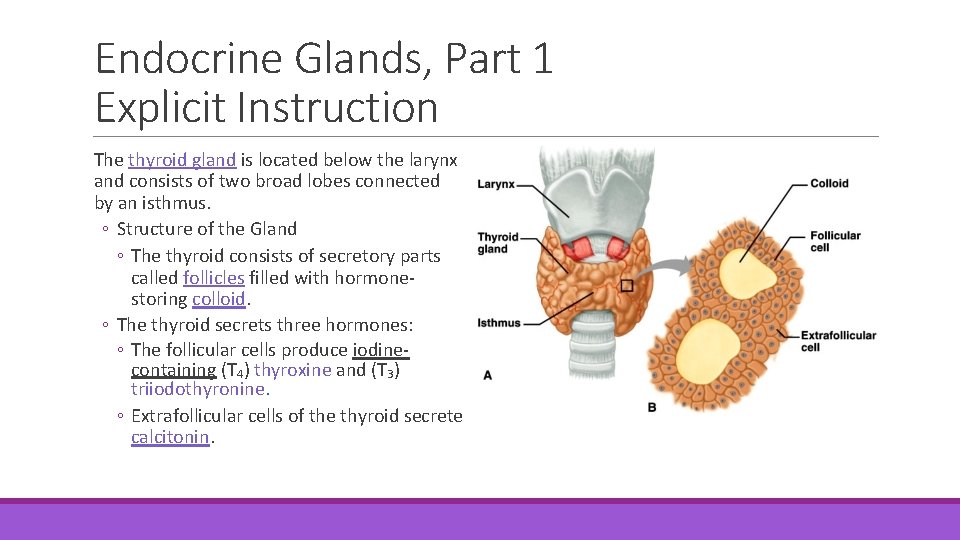
Endocrine Glands, Part 1 Explicit Instruction The thyroid gland is located below the larynx and consists of two broad lobes connected by an isthmus. ◦ Structure of the Gland ◦ The thyroid consists of secretory parts called follicles filled with hormonestoring colloid. ◦ The thyroid secrets three hormones: ◦ The follicular cells produce iodinecontaining (T 4) thyroxine and (T 3) triiodothyronine. ◦ Extrafollicular cells of the thyroid secrete calcitonin.
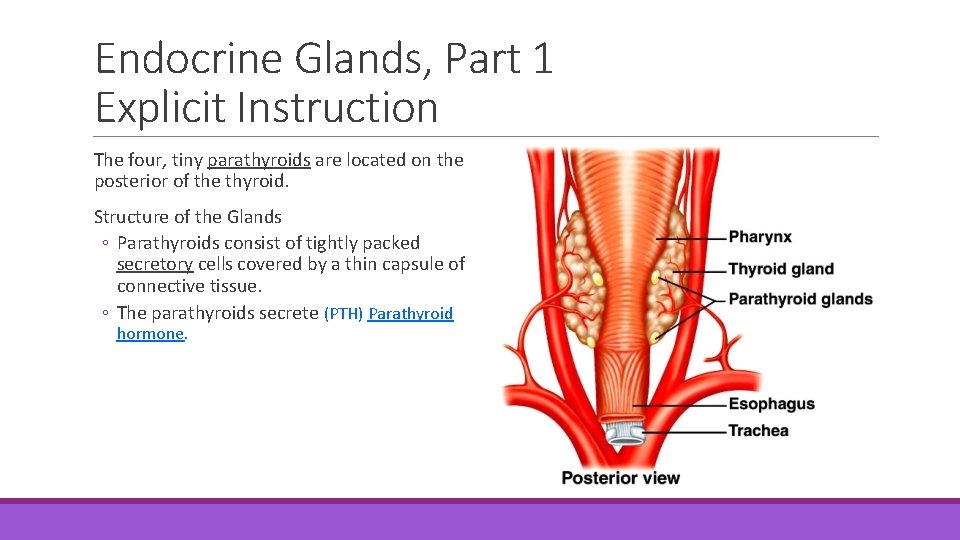
Endocrine Glands, Part 1 Explicit Instruction The four, tiny parathyroids are located on the posterior of the thyroid. Structure of the Glands ◦ Parathyroids consist of tightly packed secretory cells covered by a thin capsule of connective tissue. ◦ The parathyroids secrete (PTH) Parathyroid hormone.
Endocrine Glands, Part 1 Guided & Independent Practice GUIDED PRACTICE Complete the chart of hormones for the pituitary, thyroid and parathyroid glands on the “Hormones of the Endocrine System, Part 1” Handout. INDEPENDENT PRACTICE 1. How does the hypothalamus controls the actions of the posterior and anterior lobes of the pituitary gland? 2. How does growth hormone affect protein synthesis? 3. How is TSH regulated? What effect does it have on the body? (Be sure to explain the roles of T 4 & T 3) 4. How does PTH help regulate concentrations of blood calcium and phosphate ions?