
ENDOCRINE DISORDERS in the ELDERLY Module 2 THYROID

![Pharmacologic Therapy (1) Levothyroxine (T 4, levothyroxine Eltroxin, Levo-T, Levothroid, Levoxyl, Synthroid]). -Start at](https://slidetodoc.com/presentation_image_h/90804225afe4c69022e3bff122d6b44f/image-9.jpg "Pharmacologic Therapy (1) Levothyroxine (T 4, levothyroxine Eltroxin, Levo-T, Levothroid, Levoxyl, Synthroid]). -Start at")

- Slides: 26
ENDOCRINE DISORDERS in the ELDERLY Module #2 THYROID DISEASES Ed Vandenberg, MD, CMD Geriatric Section OVAMC & Section of Geriatrics 981320 UNMC Omaha, NE 68198 -1320 evandenb@unmc. edu Web: geriatrics. unmc. edu updated 11 -17 -06
PROCESS A series of modules and questions Step #1: Power point module with voice overlay Step #2: Case-based question and answer Step # 3: Proceed to additional modules or take a break
OBJECTIVES: Upon completion, the learner will be able to: 1) Describe the evaluation and treatment of hypothyroidism in the elderly 2) Describe the evaluation and treatment of hyperthyroidism in the elderly 3) List the evaluation and treatment of nodular thyroid disease and thyroid cancer
Hypothyroidism: Overview • Age related changes are negligible • Hypothyroidism: 1. 4% of all women over age 50 • Symptoms nonspecific so test with the slightest suspicion Test patient with declines in: -cognitive -functional -clinical
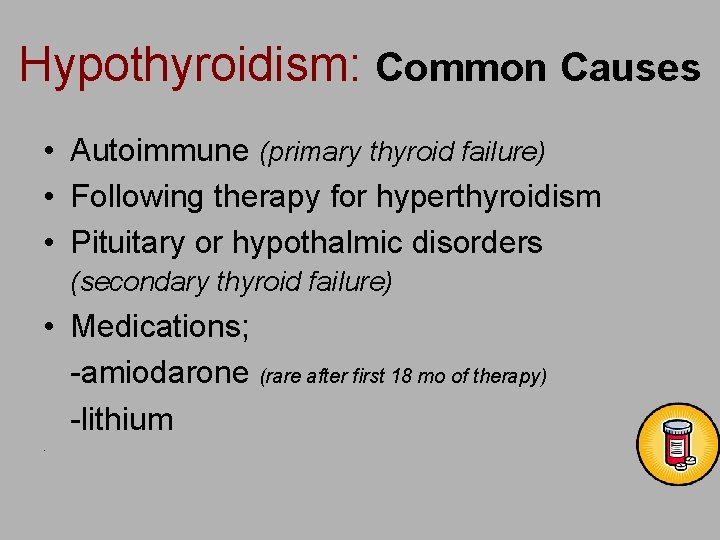
Hypothyroidism: Common Causes • Autoimmune (primary thyroid failure) • Following therapy for hyperthyroidism • Pituitary or hypothalmic disorders (secondary thyroid failure) • Medications; -amiodarone (rare after first 18 mo of therapy) -lithium.
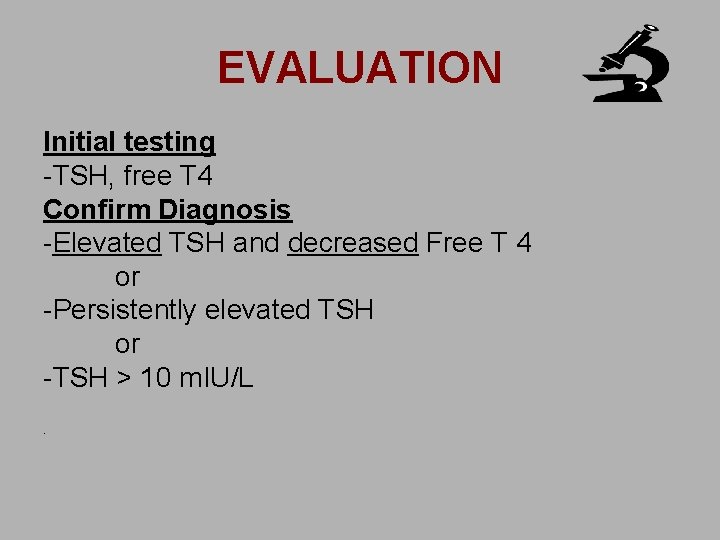
EVALUATION Initial testing -TSH, free T 4 Confirm Diagnosis -Elevated TSH and decreased Free T 4 or -Persistently elevated TSH or -TSH > 10 m. IU/L.
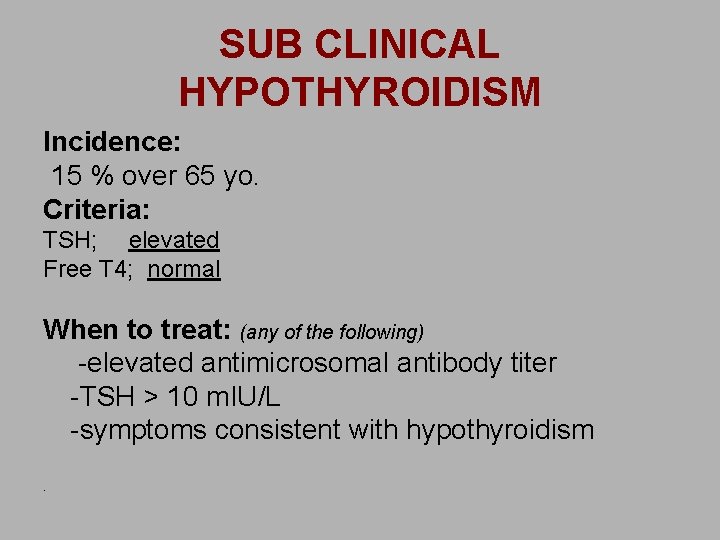
SUB CLINICAL HYPOTHYROIDISM Incidence: 15 % over 65 yo. Criteria: TSH; elevated Free T 4; normal When to treat: (any of the following) -elevated antimicrosomal antibody titer -TSH > 10 m. IU/L -symptoms consistent with hypothyroidism.
“TRAPS” Low T 4 syndrome Setting: Severe nonthyroidal illness Lab: -Free T 4 index. . decreased -TSH…………. . normal -Free T 4………. normal -reverse T 3……increased Patient is Euthyroid Secondary Hypothyroidism Setting: hypopituitarism ( other pituitary hormones deficient) Lab: -TSH………. Normal or low -Free T 4…. . . Low -reverse. T 3. . . Decreased Primary hypothyroidism & the Drug-disease “masquerade” Lab: Normal TSH, Decreased Free. T 4 Setting; -fasting, -acute illnesses -dopamine -phenytoin -carbamazepine -rifampin -glucocorticoids.
Pharmacologic Therapy (1) Levothyroxine (T 4, levothyroxine Eltroxin, Levo-T, Levothroid, Levoxyl, Synthroid]). -Start at 25 mcg and increase by 25 mcg intervals q 6 -8 wk For myxedema coma: -Load 400 mcg IV or 100 mcg q 6– 8 h for 1 d, then 100 mcg/d for 4 d; then start usual replacement regimen. To convert thyroid USP to thyroxine: -60 mg USP = 50 mcg thyroxine. PO to IV If patients are NPO and must receive IV thyroxine; -dose should be half usual po dose. .
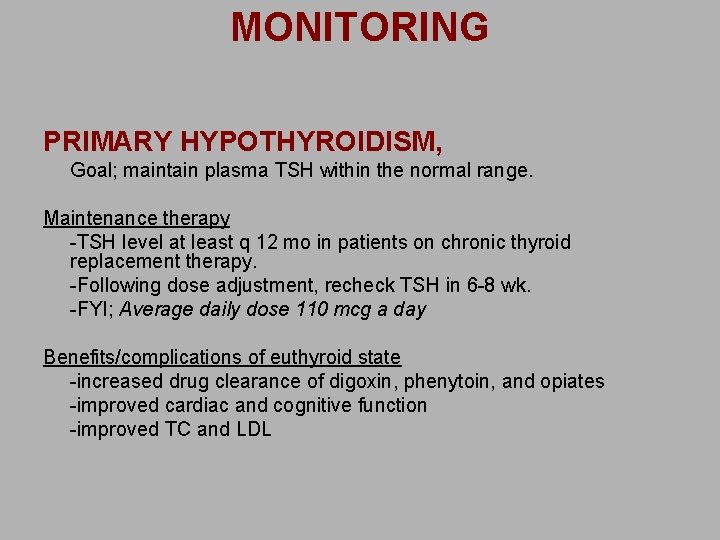
MONITORING PRIMARY HYPOTHYROIDISM, Goal; maintain plasma TSH within the normal range. Maintenance therapy -TSH level at least q 12 mo in patients on chronic thyroid replacement therapy. -Following dose adjustment, recheck TSH in 6 -8 wk. -FYI; Average daily dose 110 mcg a day Benefits/complications of euthyroid state -increased drug clearance of digoxin, phenytoin, and opiates -improved cardiac and cognitive function -improved TC and LDL
HYPERTHYROIDISM
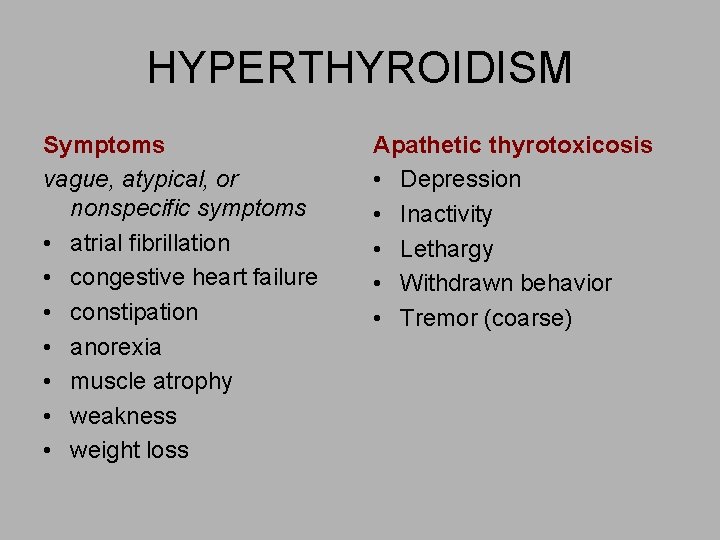
HYPERTHYROIDISM Symptoms vague, atypical, or nonspecific symptoms • atrial fibrillation • congestive heart failure • constipation • anorexia • muscle atrophy • weakness • weight loss Apathetic thyrotoxicosis • Depression • Inactivity • Lethargy • Withdrawn behavior • Tremor (coarse)
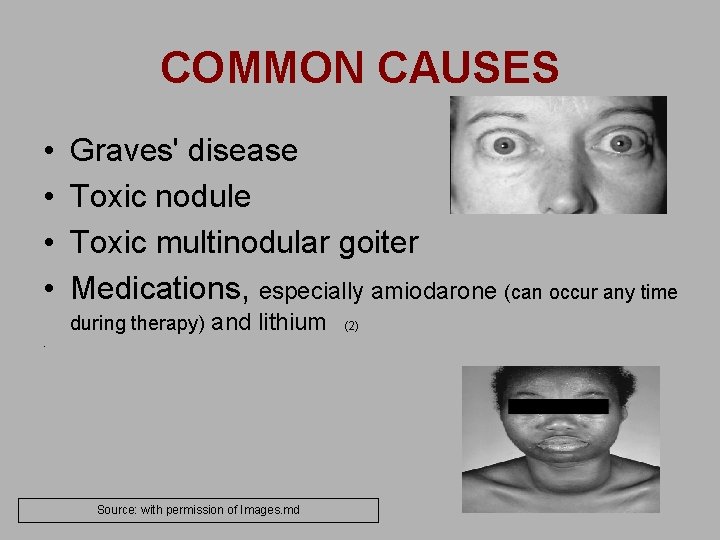
COMMON CAUSES • • Graves' disease Toxic nodule Toxic multinodular goiter Medications, especially amiodarone (can occur any time during therapy) and lithium . Source: with permission of Images. md (2)
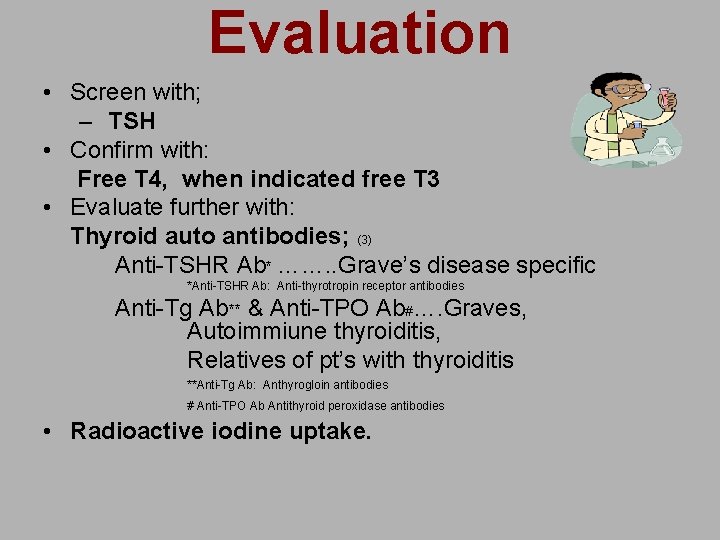
Evaluation • Screen with; – TSH • Confirm with: Free T 4, when indicated free T 3 • Evaluate further with: Thyroid auto antibodies; (3) Anti-TSHR Ab* ……. . Grave’s disease specific *Anti-TSHR Ab: Anti-thyrotropin receptor antibodies Anti-Tg Ab** & Anti-TPO Ab#…. Graves, Autoimmiune thyroiditis, Relatives of pt’s with thyroiditis **Anti-Tg Ab: Anthyrogloin antibodies # Anti-TPO Ab Antithyroid peroxidase antibodies • Radioactive iodine uptake.
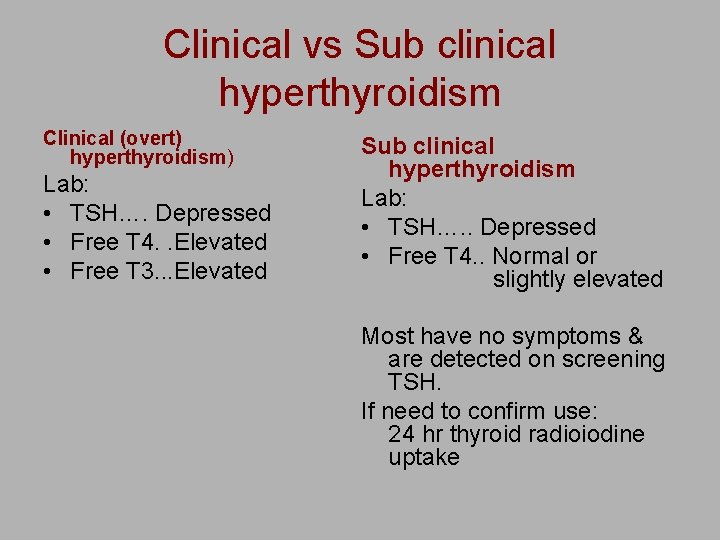
Clinical vs Sub clinical hyperthyroidism Clinical (overt) hyperthyroidism) Lab: • TSH…. Depressed • Free T 4. . Elevated • Free T 3. . . Elevated Sub clinical hyperthyroidism Lab: • TSH…. . Depressed • Free T 4. . Normal or slightly elevated Most have no symptoms & are detected on screening TSH. If need to confirm use: 24 hr thyroid radioiodine uptake
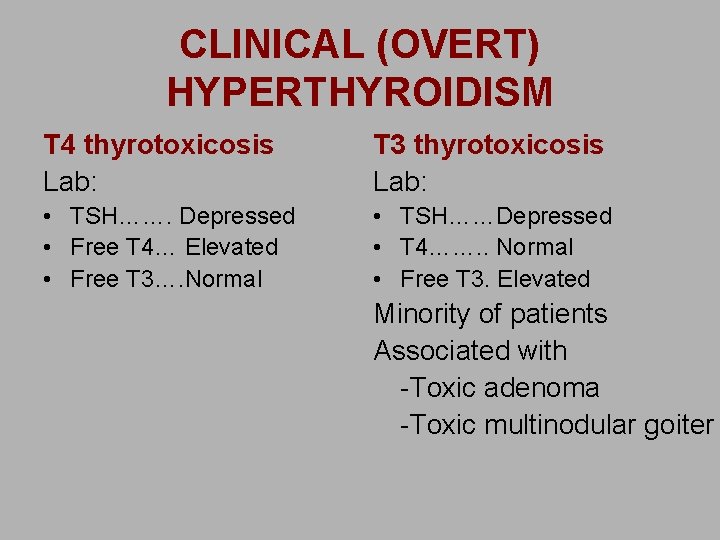
CLINICAL (OVERT) HYPERTHYROIDISM T 4 thyrotoxicosis Lab: T 3 thyrotoxicosis Lab: • TSH……. Depressed • Free T 4… Elevated • Free T 3…. Normal • TSH……Depressed • T 4……. . Normal • Free T 3. Elevated Minority of patients Associated with -Toxic adenoma -Toxic multinodular goiter
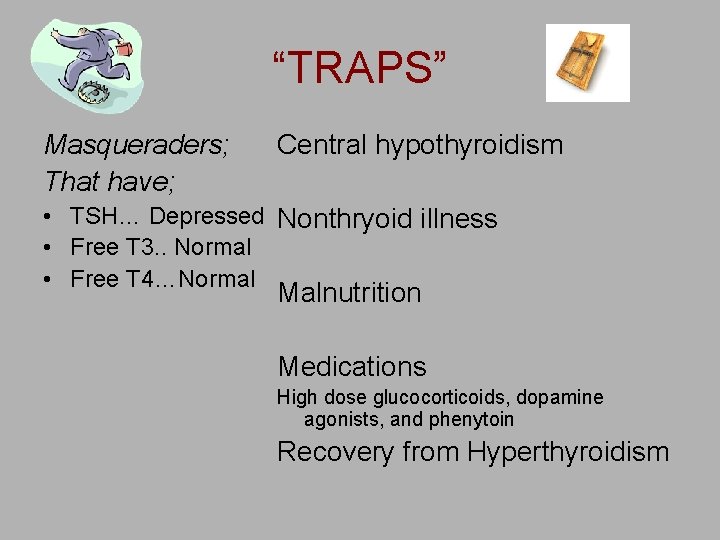
“TRAPS” Masqueraders; That have; Central hypothyroidism • TSH… Depressed Nonthryoid illness • Free T 3. . Normal • Free T 4…Normal Malnutrition Medications High dose glucocorticoids, dopamine agonists, and phenytoin Recovery from Hyperthyroidism
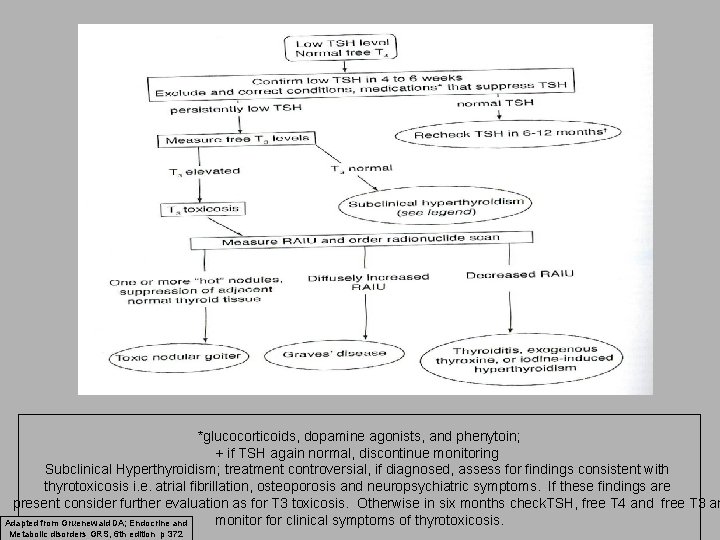
*glucocorticoids, dopamine agonists, and phenytoin; + if TSH again normal, discontinue monitoring Subclinical Hyperthyroidism; treatment controversial, if diagnosed, assess for findings consistent with thyrotoxicosis i. e. atrial fibrillation, osteoporosis and neuropsychiatric symptoms. If these findings are present consider further evaluation as for T 3 toxicosis. Otherwise in six months check. TSH, free T 4 and free T 3 an monitor for clinical symptoms of thyrotoxicosis. Adapted from Gruenewald DA; Endocrine and Metabolic disorders GRS, 6 th edition p 372
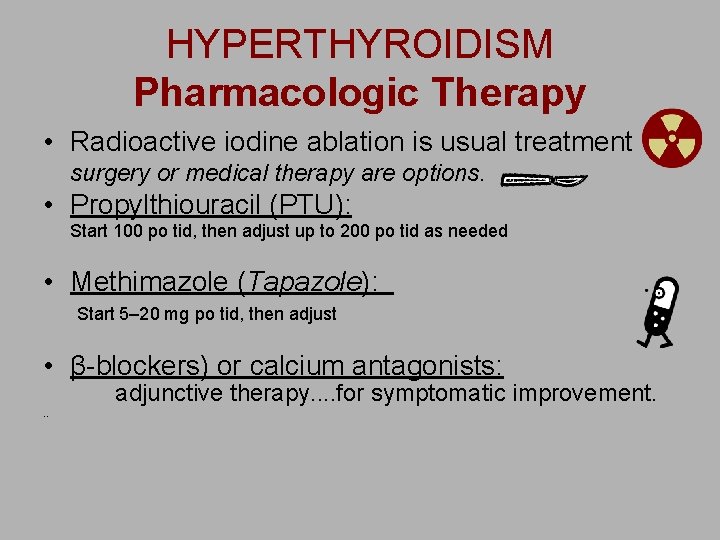
HYPERTHYROIDISM Pharmacologic Therapy • Radioactive iodine ablation is usual treatment surgery or medical therapy are options. • Propylthiouracil (PTU): Start 100 po tid, then adjust up to 200 po tid as needed • Methimazole (Tapazole): Start 5– 20 mg po tid, then adjust • β-blockers) or calcium antagonists: adjunctive therapy. . for symptomatic improvement. . .
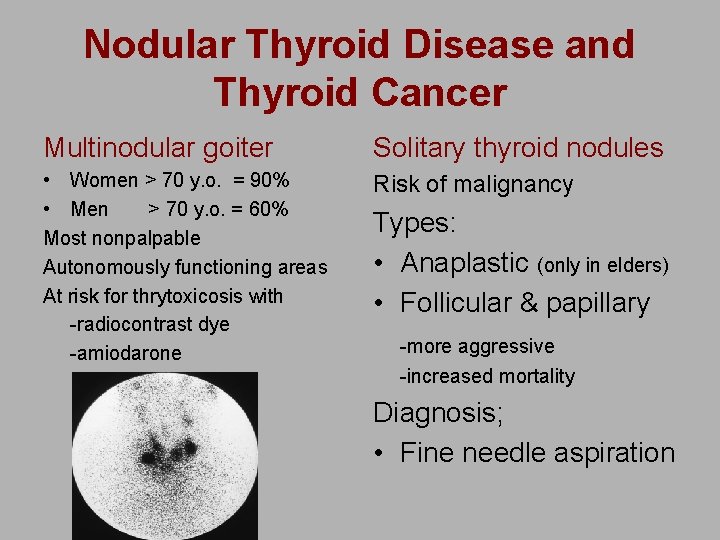
Nodular Thyroid Disease and Thyroid Cancer Multinodular goiter Solitary thyroid nodules • Women > 70 y. o. = 90% • Men > 70 y. o. = 60% Most nonpalpable Autonomously functioning areas At risk for thrytoxicosis with -radiocontrast dye -amiodarone Risk of malignancy Types: • Anaplastic (only in elders) • Follicular & papillary -more aggressive -increased mortality Diagnosis; • Fine needle aspiration
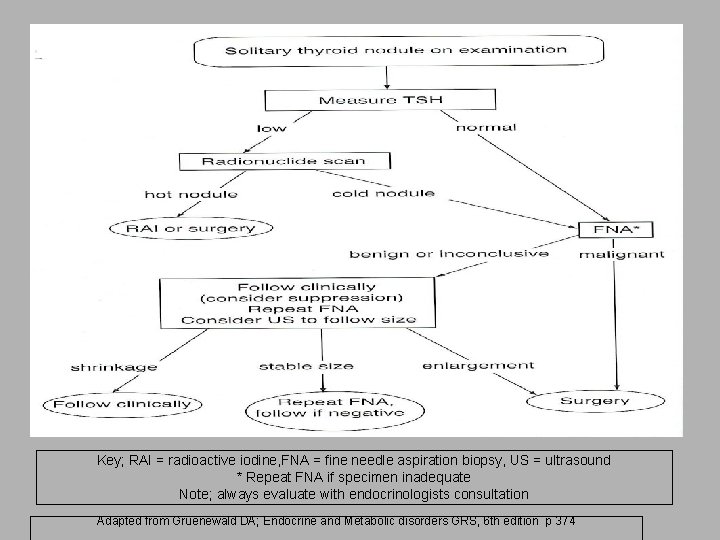
Key; RAI = radioactive iodine, FNA = fine needle aspiration biopsy, US = ultrasound * Repeat FNA if specimen inadequate Note; always evaluate with endocrinologists consultation Adapted from Gruenewald DA; Endocrine and Metabolic disorders GRS, 6 th edition p 374
The End of Module Two on Endocrine Disorders in the ELDERLY THYROID DISEASES
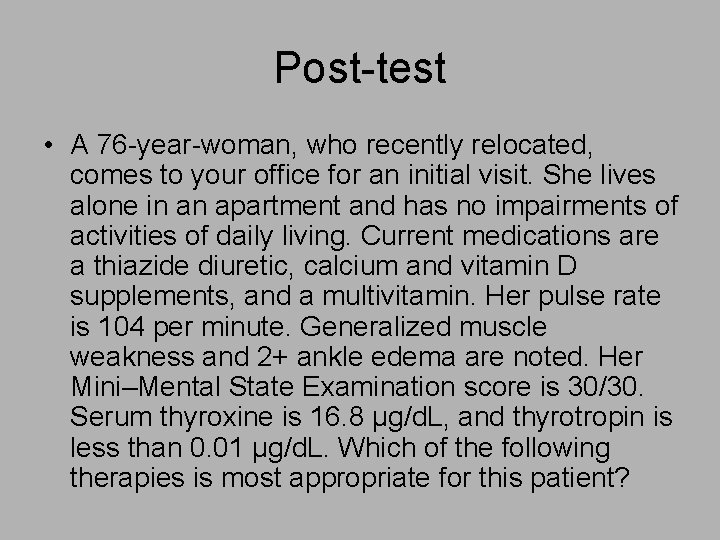
Post-test • A 76 -year-woman, who recently relocated, comes to your office for an initial visit. She lives alone in an apartment and has no impairments of activities of daily living. Current medications are a thiazide diuretic, calcium and vitamin D supplements, and a multivitamin. Her pulse rate is 104 per minute. Generalized muscle weakness and 2+ ankle edema are noted. Her Mini–Mental State Examination score is 30/30. Serum thyroxine is 16. 8 µg/d. L, and thyrotropin is less than 0. 01 µg/d. L. Which of the following therapies is most appropriate for this patient?
Which of the following therapies is most appropriate for this patient? A. No treatment B. Propylthiouracil C. Tapazole D. Radioactive iodine E. Surgical ablation of the thyroid gland Used with permission from: Murphy JB, et. al. Case Based Geriatrics Review: 500 Questions and Critiques from the Geriatric Review Syllabus. AGS 2002 New York, NY.
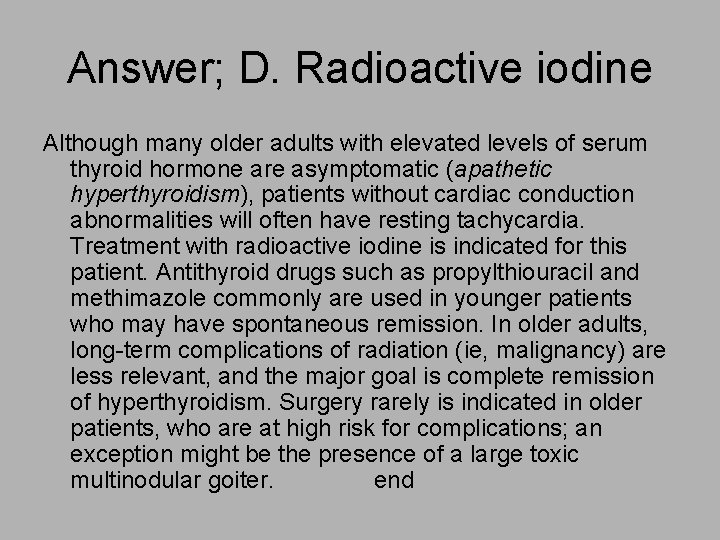
Answer; D. Radioactive iodine Although many older adults with elevated levels of serum thyroid hormone are asymptomatic (apathetic hyperthyroidism), patients without cardiac conduction abnormalities will often have resting tachycardia. Treatment with radioactive iodine is indicated for this patient. Antithyroid drugs such as propylthiouracil and methimazole commonly are used in younger patients who may have spontaneous remission. In older adults, long-term complications of radiation (ie, malignancy) are less relevant, and the major goal is complete remission of hyperthyroidism. Surgery rarely is indicated in older patients, who are at high risk for complications; an exception might be the presence of a large toxic multinodular goiter. end
Readings and Resources Recommended readings and resources; Gruenewald DA, Matsumoto AM. Endocrine and metabolic disorders. GRS sixth edition 2004 -06 PPG 368 -381 Geriatrics at Your Fingertips 8 th edition 2006 -2007 Resources (1) Epocrates accessed 2 -2 -05 (2) Micrormedex accessed 2 -2 -06 (3) Up To Date; accessed 2 -9 -06