
Endocrine and Circulatory Systems Endocrine System The endocrine
- Slides: 42
Endocrine and Circulatory Systems
Endocrine System The endocrine system is a system of glands, each of which secretes a type of hormone to regulate the body. The endocrine system is an information signal system much like the nervous system. Hormones regulate many functions of an organism, including mood, growth and development, tissue function, and metabolism. The field of study that deals with disorders of endocrine glands is endocrinology, a branch of the wider field of internal medicine.
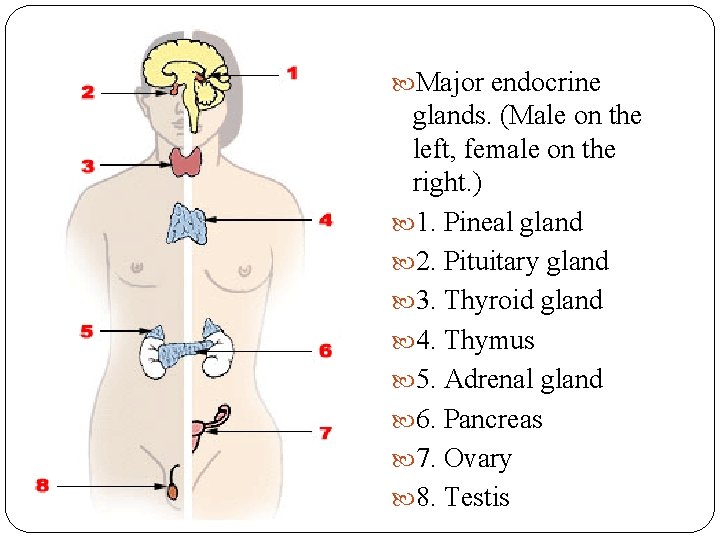
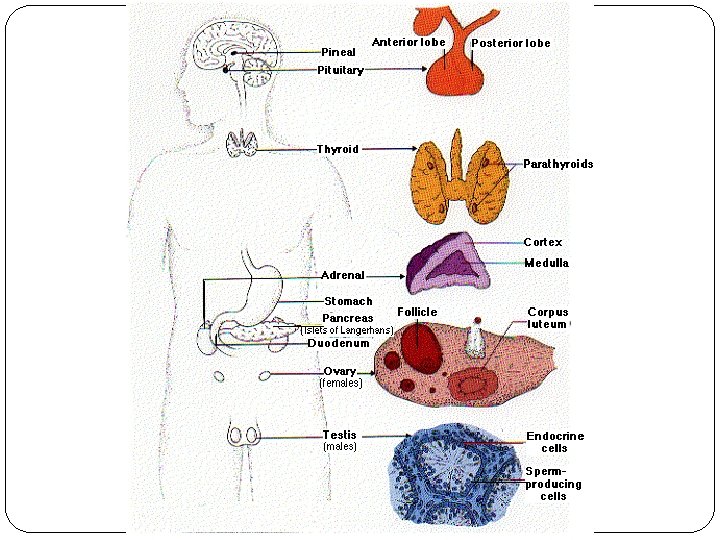
Major endocrine glands. (Male on the left, female on the right. ) 1. Pineal gland 2. Pituitary gland 3. Thyroid gland 4. Thymus 5. Adrenal gland 6. Pancreas 7. Ovary 8. Testis
Endocrine System The endocrine system is used for communication, throughout your body. The main communication system within your body is the nervous system. The nervous system works in a similar manner as a telephone. Messages are sent from one place to another place, much in the same way that a telephone carries a message from you to your friend.
Endocrine System But suppose you want to tell more than just one person. You could call your friends one at a time, but this would take a very long time. By the time you got the message out, it might be too late. So how can you get a message to all your friends quickly? Suppose that you drive to your local radio station, and broadcast your message. Doing this allows all your friends to hear your message at the same time.
Endocrine System Your endocrine system is similar to a radio broadcast. Instead of using radio waves to transmit messages, your endocrine system uses chemicals. These chemicals are called hormones. Hormones travel through the blood stream, and effect the activities of the various cells within your body.
Glands Where are these chemicals produced? Throughout your body, from your head, down to your waist there a number of small organs called glands. These glands each produce one or more hormones. These hormones are released into the bloodstream via small tubes called ducts. Once in the bloodstream, these hormones effect every cell they come in contact with, telling them to do something.
Circulatory System Think of a large city. A city is a community of people who work together to support each other, and make life possible. Each person has a different job. Some are builders, others work in markets, while others clean up. Every job is important. Suppose you work in an office building on the 86 th floor, and decide that you are hungry. How will you get food?
Circulatory System You walk down the narrow hallway, climb into an elevator, and go down to the main floor. From there you walk out into the street, and continue towards your favorite lunch spot. Using hallways, elevators, and roads, you eventually find your way to your lunch.
Circulatory System In many ways, your body is like a city. Instead of millions of people, your body is made up of trillions of cells, each with a different job. What happens if a cell on the 86 th floor of your body gets hungry? How will it get food?
Circulatory System Just like a city with hallways, and roads, your body has blood vessels, arteries, and veins that help move things around. Most of the cells inside of your body do not move. If a cell is hungry, or needs to get rid of waste, it can’t simply move itself to the part of your body where it needs to go. Instead, your body must bring the food to your cells, and the waste away from them.
4 Processes of the Circulatory System Four critical processes Obtain energy and material Ingest, digest, absorb Obtain oxygen Dispose of nitrogenous waste NH 3, urea, uric acid Dispose of CO 2 13
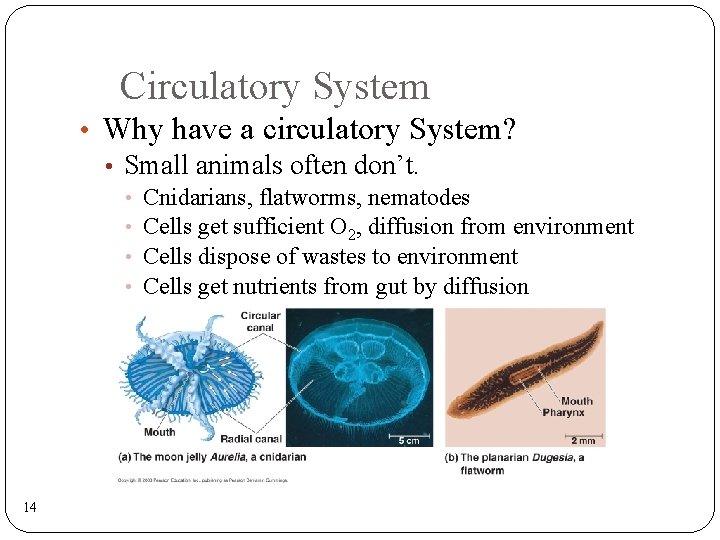
Circulatory System • Why have a circulatory System? • Small animals often don’t. • • 14 Cnidarians, flatworms, nematodes Cells get sufficient O 2, diffusion from environment Cells dispose of wastes to environment Cells get nutrients from gut by diffusion
Circulatory System • Why have a circulatory System? – Larger animals MUST have circulatory system • Most cells too far from surface and too far from gut – Diffusion would take too long!!! • Circulatory systems bring O 2, “food, ” to all tissues – All cells close enough to a capillary • Circulatory systems carry away metabolic wastes • Circulatory systems carry regulatory signaling molecules 15 Circulation & Gas. Ex. ppt 16 April 2009
Organization of the Cardiovascular System Heart = muscular double pump Blood = circulating fluid tissue Vessels Arteries carry blood FROM the heart, Capillaries distribute O 2, nutrient molecules, and pick up wastes, Veins return blood TOWARD the heart 16
Organization of the Cardiovascular System Two circulations Pulmonary To and from lungs Systemic To and from all other tissues 17
The Heart
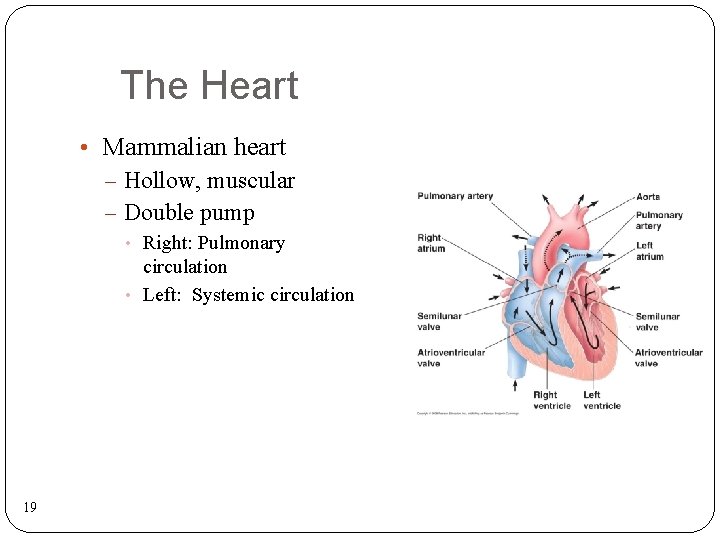
The Heart • Mammalian heart – Hollow, muscular – Double pump • Right: Pulmonary circulation • Left: Systemic circulation 19
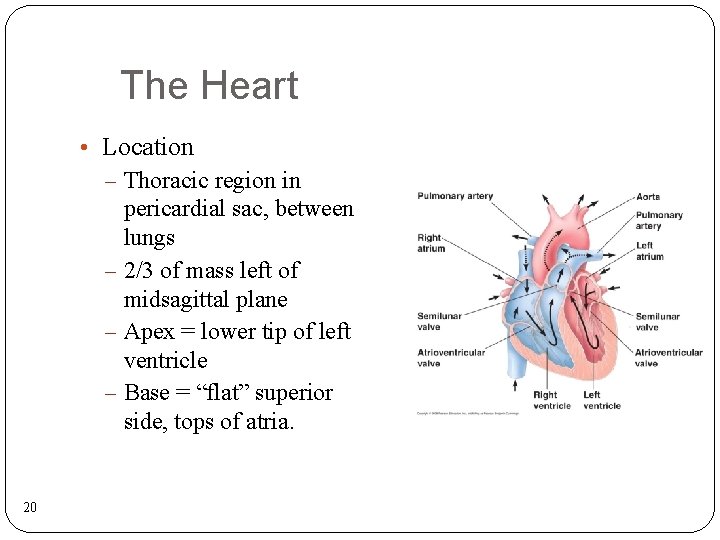
The Heart • Location – Thoracic region in pericardial sac, between lungs – 2/3 of mass left of midsagittal plane – Apex = lower tip of left ventricle – Base = “flat” superior side, tops of atria. 20
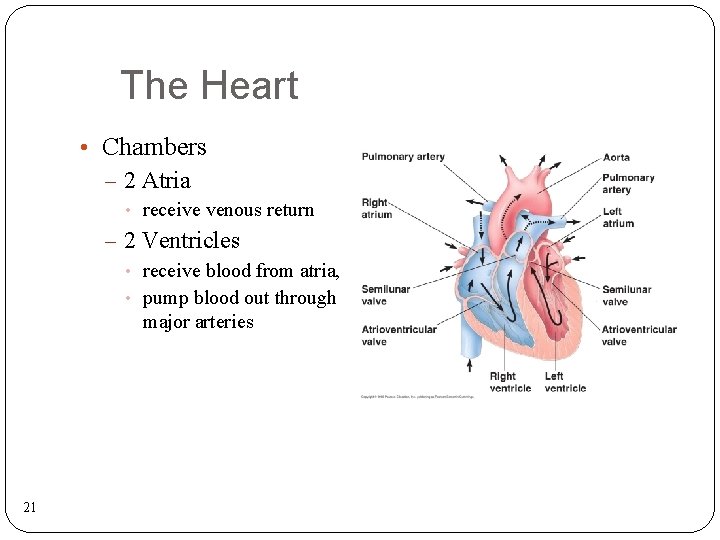
The Heart • Chambers – 2 Atria • receive venous return – 2 Ventricles • receive blood from atria, • pump blood out through major arteries 21
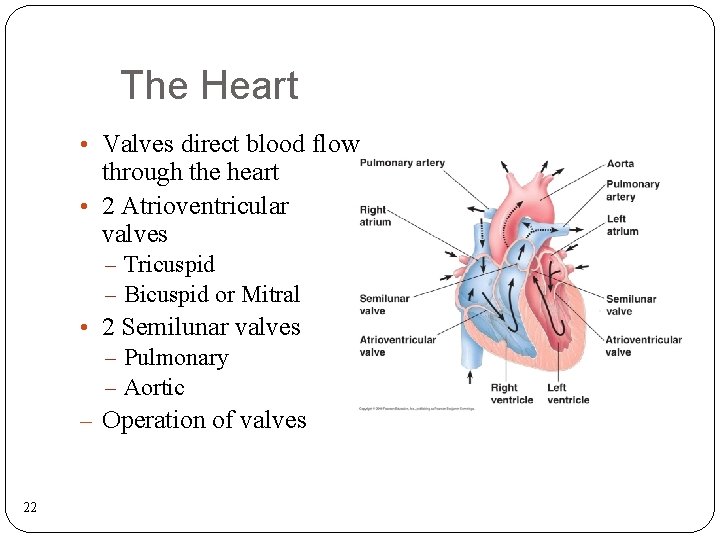
The Heart • Valves direct blood flow through the heart • 2 Atrioventricular valves – Tricuspid – Bicuspid or Mitral • 2 Semilunar valves – Pulmonary – Aortic – Operation of valves 22
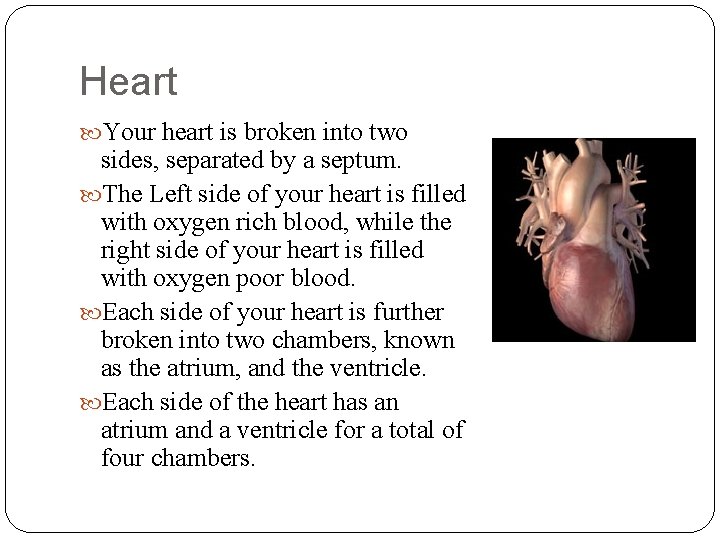
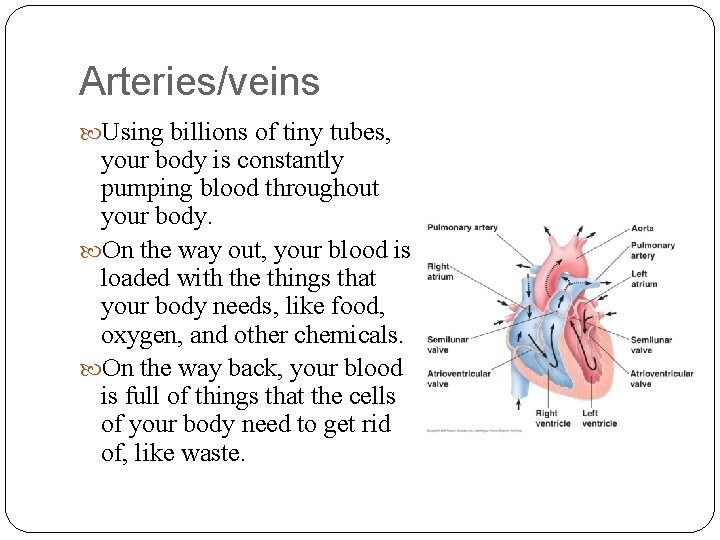
Heart Your heart is broken into two sides, separated by a septum. The Left side of your heart is filled with oxygen rich blood, while the right side of your heart is filled with oxygen poor blood. Each side of your heart is further broken into two chambers, known as the atrium, and the ventricle. Each side of the heart has an atrium and a ventricle for a total of four chambers.
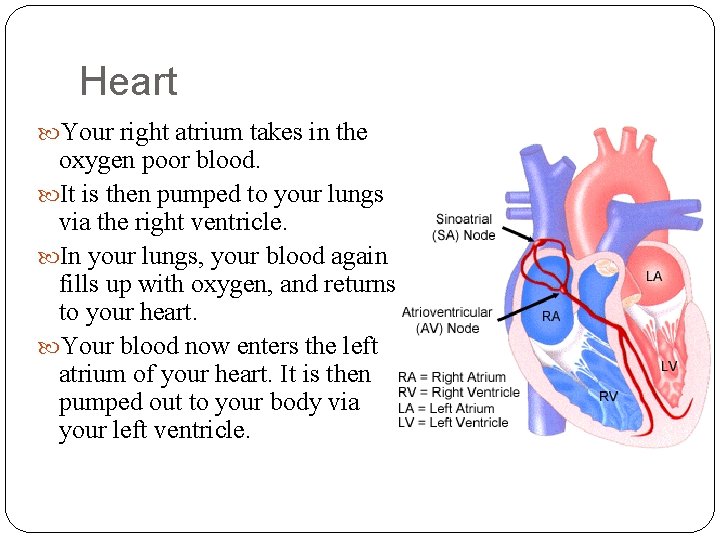
Heart Your right atrium takes in the oxygen poor blood. It is then pumped to your lungs via the right ventricle. In your lungs, your blood again fills up with oxygen, and returns to your heart. Your blood now enters the left atrium of your heart. It is then pumped out to your body via your left ventricle.
Arteries/veins Using billions of tiny tubes, your body is constantly pumping blood throughout your body. On the way out, your blood is loaded with the things that your body needs, like food, oxygen, and other chemicals. On the way back, your blood is full of things that the cells of your body need to get rid of, like waste.
Blue Blood? What color is blood? Well, that depends. Sometimes it is red, and sometimes it is blue. Look at your arm. Can you see the blue veins? Why are they blue? When blood is full of oxygen it is red, but when it is low on oxygen it turns bluish. Why don’t I ever see blue blood? Because as it leaves your body, it quickly turns red, as it takes in oxygen.
The job of your heart is to pump blood through your body. Even in your sleep, your heart keeps beating, or pumping blood. If it stopped, you would quickly die.
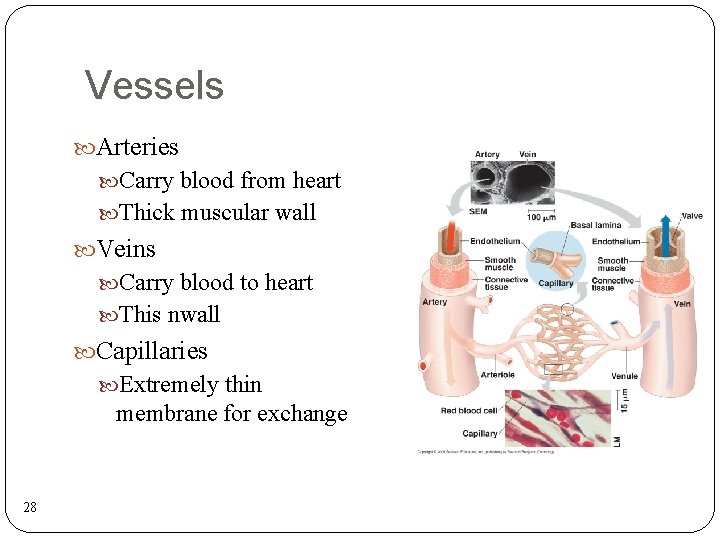
Vessels Arteries Carry blood from heart Thick muscular wall Veins Carry blood to heart This nwall Capillaries Extremely thin membrane for exchange 28
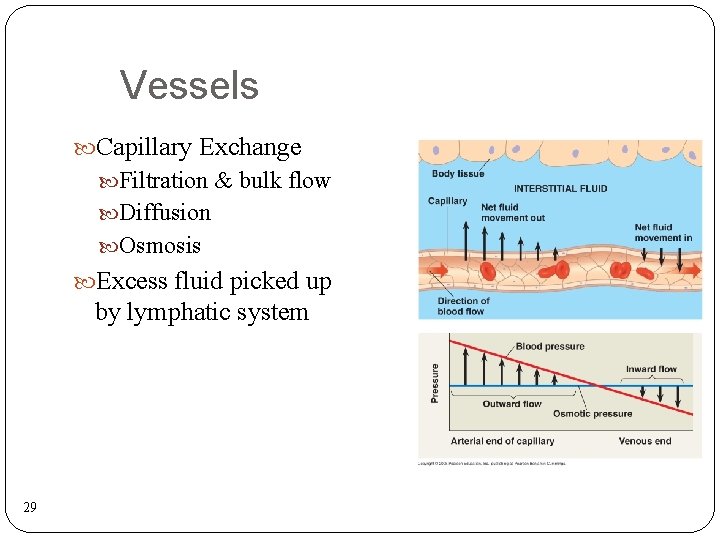
Vessels Capillary Exchange Filtration & bulk flow Diffusion Osmosis Excess fluid picked up by lymphatic system 29
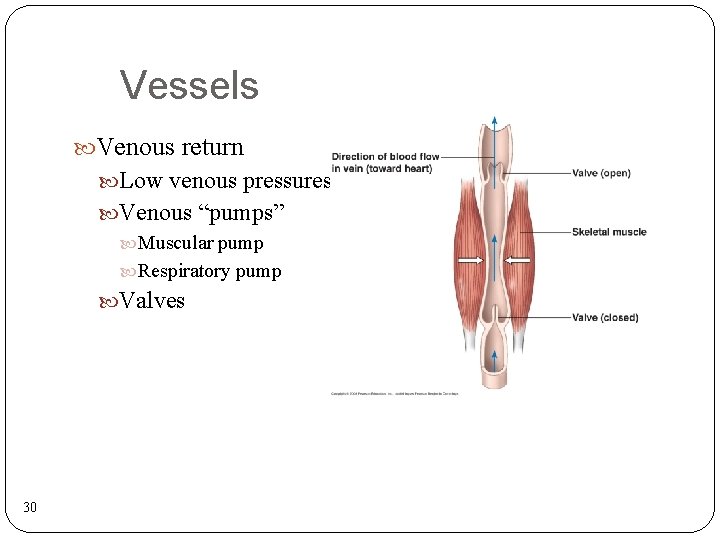
Vessels Venous return Low venous pressures Venous “pumps” Muscular pump Respiratory pump Valves 30
Arteries, Capillaries and Veins Your arteries carry blood from your heart, out to the rest of your body. They have very thick walls, which allow them to withstand the immense pressure created as your heart pumps blood forcefully. As blood travels outward the arteries become smaller and smaller until eventually the blood enters into what are known as capillaries. Capillaries are so tiny that blood usually can only get through one cell at a time. It is within the capillaries that oxygen is taken by the cells, and waste, such as carbon dioxide is released into the blood.
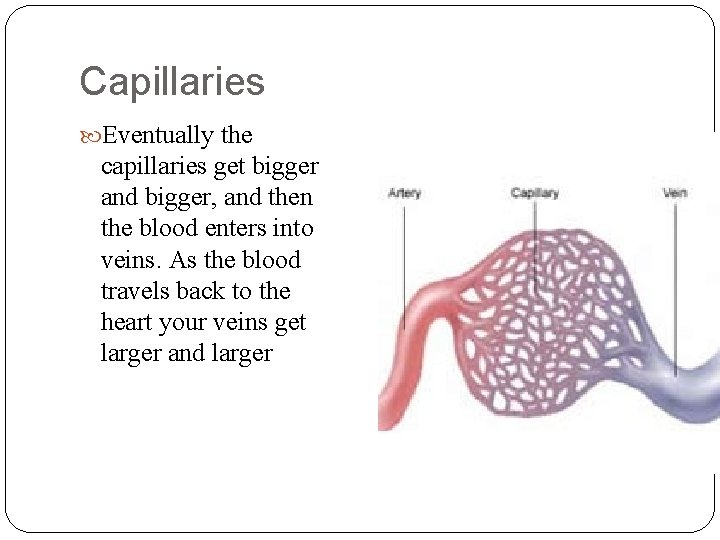
Capillaries Eventually the capillaries get bigger and bigger, and then the blood enters into veins. As the blood travels back to the heart your veins get larger and larger
The Lymphatic System: Recovering Lost Fluid The cardiovascular system is very leaky from capillary exchange, the body loses about 4 liters of fluid each day to collect and recycle this fluid, the body uses a second circulatory system called the lymphatic system is also a network of vessels filled with a fluid called lymph ultimately the lymph reenters the bloodstream through veins in the neck
The Lymphatic System: Recovering Lost Fluid The lymphatic system has three important functions it returns proteins to circulation if this protein remains in the tissues, it would cause swelling or edema it transports fats absorbed from the intestine it aids in the body’s defense swellings along lymph vessels called lymph nodes and a lymph organ called the spleen are where bacteria and dead blood cells are destroyed the thymus produces white blood cells
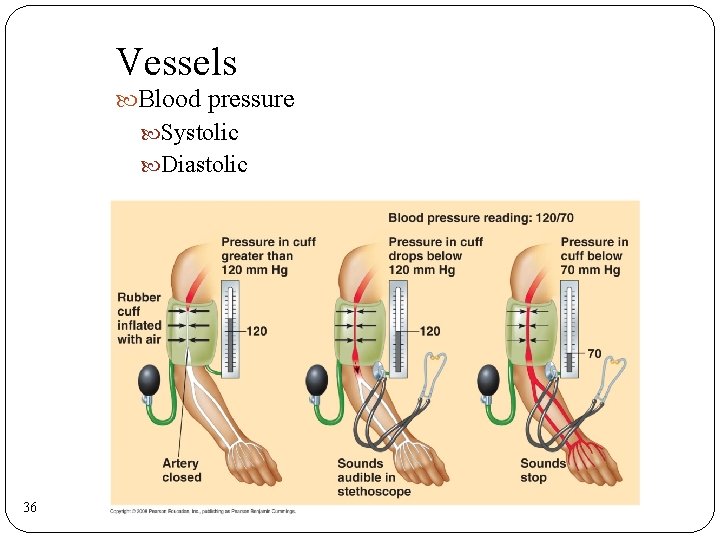
Blood Pressure During each heartbeat, BP varies between a maximum (systolic) and a minimum (diastolic) pressure. The mean BP decreases as the circulating blood moves away from the heart through arteries, has its greatest decrease in the small arteries and arterioles, and continues to decrease as the blood moves through the capillaries and back to the heart through veins 35
Vessels Blood pressure Systolic Diastolic 36
Tips to lower your Blood Pressure Reduce the sodium (salt) in your diet Choose fresh foods. Avoid adding salt at the table. Use herbs and spices liberally. Limit canned soups, frozen dinners and entrees and vegetables with sauces. Choose "low-sodium" products. You may rinse canned foods with water. Reduce your intake of bacon, sausage, hot dogs and luncheon meats such as corned beef, pastrami, bologna, ham, processed turkey and salami. Avoid smoked, pickled and cured foods.
Tips to lower your blood pressure Achieve a healthy body weight Reduce your calories by choosing low-fat foods and eating smaller portions. Increase dietary fiber. Try to get 20 -35 grams of fiber daily. Exercise regularly: your goal is 30 minute aerobic exercise daily. Walk at least 10 K steps per day.
Tips to lower your blood pressure Increase foods that are high in calcium Low-fat/fat-free dairy products daily supplements Increase foods that are high in potassium, magnesium and fiber Nuts, seeds, dried beans, and peas Potatoes, tomatoes, bananas (potassium) 100% whole grains (fiber & magnesium)
Tips to lower your blood pressure Reduce Caffeine Choose decaffeinated coffee, teas and sodas Avoid medications (if possible) that have caffeine in them Dristan Excederin Midol
Tips to lower your blood pressure Drink plenty of fluids As a good rule of thumb, drink 8 cups of water per day HINT: always keep a bottle water near you at all times…that way you are reminded to drink it. QUIT SMOKING I know this one is NOT easy The first step is to pick a day…only if you are willing to quit.
Tips to lower your blood pressure If you are on medications for your blood pressure Don’t skip your medicine If you notice any side effects, notify your doctor. Discuss the use of drugs called "NSAIDs" such as ibuprofen (Advil, Motrin), naproxen (Aleve) and ketoprofen (Orudis-KT) with your physician. NSAIDs appear to raise blood pressure in older people with hypertension. They may also blunt the action of certain antihypertensive medications.