
ENDANGERED ANIMALS Wild and Livestock By Nathaniel Mc
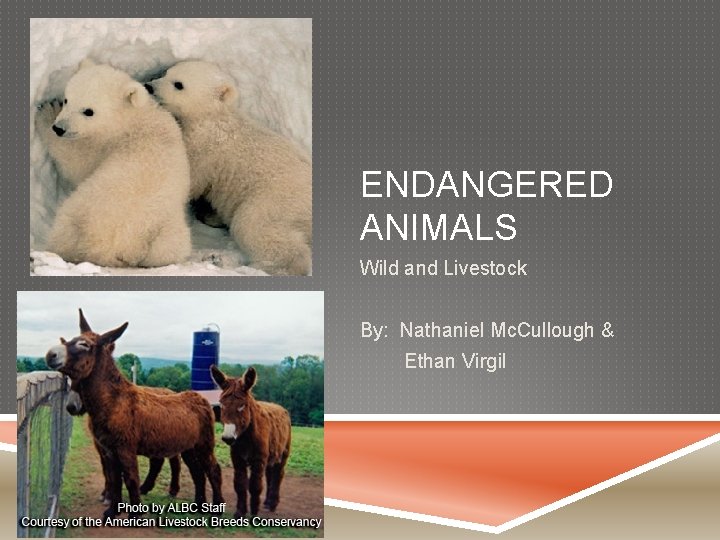
ENDANGERED ANIMALS Wild and Livestock By: Nathaniel Mc. Cullough & Ethan Virgil
WHAT DOES IT MEAN TO BE ENDANGERED? According to Dictionary. com Endangered (Adjective)Threatened with Extinction
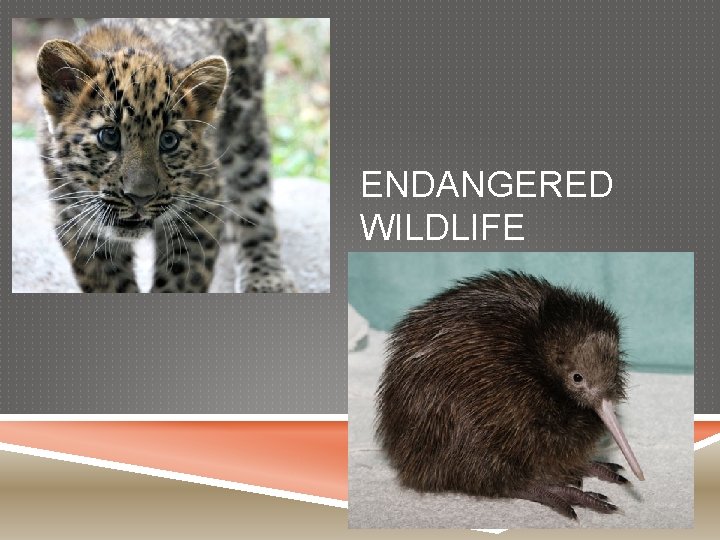
ENDANGERED WILDLIFE
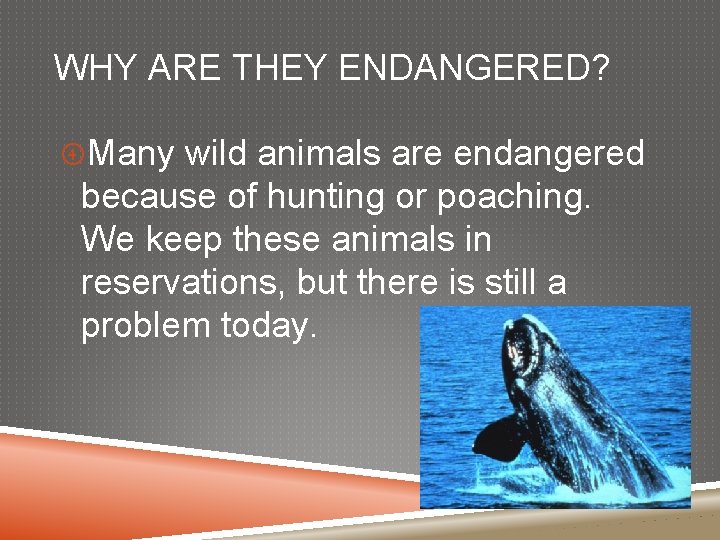
WHY ARE THEY ENDANGERED? Many wild animals are endangered because of hunting or poaching. We keep these animals in reservations, but there is still a problem today.
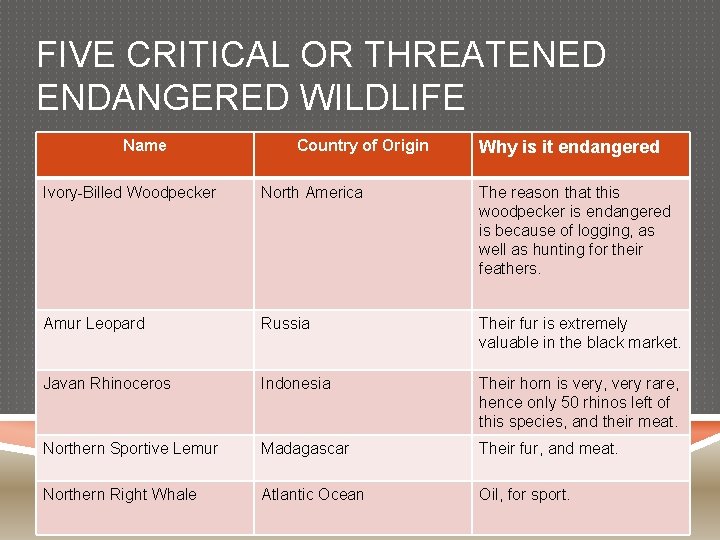
FIVE CRITICAL OR THREATENED ENDANGERED WILDLIFE Name Country of Origin Why is it endangered Ivory-Billed Woodpecker North America The reason that this woodpecker is endangered is because of logging, as well as hunting for their feathers. Amur Leopard Russia Their fur is extremely valuable in the black market. Javan Rhinoceros Indonesia Their horn is very, very rare, hence only 50 rhinos left of this species, and their meat. Northern Sportive Lemur Madagascar Their fur, and meat. Northern Right Whale Atlantic Ocean Oil, for sport.

WORLD WILDLIFE FEDERATION-WWF The WWF’s mission: We work to conserve the world’s most important natural places and significantly change global forces to protect the future of nature. Our experts are active at every level— from field work to government —conserving the largest tropical rain forests, the most remote areas of our planet, and the world’s most endangered species.
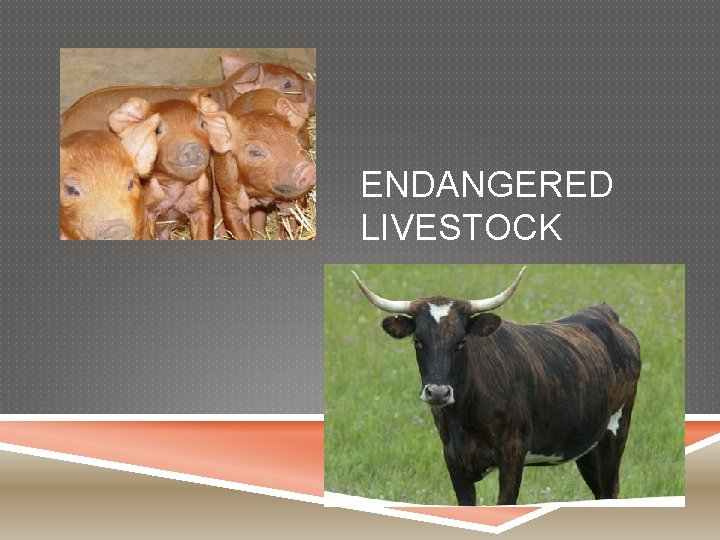
ENDANGERED LIVESTOCK
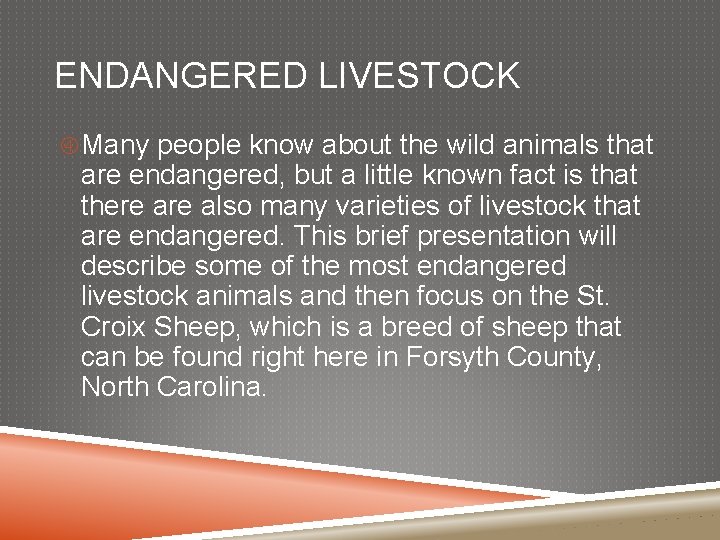
ENDANGERED LIVESTOCK Many people know about the wild animals that are endangered, but a little known fact is that there also many varieties of livestock that are endangered. This brief presentation will describe some of the most endangered livestock animals and then focus on the St. Croix Sheep, which is a breed of sheep that can be found right here in Forsyth County, North Carolina.
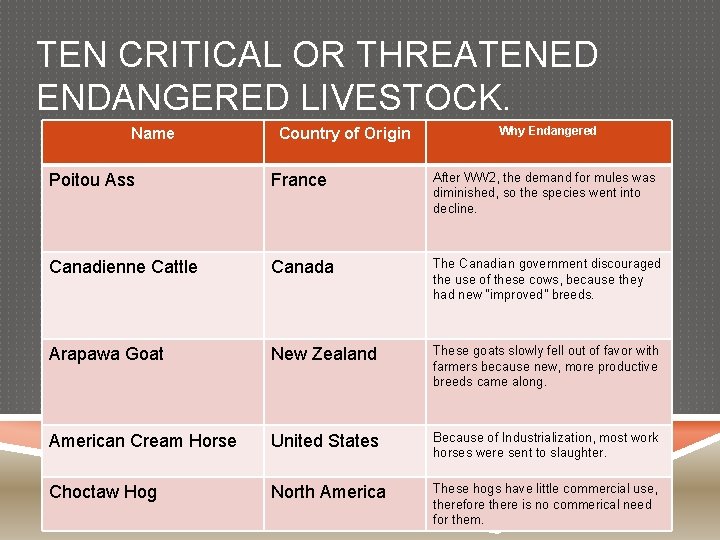
TEN CRITICAL OR THREATENED ENDANGERED LIVESTOCK. Name Country of Origin Why Endangered Poitou Ass France After WW 2, the demand for mules was diminished, so the species went into decline. Canadienne Cattle Canada The Canadian government discouraged the use of these cows, because they had new “improved” breeds. Arapawa Goat New Zealand These goats slowly fell out of favor with farmers because new, more productive breeds came along. American Cream Horse United States Because of Industrialization, most work horses were sent to slaughter. Choctaw Hog North America These hogs have little commercial use, therefore there is no commerical need for them.
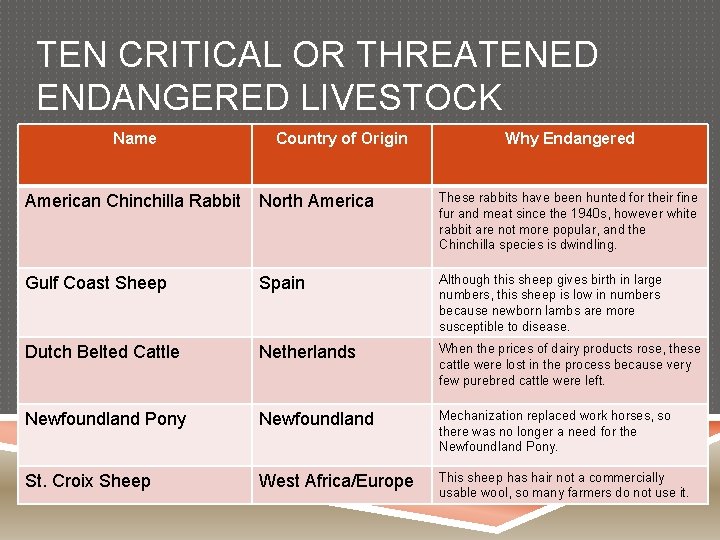
TEN CRITICAL OR THREATENED ENDANGERED LIVESTOCK Name Country of Origin Why Endangered American Chinchilla Rabbit North America These rabbits have been hunted for their fine fur and meat since the 1940 s, however white rabbit are not more popular, and the Chinchilla species is dwindling. Gulf Coast Sheep Spain Although this sheep gives birth in large numbers, this sheep is low in numbers because newborn lambs are more susceptible to disease. Dutch Belted Cattle Netherlands When the prices of dairy products rose, these cattle were lost in the process because very few purebred cattle were left. Newfoundland Pony Newfoundland Mechanization replaced work horses, so there was no longer a need for the Newfoundland Pony. St. Croix Sheep West Africa/Europe This sheep has hair not a commercially usable wool, so many farmers do not use it.
AMERICAN LIVESTOCK BREEDS CONSERVANCY - ALBC The ALBC, or American Livestock Breeds Conservancy is an organization dedicated to preserving endangered species of livestock animals. Founded in 1977, the ALBC has been and still is the only organization in the United States that is trying to conserve rare breeds and genetic diversity in livestock. The ALBC’s mission: “Ensuring the future of agriculture through genetic conservation and the promotion of endangered breeds of livestock and poultry. ” The ALBC conducts research on breed population size, distribution and health, and breed characteristics. The ALBC also educates people about genetic diversity and the roles livestock can play in a sustainable agriculture. The ALBC is located in Pittsboro, North Carolina.
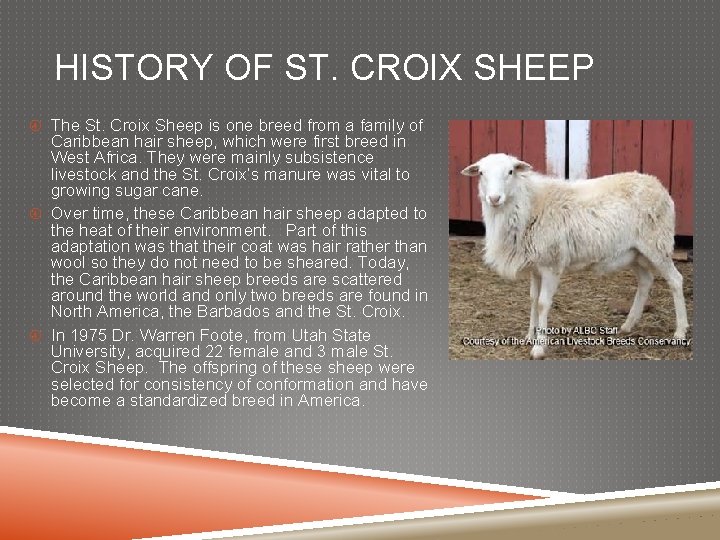
HISTORY OF ST. CROIX SHEEP The St. Croix Sheep is one breed from a family of Caribbean hair sheep, which were first breed in West Africa. They were mainly subsistence livestock and the St. Croix’s manure was vital to growing sugar cane. Over time, these Caribbean hair sheep adapted to the heat of their environment. Part of this adaptation was that their coat was hair rather than wool so they do not need to be sheared. Today, the Caribbean hair sheep breeds are scattered around the world and only two breeds are found in North America, the Barbados and the St. Croix. In 1975 Dr. Warren Foote, from Utah State University, acquired 22 female and 3 male St. Croix Sheep. The offspring of these sheep were selected for consistency of conformation and have become a standardized breed in America.
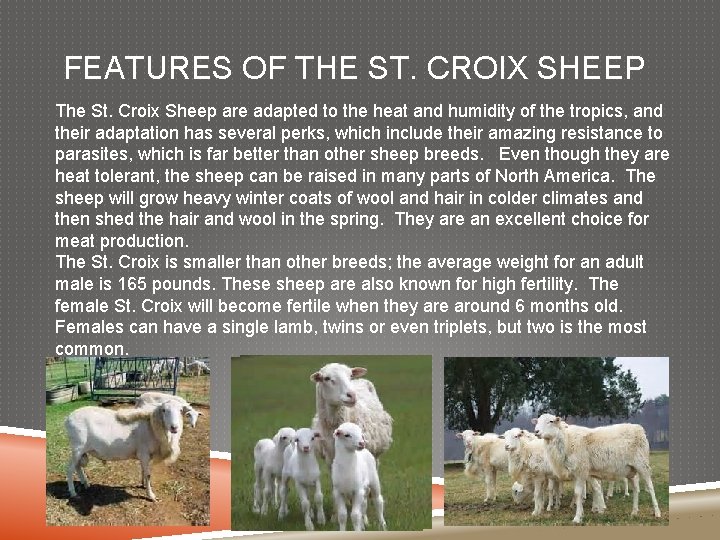
FEATURES OF THE ST. CROIX SHEEP The St. Croix Sheep are adapted to the heat and humidity of the tropics, and their adaptation has several perks, which include their amazing resistance to parasites, which is far better than other sheep breeds. Even though they are heat tolerant, the sheep can be raised in many parts of North America. The sheep will grow heavy winter coats of wool and hair in colder climates and then shed the hair and wool in the spring. They are an excellent choice for meat production. The St. Croix is smaller than other breeds; the average weight for an adult male is 165 pounds. These sheep are also known for high fertility. The female St. Croix will become fertile when they are around 6 months old. Females can have a single lamb, twins or even triplets, but two is the most common.
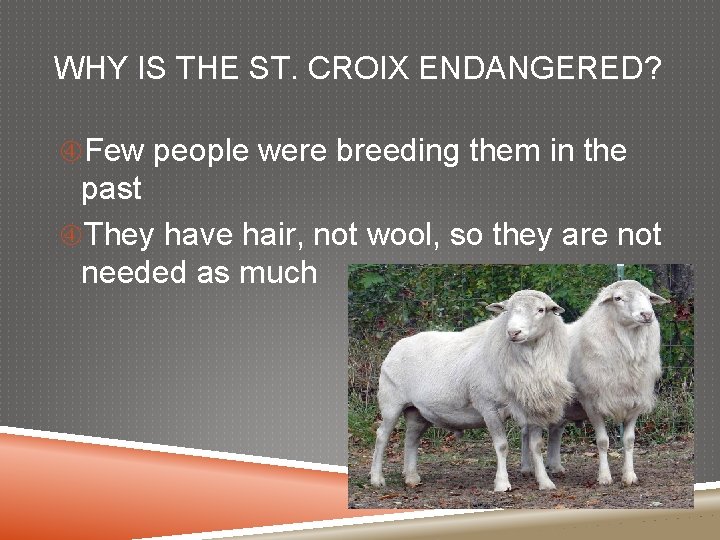
WHY IS THE ST. CROIX ENDANGERED? Few people were breeding them in the past They have hair, not wool, so they are not needed as much
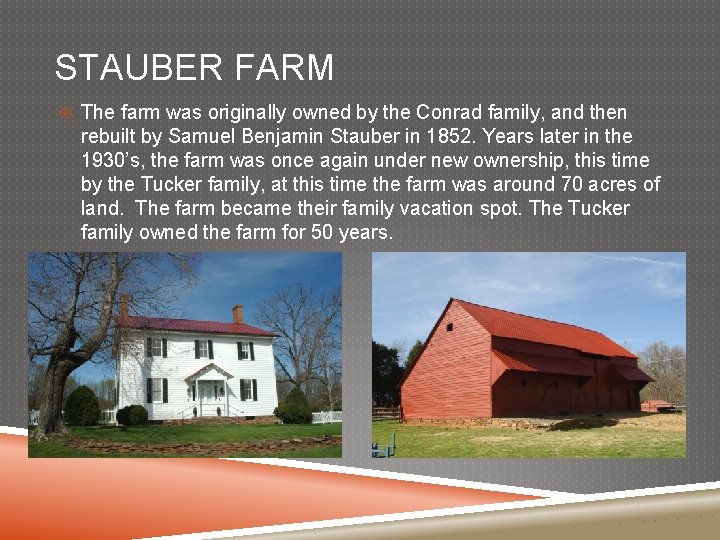
STAUBER FARM The farm was originally owned by the Conrad family, and then rebuilt by Samuel Benjamin Stauber in 1852. Years later in the 1930’s, the farm was once again under new ownership, this time by the Tucker family, at this time the farm was around 70 acres of land. The farm became their family vacation spot. The Tucker family owned the farm for 50 years.
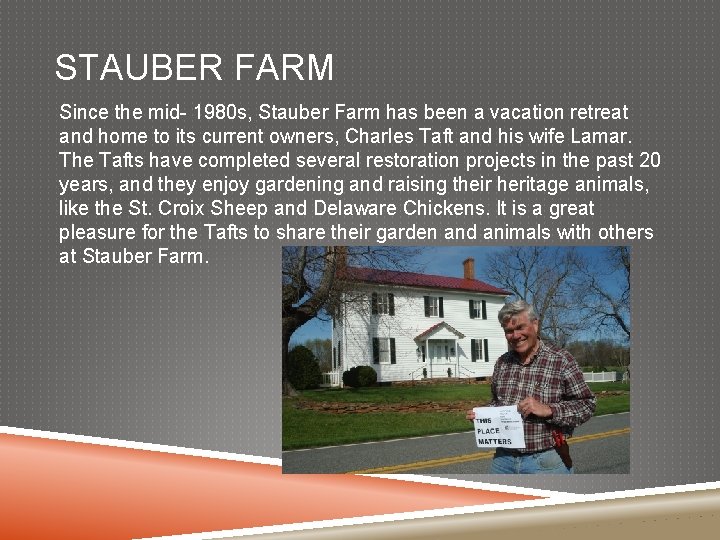
STAUBER FARM Since the mid- 1980 s, Stauber Farm has been a vacation retreat and home to its current owners, Charles Taft and his wife Lamar. The Tafts have completed several restoration projects in the past 20 years, and they enjoy gardening and raising their heritage animals, like the St. Croix Sheep and Delaware Chickens. It is a great pleasure for the Tafts to share their garden and animals with others at Stauber Farm.
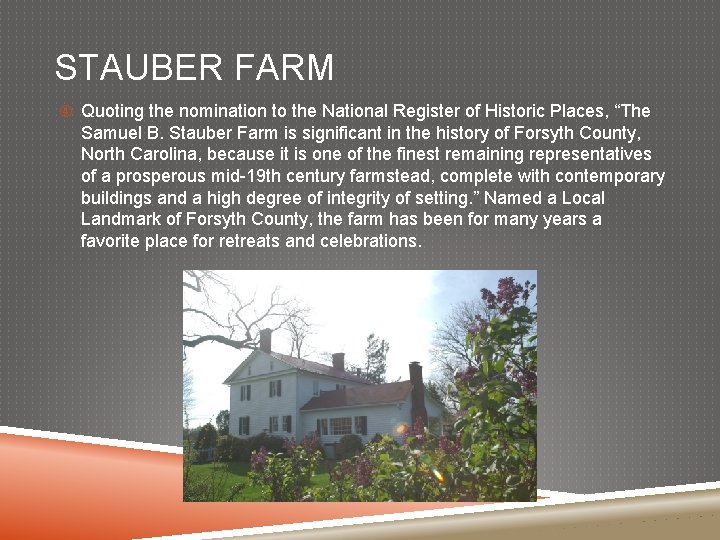
STAUBER FARM Quoting the nomination to the National Register of Historic Places, “The Samuel B. Stauber Farm is significant in the history of Forsyth County, North Carolina, because it is one of the finest remaining representatives of a prosperous mid-19 th century farmstead, complete with contemporary buildings and a high degree of integrity of setting. ” Named a Local Landmark of Forsyth County, the farm has been for many years a favorite place for retreats and celebrations.
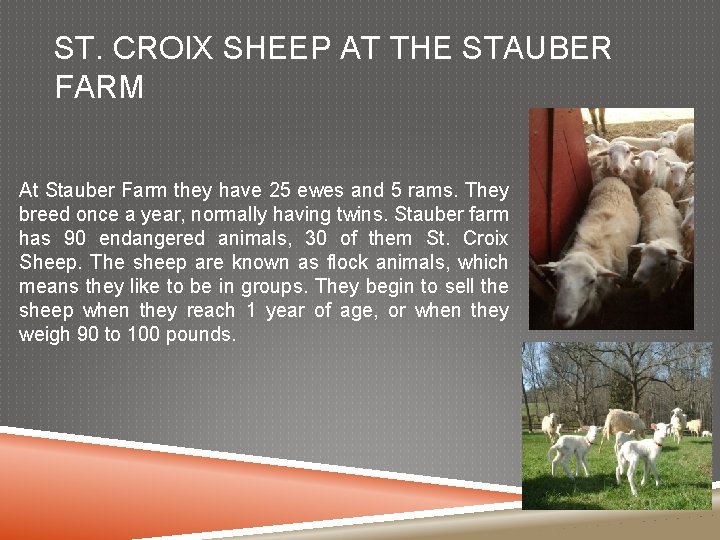
ST. CROIX SHEEP AT THE STAUBER FARM At Stauber Farm they have 25 ewes and 5 rams. They breed once a year, normally having twins. Stauber farm has 90 endangered animals, 30 of them St. Croix Sheep. The sheep are known as flock animals, which means they like to be in groups. They begin to sell the sheep when they reach 1 year of age, or when they weigh 90 to 100 pounds.
HOW CAN WE HELP THE ST. CROIX SHEEP? Encourage farmers to breed this variety of sheep Support the ALBC Eat at restaurants that purchase and serve the meat of the sheep
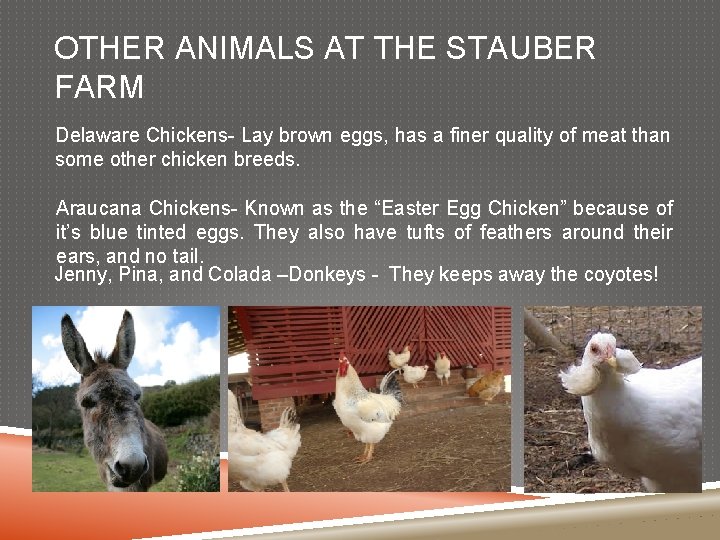
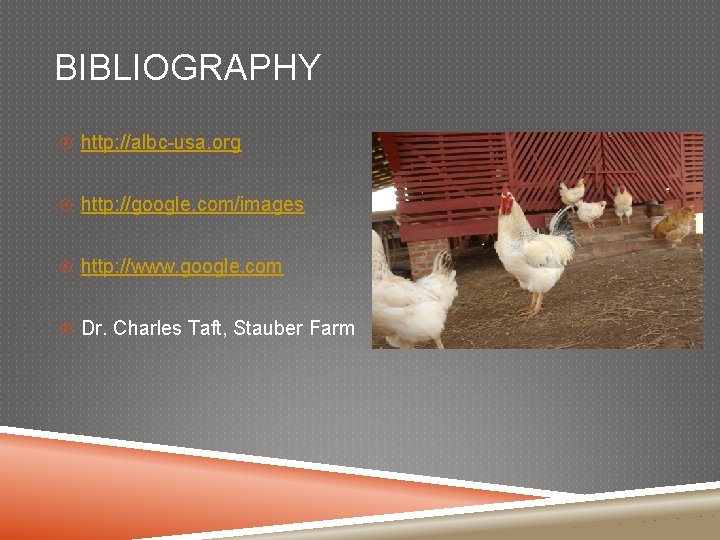
OTHER ANIMALS AT THE STAUBER FARM Delaware Chickens- Lay brown eggs, has a finer quality of meat than some other chicken breeds. Araucana Chickens- Known as the “Easter Egg Chicken” because of it’s blue tinted eggs. They also have tufts of feathers around their ears, and no tail. Jenny, Pina, and Colada –Donkeys - They keeps away the coyotes!
COMPARE: WILD VS LIVESTOCK Both have low populations in the world. Both are protected under the Endangered Species Act.
CONTRAST: WILD VS LIVESTOCK Wildlife are kept safe in preservations to keep away hunters and preserve the species. To keep livestock from going extinct, in the St. Croix Sheep’s case, their meat is sold to restaurants or other businesses, the more people who buy their meat, the more people will breed them, continuing that animal’s cycle of existence. Livestock are usually endangered because they have lost their use, while wildlife are endangered because of hunting, poaching, or loss of habitat.
BIBLIOGRAPHY www. google. com/images www. worldwildlife. org
BIBLIOGRAPHY http: //albc-usa. org http: //google. com/images http: //www. google. com Dr. Charles Taft, Stauber Farm
THANKS FOR WATCHING
- Slides: 25