
END OF LIFE RECYCLING OF PRODUCTS Recycle is

- Slides: 26
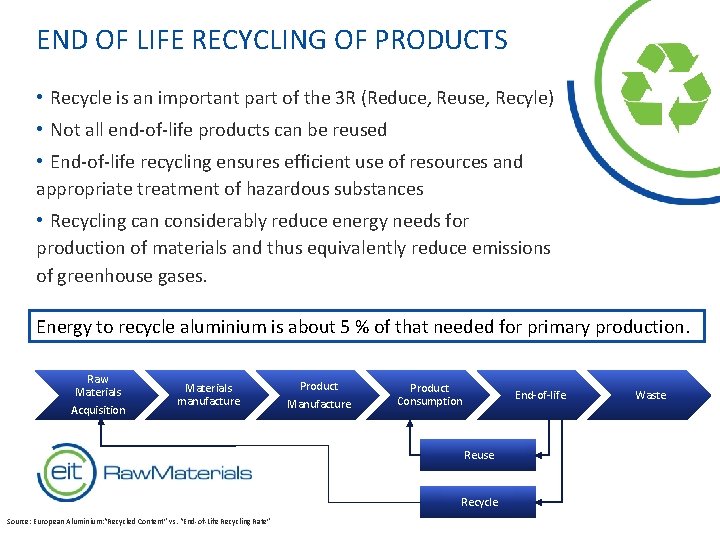
END OF LIFE RECYCLING OF PRODUCTS • Recycle is an important part of the 3 R (Reduce, Reuse, Recyle) • Not all end-of-life products can be reused • End-of-life recycling ensures efficient use of resources and appropriate treatment of hazardous substances • Recycling can considerably reduce energy needs for production of materials and thus equivalently reduce emissions of greenhouse gases. Energy to recycle aluminium is about 5 % of that needed for primary production. Raw Materials Acquisition Materials manufacture Product Manufacture Product Consumption End-of-life Reuse Recycle Source: European Aluminium: “Recycled Content” vs. “End-of-Life Recycling Rate” Waste
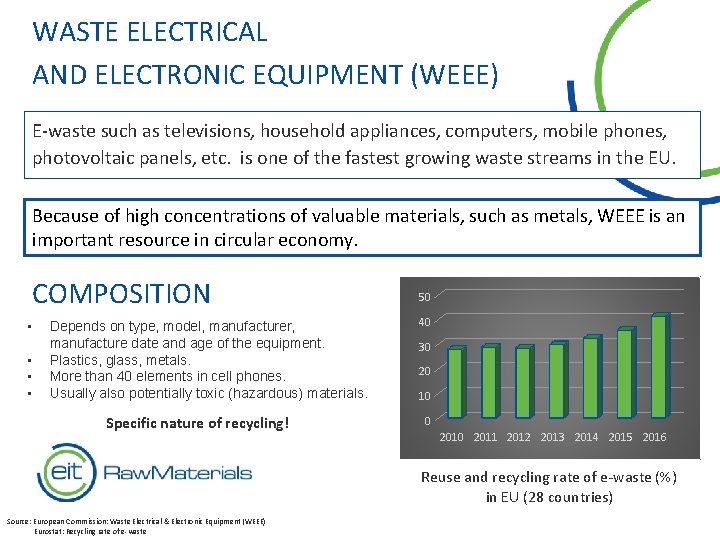
WASTE ELECTRICAL AND ELECTRONIC EQUIPMENT (WEEE) E-waste such as televisions, household appliances, computers, mobile phones, photovoltaic panels, etc. is one of the fastest growing waste streams in the EU. Because of high concentrations of valuable materials, such as metals, WEEE is an important resource in circular economy. COMPOSITION • • Depends on type, model, manufacturer, manufacture date and age of the equipment. Plastics, glass, metals. More than 40 elements in cell phones. Usually also potentially toxic (hazardous) materials. Specific nature of recycling! 50 40 30 20 10 0 2011 2012 2013 2014 2015 2016 Reuse and recycling rate of e-waste (%) in EU (28 countries) Source: European Commission: Waste Electrical & Electronic Equipment (WEEE) Eurostat: Recycling rate of e-waste
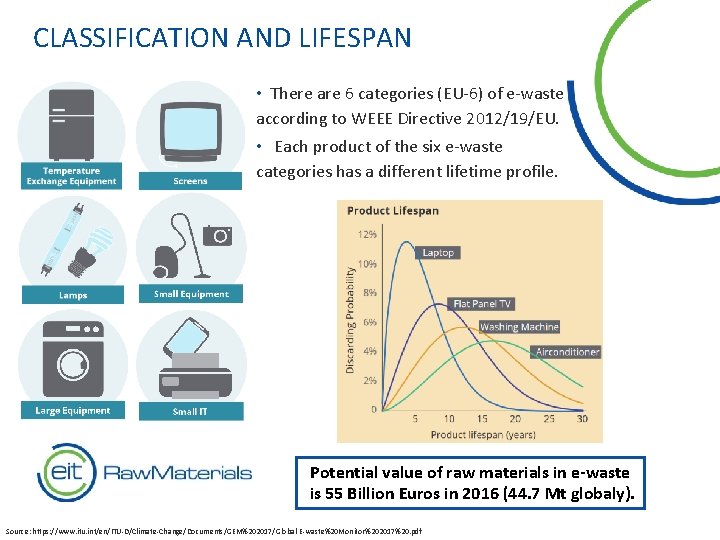
CLASSIFICATION AND LIFESPAN • There are 6 categories (EU-6) of e-waste according to WEEE Directive 2012/19/EU. • Each product of the six e-waste categories has a different lifetime profile. Potential value of raw materials in e-waste is 55 Billion Euros in 2016 (44. 7 Mt globaly). Source: https: //www. itu. int/en/ITU-D/Climate-Change/Documents/GEM%202017/Global-E-waste%20 Monitor%202017%20. pdf
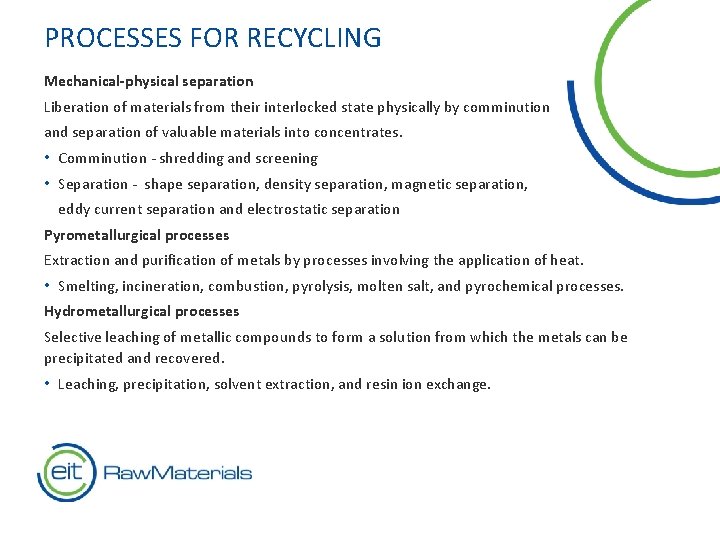
PROCESSES FOR RECYCLING Mechanical-physical separation Liberation of materials from their interlocked state physically by comminution and separation of valuable materials into concentrates. • Comminution - shredding and screening • Separation - shape separation, density separation, magnetic separation, eddy current separation and electrostatic separation Pyrometallurgical processes Extraction and purification of metals by processes involving the application of heat. • Smelting, incineration, combustion, pyrolysis, molten salt, and pyrochemical processes. Hydrometallurgical processes Selective leaching of metallic compounds to form a solution from which the metals can be precipitated and recovered. • Leaching, precipitation, solvent extraction, and resin ion exchange.
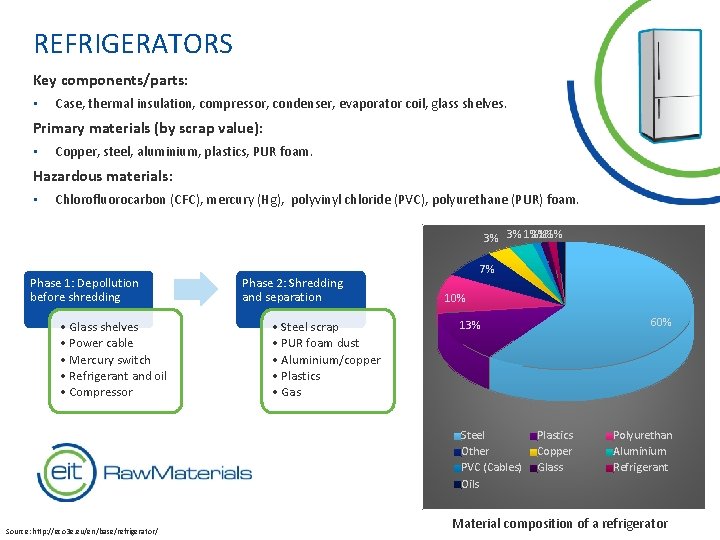
REFRIGERATORS Key components/parts: • Case, thermal insulation, compressor, condenser, evaporator coil, glass shelves. Primary materials (by scrap value): • Copper, steel, aluminium, plastics, PUR foam. Hazardous materials: • Chlorofluorocarbon (CFC), mercury (Hg), polyvinyl chloride (PVC), polyurethane (PUR) foam. 1% 1%1% 3% 3% 1% Phase 1: Depollution before shredding • Glass shelves • Power cable • Mercury switch • Refrigerant and oil • Compressor Phase 2: Shredding and separation • Steel scrap • PUR foam dust • Aluminium/copper • Plastics • Gas 7% 10% Steel Other PVC (Cables) Oils Source: http: //eco 3 e. eu/en/base/refrigerator/ 60% 13% Plastics Copper Glass Polyurethan Aluminium Refrigerant Material composition of a refrigerator
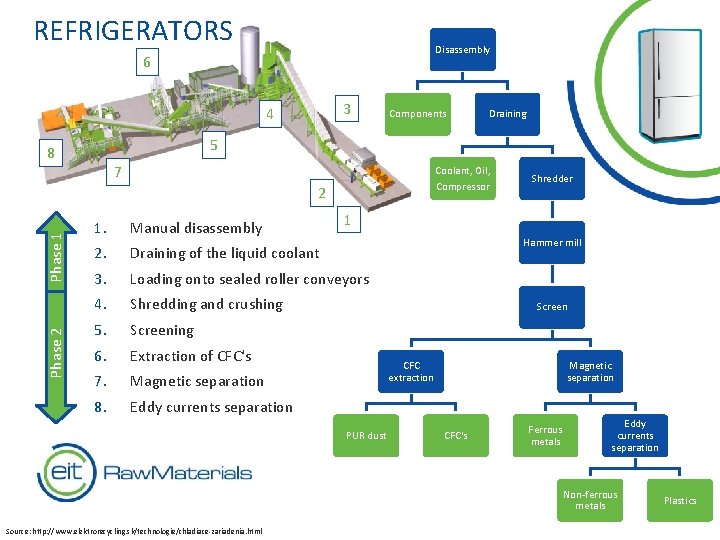
REFRIGERATORS Disassembly 6 3 4 Components 5 8 7 Coolant, Oil, Compressor Phase 1 2 Phase 2 Draining Shredder 1 1. Manual disassembly 2. Draining of the liquid coolant 3. Loading onto sealed roller conveyors 4. Shredding and crushing 5. Screening 6. Extraction of CFC‘s 7. Magnetic separation 8. Eddy currents separation Hammer mill Screen CFC extraction PUR dust Magnetic separation CFC‘s Ferrous metals Eddy currents separation Non-ferrous metals Source: http: //www. elektrorecycling. sk/technologie/chladiace-zariadenia. html Plastics
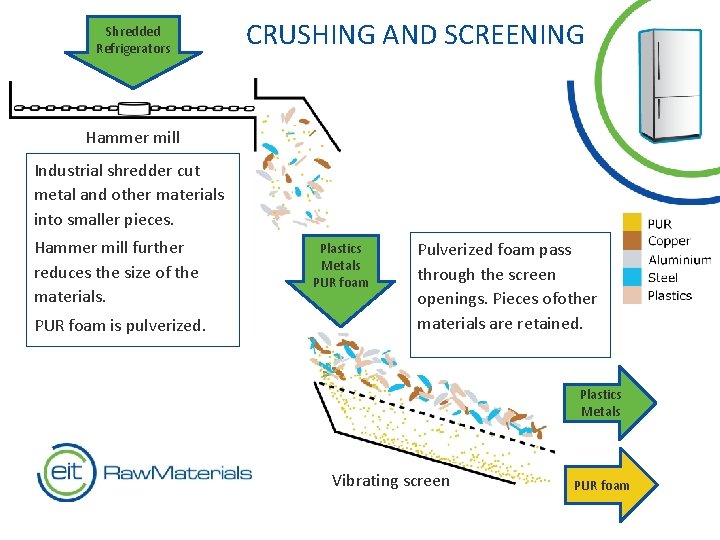
Shredded Refrigerators CRUSHING AND SCREENING Hammer mill Industrial shredder cut metal and other materials into smaller pieces. Hammer mill further reduces the size of the materials. PUR foam is pulverized. Plastics Metals PUR foam Pulverized foam pass through the screen openings. Pieces ofother materials are retained. Plastics Metals Vibrating screen PUR foam
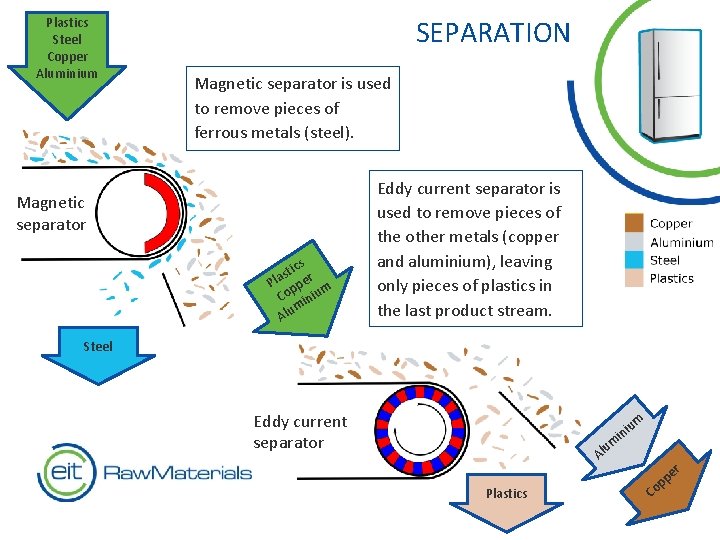
Plastics Steel Copper Aluminium SEPARATION Magnetic separator is used to remove pieces of ferrous metals (steel). Magnetic separator s tic r s a Pl ppe m Co iniu m Alu Eddy current separator is used to remove pieces of the other metals (copper and aluminium), leaving only pieces of plastics in the last product stream. Steel Eddy current separator um ini um Al Plastics er C p op
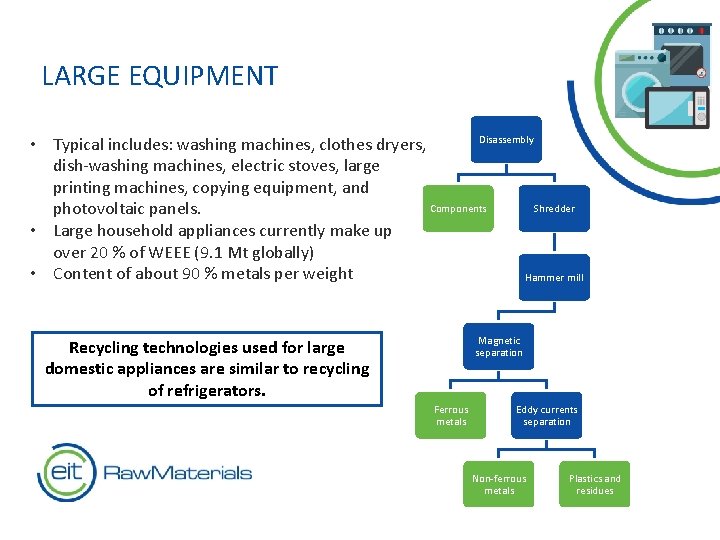
LARGE EQUIPMENT Disassembly • Typical includes: washing machines, clothes dryers, dish-washing machines, electric stoves, large printing machines, copying equipment, and Components Shredder photovoltaic panels. • Large household appliances currently make up over 20 % of WEEE (9. 1 Mt globally) • Content of about 90 % metals per weight Hammer mill Magnetic separation Recycling technologies used for large domestic appliances are similar to recycling of refrigerators. Ferrous metals Eddy currents separation Non-ferrous metals Plastics and residues
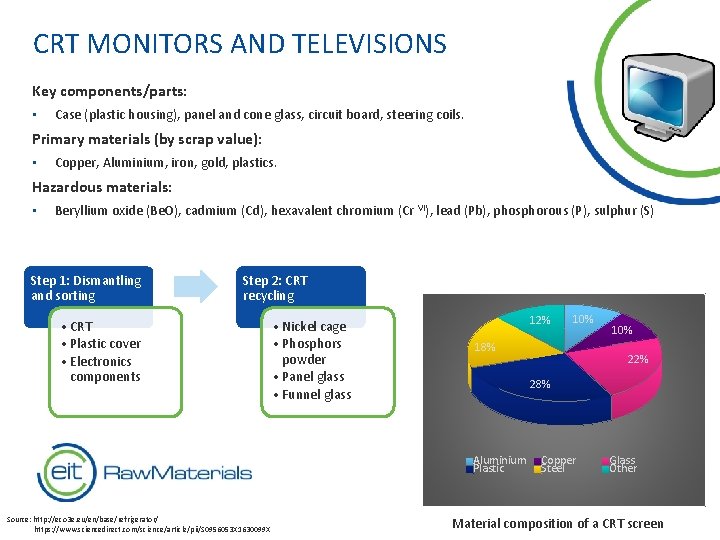
CRT MONITORS AND TELEVISIONS Key components/parts: • Case (plastic housing), panel and cone glass, circuit board, steering coils. Primary materials (by scrap value): • Copper, Aluminium, iron, gold, plastics. Hazardous materials: • Beryllium oxide (Be. O), cadmium (Cd), hexavalent chromium (Cr VI), lead (Pb), phosphorous (P), sulphur (S) Step 1: Dismantling and sorting Step 2: CRT recycling • CRT • Plastic cover • Electronics components • Nickel cage • Phosphors powder • Panel glass • Funnel glass 12% 18% 10% 22% 28% Aluminium Plastic Source: http: //eco 3 e. eu/en/base/refrigerator/ https: //www. sciencedirect. com/science/article/pii/S 0956053 X 1630099 X 10% Copper Steel Glass Other Material composition of a CRT screen
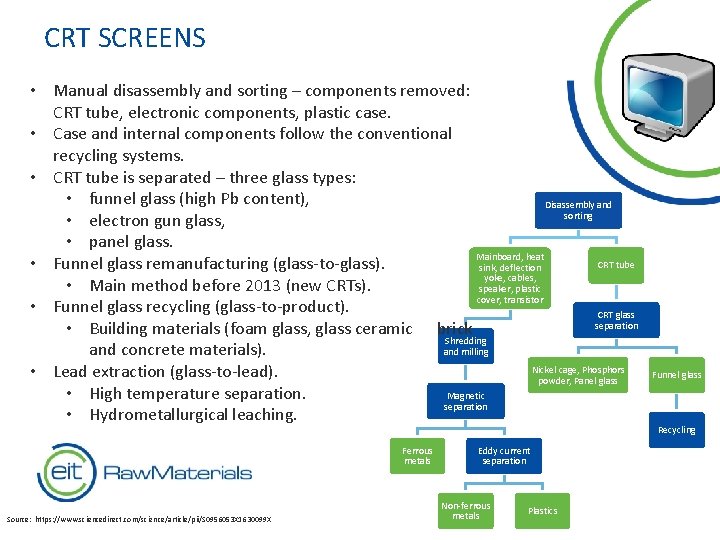
CRT SCREENS • Manual disassembly and sorting – components removed: CRT tube, electronic components, plastic case. • Case and internal components follow the conventional recycling systems. • CRT tube is separated – three glass types: • funnel glass (high Pb content), Disassembly and sorting • electron gun glass, • panel glass. Mainboard, heat CRT tube • Funnel glass remanufacturing (glass-to-glass). sink, deflection yoke, cables, • Main method before 2013 (new CRTs). speaker, plastic cover, transistor • Funnel glass recycling (glass-to-product). CRT glass separation • Building materials (foam glass, glass ceramic brick Shredding and milling and concrete materials). Nickel cage, Phosphors • Lead extraction (glass-to-lead). powder, Panel glass • High temperature separation. Magnetic separation • Hydrometallurgical leaching. Ferrous metals Source: https: //www. sciencedirect. com/science/article/pii/S 0956053 X 1630099 X Eddy current separation Non-ferrous metals Plastics Funnel glass Recycling
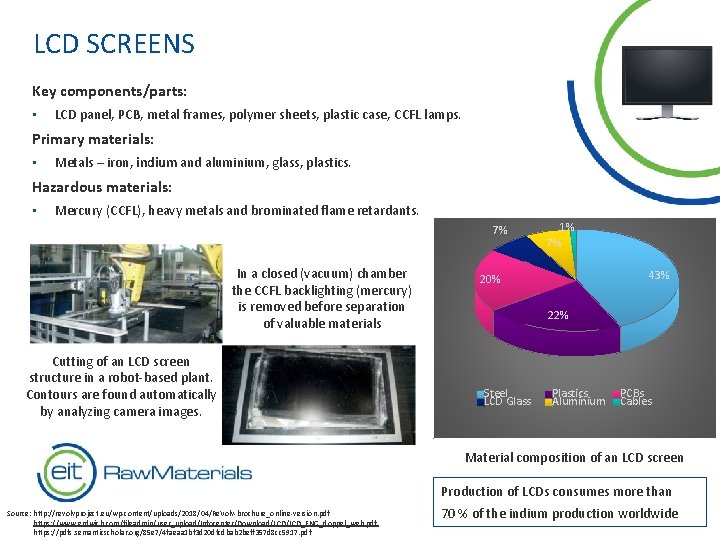
LCD SCREENS Key components/parts: • LCD panel, PCB, metal frames, polymer sheets, plastic case, CCFL lamps. Primary materials: • Metals – iron, indium and aluminium, glass, plastics. Hazardous materials: • Mercury (CCFL), heavy metals and brominated flame retardants. 7% In a closed (vacuum) chamber the CCFL backlighting (mercury) is removed before separation of valuable materials Cutting of an LCD screen structure in a robot-based plant. Contours are found automatically by analyzing camera images. 1% 7% 43% 20% 22% Steel LCD Glass Plastics Aluminium PCBs Cables Material composition of an LCD screen Production of LCDs consumes more than Source: http: //revolvproject. eu/wp-content/uploads/2018/04/Re. Volv-brochure_online-version. pdf https: //www. erdwich. com/fileadmin/user_upload/Infocenter/Download/LCD_ENG_doppel_web. pdf https: //pdfs. semanticscholar. org/85 e 7/4 faeaa 1 bf 3 d 20 dfcdbab 2 beff 357 d 8 cc 5917. pdf 70 % of the indium production worldwide
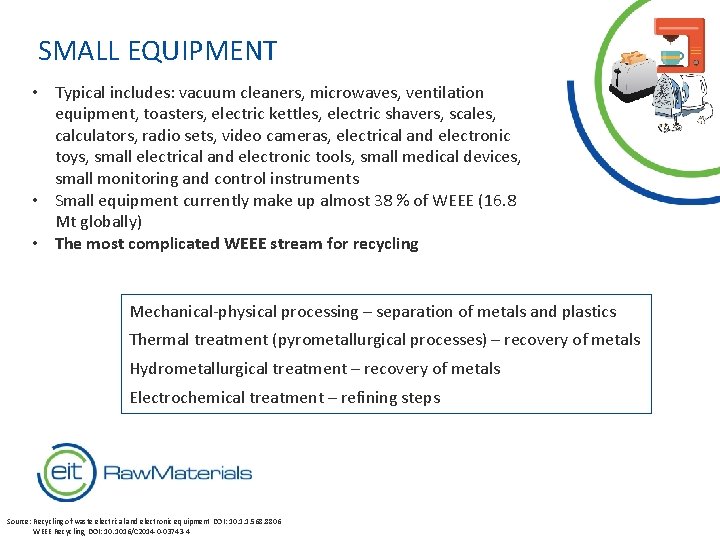
SMALL EQUIPMENT • Typical includes: vacuum cleaners, microwaves, ventilation equipment, toasters, electric kettles, electric shavers, scales, calculators, radio sets, video cameras, electrical and electronic toys, small electrical and electronic tools, small medical devices, small monitoring and control instruments • Small equipment currently make up almost 38 % of WEEE (16. 8 Mt globally) • The most complicated WEEE stream for recycling Mechanical-physical processing – separation of metals and plastics Thermal treatment (pyrometallurgical processes) – recovery of metals Hydrometallurgical treatment – recovery of metals Electrochemical treatment – refining steps Source: Recycling of waste electrical and electronic equipment DOI: 10. 1. 1. 568. 8806 WEEE Recycling, DOI: 10. 1016/C 2014 -0 -03743 -4
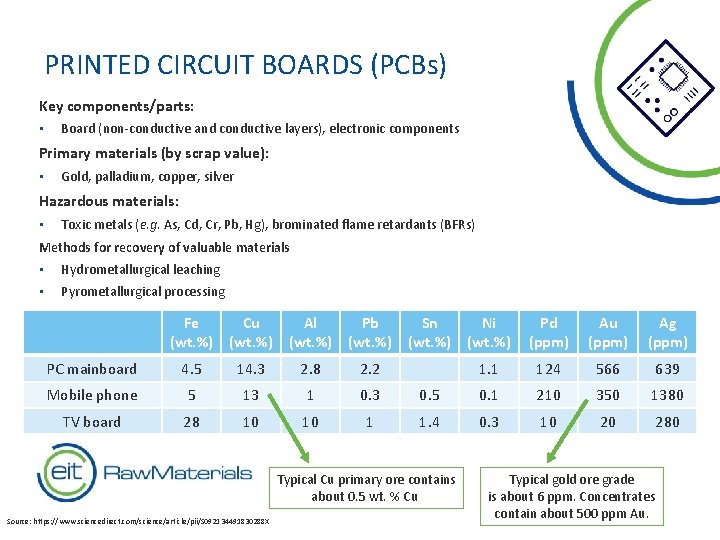
PRINTED CIRCUIT BOARDS (PCBs) Key components/parts: • Board (non-conductive and conductive layers), electronic components Primary materials (by scrap value): • Gold, palladium, copper, silver Hazardous materials: • Toxic metals (e. g. As, Cd, Cr, Pb, Hg), brominated flame retardants (BFRs) Methods for recovery of valuable materials • Hydrometallurgical leaching • Pyrometallurgical processing Fe (wt. %) Cu (wt. %) Al (wt. %) Pb (wt. %) PC mainboard 4. 5 14. 3 2. 8 2. 2 Mobile phone 5 13 1 0. 3 TV board 28 10 10 1 Sn (wt. %) Ni (wt. %) Pd (ppm) Au (ppm) Ag (ppm) 1. 1 124 566 639 0. 5 0. 1 210 350 1380 1. 4 0. 3 10 20 280 Typical Cu primary ore contains about 0. 5 wt. % Cu Source: https: //www. sciencedirect. com/science/article/pii/S 092134491830288 X Typical gold ore grade is about 6 ppm. Concentrates contain about 500 ppm Au.
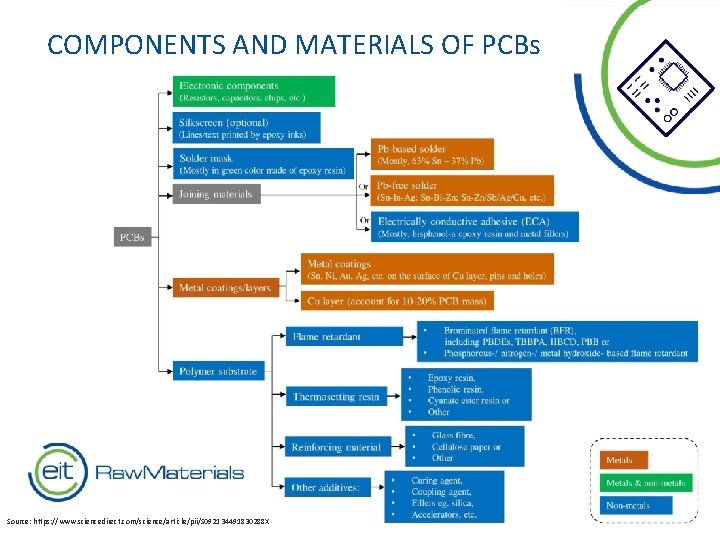
COMPONENTS AND MATERIALS OF PCBs Source: https: //www. sciencedirect. com/science/article/pii/S 092134491830288 X
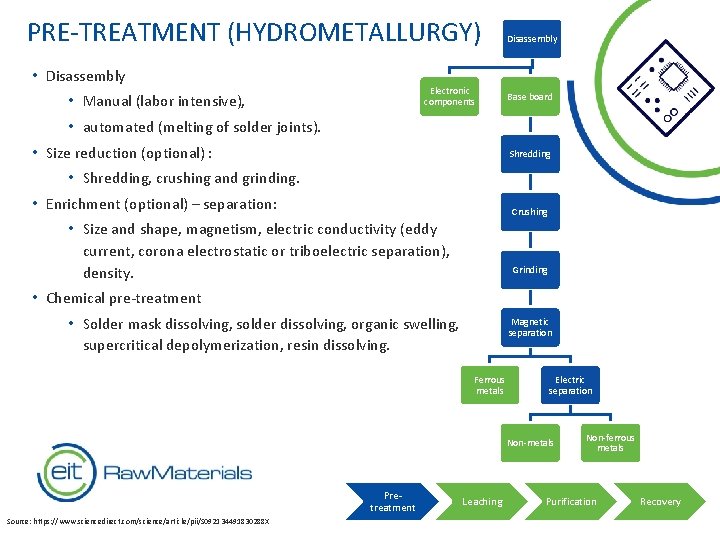
PRE-TREATMENT (HYDROMETALLURGY) • Disassembly Electronic components • Manual (labor intensive), Disassembly Base board • automated (melting of solder joints). • Size reduction (optional) : Shredding • Shredding, crushing and grinding. • Enrichment (optional) – separation: Crushing • Size and shape, magnetism, electric conductivity (eddy current, corona electrostatic or triboelectric separation), density. Grinding • Chemical pre-treatment • Solder mask dissolving, solder dissolving, organic swelling, supercritical depolymerization, resin dissolving. Magnetic separation Ferrous metals Electric separation Non-metals Pretreatment Source: https: //www. sciencedirect. com/science/article/pii/S 092134491830288 X Leaching Non-ferrous metals Purification Recovery
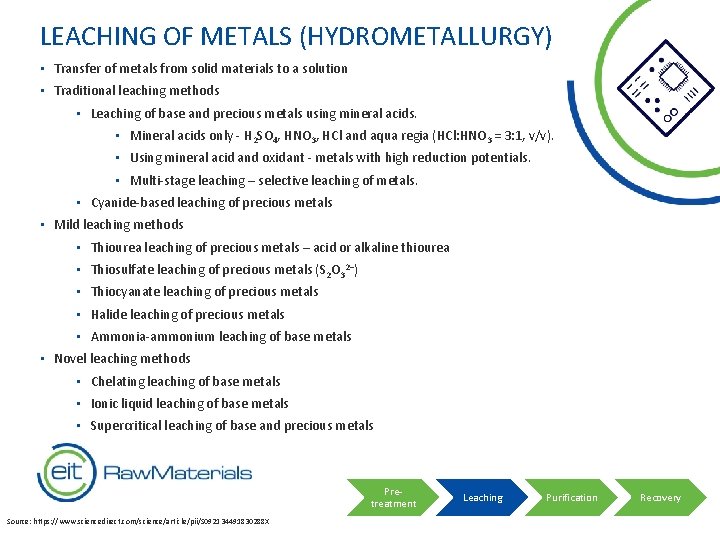
LEACHING OF METALS (HYDROMETALLURGY) • Transfer of metals from solid materials to a solution • Traditional leaching methods • Leaching of base and precious metals using mineral acids. • Mineral acids only - H 2 SO 4, HNO 3, HCl and aqua regia (HCl: HNO 3 = 3: 1, v/v). • Using mineral acid and oxidant - metals with high reduction potentials. • Multi-stage leaching – selective leaching of metals. • Cyanide-based leaching of precious metals • Mild leaching methods • Thiourea leaching of precious metals – acid or alkaline thiourea • Thiosulfate leaching of precious metals (S 2 O 32−) • Thiocyanate leaching of precious metals • Halide leaching of precious metals • Ammonia-ammonium leaching of base metals • Novel leaching methods • Chelating leaching of base metals • Ionic liquid leaching of base metals • Supercritical leaching of base and precious metals Pretreatment Source: https: //www. sciencedirect. com/science/article/pii/S 092134491830288 X Leaching Purification Recovery
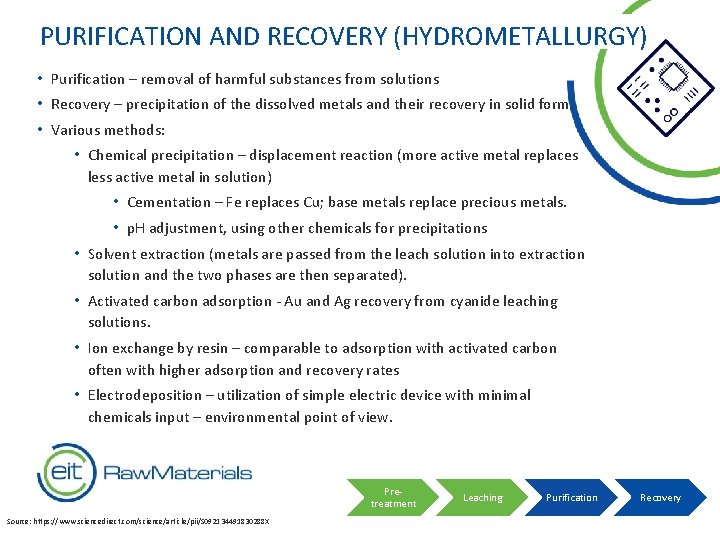
PURIFICATION AND RECOVERY (HYDROMETALLURGY) • Purification – removal of harmful substances from solutions • Recovery – precipitation of the dissolved metals and their recovery in solid form. • Various methods: • Chemical precipitation – displacement reaction (more active metal replaces less active metal in solution) • Cementation – Fe replaces Cu; base metals replace precious metals. • p. H adjustment, using other chemicals for precipitations • Solvent extraction (metals are passed from the leach solution into extraction solution and the two phases are then separated). • Activated carbon adsorption - Au and Ag recovery from cyanide leaching solutions. • Ion exchange by resin – comparable to adsorption with activated carbon often with higher adsorption and recovery rates • Electrodeposition – utilization of simple electric device with minimal chemicals input – environmental point of view. Pretreatment Source: https: //www. sciencedirect. com/science/article/pii/S 092134491830288 X Leaching Purification Recovery
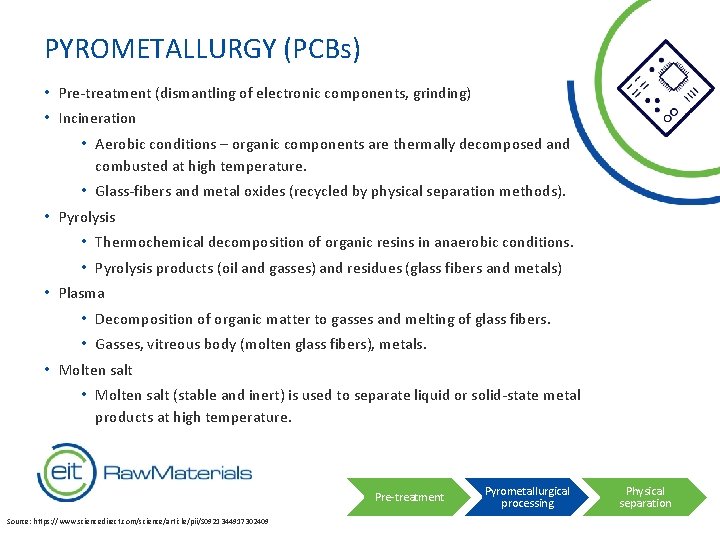
PYROMETALLURGY (PCBs) • Pre-treatment (dismantling of electronic components, grinding) • Incineration • Aerobic conditions – organic components are thermally decomposed and combusted at high temperature. • Glass-fibers and metal oxides (recycled by physical separation methods). • Pyrolysis • Thermochemical decomposition of organic resins in anaerobic conditions. • Pyrolysis products (oil and gasses) and residues (glass fibers and metals) • Plasma • Decomposition of organic matter to gasses and melting of glass fibers. • Gasses, vitreous body (molten glass fibers), metals. • Molten salt (stable and inert) is used to separate liquid or solid-state metal products at high temperature. Pre-treatment Source: https: //www. sciencedirect. com/science/article/pii/S 0921344917302409 Pyrometallurgical processing Physical separation
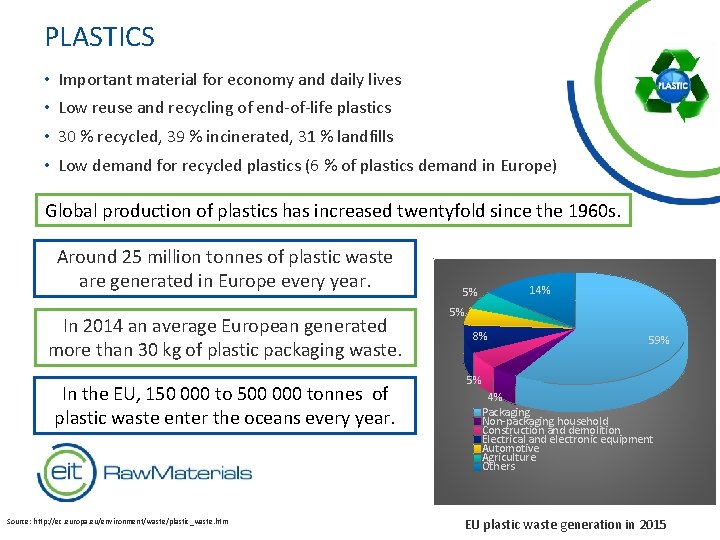
PLASTICS • Important material for economy and daily lives • Low reuse and recycling of end-of-life plastics • 30 % recycled, 39 % incinerated, 31 % landfills • Low demand for recycled plastics (6 % of plastics demand in Europe) Global production of plastics has increased twentyfold since the 1960 s. Around 25 million tonnes of plastic waste are generated in Europe every year. In 2014 an average European generated more than 30 kg of plastic packaging waste. In the EU, 150 000 to 500 000 tonnes of plastic waste enter the oceans every year. Source: http: //ec. europa. eu/environment/waste/plastic_waste. htm 14% 5% 5% 8% 59% 5% 4% Packaging Non-packaging household Construction and demolition Electrical and electronic equipment Automotive Agriculture Others EU plastic waste generation in 2015
PLASTICS RECYCLING TECHNOLOGIES Methods for recovery of plastic waste • Reuse (primary) • Mechanical recycling (secondary) • Chemical or feedstock recycling (tertiary) • Energy recycling (quaternary) Sorting PET Bottles Label removing Size reduction Washing Flakes De-Polymerization Re-Polymerization Chips • Manual sorting by operator • Visible, Near infrared and X-ray fluorescence • Electrostatic • Sink-float • Hydrocyclones / Dense medium cyclones • Froth flotation Production Source: https: //www. sciencedirect. com/science/article/pii/S 0956053 X 15002214 https: //www. sciencedirect. com/science/article/pii/S 0956053 X 18301855 Staple fiber Filament yarn
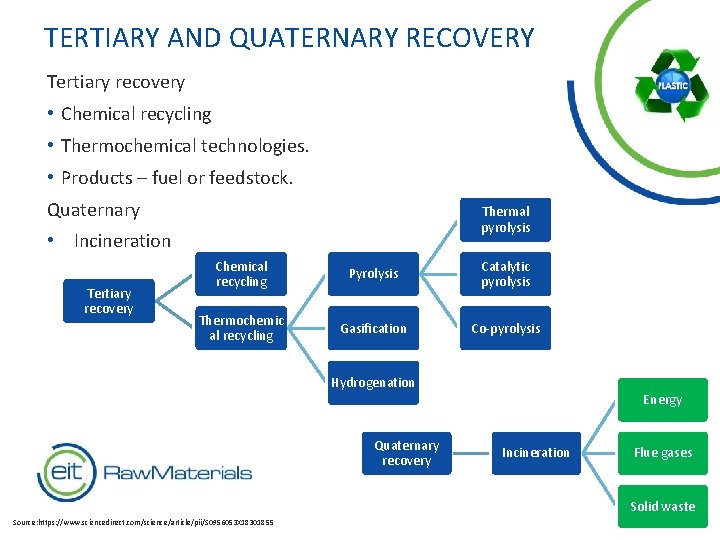
TERTIARY AND QUATERNARY RECOVERY Tertiary recovery • Chemical recycling • Thermochemical technologies. • Products – fuel or feedstock. Quaternary Thermal pyrolysis • Incineration Tertiary recovery Chemical recycling Pyrolysis Catalytic pyrolysis Thermochemic al recycling Gasification Co-pyrolysis Hydrogenation Energy Quaternary recovery Incineration Flue gases Solid waste Source: https: //www. sciencedirect. com/science/article/pii/S 0956053 X 18301855
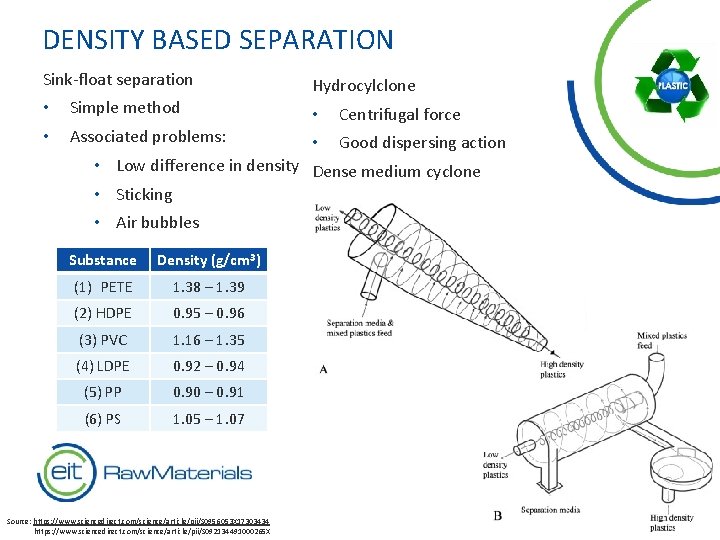
DENSITY BASED SEPARATION Sink-float separation Hydrocylclone • Simple method • Centrifugal force • Associated problems: • Good dispersing action • Low difference in density Dense medium cyclone • Sticking • Air bubbles Substance Density (g/cm 3) (1) PETE 1. 38 – 1. 39 (2) HDPE 0. 95 – 0. 96 (3) PVC 1. 16 – 1. 35 (4) LDPE 0. 92 – 0. 94 (5) PP 0. 90 – 0. 91 (6) PS 1. 05 – 1. 07 Source: https: //www. sciencedirect. com/science/article/pii/S 0956053 X 17303434 https: //www. sciencedirect. com/science/article/pii/S 092134491000265 X
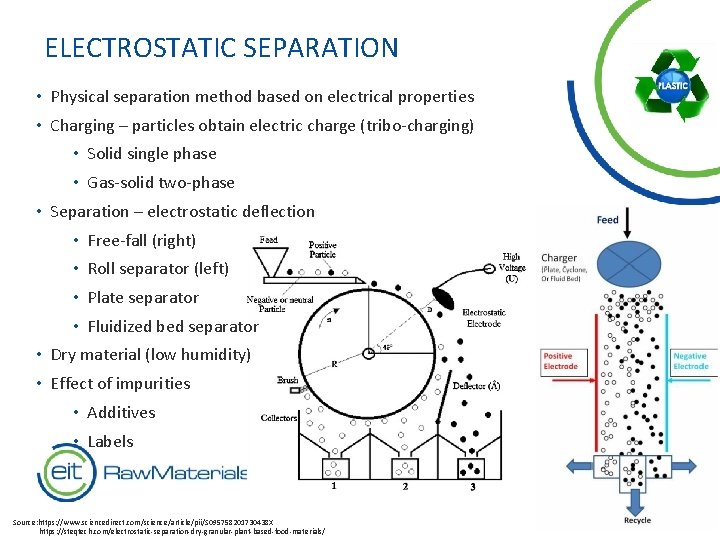
ELECTROSTATIC SEPARATION • Physical separation method based on electrical properties • Charging – particles obtain electric charge (tribo-charging) • Solid single phase • Gas-solid two-phase • Separation – electrostatic deflection • Free-fall (right) • Roll separator (left) • Plate separator • Fluidized bed separator • Dry material (low humidity) • Effect of impurities • Additives • Labels Source: https: //www. sciencedirect. com/science/article/pii/S 095758201730438 X https: //steqtech. com/electrostatic-separation-dry-granular-plant-based-food-materials/
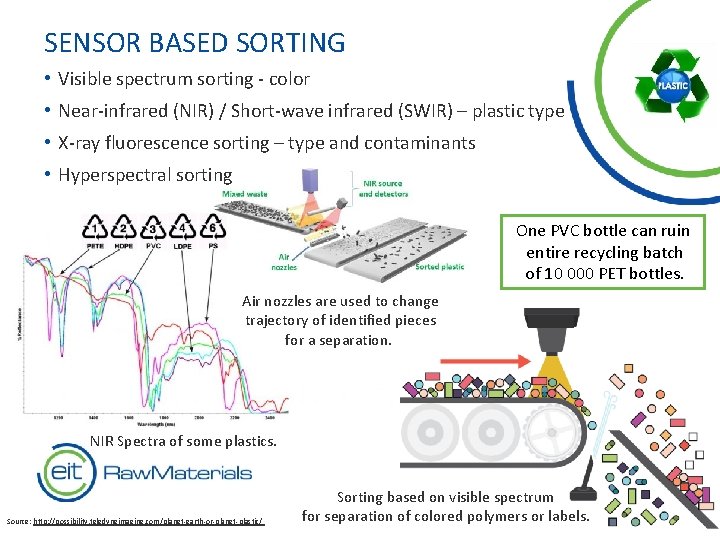
SENSOR BASED SORTING • Visible spectrum sorting - color • Near-infrared (NIR) / Short-wave infrared (SWIR) – plastic type • X-ray fluorescence sorting – type and contaminants • Hyperspectral sorting One PVC bottle can ruin entire recycling batch of 10 000 PET bottles. Air nozzles are used to change trajectory of identified pieces for a separation. NIR Spectra of some plastics. Source: http: //possibility. teledyneimaging. com/planet-earth-or-planet-plastic/ Sorting based on visible spectrum for separation of colored polymers or labels.
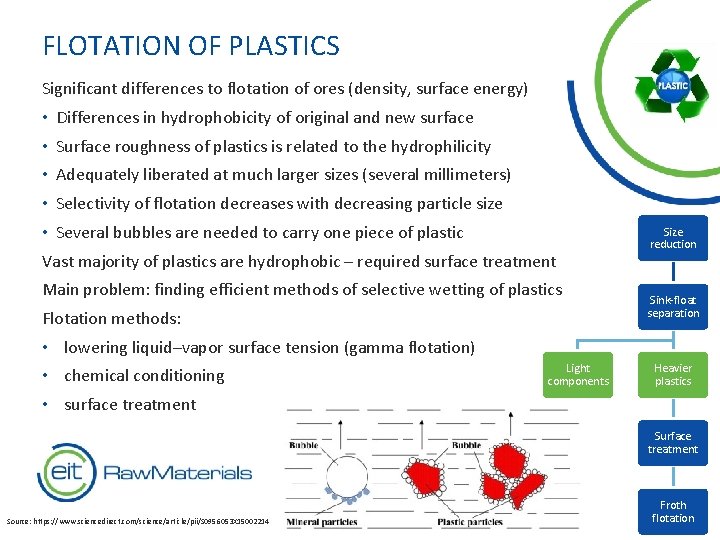
FLOTATION OF PLASTICS Significant differences to flotation of ores (density, surface energy) • Differences in hydrophobicity of original and new surface • Surface roughness of plastics is related to the hydrophilicity • Adequately liberated at much larger sizes (several millimeters) • Selectivity of flotation decreases with decreasing particle size • Several bubbles are needed to carry one piece of plastic Vast majority of plastics are hydrophobic – required surface treatment Main problem: finding efficient methods of selective wetting of plastics Flotation methods: Size reduction Sink-float separation • lowering liquid–vapor surface tension (gamma flotation) • chemical conditioning Light components Heavier plastics • surface treatment Source: https: //www. sciencedirect. com/science/article/pii/S 0956053 X 15002214 Froth flotation