
End Marks The Period Exclamation Mark and Question
- Slides: 15
End Marks The Period, Exclamation Mark and Question Mark
The Period. • At the close of every declarative sentence and of most imperative sentences
• Don’t get too near the fire. • I’ll never go back to that barber. Never.
After every part of an abbreviation • Dr. Millhouse • Ms. Stronach • Ont. • P. M. • D. J. Carroll
It has become the custom not to use periods in abbreviations of certain government agencies and international organizations. • NATO • FBI • UN
Exclamation Mark! • After an exclamatory sentence and after an exclamation set off from a sentence
• • • Wow! What a hit! Help! Bravo! That’s enough! Look out! We want Armstrong!
• The exclamation mark can be a valuable tool for conveying your tone of voice to the reader.
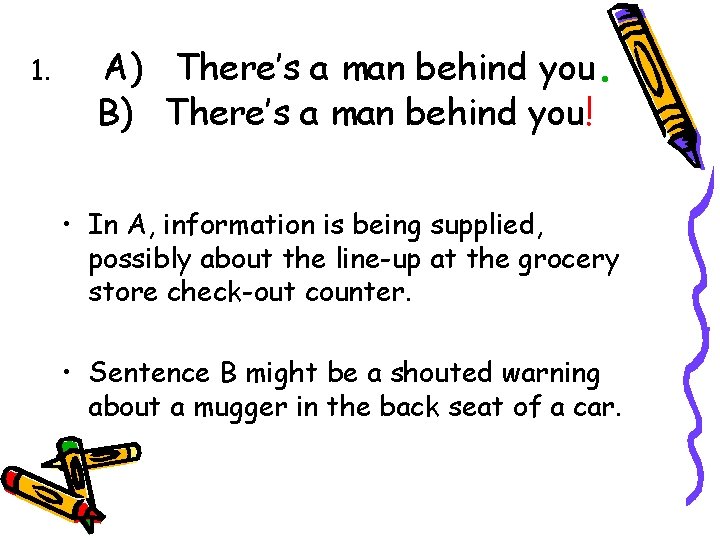
1. A) There’s a man behind you. B) There’s a man behind you! • In A, information is being supplied, possibly about the line-up at the grocery store check-out counter. • Sentence B might be a shouted warning about a mugger in the back seat of a car.
Don’t overuse the exclamation mark, or it will lose its impact. • Read the following with and without an exclamation mark, and picture the situation that would go with each reading. • Remember that punctuation changes the meaning of a sentence.
1. 2. 3. 4. He’s gone The room was empty Don’t touch that button There she goes again
Question Mark • After an interrogative sentence or after a question that is not a complete sentence. • In speech, the speaker raises his voice at the end of the sentence to indicate that the statement is a question. In writing, the question mark performs this function.
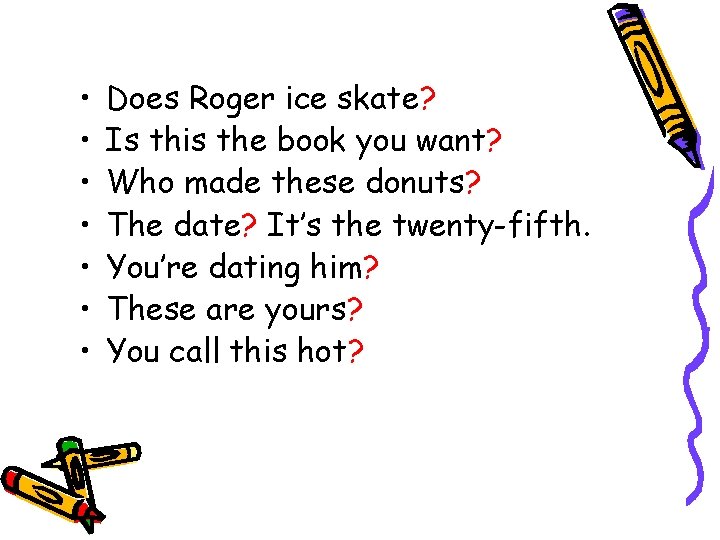
• • Does Roger ice skate? Is this the book you want? Who made these donuts? The date? It’s the twenty-fifth. You’re dating him? These are yours? You call this hot?
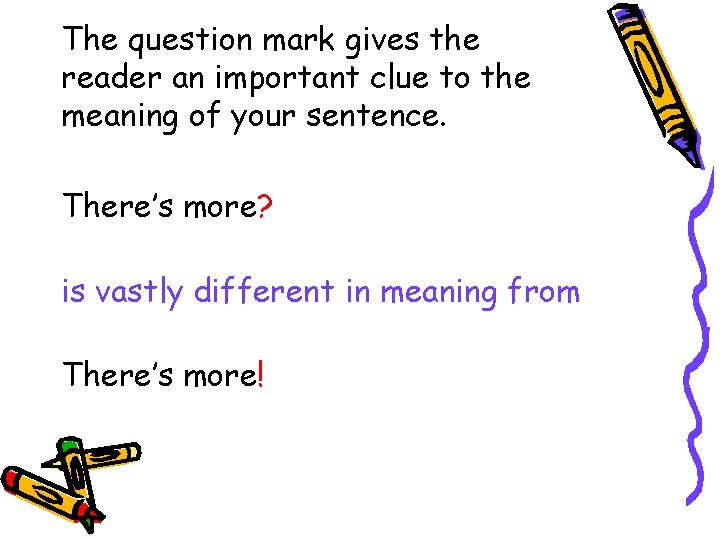
The question mark gives the reader an important clue to the meaning of your sentence. There’s more? is vastly different in meaning from There’s more!
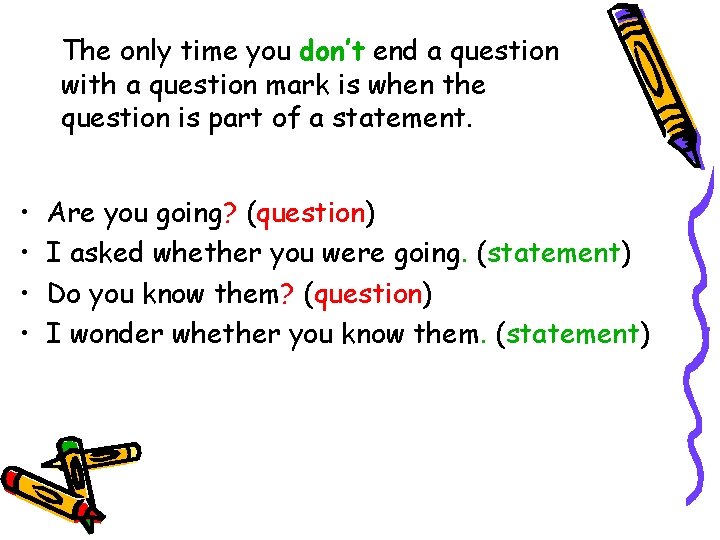
The only time you don’t end a question with a question mark is when the question is part of a statement. • • Are you going? (question) I asked whether you were going. (statement) Do you know them? (question) I wonder whether you know them. (statement)