
End Behavior Asymptotes Going beyond horizontal Asymptotes We
End – Behavior Asymptotes Going beyond horizontal Asymptotes
We will. . 1. Learn how to find horizontal asymptotes without simplifying. 2. Learn how to find an oblique asymptote. 3. Learn how to find x-intercepts. 4. Utilize our knowledge to graph rational functions.
• An end-behavior asymptote is an asymptote used to describe how the ends of a function behave. • It is possible to determine these asymptotes without much work. • Rational functions behave differently when the numerator isn’t a constant. • There are two types of end-behavior asymptotes a rational function can have: • (1) horizontal • (2) oblique
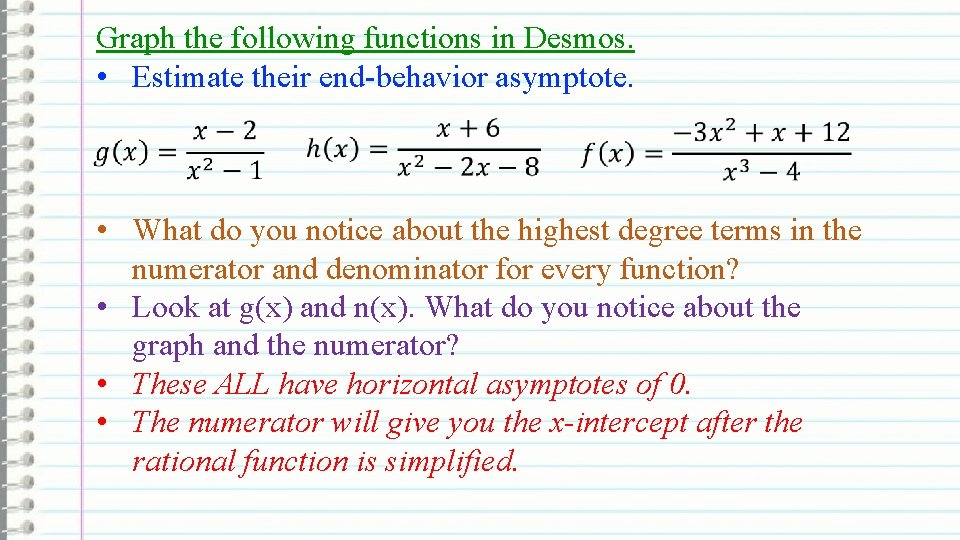
Graph the following functions in Desmos. • Estimate their end-behavior asymptote. • What do you notice about the highest degree terms in the numerator and denominator for every function? • Look at g(x) and n(x). What do you notice about the graph and the numerator? • These ALL have horizontal asymptotes of 0. • The numerator will give you the x-intercept after the rational function is simplified.
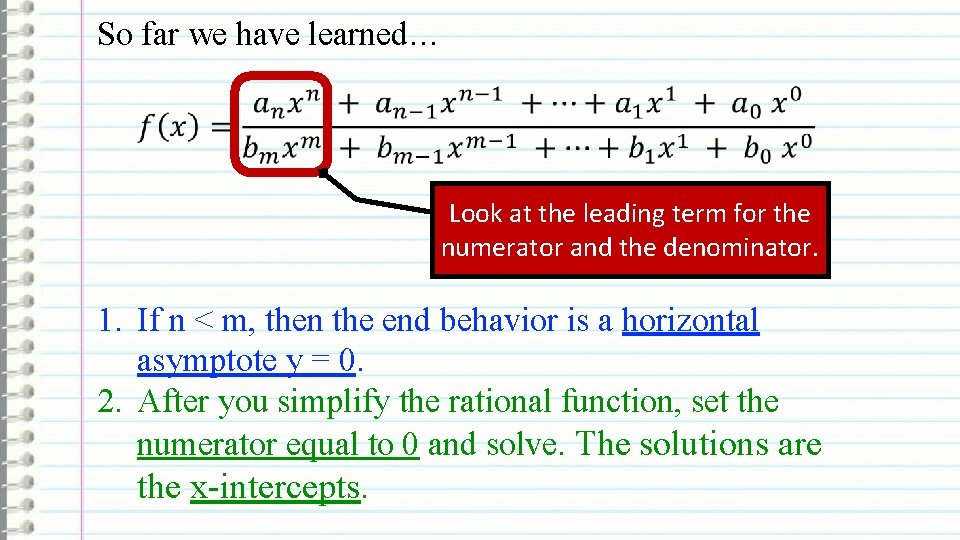
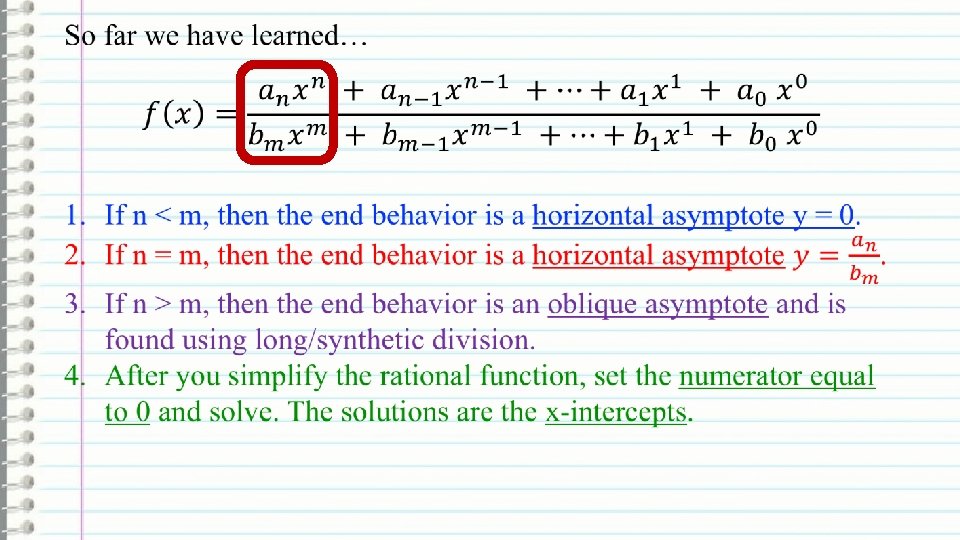
So far we have learned… Look at the leading term for the numerator and the denominator. 1. If n < m, then the end behavior is a horizontal asymptote y = 0. 2. After you simplify the rational function, set the numerator equal to 0 and solve. The solutions are the x-intercepts.
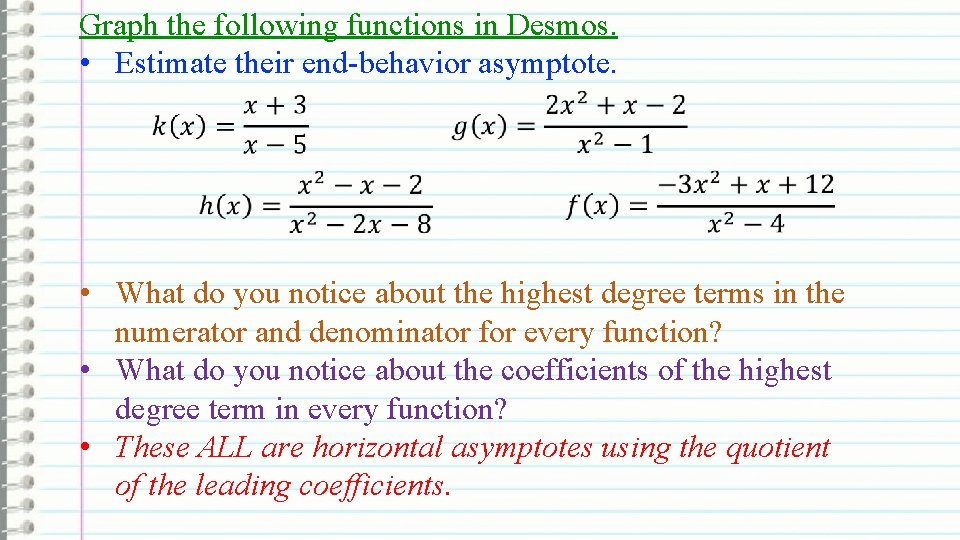
Graph the following functions in Desmos. • Estimate their end-behavior asymptote. • What do you notice about the highest degree terms in the numerator and denominator for every function? • What do you notice about the coefficients of the highest degree term in every function? • These ALL are horizontal asymptotes using the quotient of the leading coefficients.
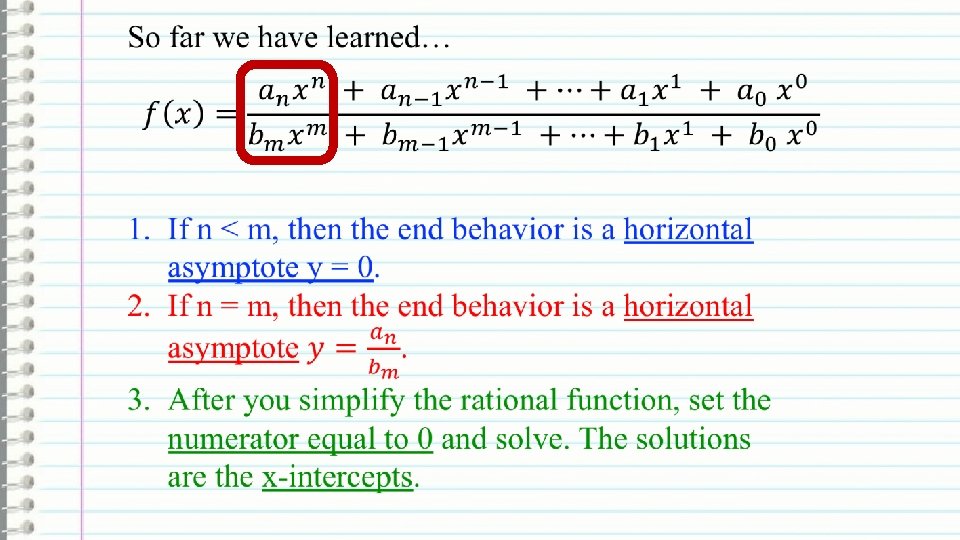
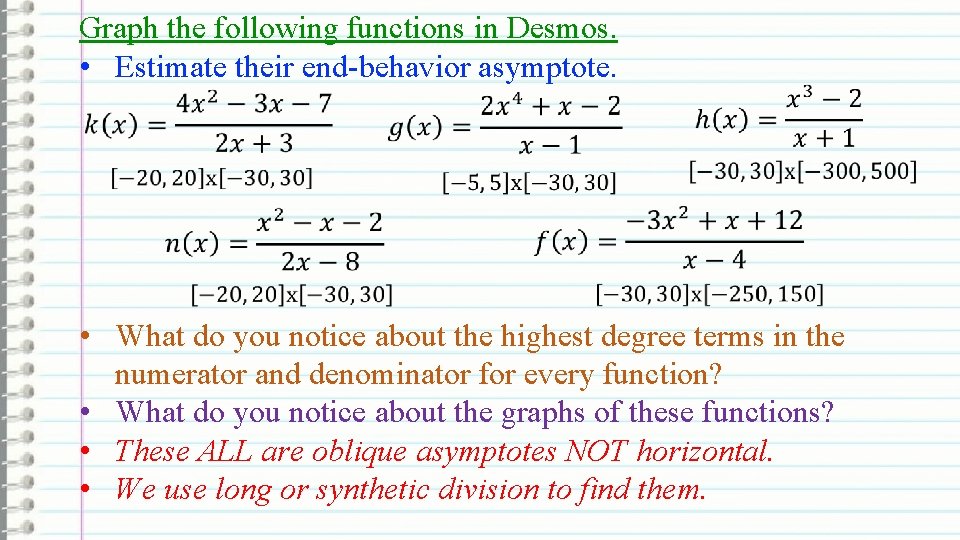
Graph the following functions in Desmos. • Estimate their end-behavior asymptote. • What do you notice about the highest degree terms in the numerator and denominator for every function? • What do you notice about the graphs of these functions? • These ALL are oblique asymptotes NOT horizontal. • We use long or synthetic division to find them.
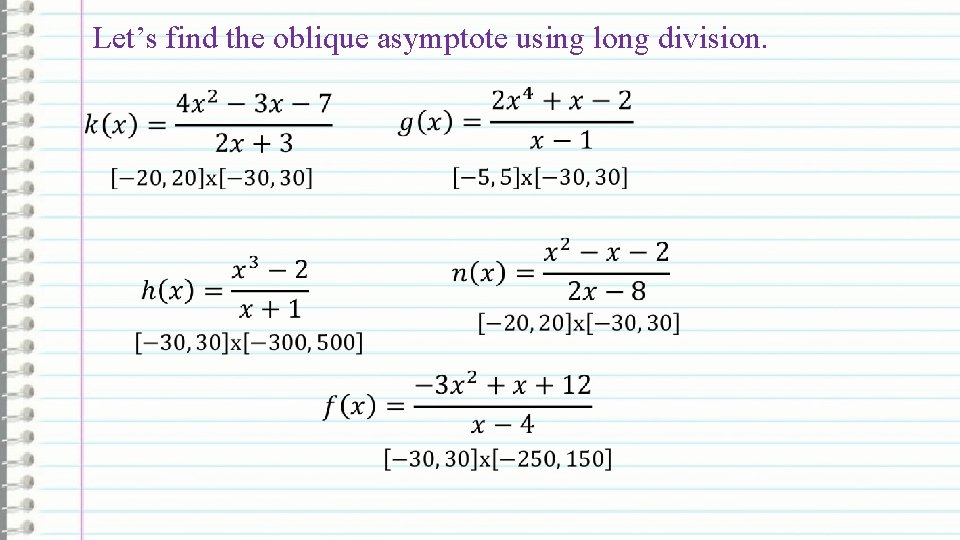
Let’s find the oblique asymptote using long division.
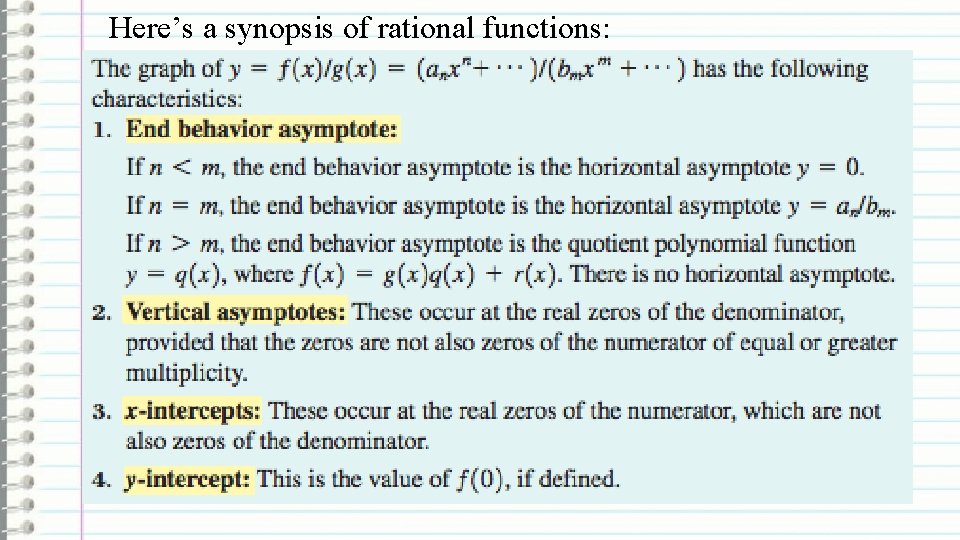
Here’s a synopsis of rational functions:
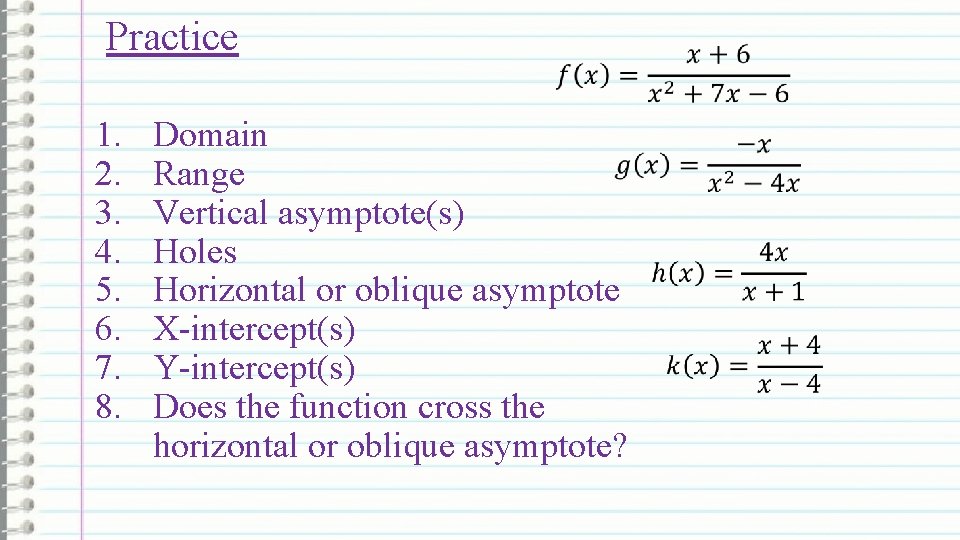
Practice 1. 2. 3. 4. 5. 6. 7. 8. Domain Range Vertical asymptote(s) Holes Horizontal or oblique asymptote X-intercept(s) Y-intercept(s) Does the function cross the horizontal or oblique asymptote?
Let’s review thus far. . 1. How do you find horizontal asymptotes without simplifying? 2. How do you to find an oblique asymptote of a rational function? 3. How do you find x-intercepts of rational functions algebraically? 4. Summarize the general process of graphing a rational function.
Mathia time Keep your notes and Mathia notebook out.
- Slides: 14