
ENCOURAGING CREATIVITY IN APPLIED RESEARCH DESIGN Nandhini Rangarajan
- Slides: 39
ENCOURAGING CREATIVITY IN APPLIED RESEARCH DESIGN Nandhini Rangarajan Texas State University nr 11@txstate. edu Patricia Shields Texas State University ps 07@txstate. edu Public Administration Theory and Network Conference, Cleveland, Ohio Saturday June 2 2018
MOTIVATION FOR OUR PAPER Emphasis on “creating” (and by extension, creativity) in Bloom’s revised taxonomy of the cognitive domain. Opportunities for student scholars to create and exercise creativity during the research process. Creativity is often claimed in the larger stages outside a student’s immediate experience. P-creative and H-creative ideas (Boden, 1991) c-creativity and C-creativity (Gardner, 1993)
RESEARCH PURPOSE The overarching purpose is to discuss creativity in the context of applied research.
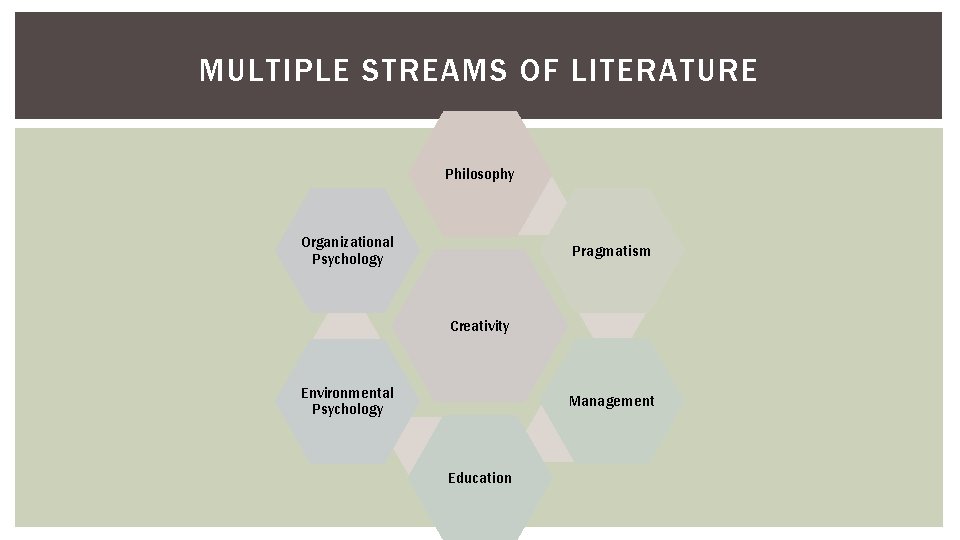
MULTIPLE STREAMS OF LITERATURE Philosophy Organizational Psychology Pragmatism Creativity Environmental Psychology Management Education
RESEARCH PURPOSE & ORGANIZATION OF PAPER First we examine a state called impasse, which commonly stalls research projects. Second, we define creativity in great detail. Third, we discuss person and process factors associated with creativity. Fourth, we discuss environments that foster creativity. We conclude this with a discussion of implications for the student scholar.
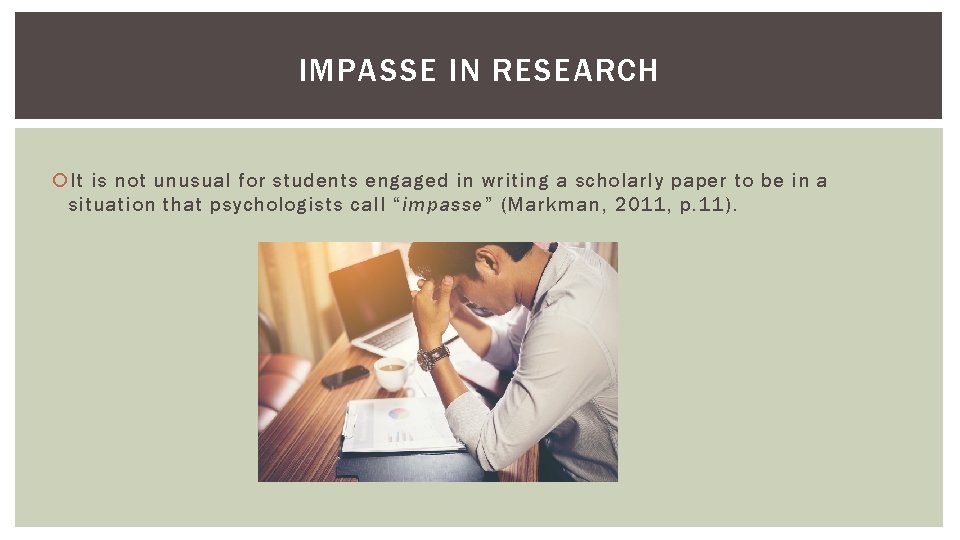
IMPASSE IN RESEARCH It is not unusual for students engaged in writing a scholarly paper to be in a situation that psychologists call “impasse” (Markman, 2011, p. 11).
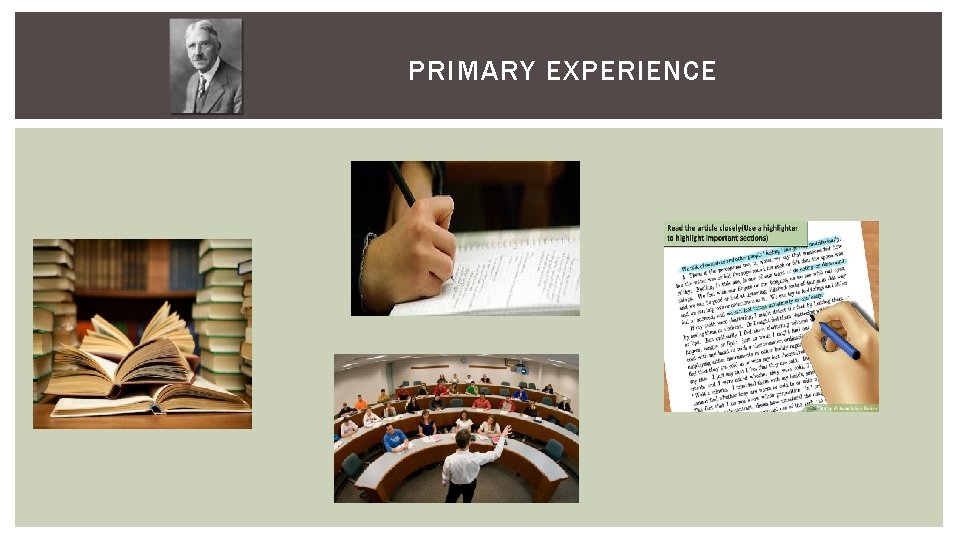
PRIMARY EXPERIENCE
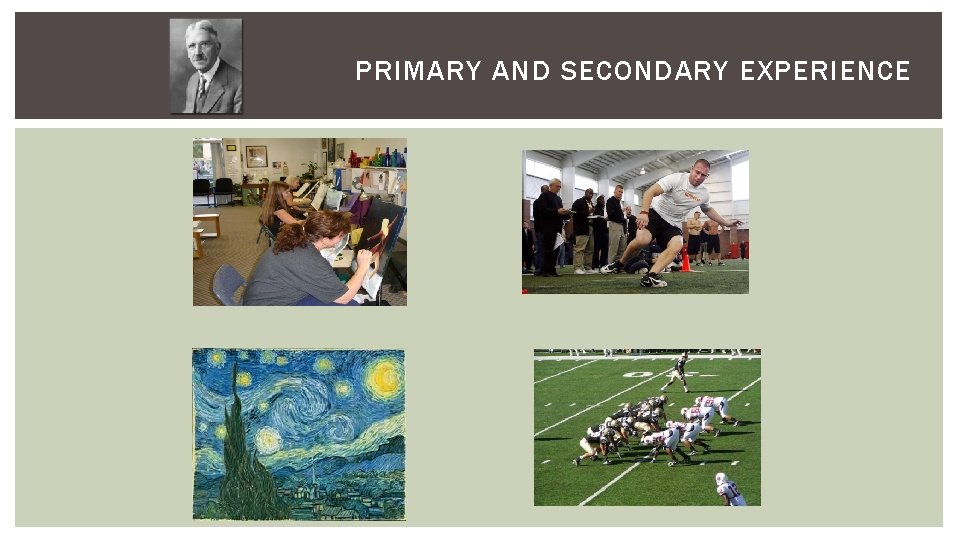
PRIMARY AND SECONDARY EXPERIENCE
“Only when humans are confronted with an entirely novel and problematic situation do they shift from ‘primary experience’ which is habitually ‘had’ and mediated by previously formed habit, to ‘secondary experience, ’ which demands genuine reflection and inquiry” (Ralston 2009, 191).
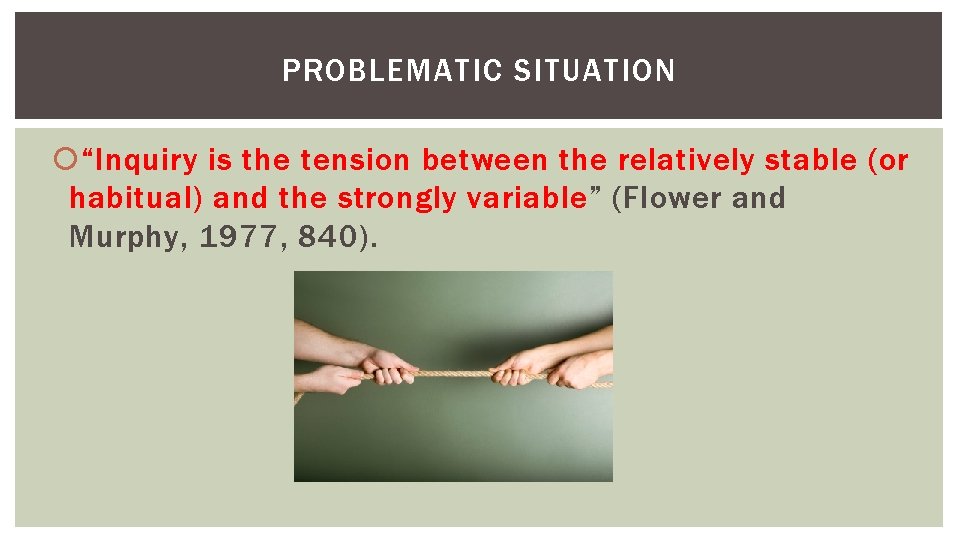
PROBLEMATIC SITUATION “Inquiry is the tension between the relatively stable (or habitual) and the strongly variable” (Flower and Murphy, 1977, 840).
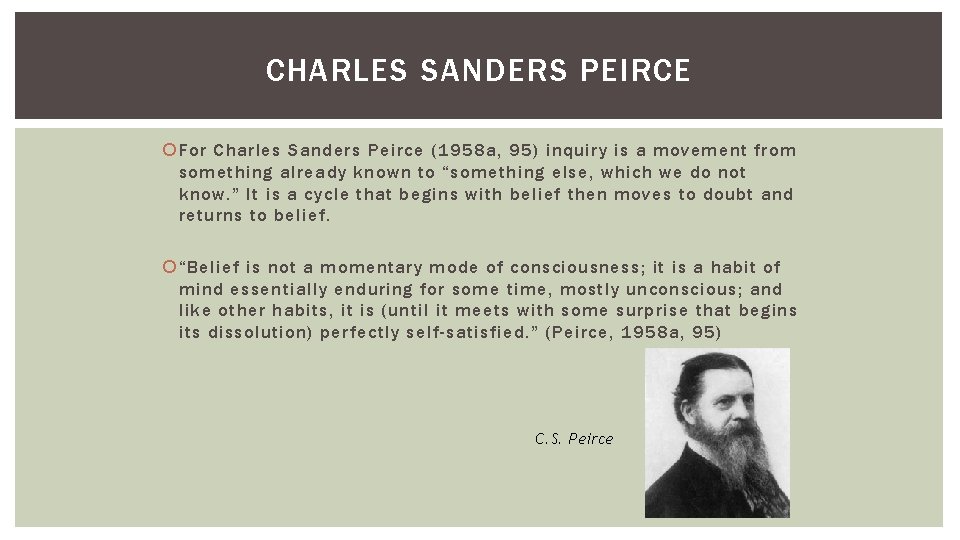
CHARLES SANDERS PEIRCE For Charles Sanders Peirce (1958 a, 95) inquiry is a movement from something already known to “something else, which we do not know. ” It is a cycle that begins with belief then moves to doubt and returns to belief. “Belief is not a momentary mode of consciousness; it is a habit of mind essentially enduring for some time, mostly unconscious; and like other habits, it is (until it meets with some surprise that begins its dissolution) perfectly self-satisfied. ” (Peirce, 1958 a, 95) C. S. Peirce
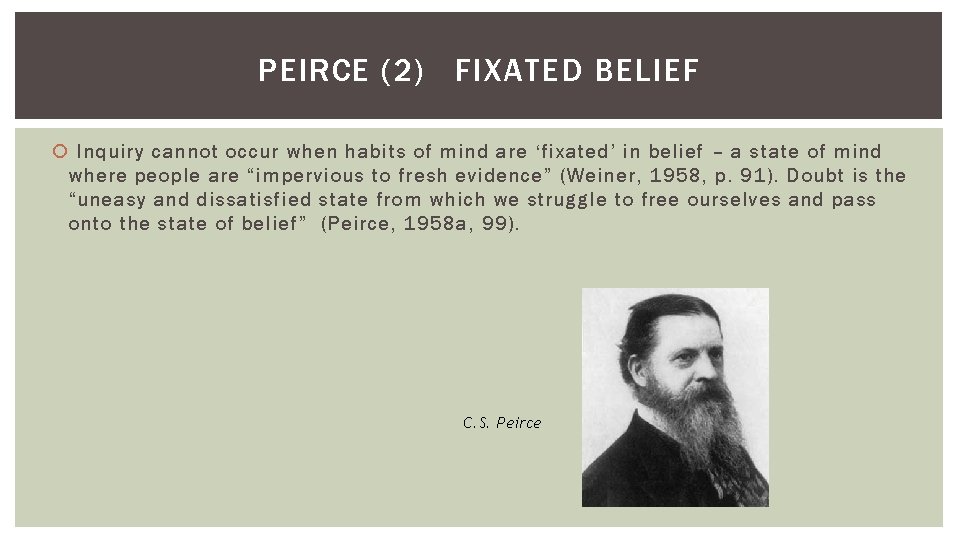
PEIRCE (2) FIXATED BELIEF Inquiry cannot occur when habits of mind are ‘fixated’ in belief – a state of mind where people are “impervious to fresh evidence” (Weiner, 1958, p. 91). Doubt is the “uneasy and dissatisfied state from which we struggle to free ourselves and pass onto the state of belief” (Peirce, 1958 a, 99). C. S. Peirce
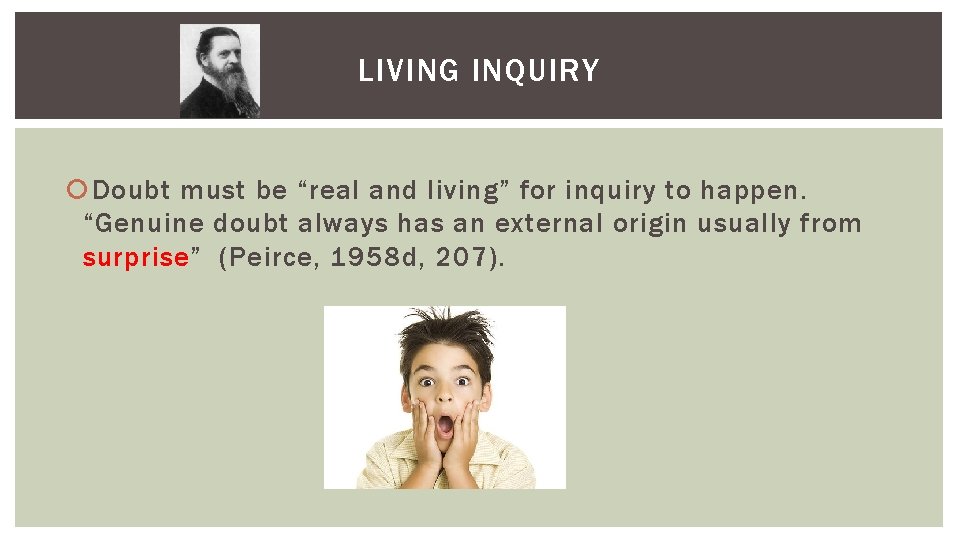
LIVING INQUIRY Doubt must be “real and living” for inquiry to happen. “Genuine doubt always has an external origin usually from surprise” (Peirce, 1958 d, 207).
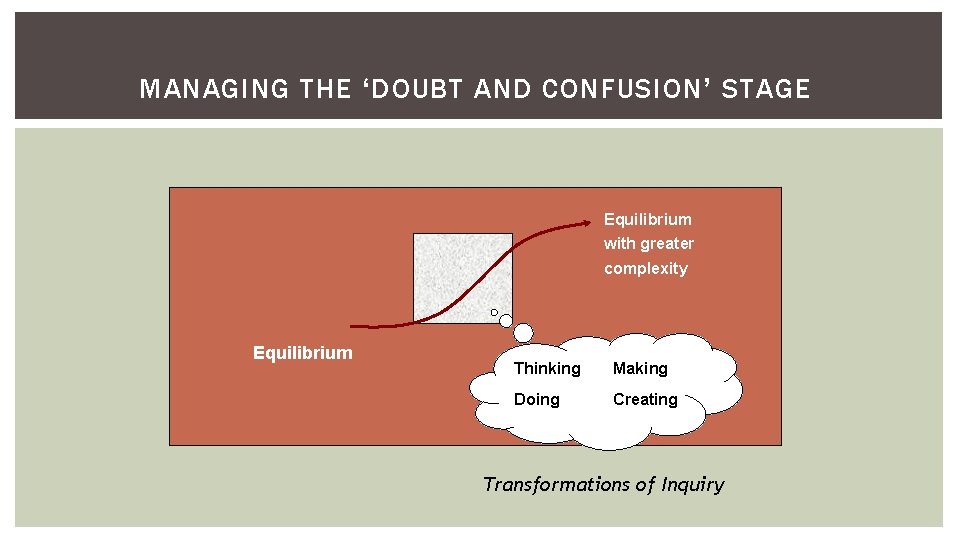
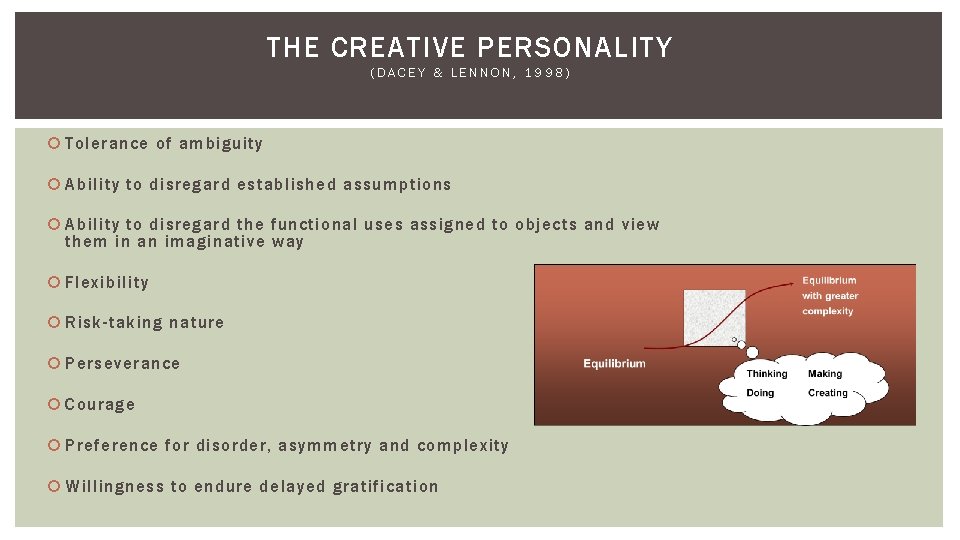
MANAGING THE ‘DOUBT AND CONFUSION’ STAGE Equilibrium with greater complexity Equilibrium Thinking Making Doing Creating Transformations of Inquiry
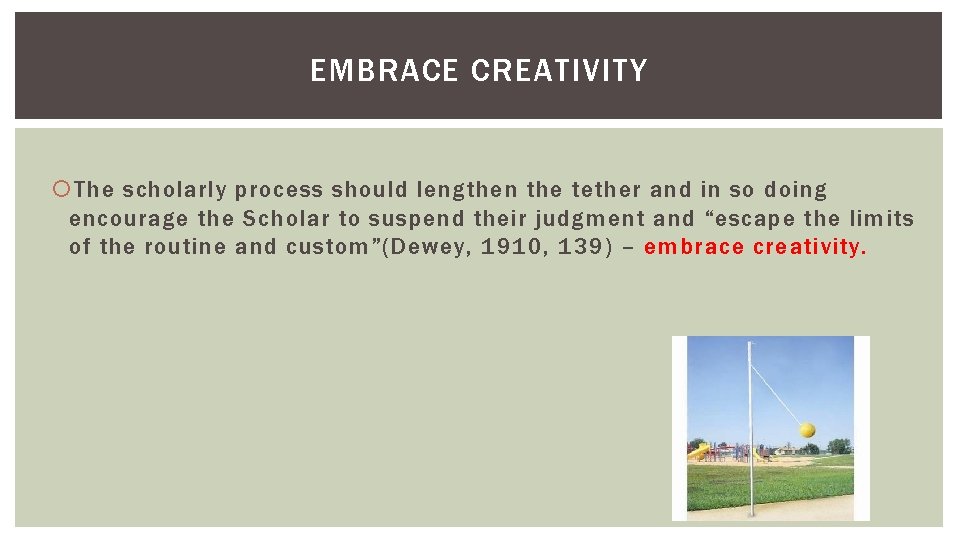
EMBRACE CREATIVITY The scholarly process should lengthen the tether and in so doing encourage the Scholar to suspend their judgment and “escape the limits of the routine and custom”(Dewey, 1910, 139) – embrace creativity.
WHAT IS CREATIVITY? Creativity is any act, idea or product that changes an existing domain or that transforms an existing domain into a new one (Cziksentmihalyi, 1998). Creativity refers to the generation of ideas or solutions that are simultaneously novel, unusual, and original, as well as appropriate, practical, and useful for the problem in question (Amabile, 1982, 1983, 1988; Shalley, 1991; Woodman, Sawyer, & Griffin, 1993).
HOW DO WE ENCOURAGE SUCH CREATIVITY IN APPLIED RESEARCH?
OVERVIEW OF FACTORS AFFECTING CREATIVITY PERSONAL FACTORS PROCESS FACTORS ENVIRONMENTAL FACTORS
THE CREATIVE PERSON Individual level factors associated with creativity
THE CREATIVE PERSONALITY Disciplined, focused Ability for remote associations Stimulation-seeking Transcendental Nature From Cziksentmihalyi (1998), “Flow, Creativity and the Evolving Self”
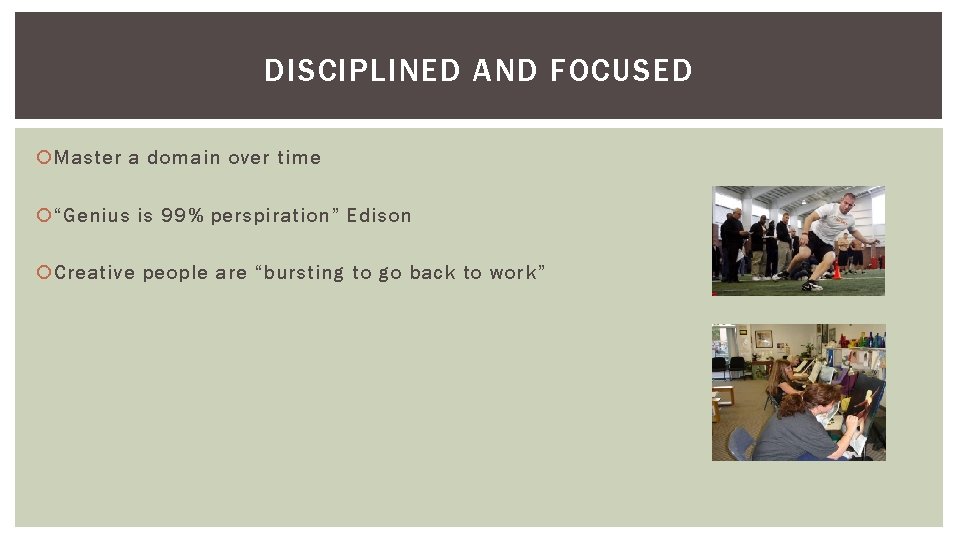
DISCIPLINED AND FOCUSED Master a domain over time “Genius is 99% perspiration” Edison Creative people are “bursting to go back to work”
ABILITY FOR REMOTE ASSOCIATIONS “The sudden interlocking of two previously unrelated skills, or matrices of thought” (Koestler 1964 cited in Bonnardel, 2000: 505) Ability to see patterns across apparently unrelated domains: § Importance of varied experiences Master of one, Jack of Many
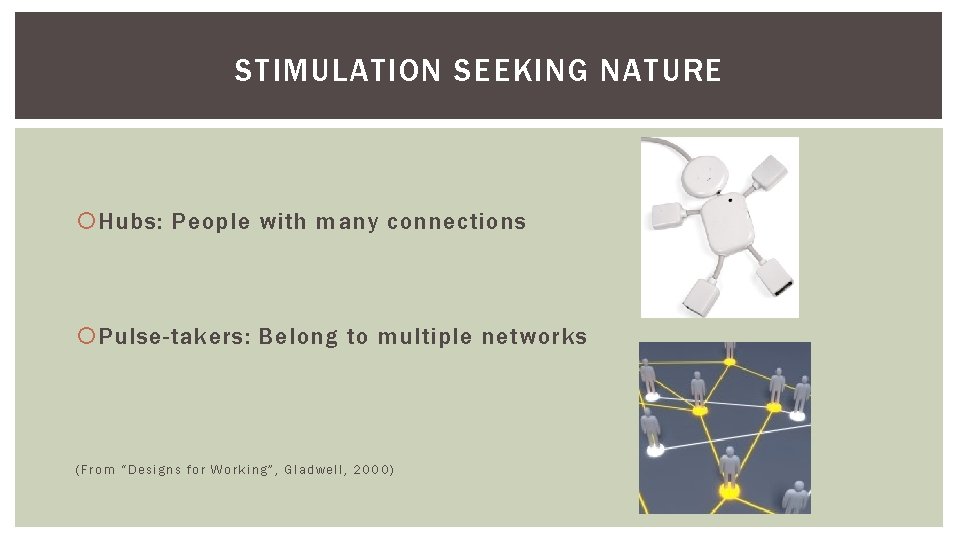
STIMULATION SEEKING NATURE Hubs: People with many connections Pulse-takers: Belong to multiple networks (From “Designs for Working”, Gladwell, 2000)
TRANSCENDENTAL NATURE Feeling as part of something BIG – bigger than oneself Identification with past and future/thrust of humanity
THE CREATIVE PERSONALITY (DACEY & LENNON, 1998) Tolerance of ambiguity Ability to disregard established assumptions Ability to disregard the functional uses assigned to objects and view them in an imaginative way Flexibility Risk-taking nature Perseverance Courage Preference for disorder, asymmetry and complexity Willingness to endure delayed gratification
THE CREATIVE PROCESS
THE CREATIVE PROCESS Two main aspects – § the cognitive processes that creative individuals employ to produce creative outcomes § How do I retrieve information? § How do I store information? § How do I use information? § the different stages of the creative process itself.
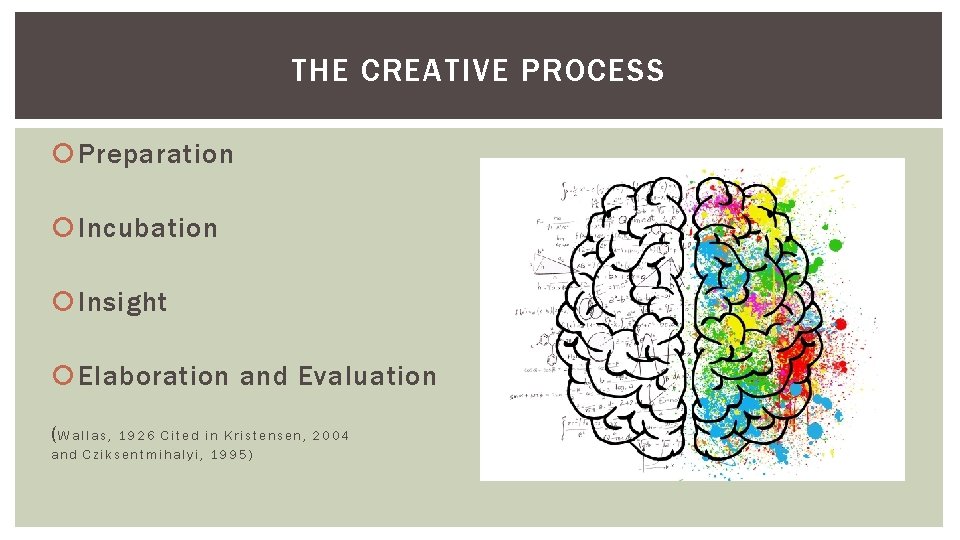
THE CREATIVE PROCESS Preparation Incubation Insight Elaboration and Evaluation (Wallas, 1926 Cited in Kristensen, 2004 and Cziksentmihalyi, 1995)
THE CREATIVE PROCESS Torrance (1988: 47), who favors the process-oriented view of creativity, defines it as § the process of sensing difficulties, problems, gaps in information, missing elements, something askew; § making guesses and formulating hypotheses about these deficiencies; § evaluating and testing these guesses and hypotheses § possibly revising and retesting them § and finally communicating the results. ”
THE CREATIVE ENVIRONMENT
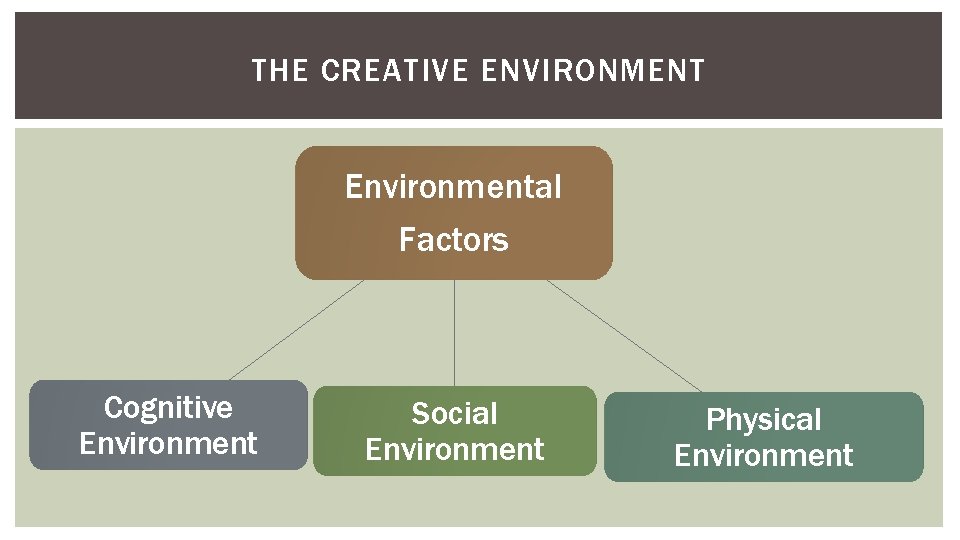
THE CREATIVE ENVIRONMENT Environmental Factors Cognitive Environment Social Environment Physical Environment
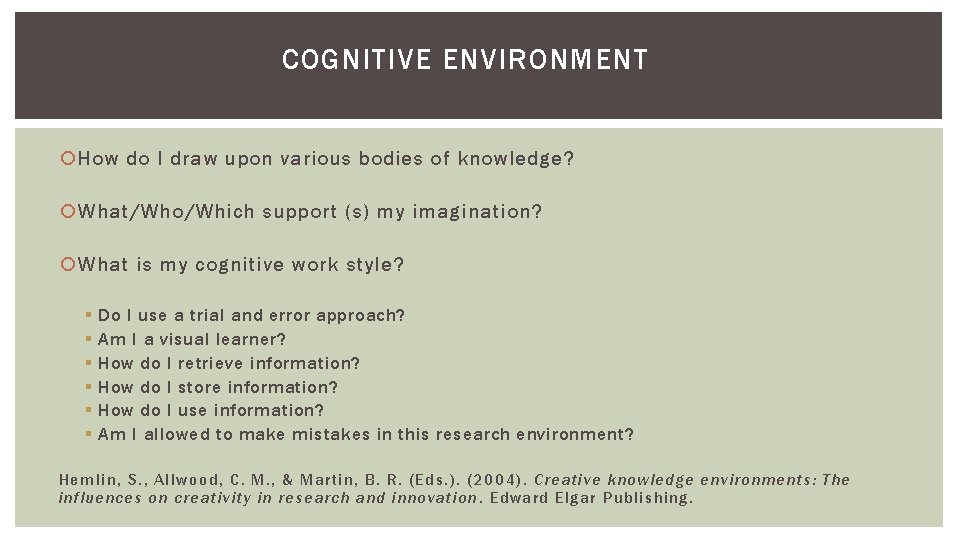
COGNITIVE ENVIRONMENT How do I draw upon various bodies of knowledge? What/Who/Which support (s) my imagination? What is my cognitive work style? § § § Do I use a trial and error approach? Am I a visual learner? How do I retrieve information? How do I store information? How do I use information? Am I allowed to make mistakes in this research environment? Hemlin, S. , Allwood, C. M. , & Martin, B. R. (Eds. ). (2004). Creative knowledge environments: The influences on creativity in research and innovation. Edward Elgar Publishing.
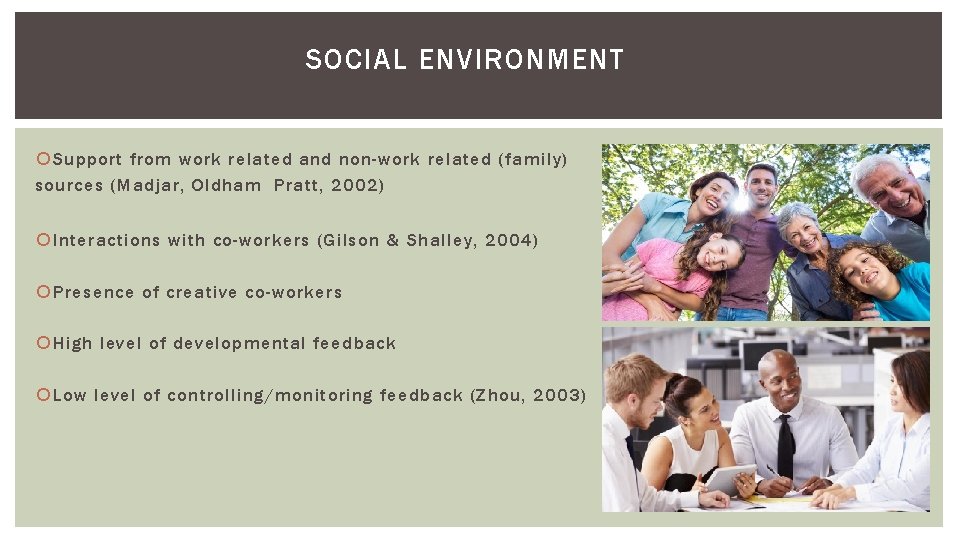
SOCIAL ENVIRONMENT Support from work related and non-work related (family) sources (Madjar, Oldham Pratt, 2002) Interactions with co-workers (Gilson & Shalley, 2004) Presence of creative co-workers High level of developmental feedback Low level of controlling/monitoring feedback (Zhou, 2003)
CREATIVITY AND PHYSICAL ENVIRONMENT (KRISTENSEN, 2004) “Creativity takes place in a physical context, i. e. in a confined space. Such space restricts and enables the free flow of sensory experiences and proximity to people. The confinements may make certain sensory experiences available, e. g. vision of source material, sight and sound (including noise). This framing allows certain cognitive processes and restricts others. This may induce emotions that, in turn, facilitate or reduce the enhancement of creativity. Physical space affects the well-being of people, the channels of information, the availability of knowledge tools and sets the stage for coherence and continuity, which may contribute to competitive advantages. ” (Kristensen, 2004)
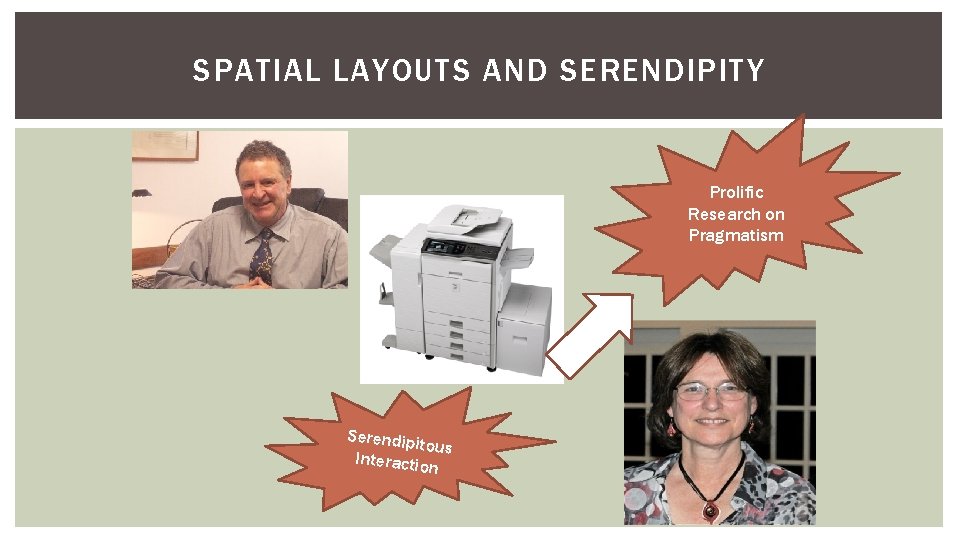
PHYSICAL ENVIRONMENT FOR CREATIVITY “The right idea space can stretch, develop, encourage and motivate” (Degraff & Lawrence, 2002: 153) Sensory elements, sounds, layout, colors, lighting and scents in the physical space have a big impact on our alertness, stress and energy levels and judgment (Degraff and Lawrence 2002, p. 156). Plants, color, light, and complexity of structural elements can have an impact on creativity (Ceylan et al. 2008). “Spatial layout influences the social interactions that are necessary both for effective task performance and the satisfaction of social needs in organizations” (Carnevale 1992. See also Elsbach 2007, Haner 2005, Streitz et al. , 1999).
SPATIAL LAYOUTS AND SERENDIPITY Prolific Research on Pragmatism Serendipi tous Interactio n
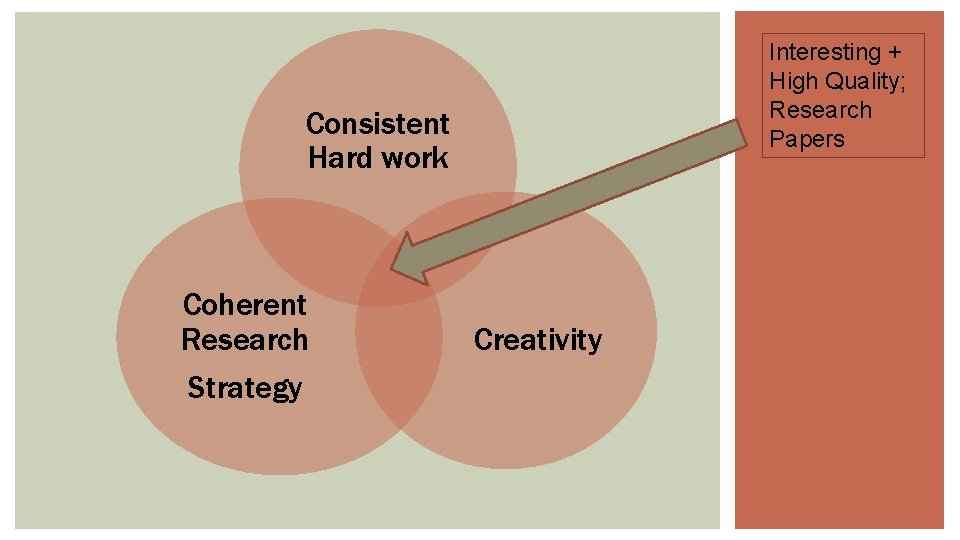
Interesting + High Quality; Research Papers Consistent Hard work Coherent Research Strategy Creativity
QUESTIONS? COMMENTS? SUGGESTIONS?