
Encoding TMs and the Universal TM CS 154
- Slides: 10
Encoding TMs and the Universal TM CS 154, Omer Reingold
It is all Zeros and Ones One of the most popular and overemphasized clichés about computer professionals. Proxy for: genius / nerd / insensitive / anti -social / …are quite fundamental, “more than Atoms”) (still bits
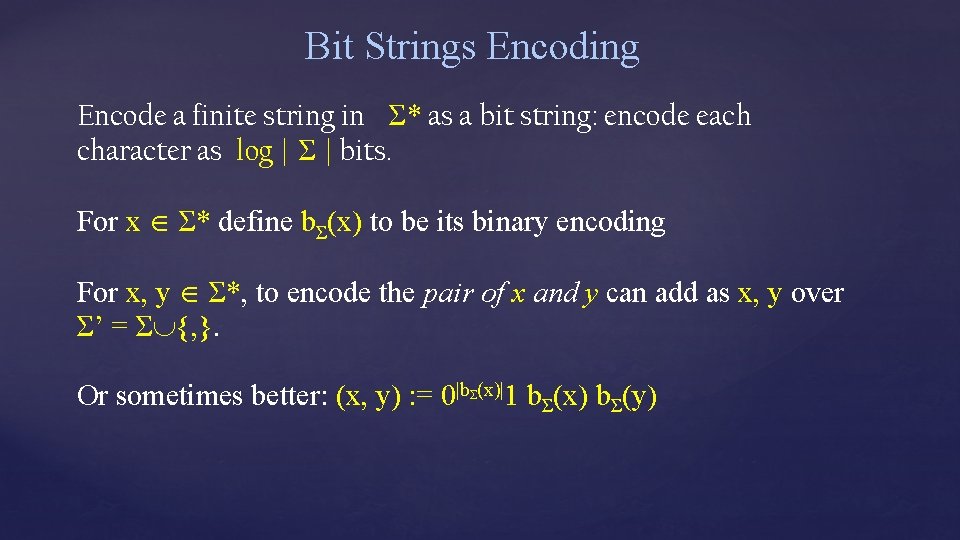
Bit Strings Encoding Encode a finite string in Σ* as a bit string: encode each character as log | Σ | bits. For x Σ* define bΣ(x) to be its binary encoding For x, y Σ*, to encode the pair of x and y can add as x, y over Σ’ = Σ {, }. Or sometimes better: (x, y) : = 0|bΣ(x)|1 bΣ(x) bΣ(y)
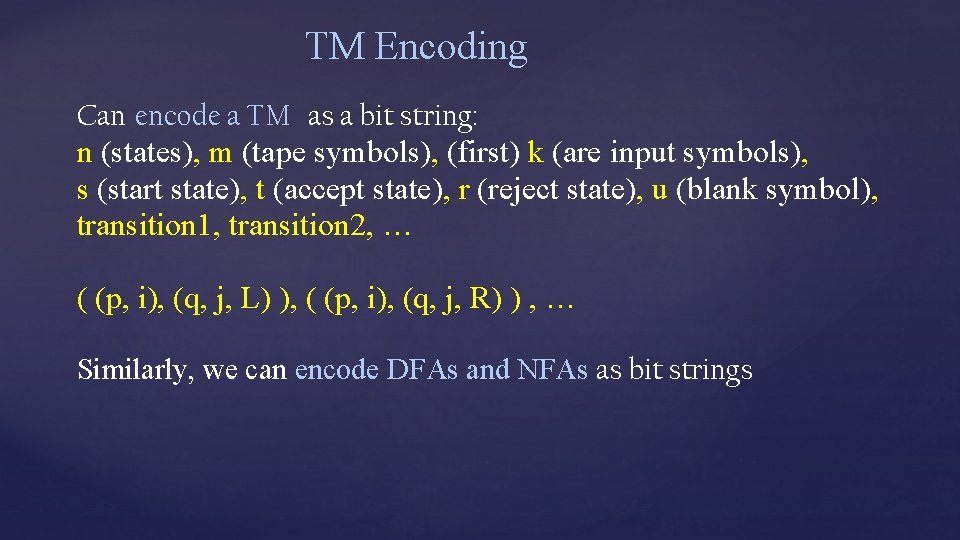
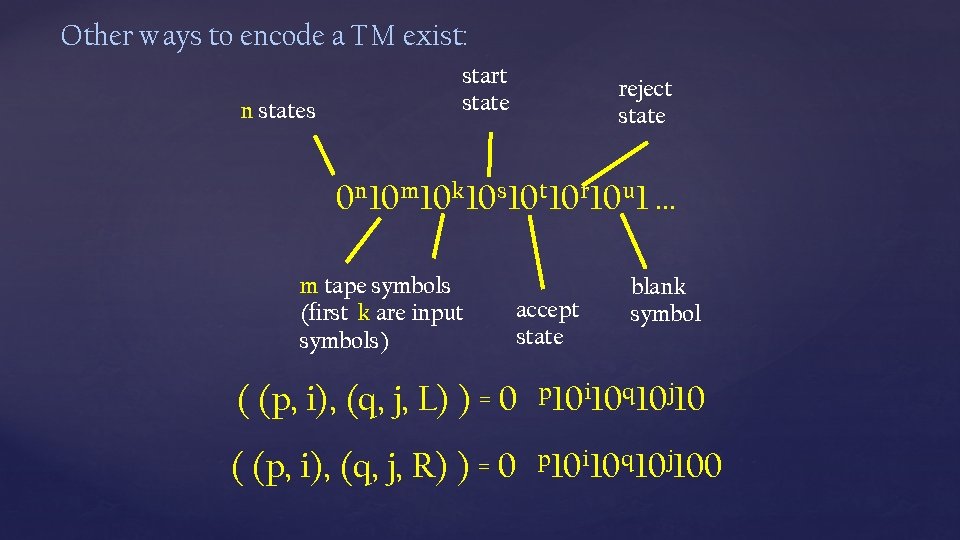
TM Encoding Can encode a TM as a bit string: n (states), m (tape symbols), (first) k (are input symbols), s (start state), t (accept state), r (reject state), u (blank symbol), transition 1, transition 2, … ( (p, i), (q, j, L) ), ( (p, i), (q, j, R) ) , … Similarly, we can encode DFAs and NFAs as bit strings
Other ways to encode a TM exist: n states start state reject state 0 n 10 m 10 k 10 s 10 t 10 r 10 u 1 … m tape symbols (first k are input symbols) accept state blank symbol ( (p, i), (q, j, L) ) = 0 p 10 i 10 q 10 j 10 ( (p, i), (q, j, R) ) = 0 p 10 i 10 q 10 j 100
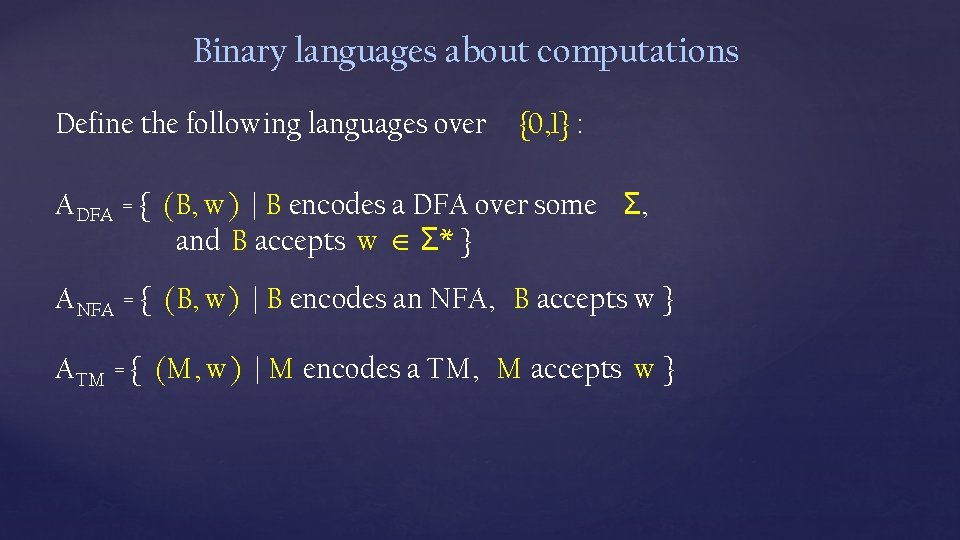
Binary languages about computations Define the following languages over {0, 1} : A DFA = { (B, w) | B encodes a DFA over some Σ, and B accepts w Σ* } A NFA = { (B, w) | B encodes an NFA, B accepts w } A TM = { (M, w) | M encodes a TM, M accepts w }
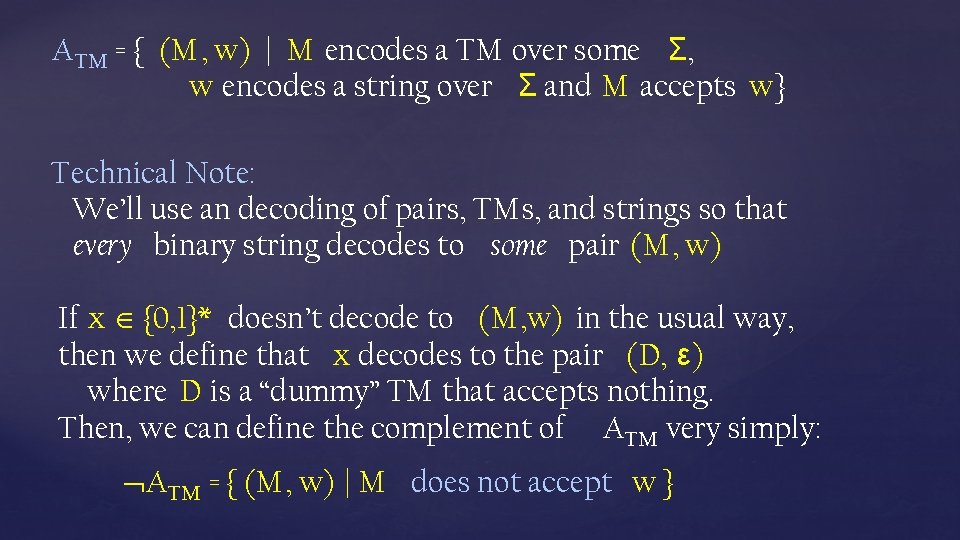
A TM = { (M, w) | M encodes a TM over some Σ, w encodes a string over Σ and M accepts w} Technical Note: We’ll use an decoding of pairs, TMs, and strings so that every binary string decodes to some pair (M, w) If x {0, 1}* doesn’t decode to (M, w) in the usual way, then we define that x decodes to the pair (D, ε) where D is a “dummy” TM that accepts nothing. Then, we can define the complement of A TM very simply: A TM = { (M, w) | M does not accept w }
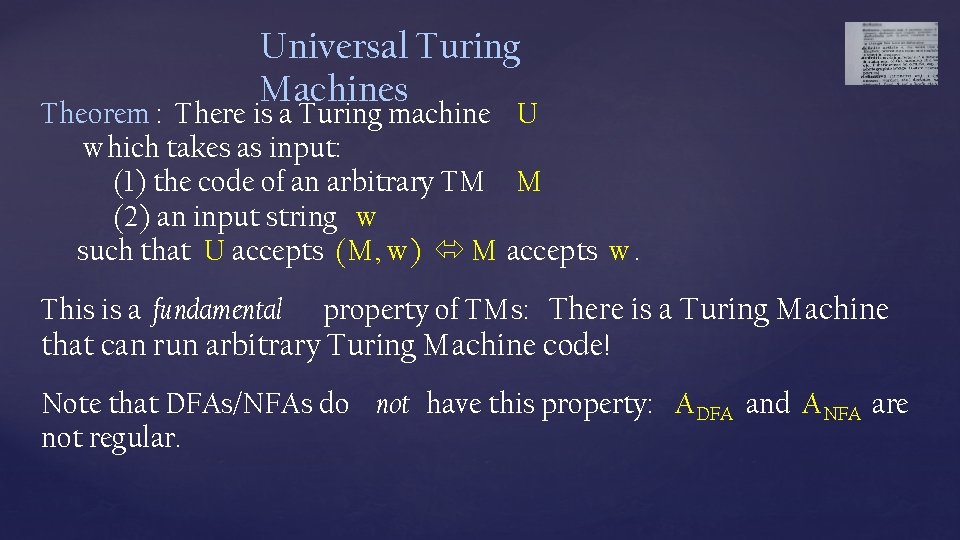
Universal Turing Machines Theorem : There is a Turing machine U which takes as input: (1) the code of an arbitrary TM M (2) an input string w such that U accepts (M, w) M accepts w. This is a fundamental property of TMs: There is a Turing Machine that can run arbitrary Turing Machine code! Note that DFAs/NFAs do not have this property: A DFA and A NFA are not regular.
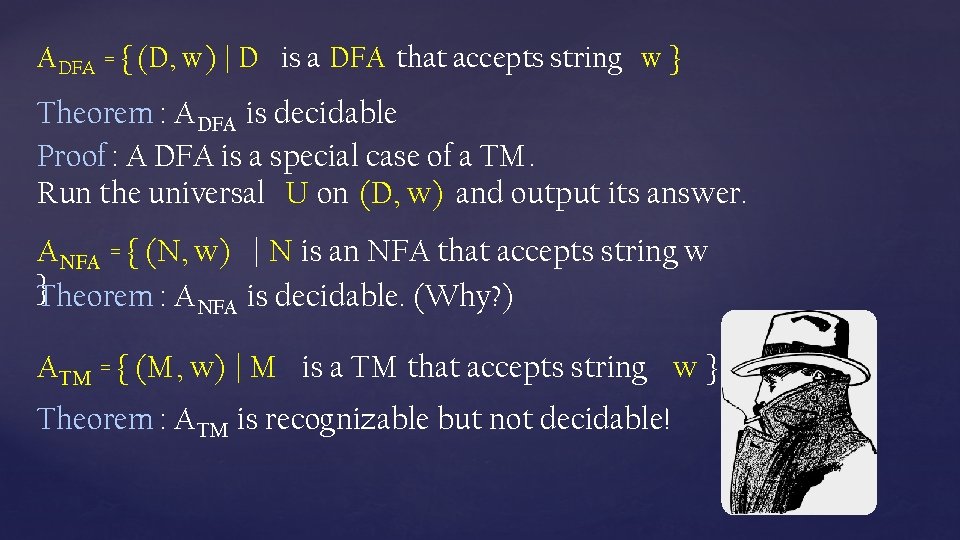
A DFA = { (D, w) | D is a DFA that accepts string w } Theorem : A DFA is decidable Proof : A DFA is a special case of a TM. Run the universal U on (D, w) and output its answer. A NFA = { (N, w) | N is an NFA that accepts string w } Theorem : A NFA is decidable. (Why? ) A TM = { (M, w) | M is a TM that accepts string w } Theorem : A TM is recognizable but not decidable!
Parting thoughts: Everything is zeros and ones, even Turing Machines. Questions about computations are natural and important. Universal TM – separating hardware from software.